roof JEEP RENEGADE 2014 1.G User Guide
[x] Cancel search | Manufacturer: JEEP, Model Year: 2014, Model line: RENEGADE, Model: JEEP RENEGADE 2014 1.GPages: 212, PDF Size: 17.48 MB
Page 136 of 212
LUGGAGE COMPARTMENT FUSE BOXESfig. 129
NOTE The configuration of the luggage compartment varies in accordance with the equipment on the vehicle.
Fuse box no. 1
DEVICES FUSE AMPERE
HI-FI system F2 20
Electric sun roof F3 20
Front seat electric lumbar adjustment (driver guide) F4 7,5
Electric front seat adjustment (driver side) F5 30
Electric front seat adjustment (driver side and passenger side) F6 7,5
Electric front seat lumbar adjustment (driver side and passenger
side)F7 30
Electrical front seat heating F8 20
The fuse box also has a 20 A protective fuse for the sun roof curtain.
Fuse box no. 2
DEVICES FUSE AMPERE
External trailer lighting control unit F1 10
External lighting control unit (left side) F5 15
External lighting control unit (right side) F6 15
134
IN AN EMERGENCY
Page 138 of 212
❒remove the fixing device for the jack
and the spare wheel;
❒remove the wheel chock;
❒remove the jack unit and the key for
removing the bolts from the spare
wheel. Turn the screw of the jack to
loosen the key and separate it from the
jack assembly;
❒take the spare wheel out of the
luggage compartment.
Tool box (where provided)
On versions with spare wheel there
is also, inside the luggage compartment
(right side), a tool box secured to the
luggage compartment carpet with
dedicated fastenings.
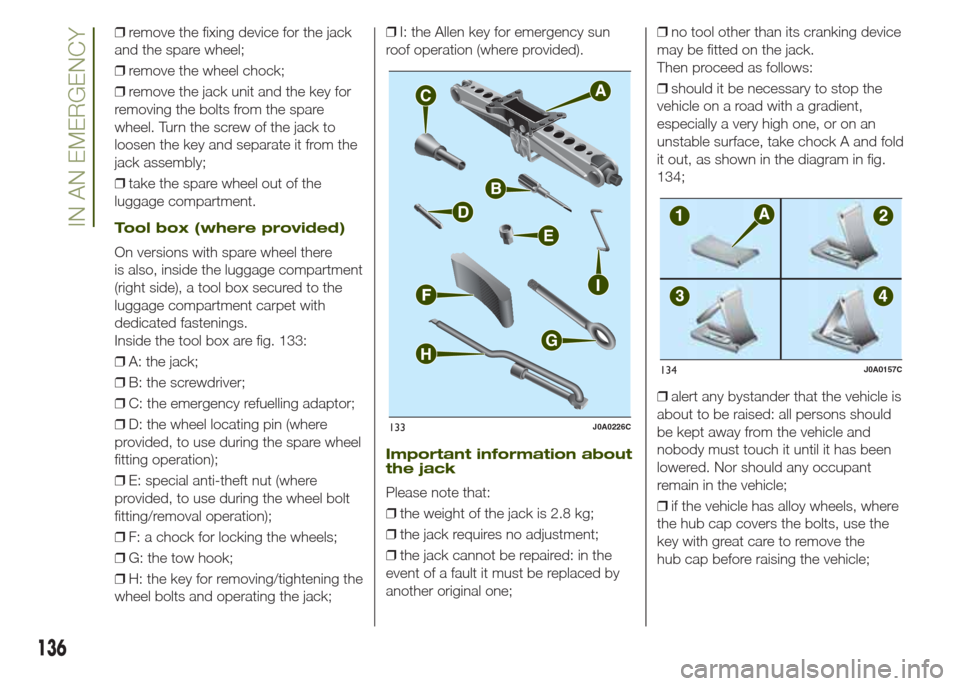
Inside the tool box are fig. 133:
❒A: the jack;
❒B: the screwdriver;
❒C: the emergency refuelling adaptor;
❒D: the wheel locating pin (where
provided, to use during the spare wheel
fitting operation);
❒E: special anti-theft nut (where
provided, to use during the wheel bolt
fitting/removal operation);
❒F: a chock for locking the wheels;
❒G: the tow hook;
❒H: the key for removing/tightening the
wheel bolts and operating the jack;❒I: the Allen key for emergency sun
roof operation (where provided).
Important information about
the jack
Please note that:
❒the weight of the jack is 2.8 kg;
❒the jack requires no adjustment;
❒the jack cannot be repaired: in the
event of a fault it must be replaced by
another original one;❒no tool other than its cranking device
may be fitted on the jack.
Then proceed as follows:
❒should it be necessary to stop the
vehicle on a road with a gradient,
especially a very high one, or on an
unstable surface, take chock A and fold
it out, as shown in the diagram in fig.
134;
❒alert any bystander that the vehicle is
about to be raised: all persons should
be kept away from the vehicle and
nobody must touch it until it has been
lowered. Nor should any occupant
remain in the vehicle;
❒if the vehicle has alloy wheels, where
the hub cap covers the bolts, use the
key with great care to remove the
hub cap before raising the vehicle;
A
C
B
D
E
I
F
G
H
133J0A0226C
134J0A0157C
136
IN AN EMERGENCY
Page 164 of 212
IMPORTANT In versions with a sun
roof, make sure that the sun roof is
closed before operating the window
washer jets.
Rear window washer
The rear window washer jets are fixed.
The nozzle holder is located above
the rear window.
WARNING
176)The air intake system (air cleaner,
rubber hoses, etc.) can be a protection in
the case of blowbacks from the engine.
DO NOT REMOVE this system unless you
need to carry out repair or servicing
operations. Before starting the engine
make sure the system is not dismantled:
failure to comply with this precaution
may cause serious injuries.
177)Exhaust emissions are very
dangerous and may be fatal. They contain
carbon monoxide, a colourless and
odourless gas which, if inhaled, may cause
fainting and poisoning.
178)The exhaust system can reach high
temperatures and cause a fire if the vehicle
is parked on flammable material. Dry grass
or leaves can also catch fire if they come
into contact with the exhaust system.
Do not park or use the vehicle in a place in
which the exhaust system might come
into contact with flammable material.
WARNING
64)Incorrect maintenance of the vehicle or
failure to carry out operations or repairs
(when necessary) may lead to more
expensive repairs, damage to other
components or a negative impact on the
vehicle performance. Have any operating
faults immediately checked by a Jeep
Dealership.
65)The vehicle is equipped with fluids
optimised for protecting its performance
and duration, and to extend servicing
intervals. Do not use chemicals for washing
these components since they may
damage the engine, the gearbox or the
climate control system. This damage is not
covered by the vehicle’s warranty. If, due
to malfunction of a component, washing is
needed, only use the fluid specific for
that procedure.
66)An excessive or insufficient amount of
oil in the block is extremely harmful for
the engine. Make sure it is always at an
adequate level.
67)Always require the use of only
compressor coolants and lubricants
approved and suitable for the specific air
conditioning system fitted on the vehicle.
Some non-approved coolants are
flammable and may explode, with the risk
of injuries. The use of non-approved
coolants or lubricants may adversely affect
system efficiency, leading to expensive
repairs.68)The air conditioning system contains
high-pressure coolant: to prevent damage
to people or the system, any topping-up
with fuel or repairs that involves
disconnection of the pipes must be carried
out by a Jeep Dealership.
69)Vehicles equipped with a catalytic
converter must be exclusively supplied with
unleaded petrol. Leaded petrol would
permanently damage the catalytic
converter and eliminate its ability to reduce
polluting emissions, seriously
compromising the engine performance,
which would be irreparably damaged. If the
engine does not work correctly, especially
if it starts irregularly or if there is a reduction
of its performance, immediately go to a
Jeep Dealership. Prolonged and faulty
operation of the engine may cause
overheating of the converter and, as a
consequence, possible damage to the
converter and the vehicle.
70)Using a gearbox fluid different from that
approved may compromise gearshifting
quality and/or cause vibration of the
gearbox itself.
71)It is recommended to have the vehicle
serviced by a Jeep Dealership. When
carrying out normal periodic operations
and small servicing interventions personally
on the vehicle, it is recommended to use
suitable equipment, original spare parts
and the necessary fluids. Do not carry out
any interventions if you don't have the
necessary experience.
162
SERVICING AND MAINTENANCE
Page 166 of 212
BODYWORK
PRESERVING THE
BODYWORK
Paintwork
76)7)
Touch up abrasions and scratches
immediately to prevent the formation of
rust.
Some parts of the vehicle are painted
with a matte paintwork which requires
special care for its preservation
77)To correctly wash the vehicle, follow
these instructions:
❒is the vehicle is washed remove the
aerial from the roof;
❒if high pressure jets or cleaners are
used to wash the vehicle, keep a
distance of at least 40 cm from the
bodywork to avoid damage or
alteration. Build up of water could
cause damage to the vehicle in the long
term.
WARNING
76)In order to preserve the aesthetic
appearance of the paint abrasive products
and/or polishes should not be used for
cleaning the vehicle.
77)Avoid washing with rollers and/or
brushes in washing stations. Wash the
vehicle only by hand using neutral pH
detergents; dry it with a wet chamois
leather. Abrasive products and/or polishes
should not be used for cleaning the vehicle.
Bird droppings must be washed off
immediately and thoroughly as the acid
they contain is particularly aggressive.
Avoid (if at all possible) parking the vehicle
under trees; remove vegetable resins
immediately as, when dried, it may only be
possible to remove them with abrasive
products and/or polishes, which is highly
inadvisable as they could alter the typical
opaqueness of the paint. Do not use pure
screen washer fluid for cleaning the
windscreen and rear window; dilute it min.
50% with water. Only use pure screen
washer fluid when strictly necessary due to
outside temperature conditions.
WARNING
7)Detergents cause water pollution. Only
wash your vehicle in areas equipped to
collect and treat wastewater from this type
of activity.
164
SERVICING AND MAINTENANCE
Page 173 of 212
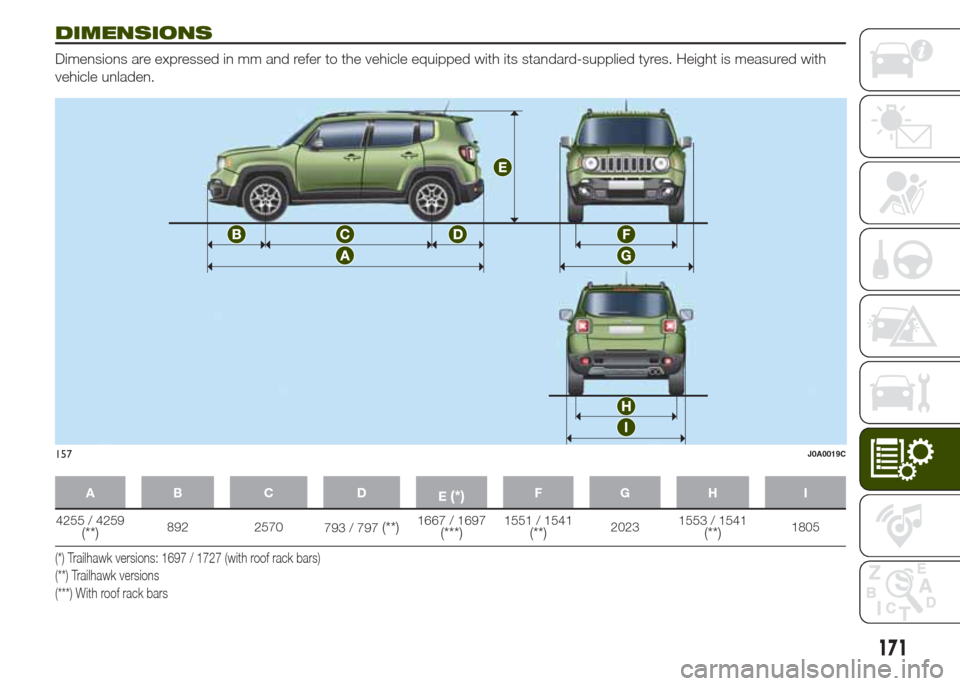
DIMENSIONS
Dimensions are expressed in mm and refer to the vehicle equipped with its standard-supplied tyres. Height is measured with
vehicle unladen.
AB C D
E(*)FGH I
4255 / 4259(**)892 2570
793 / 797(**)1667 / 1697(***)1551 / 1541(**)20231553 / 1541(**)1805
(*) Trailhawk versions: 1697 / 1727 (with roof rack bars)
(**) Trailhawk versions
(***) With roof rack bars
157J0A0019C
171
Page 176 of 212
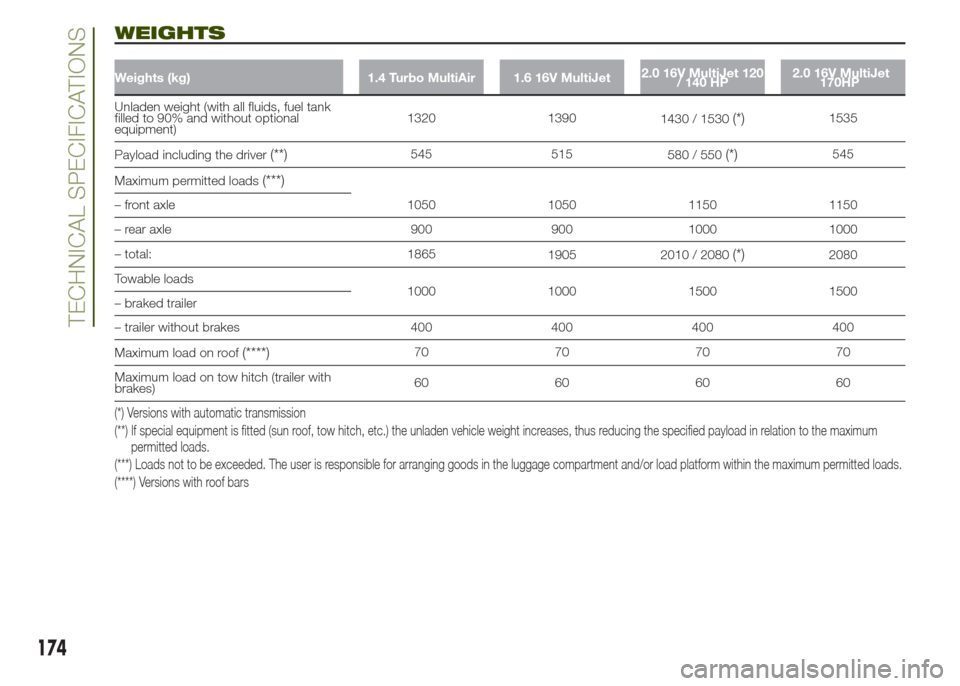
WEIGHTS
Weights (kg) 1.4 Turbo MultiAir 1.6 16V MultiJet 2.0 16V MultiJet 120 / 140 HP 2.0 16V MultiJet
Unladen weight (with all fluids, fuel tank filled to 90% and without optional equipment) 1320 1390 1430 / 1530(*)1535
Payload including the driver(**)545 515 580 / 550(*)545
Maximum permitted loads(***)
1050 1050 1150 1150 – front axle
– rear axle 900 900 1000 1000
– total: 1865 1905 2010 / 2080(*)2080
Towable loads 1000 1000 1500 1500 – braked trailer
– trailer without brakes 400 400 400 400
Maximum load on roof(****)70 70 70 70
Maximum load on tow hitch (trailer with brakes) 60 60 60 60
(*) Versions with automatic transmission
(**) If special equipment is fitted (sun roof, tow hitch, etc.) the unladen vehicle weight increases, thus reducing the specified payload in relation to the maximum permitted loads.
(***) Loads not to be exceeded. The user is responsible for arranging goods in the luggage compartment and/or load platform within the maximum permitt ed loads.
(****) Versions with roof bars
174
TECHNICAL SPECIFICATIONS
170HP
Page 180 of 212
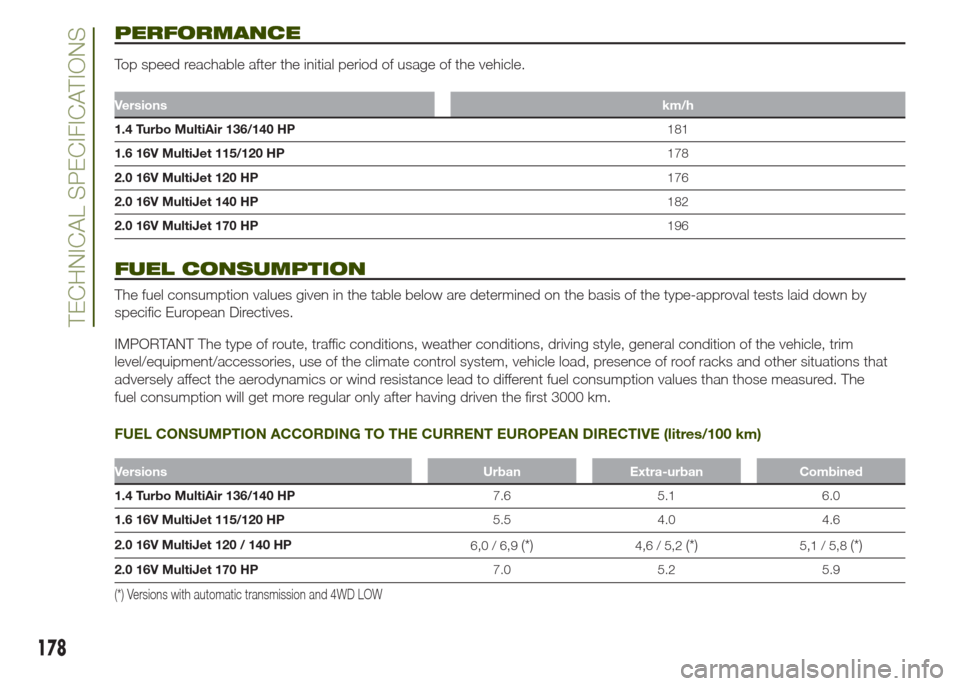
PERFORMANCE
Top speed reachable after the initial period of usage of the vehicle.
Versionskm/h
1.4 Turbo MultiAir 136/140 HP181
1.6 16V MultiJet 115/120 HP178
2.0 16V MultiJet 120 HP176
2.0 16V MultiJet 140 HP182
2.0 16V MultiJet 170 HP196
FUEL CONSUMPTION
The fuel consumption values given in the table below are determined on the basis of the type-approval tests laid down by
specific European Directives.
IMPORTANT The type of route, traffic conditions, weather conditions, driving style, general condition of the vehicle, trim
level/equipment/accessories, use of the climate control system, vehicle load, presence of roof racks and other situations that
adversely affect the aerodynamics or wind resistance lead to different fuel consumption values than those measured. The
fuel consumption will get more regular only after having driven the first 3000 km.
FUEL CONSUMPTION ACCORDING TO THE CURRENT EUROPEAN DIRECTIVE (litres/100 km)
Versions Urban Extra-urban Combined
1.4 Turbo MultiAir 136/140 HP7.6 5.1 6.0
1.6 16V MultiJet 115/120 HP5.5 4.0 4.6
2.0 16V MultiJet 120 / 140 HP
6,0 / 6,9
(*)4,6 / 5,2(*)5,1 / 5,8(*)
2.0 16V MultiJet 170 HP7.0 5.2 5.9
(*) Versions with automatic transmission and 4WD LOW
178
TECHNICAL SPECIFICATIONS
Page 203 of 212
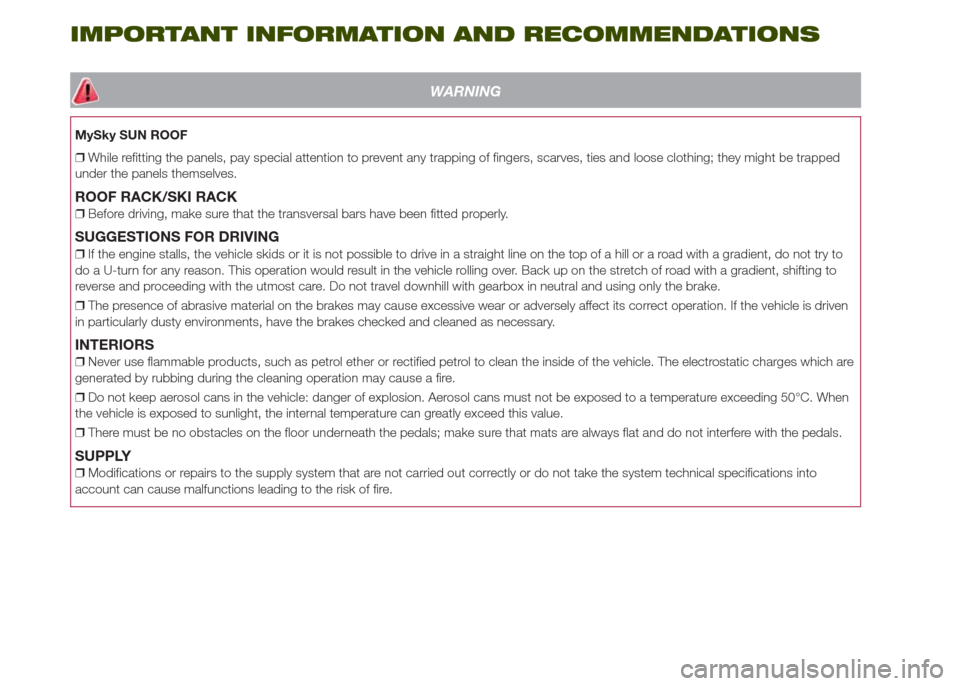
IMPORTANT INFORMATION AND RECOMMENDATIONS
WARNING
MySky SUN ROOF
❒While refitting the panels, pay special attention to prevent any trapping of fingers, scarves, ties and loose clothing; they might be trapped
under the panels themselves.
ROOF RACK/SKI RACK
❒Before driving, make sure that the transversal bars have been fitted properly.
SUGGESTIONS FOR DRIVING
❒If the engine stalls, the vehicle skids or it is not possible to drive in a straight line on the top of a hill or a road with a gradient, do not try to
do a U-turn for any reason. This operation would result in the vehicle rolling over. Back up on the stretch of road with a gradient, shifting to
reverse and proceeding with the utmost care. Do not travel downhill with gearbox in neutral and using only the brake.
❒The presence of abrasive material on the brakes may cause excessive wear or adversely affect its correct operation. If the vehicle is driven
in particularly dusty environments, have the brakes checked and cleaned as necessary.
INTERIORS
❒Never use flammable products, such as petrol ether or rectified petrol to clean the inside of the vehicle. The electrostatic charges which are
generated by rubbing during the cleaning operation may cause a fire.
❒Do not keep aerosol cans in the vehicle: danger of explosion. Aerosol cans must not be exposed to a temperature exceeding 50°C. When
the vehicle is exposed to sunlight, the internal temperature can greatly exceed this value.
❒There must be no obstacles on the floor underneath the pedals; make sure that mats are always flat and do not interfere with the pedals.
SUPPLY
❒Modifications or repairs to the supply system that are not carried out correctly or do not take the system technical specifications into
account can cause malfunctions leading to the risk of fire.
Page 204 of 212
WARNING
ROOF RACK/SKI RACK
❒The use of transversal bars on longitudinal ones prevents the use of the sunroof, because the latter, while opening, interferes with the bars.
❒Therefore do not move the sunroof if transversal bars have been fitted.
❒Fully comply with the regulations in force concerning maximum clearance.
INTERIORS
❒Never use alcohol, petrols and derivatives to clean the dashboard and instrument panel lens.
Page 209 of 212
INDEX
4
WD LOW mode
(engagement/release)................... 110
ABS (system) ................................ 64
Active safety systems ..................... 64
Airbag ............................................ 91
Alarm ............................................. 11
All-wheel drive ................................ 109
Automatic transmission gear
lever unlocking ............................. 143
Automatic transmission .................. 103
Auxiliary driving systems................. 69
Battery recharging ........................ 160
Bodywork (cleaning and
maintenance) ............................... 164
Bonnet ........................................... 33
Broken-down vehicle towing .......... 146
BSM system .................................. 69
Changing a wheel ......................... 135
Child protection systems ................ 81
Climate control ............................... 24
CO2 emissions............................... 179
Control panel and on-board
instruments .................................. 38
Daytime running lights (DRL) ......... 19
Dimensions .................................... 171
Dipped beam headlights ................ 19
Direction indicators ........................ 20
Disabling active safety systems ...... 66Display ........................................... 40
Doors ............................................. 11
DST (system).................................. 65
DTC (system) ................................. 64
Electric Parking Brake (EPB) ......... 100
Electric steering wheel heating ....... 17
Electric sun roof ............................. 29
Electric windows ............................ 28
Electronic Cruise Control ................ 108
Engine compartment...................... 155
Engine............................................ 167
ERM (system) ................................. 65
ESC (system) ................................. 64
Exterior lights ................................. 19
Fluids and lubricants ..................... 176
Fog lights ....................................... 19
Forward Collision Warning Plus
system ......................................... 71
Front airbags .................................. 91
Front courtesy lights ....................... 21
Fuel consumption .......................... 178
Fuel cut-off system......................... 143
Fuse boxes .................................... 130
Fuses (replacement) ....................... 130
Hazard warning lights ................... 124
HDC (system) ................................. 65
Headlight alignment adjustment ..... 20
Head restraints............................... 16
HSA (system) ................................. 64
Identification data .......................... 166
Ignition device ................................ 8
Important information and
recommendations ........................ 201
Interior lights .................................. 21
Jump starting ................................ 141
Keys
– electronic key ............................ 7
– key with remote control ............. 7
Lane Change ................................ 20
LaneSense system ......................... 114
Lifting the vehicle ........................... 163
Light switch.................................... 19
Luggage compartment................... 34
Main beam headlights .................. 20
Main beam headlights
– Automatic main beam
headlights ................................. 20
Manual gearbox ............................. 103
MySky sun roof .............................. 31
Occupant protection systems ....... 76
Parking lights ................................ 20
ParkSense (system)........................ 112
PBA (system) ................................. 64
Performance (top speed) ................ 178
Prescriptions for handling the
vehicle at the end of its life ........... 179
Pretensioners ................................. 79