trailer JEEP RENEGADE 2014 1.G User Guide
[x] Cancel search | Manufacturer: JEEP, Model Year: 2014, Model line: RENEGADE, Model: JEEP RENEGADE 2014 1.GPages: 212, PDF Size: 17.48 MB
Page 122 of 212
To ensure correct operation of the
system, periodically remove all deposits
of dirt which may have accumulated
on the ball head bar and from the
mounting pipe. The lock must only be
treated with graphite.
Periodically lubricate the joints, the
sliding surfaces and the balls with
grease without resin or oil. Lubrication
is also a further corrosion protection.
if the vehicle is washed with high-
pressure jets, the ball head bar must be
removed and the dedicated plug fitted.
The ball head bar must never be
treated with high-pressure jets.
Two keys are supplied together with the
removable ball tow bar. Note down
the four-digit key number and keep it in
a safe place. This number is to be
used for ordering any duplicate keys
that may be required.
IMPORTANT To install a tow hook
contact a Jeep Dealership.
WARNING
128)The ABS with which the vehicle is
equipped will not control the braking
system of the trailer. Particular caution is
therefore required on slippery surfaces.
129)Never modify the braking system of
the vehicle to control the trailer brake. The
trailer braking system must be fully
independent of the vehicle’s hydraulic
system.
REFUELLING THE
VEHICLE
Always stop the engine before
refuelling.
130) 131) 132)
PETROL ENGINES
Only use unleaded petrol with a number
of octanes (R.O.N.) not lower than 95
(EN228 specification).
DIESEL ENGINES
51)Only use Diesel for motor vehicles
(EN590 specification).
When using or parking the vehicle for a
long time in the mountains or cold
areas, it is advisable to refuel using
locally available diesel. In this case, it is
also advisable to keep the tank over
50% full.
REFUELLING
PROCEDURE
The fuel flap is unlocked when the
central door locking system is released,
while it is automatically locked when
the central locking system is applied.
Opening the flap
To refuel proceed as follows:
❒open flap A fig. 102, from the point
shown by the arrow;
120
STARTING AND DRIVING
Page 136 of 212
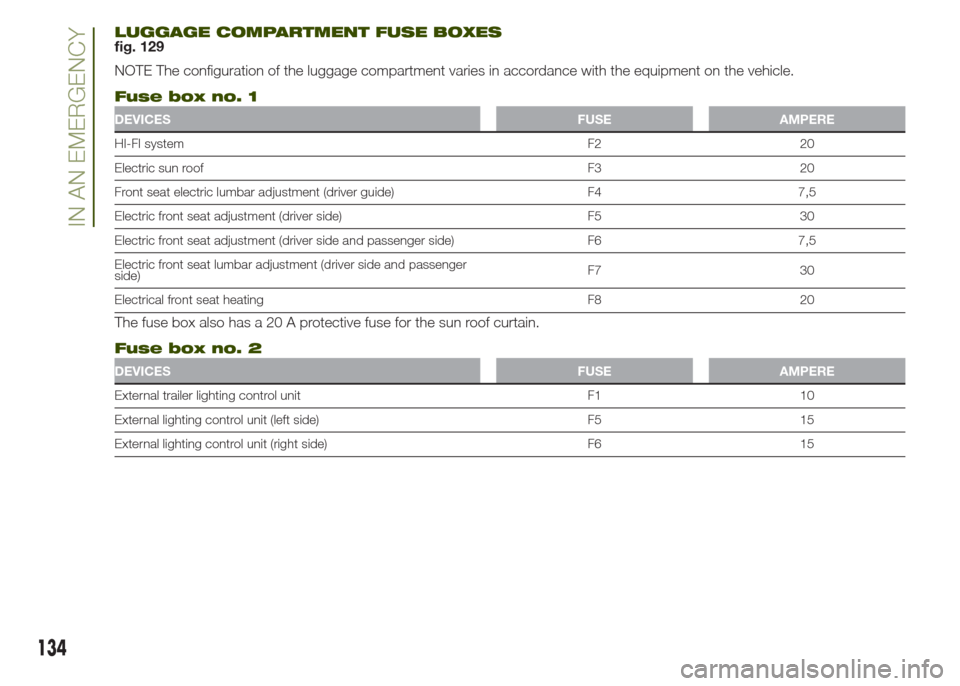
LUGGAGE COMPARTMENT FUSE BOXESfig. 129
NOTE The configuration of the luggage compartment varies in accordance with the equipment on the vehicle.
Fuse box no. 1
DEVICES FUSE AMPERE
HI-FI system F2 20
Electric sun roof F3 20
Front seat electric lumbar adjustment (driver guide) F4 7,5
Electric front seat adjustment (driver side) F5 30
Electric front seat adjustment (driver side and passenger side) F6 7,5
Electric front seat lumbar adjustment (driver side and passenger
side)F7 30
Electrical front seat heating F8 20
The fuse box also has a 20 A protective fuse for the sun roof curtain.
Fuse box no. 2
DEVICES FUSE AMPERE
External trailer lighting control unit F1 10
External lighting control unit (left side) F5 15
External lighting control unit (right side) F6 15
134
IN AN EMERGENCY
Page 147 of 212
TOWING THE
VEHICLE
ATTACHING THE TOW
HOOK
161) 162) 163)
The tow hook provided with the vehicle
is located in the tool box inside the
luggage compartment.
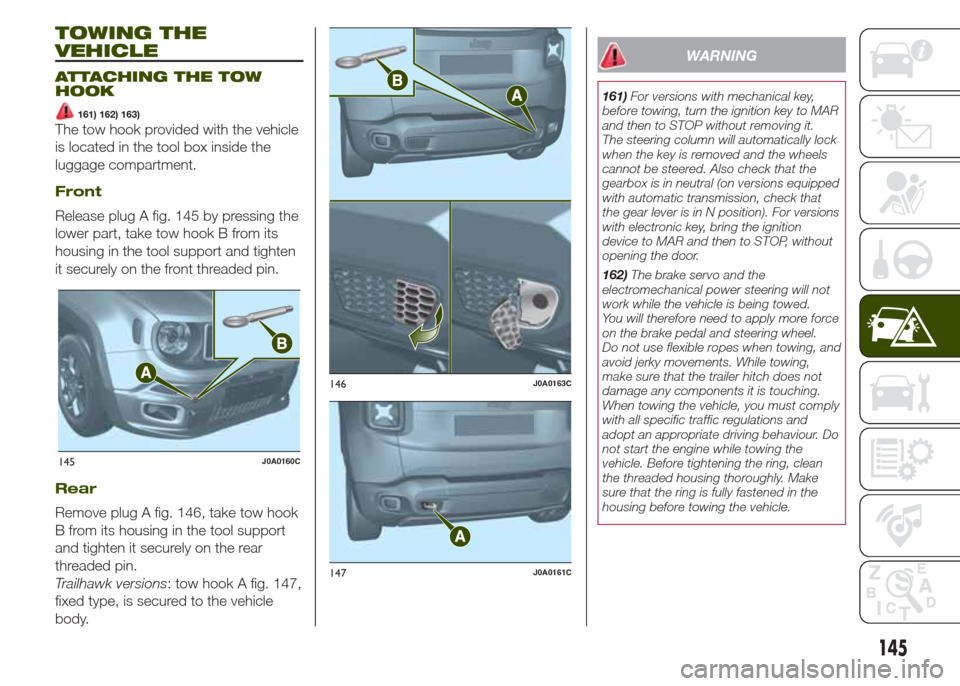
Front
Release plug A fig. 145 by pressing the
lower part, take tow hook B from its
housing in the tool support and tighten
it securely on the front threaded pin.
Rear
Remove plug A fig. 146, take tow hook
B from its housing in the tool support
and tighten it securely on the rear
threaded pin.
Trailhawk versions: tow hook A fig. 147,
fixed type, is secured to the vehicle
body.
WARNING
161)For versions with mechanical key,
before towing, turn the ignition key to MAR
and then to STOP without removing it.
The steering column will automatically lock
when the key is removed and the wheels
cannot be steered. Also check that the
gearbox is in neutral (on versions equipped
with automatic transmission, check that
the gear lever is in N position). For versions
with electronic key, bring the ignition
device to MAR and then to STOP, without
opening the door.
162)The brake servo and the
electromechanical power steering will not
work while the vehicle is being towed.
You will therefore need to apply more force
on the brake pedal and steering wheel.
Do not use flexible ropes when towing, and
avoid jerky movements. While towing,
make sure that the trailer hitch does not
damage any components it is touching.
When towing the vehicle, you must comply
with all specific traffic regulations and
adopt an appropriate driving behaviour. Do
not start the engine while towing the
vehicle. Before tightening the ring, clean
the threaded housing thoroughly. Make
sure that the ring is fully fastened in the
housing before towing the vehicle.
145J0A0160C
146J0A0163C
147J0A0161C
145
Page 150 of 212
SCHEDULED
SERVICING
Correct servicing is crucial for
guaranteeing a long life for the vehicle
under the best conditions. For this
reason, Jeep has planned a series of
checks and services at fixed distance
intervals and, where provided, at fixed
time intervals, as described in the
Scheduled Servicing Plan.
Before each service, it is always
necessary to carefully follow the
instructions in the Scheduled Servicing
Plan (e.g. periodically check level of
fluids, tyre pressure, etc.).
Scheduled Servicing is offered by all
Jeep Dealerships according to a set
time schedule. If, during each
operation, in addition to the ones
scheduled, the need arises for further
replacements or repairs, these may
be carried out with your explicit
agreement only. If your vehicle is used
frequently for towing, the interval
between one service operation and the
next should be reduced.IMPORTANT Scheduled Servicing
Coupons are required by the
Manufacturer. Failure to have them
carried out may invalidate the warranty.
It is advisable to inform a Jeep
Dealership of any small operating
irregularities without waiting for the next
service.
PERIODIC CHECKS
Every1,000km or before long
journeys, check and if necessary, top
up: engine coolant level; brake fluid
level; screen washer fluid level; tyre
inflation pressure and condition; lighting
system operation (headlights, direction
indicators, hazard warning lights, etc.);
screen washer/wiper system operation
and positioning/wear of windscreen/
rear window wiper blades.
Every3,000km, check and top up if
required: engine oil level.
HEAVY-DUTY USE OF THE
VEHICLE
If the vehicle is used under one of the
following conditions: towing a trailer
or caravan; dusty roads; short (less
than 7-8 km), repeated journeys with
sub-zero outside temperatures; engine
often idling or driving long distances
at low speed or long periods of
inactivity, the following checks must be
carried out more often than indicated
in the Scheduled Servicing Plan:❒check front disc brake pad condition
and wear;
❒check cleanliness of bonnet and
luggage compartment locks,
cleanliness and lubrication of linkage;
❒visually inspect condition of: engine,
gearbox, transmission, pipes and hoses
(exhaust/fuel system/brakes) and
rubber elements (boots/sleeves/
bushes, etc.);
❒check battery charge and battery
fluid level (electrolyte);
❒visually inspect condition of the
accessory drive belts;
❒check and, if necessary, change
engine oil and replace oil filter;
❒check and, if necessary, replace
pollen filter;
❒check and, if necessary, replace air
cleaner.
On versions with automatic
transmission, change transmission oil
and replace oil filter every 60,000 km
(40,000) or every 4 years.
148
SERVICING AND MAINTENANCE
Page 176 of 212
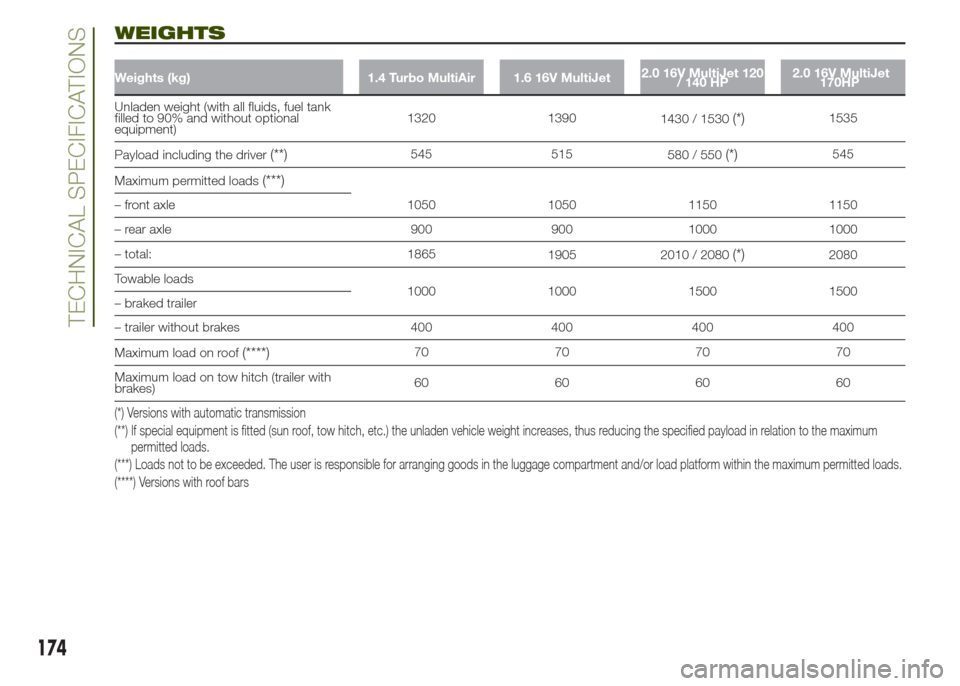
WEIGHTS
Weights (kg) 1.4 Turbo MultiAir 1.6 16V MultiJet 2.0 16V MultiJet 120 / 140 HP 2.0 16V MultiJet
Unladen weight (with all fluids, fuel tank filled to 90% and without optional equipment) 1320 1390 1430 / 1530(*)1535
Payload including the driver(**)545 515 580 / 550(*)545
Maximum permitted loads(***)
1050 1050 1150 1150 – front axle
– rear axle 900 900 1000 1000
– total: 1865 1905 2010 / 2080(*)2080
Towable loads 1000 1000 1500 1500 – braked trailer
– trailer without brakes 400 400 400 400
Maximum load on roof(****)70 70 70 70
Maximum load on tow hitch (trailer with brakes) 60 60 60 60
(*) Versions with automatic transmission
(**) If special equipment is fitted (sun roof, tow hitch, etc.) the unladen vehicle weight increases, thus reducing the specified payload in relation to the maximum permitted loads.
(***) Loads not to be exceeded. The user is responsible for arranging goods in the luggage compartment and/or load platform within the maximum permitt ed loads.
(****) Versions with roof bars
174
TECHNICAL SPECIFICATIONS
170HP
Page 210 of 212
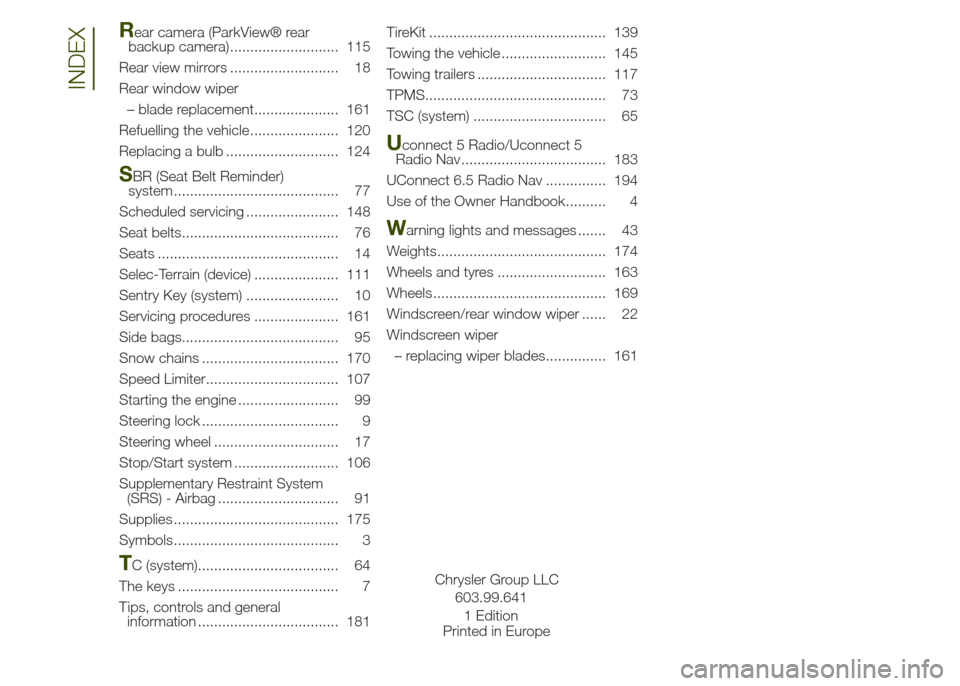
Rear camera (ParkView® rear
backup camera) ........................... 115
Rear view mirrors ........................... 18
Rear window wiper
– blade replacement..................... 161
Refuelling the vehicle ...................... 120
Replacing a bulb ............................ 124
SBR (Seat Belt Reminder)
system ......................................... 77
Scheduled servicing ....................... 148
Seat belts....................................... 76
Seats ............................................. 14
Selec-Terrain (device) ..................... 111
Sentry Key (system) ....................... 10
Servicing procedures ..................... 161
Side bags....................................... 95
Snow chains .................................. 170
Speed Limiter................................. 107
Starting the engine ......................... 99
Steering lock .................................. 9
Steering wheel ............................... 17
Stop/Start system .......................... 106
Supplementary Restraint System
(SRS) - Airbag .............................. 91
Supplies ......................................... 175
Symbols......................................... 3
TC (system)................................... 64
The keys ........................................ 7
Tips, controls and general
information ................................... 181TireKit ............................................ 139
Towing the vehicle .......................... 145
Towing trailers ................................ 117
TPMS............................................. 73
TSC (system) ................................. 65
Uconnect 5 Radio/Uconnect 5
Radio Nav .................................... 183
UConnect 6.5 Radio Nav ............... 194
Use of the Owner Handbook.......... 4
Warning lights and messages ....... 43
Weights.......................................... 174
Wheels and tyres ........................... 163
Wheels ........................................... 169
Windscreen/rear window wiper ...... 22
Windscreen wiper
– replacing wiper blades............... 161
INDEX
Chrysler Group LLC
603.99.641
Printed in Europe1 Edition