cooling JEEP RENEGADE 2015 1.G User Guide
[x] Cancel search | Manufacturer: JEEP, Model Year: 2015, Model line: RENEGADE, Model: JEEP RENEGADE 2015 1.GPages: 678, PDF Size: 29.84 MB
Page 423 of 678
Electronic Speed Control — If Equipped
•Do not use in hilly terrain or with heavy loads.
•When using the speed control, if you experience speed
drops greater than 10 mph (16 km/h), disengage until
you can get back to cruising speed.
•Use speed control in flat terrain and with light loads to
maximize fuel efficiency.
Cooling System
To reduce potential for engine and transmission over-
heating, take the following actions:
City Driving
When stopped for short periods of time, shift the trans-
mission into NEUTRAL and increase engine idle speed.
Highway Driving
Reduce speed.
Air Conditioning
Turn off temporarily.
7
STARTING AND OPERATING 421
Page 467 of 678
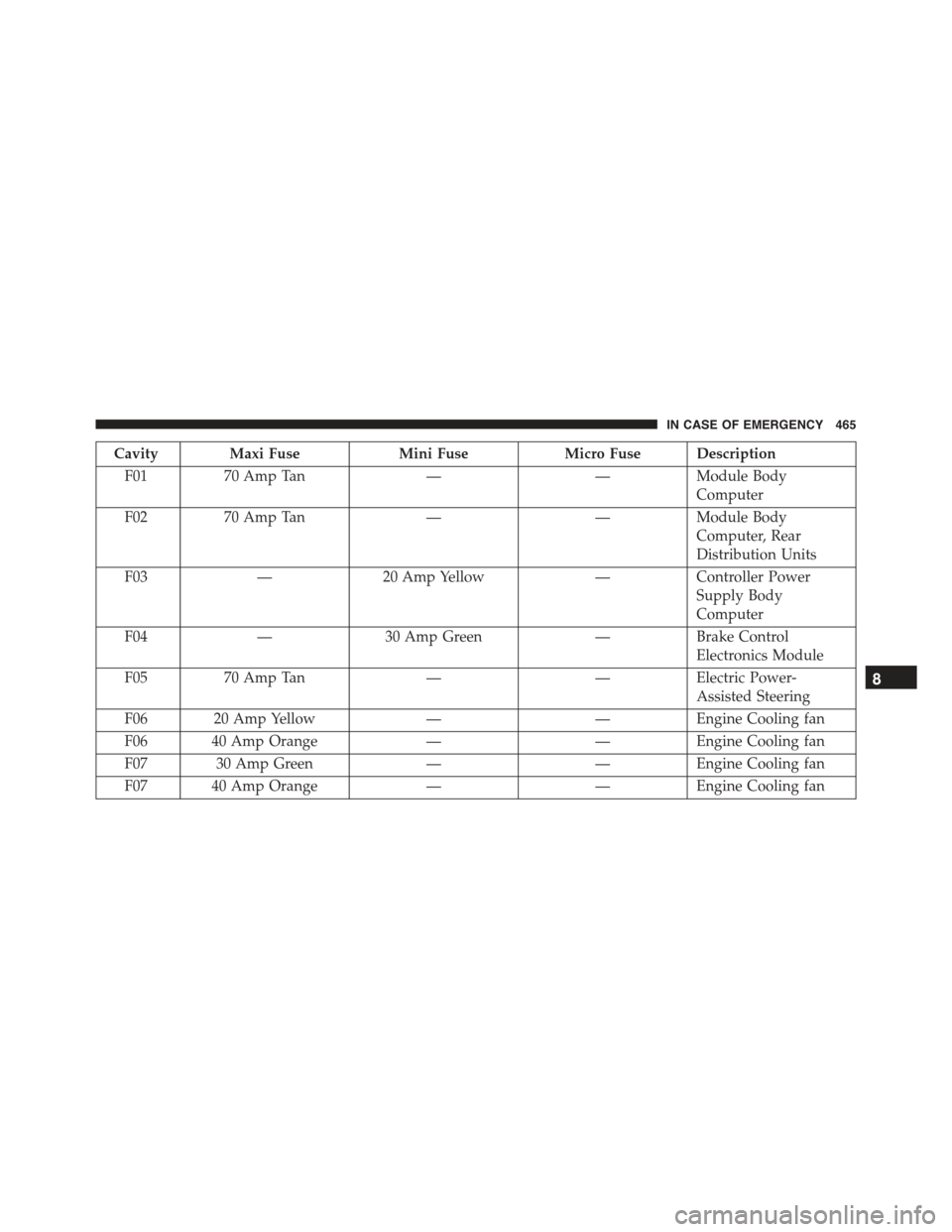
Cavity Maxi FuseMini FuseMicro Fuse Description
F0170 Amp Tan——Module Body
Computer
F0270 Amp Tan——Module Body
Computer, Rear
Distribution Units
F03—20 Amp Yellow—Controller Power
Supply Body
Computer
F04—30 Amp Green—Brake Control
Electronics Module
F0570 Amp Tan——Electric Power-
Assisted Steering
F06 20 Amp Yellow——Engine Cooling fan
F06 40 Amp Orange——Engine Cooling fan
F07 30 Amp Green——Engine Cooling fan
F07 40 Amp Orange——Engine Cooling fan
8
IN CASE OF EMERGENCY 465
Page 495 of 678
WARNING!
•Take care to avoid the radiator cooling fan when-
ever the hood is raised. It can start anytime the
ignition switch is ON. You can be injured by
moving fan blades.
•Remove any metal jewelry such as rings, watch
bands and bracelets that could make an inadvertent
electrical contact. You could be seriously injured.
•Batteries contain sulfuric acid that can burn your
skin or eyes and generate hydrogen gas which is
flammable and explosive. Keep open flames or
sparks away from the battery.
Proceed as follows:
1. Set the Electric Park Brake, shift the automatic trans-
mission into PARK (manual transmission in NEU-
TRAL) and turn the ignition to STOP/OFF.
2. Turn off the heater, radio, and all unnecessary electri-
cal accessories.
3. If using another vehicle to jump-start the battery, park
the vehicle within the jumper cables reach, set the
parking brake and make sure the ignition is STOP/
OFF.
WARNING!
Do not allow vehicles to touch each other as this
could establish a ground connection and personal
injury could result.
8
IN CASE OF EMERGENCY 493
Page 500 of 678
IF YOUR ENGINE OVERHEATS
In any of the following situations, you can reduce the
potential for overheating your engine by taking the
appropriate action.
•On the highways — slow down.
•In city traffic — while stopped, put transmission in
NEUTRAL, but do not increase engine idle speed.
CAUTION!
Driving with a hot cooling system could damage
your vehicle. If the temperature gauge reads “H,”
pull over and stop the vehicle. Idle the vehicle with
the air conditioner turned off until the pointer drops
back into the normal range. If the pointer remains on
the “H” and you hear continuous chimes, turn the
engine off immediately and call for service.
NOTE:There are steps that you can take to slow down
an impending overheat condition:
•If your air conditioner (A/C) is on, turn it off. The A/C
system adds heat to the engine cooling system and
turning the A/C off can help remove this heat.
•You can also turn the temperature control to maximum
heat, the mode control to floor and the blower control
to high. This allows the heater core to act as a
supplement to the radiator and aids in removing heat
from the engine cooling system.
WARNING!
You or others can be badly burned by hot engine
coolant (antifreeze) or steam from your radiator. If
you see or hear steam coming from under the hood,
do not open the hood until the radiator has had time
to cool. Never try to open a cooling system pressure
cap when the radiator or coolant bottle is hot.
498 IN CASE OF EMERGENCY
Page 514 of 678
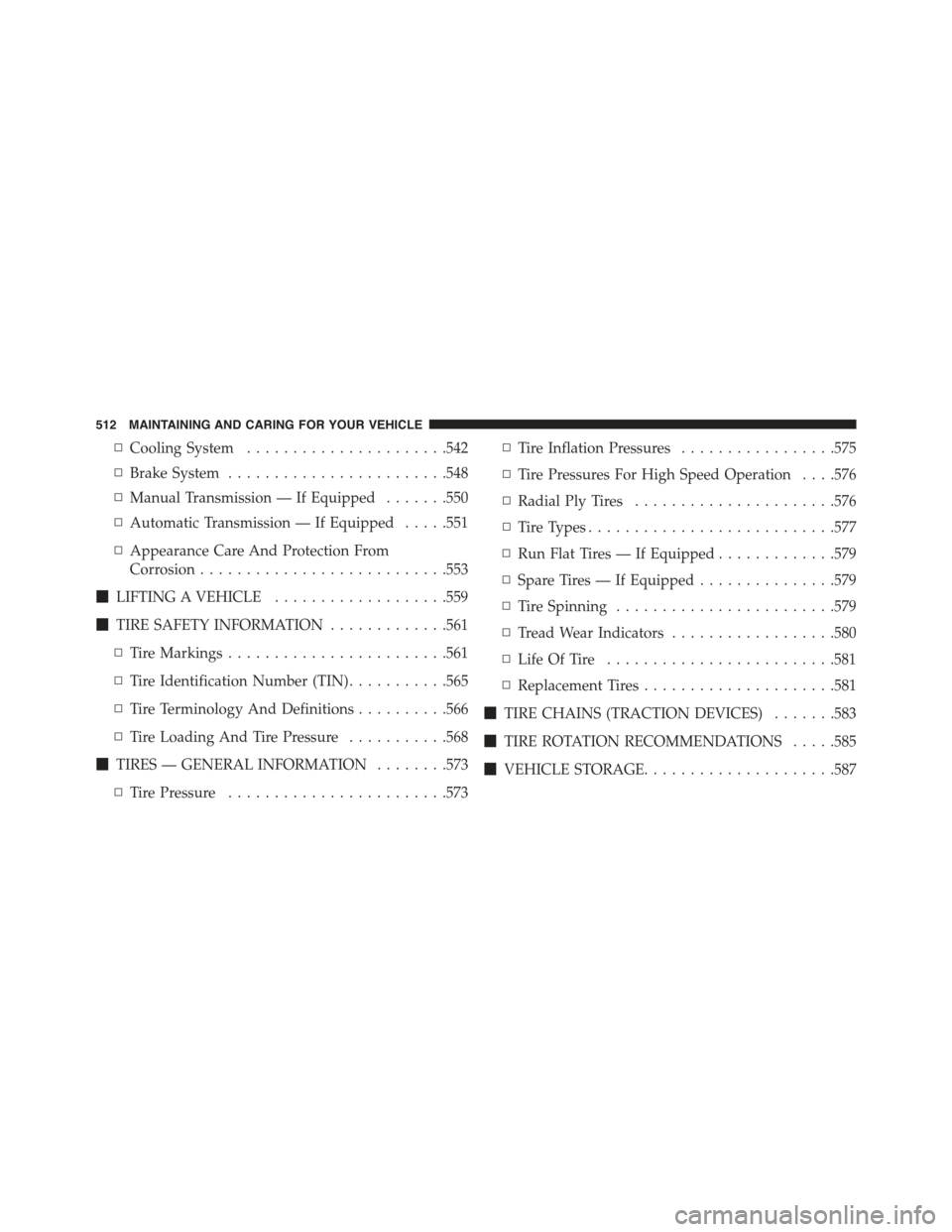
▫Cooling System......................542
▫Brake System........................548
▫Manual Transmission — If Equipped.......550
▫Automatic Transmission — If Equipped.....551
▫Appearance Care And Protection From
Corrosion...........................553
!LIFTING A VEHICLE...................559
!TIRE SAFETY INFORMATION.............561
▫Tire Markings........................561
▫Tire Identification Number (TIN)...........565
▫Tire Terminology And Definitions..........566
▫Tire Loading And Tire Pressure...........568
!TIRES — GENERAL INFORMATION........573
▫Tire Pressure........................573
▫Tire Inflation Pressures.................575
▫Tire Pressures For High Speed Operation . . . .576
▫Radial Ply Tires......................576
▫Tire Types...........................577
▫Run Flat Tires — If Equipped.............579
▫Spare Tires — If Equipped...............579
▫Tire Spinning........................579
▫Tread Wear Indicators..................580
▫Life Of Tire.........................581
▫Replacement Tires.....................581
!TIRE CHAINS (TRACTION DEVICES).......583
!TIRE ROTATION RECOMMENDATIONS.....585
!VEHICLE STORAGE.....................587
512 MAINTAINING AND CARING FOR YOUR VEHICLE
Page 519 of 678
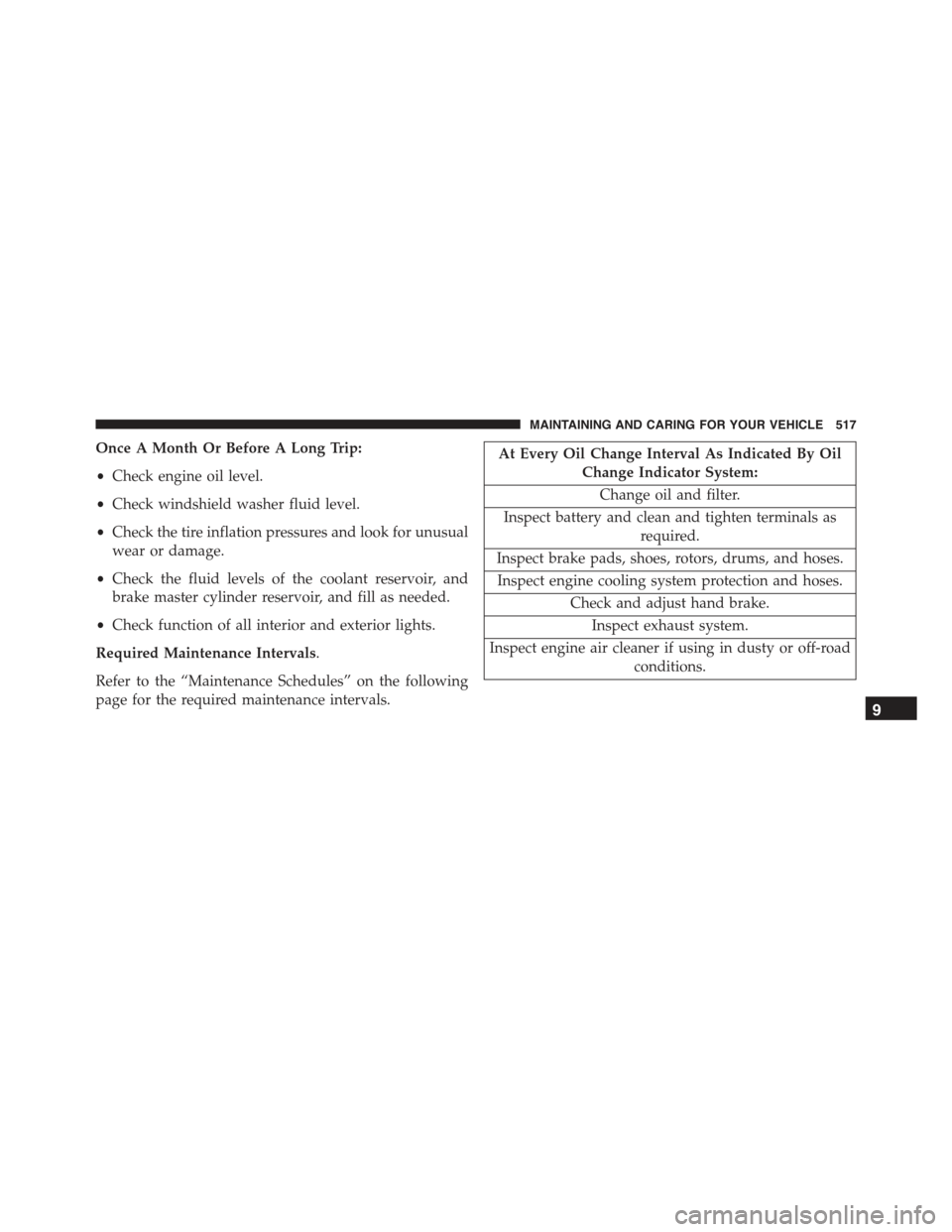
Once A Month Or Before A Long Trip:
•Check engine oil level.
•Check windshield washer fluid level.
•Check the tire inflation pressures and look for unusual
wear or damage.
•Check the fluid levels of the coolant reservoir, and
brake master cylinder reservoir, and fill as needed.
•Check function of all interior and exterior lights.
Required Maintenance Intervals.
Refer to the “Maintenance Schedules” on the following
page for the required maintenance intervals.
At Every Oil Change Interval As Indicated By Oil
Change Indicator System:
Change oil and filter.
Inspect battery and clean and tighten terminals as
required.
Inspect brake pads, shoes, rotors, drums, and hoses.
Inspect engine cooling system protection and hoses.
Check and adjust hand brake.
Inspect exhaust system.
Inspect engine air cleaner if using in dusty or off-road
conditions.
9
MAINTAINING AND CARING FOR YOUR VEHICLE 517
Page 544 of 678
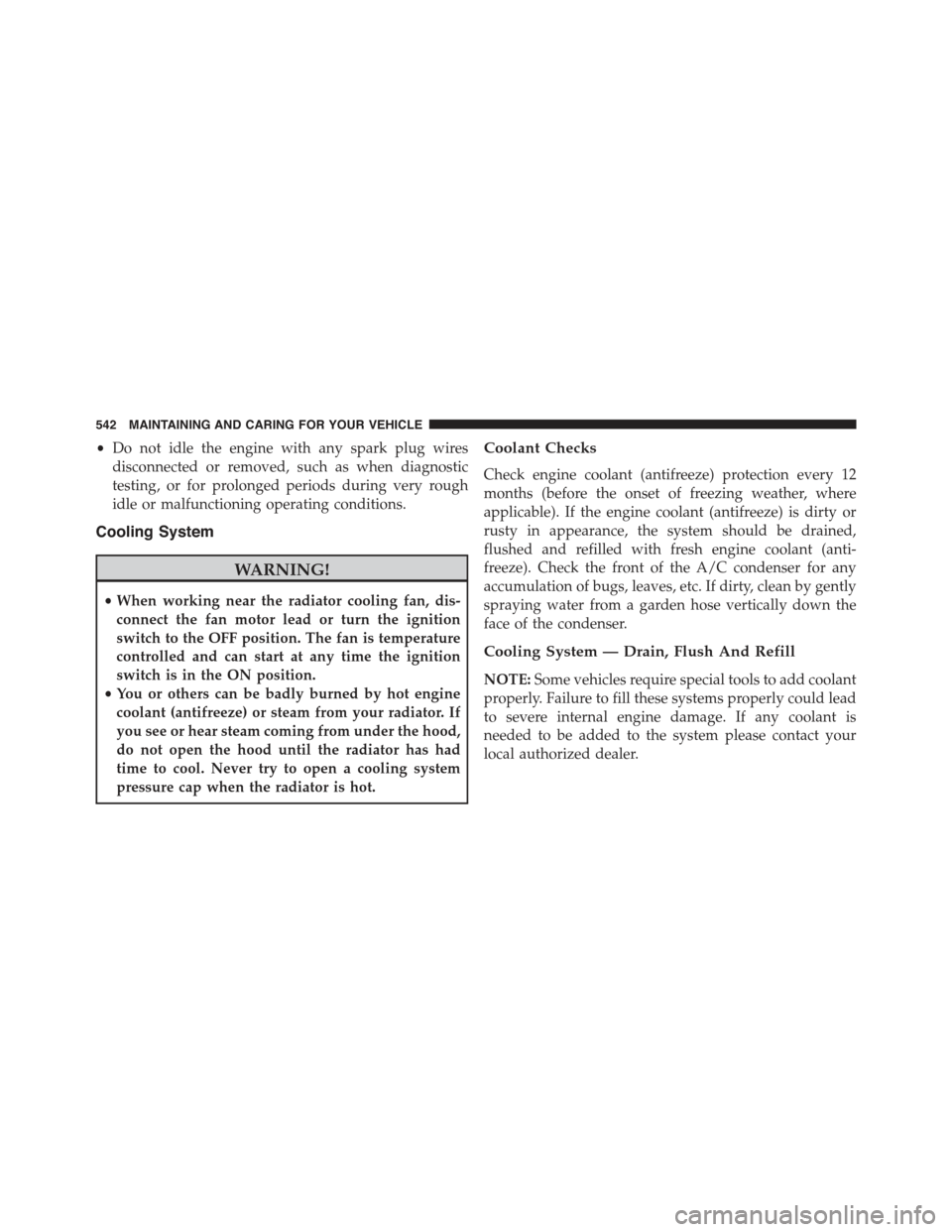
•Do not idle the engine with any spark plug wires
disconnected or removed, such as when diagnostic
testing, or for prolonged periods during very rough
idle or malfunctioning operating conditions.
Cooling System
WARNING!
•When working near the radiator cooling fan, dis-
connect the fan motor lead or turn the ignition
switch to the OFF position. The fan is temperature
controlled and can start at any time the ignition
switch is in the ON position.
•You or others can be badly burned by hot engine
coolant (antifreeze) or steam from your radiator. If
you see or hear steam coming from under the hood,
do not open the hood until the radiator has had
time to cool. Never try to open a cooling system
pressure cap when the radiator is hot.
Coolant Checks
Check engine coolant (antifreeze) protection every 12
months (before the onset of freezing weather, where
applicable). If the engine coolant (antifreeze) is dirty or
rusty in appearance, the system should be drained,
flushed and refilled with fresh engine coolant (anti-
freeze). Check the front of the A/C condenser for any
accumulation of bugs, leaves, etc. If dirty, clean by gently
spraying water from a garden hose vertically down the
face of the condenser.
Cooling System — Drain, Flush And Refill
NOTE:Some vehicles require special tools to add coolant
properly. Failure to fill these systems properly could lead
to severe internal engine damage. If any coolant is
needed to be added to the system please contact your
local authorized dealer.
542 MAINTAINING AND CARING FOR YOUR VEHICLE
Page 545 of 678
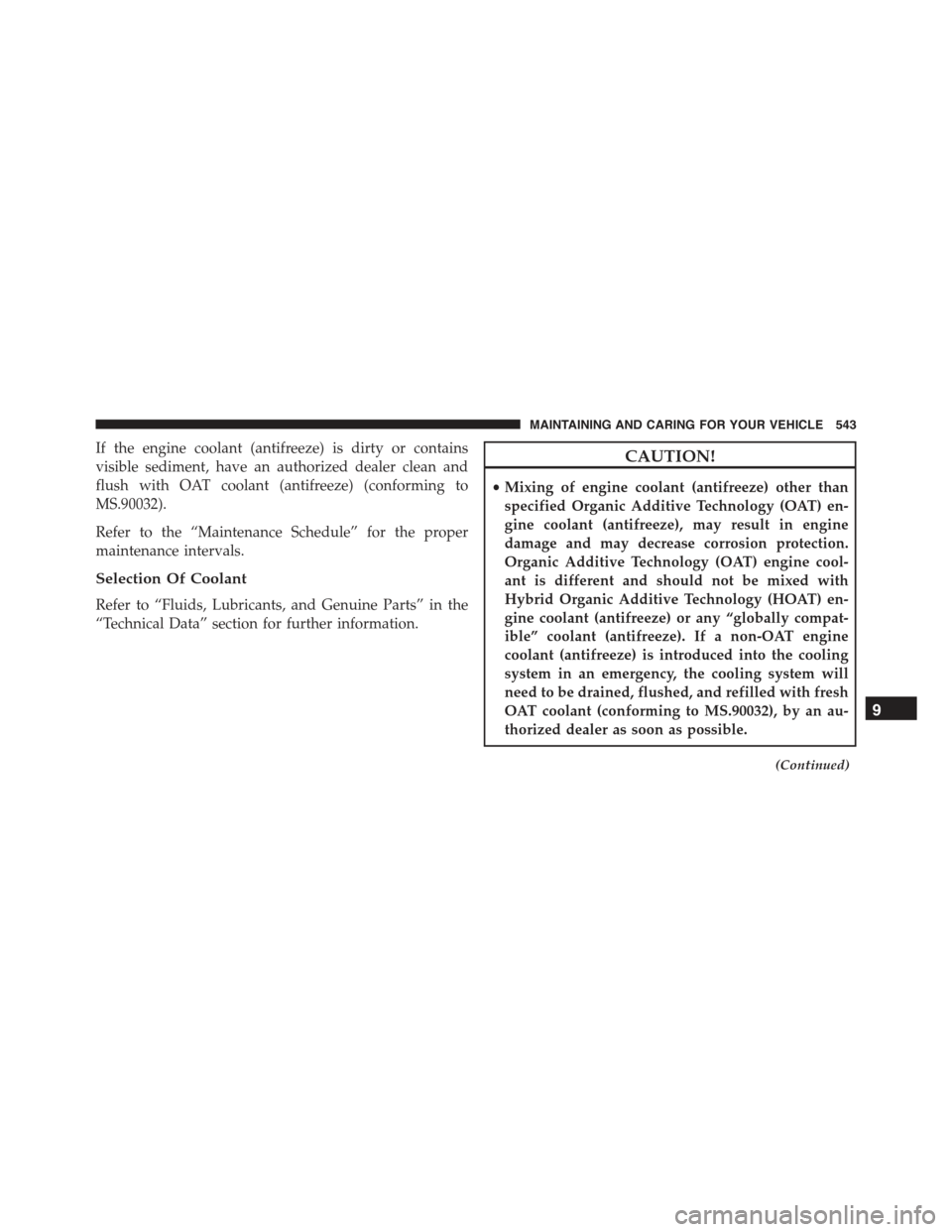
If the engine coolant (antifreeze) is dirty or contains
visible sediment, have an authorized dealer clean and
flush with OAT coolant (antifreeze) (conforming to
MS.90032).
Refer to the “Maintenance Schedule” for the proper
maintenance intervals.
Selection Of Coolant
Refer to “Fluids, Lubricants, and Genuine Parts” in the
“Technical Data” section for further information.
CAUTION!
•Mixing of engine coolant (antifreeze) other than
specified Organic Additive Technology (OAT) en-
gine coolant (antifreeze), may result in engine
damage and may decrease corrosion protection.
Organic Additive Technology (OAT) engine cool-
ant is different and should not be mixed with
Hybrid Organic Additive Technology (HOAT) en-
gine coolant (antifreeze) or any “globally compat-
ible” coolant (antifreeze). If a non-OAT engine
coolant (antifreeze) is introduced into the cooling
system in an emergency, the cooling system will
need to be drained, flushed, and refilled with fresh
OAT coolant (conforming to MS.90032), by an au-
thorized dealer as soon as possible.
(Continued)
9
MAINTAINING AND CARING FOR YOUR VEHICLE 543
Page 547 of 678
(antifreeze) solution. The use of lower quality water
will reduce the amount of corrosion protection in the
engine cooling system.
Please note that it is the owner’s responsibility to main-
tain the proper level of protection against freezing ac-
cording to the temperatures occurring in the area where
the vehicle is operated.
NOTE:
•Some vehicles require special tools to add coolant
properly. Failure to fill these systems properly could
lead to severe internal engine damage. If any coolant is
needed to be added to the system please contact your
local authorized dealer.
•Mixing engine coolant (antifreeze) types is not recom-
mended and can result in cooling system damage. If
HOAT and OAT coolant are mixed in an emergency,
have a authorized dealer drain, flush, and refill with
OAT coolant (conforming to MS.90032) as soon as
possible.
Cooling System Pressure Cap
The cap must be fully tightened to prevent loss of engine
coolant (antifreeze) and to ensure that engine coolant
(antifreeze) will return to the radiator from the coolant
recovery tank.
The cap should be inspected and cleaned if there is any
accumulation of foreign material on the sealing surfaces.9
MAINTAINING AND CARING FOR YOUR VEHICLE 545
Page 548 of 678
WARNING!
•Do not open hot engine cooling system. Never add
engine coolant (antifreeze) when the engine is
overheated. Do not loosen or remove the cap to cool
an overheated engine. Heat causes pressure to
build up in the cooling system. To prevent scalding
or injury, do not remove the pressure cap while the
system is hot or under pressure.
•Do not use a pressure cap other than the one
specified for your vehicle. Personal injury or en-
gine damage may result.
Disposal Of Used Engine Coolant
Used ethylene glycol-based engine coolant (antifreeze) is
a regulated substance requiring proper disposal. Check
with your local authorities to determine the disposal
rules for your community. To prevent ingestion by ani-
mals or children, do not store ethylene glycol-based
engine coolant in open containers or allow it to remain in
puddles on the ground. If ingested by a child or pet, seek
emergency assistance immediately. Clean up any ground
spills immediately.
Coolant Level
The coolant expansion bottle provides a quick visual
method for determining that the coolant level is ad-
equate. With the engine off and cold, the level of the
engine coolant (antifreeze) in the bottle should be be-
tween the “MIN” and “MAX” marks.
As long as the engine operating temperature is satisfac-
tory, the coolant bottle need only be checked once a
month.
When additional engine coolant (antifreeze) is needed to
maintain the proper level, it should be added to the
coolant bottle. Do not overfill.
546 MAINTAINING AND CARING FOR YOUR VEHICLE