tow JEEP RENEGADE 2015 1.G Owner's Manual
[x] Cancel search | Manufacturer: JEEP, Model Year: 2015, Model line: RENEGADE, Model: JEEP RENEGADE 2015 1.GPages: 678, PDF Size: 29.84 MB
Page 263 of 678
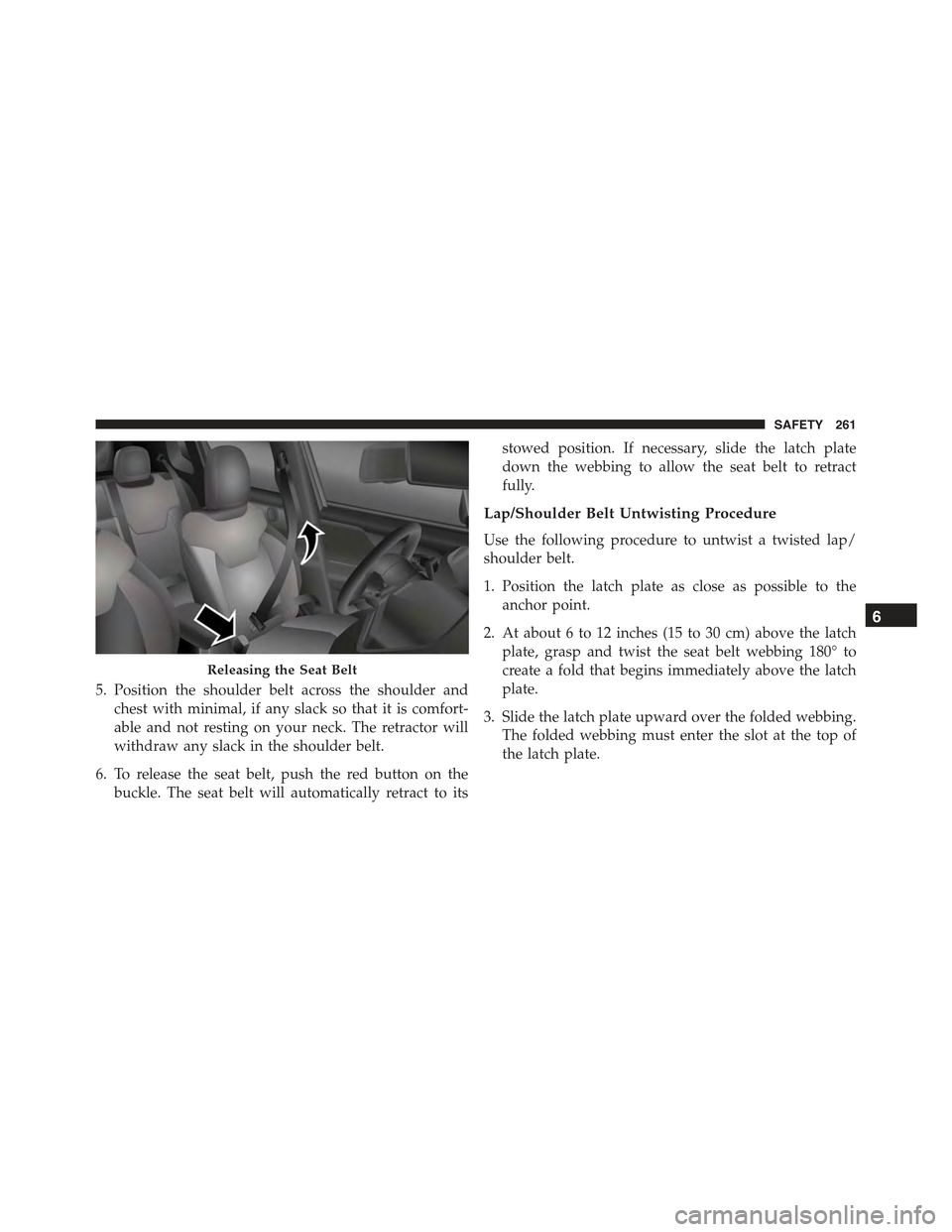
5. Position the shoulder belt across the shoulder and
chest with minimal, if any slack so that it is comfort-
able and not resting on your neck. The retractor will
withdraw any slack in the shoulder belt.
6. To release the seat belt, push the red button on the
buckle. The seat belt will automatically retract to its
stowed position. If necessary, slide the latch plate
down the webbing to allow the seat belt to retract
fully.
Lap/Shoulder Belt Untwisting Procedure
Use the following procedure to untwist a twisted lap/
shoulder belt.
1. Position the latch plate as close as possible to the
anchor point.
2. At about 6 to 12 inches (15 to 30 cm) above the latch
plate, grasp and twist the seat belt webbing 180° to
create a fold that begins immediately above the latch
plate.
3. Slide the latch plate upward over the folded webbing.
The folded webbing must enter the slot at the top of
the latch plate.
Releasing the Seat Belt
6
SAFETY 261
Page 264 of 678
4. Continue to slide the latch plate up until it clears the
folded webbing and the seat belt is no longer twisted.
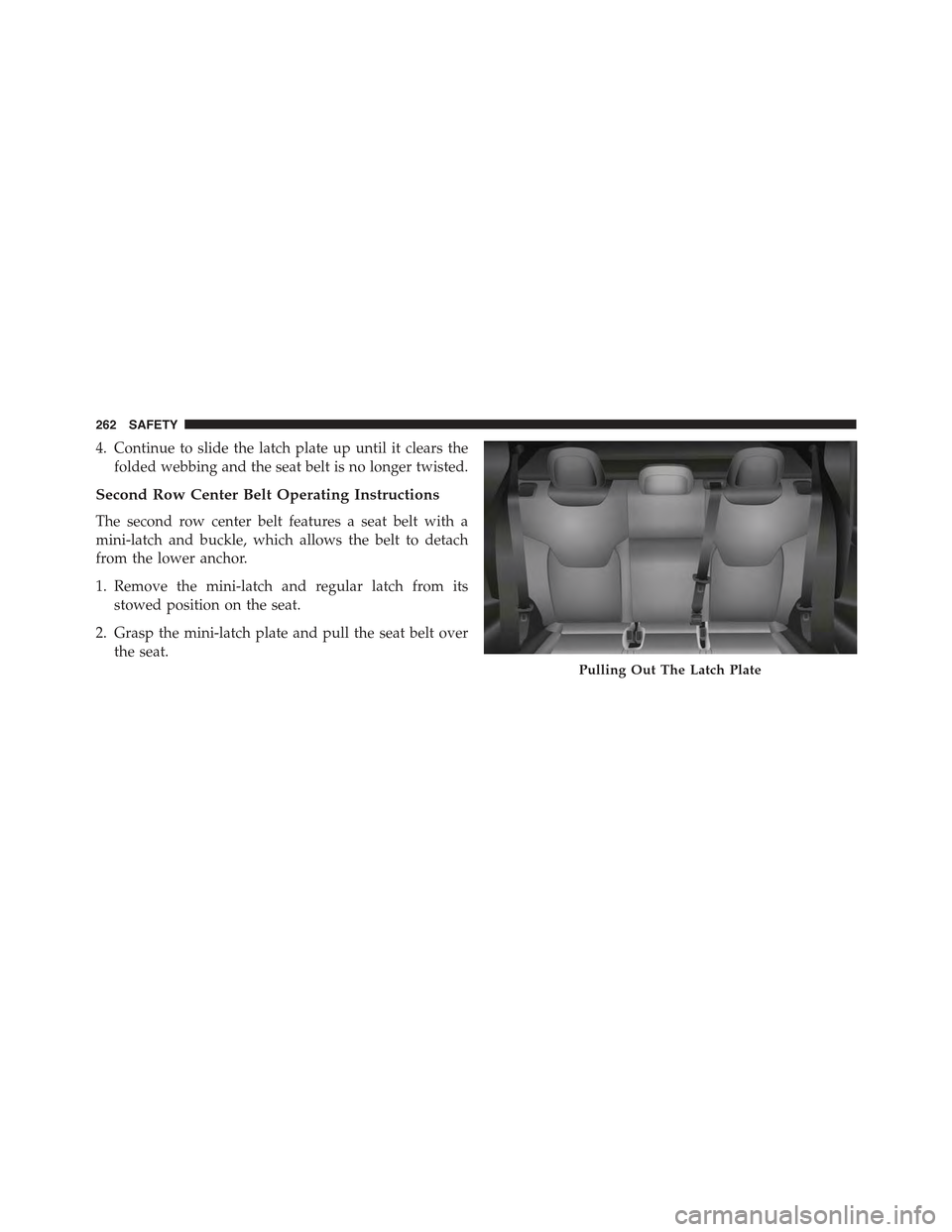
Second Row Center Belt Operating Instructions
The second row center belt features a seat belt with a
mini-latch and buckle, which allows the belt to detach
from the lower anchor.
1. Remove the mini-latch and regular latch from its
stowed position on the seat.
2. Grasp the mini-latch plate and pull the seat belt over
the seat.
Pulling Out The Latch Plate
262 SAFETY
Page 266 of 678
10. To disengage the mini-latch from the mini-buckle for
storage, insert the regular latch plate into the center
red slot on the mini-buckle. The seat belt will auto-
matically retract to its stowed position. If necessary,
slide the latch plate down the webbing to allow the
seat belt to retract fully. Insert the mini-latch plate
and regular latch plate into its stowed position.
WARNING!
•If the mini-latch and mini-buckle are not properly
connected when the seat belt is used by an occu-
pant, the seat belt will not be able to provide
proper restraint and will increase the risk of injury
in a collision.
(Continued)
WARNING!(Continued)
•When reattaching the mini-latch and mini-buckle,
ensure the seat belt webbing is not twisted. If the
webbing is twisted, follow the preceding proce-
dure to detach the mini-latch and mini-buckle,
untwist the webbing, and reattach the mini-latch
and mini-buckle.
Adjustable Upper Shoulder Belt Anchorage
In the driver and front passenger seats, the top of the
shoulder belt can be adjusted upward or downward to
position the seat belt away from your neck. Push or
squeeze the anchorage button to release the anchorage,
and move it up or down to the position that serves you
best.
264 SAFETY
Page 303 of 678
Center Seat LATCH:
WARNING!
•Do not install a child restraint in the center posi-
tion using the LATCH system. This position is not
approved for installing child seats using the
LATCH attachments. You must use the seat belt
and tether anchor to install a child seat in the center
seating position.
•Never use the same lower anchorage to attach more
than one child restraint. Please refer to “Installing
The LATCH-Compatible Child Restraint System”
for typical installation instructions.
Always follow the directions of the child restraint manu-
facturer when installing your child restraint. Not all child
restraint systems will be installed as described here.
To Install A LATCH-Compatible Child Restraint
If the selected seating position has a Switchable Auto-
matic Locking Retractor (ALR) seat belt, stow the seat
belt, following the instructions below. See the section
“Installing Child Restraints Using the Vehicle Seat Belt”
to check what type of seat belt each seating position has.
1. Loosen the adjusters on the lower straps and on the
tether strap of the child seat so that you can more
easily attach the hooks or connectors to the vehicle
anchorages.
2. Place the child seat between the lower anchorages for
that seating position. For some second row seats, you
may need to recline the seat and/or raise the head
restraint to get a better fit. If the rear seat can be moved
forward and rearward in the vehicle, you may wish to
move it to its rear-most position to make room for the
child seat. You may also move the front seat forward
to allow more room for the child seat.
6
SAFETY 301
Page 304 of 678
3. Attach the lower hooks or connectors of the child
restraint to the lower anchorages in the selected seat-
ing position.
4. If the child restraint has a tether strap, connect it to the
top tether anchorage. See the section “Installing Child
Restraints Using the Top Tether Anchorage” for direc-
tions to attach a tether anchor.
5. Tighten all of the straps as you push the child restraint
rearward and downward into the seat. Remove slack
in the straps according to the child restraint manufac-
turer ’s instructions.
6. Test that the child restraint is installed tightly by
pulling back and forth on the child seat at the belt
path. It should not move more than 1 inch (25.4 mm)
in any direction.
How To Stow An Unused ALR Seat Belt:
When using the LATCH attaching system to install a
child restraint, stow all ALR seat belts that are not being
used by other occupants or being used to secure child
restraints. An unused belt could injure a child if they play
with it and accidentally lock the seat belt retractor. Before
installing a child restraint using the LATCH system,
buckle the seat belt behind the child restraint and out of
the child’s reach. If the buckled seat belt interferes with
the child restraint installation, instead of buckling it
behind the child restraint, route the seat belt through the
child restraint belt path and then buckle it. Do not lock
the seat belt. Remind all children in the vehicle that the
seat belts are not toys and that they should not play with
them.
302 SAFETY
Page 320 of 678
▫Maintenance........................396
!ADDING FUEL........................396
!VEHICLE LOADING....................400
▫Certification Label....................400
!ON-ROAD DRIVING TIPS................402
!OFF-ROAD DRIVING TIPS................403
▫When To Use 4WD LOW Range...........403
▫Driving Through Water.................403
▫Driving In Snow, Mud And Sand..........404
▫Hill Climbing........................404
▫Traction Downhill.....................405
▫After Driving Off-Road.................406
!POWER STEERING.....................407
!TRAILER TOWING.....................408
▫Common Towing Definitions.............409
▫Trailer Hitch Classification...............412
▫Trailer Towing Weights (Maximum Trailer Weight
Ratings)............................413
▫Trailer And Tongue Weight..............413
▫Towing Requirements..................415
▫Towing Tips.........................420
!RECREATIONAL TOWING................422
▫Towing This Vehicle Behind Another Vehicle . .422
▫Recreational Towing....................423
318 STARTING AND OPERATING
Page 323 of 678
floor and hold it there. Crank the engine for no more than
15 seconds. This should clear any excess fuel in case the
engine is flooded. Leave the ignition key in the
MAR/ON position, release the accelerator pedal and
repeat the “Normal Starting” procedure.
CAUTION!
To prevent damage to the starter, do not continuously
crank the engine for more than 25 seconds at a time.
Wait 60 seconds before trying again.
WARNING!
•Never pour fuel or other flammable liquid into the
throttle body air inlet opening in an attempt to start
the vehicle. This could result in flash fire causing
serious personal injury.
(Continued)
WARNING!(Continued)
•Do not attempt to push or tow your vehicle to get it
started. Vehicles equipped with an automatic trans-
mission cannot be started this way. Unburned fuel
could enter the catalytic converter and once the
engine has started, ignite and damage the converter
and vehicle.
•If the vehicle has a discharged battery, booster
cables may be used to obtain a start from a booster
battery or the battery in another vehicle. This type
of start can be dangerous if done improperly. Refer
to “Jump Starting” in “In Case Of Emergencies” for
further information.
Extreme Cold Weather (Below –20°F or−29°C)
To ensure reliable starting under extreme cold conditions
an externally powered electric block heater (available
from your authorized dealer) is required for the 1.4L
7
STARTING AND OPERATING 321
Page 329 of 678
NOTE:
•When parking on a hill, it is important to turn the front
wheels toward the curb on a downhill grade and away
from the curb on an uphill grade. Apply the EPB
before placing the shift lever in PARK, otherwise the
load on the transmission locking mechanism may
make it difficult to move the shift lever out of PARK.
The EPB should always be applied whenever the
driver is not in the vehicle.
•If the clutch pedal is released at the same time the gas
pedal is pressed, the EPB will be automatically re-
leased (manual transmissions only).
WARNING!
•Never use the PARK position as a substitute for the
parking brake. Always apply the parking brake
fully when parked to guard against vehicle move-
ment and possible injury or damage.
•When leaving the vehicle, always remove the Key
Fob from the ignition and lock your vehicle.
•Never leave children alone in a vehicle, or with
access to an unlocked vehicle. Allowing children to
be in a vehicle unattended is dangerous for a
number of reasons. A child or others could be
seriously or fatally injured. Children should be
warned not to touch the parking brake, brake pedal
or the shift lever.
(Continued)
7
STARTING AND OPERATING 327
Page 343 of 678
When parking on a hill, apply the EPB before shifting the
transmission to PARK, otherwise the load on the trans-
mission locking mechanism may make it difficult to
move the shift lever out of PARK. As an added precau-
tion, turn the front wheels toward the curb on a downhill
grade and away from the curb on an uphill grade.
WARNING!
•Never use the PARK position as a substitute for the
Electronic Parking Brake (EPB). Always apply the
EPB fully when parked to guard against vehicle
movement and possible injury or damage.
•Your vehicle could move and injure you and others
if it is not in PARK. Check by trying to move the
shift lever out of PARK with the brake pedal
released. Make sure the transmission is in PARK
before leaving the vehicle.
(Continued)
WARNING!(Continued)
•It is dangerous to shift out of PARK or NEUTRAL
if the engine speed is higher than idle speed. If
your foot is not firmly pressing the brake pedal, the
vehicle could accelerate quickly forward or in RE-
VERSE. You could lose control of the vehicle and
hit someone or something. Only shift into gear
when the engine is idling normally and your foot is
firmly pressing the brake pedal.
(Continued)7
STARTING AND OPERATING 341
Page 346 of 678
WARNING!(Continued)
or road conditions. You might lose control of the
vehicle and have a collision.
CAUTION!
Towing the vehicle, coasting, or driving for any other
reason with the transmission in NEUTRAL can cause
severe transmission damage. Refer to “Recreational
Towing” in “Starting And Operating” and “Towing A
Disabled Vehicle” in “In Case Of Emergency” for
further information.
Drive (D)
This range should be used for most city and highway
driving. It provides the smoothest upshifts and down-
shifts, and the best fuel economy. The transmission
automatically upshifts through all forward gears. The
DRIVE position provides optimum driving characteris-
tics under all normal operating conditions.
When frequent transmission shifting occurs (such as
when operating the vehicle under heavy loading condi-
tions, in hilly terrain, traveling into strong head winds, or
while towing heavy trailers), use the AutoStick shift
control (refer to#AutoStick#in this section for further
information) to select a lower gear. Under these condi-
tions, using a lower gear will improve performance and
extend transmission life by reducing excessive shifting
and heat buildup.
If the transmission temperature exceeds normal operat-
ing limits, the transmission controller may modify the
transmission shift schedule, reduce engine torque,
and/or expand the range of torque converter clutch
engagement. This is done to prevent transmission dam-
age due to overheating.
344 STARTING AND OPERATING