weight JEEP RENEGADE 2015 1.G Owners Manual
[x] Cancel search | Manufacturer: JEEP, Model Year: 2015, Model line: RENEGADE, Model: JEEP RENEGADE 2015 1.GPages: 678, PDF Size: 29.84 MB
Page 163 of 678
NOTE:The cargo box is sized for a maximum capacity of
distributed weight equal to 242 lbs (110 kg).
INTERNAL EQUIPMENT
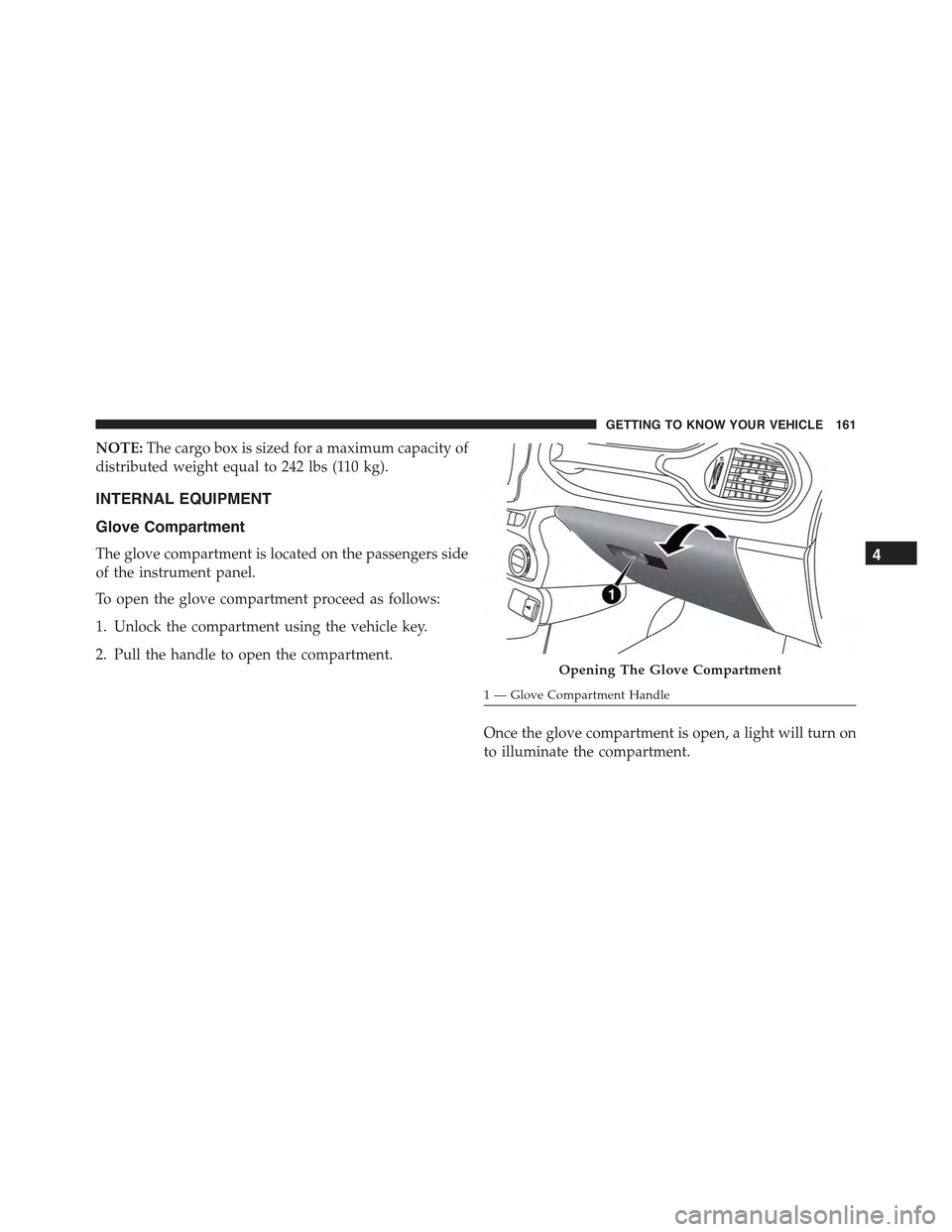
Glove Compartment
The glove compartment is located on the passengers side
of the instrument panel.
To open the glove compartment proceed as follows:
1. Unlock the compartment using the vehicle key.
2. Pull the handle to open the compartment.
Once the glove compartment is open, a light will turn on
to illuminate the compartment.
Opening The Glove Compartment
1—GloveCompartmentHandle
4
GETTING TO KNOW YOUR VEHICLE 161
Page 242 of 678
NOTE:TSC cannot stop all trailers from swaying. Al-
ways use caution when towing a trailer and follow the
trailer tongue weight recommendations. Refer to “Trailer
Towing” in this section for further information. When
TSC is functioning, the “ESC Activation/Malfunction
Indicator Light” will flash, the engine power may be
reduced and you may feel the brakes being applied to
individual wheels to attempt to stop the trailer from
swaying. TSC is disabled when the ESC system is in the
“Partial Off” mode.
WARNING!
If TSC activates while driving, slow the vehicle
down, stop at the nearest safe location, and adjust the
trailer load to eliminate trailer sway.
Ready Alert Braking (RAB)
Ready Alert Braking may reduce the time required to
reach full braking during emergency braking situations.
It anticipates when an emergency braking situation may
occur by monitoring how fast the throttle is released by
the driver. When the throttle is released very quickly,
Ready Alert Braking applies a small amount of brake
pressure. This brake pressure will not be noticed by the
driver. The brake system uses this brake pressure to allow
a fast brake response if the driver applies the brakes.
Dynamic Steering Torque (DST)
The DST function uses the integration of the ESC system
with the electric power steering to increase the safety
level of the whole car. In critical situations (understeer-
ing, oversteering, braking with different grip conditions),
through the DST function the ESC system controls the
steering to implement an additional torque contribution
240 SAFETY
Page 291 of 678
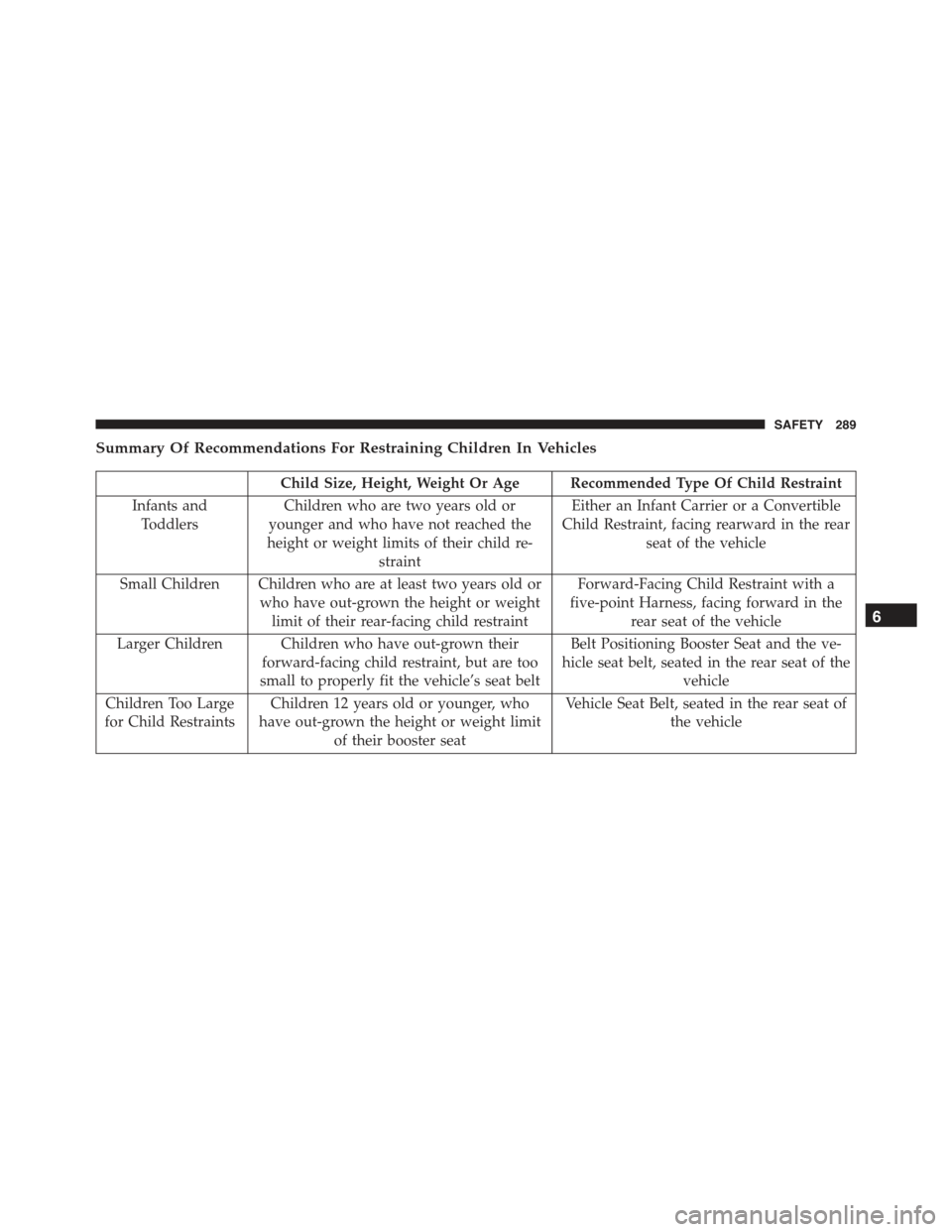
Summary Of Recommendations For Restraining Children In Vehicles
Child Size, Height, Weight Or Age Recommended Type Of Child Restraint
Infants and
Toddlers
Children who are two years old or
younger and who have not reached the
height or weight limits of their child re-
straint
Either an Infant Carrier or a Convertible
Child Restraint, facing rearward in the rear
seat of the vehicle
Small Children Children who are at least two years old or
who have out-grown the height or weight
limit of their rear-facing child restraint
Forward-Facing Child Restraint with a
five-point Harness, facing forward in the
rear seat of the vehicle
Larger Children Children who have out-grown their
forward-facing child restraint, but are too
small to properly fit the vehicle’s seat belt
Belt Positioning Booster Seat and the ve-
hicle seat belt, seated in the rear seat of the
vehicle
Children Too Large
for Child Restraints
Children 12 years old or younger, who
have out-grown the height or weight limit
of their booster seat
Vehicle Seat Belt, seated in the rear seat of
the vehicle
6
SAFETY 289
Page 292 of 678
Infants And Child Restraints
Safety experts recommend that children ride rear-facing
in the vehicle until they are two years old or until they
reach either the height or weight limit of their rear-facing
child restraint. Two types of child restraints can be used
rear-facing: infant carriers and convertible child seats.
The infant carrier is only used rear-facing in the vehicle.
It is recommended for children from birth until they
reach the weight or height limit of the infant carrier.
Convertible child seats can be used either rear-facing or
forward-facing in the vehicle. Convertible child seats
often have a higher weight limit in the rear-facing
direction than infant carriers do, so they can be used
rear-facing by children who have outgrown their infant
carrier but are still less than at least two years old.
Children should remain rear-facing until they reach the
highest weight or height allowed by their convertible
child seat.
WARNING!
•Never place a rear-facing child restraint in front of
an air bag. A deploying passenger Advanced Front
Air Bag can cause death or serious injury to a child
12 years or younger, including a child in a rear-
facing child restraint.
•Only use a rear-facing child restraint in a vehicle
with a rear seat.
290 SAFETY
Page 293 of 678
Older Children And Child Restraints
Children who are two years old or who have outgrown
their rear-facing convertible child seat can ride forward-
facing in the vehicle. Forward-facing child seats and
convertible child seats used in the forward-facing direc-
tion are for children who are over two years old or who
have outgrown the rear-facing weight or height limit of
their rear-facing convertible child seat. Children should
remain in a forward-facing child seat with a harness for
as long as possible, up to the highest weight or height
allowed by the child seat.
All children whose weight or height is above the
forward-facing limit for the child seat should use a
belt-positioning booster seat until the vehicle’s seat belts
fit properly. If the child cannot sit with knees bent over
the vehicle’s seat cushion while the child’s back is against
the seatback, they should use a belt-positioning booster
seat. The child and belt-positioning booster seat are held
in the vehicle by the seat belt.
6
SAFETY 291
Page 296 of 678
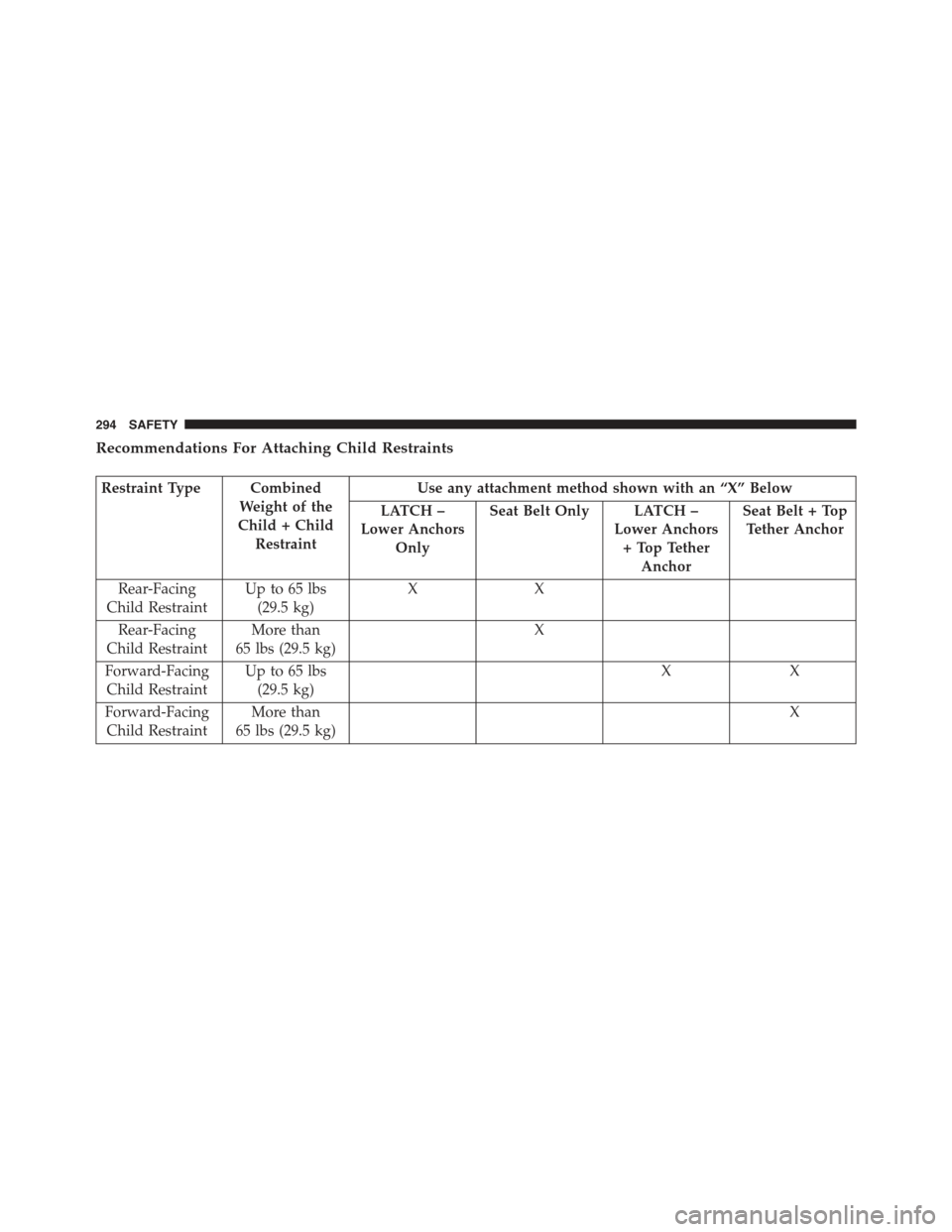
Recommendations For Attaching Child Restraints
Restraint Type Combined
Weight of the
Child + Child
Restraint
Use any attachment method shown with an “X” Below
LATCH –
Lower Anchors
Only
Seat Belt Only LATCH –
Lower Anchors
+ Top Tether
Anchor
Seat Belt + Top
Tether Anchor
Rear-Facing
Child Restraint
Up to 65 lbs
(29.5 kg)
XX
Rear-Facing
Child Restraint
More than
65 lbs (29.5 kg)
X
Forward-Facing
Child Restraint
Up to 65 lbs
(29.5 kg)
XX
Forward-Facing
Child Restraint
More than
65 lbs (29.5 kg)
X
294 SAFETY
Page 299 of 678
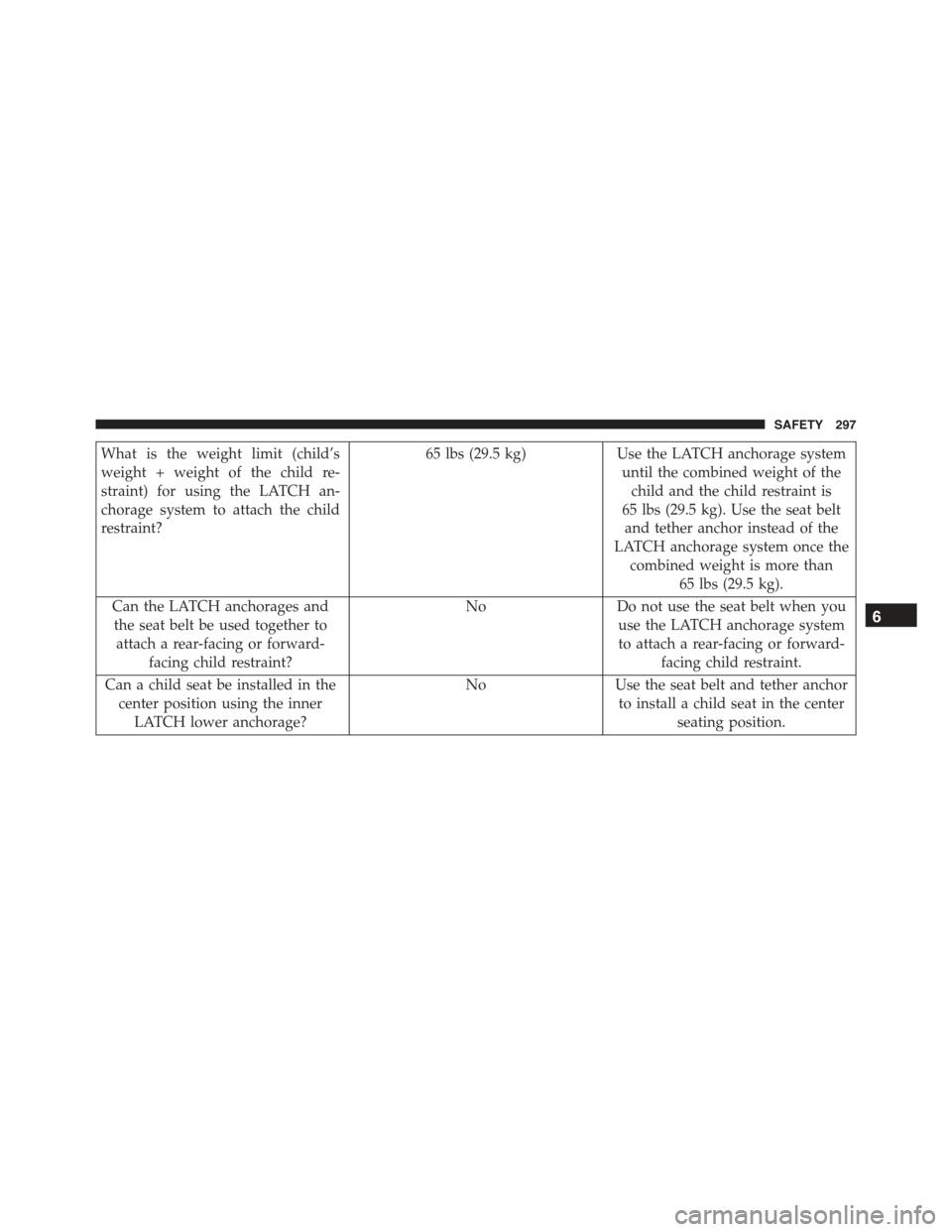
What is the weight limit (child’s
weight + weight of the child re-
straint) for using the LATCH an-
chorage system to attach the child
restraint?
65 lbs (29.5 kg) Use the LATCH anchorage system
until the combined weight of the
child and the child restraint is
65 lbs (29.5 kg). Use the seat belt
and tether anchor instead of the
LATCH anchorage system once the
combined weight is more than
65 lbs (29.5 kg).
Can the LATCH anchorages and
the seat belt be used together to
attach a rear-facing or forward-
facing child restraint?
No Do not use the seat belt when you
use the LATCH anchorage system
to attach a rear-facing or forward-
facing child restraint.
Can a child seat be installed in the
center position using the inner
LATCH lower anchorage?
NoUse the seat belt and tether anchor
to install a child seat in the center
seating position.
6
SAFETY 297
Page 307 of 678
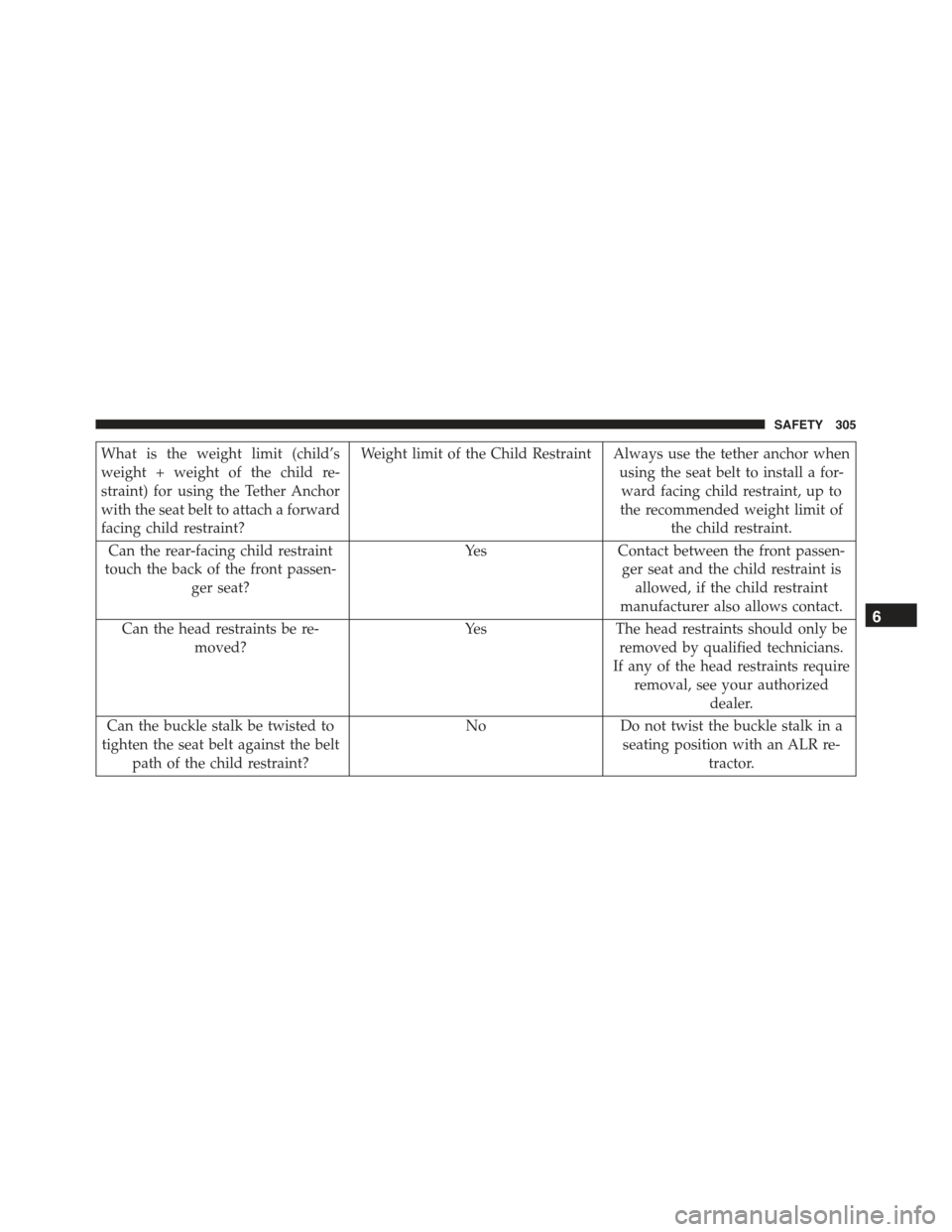
What is the weight limit (child’s
weight + weight of the child re-
straint) for using the Tether Anchor
with the seat belt to attach a forward
facing child restraint?
Weight limit of the Child Restraint Always use the tether anchor when
using the seat belt to install a for-
ward facing child restraint, up to
the recommended weight limit of
the child restraint.
Can the rear-facing child restraint
touch the back of the front passen-
ger seat?
YesContact between the front passen-
ger seat and the child restraint is
allowed, if the child restraint
manufacturer also allows contact.
Can the head restraints be re-
moved?
YesThe head restraints should only be
removed by qualified technicians.
If any of the head restraints require
removal, see your authorized
dealer.
Can the buckle stalk be twisted to
tighten the seat belt against the belt
path of the child restraint?
NoDo not twist the buckle stalk in a
seating position with an ALR re-
tractor.
6
SAFETY 305
Page 320 of 678
▫Maintenance........................396
!ADDING FUEL........................396
!VEHICLE LOADING....................400
▫Certification Label....................400
!ON-ROAD DRIVING TIPS................402
!OFF-ROAD DRIVING TIPS................403
▫When To Use 4WD LOW Range...........403
▫Driving Through Water.................403
▫Driving In Snow, Mud And Sand..........404
▫Hill Climbing........................404
▫Traction Downhill.....................405
▫After Driving Off-Road.................406
!POWER STEERING.....................407
!TRAILER TOWING.....................408
▫Common Towing Definitions.............409
▫Trailer Hitch Classification...............412
▫Trailer Towing Weights (Maximum Trailer Weight
Ratings)............................413
▫Trailer And Tongue Weight..............413
▫Towing Requirements..................415
▫Towing Tips.........................420
!RECREATIONAL TOWING................422
▫Towing This Vehicle Behind Another Vehicle . .422
▫Recreational Towing....................423
318 STARTING AND OPERATING
Page 402 of 678
VEHICLE LOADING
Certification Label
As required by National Highway Traffic Safety Admin-
istration regulations, your vehicle has a certification label
affixed to the driver’s side door or pillar.
This label contains the month and year of manufacture,
Gross Vehicle Weight Rating (GVWR), Gross Axle Weight
Rating (GAWR) front and rear, and Vehicle Identification
Number (VIN). A Month-Day-Hour (MDH) number is
included on this label and indicates the Month, Day and
Hour of manufacture. The bar code that appears on the
bottom of the label is your VIN.
Gross Vehicle Weight Rating (GVWR)
The GVWR is the total permissible weight of your vehicle
including driver, passengers, vehicle, options and cargo.
The label also specifies maximum capacities of front and
rear axle systems (GAWR). Total load must be limited so
GVWR and front and rear GAWR are not exceeded.
Payload
The payload of a vehicle is defined as the allowable load
weight a truck can carry, including the weight of the
driver, all passengers, options and cargo.
Gross Axle Weight Rating (GAWR)
The GAWR is the maximum permissible load on the front
and rear axles. The load must be distributed in the cargo
area so that the GAWR of each axle is not exceeded.
Each axle GAWR is determined by the components in the
system with the lowest load carrying capacity (axle,
springs, tires or wheels). Heavier axles or suspension
components sometimes specified by purchasers for in-
creased durability does not necessarily increase the vehi-
cle’s GVWR.
400 STARTING AND OPERATING