engine coolant JEEP RENEGADE 2016 1.G Owner's Manual
[x] Cancel search | Manufacturer: JEEP, Model Year: 2016, Model line: RENEGADE, Model: JEEP RENEGADE 2016 1.GPages: 688, PDF Size: 7.09 MB
Page 553 of 688
Cooling System Pressure Cap
The cap must be fully tightened to prevent loss of engine
coolant (antifreeze) and to ensure that engine coolant
(antifreeze) will return to the radiator from the coolant
recovery tank.
The cap should be inspected and cleaned if there is any
accumulation of foreign material on the sealing surfaces.
WARNING!
•Do not open hot engine cooling system. Never add
engine coolant (antifreeze) when the engine is
overheated. Do not loosen or remove the cap to cool
an overheated engine. Heat causes pressure to
build up in the cooling system. To prevent scalding
or injury, do not remove the pressure cap while the
system is hot or under pressure.
(Continued)
WARNING!(Continued)
•Do not use a pressure cap other than the one
specified for your vehicle. Personal injury or en-
gine damage may result.
Disposal Of Used Engine Coolant
Used ethylene glycol-based engine coolant (antifreeze) is
a regulated substance requiring proper disposal. Check
with your local authorities to determine the disposal
rules for your community. To prevent ingestion by ani-
mals or children, do not store ethylene glycol-based
engine coolant in open containers or allow it to remain in
puddles on the ground. If ingested by a child or pet, seek
emergency assistance immediately. Clean up any ground
spills immediately.
9
MAINTAINING AND CARING FOR YOUR VEHICLE 551
Page 554 of 688
Coolant Level
The coolant expansion bottle provides a quick visual
method for determining that the coolant level is ad-
equate. With the engine off and cold, the level of the
engine coolant (antifreeze) in the bottle should be be-
tween the “MIN” and “MAX” marks.
As long as the engine operating temperature is satisfac-
tory, the coolant bottle need only be checked once a
month.
When additional engine coolant (antifreeze) is needed to
maintain the proper level, it should be added to the
coolant bottle. Do not overfill.
Points To Remember
NOTE:When the vehicle is stopped after a few miles/
kilometers of operation, you may observe vapor coming
from the front of the engine compartment. This is nor-
mally a result of moisture from rain, snow, or high
humidity accumulating on the radiator and being vapor-
ized when the thermostat opens, allowing hot engine
coolant (antifreeze) to enter the radiator.
If an examination of your engine compartment shows no
evidence of radiator or hose leaks, the vehicle may be
safely driven. The vapor will soon dissipate.
•Do not overfill the coolant expansion bottle.
•Check the coolant freeze point in the radiator and in
the coolant expansion bottle. If engine coolant (anti-
freeze) needs to be added, the contents of the coolant
expansion bottle must also be protected against freez-
ing.
552 MAINTAINING AND CARING FOR YOUR VEHICLE
Page 555 of 688
•If frequent engine coolant (antifreeze) additions are
required, the cooling system should be pressure tested
for leaks.
•Maintain engine coolant (antifreeze) concentration at a
minimum of 50% OAT coolant (conforming to
MS.90032) and distilled water for proper corrosion
protection of your engine which contains aluminum
components.
•Keep the front of the radiator clean. If your vehicle is
equipped with air conditioning, keep the front of the
condenser clean.
•Do not change the thermostat for Summer or Winter
operation. If replacement is ever necessary, install
ONLY the correct type thermostat. Other designs may
result in unsatisfactory engine coolant (antifreeze)
performance, poor gas mileage, and increased emis-
sions.Brake System
In order to assure brake system performance, all brake
system components should be inspected periodically.
Refer to the “Maintenance Schedule” for the proper
maintenance intervals.
WARNING!
Riding the brakes can lead to brake failure and
possibly a collision. Driving with your foot resting or
riding on the brake pedal can result in abnormally
high brake temperatures, excessive lining wear, and
possible brake damage. Riding the brakes may also
reduce braking capacity in an emergency.
Brake Master Cylinder
The fluid level in the master cylinder should be checked
when performing under hood services, or immediately if
the “Brake Warning Light” is on.
9
MAINTAINING AND CARING FOR YOUR VEHICLE 553
Page 602 of 688
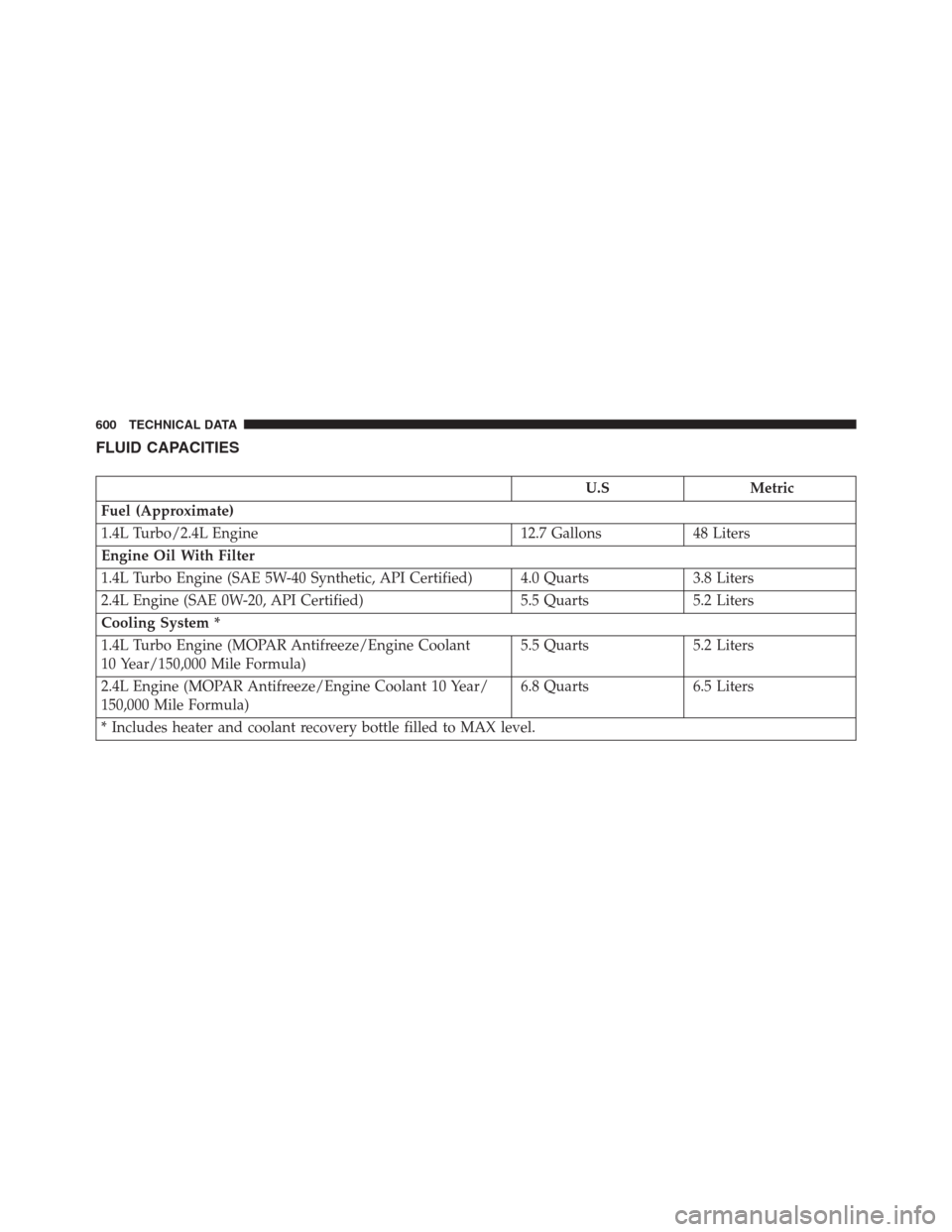
FLUID CAPACITIES
U.S Metric
Fuel (Approximate)
1.4L Turbo/2.4L Engine 12.7 Gallons 48 Liters
Engine Oil With Filter
1.4L Turbo Engine (SAE 5W-40 Synthetic, API Certified) 4.0 Quarts 3.8 Liters
2.4L Engine (SAE 0W-20, API Certified) 5.5 Quarts 5.2 Liters
Cooling System *
1.4L Turbo Engine (MOPAR Antifreeze/Engine Coolant
10 Year/150,000 Mile Formula)5.5 Quarts 5.2 Liters
2.4L Engine (MOPAR Antifreeze/Engine Coolant 10 Year/
150,000 Mile Formula)6.8 Quarts 6.5 Liters
* Includes heater and coolant recovery bottle filled to MAX level.
600 TECHNICAL DATA
Page 603 of 688
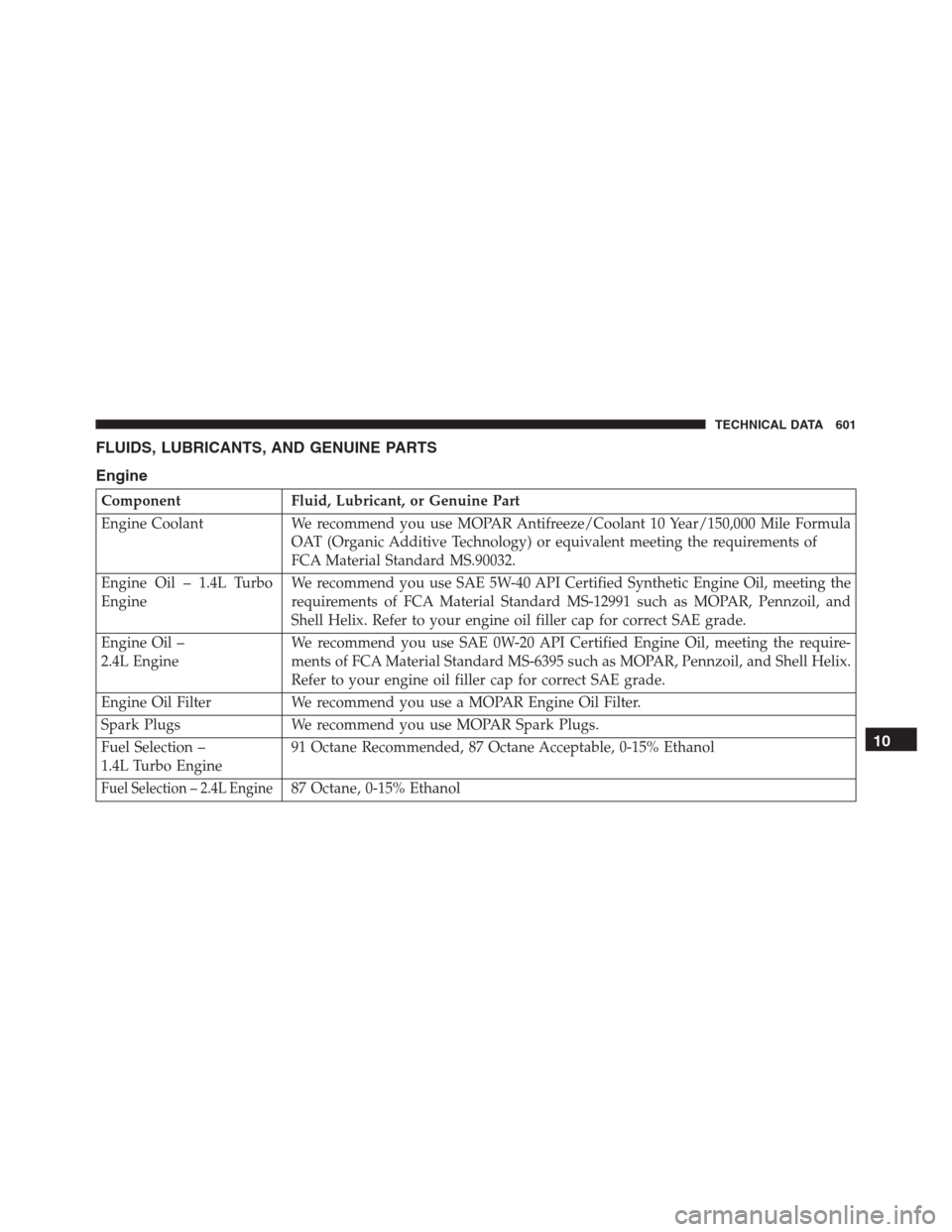
FLUIDS, LUBRICANTS, AND GENUINE PARTS
Engine
Component Fluid, Lubricant, or Genuine Part
Engine Coolant We recommend you use MOPAR Antifreeze/Coolant 10 Year/150,000 Mile Formula
OAT (Organic Additive Technology) or equivalent meeting the requirements of
FCA Material Standard MS.90032.
Engine Oil – 1.4L Turbo
EngineWe recommend you use SAE 5W-40 API Certified Synthetic Engine Oil, meeting the
requirements of FCA Material Standard MS-12991 such as MOPAR, Pennzoil, and
Shell Helix. Refer to your engine oil filler cap for correct SAE grade.
Engine Oil –
2.4L EngineWe recommend you use SAE 0W-20 API Certified Engine Oil, meeting the require-
ments of FCA Material Standard MS-6395 such as MOPAR, Pennzoil, and Shell Helix.
Refer to your engine oil filler cap for correct SAE grade.
Engine Oil Filter We recommend you use a MOPAR Engine Oil Filter.
Spark Plugs We recommend you use MOPAR Spark Plugs.
Fuel Selection –
1.4L Turbo Engine91 Octane Recommended, 87 Octane Acceptable, 0-15% Ethanol
Fuel Selection – 2.4L Engine87 Octane, 0-15% Ethanol
10
TECHNICAL DATA 601
Page 668 of 688
About Your Brakes........................239
ABS (Anti-Lock Brake System)................241
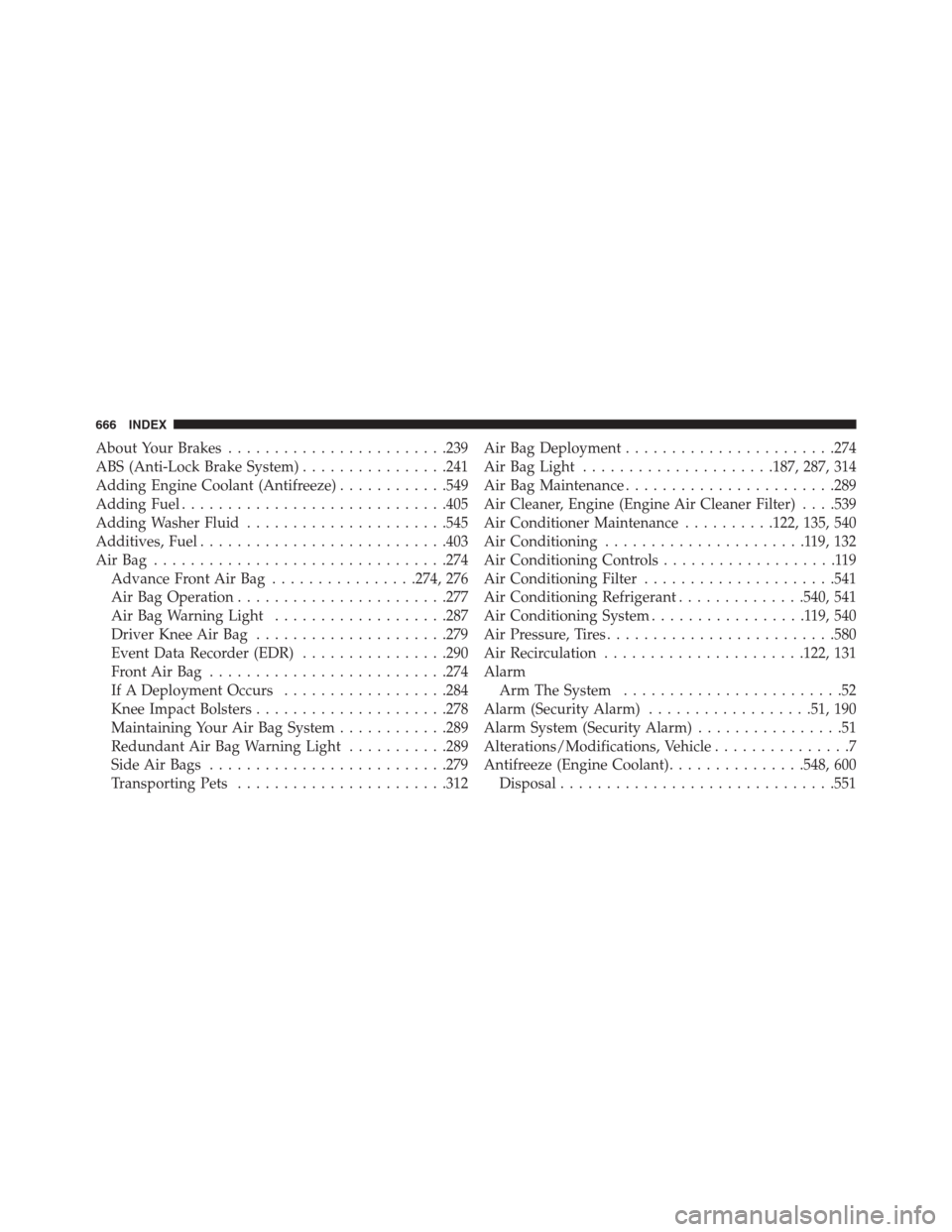
Adding Engine Coolant (Antifreeze)............549
Adding Fuel.............................405
Adding Washer Fluid......................545
Additives, Fuel...........................403
AirBag ................................274
Advance Front Air Bag................274, 276
Air Bag Operation.......................277
Air Bag Warning Light...................287
Driver Knee Air Bag.....................279
Event Data Recorder (EDR)................290
FrontAirBag ..........................274
If A Deployment Occurs..................284
Knee Impact Bolsters.....................278
Maintaining Your Air Bag System............289
Redundant Air Bag Warning Light...........289
Side Air Bags..........................279
Transporting Pets.......................312Air Bag Deployment.......................274
Air Bag Light.....................187, 287, 314
Air Bag Maintenance.......................289
Air Cleaner, Engine (Engine Air Cleaner Filter). . . .539
Air Conditioner Maintenance..........122, 135, 540
Air Conditioning......................119,132
Air Conditioning Controls...................119
Air Conditioning Filter.....................541
Air Conditioning Refrigerant..............540, 541
Air Conditioning System.................119,540
Air Pressure, Tires.........................580
Air Recirculation......................122, 131
Alarm
Arm The System........................52
Alarm (Security Alarm)..................51, 190
Alarm System (Security Alarm)................51
Alterations/Modifications, Vehicle...............7
Antifreeze (Engine Coolant)...............548, 600
Disposal
..............................551
666 INDEX
Page 671 of 688
Clutch Fluid.............................553
Coin Holder.............................171
Cold Weather Operation....................323
Connector
UCI.................................641
Universal Consumer Interface (UCI)..........641
Console................................171
Console, Floor...........................171
Contract, Service...........................13
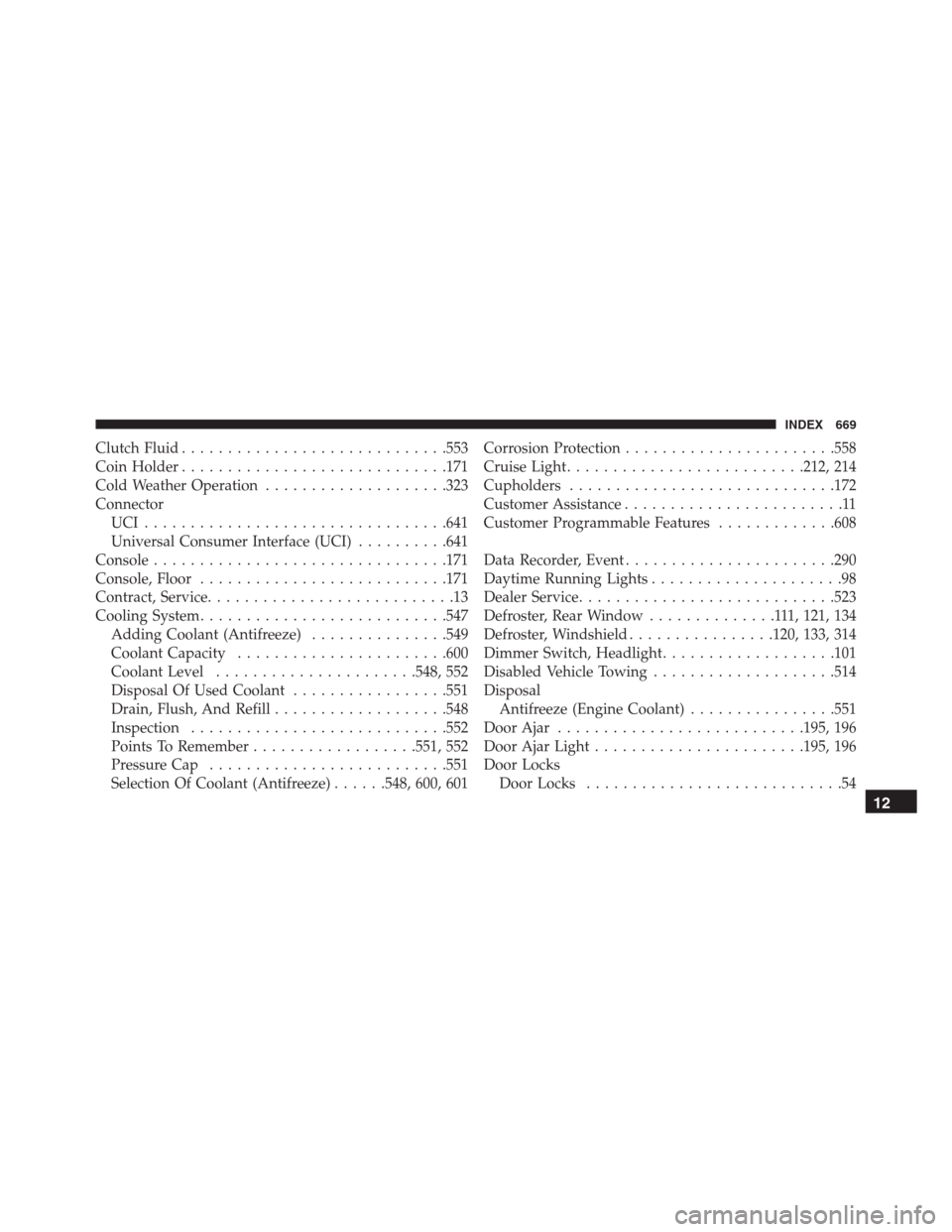
Cooling System...........................547
Adding Coolant (Antifreeze)...............549
Coolant Capacity.......................600
Coolant Level......................548, 552
Disposal Of Used Coolant.................551
Drain, Flush, And Refill...................548
Inspection............................552
Points To Remember..................551, 552
Pressure Cap..........................551
Selection Of Coolant (Antifreeze)......548, 600, 601Corrosion Protection.......................558
Cruise Light..........................212, 214
Cupholders.............................172
Customer Assistance........................11
Customer Programmable Features.............608
Data Recorder, Event.......................290
Daytime Running Lights.....................98
Dealer Service............................523
Defroster, Rear Window..............111,121, 134
Defroster, Windshield................120, 133, 314
Dimmer Switch, Headlight...................101
Disabled Vehicle Towing....................514
Disposal
Antifreeze (Engine Coolant)................551
Door Ajar...........................195, 196
Door Ajar Light.......................195, 196
Door Locks
Door Locks............................54
12
INDEX 669
Page 672 of 688
KeyFob...............................54
Remote...............................54
Remote Keyless Entry (RKE)................54
Driver Information Display (DID)
Instrument Cluster......................221
Oil Change............................221
Driver’s Seat Back Tilt.......................67
Driving................................411
Electrical Outlet, Auxiliary (Power Outlet)........166
Electric Park Brake........................327
Electric Parking Brake......................327
Electronic Roll Mitigation (ERM)..............245
Electronic Speed Control (Cruise Control)........351
Electronic Stability Control (ESC)...........240, 250
Electronic Throttle Control Warning Light........193
Electronic Vehicle Information Center (EVIC)......386
Electronic Vehicle Information Center (EVIC). . . .216Emergency, In Case Of
Hazard Warning Flasher..................435
Jacking...........................483, 565
Jump Starting..........................499
Overheating...........................506
Tow Hooks............................516
Towing..............................514
Emission Control System Maintenance..........522
Engine
Air Cleaner...........................539
Break-In Recommendations................326
Checking Oil Level......................535
Compartment..........................533
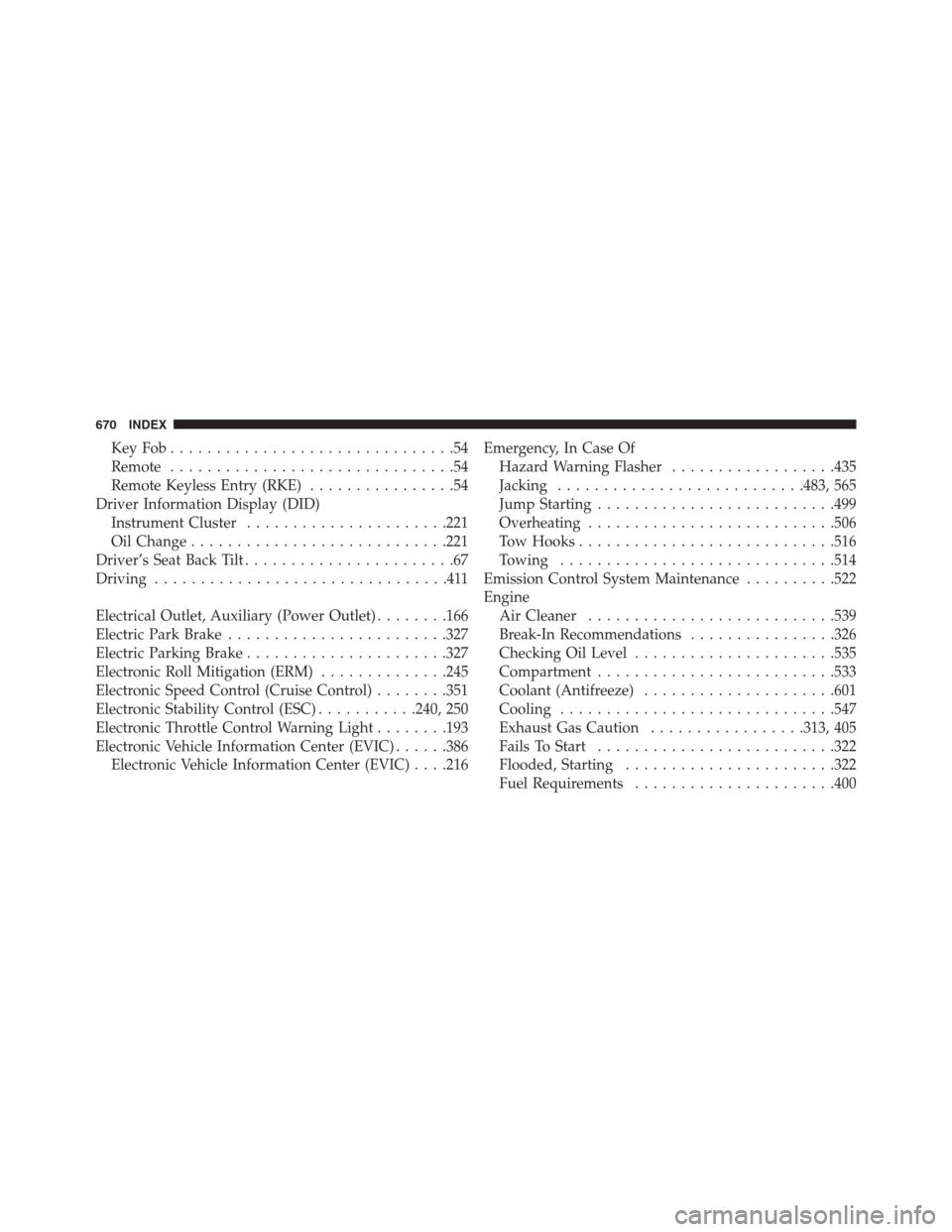
Coolant (Antifreeze).....................601
Cooling..............................547
Exhaust Gas Caution.................313, 405
Fails To Start..........................322
Flooded, Starting.......................322
Fuel Requirements......................400
670 INDEX