ECU JEEP RENEGADE 2017 1.G User Guide
[x] Cancel search | Manufacturer: JEEP, Model Year: 2017, Model line: RENEGADE, Model: JEEP RENEGADE 2017 1.GPages: 516, PDF Size: 5.73 MB
Page 34 of 516
The doors can also be locked and unlocked with the
Keyless Enter-N-Go — Passive Entry system if equipped.
refer to “Keyless Enter-N-Go — Passive Entry” located in
“Doors” of “Getting To Know Your Vehicle” for further
information.
Keyless Enter-N-Go — Passive Entry — If
Equipped
The Passive Entry system is an enhancement to the vehi-
cle’s Remote Keyless Entry system and a feature of Keyless
Enter-N-Go. This feature allows you to lock and unlock the
vehicle’s door(s) without having to push the key fob lock
or unlock buttons.
NOTE:
•Passive Entry can be enabled or disabled. Refer to
“Uconnect Settings” in “Multimedia” for further infor-
mation.
• If wearing gloves on your hands, or if it has been
raining/snowing on the Passive Entry door handle, the
unlock sensitivity can be affected, resulting in a slower
response time. •
If the vehicle is unlocked by the Passive Entry Door
Handle, and no door is opened within 60 seconds, the
vehicle will re-lock and if equipped, the security alarm
will arm.
• The key fob may not be able to be detected by the vehicle
keyless-go system if it is located next to a mobile phone,
laptop or other electronic device; these devices may
block the key fob’s wireless signal and prevent the
keyless-go system from starting the vehicle.
To Unlock From The Driver’s Side
With a valid Passive Entry key fob within 5 ft (1.5 m) of the
driver’s door handle, grab the front driver door handle to
unlock the driver’s door automatically.
32 GETTING TO KNOW YOUR VEHICLE
Page 36 of 516
NOTE:The Passive Entry system will not operate if the
key fob battery is dead.
The vehicle doors can also be locked by using the lock
button located on the vehicle’s interior door panel.
Preventing Inadvertent Locking Of Passive Entry Key
Fob In Vehicle (FOBIK-Safe)
To minimize the possibility of unintentionally locking a
Passive Entry key fob inside your vehicle, the Passive Entry
system is equipped with an automatic door unlock feature
which will function if the ignition switch is in the OFF
position. FOBIK-Safe only executes in vehicles with Passive Entry.
There are three situations that trigger a FOBIK-Safe search
in any Passive Entry vehicle:
1. A lock request is made by a valid Passive Entry key fob
while a door is open.
2. A lock request is made by the Passive Entry door handle while a door is open.
3. A lock request is made by the door panel switch while the door is open.
When any of these situations occur, after all open doors are
shut, the FOBIK-Safe search will be executed. If it finds a
Passive Entry key fob inside the car, and it does not find any
Passive Entry key fobs outside the car, then the car will
unlock and alert the customer.
NOTE:The vehicle will only unlock the doors when a valid
Passive Entry key fob is detected inside the vehicle, and no
valid Passive Entry key fob is detected outside the vehicle.
The vehicle will not unlock the doors when any of the
following conditions are met:
•The doors are manually locked using the door lock knobs.
•There is a valid Passive Entry key fob outside the vehicle
and within 5 ft (1.5 m) of either Passive Entry door handle.
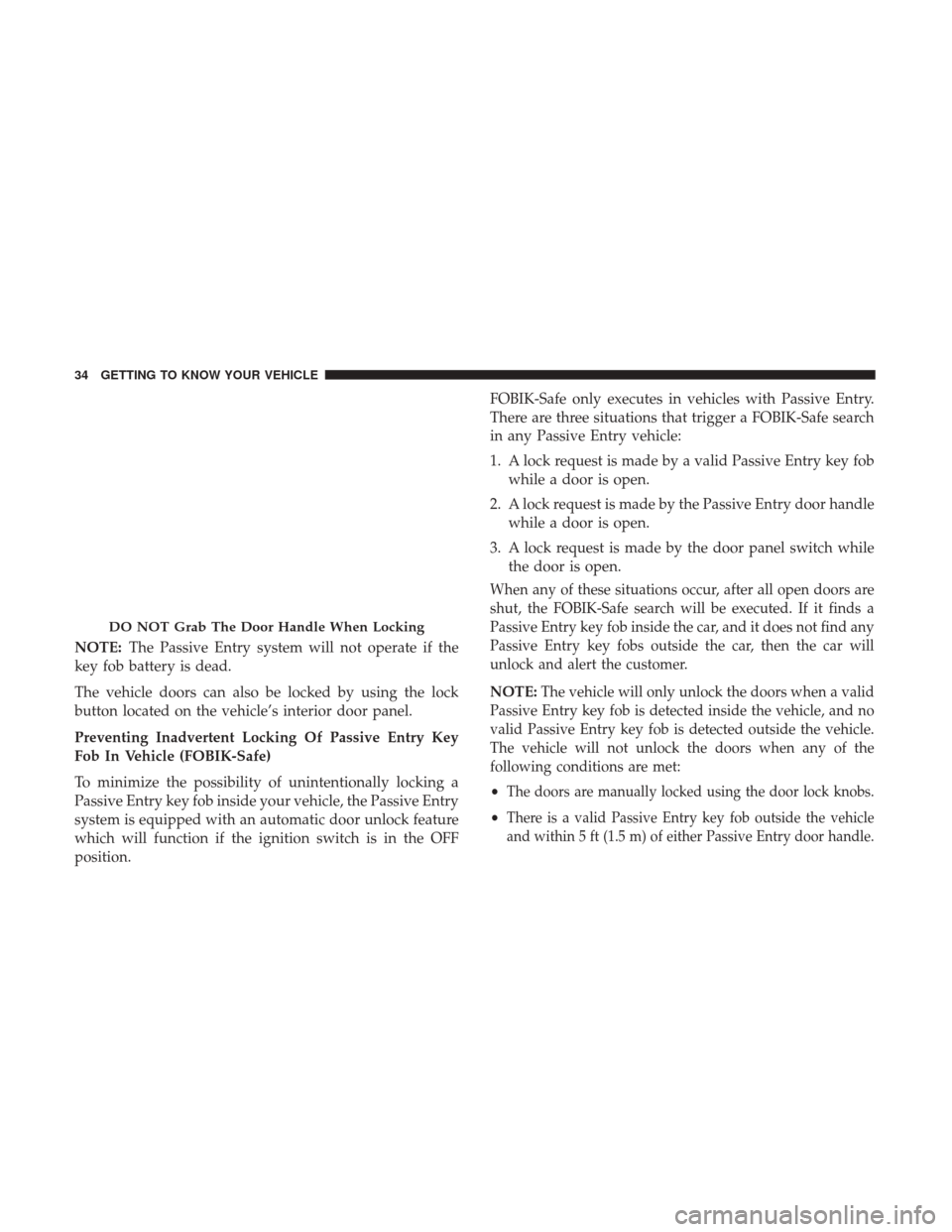
DO NOT Grab The Door Handle When Locking
34 GETTING TO KNOW YOUR VEHICLE
Page 44 of 516
NOTE:The engine must be running for the heated seats to
operate.
Auto Comfort Systems — If Equipped
In vehicles equipped with Auto On Comfort, when turning
on the vehicle the driver ’s heated seat will automatically
turn on when temperatures are below 40° F (4.4° C).
WARNING!
• Persons who are unable to feel pain to the skin
because of advanced age, chronic illness, diabetes,
spinal cord injury, medication, alcohol use, exhaus-
tion or other physical condition must exercise care
when using the seat heater. It may cause burns even
at low temperatures, especially if used for long
periods of time
• Do not place anything on the seat or seatback that
insulates against heat, such as a blanket or cushion.
This may cause the seat heater to overheat. Sitting in
a seat that has been overheated could cause serious
burns due to the increased surface temperature of the
seat.
Rear Seats
Split Rear Seats
The split rear seat has the ability to fold flat which increases
the storage of the rear cargo area.
NOTE:
• Prior to folding the rear seat down, it may be necessary
to position the front seat to its mid-track position. Be
sure that the front seats are fully upright and positioned
forward, this will allow the rear seat to fold down easily.
• Prior to folding the rear seat, you must secure the rear
armrest in up position.
• You may experience deformation in the seat cushion
from the seat belt buckles if the seats are left folded for
an extended period of time. This is normal and by
simply opening the seats to the open position, over time
the seat cushion will return to its normal shape.
WARNING!
• It is extremely dangerous to ride in a cargo area,
inside or outside of a vehicle. In a collision, people
(Continued)
42 GETTING TO KNOW YOUR VEHICLE
Page 46 of 516
Cargo Area Enlargement
Folding both sides of the rear seat provides additional
storage in the rear cargo area.
Proceed as follows:
1. Fully lower the rear seat head restraints.
2. Move the safety belts to the outboard side of the seat.
3. Pull the seatback release lever to fold both sides of therear seatbacks completely forward.
Seatback Repositioning
NOTE: If interference from the cargo area prevents the
seatback from fully locking, you will have difficulty return-
ing the seat to its proper position.
1. Move the safety belts to the seat belt guides on the top edge of the seat to ensure the seatbacks properly latch.
2. Lift the seatbacks, pushing them back until they lock on both the latches. Verify the red notches are no longer
visible on the release lever. If the red notches are visible,
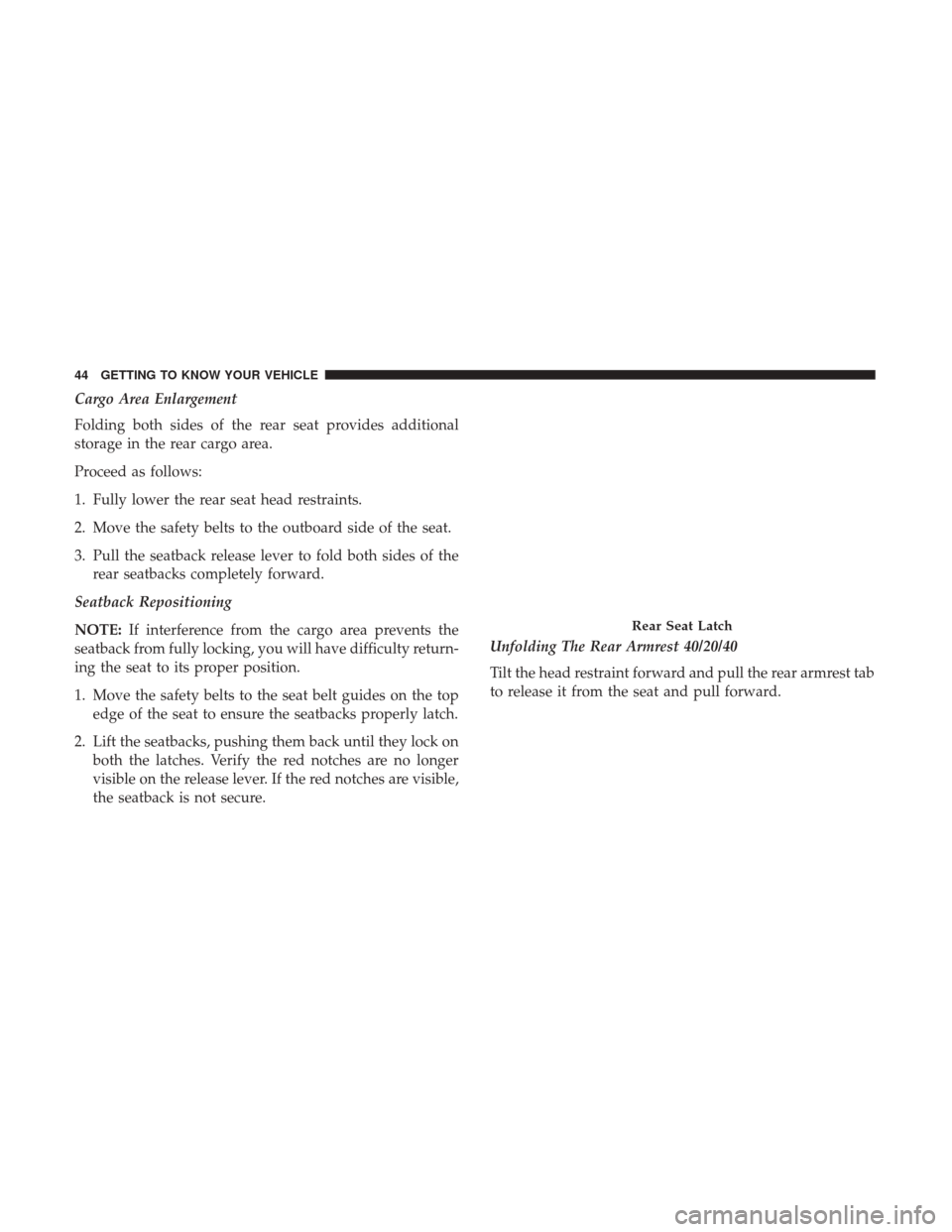
the seatback is not secure. Unfolding The Rear Armrest 40/20/40
Tilt the head restraint forward and pull the rear armrest tab
to release it from the seat and pull forward.
Rear Seat Latch
44 GETTING TO KNOW YOUR VEHICLE
Page 47 of 516
The center part of the rear seat can also be used as rear
armrest with cupholders.
WARNING!
Be certain that the seatback is securely locked into
position. If the seatback is not securely locked into
position the seat will not provide the proper stability
for child seats and/or passengers. An improperly
latched seat could cause serious injury.
Rear Seat Center Armrest — If Equipped
Rear Armrest
3
GETTING TO KNOW YOUR VEHICLE 45
Page 106 of 516
Position 2 (Elevated Position):
When the rear seatbacks and front passenger seat is folded
flat, it will allow for loading objects of long dimensions. It
is recommended to use this position only during the actual
transporting of the objects, then bring the load floor in
position 1.
Table Tilt Load
In addition to the two positions described above, the load
floor can also be placed in a tilted position (slanted toward
the rear seatbacks as to ease the access to the underlying
zone of the luggage compartment (e.g. to pick up the spare
tire or the Tire Service Kit).
Place the load floor in a way that it rests at the supports 1
and 2 on the sides of the cargo area.
The load floor provides securing of any cargo inside this
position, so that the cargo will slide in the case of sudden
braking.
Load Floor
104 GETTING TO KNOW YOUR VEHICLE
Page 108 of 516
2. Place the desired objects inside the compartment.
3. Reposition the load floor.
CAUTION!
The load floor must be arranged in a central position
with respect to cargo area.Displacement Load Floor
To position the load from the lower to the upper position,
proceed as follows:
1. Grasp the load floor handle and lift up the load floor.
2. Correctly place the load floor on the side panel guides
and on the rear cross member.
Access To Tire Service Kit Or Spare Tire
To access the Tire Service Kit or spare tire and container
carrier, proceed as follows:
1. Grasp the load floor handle and remove the floor.
2. Pull the tab and lift up on the carpet.
Anchoring Of The Load
The cargo tie-downs, located on the cargo area floor,
should be used to safely secure loads when the vehicle is
moving.
Cargo Area Storage
106 GETTING TO KNOW YOUR VEHICLE
Page 109 of 516
The side panels may be equipped with three grocery hooks
(one on the left side and two on the right side) for securing
loads that are not excessively heavy.
Tie-DownsGroceryHook
3
GETTING TO KNOW YOUR VEHICLE 107
Page 120 of 516
Handle Grip
The handle grip is located on the passenger side of the
instrument panel. The handle can be used to enter or exit
the vehicle or when traveling on rough terrain.
ROOF LUGGAGE RACK — IF EQUIPPED
Your vehicle may be equipped with a Roof Luggage Rack
for transporting accessories.
Crossbars should always be used whenever cargo is placed
on the Roof Luggage Rack. Check the straps frequently to
be sure that the load remains securely attached.
NOTE:Crossbars can be purchased at a authorized dealer
through Mopar parts. External racks do not increase the
total load carrying capacity of the vehicle. Be sure that the
total occupant and luggage load inside the vehicle, plus the
load on the Roof Luggage Rack, do not exceed the maxi-
mum vehicle load capacity.
The load carried on the roof, when equipped with a
luggage rack, must not exceed 150 lbs (68 kg), and it should
be uniformly distributed over the cargo area.
Do not use the retractable roof when using the crossbars.
Handle Grip
118 GETTING TO KNOW YOUR VEHICLE
Page 121 of 516
WARNING!
Cargo must be securely tied down before driving your
vehicle. Improperly secured loads can fly off the ve-
hicle, particularly at high speeds, resulting in personal
injury or property damage. Follow the roof rack cau-
tions when carrying cargo on your roof rack.
CAUTION!
•To avoid damage to the roof rack and vehicle, do not
exceed the maximum roof rack load capacity. Always
distribute heavy loads as evenly as possible and
secure the load appropriately.
• Long loads, which extend over the windshield, such
as wood panels or surfboards, should be secured to
both the front and rear of the vehicle.
• Place a blanket or other protection between the
surface of the roof and the load.
• Travel at reduced speeds and turn corners carefully
when carrying large or heavy loads on the roof rack.
Wind forces, due to natural causes or nearby truck
(Continued)
CAUTION! (Continued)
traffic, can add sudden upward loads. This is espe-
cially true on large flat loads and may result in
damage to the cargo or your vehicle.
• Load should always be secured to cross bars first,
with tie down loops used as additional securing
points if needed. Tie loops are intended as supple-
mentary tie down points only. Do not use ratcheting
mechanisms with the tie loops. Check the straps
frequently to be sure that the load remains securely
attached.
3
GETTING TO KNOW YOUR VEHICLE 119