engine oil JEEP RENEGADE 2017 1.G Owner's Manual
[x] Cancel search | Manufacturer: JEEP, Model Year: 2017, Model line: RENEGADE, Model: JEEP RENEGADE 2017 1.GPages: 516, PDF Size: 5.73 MB
Page 388 of 516
CAUTION!
•It is essential when replacing the cables on the
battery that the positive cable is attached to the
positive post and the negative cable is attached to the
negative post. Battery posts are marked positive (+)
and negative (-) and are identified on the battery
case. Cable clamps should be tight on the terminal
posts and free of corrosion.
• If a “fast charger” is used while the battery is in the
vehicle, disconnect both vehicle battery cables before
connecting the charger to the battery. Do not use a
“fast charger” to provide starting voltage.
DEALER SERVICE
Your authorized dealer has the qualified service personnel,
special tools, and equipment to perform all service opera-
tions in an expert manner. Service Manuals are available
which include detailed service information for your ve-
hicle. Refer to these Service Manuals before attempting any
procedure yourself.
NOTE: Intentional tampering with emissions control sys-
tems may void your warranty and could result in civil
penalties being assessed against you.
WARNING!
You can be badly injured working on or around a
motor vehicle. Only do service work for which you
have the knowledge and the proper equipment. If you
have any doubt about your ability to perform a service
job, take your vehicle to a competent mechanic.
Engine Oil
Checking Oil Level
To assure proper engine lubrication, the engine oil must be
maintained at the correct level. Check the oil level at
regular intervals, such as every fuel stop. The best time to
check the engine oil level is approximately five minutes
after a fully warmed engine is shut off. Do not check oil
level before starting the engine after it has sat overnight.
Checking engine oil level when the engine is cold will give
you an incorrect reading.
Checking the oil while the vehicle is on level ground, and
approximately five minutes after a fully warmed engine is
shut off, will improve the accuracy of the oil level readings.
Maintain the oil level between the range markings on the
dipstick. The safe range is indicated by a crosshatch zone.
Adding 1 quart (0.9 Liters) of oil when the reading is at the
386 SERVICING AND MAINTENANCE
Page 389 of 516
low end of the indicated range will result in the oil level at
the full end of the indicator range.
CAUTION!
Do not overfill the engine with oil. Overfilling the
engine with oil will cause oil aeration, which can lead
to loss of oil pressure and an increase in oil tempera-
ture. This loss of oil pressure and increased oil tem-
perature could damage your engine.
Change Engine Oil — Gasoline Engine
Refer to the “Scheduled Servicing” in this section for the
proper maintenance intervals.
NOTE:Under no circumstances should oil change inter-
vals exceed 10,000 miles (16,000 km), twelve months or 350
hours of engine run time, whichever comes first. The 350
hours of engine run or idle time is generally only a concern
for fleet customers.
Engine Oil Selection — 1.4L Turbo Engine
For best performance and maximum protection for turbo-
charged engines under all types of operating conditions, the manufacturer recommends synthetic engine oils that
are API Certified and meet the requirements of FCA
Material Standard MS-12991.
Engine Oil Selection — 2.4L Engine
For best performance and maximum protection under all
types of operating conditions, the manufacturer only rec-
ommends 0W-20 engine oils that are API Certified and
meet the requirements of FCA Material Standard MS-6395.
Engine Oil Viscosity (SAE Grade) — 1.4L Turbo
Engine
Mopar SAE 5W-40 synthetic engine oil approved to FCA
Material Standard MS-12991 such as Pennzoil, Shell Helix
or equivalent is recommended for all operating tempera-
tures. This engine oil improves low temperature starting
and vehicle fuel economy.
The engine oil filler cap also shows the recommended
engine oil viscosity for your engine. For information on
engine oil filler cap location, refer to “Engine Compart-
ment” in this section.
Lubricants which do not have both the engine oil certifi-
cation mark and the correct SAE viscosity grade number
should not be used.8
SERVICING AND MAINTENANCE 387
Page 390 of 516
Engine Oil Viscosity (SAE Grade) — 2.4L Engine
Mopar SAE 0W-20 engine oil approved to FCA Material
Standard MS-6395 such as Pennzoil, Shell Helix or equiva-
lent is recommended for all operating temperatures. This
engine oil improves low temperature starting and vehicle
fuel economy.
The engine oil filler cap also shows the recommended
engine oil viscosity for your engine. For information on
engine oil filler cap location, refer to “Engine Compart-
ment” in this section.
Lubricants which do not have both the engine oil certifi-
cation mark and the correct SAE viscosity grade number
should not be used.
Materials Added To Engine Oil
The manufacturer strongly recommends against the addi-
tion of any additives (other than leak detection dyes) to the
engine oil. Engine oil is an engineered product and its
performance may be impaired by supplemental additives.
Disposing Of Used Engine Oil And Oil Filters
Care should be taken in disposing of used engine oil and
oil filters from your vehicle. Used oil and oil filters,
indiscriminately discarded, can present a problem to theenvironment. Contact your authorized dealer, service sta-
tion or governmental agency for advice on how and where
used oil and oil filters can be safely discarded in your area.
Engine Oil Filter
The engine oil filter should be replaced with a new filter at
every engine oil change.
Engine Oil Filter Selection
This manufacturer’s engines have a full-flow type dispos-
able oil filter. Use a filter of this type for replacement. The
quality of replacement filters varies considerably. Only
high quality filters should be used to assure most efficient
service. Mopar engine oil filters are high quality oil filters
and are recommended.
Engine Air Cleaner Filter
Refer to the “Maintenance Plan” in this section for the
proper maintenance intervals.
388 SERVICING AND MAINTENANCE
Page 393 of 516
Avoid using the wiper blades to remove frost or ice from
the windshield. Keep the blade rubber out of contact with
petroleum products such as engine oil, gasoline, etc.
NOTE:Life expectancy of wiper blades varies depending
on geographical area and frequency of use. Poor perfor-
mance of blades may be present with chattering, marks,
water lines or wet spots. If any of these conditions are
present, clean the wiper blades or replace as necessary.
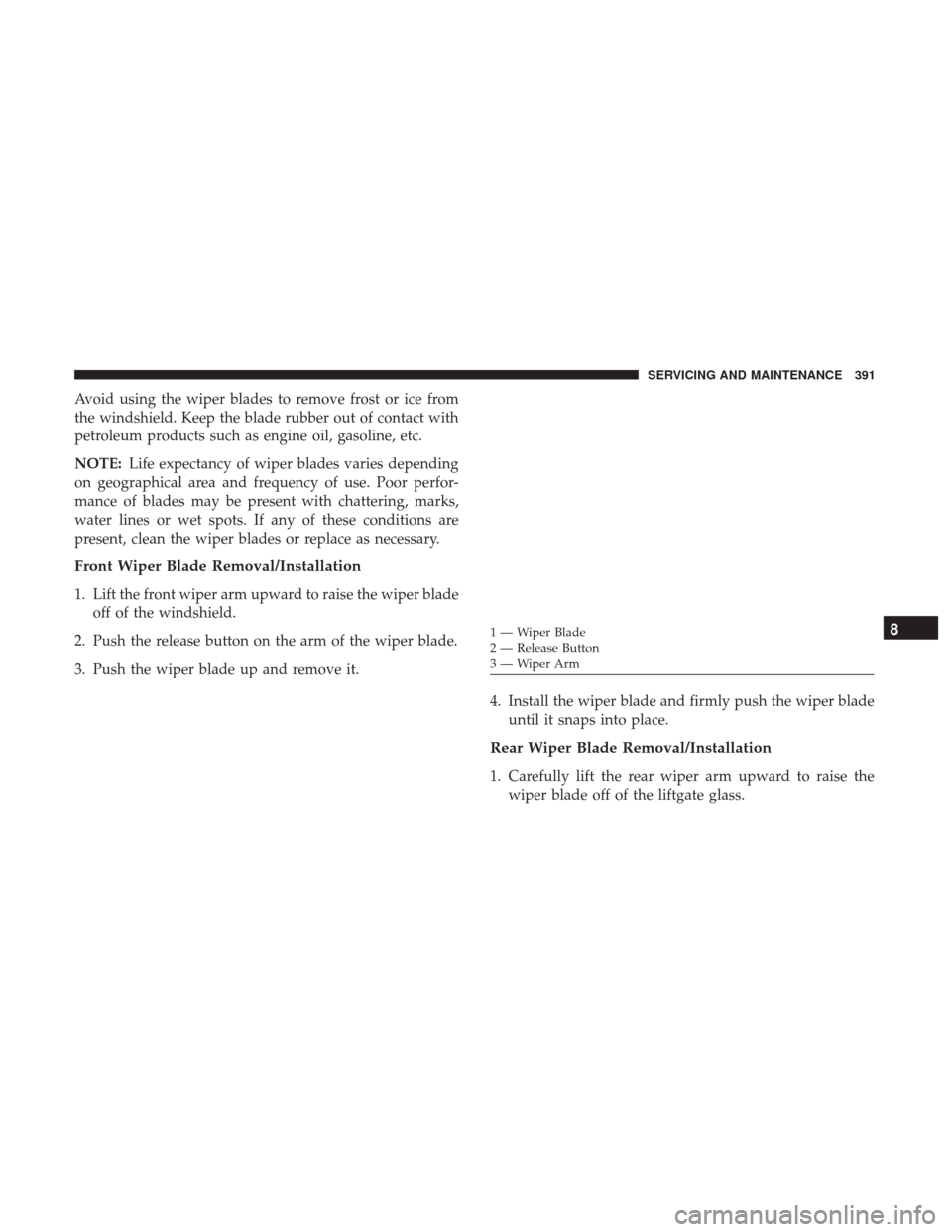
Front Wiper Blade Removal/Installation
1. Lift the front wiper arm upward to raise the wiper blade off of the windshield.
2. Push the release button on the arm of the wiper blade.
3. Push the wiper blade up and remove it.
4. Install the wiper blade and firmly push the wiper bladeuntil it snaps into place.
Rear Wiper Blade Removal/Installation
1. Carefully lift the rear wiper arm upward to raise thewiper blade off of the liftgate glass.
1 — Wiper Blade
2 — Release Button
3—WiperArm8
SERVICING AND MAINTENANCE 391
Page 394 of 516
2. Grab and hold the wiper arm closest to the wiper bladeend while pushing the wiper blade towards the liftgate
glass to unsnap the blade pivot pin from the wiper blade
holder on the wiper arm.
3. Install the wiper blade pivot pin into the wiper blade holder at the end of the wiper arm, and firmly push the
wiper blade until it snaps into place.
Exhaust System
The best protection against carbon monoxide entry into the
vehicle body is a properly maintained engine exhaust
system.
If you notice a change in the sound of the exhaust system;
or if the exhaust fumes can be detected inside the vehicle;
or when the underside or rear of the vehicle is damaged;
have an authorized technician inspect the complete ex-
haust system and adjacent body areas for broken, dam-
aged, deteriorated, or mispositioned parts. Open seams or
loose connections could permit exhaust fumes to seep into
the passenger compartment. In addition, have the exhaust
system inspected each time the vehicle is raised for lubri-
cation or oil change. Replace as required.
WARNING!
•Exhaust gases can injure or kill. They contain carbon
monoxide (CO), which is colorless and odorless.
Breathing it can make you unconscious and can
eventually poison you. To avoid breathing CO, refer
to “Safety Tips” in “Safety” for further information.
• A hot exhaust system can start a fire if you park over
materials that can burn. Such materials might be
grass or leaves coming into contact with your exhaust
system. Do not park or operate your vehicle in areas
where your exhaust system can contact anything that
can burn.
CAUTION!
• The catalytic converter requires the use of unleaded
fuel only. Leaded gasoline will destroy the effective-
ness of the catalyst as an emissions control device
and may seriously reduce engine performance and
cause serious damage to the engine.
• Damage to the catalytic converter can result if your
vehicle is not kept in proper operating condition. In
(Continued)
392 SERVICING AND MAINTENANCE
Page 401 of 516
NOTE:If your vehicle is equipped with a manual trans-
mission, the brake fluid reservoir supplies fluid to both the
brake system and the clutch release system. The two
systems are separated in the reservoir, and a leak in one
system will not affect the other system. The manual
transmission clutch release system should not require fluid
replacement during the life of the vehicle. If the brake fluid
reservoir is low and the brake system does not indicate any
leaks or other problems, it may be a result of a leak in the
hydraulic clutch release system. See your local authorized
dealer for service.
Use only manufacturer’s recommended brake fluid. Refer
to “Fluids And Lubricants” in the “Technical Specifica-
tions” section for further information.
WARNING!
• Use only manufacturer ’s recommended brake fluid.
Refer to “Fluids And Lubricants” in the “Technical
Specifications” section for further information. Us-
ing the wrong type of brake fluid can severely
damage your brake system and/or impair its perfor-
mance. The proper type of brake fluid for your
(Continued)
WARNING! (Continued)
vehicle is also identified on the original factory
installed hydraulic master cylinder reservoir.
• To avoid contamination from foreign matter or mois-
ture, use only new brake fluid or fluid that has been
in a tightly closed container. Keep the master cylin-
der reservoir cap secured at all times. Brake fluid in
a open container absorbs moisture from the air
resulting in a lower boiling point. This may cause it
to boil unexpectedly during hard or prolonged brak-
ing, resulting in sudden brake failure. This could
result in a collision.
• Overfilling the brake fluid reservoir can result in
spilling brake fluid on hot engine parts, causing the
brake fluid to catch fire. Brake fluid can also damage
painted and vinyl surfaces, care should be taken to
avoid its contact with these surfaces.
CAUTION!
Use of improper brake fluids will affect overall clutch
system performance. Improper brake fluids may dam-
age the clutch system resulting in loss of clutch func-
tion and the ability to shift the transmission.
8
SERVICING AND MAINTENANCE 399
Page 435 of 516

BRAKE SYSTEM
Your vehicle is equipped with dual hydraulic brake sys-
tems. If either of the two hydraulic systems loses normal
capability, the remaining system will still function. How-
ever, there will be some loss of overall braking effective-
ness. You may notice increased pedal travel during appli-
cation, greater pedal force required to slow or stop, and
potential activation of the “Brake System Warning Light.”
In the event power assist is lost for any reason (i.e.,
repeated brake applications with the engine off) the brakes
will still function. However, the effort required to brake the
vehicle will be much greater than that required with the
power system operating.
WHEEL AND TIRE TORQUE SPECIFICATIONS
Proper lug nut/bolt torque is very important to ensure that
the wheel is properly mounted to the vehicle. Any time a
wheel has been removed and reinstalled on the vehicle, the
lug nuts/bolts should be torqued using a properly cali-
brated torque wrench.
Torque Specifications
Wheel Bolt Torque **Wheel BoltSizeWheel Bolt
Socket Size
89 Ft-Lbs (120 N·m) M12 x 1.25 17 mm
**Use only your authorized dealer recommended lug nuts/
bolts and clean or remove any dirt or oil before tightening.
Inspect the wheel mounting surface prior to mounting the
tire and remove any corrosion or loose particles.
Wheel Mounting Surface
9
TECHNICAL SPECIFICATIONS 433
Page 440 of 516
Carbon Monoxide Warnings
WARNING!
Carbon monoxide (CO) in exhaust gases is deadly.
Follow the precautions below to prevent carbon mon-
oxide poisoning:
•
Do not inhale exhaust gases. They contain carbon mon-
oxide, a colorless and odorless gas, which can kill. Never
run the engine in a closed area, such as a garage, and
never sit in a parked vehicle with the engine running for
(Continued)
WARNING! (Continued)
an extended period. If the vehicle is stopped in an open
area with the engine running for more than a short
period, adjust the ventilation system to force fresh,
outside air into the vehicle.
•Guard against carbon monoxide with proper mainte-
nance. Have the exhaust system inspected every time the
vehicle is raised. Have any abnormal conditions repaired
promptly. Until repaired, drive with all side windows
fully open.
FLUID CAPACITIES
U.S Metric
Fuel (Approximate)
1.4L Turbo/2.4L Engine 12.7 Gallons48 Liters
Engine Oil With Filter
1.4L Turbo Engine (SAE 5W-40 Synthetic, API Certified) 4.0 Quarts 3.8 Liters
2.4L Engine (SAE 0W-20, API Certified) 5.5 Quarts5.2 Liters
Cooling System *
1.4L Turbo Engine (Mopar Antifreeze/Engine Coolant 10 Year/
150,000 Mile Formula) 5.5 Quarts
5.2 Liters
438 TECHNICAL SPECIFICATIONS
Page 441 of 516

U.SMetric
2.4L Engine (Mopar Antifreeze/Engine Coolant 10 Year/
150,000 Mile Formula) 6.8 Quarts
6.5 Liters
* Includes heater and coolant recovery bottle filled to MAX level.
FLUIDS AND LUBRICANTS
Engine
Component Fluid, Lubricant, or Genuine Part
Engine Coolant We recommend you use Mopar Antifreeze/Coolant 10
Year/150,000 Mile Formula OAT (Organic Additive Tech-
nology) or equivalent meeting the requirements of FCA
Material Standard MS.90032.
Engine Oil – 1.4L Turbo Engine We recommend you use SAE 5W-40 API Certified Synthetic
Engine Oil, meeting the requirements of FCA Material
Standard MS-12991 such as Mopar, Pennzoil, and Shell
Helix. Refer to your engine oil filler cap for correct SAE
grade.
Engine Oil – 2.4L Engine We recommend you use SAE 0W-20 API Certified Engine
Oil, meeting the requirements of FCA Material Standard
MS-6395 such as Mopar, Pennzoil, and Shell Helix. Refer to
your engine oil filler cap for correct SAE grade.
Engine Oil Filter We recommend you use a Mopar Engine Oil Filter.
9
TECHNICAL SPECIFICATIONS 439
Page 503 of 516

Fluid Level Check....................... .401
Fluid Type ......................... .400, 440
Special Additives ........................ .401
Auto Up Power Windows .....................84
Auxiliary Electrical Outlet (Power Outlet) .........111
Auxiliary Power Outlet ......................111
Axle Fluid .............................. .440
Axle Lubrication .......................... .440
Battery .............................. .140, 385
Charging System Light ....................140
Belts, Seat ............................... .244
Blind Spot Monitoring ...................... .180
Body Mechanism Lubrication ..................390
B-Pillar Location .......................... .407
Brake Assist System ........................ .169
Brake Control System, Electronic ................169
Brake Fluid .............................. .440
Brakes ................................. .398
Brake System ......................... .398, 433
Anti-Lock (ABS) ........................ .433
Fluid Check ........................... .440
Master Cylinder ........................ .398
Warning Light .......................... .136
Brightness, Interior Lights .....................56 Bulbs, Light
............................. .247
Camera, Rear ............................ .285
Capacities, Fluid .......................... .438
Caps, Filler Oil (Engine) ..................... .382, 387, 388
Radiator (Coolant Pressure) .................396
Carbon Monoxide Warning ................244, 438
Car Washes .............................. .427
Cellular Phone ........................... .477
Certification Label ......................... .294
Changing A Flat Tire .....................350, 402
Check Engine Light (Malfunction Indicator Light). . . .165
Checking Your Vehicle For Safety ...............243
Checks,
Safety............................ .243
Child Restraint ........................... .227
Child Restraints Booster Seats ........................... .231
Child Restraints ........................ .227
Child Seat Installation .....................240
How To Stow An Unused ALR Seat Belt ........238
Infants And Child Restraints ................229
LATCH Positions ........................ .233
Locating The LATCH Anchorages .............236
Lower Anchors And Tethers For Children .......233
12
INDEX 501