light sensor JEEP RENEGADE 2017 1.G Owners Manual
[x] Cancel search | Manufacturer: JEEP, Model Year: 2017, Model line: RENEGADE, Model: JEEP RENEGADE 2017 1.GPages: 516, PDF Size: 5.73 MB
Page 55 of 516
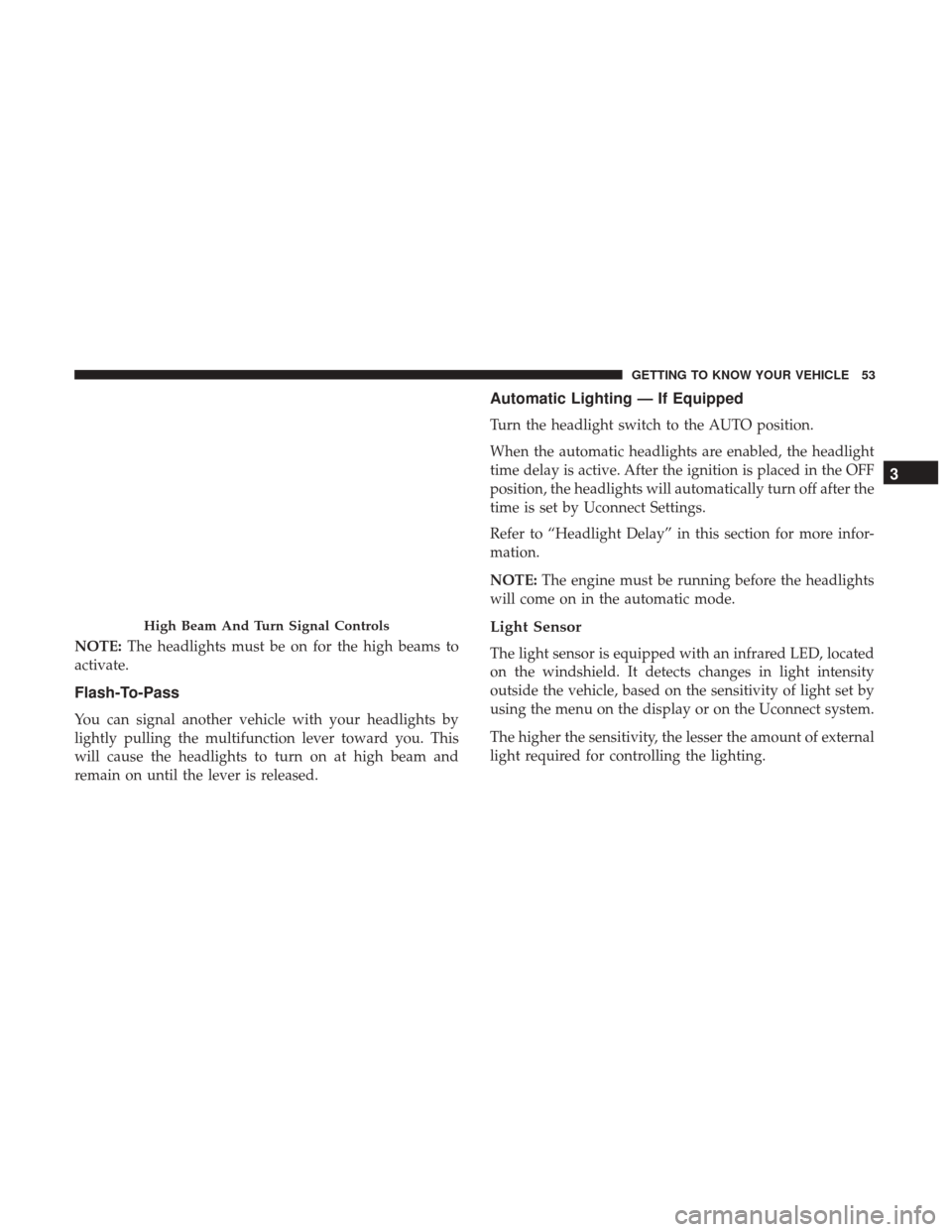
NOTE:The headlights must be on for the high beams to
activate.
Flash-To-Pass
You can signal another vehicle with your headlights by
lightly pulling the multifunction lever toward you. This
will cause the headlights to turn on at high beam and
remain on until the lever is released.
Automatic Lighting — If Equipped
Turn the headlight switch to the AUTO position.
When the automatic headlights are enabled, the headlight
time delay is active. After the ignition is placed in the OFF
position, the headlights will automatically turn off after the
time is set by Uconnect Settings.
Refer to “Headlight Delay” in this section for more infor-
mation.
NOTE: The engine must be running before the headlights
will come on in the automatic mode.
Light Sensor
The light sensor is equipped with an infrared LED, located
on the windshield. It detects changes in light intensity
outside the vehicle, based on the sensitivity of light set by
using the menu on the display or on the Uconnect system.
The higher the sensitivity, the lesser the amount of external
light required for controlling the lighting.
High Beam And Turn Signal Controls
3
GETTING TO KNOW YOUR VEHICLE 53
Page 141 of 516
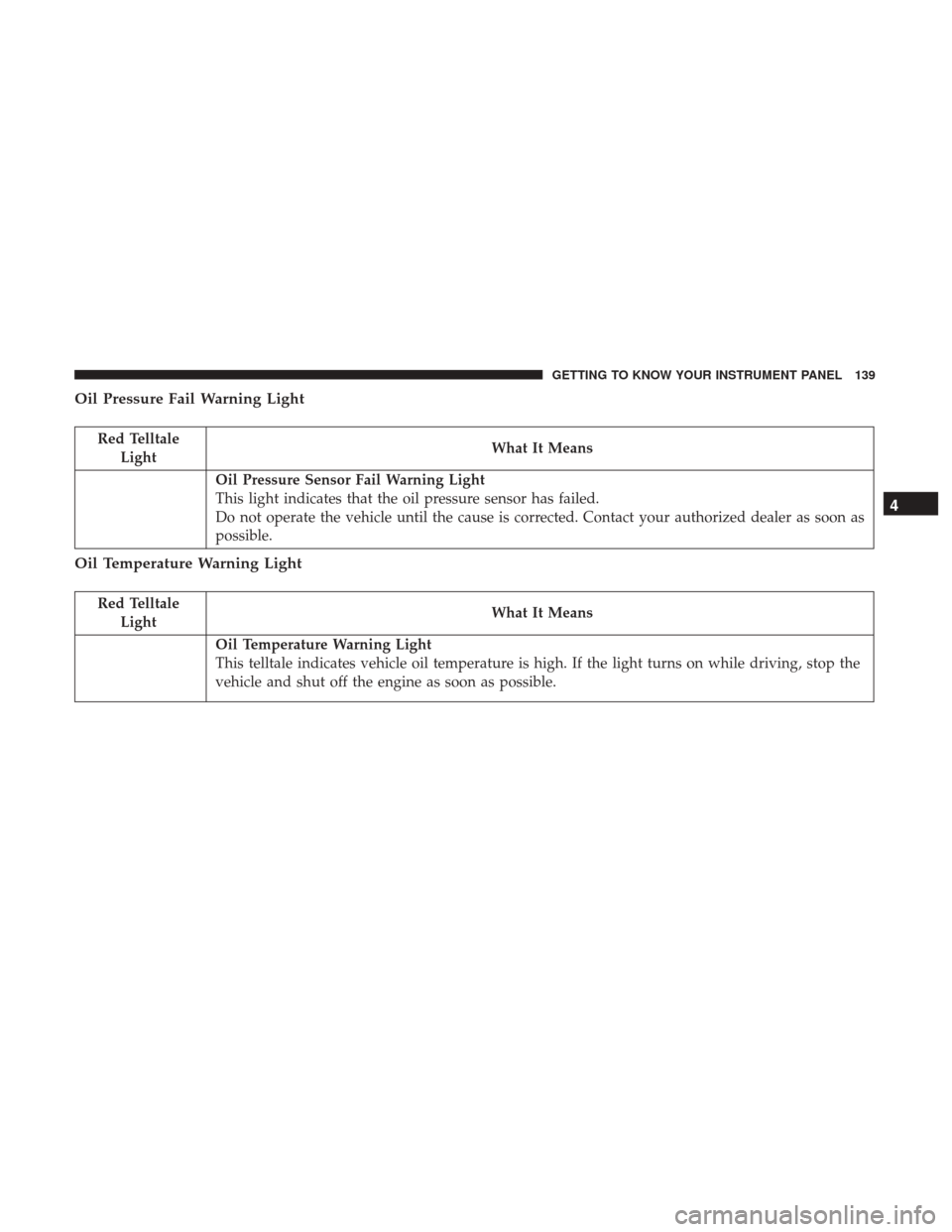
Oil Pressure Fail Warning Light
Red TelltaleLight What It Means
Oil Pressure Sensor Fail Warning Light
This light indicates that the oil pressure sensor has failed.
Do not operate the vehicle until the cause is corrected. Contact your authorized dealer as soon as
possible.
Oil Temperature Warning Light
Red Telltale
Light What It Means
Oil Temperature Warning Light
This telltale indicates vehicle oil temperature is high. If the light turns on while driving, stop the
vehicle and shut off the engine as soon as possible.
4
GETTING TO KNOW YOUR INSTRUMENT PANEL 139
Page 146 of 516
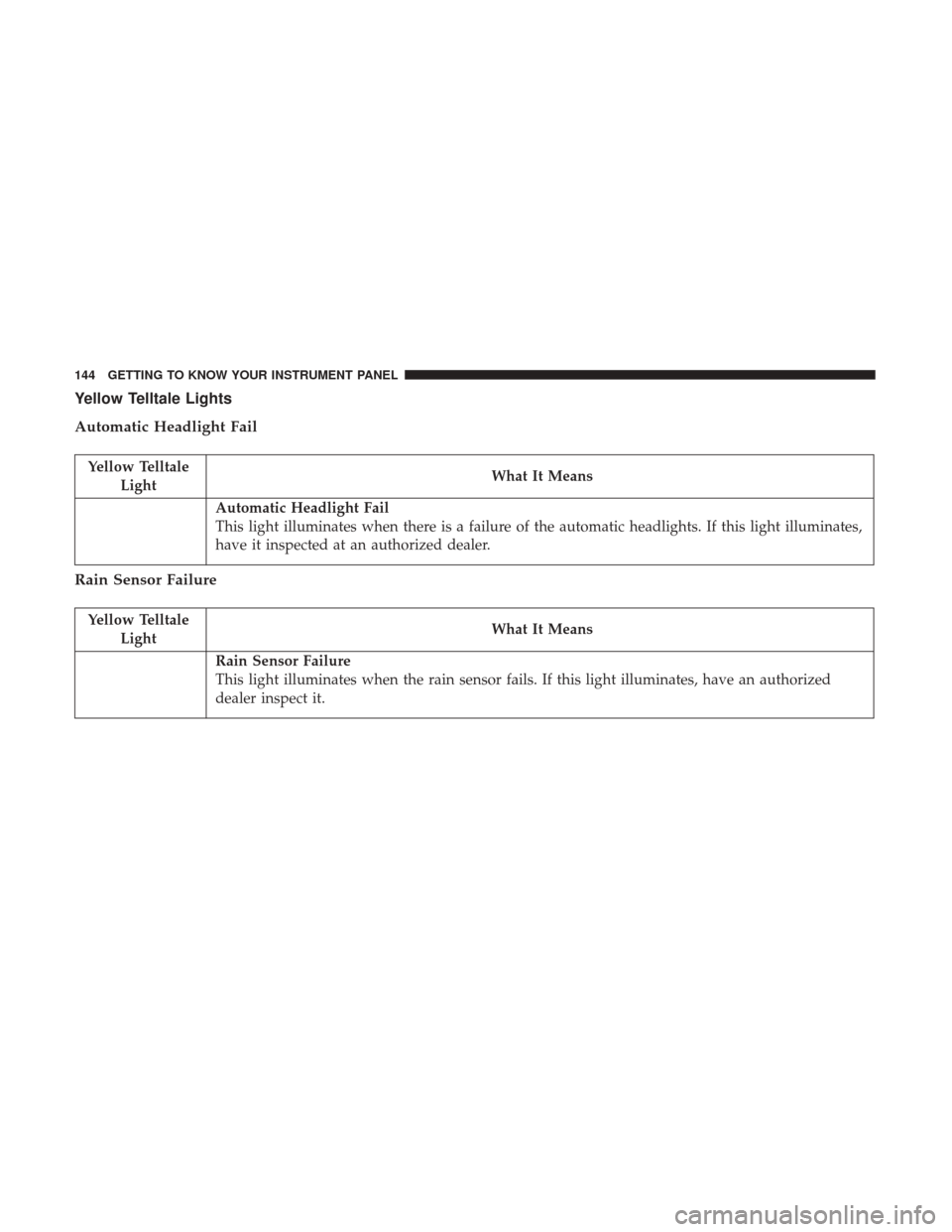
Yellow Telltale Lights
Automatic Headlight Fail
Yellow TelltaleLight What It Means
Automatic Headlight Fail
This light illuminates when there is a failure of the automatic headlights. If this light illuminates,
have it inspected at an authorized dealer.
Rain Sensor Failure
Yellow Telltale
Light What It Means
Rain Sensor Failure
This light illuminates when the rain sensor fails. If this light illuminates, have an authorized
dealer inspect it.
144 GETTING TO KNOW YOUR INSTRUMENT PANEL
Page 149 of 516
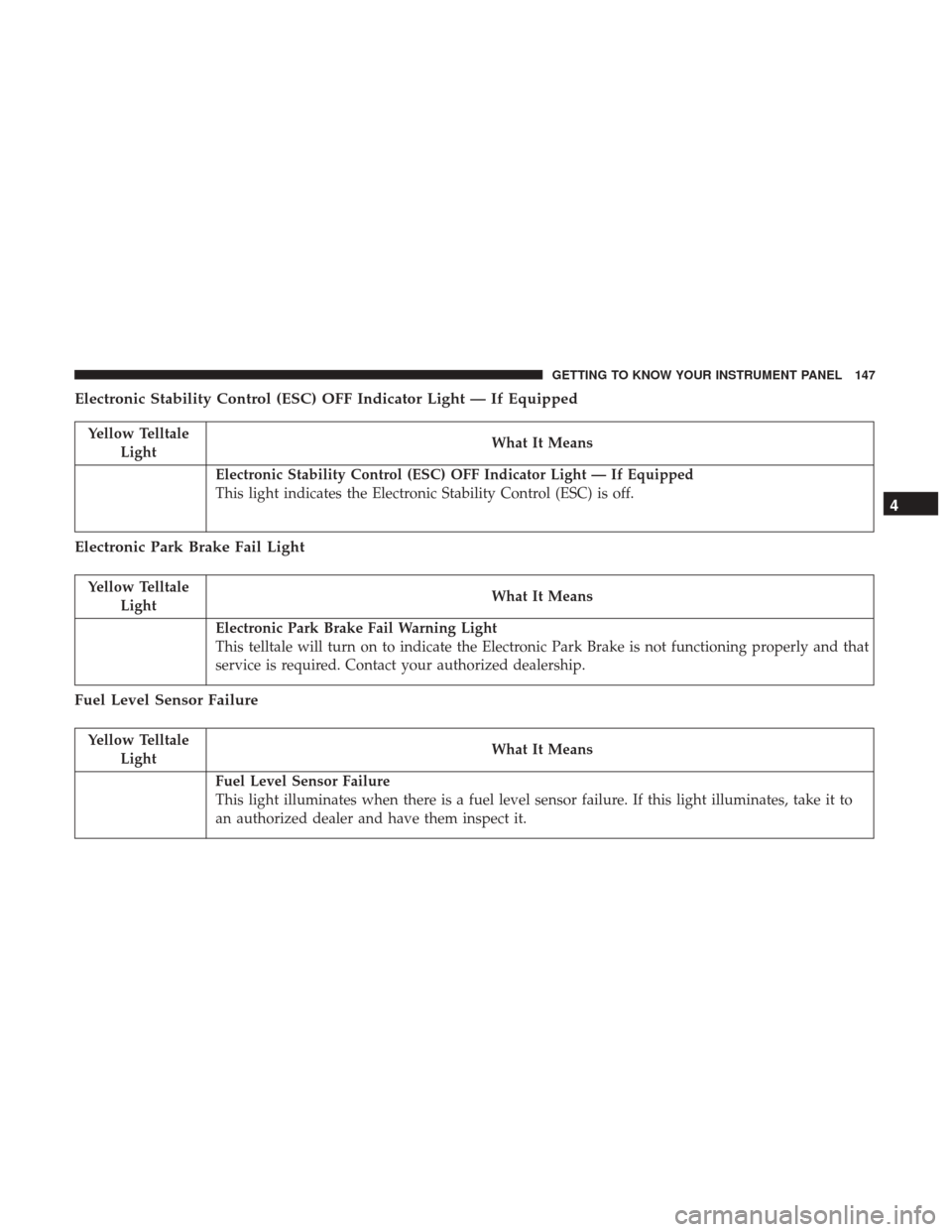
Electronic Stability Control (ESC) OFF Indicator Light — If Equipped
Yellow TelltaleLight What It Means
Electronic Stability Control (ESC) OFF Indicator Light — If Equipped
This light indicates the Electronic Stability Control (ESC) is off.
Electronic Park Brake Fail Light
Yellow Telltale
Light What It Means
Electronic Park Brake Fail Warning Light
This telltale will turn on to indicate the Electronic Park Brake is not functioning properly and that
service is required. Contact your authorized dealership.
Fuel Level Sensor Failure
Yellow Telltale
Light What It Means
Fuel Level Sensor Failure
This light illuminates when there is a fuel level sensor failure. If this light illuminates, take it to
an authorized dealer and have them inspect it.
4
GETTING TO KNOW YOUR INSTRUMENT PANEL 147
Page 157 of 516
CAUTION!
The TPMS has been optimized for the original equip-
ment tires and wheels. TPMS pressures and warning
have been established for the tire size equipped on
your vehicle. Undesirable system operation or sensor
damage may result when using replacement equip-
ment that is not of the same size, type, and/or style.
(Continued)
CAUTION!(Continued)
Aftermarket wheels can cause sensor damage. Using
aftermarket tire sealants may cause the Tire Pressure
Monitoring System (TPMS) sensor to become inoper-
able. After using an aftermarket tire sealant it is
recommended that you take your vehicle to an autho-
rized dealer to have your sensor function checked.
Audio System Failure Light — If Equipped
Yellow Telltale
Light What It Means
Audio System Failure Light
The telltale illuminates to report a failure of the Audio System.
Contact your authorized dealership as soon as possible.
4
GETTING TO KNOW YOUR INSTRUMENT PANEL 155
Page 164 of 516
White Telltale Lights
Cruise Control Ready Indicator Light
White TelltaleLight What It Means
Cruise Control Ready Indicator Light
This light will turn on when the electronic speed control is ON, but not set.
Light Sensor Failure
White Telltale
Light What It Means
Light Sensor Failure
This light illuminates when there is light sensor failure. If this light illuminates, have an autho-
rized dealer inspect it.
162 GETTING TO KNOW YOUR INSTRUMENT PANEL
Page 173 of 516
WARNING!(Continued)
while pulling a trailer. HSA is not a substitute for
active driving involvement. It is always the driver ’s
responsibility to be attentive to distance to other ve-
hicles, people, and objects, and most importantly brake
operation to ensure safe operation of the vehicle under
all road conditions. Your complete attention is always
required while driving to maintain safe control of your
vehicle. Failure to follow these warnings can result in
a collision or serious personal injury.
Trailer Sway Control (TSC) — If Equipped
TSC uses sensors in the vehicle to recognize an excessively
swaying trailer and will take the appropriate actions to
attempt to stop the sway. The system may reduce engine
power and apply the brake of the appropriate wheel(s) to
counteract the sway of the trailer. TSC will become active
automatically once an excessively swaying trailer is recog-
nized. NOTE:
TSC cannot stop all trailers from swaying. Always
use caution when towing a trailer and follow the trailer
tongue weight recommendations. Refer to “Trailer Tow-
ing” in “Starting And Operating” for further information.
When TSC is functioning, the “ESC Activation/
Malfunction Indicator Light” will flash, the engine power
may be reduced and you may feel the brakes being applied
to individual wheels to attempt to stop the trailer from
swaying. TSC is disabled when the ESC system is in the
“Partial Off” mode.
WARNING!
If TSC activates while driving, slow the vehicle down,
stop at the nearest safe location, and adjust the trailer
load to eliminate trailer sway.
Electronic Stability Control (ESC)
This system enhances directional control and stability of
the vehicle under various driving conditions. ESC corrects
for oversteering or understeering of the vehicle by apply-
ing the brake of the appropriate wheel(s) to assist in
counteracting the oversteer or understeer condition. En-
gine power may also be reduced to help the vehicle
maintain the desired path.
5
SAFETY 171
Page 174 of 516
ESC uses sensors in the vehicle to determine the vehicle
path intended by the driver and compares it to the actual
path of the vehicle. When the actual path does not match
the intended path, ESC applies the brake of the appropriate
wheel to assist in counteracting the oversteer or understeer
condition.
•Oversteer — when the vehicle is turning more than
appropriate for the steering wheel position.
• Understeer — when the vehicle is turning less than
appropriate for the steering wheel position.
The “ESC Activation/Malfunction Indicator Light” located
in the instrument cluster will start to flash as soon as the
ESC system becomes active. The “ESC Activation/
Malfunction Indicator Light” also flashes when the TCS is
active. If the “ESC Activation/Malfunction Indicator
Light” begins to flash during acceleration, ease up on the
accelerator and apply as little throttle as possible. Be sure to
adapt your speed and driving to the prevailing road
conditions.WARNING!
• Electronic Stability Control (ESC) cannot prevent the
natural laws of physics from acting on the vehicle,
nor can it increase the traction afforded by prevailing
road conditions. ESC cannot prevent accidents, in-
cluding those resulting from excessive speed in
turns, driving on very slippery surfaces, or hydro-
planing. ESC also cannot prevent accidents resulting
from loss of vehicle control due to inappropriate
driver input for the conditions. Only a safe, attentive,
and skillful driver can prevent accidents. The capa-
bilities of an ESC equipped vehicle must never be
exploited in a reckless or dangerous manner which
could jeopardize the user ’s safety or the safety of
others.
• Vehicle modifications, or failure to properly main-
tain your vehicle, may change the handling charac-
teristics of your vehicle, and may negatively affect
the performance of the ESC system. Changes to the
steering system, suspension, braking system, tire
type and size or wheel size may adversely affect ESC
performance. Improperly inflated and unevenly
worn tires may also degrade ESC performance. Any
(Continued)
172 SAFETY
Page 182 of 516
•The vehicle is driven greater than 25 mph (40 km/h)
(HDC exits immediately.)
Feedback To The Driver:
The instrument cluster has an HDC icon and the HDC
switch has an LED which offer feedback to the driver about
the state HDC is in.
• The cluster icon and switch lamp will illuminate and
remain solid when HDC is enabled or activated. This is
the normal operating condition for HDC.
• The switch lamp will flash for several seconds then
extinguish when the driver pushes the HDC switch
when enable conditions have not been met.
The Hill Descent Switch is located within the Selec-Terrain
knob in the upper right position.
WARNING!
HDC is only intended to assist the driver in controlling
vehicle speed when descending hills. The driver must
remain attentive to the driving conditions and is re-
sponsible for maintaining a safe vehicle speed.
AUXILIARY DRIVING SYSTEMS
Blind Spot Monitoring (BSM) — If Equipped
The Blind Spot Monitoring (BSM) system uses two radar-
based sensors, located inside the rear bumper fascia, to
detect highway licensable vehicles (automobiles, trucks,
motorcycles, etc.) that enter the blind spot zones from the
rear/front/side of the vehicle.
When the vehicle is started, the BSM warning light will
momentarily illuminate in both outside rear view mirrors
to let the driver know that the system is operational. The
Rear Detection Zones
180 SAFETY
Page 189 of 516
Modes Of Operation
Three selectable modes of operation are available in the
Uconnect System. Refer to “Uconnect Settings” in “Multi-
media” for further information.
Blind Spot Alert Lights Only
When operating in Blind Spot Alert mode, the BSM system
will provide a visual alert in the appropriate side view
mirror based on a detected object. However, when the
system is operating in Rear Cross Path (RCP) mode, the
system will respond with both visual and audible alerts
when a detected object is present. Whenever an audible
alert is requested, the radio is muted.
Blind Spot Alert Lights/Chime
When operating in Blind Spot Alert Lights/Chime mode,
the BSM system will provide a visual alert in the appro-
priate side view mirror based on a detected object. If the
turn signal is then activated, and it corresponds to an alert
present on that side of the vehicle, an audible chime will
also be sounded. Whenever a turn signal and detected
object are present on the same side at the same time, both
the visual and audible alerts will be issued. In addition to
the audible alert, the radio (if on) will also be muted.NOTE:
Whenever an audible alert is requested by the BSM
system, the radio is also muted.
When the system is in RCP, the system will respond with
both visual and audible alerts when a detected object is
present. Whenever an audible alert is requested, the radio
is also muted. Turn/hazard signal status is ignored; the
RCP state always requests the chime.
Blind Spot Alert Off
When the BSM system is turned off, there will be a related
message on instrument cluster display. If BSM system is
off, this message will be visualized every time the vehicle
is restarted.
NOTE: The BSM system will store the current operating
mode when the vehicle is shut off. Each time the vehicle is
started the previously stored mode will be recalled and
used.
Blind Spot Monitoring Fault Warnings
Sensor Blinded
In the case of a sensor blinded:
• BSM Mirror Warning Lights are turned on continuously.
• A instrument cluster dedicated message will display.
5
SAFETY 187