light JEEP RENEGADE 2023 Owners Manual
[x] Cancel search | Manufacturer: JEEP, Model Year: 2023, Model line: RENEGADE, Model: JEEP RENEGADE 2023Pages: 364, PDF Size: 18.65 MB
Page 282 of 364
280 IN CASE OF EMERGENCY
Disconnecting The Jumper Cables
1. Disconnect the negative
(-)
en
d of the jumper
cable from the engine ground of the vehicle
with the discharged battery.
2. Disconnect the opposite end of the negative (-)
ju m
per cable from the negative (-) post of the
booster battery.
3. Disconnect the positive (+) en
d of the jumper
cable from the positive (+) post of the booster
battery.
4. Disconnect the opposite end of the positive (+)
ju m
per cable from the positive (+) post of the
vehicle with the discharged battery, and
reinstall the protective cap.
If frequent jump starting is required to start your
vehicl
e you should have the battery and charging
system inspected at an authorized dealer.
REFUELING IN EMERGENCY – IF EQUIPPED
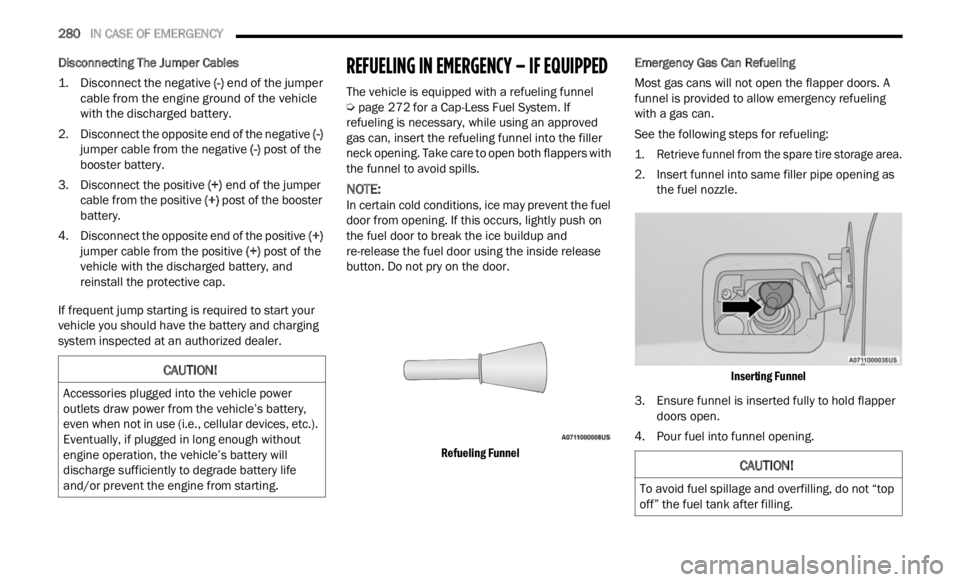
The vehicle is equipped with a refueling funnel
Ú page 272 for a Cap-Less Fuel System. If
refueling is necessary, while using an approved
g as ca
n, insert the refueling funnel into the filler
neck opening. Take care to open both flappers with
the funnel to avoid spills.
NOTE:
In certain cold conditions, ice may prevent the fuel
door fr om
opening. If this occurs, lightly push on
the fuel door to break the ice buildup and
re-release the fuel door using the inside release
button. Do not pry on the door.
Refueling Funnel
Emergency Gas Can Refueling
Most gas cans will not open the flapper doors. A
f
unne l
is provided to allow emergency refueling
with a gas can.
See the following steps for refueling:
1. Retrieve funnel from the spare tire storage area.
2. Ins
ert funnel into same filler pipe opening as
the f
uel nozzle.
Inserting Funnel
3. Ensure funnel is inserted fully to hold flapper doors op
en.
4. Pour fuel into funnel opening.
CAUTION!
Accessories plugged into the vehicle power
outlets draw power from the vehicle’s battery,
even when not in use (i.e., cellular devices, etc.).
Eventually, if plugged in long enough without
engine operation, the vehicle’s battery will
discharge sufficiently to degrade battery life
and/or prevent the engine from starting.
CAUTION!
To avoid fuel spillage and overfilling, do not “top
off” the fuel tank after filling.
Page 283 of 364
IN CASE OF EMERGENCY 281
5. Remove funnel from filler pipe, clean off prior
to putting back in the spare tire storage area.
IF YOUR ENGINE OVERHEATS
If the vehicle is overheating, it will need to be
serviced by an authorized dealer.
In any of the following situations, you can reduce
the pot
ential for overheating your engine by taking
the appropriate action.
On the highways — slow down.
In city traffic — while stopped, put transmission
in NEUTRAL (N), but do not increase engine idle
speed.
NOTE:
There are steps that you can take to slow down an
impen d
ing overheat condition:
If your Air Conditioner (A/C) is on, turn it off. The
A/C system adds heat to the engine cooling
system and turning the A/C off can help remove
this heat.
You can also turn the temperature control to
maximum heat, the mode control to floor and
the blower control to high. This allows the heater
core to act as a supplement to the radiator and
aids in removing heat from the engine cooling
system.
GEAR SELECTOR OVERRIDE
If a malfunction occurs and the gear selector
cannot be moved out of the PARK position, follow
the steps below:
NOTE:
A depleted battery will prevent the Electric Park
Brake
to be applied.
1. Turn the engine OFF.
2. App
ly the Electric Park Brake.
WARNING!
Never have any smoking materials lit in or
near the vehicle when the fuel door is open or
the tank is being filled.
Never add fuel when the engine is running.
This is in violation of most state and federal
fire regulations and may cause the Malfunc -
tion Indicator Light to turn on.
A fire may result if fuel is pumped into a
portable container that is inside of a vehicle.
You could be burned. Always place fuel
containers on the ground while filling.
CAUTION!
Driving with a hot cooling system could damage
your vehicle. If the temperature gauge reads
“H”, pull over and stop the vehicle. Idle the vehi -
cle with the air conditioner turned off until the
pointe r
drops back into the normal range. If the
pointer remains on the “H” and you hear contin -
uous chimes, turn the engine off immediately
and c a
ll for service.
WARNING!
You or others can be badly burned by hot engine
coolant (antifreeze) or steam from your radiator.
If you see or hear steam coming from under the
hood, do not open the hood until the radiator
has had time to cool. Never try to open a cooling
system pressure cap when the radiator or cool -
ant bottle is hot.
7
Page 288 of 364
286
SERVICING AND MAINTENANCE
SCHEDULED SERVICING
Your vehicle is equipped with an automatic oil
change indicator system. The oil change indicator
system will remind you that it is time to take your
vehicle in for scheduled maintenance.
Based on engine operation conditions, the oil
change
indicator message will illuminate in the
instrument cluster. This means that service is
required for your vehicle. Operating conditions
such as frequent short-trips, trailer tow and
extremely hot or cold ambient temperatures will
influence when the “Change Oil” or “Oil Change
Required” message is displayed. Have your vehicle
serviced as soon as possible, within the next
500 miles (805 km). An authorized dealer will reset the oil change
indica
tor message after completing the scheduled
oil change.
NOTE:
Under no circumstances should oil change
inter v
als exceed 10,000 miles (16,000 km),
1 year or 350 hours of engine run time, whichever
c omes f
irst. The 350 hours of engine run or idle
time is generally only a concern for fleet
customers.
NOTE:
The Oil Change Indicator will not illuminate under
these
conditions. Once A Month Or Before A Long Trip:
Check engine oil level.
Check windshield washer fluid level.
Check the tire inflation pressures and look for
unusual wear or damage.
Check the fluid levels of the coolant reservoir,
and brake master cylinder reservoir, and fill as
needed.
Check function of all interior and exterior lights.
Page 290 of 364

288 SERVICING AND MAINTENANCE
Mileage or time passed
(whichever comes first)
10,000
20,000
30,000
40,000
50,000
60,000
70,000
80,000
90,000
100,000
110,000
120,000
130,000
140,000
150,000
Or Years: 12345678910 1112131415
Or Kilometers:
16,000
32,000
48,000
64,000
80,000
96,000
112,000
128,000
144,000
160,000
176,000
192,000
208,000
224,000
240,000
Replace the Uconnect box (telematics
box) battery (if equipped).1
• ••
Check tire condition/wear and adjust
press u
re, if necessary, check Tire
Service Kit expiration date (if
equipped). •
••••••••••••••
Check operation of lighting system
(head l
amps, direction indicators,
hazard warning lights, luggage
compartment, passenger
compartment, glove compartment,
instrument panel warning lights, etc.). •
••••••••••••••
Check and, if necessary, top up fluid
l evel
s
(brakes/hydraulic clutch,
windshield washer, engine coolant,
etc.).
2
• ••••••••••••••
Check engine control system operation
(via d
iagnostic tool). •
••••••••••••••
Page 293 of 364
SERVICING AND MAINTENANCE 291
○ Recommend replacement
• Mandatory service
Flush and replace the engine coolant
at 10 years or 150,000 miles
(240,000 km) whichever comes first. •
•
1. The Uconnect box (telematics box) battery replacement has to be done every five years, regardless of mileage.2. Always only use the fluids shown in the handbook for topping up after having checked that the system is not damaged.
3. The maximum mileage is 75,000 mile s (120,000 km). The belt must be replaced every six years, regardless of distance traveled. If the vehicle is used in heavy conditions (dusty
areas,
cold climates, urban driving, long periods of idling), the maximum mileage is 37,500 miles (60,000 km). The belt must be replaced every four years regardless of the mileage.
4. The oil and oil filter replacement must be carried out when indicated by a warning light or message on the instrument panel, or in any case should not exceed one year or
10,0 0
0 miles (16,000 km).
5. Always only use the fluids shown in the handbook for topping up after having checked that the system is not damaged.
6. If
the engine oil quality detected by the vehicle diagnostics is lower than 20%, it is advisable to replace the engine oil and engine filter in order to avoid another service operation
afte r
a short time.
7. The spark plug change is distance based only, yearly intervals do not apply. The following are essential to ensure correct operation and prevent serious damage to the engine:
Only use spark plugs of the same make and type which are especially certified for such engines
Ú page 345 .
Strictly comply with the spark plug replacement interval given in the “Maintenance Schedule” for spark plug replacement.
Contact an authorized dealer if you have any questions.
8. Th e
engine air cleaner filter should be inspected at every oil change if used in dusty areas.
9. The brake fluid change interval is time based only, mileage intervals do not apply.
Mileage or time passed
(whichever comes first)
10,000
20,000
30,000
40,000
50,000
60,000
70,000
80,000
90,000
100,000
110,000
120,000
130,000
140,000
150,000
Or Years: 1 2 3 4 5 6 7 8 9 10 11 12 13 14 15
Or Kilometers:
16,000
32,000
48,000
64,000
80,000
96,000
112,000
128,000
144,000
160,000
176,000
192,000
208,000
224,000
240,000
8
Page 304 of 364
302 SERVICING AND MAINTENANCE
(Continued)
Keep the front of the radiator clean. If your
vehicle is equipped with air conditioning, keep
the front of the condenser clean.
Do not change the thermostat for Summer or
Winter operation. If replacement is ever neces-
sary, install ONLY the correct type thermostat.
O ther
designs may result in unsatisfactory
engine cooling performance, poor gas mileage,
and increased emissions.
BRAKE SYSTEM
In order to ensure brake system performance, all
brake system components should be inspected
periodically Ú page 287.
Brake Master Cylinder
The fluid level in the master cylinder should be
checked when performing under hood services, or
immediately if the Brake Warning Light is on.
Be sure to clean the top of the master cylinder area
before
removing the cap. If necessary, add fluid to
bring the fluid level up to the requirements
described on the brake fluid reservoir. Fluid level
can be expected to fall as the brake pads wear. The
brake fluid level should be checked when the pads
are replaced. However, low fluid level may be
caused by a leak and a checkup may be needed.
Use only manufacturer's recommended brake fluid
Ú page 345.
WARNING!
Riding the brakes can lead to brake failure and
possibly a collision. Driving with your foot resting
or riding on the brake pedal can result in
abnormally high brake temperatures, excessive
lining wear, and possible brake damage. Riding
the brakes may also reduce braking capacity in
an emergency.WARNING!
Use only manufacturer’s recommended brake
fluid
Ú page 345. Using the wrong type of
brake fluid can severely damage your brake
system
and/or impair its performance. The
proper type of brake fluid for your vehicle is
also identified on the original factory installed
hydraulic master cylinder reservoir.
To avoid contamination from foreign matter or
moisture, use only new brake fluid or fluid that
has been in a tightly closed container. Keep
the master cylinder reservoir cap secured at
all times. Brake fluid in an open container
absorbs moisture from the air resulting in a
lower boiling point. This may cause it to boil
unexpectedly during hard or prolonged
braking, resulting in sudden brake failure. This
could result in a collision.
Overfilling the brake fluid reservoir can result
in spilling brake fluid on hot engine parts,
causing the brake fluid to catch fire. Brake
fluid can also damage painted and vinyl
surfaces, care should be taken to avoid its
contact with these surfaces.
CAUTION!
Use of improper brake fluids will affect overall
clutch system performance. Improper brake
fluids may damage the clutch system resulting in
loss of clutch function and the ability to shift the
transmission.
WARNING!
Page 310 of 364
308 SERVICING AND MAINTENANCE
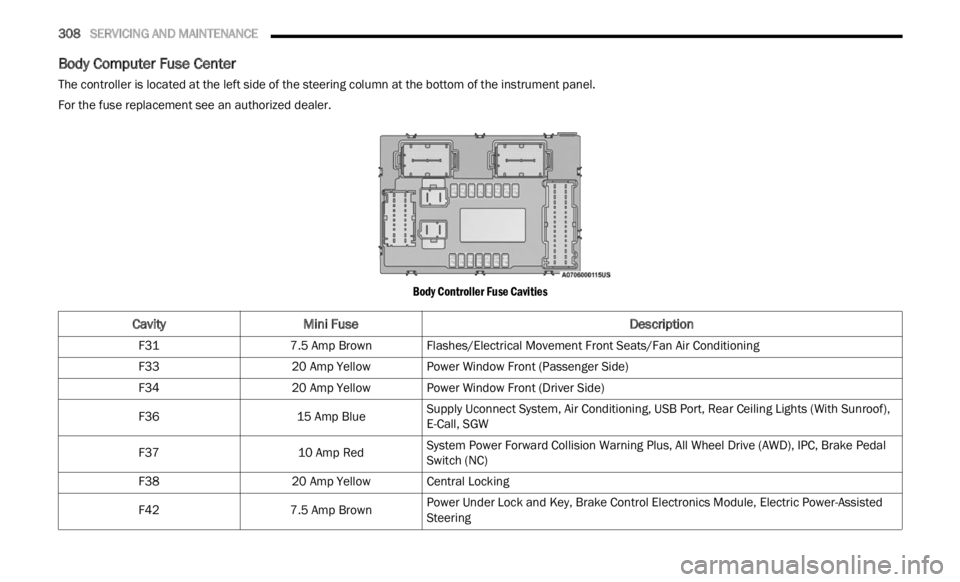
Body Computer Fuse Center
The controller is located at the left side of the steering column at the bottom of the instrument panel.
For the fuse replacement see an authorized dealer.
Body Controller Fuse Cavities
CavityMini Fuse Description
F317.5 Amp BrownFlashes/Electrical Movement Front Seats/Fan Air Conditioning
F33 20 Amp YellowPower Window Front (Passenger Side)
F34 20 Amp YellowPower Window Front (Driver Side)
F36 15 Amp BlueSupply Uconnect System, Air Conditioning, USB Port, Rear Ceiling Lights (With Sunroof),
E-Call
, SGW
F37 10 Amp RedSystem Power Forward Collision Warning Plus, All Wheel Drive (AWD), IPC, Brake Pedal
Switc
h
(NC)
F38 20 Amp YellowCentral Locking
F42 7.5 Amp BrownPower Under Lock and Key, Brake Control Electronics Module, Electric Power-Assisted
Steer
i
ng
Page 311 of 364
SERVICING AND MAINTENANCE 309
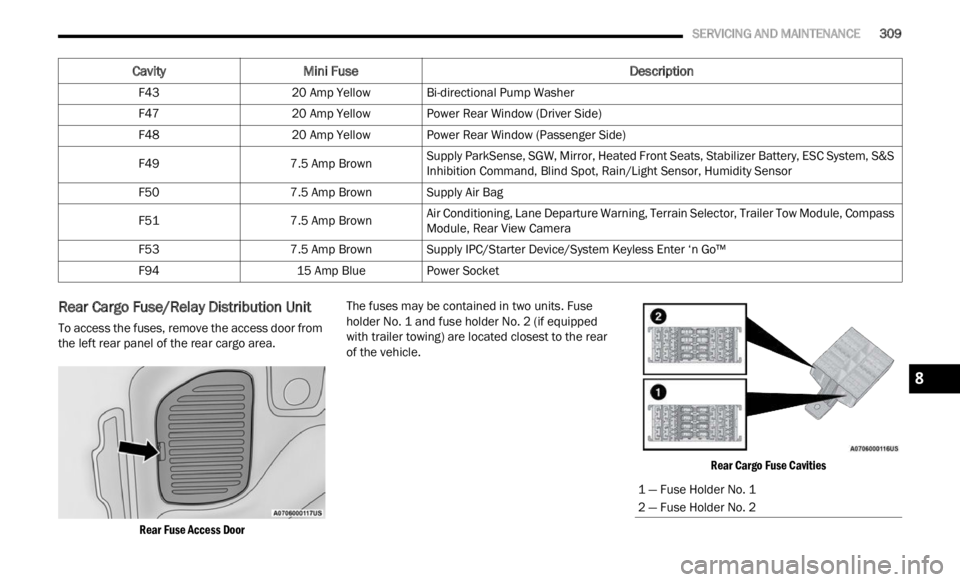
Rear Cargo Fuse/Relay Distribution Unit
To access the fuses, remove the access door from
the left rear panel of the rear cargo area.
Rear Fuse Access Door
The fuses may be contained in two units. Fuse
holder
No. 1 and fuse holder No. 2 (if equipped
with trailer towing) are located closest to the rear
of the vehicle.
Rear Cargo Fuse Cavities
F43
20 Amp YellowBi-directional Pump Washer
F47 20 Amp YellowPower Rear Window (Driver Side)
F48 20 Amp YellowPower Rear Window (Passenger Side)
F49 7.5 Amp BrownSupply ParkSense, SGW, Mirror, Heated Front Seats, Stabilizer Battery, ESC System, S&S
Inhib
i
tion Command, Blind Spot, Rain/Light Sensor, Humidity Sensor
F50 7.5 Amp BrownSupply Air Bag
F51 7.5 Amp BrownAir Conditioning, Lane Departure Warning, Terrain Selector, Trailer Tow Module, Compass
Module
,
Rear View Camera
F53 7.5 Amp BrownSupply IPC/Starter Device/System Keyless Enter ‘n Go™
F94 15 Amp BluePower Socket
Cavity Mini Fuse Description
1 — Fuse Holder No. 1
2 — Fuse Holder No. 2
8
Page 312 of 364

310 SERVICING AND MAINTENANCE
Fuse Holder No. 1
Fuse Holder No. 2
On the controller there is also a 20 amp fuse for the sun visor of the retractable roof.
Cavity Mini Fuse Description
F130 Amp BluePower Inverter
F2 20 Amp YellowHIFI Audio System
F3 20 Amp YellowMY SKY
F5 30 Amp GreenPower Seat (Driver Side)
F6 7.5 Amp BrownLumbar Adjustment Front Seat (Driver Side)
F8 20 Amp YellowHeating Front Seats
CavityMini Fuse Description
F515 Amp BlueController Exterior Lighting Lights (Drivers Side)
F6 15 Amp BlueController Exterior Lighting Lights (Passenger Side)
Page 313 of 364

SERVICING AND MAINTENANCE 311
BULB REPLACEMENT
General Information
Before you replace a bulb, check the contacts to
be sure they are not oxidized.
Replace the bulbs with the same type and
wattage.
After replacing a light bulb, always check the
correct orientation.
Before replacing a bulb that is not functioning,
check that the fuse is intact.
NOTE:
Lens fogging can occur under certain atmospheric
condit i
ons. This will usually clear as atmospheric
conditions change to allow the condensation to
change back into a vapor. Turning the lamps on will
usually accelerate the clearing process.Replacement Bulbs, Names, And Part
Numbers
In the instance a bulb needs to be replaced, this
section includes bulb description and replacement
part numbers.
NOTE:
See an authorized dealer for LED bulb
repla c
ement.
Interior Bulbs
Lamps Bulb Number
Front Courtesy Light C5W
Front Courtesy Lights (Sun Visors) C5W
Rear Dome Light (Models Without Retractable Roof) C5W
Rear Interior Lights (Models With Retractable Roof) C5W
Interior Lights W5W
Dome Light (Glove Compartment) W5W
Exterior Bulbs
Lamps Bulb Number
Low Beam/High Beam Headlamps (LED Version) LED (Serviced at an authorized dealer)
Low Beam/High Beam Headlamps H13
8