ignition JEEP WRANGLER 2007 JK / 3.G Repair Manual
[x] Cancel search | Manufacturer: JEEP, Model Year: 2007, Model line: WRANGLER, Model: JEEP WRANGLER 2007 JK / 3.GPages: 467, PDF Size: 8.83 MB
Page 319 of 467
The “Tire Pressure Monitoring Telltale Light” will
illuminate in the instrument cluster, and an au-
dible chime will be activated when one or more of
the four active road tire pressures are low. The audible
chime will sound once every ignition cycle for each
condition that it detects. Should this occur, you should
stop as soon as possible, check the inflation pressure of
each tire on your vehicle, and inflate each tire to the
pressure recommended by the vehicle manufacturer. The
system will automatically update and the “Tire Pressure
Monitoring Telltale Light” will extinguish once the up-
dated tire pressures have been received. The vehicle may
need to be driven for up to 10 minutes above 15 mph (25
km/h) to receive this information. A low spare tire will
not cause the “Tire Pressure Monitoring Telltale Light” to
illuminate or the chime to sound.The “Tire Pressure Monitoring Telltale Light” will flash
on and off for 60 seconds, and an audible chime will
sound when a system fault is detected. The flash cycle
will repeat every ten minutes, without an audible chime,
until the fault condition no longer exists. If the ignition
key is cycled, this sequence will repeat, providing the
system fault still exists.
NOTE:In the event that the matching full size spare tire
is swapped with a low pressure road tire, the next
ignition key cycle will still show the “Tire Pressure
Monitoring Telltale Light” to be ON, and a chime to
sound. Driving the vehicle for up to 10 minutes above 15
mph (25 kph) will turn OFF the “Tire Pressure Monitor-
ing Telltale Light” as long as the spare tire or any other
road tire(s) are not below the low pressure warning
threshold.
STARTING AND OPERATING 319
5
Page 324 of 467
Fuel System Cautions
CAUTION!
Follow these guidelines to maintain your vehicle’s
performance:
•The use of leaded gasoline is prohibited by Federal
law. Using leaded gasoline can impair engine perfor-
mance, damage the emission control system.
•An out-of-tune engine, or certain fuel or ignition
malfunctions, can cause the catalytic converter to
overheat. If you notice a pungent burning odor or
some light smoke, your engine may be out of tune or
malfunctioning and may require immediate service.
Contact your dealer for service assistance.
•The use of fuel additives which are now being sold as
octane enhancers is not recommended. Most of theseproducts contain high concentrations of methanol.
Fuel system damage or vehicle performance problems
resulting from the use of such fuels or additives is not
the responsibility of the manufacturer.
NOTE:Intentional tampering with emissions control
systems can result in civil penalties being assessed
against you.
Carbon Monoxide Warnings
WARNING!
Carbon monoxide (CO) in exhaust gases is deadly.
Follow the precautions below to prevent carbon
monoxide poisoning:
•Do not inhale exhaust gases. They contain carbon
monoxide, a colorless and odorless gas which can kill.
Never run the engine in a closed area, such as a
324 STARTING AND OPERATING
Page 347 of 467
4. Start engine.
5. Shift automatic transmission into D (Drive) or manual
transmission into gear.
6. Release brake pedal and ensure that there is no vehicle
movement.
7. Shut the engine off and place the ignition key into the
ACC position.
8. Shift automatic transmission into P (Park).
9. Apply parking brake.
10. Attach vehicle to the tow vehicle with tow bar.
11. Release parking brake.
12. Disconnect the negative battery cable, and secure it
away from the negative battery post.CAUTION!
Damage to the transmission may occur if the trans-
mission is shifted into P (Park) with the transfer case
in N (Neutral) and the engine running. With the
transfer case in N (Neutral) ensure that the engine is
off prior to shifting the transmission into P (Park)
(refer to steps 7 – 8 above).
Shifting Out Of Neutral (N)
Use the following procedure to prepare your vehicle for
normal usage.
1. Shift automatic transmission into N (Neutral) or de-
press clutch pedal on manual transmission.
2. Shift transfer case lever into desired position.
STARTING AND OPERATING 347
5
Page 353 of 467
Spare Tire Stowage
To remove the spare tire from the carrier, remove the tire
cover, if equipped, and remove the lug nuts with the lug
wrench turning them counterclockwise.
NOTE:If you have added aftermarket accessories to the
spare tire mounted carrier, it cannot exceed a gross
weight of 50 lbs (23 kg) including the weight of the spare
tire.
Preparations For Jacking
Park on a firm level surface, avoid ice or slippery areas,
set the parking brakeand place automatic transmission
in P (Park), or manual transmission in R (Reverse). Turn
OFF the ignition.
WARNING!
Do not attempt to change a tire on the side of the
vehicle close to moving traffic. Pull far enough off
the road to avoid being hit when operating the jack
or changing the wheel.
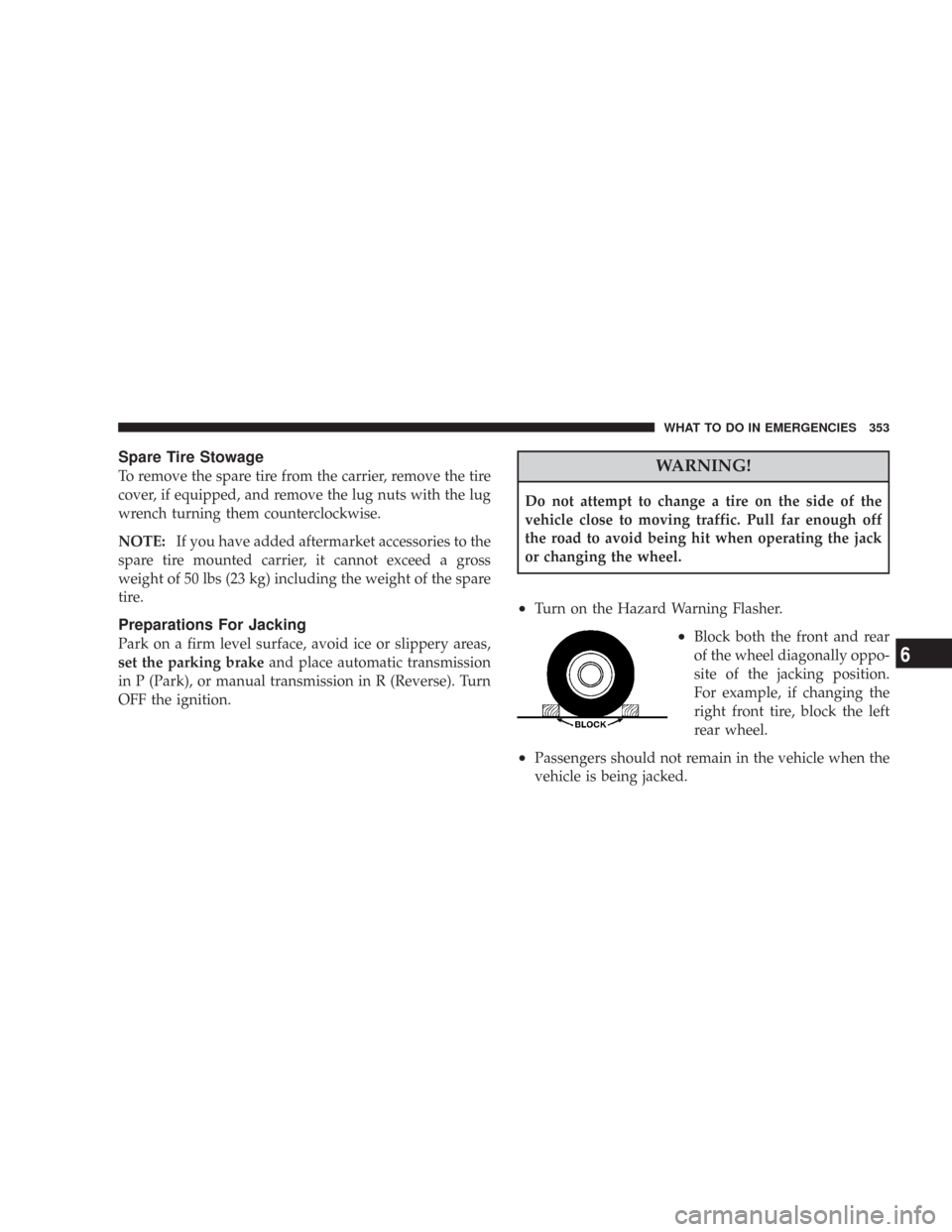
•Turn on the Hazard Warning Flasher.
•Block both the front and rear
of the wheel diagonally oppo-
site of the jacking position.
For example, if changing the
right front tire, block the left
rear wheel.
•Passengers should not remain in the vehicle when the
vehicle is being jacked.
WHAT TO DO IN EMERGENCIES 353
6
Page 356 of 467
JUMP STARTING
If the vehicle has a discharged battery, booster cables may
be used to obtain a start from a booster battery or the
battery in another vehicle. This type of start can be danger-
ous if done improperly, so follow this procedure carefully.
WARNING!
Battery fluid is a corrosive acid solution; do not allow
battery fluid to contact eyes, skin or clothing. Don’t lean
over battery when attaching clamps or allow the clamps
to touch each other. If acid splashes in eyes or on skin,
flush contaminated area immediately with large quan-
tities of water.
A battery generates hydrogen gas which is flammable
and explosive. Keep flame or spark away from the vent
holes.
Do not use a booster battery or any other booster source
that has a greater than 12 volt system, i.e. Do not use a 24
volt power source.
1. Remove all metal jewelry such as watch bands or
bracelets which might make an unintended electrical
contact.
2. Park the booster vehicle within cable reach but with-
out letting the vehicles touch. Set the parking brake on
both vehicles, place the automatic transmission in P
(Park), or the manual transmission in N (Neutral), and
turn the ignition OFF.
3. Turn off the heater, radio, and all unnecessary electri-
cal loads.
4. Connect one end of a jumper cable to the positive
terminal of the booster battery. Connect the other end of
the same cable to the positive terminal of the discharged
battery.
356 WHAT TO DO IN EMERGENCIES
Page 367 of 467
Your vehicle has a simple ignition key actuated test,
which you can use prior to going to the test station. To
check if your vehicle’s OBD system is ready, you must do
the following:
1. Insert your ignition key into the ignition switch.
2. Turn the ignition to the ON position, but do not crank
or start the engine.
3. If you crank or start the engine, you will have to start
this test over.
4. As soon as you turn your key to the ON position, you
will see your MIL symbol come on as part of a normal
bulb check.
5. Approximately 15 seconds later, one of two things will
happen:
a. The MIL will flash for about 10 seconds and then
return to being fully illuminated until you turn off theignition key or start the engine. This means that your
vehicle’s OBD system isnot readyand you shouldnot
proceed to the I/M station.
b. The MIL will not flash at all and will remain fully
illuminated until you turn off the ignition key or start
the engine. This means that your vehicle’s OBD system
isreadyand you can proceed to the I/M station.
If your OBD system isnot ready,you should see your
authorized dealer or repair facility. If your vehicle was
recently serviced or had a battery failure or replacement,
you may need to do nothing more than drive your
vehicle as you normally would in order for your OBD
system to update. A recheck with the above test routine
may then indicate that the system is now ready.
Regardless of whether your vehicle’s OBD system is
ready or not ready, if the MIL symbol is illuminated
during normal vehicle operation, you should have your
MAINTAINING YOUR VEHICLE 367
7
Page 374 of 467
WARNING!
A hot exhaust system can start a fire if you park over
materials that can burn. Such materials might be
grass or leaves coming into contact with your exhaust
system. Do not park or operate your vehicle in areas
where your exhaust system can contact anything that
can burn.
In unusual situations involving grossly malfunctioning
engine operation, a scorching odor may suggest severe
and abnormal catalyst overheating. If this occurs, stop
the vehicle, turn off the engine and allow it to cool.
Service, including a tune up to manufacturer’s specifica-
tions, should be obtained immediately.
To minimize the possibility of catalytic converter dam-
age:
•Do not shut off the engine or interrupt the ignition
when the transmission is in gear and the vehicle is in
motion.
•Do not try to start the engine by pushing or towing the
vehicle.
•Do not idle the engine with any spark plug wires
disconnected or removed, such as when diagnostic
testing.
•Do not idle the engine for prolonged periods during
very rough idle or malfunctioning operating condi-
tions.
•Do not allow vehicle to run out of fuel.
NOTE:Intentional tampering with emissions control
systems can result in civil penalties being assessed
against you.
374 MAINTAINING YOUR VEHICLE
Page 401 of 467
Cavity Cartridge
FuseMini
FuseDescription
J1 40 Amp
GreenPower Folding Seat
J2 30 Amp
PinkTransfer Case/Pwr
Liftgate Module
J3 40 Amp
GreenRear Door Module
(RR DOOR NODE)
J4 25 Amp
NaturalDriver Door Node
J5 25 Amp
NaturalPassenger Door Node
J6 40 Amp
GreenAnti-Lock Brake Sys-
tem (ABS) Pump/ESP
J7 30 Amp
PinkAnti-Lock Brake Sys-
tem (ABS) Valve/ESP
J8 40 Amp
GreenPower Memory Seat
(If Equipped)Cavity Cartridge
FuseMini
FuseDescription
J9 40 Amp
GreenPZEV Motor/Flex
Fuel
J10 30 Amp
PinkHeadlamp Wash
Relay/Manual Tuning
Valve
J11 30 Amp
PinkSway Bar/
THATCHAM Lock-
Unlock/Power Slid-
ing Door Module
J13 60 Amp
YellowIgnition Off Draw
(IOD) — Main
J14 40 Amp
GreenEBL (Rear Window
Defogger)
J15 30 Amp
PinkRear Blower
J17 40 Amp
GreenStarter Solenoid
MAINTAINING YOUR VEHICLE 401
7
Page 403 of 467
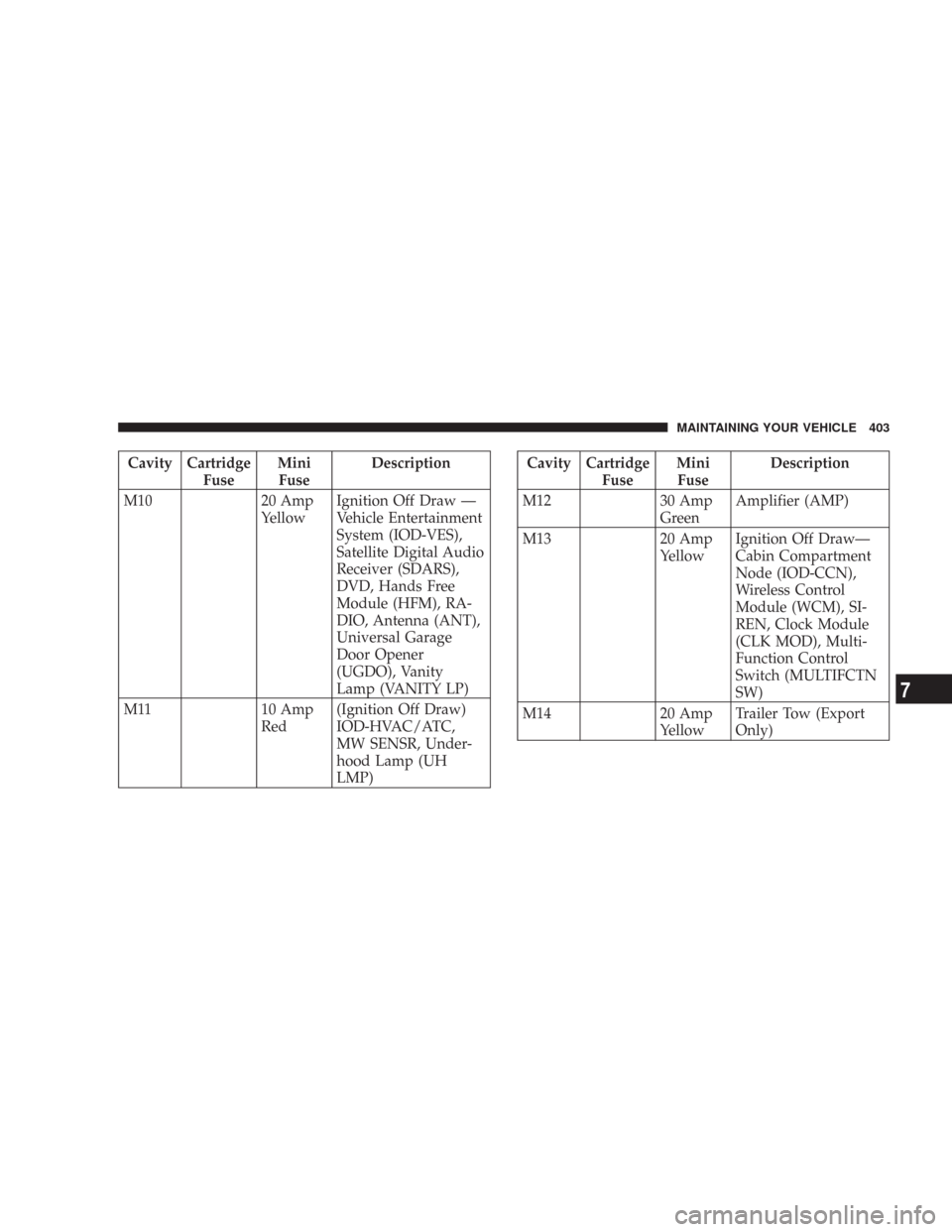
Cavity Cartridge
FuseMini
FuseDescription
M10 20 Amp
YellowIgnition Off Draw —
Vehicle Entertainment
System (IOD-VES),
Satellite Digital Audio
Receiver (SDARS),
DVD, Hands Free
Module (HFM), RA-
DIO, Antenna (ANT),
Universal Garage
Door Opener
(UGDO), Vanity
Lamp (VANITY LP)
M11 10 Amp
Red(Ignition Off Draw)
IOD-HVAC/ATC,
MW SENSR, Under-
hood Lamp (UH
LMP)Cavity Cartridge
FuseMini
FuseDescription
M12 30 Amp
GreenAmplifier (AMP)
M13 20 Amp
YellowIgnition Off Draw—
Cabin Compartment
Node (IOD-CCN),
Wireless Control
Module (WCM), SI-
REN, Clock Module
(CLK MOD), Multi-
Function Control
Switch (MULTIFCTN
SW)
M14 20 Amp
YellowTrailer Tow (Export
Only)
MAINTAINING YOUR VEHICLE 403
7
Page 405 of 467
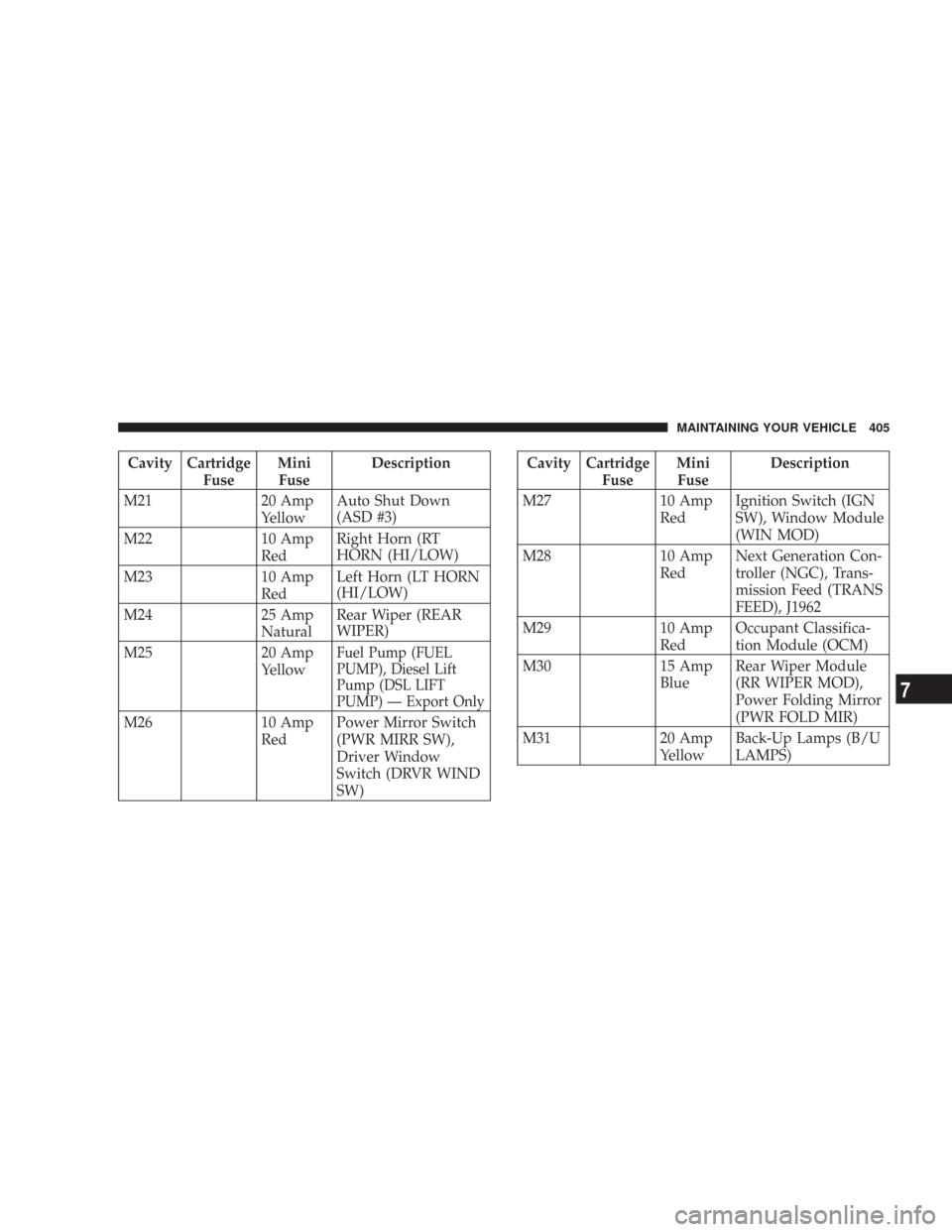
Cavity Cartridge
FuseMini
FuseDescription
M21 20 Amp
YellowAuto Shut Down
(ASD #3)
M22 10 Amp
RedRight Horn (RT
HORN (HI/LOW)
M23 10 Amp
RedLeft Horn (LT HORN
(HI/LOW)
M24 25 Amp
NaturalRear Wiper (REAR
WIPER)
M25 20 Amp
Yellow
Fuel Pump (FUEL
PUMP), Diesel Lift
Pump (DSL LIFT
PUMP) — Export Only
M26 10 Amp
RedPower Mirror Switch
(PWR MIRR SW),
Driver Window
Switch (DRVR WIND
SW)
Cavity Cartridge
FuseMini
FuseDescription
M27 10 Amp
RedIgnition Switch (IGN
SW), Window Module
(WIN MOD)
M28 10 Amp
RedNext Generation Con-
troller (NGC), Trans-
mission Feed (TRANS
FEED), J1962
M29 10 Amp
RedOccupant Classifica-
tion Module (OCM)
M30 15 Amp
BlueRear Wiper Module
(RR WIPER MOD),
Power Folding Mirror
(PWR FOLD MIR)
M31 20 Amp
YellowBack-Up Lamps (B/U
LAMPS)
MAINTAINING YOUR VEHICLE 405
7