tire JEEP WRANGLER 2008 JK / 3.G Owners Manual
[x] Cancel search | Manufacturer: JEEP, Model Year: 2008, Model line: WRANGLER, Model: JEEP WRANGLER 2008 JK / 3.GPages: 466, PDF Size: 8.97 MB
Page 9 of 466
WARNINGS AND CAUTIONS
This Owner’s Manual containsWARNINGSagainst op-
erating procedures that could result in an accident or
bodily injury. It also contains CAUTIONSagainst proce-
dures that could result in damage to your vehicle. If you
do not read this entire manual, you may miss important
information. Observe all Warnings and Cautions.
VEHICLE IDENTIFICATION NUMBER
The Vehicle Identification Number (VIN) is found on a
stamped plate located on the left front corner of the
instrument panel pad, visible from outside of the vehicle
through the windshield. This number also appears on the
Automobile Information Disclosure Label affixed to a
window on your vehicle. Save this label for a convenient
record of your vehicle identification number and optional
equipment.
NOTE: It is illegal to remove the VIN plate.
VEHICLE MODIFICATIONS/ALTERATIONS
WARNING!
Any modifications or alterations to this vehicle could
seriously affect its roadworthiness and safety and
may lead to an accident resulting in serious injury or
death.
8 INTRODUCTION
Page 63 of 466
•Airbag deployment level (if applicable)
•Impact acceleration and angle
•Seat belt status
•Brake status (service and parking brakes)
•Accelerator status (including vehicle speed)
•Engine control status (including engine speed)
•Transmission gear selection
•Cruise control status
•Traction/stability control status
•Tire pressure monitoring system (TPMS) status
Child Restraint
Everyone in your vehicle needs to be buckled up at all
times — babies and children, too. Every state in the
United States and all Canadian provinces require that
small children ride in proper restraint systems. This is the
law, and you can be prosecuted for ignoring it.
Children 12 years and under should ride properly buck-
led up in a rear seat, if available. According to crash
statistics, children are safer when properly restrained in
the rear seats, rather than in the front.
There are different sizes and types of restraints for
children from newborn size to the child almost large
enough for an adult safety belt. Always check the child
seat owner’s manual to ensure you have the correct seat
for your child. Use the restraint that is correct for your
child.
62 THINGS TO KNOW BEFORE STARTING YOUR VEHICLE
Page 78 of 466
Airbag Warning Light
The light should come on and remain on for six to eight
seconds as a indicator check when the ignition switch is
first turned on. If the indicator is not lit during starting,
have it serviced. If the light stays on or comes on while
driving, have the system checked by an authorized
dealer.
Defrosters
Check operation by selecting the defrost mode and place
the blower control on high speed. You should be able to
feel the air directed against the windshield. See your
authorized dealer for service if your defroster is inoper-
able.
Safety Checks You Should Make Outside The
Vehicle
Tires
Examine tires for excessive tread wear or uneven wear
patterns. Check for stones, nails, glass, or other objects
lodged in the tread. Inspect for tread cuts or sidewall
cracks. Check wheel nuts for tightness and tires (includ-
ing spare) for proper pressure.
Lights
Have someone observe the operation of all exterior lights
while you work the controls. Check turn signal and high
beam indicator lights on the instrument panel.
Fluid Leaks
Check area under vehicle after overnight parking for fuel,
coolant, oil, or other fluid leaks. Also, if gasoline fumes
are detected, the cause should be located and corrected
immediately.
THINGS TO KNOW BEFORE STARTING YOUR VEHICLE 77
2
Page 89 of 466
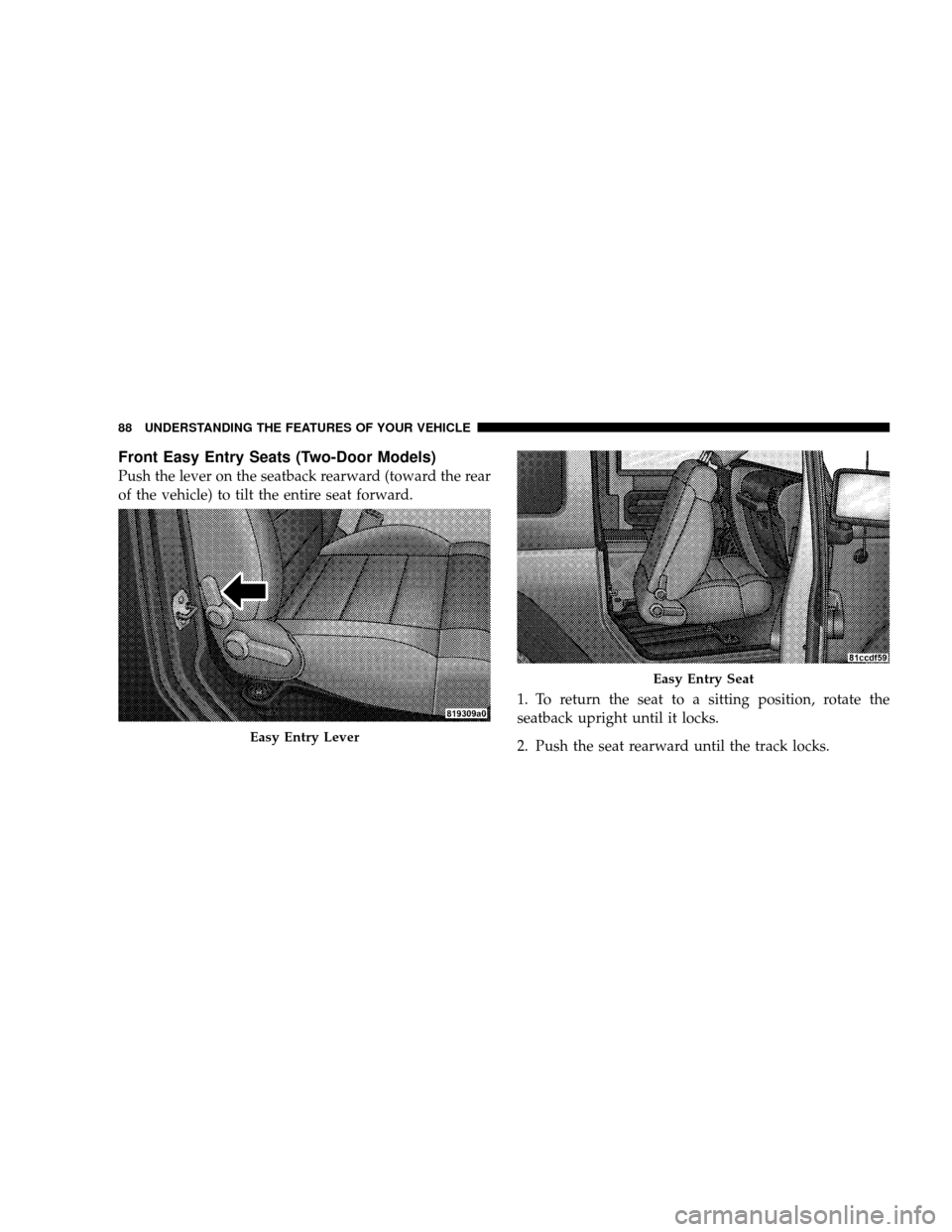
Front Easy Entry Seats (Two-Door Models)
Push the lever on the seatback rearward (toward the rear
of the vehicle) to tilt the entire seat forward.1. To return the seat to a sitting position, rotate the
seatback upright until it locks.
2. Push the seat rearward until the track locks.
Easy Entry Lever
Easy Entry Seat
88 UNDERSTANDING THE FEATURES OF YOUR VEHICLE
Page 91 of 466
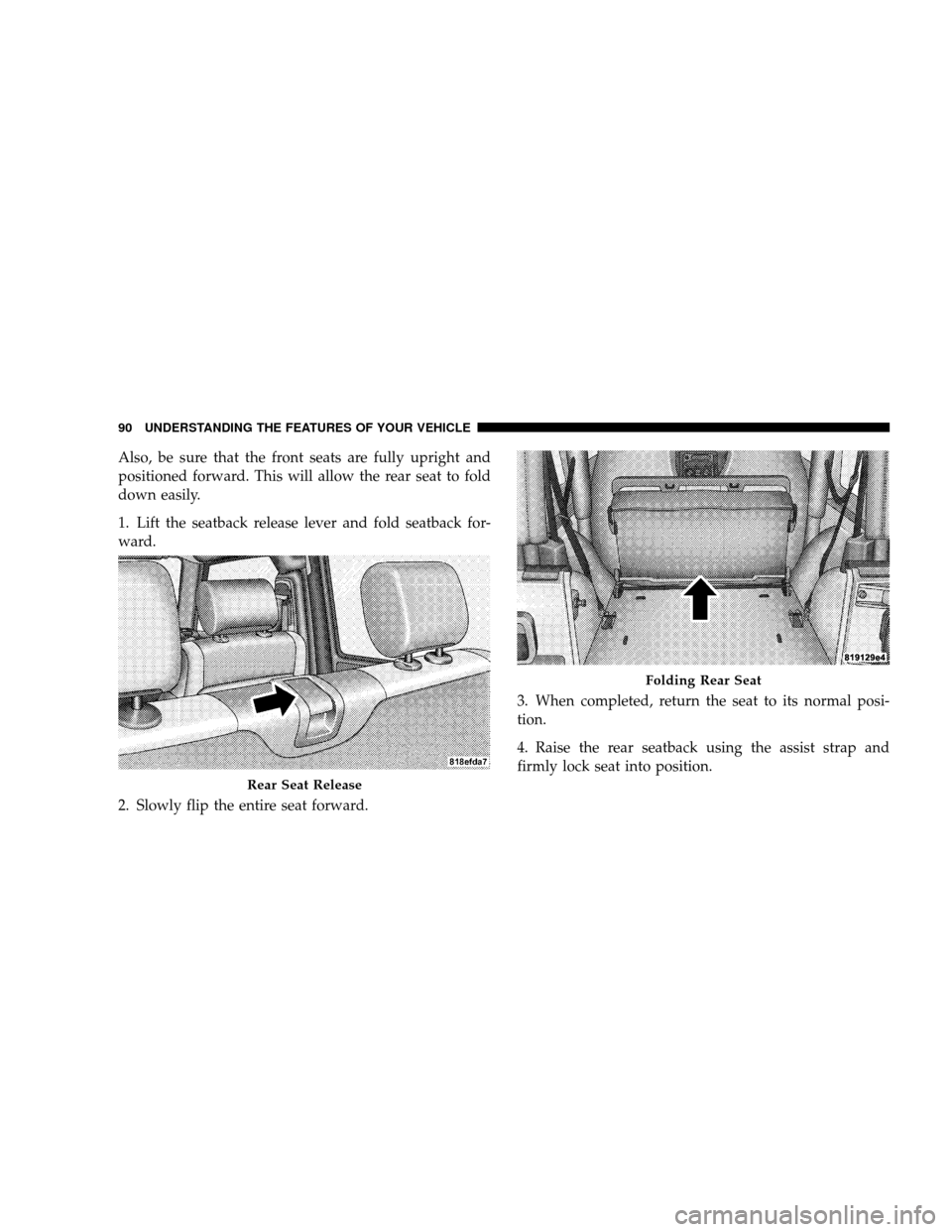
Also, be sure that the front seats are fully upright and
positioned forward. This will allow the rear seat to fold
down easily.
1. Lift the seatback release lever and fold seatback for-
ward.
2. Slowly flip the entire seat forward.3. When completed, return the seat to its normal posi-
tion.
4. Raise the rear seatback using the assist strap and
firmly lock seat into position.
Rear Seat Release
Folding Rear Seat
90 UNDERSTANDING THE FEATURES OF YOUR VEHICLE
Page 110 of 466
ESP (Electronic Stability Program)
This system enhances directional control and stability of
the vehicle under various driving conditions. ESP cor-
rects for over/under steering of the vehicle by applying
the brake of the appropriate wheel to assist in counter-
acting the over/under steer condition. Engine power
may also be reduced to help the vehicle maintain the
desired path.
ESP uses sensors in the vehicle to determine the vehicle
path intended by the driver and compares it to the actual
path of the vehicle. When the actual path does not match
the intended path, ESP applies the brake of the appropri-
ate wheel to assist in counteracting the oversteer or
understeer condition.
•Oversteer - when the vehicle is turning more than
appropriate for the steering wheel position.
•Understeer - when the vehicle is turning less than
appropriate for the steering wheel position.
The ESP/TCS Indicator Light (located in the instrument
cluster), starts to flash as soon as the tires lose traction
and the ESP system becomes active. The ESP/TCS Indi-
cator Light also flashes when TCS is active. If the
ESP/TCS Indicator Light begins to flash during accelera-
tion, ease up on the accelerator and apply as little throttle
as possible. Be sure to adapt your speed and driving to
the prevailing road conditions.
UNDERSTANDING THE FEATURES OF YOUR VEHICLE 109
3
Page 114 of 466
40 mph (48 km/h), the normal ESP stability function
returns but TCS remains off. When the vehicle speed
drops below 35 mph (40 km/h), the ESP system shuts off.
ESP is off at low vehicle speeds in 4L range so that it will
not interfere with off-road driving, but the ESP function
returns to provide the stability feature at speeds above 40
mph (48 km/h). The ESP/TCS Indicator Light will al-
ways be illuminated in 4L range when ESP is off.
NOTE:The “ESP OFF” message will display and the
audible chime will sound when the shift lever is placed in
the PARK position from any position other than PARK,
and then moved out of the PARK position. This will
occur even if the message was previously cleared.WARNING!
With the ESP switched off, the enhanced vehicle
stability offered by ESP and ERM are unavailable. In
an emergency evasive maneuver, the ESP and ERM
systems will not engage to assist in maintaining
stability. The “Full Off” mode is intended for off-
road use only.
Disabling ESP for Modified Vehicles (4WD Models
Only)
Vehicles modified with larger tires and/or suspension
lifts may experience early ESP activations as compared to
a non-modified production vehicle depending on lift
size, tire size, suspension changes and/or driving habits.
If early ESP activations are experienced while driving a
modified vehicle, the additional ability to permanently
turn off ESP is available. A steering wheel/ESP button
UNDERSTANDING THE FEATURES OF YOUR VEHICLE 113
3
Page 126 of 466
5. Unsnap and remove the black boot cover. This cover
should be discarded. It was intended as a protective
cover for shipping only.
NOTE:A visual instruction sheet is enclosed in the dual
top wrap.
6. Remove the swing gate bar (black metal bar for
bottom of rear window) and set aside.
NOTE: Be sure the wire harness in the left rear corner is
not tangled in the soft top bows before you lift the top.
7. Put up the soft top. Refer to “Soft Top — Putting Up
the Soft Top” in this section.FREEDOM TOP THREE-PIECE MODULAR HARD
TOP
CAUTION!
•The hard top is not designed to carry any addi-
tional loads such as roof racks, spare tires, build-
ing, hunting, or camping supplies, and/or luggage,
etc. Also, it was not designed as a structural
member of the vehicle, and thus cannot properly
carry any additional loads other than environmen-
tal (rain, snow, etc.).
CAUTION!
Do not move your vehicle until the top has been
either fully attached to the windshield frame and
bodyside, or fully removed.
UNDERSTANDING THE FEATURES OF YOUR VEHICLE 125
3
Page 142 of 466
SOFT TOP (TWO-DOOR MODELS)
CAUTION!
•The soft top is not designed to carry any additional
loads such as roof racks, spare tires, building,
hunting, or camping supplies, and/or luggage, etc.
Also, it was not designed as a structural member of
the vehicle, and thus cannot properly carry any
additional loads other than environmental (rain,
snow, etc.).If the temperature is below 72°F (24°C) and/or the top
has been folded down for a period of time, the top will
appear to have shrunk when you raise it, making it
difficult to put up. This is caused by a natural contraction
of the vinyl coating on the fabric top.
Place the vehicle in a warm area. Pull steadily on the top
fabric. The vinyl will stretch back to its original size and
the top can then be installed.
If temperature is 41°F (5°C)
or below, do not attempt to put the top down or roll the
rear or side curtains.
UNDERSTANDING THE FEATURES OF YOUR VEHICLE 141
3
Page 150 of 466
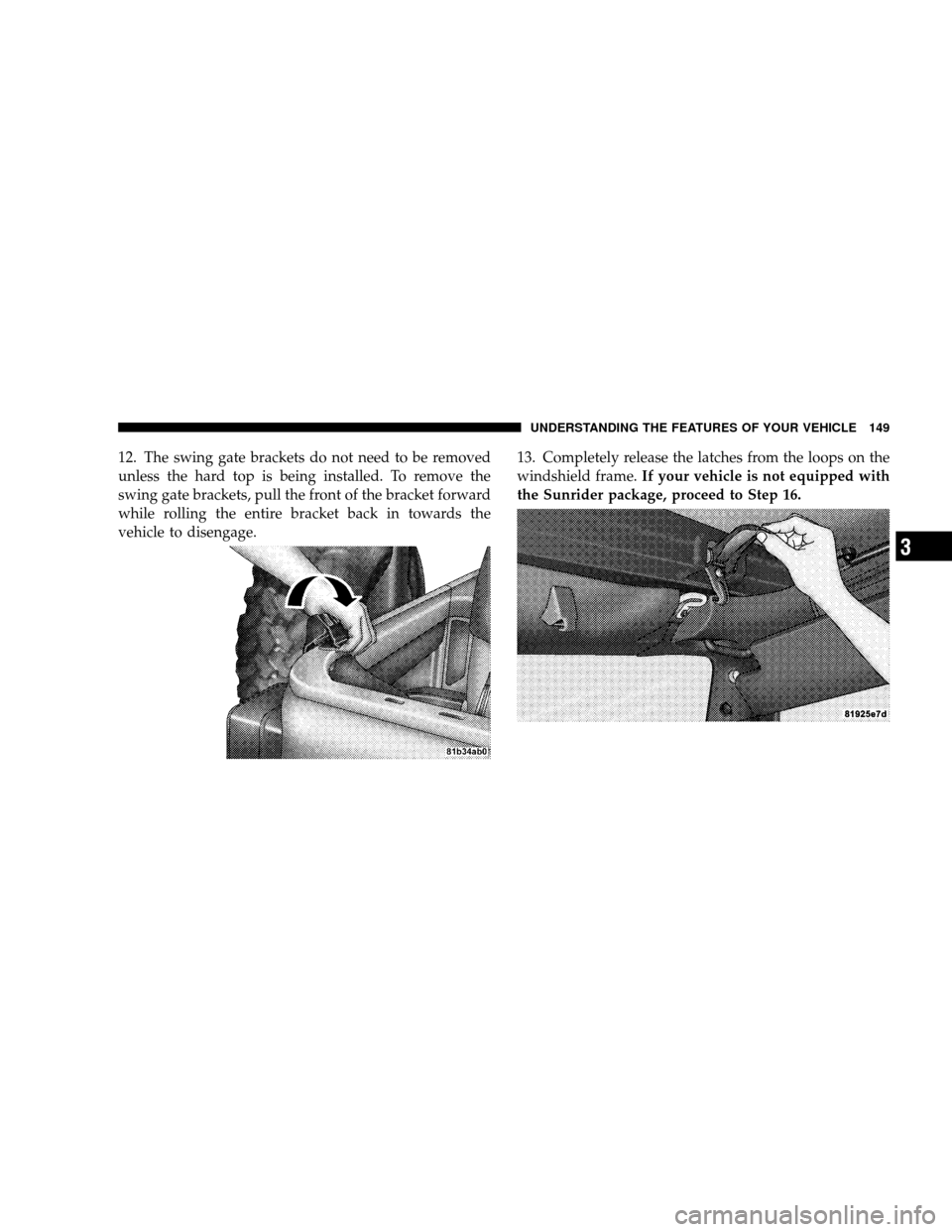
12. The swing gate brackets do not need to be removed
unless the hard top is being installed. To remove the
swing gate brackets, pull the front of the bracket forward
while rolling the entire bracket back in towards the
vehicle to disengage.13. Completely release the latches from the loops on the
windshield frame.
If your vehicle is not equipped with
the Sunrider package, proceed to Step 16.
UNDERSTANDING THE FEATURES OF YOUR VEHICLE 149
3