torque JEEP WRANGLER 2008 JK / 3.G Owners Manual
[x] Cancel search | Manufacturer: JEEP, Model Year: 2008, Model line: WRANGLER, Model: JEEP WRANGLER 2008 JK / 3.GPages: 466, PDF Size: 8.97 MB
Page 107 of 466
WARNING!
ABS (Anti-Lock Brake System) cannot prevent the
natural laws of physics from acting on the vehicle,
nor can it increase the traction afforded by prevailing
road conditions. ABS cannot prevent accidents, in-
cluding those resulting from excessive speed in
turns, driving on very slippery surfaces, or hydro-
planing. Only a safe, attentive, and skillful driver can
prevent accidents. The capabilities of an ABS-
equipped vehicle must never be exploited in a reck-
less or dangerous manner which could jeopardize the
user’s safety or the safety of others.
TCS (Traction Control System)
This system monitors the amount of wheel spin of each of
the driven wheels. If wheel spin is detected, brake
pressure is applied to the slipping wheel(s) to provide
enhanced acceleration and stability. A feature of the TCS
system functions similar to a limited slip differential and
controls the wheel spin across a driven axle. If one wheel
on a driven axle is spinning faster than the other, the
system will apply the brake of the spinning wheel. This
will allow more engine torque to be applied to the wheel
that is not spinning. This feature remains active even if
TCS and ESP are in either the “Partial Off” or “Full Off”
modes. Refer to “ESP (Electronic Stability Program)” in
this section.
106 UNDERSTANDING THE FEATURES OF YOUR VEHICLE
Page 286 of 466
Torque Converter Clutch
A feature designed to improve fuel economy has been
added to the automatic transmission of this vehicle. A
clutch within the torque converter engages automatically
at calibrated speeds. This may result in a slightly differ-
ent feeling or response during normal operation in high
gear. When the vehicle speed drops or during accelera-
tion, the clutch automatically and smoothly disengages.
FOUR–WHEEL DRIVE OPERATION
(COMMAND-TRAC™ OR ROCK-TRAC™) — IF
EQUIPPED
Operating Instructions/Precautions
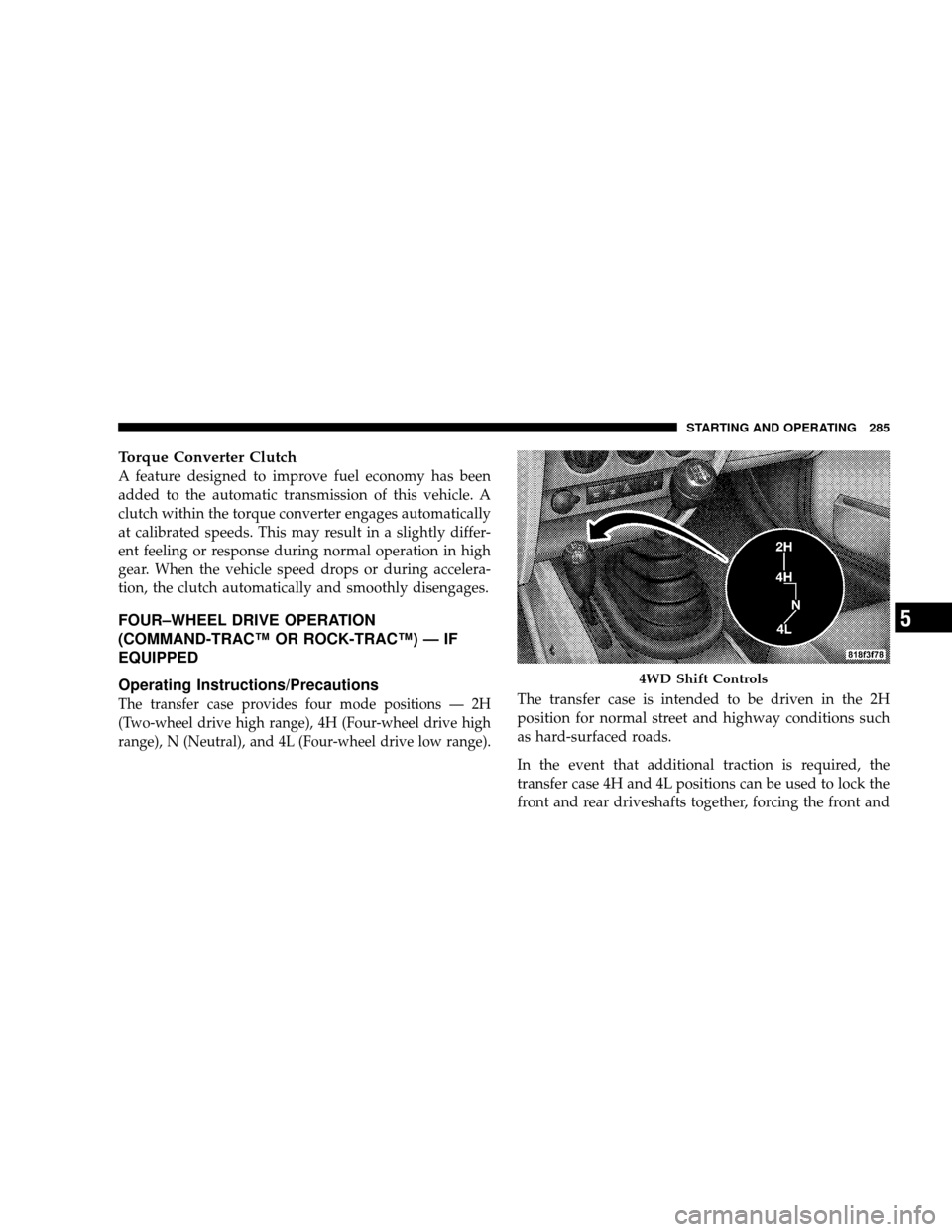
The transfer case provides four mode positions — 2H
(Two-wheel drive high range), 4H (Four-wheel drive high
range), N (Neutral), and 4L (Four-wheel drive low range).The transfer case is intended to be driven in the 2H
position for normal street and highway conditions such
as hard-surfaced roads.
In the event that additional traction is required, the
transfer case 4H and 4L positions can be used to lock the
front and rear driveshafts together, forcing the front and
4WD Shift Controls
STARTING AND OPERATING 285
5
Page 290 of 466
4H to 4L or 4L to 4H
With the vehicle rolling at 2 to 3 mph (3 to 5 km/h), shift
an automatic transmission into NEUTRAL (N), or de-
press the clutch pedal on a manual transmission. While
the vehicle is coasting at 2 to 3 mph (3 to 5 km/h), shift
the transfer case lever firmly to the desired position. Do
not pause with the transfer case in N (Neutral).
NOTE:Shifting into or out of 4L is possible with the
vehicle completely stopped, however, difficulty may oc-
cur due to the mating teeth not being properly aligned.
Several attempts may be required for clutch teeth align-
ment and shift completion to occur. The preferred
method is with the vehicle rolling at 2 to 3 mph (3 to 5
km/h). Avoid attempting to engage or disengage 4L with
the vehicle moving faster than 2 to 3 mph (3 to 5 km/h).WARNING!
Failure to engage a position completely can cause
transfer case damage or loss of power and vehicle
control. You could have an injury accident. Do not
drive the vehicle unless the transfer case is fully
engaged.
TRAC-LOK™ REAR AXLE — IF EQUIPPED
The Trac-Lok™ rear axle provides a constant driving
force to both rear wheels and reduces wheel spin caused
by the loss of traction at one driving wheel. If traction
differs between the two rear wheels, the differential
automatically proportions the usable torque by providing
more torque to the wheel that has traction.
STARTING AND OPERATING 289
5
Page 294 of 466
when activation conditions are not met. The stabilizer/
sway bar should remain in on-road mode during normal
driving conditions.
WARNING!
Do not disconnect the stabilizer bar and drive on
hard surfaced roads or at speeds above 18 mph (29
km/h), you may lose control of the vehicle, which
could result in serious injury. The front stabilizer bar
enhances vehicle stability and is necessary for main-
taining control of the vehicle. The system monitors
vehicle speed and will attempt to reconnect the
stabilizer bar at speeds over 18 mph (29 km/h). This is
indicated by a flashing or solid Sway Bar Indicator
Light. Once vehicle speed is reduced below 14 mph
(22 km/h), the system will once again attempt to
return to off-road mode.To disconnect the stabilizer/sway bar, shift to either 4H
or 4L (refer to “Four Wheel Drive Operation” in this
section) and press the SWAY BAR switch to obtain the
off-road position. The Sway Bar Indicator Light will flash
until the stabilizer/sway bar has been fully disconnected.
NOTE:
The stabilizer/sway bar may be torque locked
due to left and right suspension height differences. This
condition is due to driving surface differences or vehicle
loading. In order for the stabilizer/sway bar to
disconnect/reconnect, the right and left halves of the bar
must be aligned. This alignment may require that the
vehicle be driven onto level ground or rocked from side
to side.
To return to on-road mode, press the SWAY BAR switch
again.
STARTING AND OPERATING 293
5
Page 308 of 466
After Driving Off-Road
Off-road operation puts more stress on your vehicle than
does most on-road driving. After going off-road it is
always a good idea to check for damage. That way you
can get any problems taken care of right away and have
your vehicle ready when you need it.
•Completely inspect the underbody of your vehicle.
Check tires, body structure, steering, suspension, and
exhaust system for damage.
•Check threaded fasteners for looseness, particularly on
the chassis, drivetrain components, steering, and sus-
pension. Retighten them, if required, and torque to the
values specified in the Service Manual.
•Check for accumulations of plants or brush. These
things could be a fire hazard. They might hide damage
to fuel lines, brake hoses, axle pinion seals, and
propeller shafts.
•After extended operation in mud, sand, water, or
similar dirty conditions, have the radiator, brake ro-
tors, wheels, brake linings, and axle yokes inspected
and cleaned as soon as possible.
WARNING!
Abrasive material in any part of the brakes may cause
excessive wear or unpredictable braking. You might
not have full braking power when you need it to
prevent an accident. If you have been operating your
vehicle in dirty conditions, get your brakes checked
and cleaned as necessary.
•If you experience unusual vibration after driving in
mud, slush or similar conditions, check the wheels for
impacted material. Impacted material can cause a
wheel imbalance and freeing the wheels of it will
correct the situation.
STARTING AND OPERATING 307
5
Page 371 of 466
WARNING!
Raising the vehicle higher than necessary can make
the vehicle less stable and cause an accident. It could
slip off the jack and hurt someone near it. Raise the
vehicle only enough to remove the tire.
6. Remove the lug nuts and wheel.
7. Position spare wheel/tire on vehicle and install lug
nuts with cone-shaped end toward wheel. Lightly tighten
nuts clockwise. To avoid the risk of forcing the vehicle off
the jack, do not tighten the nuts fully until the vehicle has
been lowered.
8. Lower the vehicle by turning the jack screw to the left,
and remove the jack and wheel blocks. 9. Finish tightening the lug nuts. Push down on the
wrench while tightening for increased leverage. Alternate
nuts until each nut has been tightened twice. Correct
wheel nut tightness is 95 ft lbs (130 N·m). If in doubt
about the correct tightness, have them checked with a
torque wrench by your authorized dealer or at a service
station.
10. Remove jack assembly and wheel blocks.
WARNING!
A loose tire or jack, thrown forward in a collision or
hard stop, could endanger the occupants of the ve-
hicle. Always stow the jack parts and the spare tire in
the places provided.
11. Secure the tire, jack, and tools in their proper loca-
tions.
370 WHAT TO DO IN EMERGENCIES
Page 402 of 466
Use only brake fluid that has been in a tightly closed
container to avoid contamination from foreign matter or
moisture.
CAUTION!
Do not allow petroleum base fluid to contaminate the
brake fluid. Seal damage will result.
Automatic Transmission
Selection of Lubricant
It is important that the proper lubricant is used in the
transmission to assure optimum transmission perfor-
mance. Use only manufacturer’s recommended transmis-
sion fluid. Refer to Fluids, Lubricants, and Genuine Parts
in this section for the correct fluid type. It is important
that the transmission fluid be maintained at the pre-
scribed level using the recommended fluid.
CAUTION!
Using a transmission fluid other than the manufac-
turer’s recommended fluid may cause deterioration
in transmission shift quality and/or torque converter
shudder. Using a transmission fluid other than the
manufacturer’s recommended fluid will result in
more frequent fluid and filter changes. Refer to
Fluids, Lubricants, and Genuine Parts in this section
for the correct fluid type.
Fluid Level Check — 42RLE
Check the fluid level while the transmission is at normal
operating temperature 180° F (82° C). This occurs after at
least 15 mi (25 km) of driving. At normal operating
temperature the fluid cannot be held comfortably be-
tween the fingertips.
MAINTAINING YOUR VEHICLE 401
7
Page 406 of 466
Drain
First remove fill plug (B), then drain plug (C). Recom-
mended tightening torque for drain and fill plugs is 15 to
25 ft lbs (20 to 34 N·m).
CAUTION!
When replacing plugs, do not overtighten. You could
damage them and cause them to leak.
Selection of Lubricant
Use only manufacturer’s recommended fluid. Refer to
Fluids, Lubricants, and Genuine Parts in this section for
the correct fluid type.
Front/Rear Axle Fluid
Fluid Level Check
Lubricant should be at bottom edge of the oil fill hole.
Adding Fluid
Add lubricant only at the fill hole and only to the level
specified above.
Selection of Lubricant
Use only manufacturer’s recommended fluid. Refer to
Fluids, Lubricants, and Genuine Parts in this section for
the correct fluid type.
Maintenance After Off-Road Driving
After extended operation in mud, sand or water, or
similar dirty conditions, have your brake drums, brake
linings, and axle joints inspected and cleaned as soon as
possible. This will prevent any abrasive material from
causing excessive wear or unpredictable braking action.
MAINTAINING YOUR VEHICLE 405
7
Page 407 of 466
Following off-road usage, completely inspect the under-
body of your vehicle. Check tires, body structure, steer-
ing, suspension and exhaust system for damage. Check
threaded fasteners for looseness, particularly on the
chassis, drivetrain components, steering and suspension.
Retighten, if required, to torque values specified in the
Service Manual. Also check for accumulations of vegeta-
tion or brush that could become a fire hazard, or conceal
damage to fuel lines, brake hoses, axle pinion seals, and
propeller shafts. Check air conditioning drain tube on the
lower dash wall in the engine compartment for mud or
debris, and clean as required. A plugged tube will
adversely affect air conditioning performance.CAUTION!
Under frequent heavy-duty driving conditions,
change all lubricants, and lubricate body compo-
nents more often than in normal service to prevent
excessive wear.
Appearance Care And Protection From Corrosion
Protection Of Body And Paint From Corrosion
Vehicle body care requirements vary according to geo-
graphic locations and usage. Chemicals that make roads
passable in snow and ice, and those that are sprayed on
trees and road surfaces during other seasons, are highly
corrosive to the metal in your vehicle. Outside parking,
which exposes your vehicle to airborne contaminants,
road surfaces on which the vehicle is operated, extreme
406 MAINTAINING YOUR VEHICLE
Page 447 of 466
ABS (Anti-Lock Brake System)............208,309
Adding Fuel ........................... 340
Adding Washer Fluid ..................... 198
Air Cleaner, Engine (Engine Air Cleaner Filter) . . . 389
Air Conditioner Maintenance ............... 390
Air Conditioning ..................... 261,264
Air Conditioning Controls ................. 264
Air Conditioning, Operating Tips ............ 265
Air Conditioning Refrigerant ............... 391
Air Conditioning System .................. 264
Air Filter .............................. 389
Air Pressure, Tires ....................... 322
Airbag ................................ 51
Airbag Deployment ....................... 57
Airbag Light ......................... 60,208
Airbag Maintenance ....................... 59
Airbag, Side ............................ 57
Alarm (Security Alarm) .................... 18
Alignment and Balance ................... 328 Alterations/Modifications, Vehicle
............. 8
Antenna, Satellite Radio ................... 255
Antifreeze (Engine Coolant) ................ 424
Anti-Lock Brake System (ABS) ............105,309
Anti-Lock Warning Light .................. 208
Appearance Care ........................ 406
Arming Theft System (Security Alarm) ......... 18
Audio Systems (Radio) .................... 250
Auto Down Power Windows ................ 37
Automatic Transmission ................... 401
Fluid and Filter Changes ................. 401
Fluid Level Check ...................... 401
Fluid Type ........................... 401
Gear Ranges .......................... 281
Shifting ............................. 281
Special Additives ...................... 403
Torque Converter ...................... 285
Auxiliary Electrical Outlet (Power Outlet) ....... 116
Auxiliary Power Outlet .................... 116
446 INDEX