seats JEEP WRANGLER 2008 Owners Manual
[x] Cancel search | Manufacturer: JEEP, Model Year: 2008, Model line: WRANGLER, Model: JEEP WRANGLER 2008Pages: 466, PDF Size: 8.61 MB
Page 53 of 466
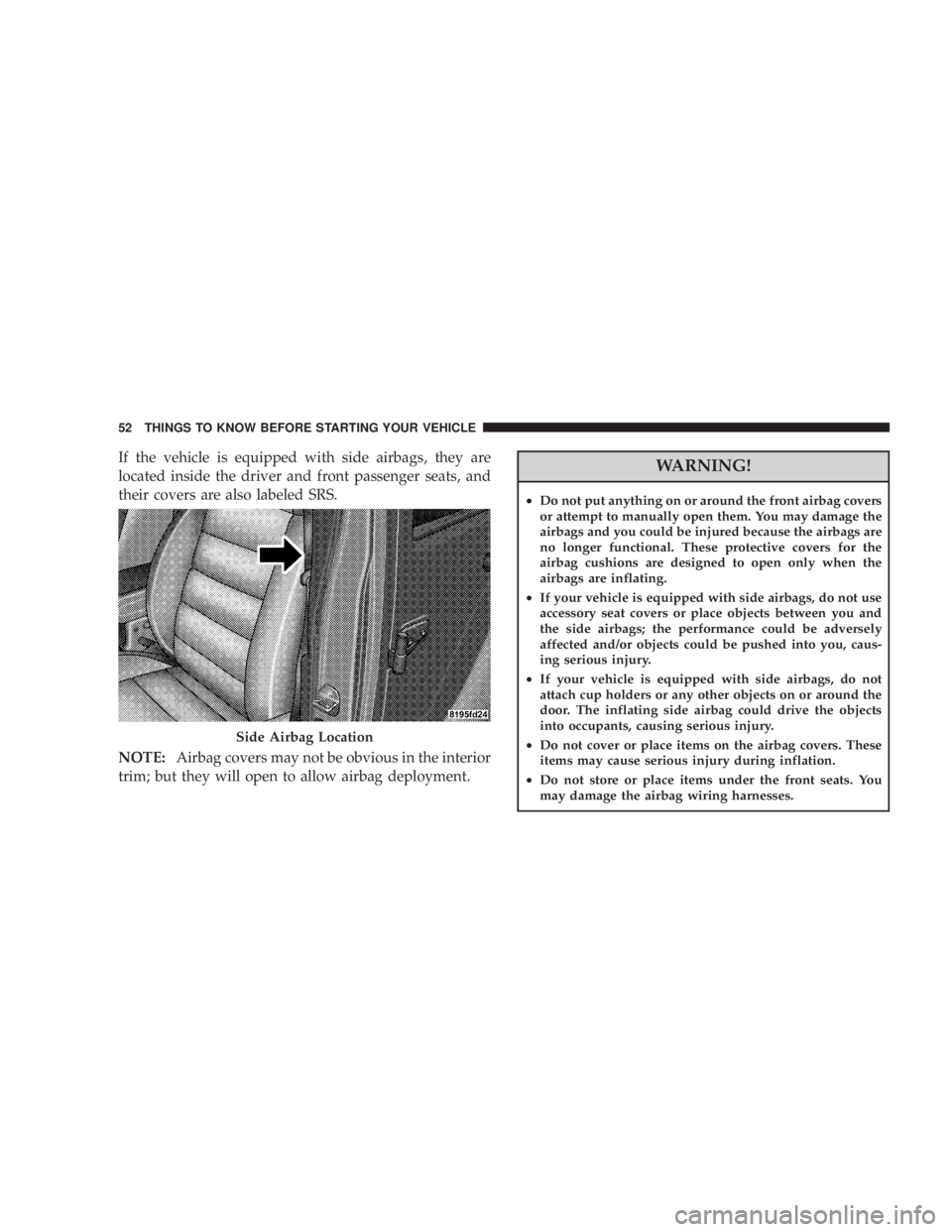
If the vehicle is equipped with side airbags, they are
located inside the driver and front passenger seats, and
their covers are also labeled SRS.
NOTE:Airbag covers may not be obvious in the interior
trim; but they will open to allow airbag deployment.
Page 55 of 466
seat as far back as possible, and use the proper child
restraint. Refer to “Child Restraint” in this section.
You should read the instructions provided with your
child restraint to make sure that you are using it properly.
2. All occupants should use their lap and shoulder belts
properly.
3. The driver and front passenger seats should be moved
back as far as practical to allow the front airbags room to
inflate.
4. If your vehicle has side airbags, do not lean against the
door, airbags will inflate forcefully into the space be-
tween you and the door.
5. If the airbag system in this vehicle needs to be
modified to accommodate a disabled person, contact the
Customer Center. Phone numbers are provided under “If
You Need Assistance” in Section 9 of this manual.
Page 63 of 466
•Airbag deployment level (if applicable)
•Impact acceleration and angle
•Seat belt status
•Brake status (service and parking brakes)
•Accelerator status (including vehicle speed)
•Engine control status (including engine speed)
•Transmission gear selection
•Cruise control status
•Traction/stability control status
•Tire pressure monitoring system (TPMS) status
Child Restraint
Everyone in your vehicle needs to be buckled up at all
times — babies and children, too. Every state in the
United States and all Canadian provinces require that
small children ride in proper restraint systems. This is the
law, and you can be prosecuted for ignoring it.
Children 12 years and under should ride properly buck-
led up in a rear seat, if available. According to crash
statistics, children are safer when properly restrained in
the rear seats, rather than in the front.
There are different sizes and types of restraints for
children from newborn size to the child almost large
enough for an adult safety belt. Always check the child
seat owner’s manual to ensure you have the correct seat
for your child. Use the restraint that is correct for your
child.
62 THINGS TO KNOW BEFORE STARTING YOUR VEHICLE
Page 65 of 466
WARNING!
•Improper installation can lead to failure of an
infant or child restraint. It could come loose in a
collision. The child could be badly injured or
killed. Follow the manufacturer’s directions ex-
actly when installing an infant or child restraint.
•A rearward facing infant restraint should only be
used in a rear seat. A rearward facing infant
restraint in the front seat may be struck by a
deploying passenger airbag which may cause se-
vere or fatal injury to the infant.
Here are some tips for getting the most out of your child
restraint:
•Before buying any restraint system, make sure that it
has a label certifying that it meets all applicable Safety Standards. The manufacturer also recommends that
you try a child restraint in the vehicle seats where you
will use it before you buy it.
•The restraint must be appropriate for your child’s
weight and height. Check the label on the restraint for
weight and height limits.
•Carefully follow the instructions that come with the
restraint. If you install the restraint improperly, it may
not work when you need it.
•All seating positions (except for driver) have a auto-
matic locking retractor identified by a distinctive label.
The seat belts are designed to keep the lap portion
tight around the child restraint so that it is not
necessary to use a locking clip. For the seat belt with
the automatic locking retractor, pull the belt from the
retractor until there is enough to allow you to pass
through the child restraint and slide the latch plate
into the buckle. Then, pull the belt until it is fully
64 THINGS TO KNOW BEFORE STARTING YOUR VEHICLE
Page 67 of 466
vehicle by the lap/shoulder belt or the LATCH child
restraint anchorage system (Refer to LATCH — Child
Seat Anchorage System in this section).
The belt-positioning booster seat is for children weighing
more than 40 lbs (18 kg), but who are still too small to fit
the vehicle’s seat belts properly. If the child cannot sit
with knees bent over the vehicle’s seat cushion while the
child’s back is against the seatback, they should use a
belt-positioning booster seat. The child and belt-
positioning booster seat are held in the vehicle by the
lap/shoulder belt.
Children Too Large for Booster Seats
Children who are large enough to wear the shoulder belt
comfortably, and whose legs are long enough to bend
over the front of the seat when their back is against the
seatback, should use the lap/shoulder belt in a rear seat.
•Make sure that the child is upright in the seat.
•The lap portion should be low on the hips and as snug
as possible.
•Check belt fit periodically. A child’s squirming or
slouching can move the belt out of position.
•If the shoulder belt contacts the face or neck, move the
child closer to the center of the vehicle. Never allow a
child to put the shoulder belt under an arm or behind
the back.
Automatic-Locking Retractor (ALR)
To operate the switchable retractor, pull the belt from the
retractor until there is enough to allow you to pass
through the child restraint and slide the latch plate into
the buckle. Then pull on the belt until it is fully extended
from the retractor. Allow the belt to return into the
retractor, pulling on the excess webbing to tighten the lap
portion about the child restraint. Follow the instructions
of the child restraint manufacture.
66 THINGS TO KNOW BEFORE STARTING YOUR VEHICLE
Page 87 of 466
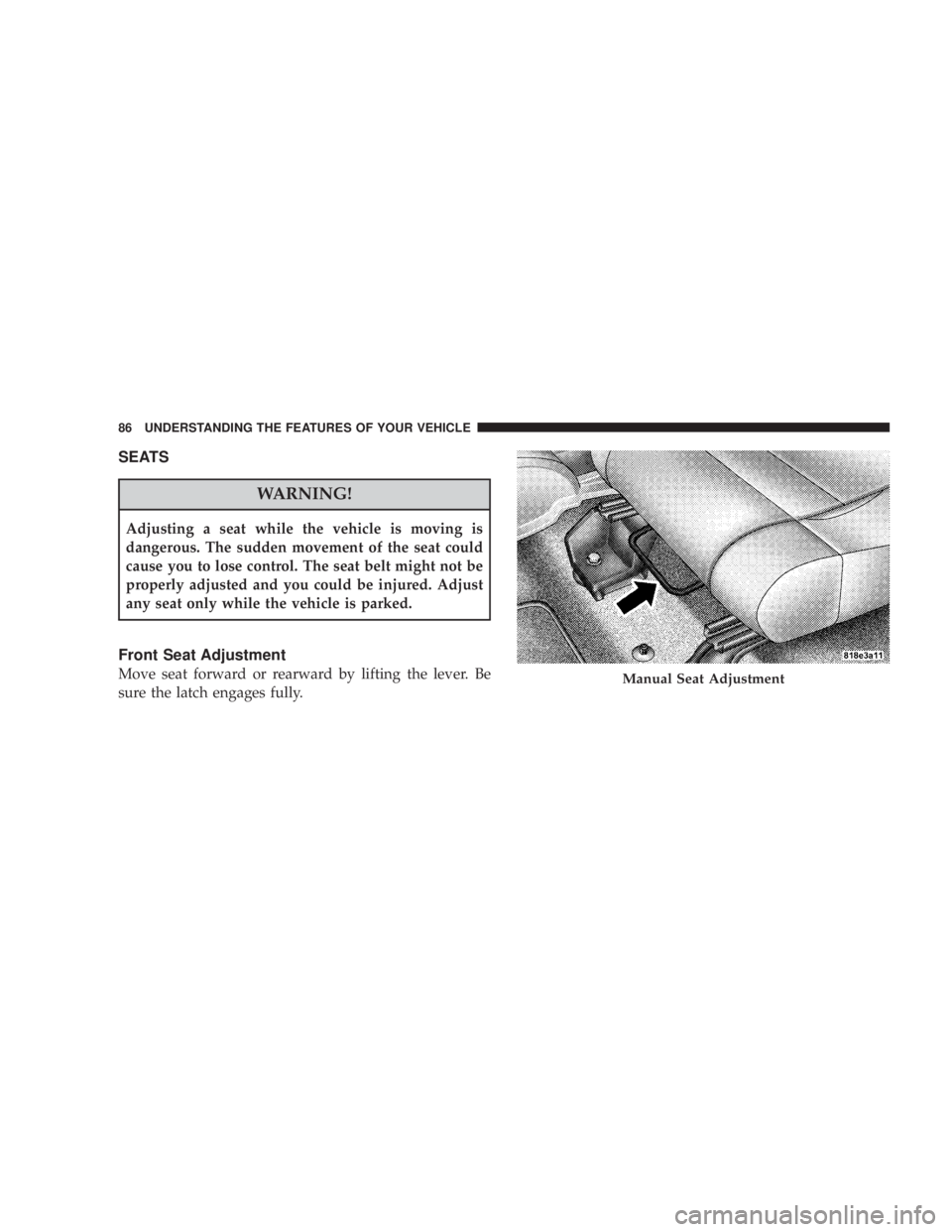
SEATS
Page 89 of 466
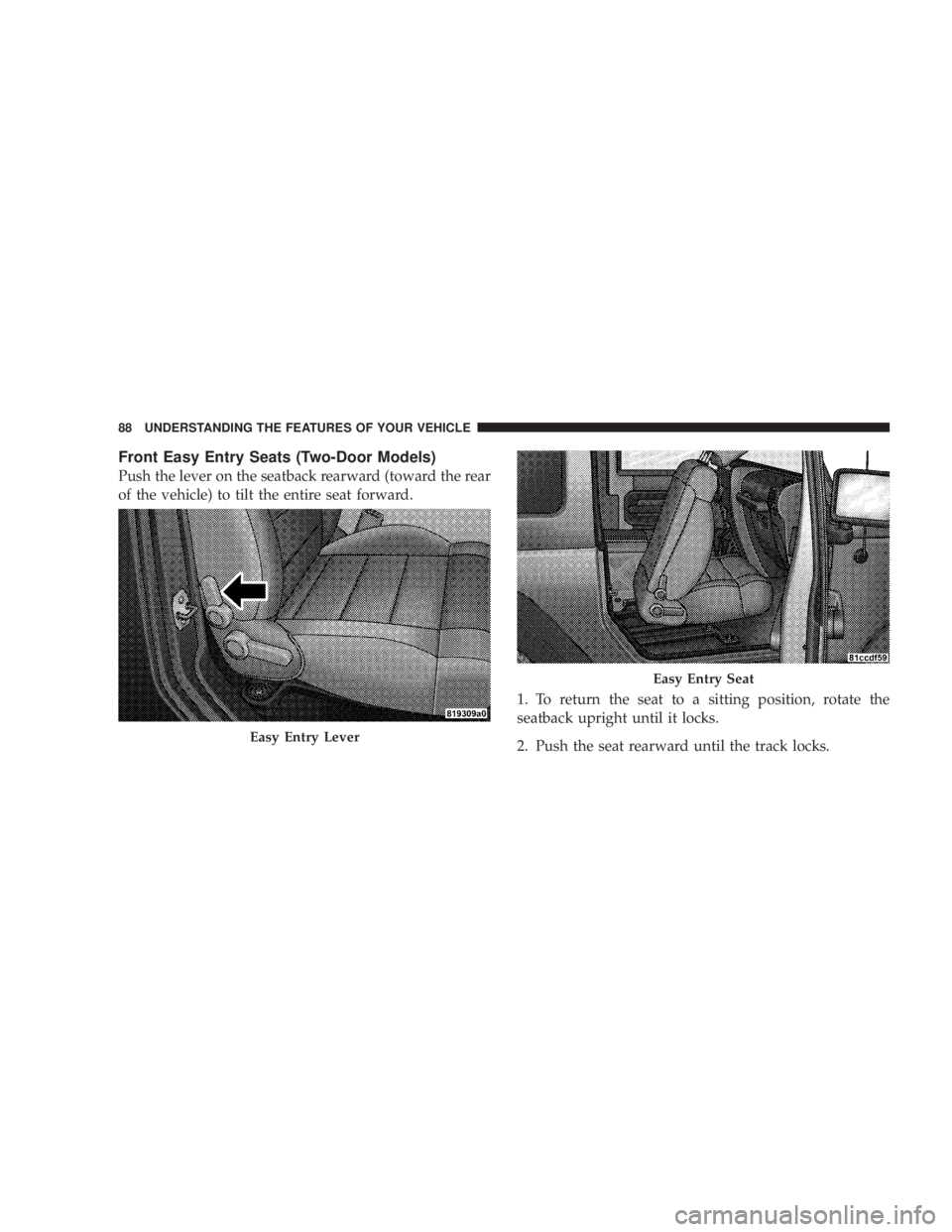
Front Easy Entry Seats (Two-Door Models)
Push the lever on the seatback rearward (toward the rear
of the vehicle) to tilt the entire seat forward.1. To return the seat to a sitting position, rotate the
seatback upright until it locks.
2. Push the seat rearward until the track locks.
Page 91 of 466
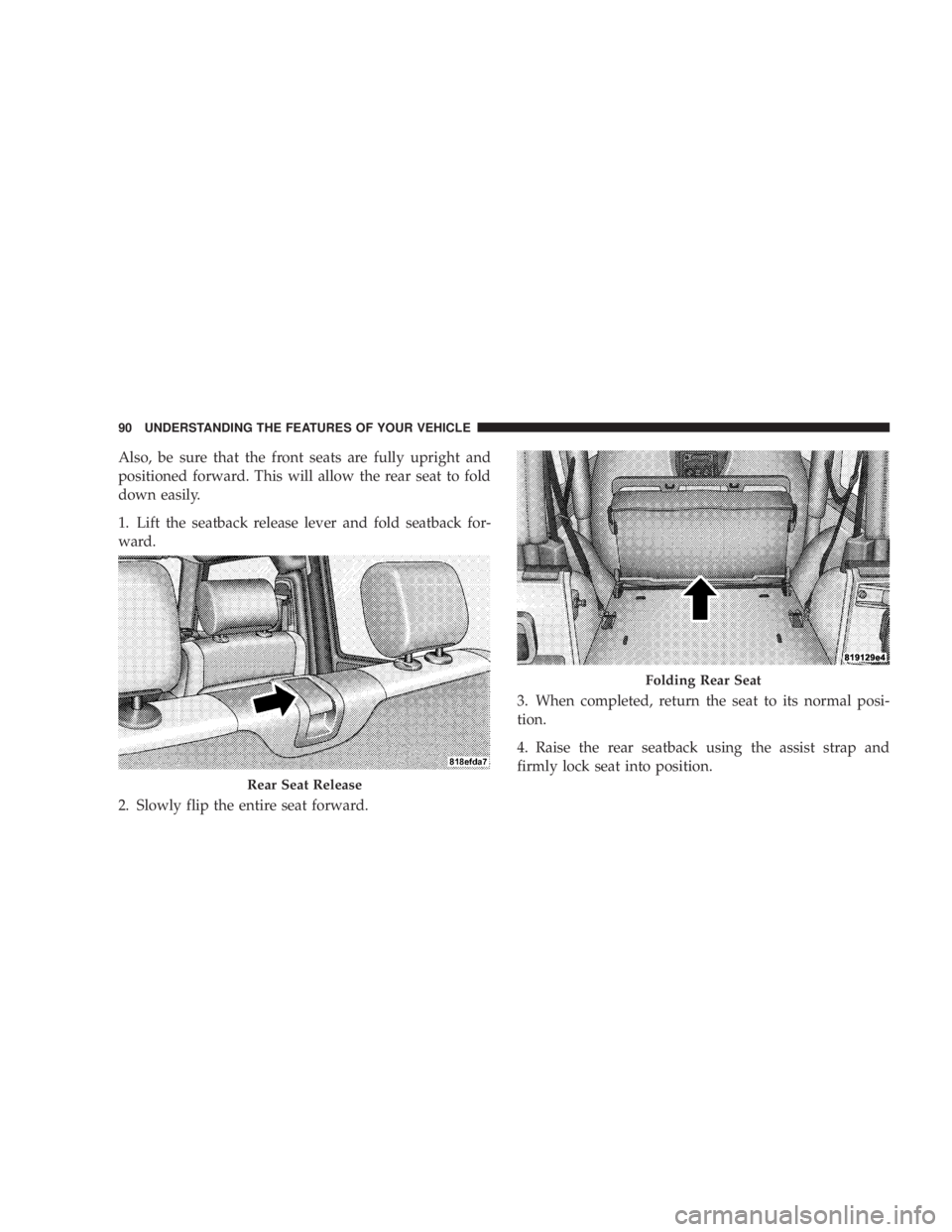
Also, be sure that the front seats are fully upright and
positioned forward. This will allow the rear seat to fold
down easily.
1. Lift the seatback release lever and fold seatback for-
ward.
2. Slowly flip the entire seat forward.3. When completed, return the seat to its normal posi-
tion.
4. Raise the rear seatback using the assist strap and
firmly lock seat into position.
Page 459 of 466
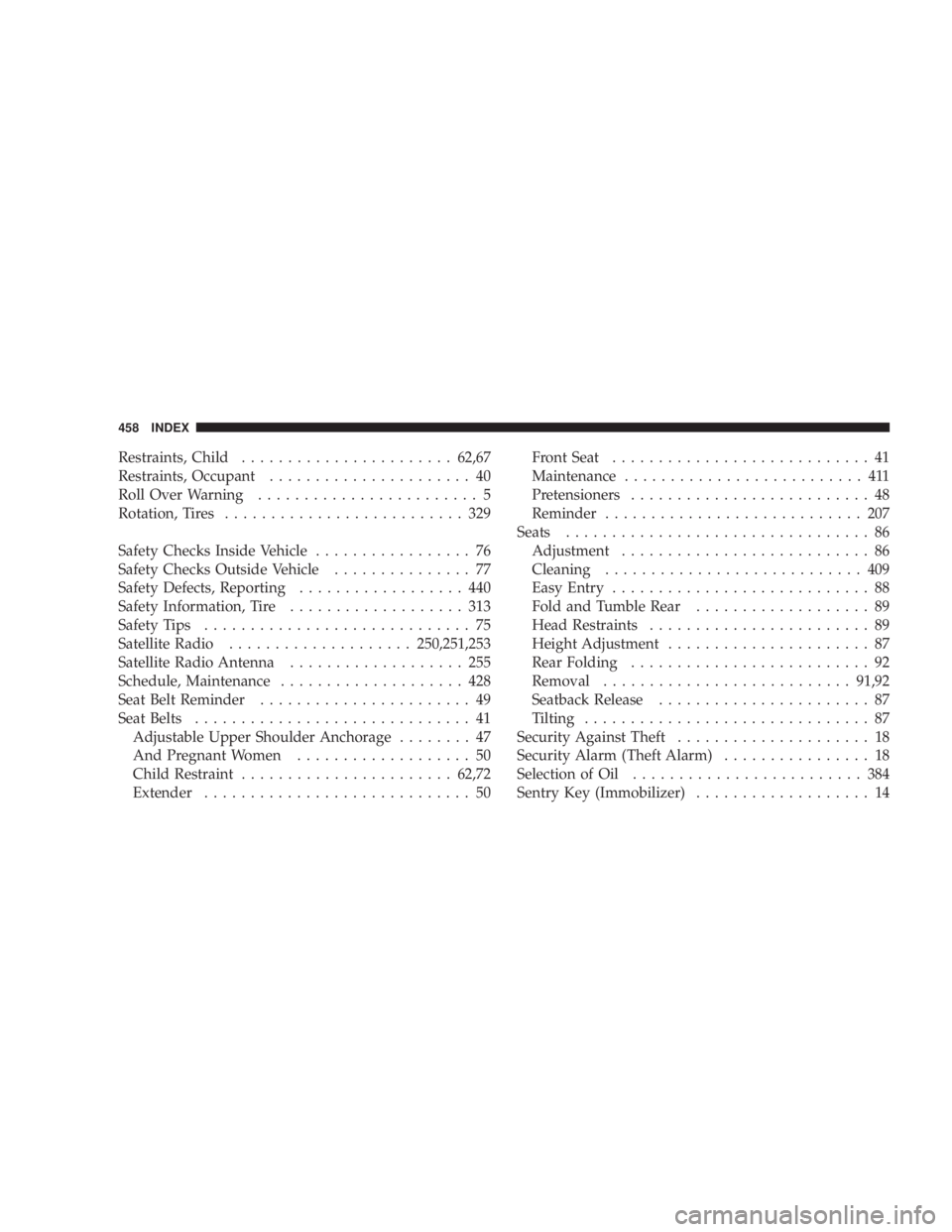
Restraints, Child....................... 62,67
Restraints, Occupant ...................... 40
Roll Over Warning ........................ 5
Rotation, Tires .......................... 329
Safety Checks Inside Vehicle ................. 76
Safety Checks Outside Vehicle ............... 77
Safety Defects, Reporting .................. 440
Safety Information, Tire ................... 313
Safety Tips ............................. 75
Satellite Radio .................... 250,251,253
Satellite Radio Antenna ................... 255
Schedule, Maintenance .................... 428
Seat Belt Reminder ....................... 49
Seat Belts .............................. 41
Adjustable Upper Shoulder Anchorage ........ 47
And Pregnant Women ................... 50
Child Restraint ....................... 62,72
Extender ............................. 50 Front Seat
............................ 41
Maintenance .......................... 411
Pretensioners .......................... 48
Reminder ............................ 207
Seats ................................. 86
Adjustment ........................... 86
Cleaning ............................ 409
Easy Entry ............................ 88
Fold and Tumble Rear ................... 89
Head Restraints ........................ 89
Height Adjustment ...................... 87
Rear Folding .......................... 92
Removal ........................... 91,92
Seatback Release ....................... 87
Tilting ............................... 87
Security Against Theft ..................... 18
Security Alarm (Theft Alarm) ................ 18
Selection of Oil ......................... 384
Sentry Key (Immobilizer) ................... 14
458 INDEX
Page 465 of 466

INTRODUCTION INTRODUCTION ROLLOVER WARNING HOW TO USE THIS MANUAL WARNINGS AND CAUTIONS VEHICLE IDENTIFICATION NUMBER VEHICLE MODIFICATIONS/ALTERATIONS THINGS TO KNOW BEFORE STARTING YOUR VEHICLE A WORD
ABOUT YOUR KEYS Ignition Key RemovalKey-In-Ignition ReminderSTEERING WHEEL LOCK To Manually Lock the Steering WheelTo Release the Steering Wheel LockSENTRY KEY Replacement KeysCustomer Key ProgrammingGeneral InformationSECURITY ALARM
SYSTEM - IF EQUIPPED To Set the AlarmTo Disarm the SystemILLUMINATED ENTRY REMOTE KEYLESS ENTRY - IF EQUIPPED To Unlock the Doors and Swing GateTo Lock the Doors and Swing GateUsing The Panic AlarmTo Turn Off Flash Lights With Lock
Programming Additional TransmittersGeneral InformationBattery ReplacementREMOTE STARTING SYSTEM - IF EQUIPPED DOORS Upper Half Door Window Removal (If Equipped)Upper Half Door Window Installation (If Equipped)Front Door RemovalRear Door Removal
(Four-Door Models)DOOR LOCKS Manual Door LocksPower Door Locks - If EquippedAutomatic Unlock Doors On ExitAutomatic Door LocksWINDOWS Power Windows - If EquippedRear Power Windows (Four-Door Models Only)Wind BuffetingREAR SWING GATE
OCCUPANT RESTRAINTS Lap/Shoulder BeltsRear Center Lap/Shoulder Belt Retractor Lock-Out (Four-Door Models Only)Adjustable Upper Shoulder Belt AnchorageSeat Belt PretensionersEnhanced Seat Belt Use Reminder System (BeltAlert)Seat Belts And Pregnant
WomenSeat Belt ExtenderDriver And Front Passenger Supplemental Restraint Systems (SRS) Child RestraintENGINE BREAK-IN RECOMMENDATIONS SAFETY TIPS Exhaust GasSafety Checks You Should Make Inside The VehicleSafety Checks You Should Make
Outside The VehicleUNDERSTANDING THE FEATURES OF YOUR VEHICLE MIRRORS Inside Day/Night MirrorOutside MirrorsHANDS-FREE COMMUNICATION (UConnect) SEATS Front Seat AdjustmentManual Seat Height Adjustment - If EquippedFront Seatback
ReclineFront Easy Entry Seats (Two-Door Models)Head RestraintsFold And Tumble Rear Seat (Two-Door Models)Removing the Rear Seat (Two-Door Models)Replacing the Rear Seat (Two-Door Models)60/40 Split Folding Rear Seat (Four-Door Models)To Raise the Rear
SeatTO OPEN AND CLOSE THE HOOD LIGHTS Interior LightsMultifunction Control LeverParking Lights, Instrument Panel Lights, and HeadlightsLights-On ReminderHeadlight Dimmer SwitchPassing LightFront Fog Lights - If EquippedTurn SignalsDaytime Running Lights
- If EquippedWINDSHIELD WIPERS AND WASHERS Intermittent Wiper SystemWindshield Wiper OperationWindshield WashersMist FeatureTILT STEERING COLUMN ELECTRONIC SPEED CONTROL - IF EQUIPPED To ActivateTo Set At A Desired SpeedTo Deactivate
To Resume SpeedTo Vary The Speed SettingManual TransmissionTo Accelerate For PassingELECTRONIC BRAKE CONTROL SYSTEM ABS (Anti-Lock Brake System)TCS (Traction Control System)BAS (Brake Assist System)ERM (Electronic Roll Mitigation)ESP (Electronic
Stability Program)ESP/BAS Warning LightELECTRICAL POWER OUTLET Electrical Outlet Use With Engine OffCUPHOLDERS Front CupholdersRear CupholdersSTORAGE Console Storage CompartmentRear Storage CompartmentDUAL TOP - IF EQUIPPED Removing
The Soft TopInstalling the Soft TopFREEDOM TOP THREE-PIECE MODULAR HARD TOP Front Panel(s) RemovalFront Panel(s) InstallationFront Panel(s) Installation Only (With Rear Hard Top Removed)Rear Hard Top RemovalRear Hard Top InstallationDOOR FRAME
Door Frame Removal (Two-Door Models)Door Frame Installation (Two-Door Models)Door Frame Removal (Four-Door Models)Door Frame Installation (Four-Door Models)SOFT TOP (TWO-DOOR MODELS) Folding Down The Soft Top Putting Up The Soft Top SUNRIDER
(TWO-DOOR MODELS) - IF EQUIPPED SUNRIDER (FOUR-DOOR MODELS) - IF EQUIPPED SOFT TOP (FOUR-DOOR MODELS) Folding Down The Soft Top Putting Up The Soft Top FOLDING WINDSHIELD Lowering The Windshield And Removing Side BarsRaising
The Windshield And Replacing Side BarsREAR WINDOW FEATURES - HARD TOP ONLY Rear Window Wiper/Washer - If EquippedRear Window Defroster - If EquippedUNDERSTANDING YOUR INSTRUMENT PANEL INSTRUMENT PANEL AND CONTROLS
INSTRUMENT CLUSTER INSTRUMENT CLUSTER DESCRIPTION COMPASS AND TRIP COMPUTER - IF EQUIPPED Control ButtonsTrip ConditionsCompass Temperature DisplayRADIO GENERAL INFORMATION Radio Broadcast SignalsTwo Types of SignalsElectrical
DisturbancesAM ReceptionFM ReceptionSALES CODE RES - AM/FM STEREO RADIO WITH CD PLAYER (MP3 AUX JACK) Operating Instructions - Radio ModeOperation Instructions - CD MODE for CD and MP3 Audio PlayNotes On Playing MP3 FilesLIST Button (CD
Mode for MP3 Play)INFO Button (CD Mode for MP3 Play)SALES CODE REQ - AM/FM STEREO RADIO AND 6-DISC CD/DVD CHANGER (MP3/WMA AUX JACK) Operating Instructions - Radio ModeOperation Instructions - (DISC MODE for CD and MP3/WMA Audio
Play, DVD-VIDEO)Notes On Playing MP3/WMA FilesLIST Button (DISC Mode for MP3/WMA Play)INFO Button (DISC Mode for MP3/WMA Play)SALES CODE RER - MULTIMEDIA SYSTEM - IF EQUIPPED Operating Instructions - Satellite RadioOperating Instructions -
Hands-Free Communication (UConnect) (If Equipped)Clock Setting ProcedureSATELLITE RADIO - IF EQUIPPED (REN/REQ/RER/RES RADIOS ONLY) System Act ivationElectronic Serial Number/Sirius Identification Number (ESN/SID)Selecting Satellite ModeSatellite
AntennaReception QualityOperating Instructions - Satellite ModeOperating Instructions - Hands-Free Phone (If Equipped)Operating Instruction s - Video Entertainment System (VES) (If Equipped)CD/DVD DISC MAINTENANCE RADIO OPERATION AND CELLULAR
PHONES CLIMATE CONTROLS Manual Heater OnlyManual Air Conditioning and Heating System - If EquippedAir ConditioningOperating TipsSTARTING AND OPERATING STARTING PROCEDURES Manual TransmissionAutomatic TransmissionNormal StartingExtreme
Cold Weather (below -20 degrees F or -29 degrees C)If Engine Fails to StartAfter StartingENGINE BLOCK HEATER - IF EQUIPPED MANUAL TRANSMISSION ShiftingDownshiftingReverse ShiftingAUTOMATIC TRANSMISSION Shift Lock Manual Override
Brake/Transmission Interlock SystemAutomatic Transmission with OverdriveFOUR-WHEEL DRIVE OPERATION (COMMAND-TRAC OR ROCK-TRAC) - IF EQUIPPED Operating Instructions/PrecautionsShift PositionsShifting ProcedureTRAC-LOK REAR AXLE - IF
EQUIPPED AXLE LOCK (TRU-LOK) - RUBICON MODELS REAR AXLE LOCK - 4WD NON-RUBICON MODELS (IF EQUIPPED) ELECTRONIC SWAY BAR DISCONNECT - IF EQUIPPED ON-ROAD DRIVING TIPS OFF-ROAD DRIVING TIPS Side Step Removal - If
EquippedThe Basics of Off-Road DrivingWhen To Use 4L (Low) RangeSimultaneous Brake And Throttle OperationDriving In Snow, Mud and SandCrossing Obstacles (Rocks And Other High Points)Hill ClimbingDriving Through WaterAfter Driving Off-RoadPARKING BRAKE
ANTI-LOCK BRAKE SYSTEM POWER STEERING TIRE SAFETY INFORMATION Tire Markings Tire Identification Number (TIN)Tire Loading and Tire PressureTIRES - GENERAL INFORMATION Tire PressureTire Inflation Pressures Tire Pressures for High-Speed Operation
Radial-Ply TiresTire SpinningTread Wear IndicatorsLife of TireReplacement TiresAlignment and BalanceTIRE CHAINS TIRE ROTATION RECOMMENDATIONS TIRE PRESSURE MONITOR SYSTEM (TPMS) Base SystemGeneral InformationFUEL REQUIREMENTS
Reformulated GasolineGasoline/Oxygenate BlendsMMT In GasolineMaterials Added To FuelFuel System CautionsCarbon Monoxide WarningsADDING FUEL Fuel Filler Cap (Gas Cap)VEHICLE LOADING Certification LabelTRAILER TOWING Common Towing Definitions
Trailer Hitch ClassificationTrailer Towing Weights (Maximum Trailer Weight Ratings)Trailer and Trailer Tongue WeightTowing RequirementsTowing TipsRECREATIONAL TOWING (BEHIND MOTORHOME, ETC.) Towing - 2WD ModelsTowing - 4WD ModelsWHAT TO DO
IN EMERGENCIES HAZARD WARNING FLASHERS IF YOUR ENGINE OVERHEATS JACKING AND TIRE CHANGING Jack LocationSpare Tire StowagePreparations For JackingJacking Instructions JUMP STARTING EMERGENCY TOW HOOKS - IF EQUIPPED TOWING
A DISABLED VEHICLE MAINTAINING YOUR VEHICLE ENGINE COMPARTMENT - 3.8L ONBOARD DIAGNOSTIC SYSTEM - OBD II Loose Fuel Filler Cap MessageEMISSIONS INSPECTION AND MAINTENANCE PROGRAMS REPLACEMENT PARTS AUTHORIZED
DEALER SERVICE MAINTENANCE PROCEDURES Engine OilDrive Belts - Check Condition and TensionSpark PlugsCatalytic ConverterCrankcase Emission Control SystemFuel FilterEngine Air Cleaner FilterMaintenance-Free BatteryAir Conditioner MaintenancePower
Steering Fluid CheckDriveline And Steering Component LubricationBody LubricationWindshield Wiper BladesWindshield And Rear Window WashersExhaust SystemCooling SystemHoses and Vacuum/Vapor HarnessesBrake SystemAutomatic TransmissionHydraulic Clutch
Fluid - Manual TransmissionManual TransmissionTransfer CaseFront/Rear Axle FluidMaintenance After Off-Road DrivingAppearance Care And Protection From CorrosionFUSES (TOTALLY INTEGRATED POWER MODULE) VEHICLE STORAGE REPLACEMENT BULBS
- IF EQUIPPED BULB REPLACEMENT Head LightFront Park/Turn SignalFront Side MarkerFront Fog LightRear Tail, Stop, Turn Signal, and Backup LightsCenter High-Mounted Stop Light (CHMSL)FLUID CAPACITIES FLUIDS, LUBRICANTS AND GENUINE PARTS Engine
ChassisMAINTENANCE SCHEDULES EMISSIONS CONTROL SYSTEM MAINTENANCE MAINTENANCE SCHEDULE Required Maintenance IntervalsIF YOU NEED CONSUMER ASSISTANCE SUGGESTIONS FOR OBTAINING SERVICE FOR YOUR VEHICLE Prepare
For The AppointmentPrepare A ListBe Reasonable With RequestsIF YOU NEED ASSISTANCE DaimlerChrysler Motors Corporation Customer CenterDaimlerChrysler Canada Inc. Customer CenterIn Mexico contactCustomer Assistance For The Hearing Or Speech Impaired
(TDD/TTY)Service ContractWARRANTY INFORMATION (U.S. Vehicles Only) MOPAR PARTS REPORTING SAFETY DEFECTS In The 50 United States And Washington, D.CIn CanadaPUBLICATION ORDER FORMS DEPARTMENT OF TRANSPORTATION UNIFORM
TIRE QUALITY GRADES TreadwearTraction GradesTemperature GradesINDEX