transmission JEEP WRANGLER 2009 User Guide
[x] Cancel search | Manufacturer: JEEP, Model Year: 2009, Model line: WRANGLER, Model: JEEP WRANGLER 2009Pages: 502, PDF Size: 13.82 MB
Page 282 of 502
If the engine shows no sign of starting after two 15–
second periods of cranking with the accelerator pedal
held to the floor, repeat the “Normal Starting” or “Ex-
treme Cold Weather” procedures.
With Tip Start — Automatic Transmission Only
If the engine fails to start after you have followed the
“Normal Starting” or “Extreme Cold Weather” proce-
dures, it may be flooded. To clear any excess fuel, push
the accelerator pedal all the way to the floor and hold it.
Then, turn the ignition switch to the START position and
release it as soon as the starter engages. The starter motor
will disengage automatically in 10 seconds. Once this
occurs, release the accelerator pedal, turn the ignition
switch to the LOCK position, wait 10 to 15 seconds, then
repeat the “Normal Starting” procedure.
Page 284 of 502
NOTE:During cold weather, you may experience in-
creased effort in shifting until the transmission fluid
warms up. This is normal.Shifting
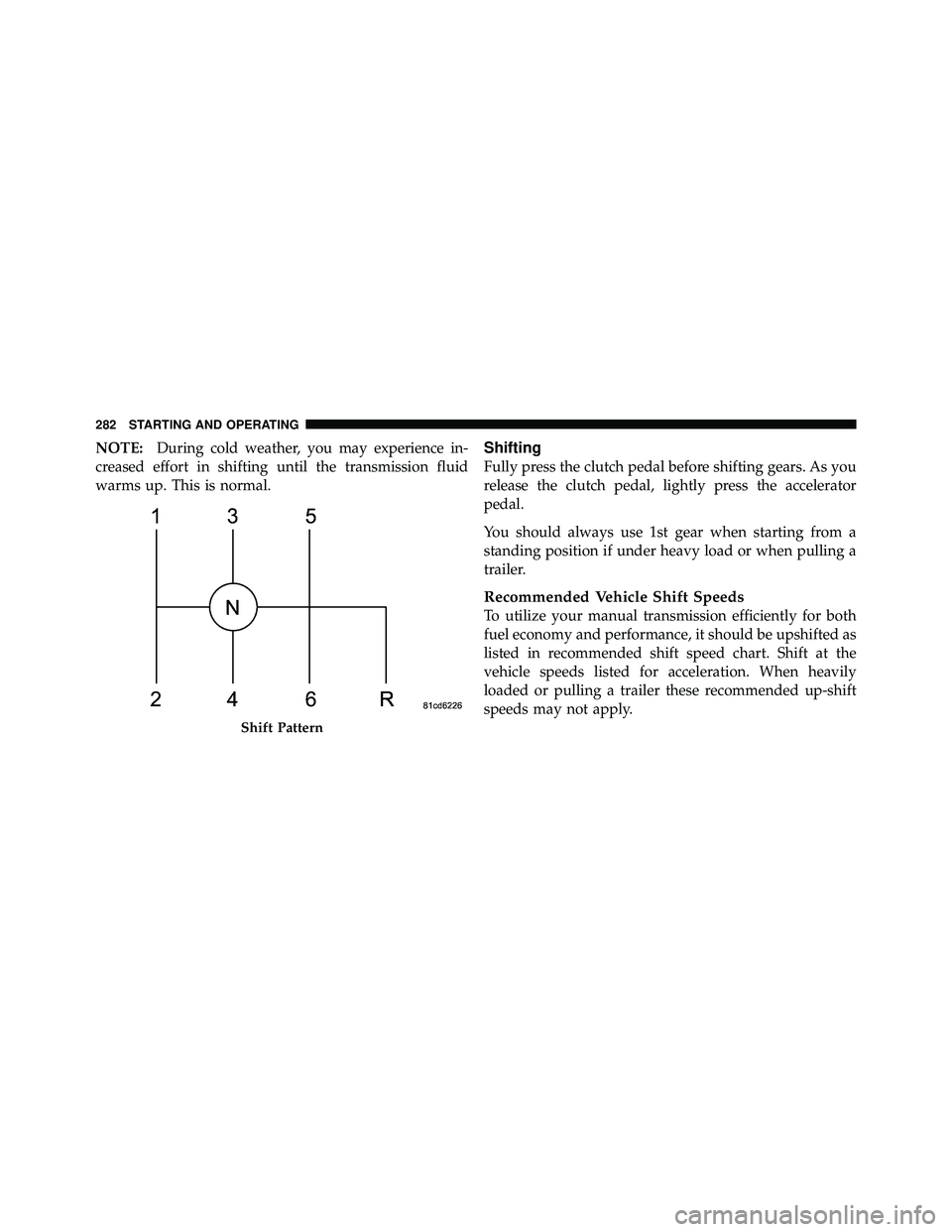
Fully press the clutch pedal before shifting gears. As you
release the clutch pedal, lightly press the accelerator
pedal.
You should always use 1st gear when starting from a
standing position if under heavy load or when pulling a
trailer.
Recommended Vehicle Shift Speeds
To utilize your manual transmission efficiently for both
fuel economy and performance, it should be upshifted as
listed in recommended shift speed chart. Shift at the
vehicle speeds listed for acceleration. When heavily
loaded or pulling a trailer these recommended up-shift
speeds may not apply.
Page 288 of 502
Brake/Transmission Interlock System
This vehicle is equipped with a Brake Transmission Shift
Interlock System (BTSI) that holds the shift lever in the
PARK position when the ignition switch is in the LOCK
position. To move the shift lever out of the PARK
position, the ignition switch must be turned to any other
switch position (ACC, ON, or START) (engine running or
not) and the brake pedal must be pressed.
Brake/Transmission Interlock Manual Override
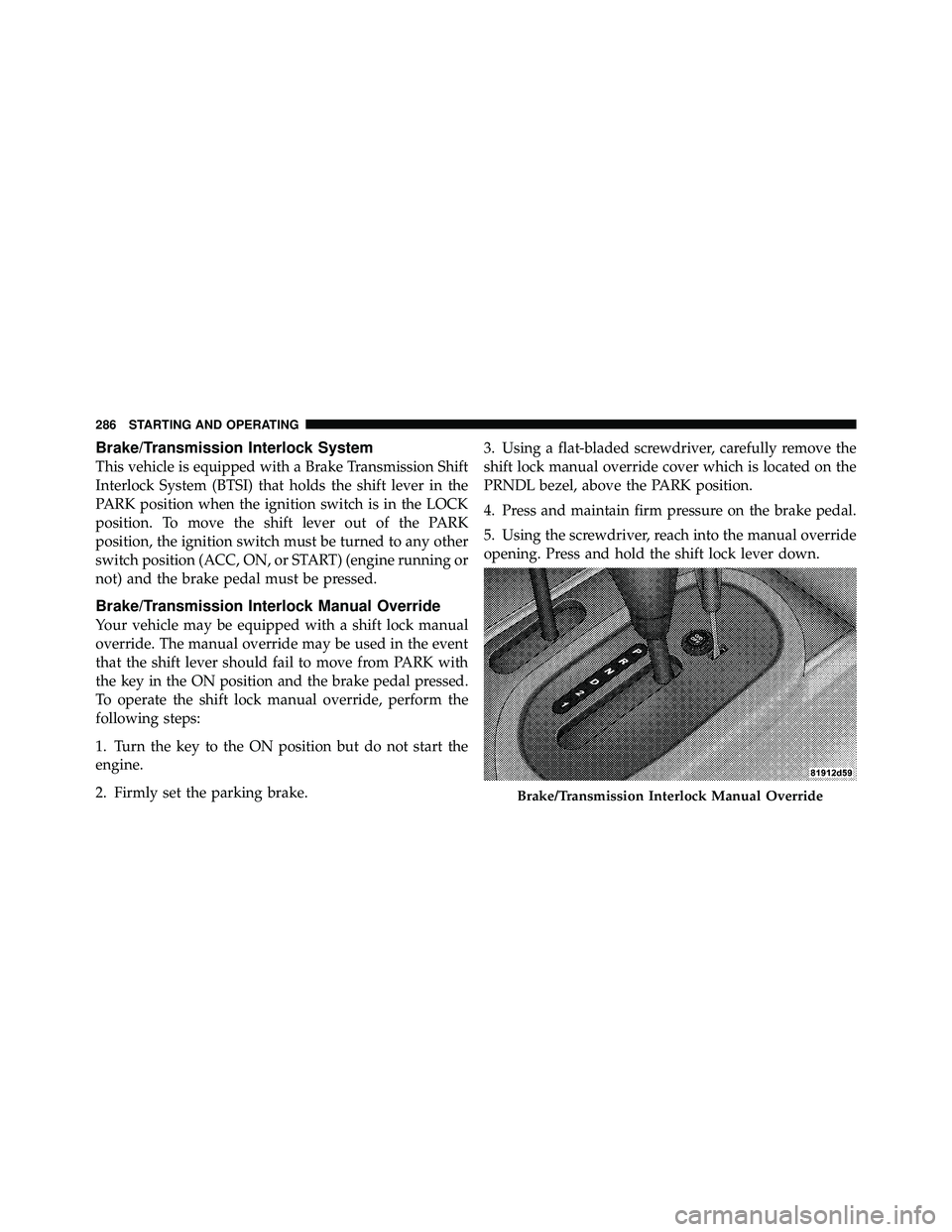
Your vehicle may be equipped with a shift lock manual
override. The manual override may be used in the event
that the shift lever should fail to move from PARK with
the key in the ON position and the brake pedal pressed.
To operate the shift lock manual override, perform the
following steps:
1. Turn the key to the ON position but do not start the
engine.
2. Firmly set the parking brake.3. Using a flat-bladed screwdriver, carefully remove the
shift lock manual override cover which is located on the
PRNDL bezel, above the PARK position.
4. Press and maintain firm pressure on the brake pedal.
5. Using the screwdriver, reach into the manual override
opening. Press and hold the shift lock lever down.
Page 290 of 502
Gear Ranges
NOTE:Under extreme cold temperatures (-10°F (-23°C)
and when in DRIVE, transmission operation may be
briefly limited to only second gear operation. Normal
operation will resume once the transmission temperature
has risen to a suitable level.
DO NOT race the engine when shifting from PARK or
NEUTRAL position into another gear range.
PARK
This range supplements the parking brake by locking the
transmission. The engine can be started in this range.
Never use PARK while the vehicle is in motion. Apply
the parking brake when leaving the vehicle in this range.
Always apply the parking brake first, then place the shift
lever in the PARK position.
Page 292 of 502
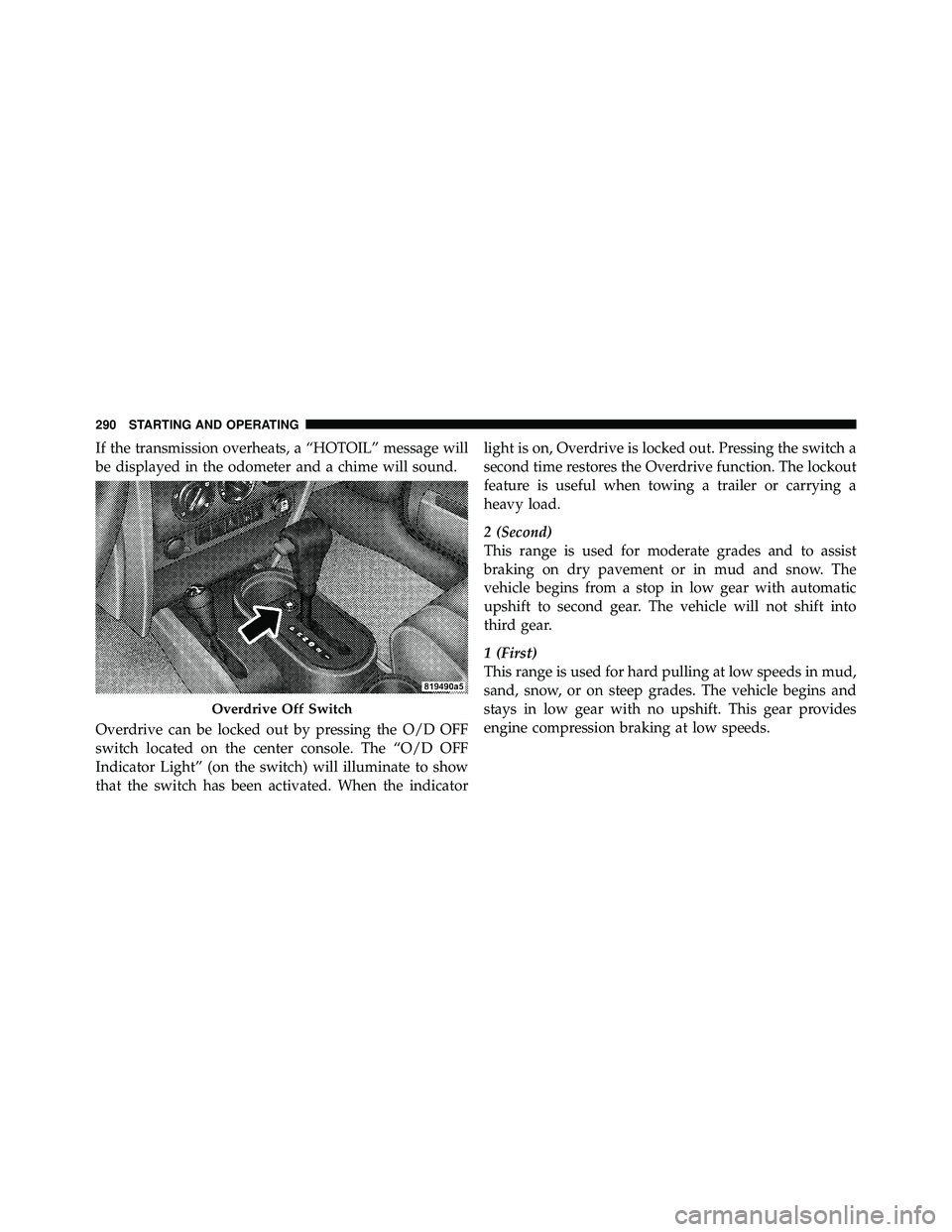
If the transmission overheats, a “HOTOIL” message will
be displayed in the odometer and a chime will sound.
Overdrive can be locked out by pressing the O/D OFF
switch located on the center console. The “O/D OFF
Indicator Light” (on the switch) will illuminate to show
that the switch has been activated. When the indicatorlight is on, Overdrive is locked out. Pressing the switch a
second time restores the Overdrive function. The lockout
feature is useful when towing a trailer or carrying a
heavy load.
2 (Second)
This range is used for moderate grades and to assist
braking on dry pavement or in mud and snow. The
vehicle begins from a stop in low gear with automatic
upshift to second gear. The vehicle will not shift into
third gear.
1 (First)
This range is used for hard pulling at low speeds in mud,
sand, snow, or on steep grades. The vehicle begins and
stays in low gear with no upshift. This gear provides
engine compression braking at low speeds.
Page 312 of 502
designated and approved. You should tread lightly and
avoid damage to the environment. You should know
your vehicle’s abilities and be able to recover it if
something goes wrong. You should never stop or shut a
vehicle off when crossing deep water unless you ingested
water into the engine air intake. If the engine stalls, do
not attempt to restart it. Determine if it has ingested
water first. The key to any crossing is low and slow. Shift
into first gear (manual transmission), or DRIVE (auto-
matic transmission), with the transfer case in the 4L
(Low) position and proceed very slowly with a constant
slow speed {3 to 5 mph (5 to 8 km/h) maximum} and
light throttle. Keep the vehicle moving; do not try to
accelerate through the crossing. After crossing any water
higher than the bottom of the axle differentials, you
should inspect all of the vehicle fluids for signs of water
ingestion.
Page 318 of 502
Be sure the parking brake is firmly set when parked, and
the shift lever is in the PARK position (automatic trans-
mission), or REVERSE, or first gear (manual transmis-
sion). When parking on a hill, you should apply the
parking brake before placing the shift lever in PARK;
otherwise, the load on the transmission locking mecha-
nism may make it difficult to move the shifter out of
PARK.
Page 384 of 502
Electronic Speed Control — If Equipped
Do not use in hilly terrain or with heavy loads.
When using the speed control, if you experience speed
drops greater than 10 mph (16 km/h), disengage until
you can get back to cruising speed.
Use speed control in flat terrain and with light loads to
maximize fuel efficiency.
Cooling System
To reduce potential for engine and transmission over-
heating, take the following actions:
Highway Driving
Reduce speed.
Air Conditioning
Turn off temporarily.
RECREATIONAL TOWING (BEHIND
MOTORHOME, ETC.)
Page 386 of 502
7. Release the brake pedal and ensure that there is no
vehicle movement.
8. Turn the engine off and turn the ignition switch to the
ACC position.
9. Shift the automatic transmission into PARK.
10. Apply the parking brake.
11. Attach the vehicle to the tow vehicle with the tow bar.
12. Release the parking brake.
13. Disconnect the negative battery cable, and secure it
away from the negative battery post.
Page 390 of 502
HAZARD WARNING FLASHER
The Hazard Warning flasher switch is located on the
lower switch bank below the climate controls.Press the switch to turn on the Hazard Warning
flasher. When the switch is activated, all directional
turn signals will flash on and off to warn oncoming
traffic of an emergency. Press the switch a second time to
turn off the Hazard Warning flasher.
This is an emergency warning system and should not be
used when the vehicle is in motion. Use it when your
vehicle is disabled and is creating a safety hazard for
other motorists.
If it is necessary to leave the vehicle to go for service, the
Hazard Warning flasher will continue to operate with the
ignition key removed and the vehicle locked.
NOTE: With extended use, the Hazard Warning flasher
may wear down your battery.
IF YOUR ENGINE OVERHEATS
In any of the following situations, you can reduce the
potential for overheating by taking the appropriate ac-
tion.
•On the highways — slow down.
•In city traffic — while stopped, shift transmission into
NEUTRAL, but do not increase engine idle speed.