light JEEP WRANGLER 2009 Service Manual
[x] Cancel search | Manufacturer: JEEP, Model Year: 2009, Model line: WRANGLER, Model: JEEP WRANGLER 2009Pages: 502, PDF Size: 13.82 MB
Page 356 of 502
The Tire Pressure Monitor System (TPMS) consists of the
following components:
•Receiver Module
•Four Tire Pressure Monitoring Sensors
•Tire Pressure Monitoring Telltale Light
A tire pressure monitoring sensor is located in the spare
wheel if the vehicle is equipped with a matching full size
spare wheel and tire assembly. The matching full size
spare tire can be used in place of any of the four road
tires. A low spare tire will not cause the “Tire Pressure
Monitoring Telltale Light” to illuminate or the chime to
sound. The “Tire Pressure Monitoring Telltale Light” will
illuminate in the instrument cluster, and an au-
dible chime will be activated when one or more of
the four active road tire pressures are low. Should this
occur, you should stop as soon as possible, check the inflation pressure of each tire on your vehicle, and inflate
each tire to the vehicle’s recommended cold placard
pressure value. The system will automatically update
and the “Tire Pressure Monitoring Telltale Light” will
extinguish once the updated tire pressures have been
received. The vehicle may need to be driven for up to
20 minutes above 15 mph (25 km/h) to receive this
information.
The “Tire Pressure Monitoring Telltale Light” will flash
on and off for 75 seconds, and will remain on solid when
a system fault is detected. The system fault will also
sound a chime. If the ignition key is cycled, this sequence
will repeat, providing the system fault still exists. A
system fault can occur by any of the following scenarios:
1. Jamming due to electronic devices or driving next to
facilities emitting the same Radio Frequencies as the TPM
sensors.
Page 358 of 502
vehicle in place of the spare tire, the TPMS will update
automatically and the “Tire Pressure Monitoring Tell-
tale Light” will turn OFF, as long as no tire pressure is
below the low-pressure warning limit in any of the
four active road tires. The vehicle may need to be
driven for up to 20 minutes above 15 mph (25 km/h)
in order for the TPMS to receive this information.
General Information
This device complies with part 15 of the FCC rules and
RSS 210 of Industry Canada. Operation is subject to the
following conditions:
•This device may not cause harmful interference.
•This device must accept any interference received,
including interference that may cause undesired
operation.The tire pressure sensors are covered under one of the
following licenses:
United States
..................... KR5S120123
Canada ........................ 2671-S120123
FUEL REQUIREMENTS
All engines are designed to meet all emis-
sions regulations and provide excellent
fuel economy and performance when us-
ing high quality unleaded “regular” gaso-
line having an octane rating of 87. The use
of premium gasoline is not recommended,
as it will not provide any benefit over regular gasoline in
these engines.
Light spark knock at low engine speeds is not harmful to
your engine. However, continued heavy spark knock at
high speeds can cause damage, and immediate service is
required.
Page 360 of 502
Problems that result from using methanol/gasoline
blends are not the responsibility of the manufacturer.
While MTBE is an oxygenate made from Methanol, it
does not have the negative effects of Methanol.
E-85 Usage In Non-Flex Fuel Vehicles
Non-FFV vehicles are compatible with gasoline contain-
ing 10% ethanol (E10). Gasoline with higher ethanol
content may void the vehicle’s warranty.
If a Non-FFV vehicle is inadvertently fueled with E-85
fuel, the engine will have some or all of these symptoms:
•operate in a lean mode
•OBD II “Malfunction Indicator Light” on
•poor engine performance
•poor cold start and cold drivability
•increased risk for fuel system component corrosionTo fix a Non-FFV vehicle inadvertently fueled once with
E-85 perform the following:
•drain the fuel tank (see your authorized dealer)
•change the engine oil and oil filter
•disconnect and reconnect the battery to reset the
engine controller memory
More extensive repairs will be required for prolonged
exposure to E-85 fuel.
MMT In Gasoline
MMT is a manganese containing metallic additive that is
blended into some gasoline to increase the octane num-
ber. Gasoline blended with MMT offers no performance
advantage beyond gasoline of the same octane number
without MMT. Gasoline blended with MMT has shown
to reduce sparkplug life and reduce emission system
performance in some vehicles. The manufacturer recom-
mends that gasoline without MMT be used in your
358 STARTING AND OPERATING
Page 364 of 502
CAUTION!
•Damage to the fuel system or emission control
system could result from using an improper fuel
cap (gas cap). A poorly fitting cap could let impu-
rities into the fuel system. Also, a poorly fitting
aftermarket cap can cause the “Malfunction Indi-
cator Light (MIL)” to illuminate, due to fuel vapors
escaping from the system.
•To avoid fuel spillage and overfilling, do not “top
off” the fuel tank after filling.
Page 382 of 502
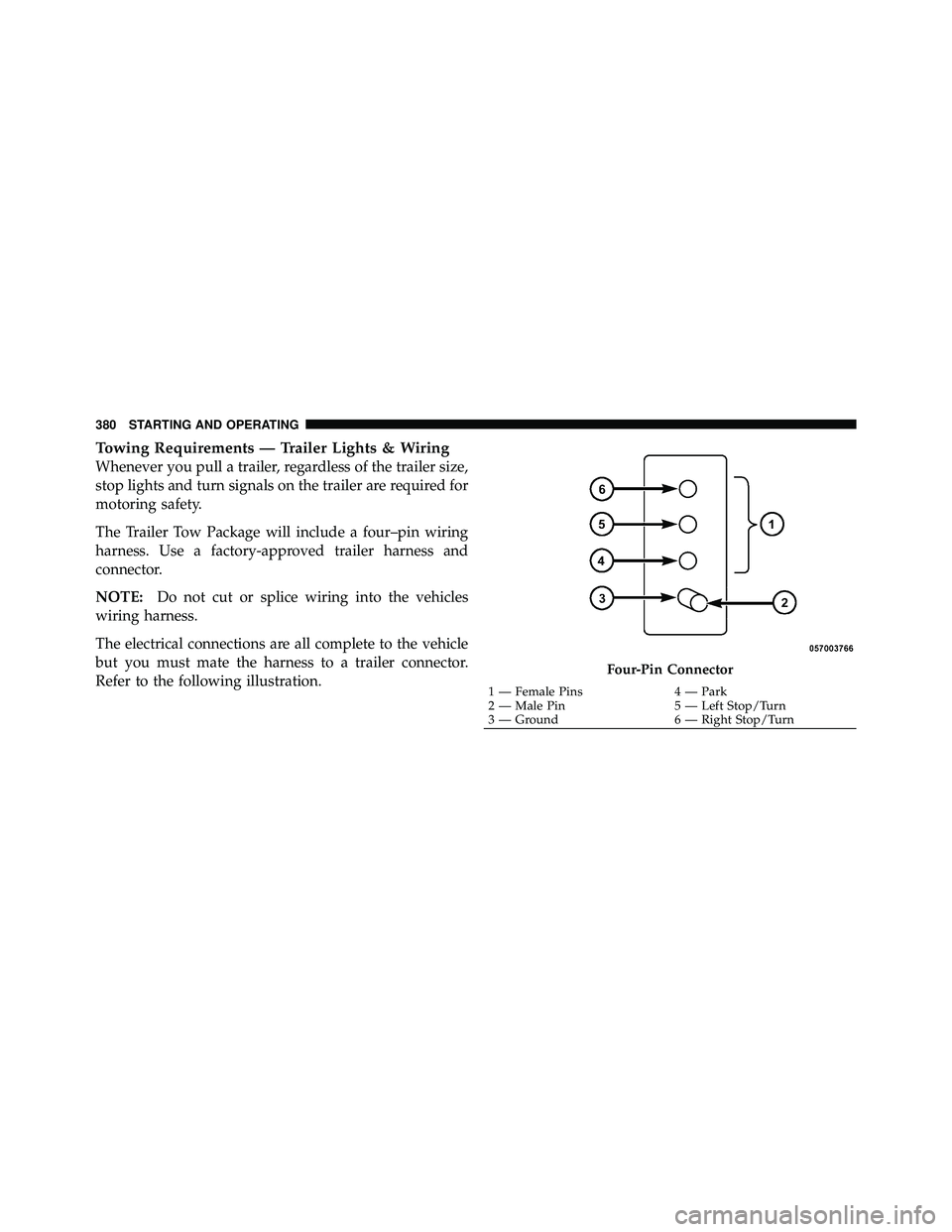
Towing Requirements — Trailer Lights & Wiring
Whenever you pull a trailer, regardless of the trailer size,
stop lights and turn signals on the trailer are required for
motoring safety.
The Trailer Tow Package will include a four–pin wiring
harness. Use a factory-approved trailer harness and
connector.
NOTE:Do not cut or splice wiring into the vehicles
wiring harness.
The electrical connections are all complete to the vehicle
but you must mate the harness to a trailer connector.
Refer to the following illustration.
Page 384 of 502
Electronic Speed Control — If Equipped
Do not use in hilly terrain or with heavy loads.
When using the speed control, if you experience speed
drops greater than 10 mph (16 km/h), disengage until
you can get back to cruising speed.
Use speed control in flat terrain and with light loads to
maximize fuel efficiency.
Cooling System
To reduce potential for engine and transmission over-
heating, take the following actions:
Highway Driving
Reduce speed.
Air Conditioning
Turn off temporarily.
RECREATIONAL TOWING (BEHIND
MOTORHOME, ETC.)
Page 404 of 502
ONBOARD DIAGNOSTIC SYSTEM — OBD II
Your vehicle is equipped with a sophisticated onboard
diagnostic system called OBD II. This system monitors
the performance of the emissions, engine, and automatic
transmission control systems. When these systems are
operating properly, your vehicle will provide excellent
performance and fuel economy, as well as engine emis-
sions well within current government regulations.
If any of these systems require service, the OBD II system
will turn on the “Malfunction Indicator Light (MIL).” It
will also store diagnostic codes and other information to
assist your service technician in making repairs. Al-
though your vehicle will usually be drivable and not
need towing, see your authorized dealer for service as
soon as possible.
Page 440 of 502
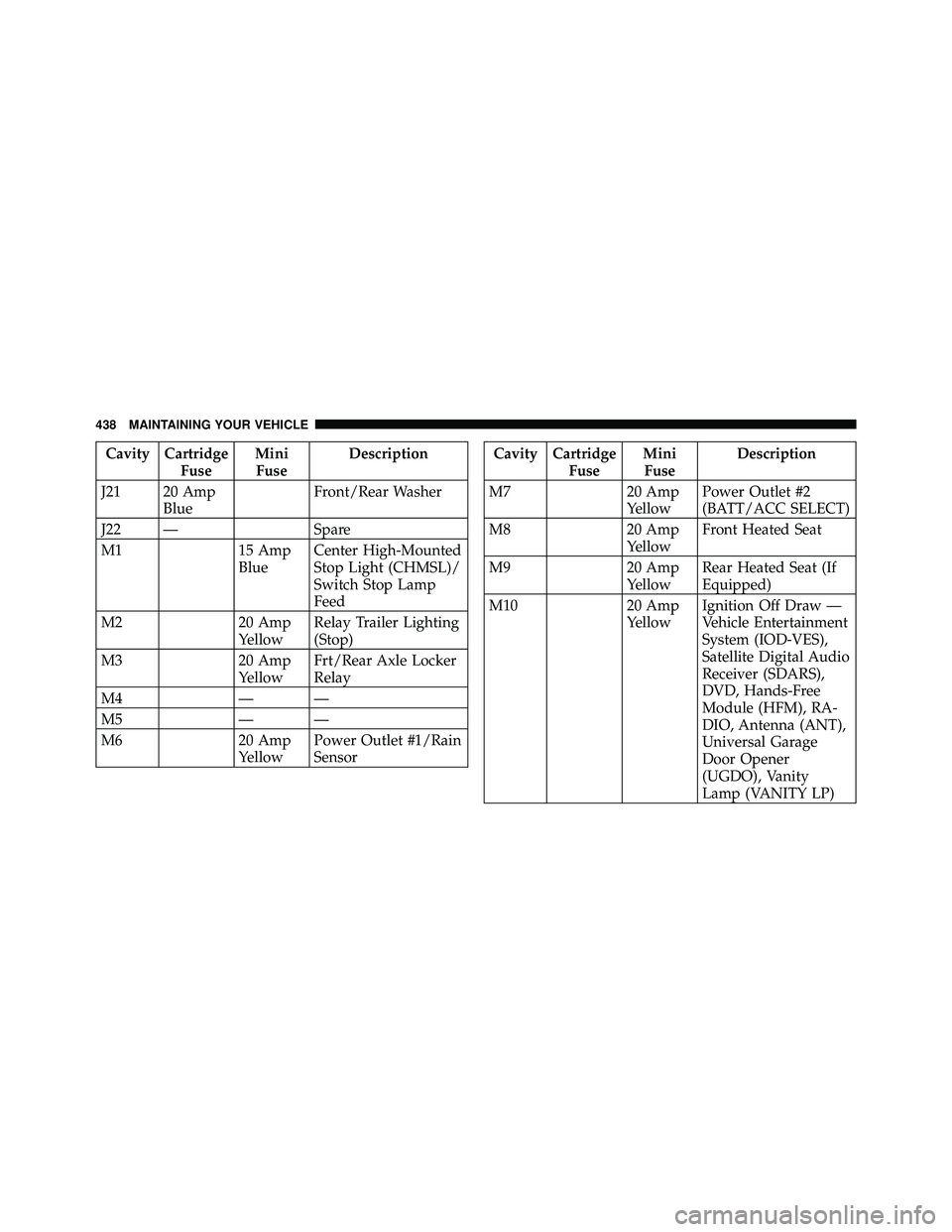
Cavity CartridgeFuseMini
Fuse Description
J21 20 Amp Blue Front/Rear Washer
J22 — Spare
M1 15 Amp
Blue Center High-Mounted
Stop Light (CHMSL)/
Switch Stop Lamp
Feed
M2 20 Amp
Yellow Relay Trailer Lighting
(Stop)
M3 20 Amp
Yellow Frt/Rear Axle Locker
Relay
M4 — —
M5 — —
M6 20 Amp
Yellow Power Outlet #1/Rain
Sensor
Page 442 of 502
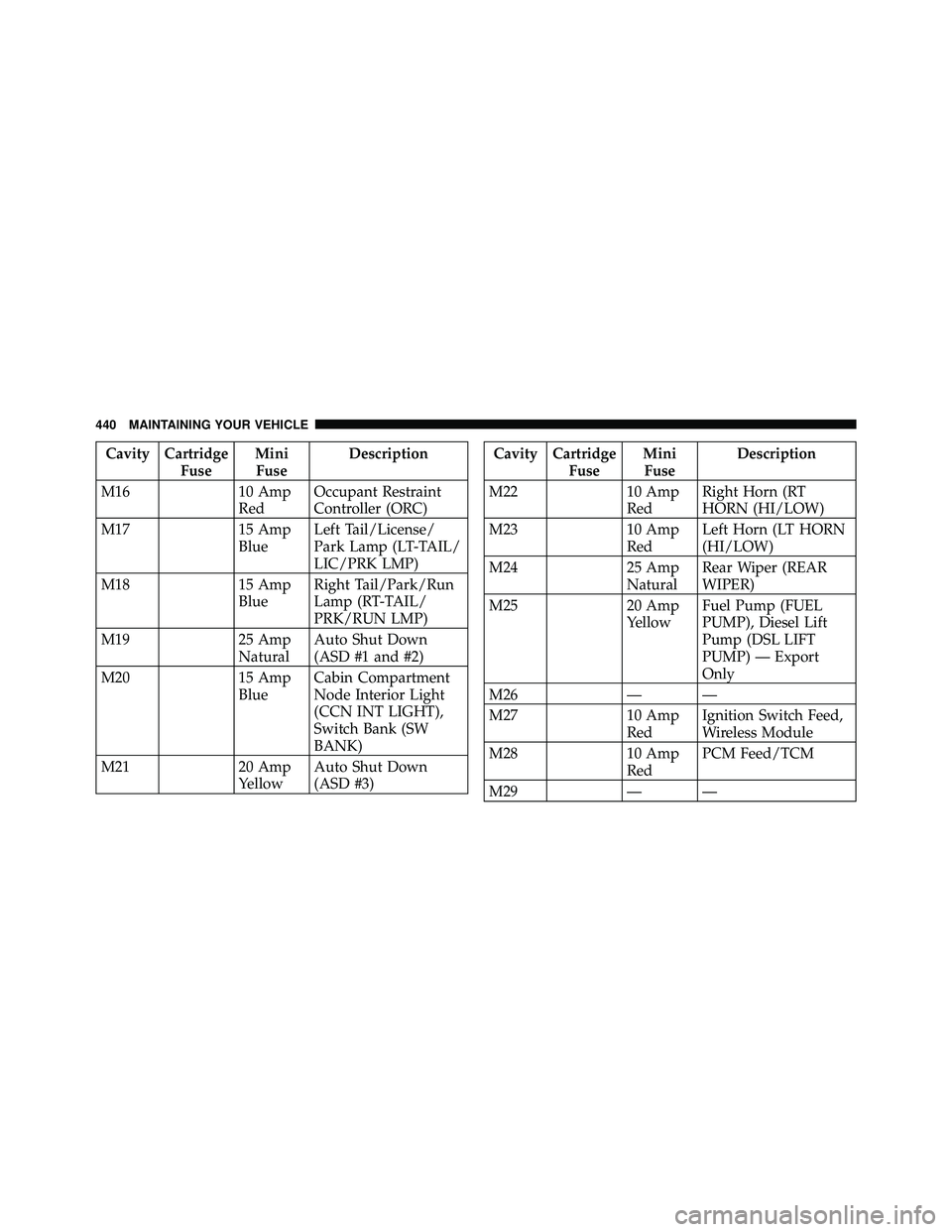
Cavity CartridgeFuseMini
Fuse Description
M16 10 Amp
Red Occupant Restraint
Controller (ORC)
M17 15 Amp
Blue Left Tail/License/
Park Lamp (LT-TAIL/
LIC/PRK LMP)
M18 15 Amp
Blue Right Tail/Park/Run
Lamp (RT-TAIL/
PRK/RUN LMP)
M19 25 Amp
Natural Auto Shut Down
(ASD #1 and #2)
M20 15 Amp
Blue Cabin Compartment
Node Interior Light
(CCN INT LIGHT),
Switch Bank (SW
BANK)
M21 20 Amp
Yellow Auto Shut Down
(ASD #3)
Page 448 of 502
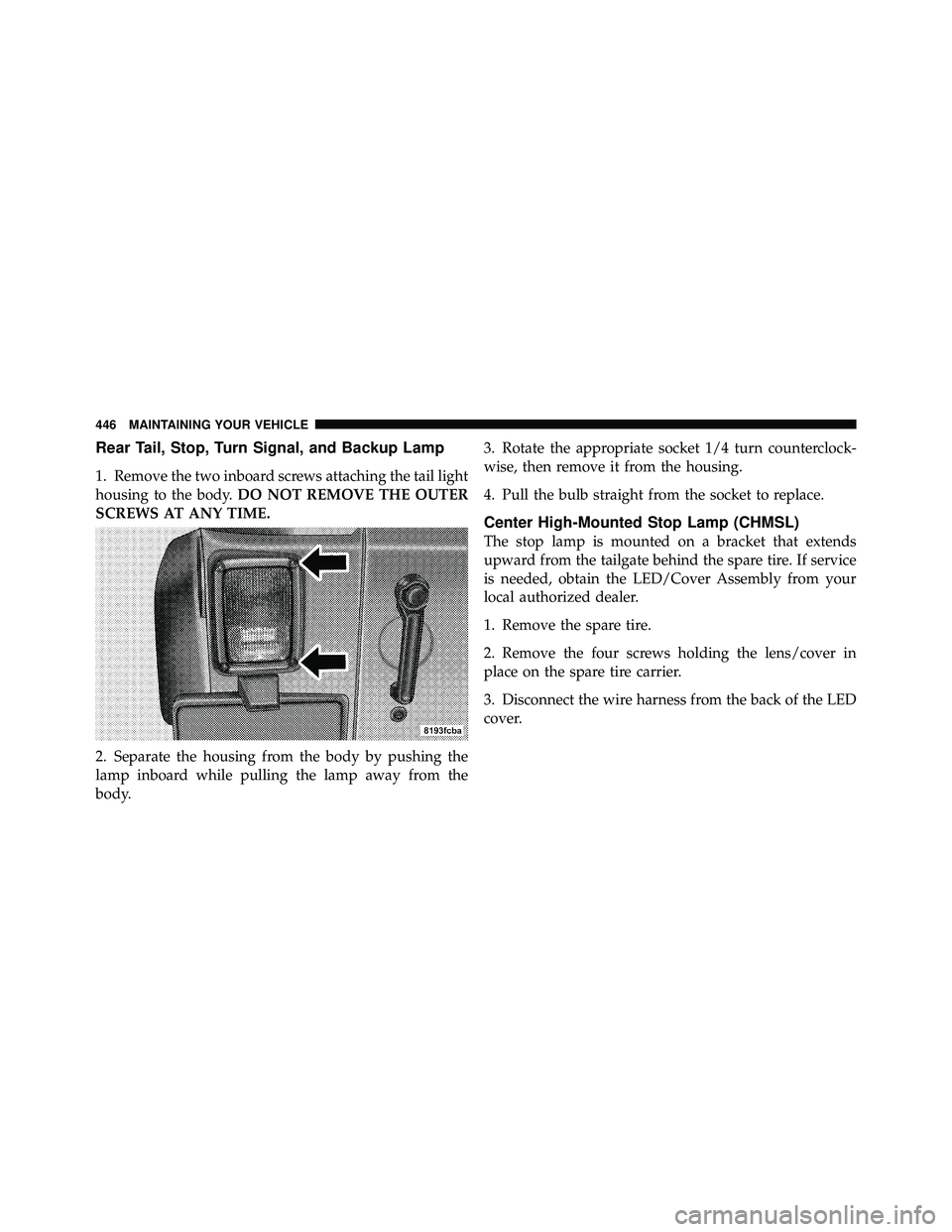
Rear Tail, Stop, Turn Signal, and Backup Lamp
1. Remove the two inboard screws attaching the tail light
housing to the body.DO NOT REMOVE THE OUTER
SCREWS AT ANY TIME.
2. Separate the housing from the body by pushing the
lamp inboard while pulling the lamp away from the
body. 3. Rotate the appropriate socket 1/4 turn counterclock-
wise, then remove it from the housing.
4. Pull the bulb straight from the socket to replace.
Center High-Mounted Stop Lamp (CHMSL)
The stop lamp is mounted on a bracket that extends
upward from the tailgate behind the spare tire. If service
is needed, obtain the LED/Cover Assembly from your
local authorized dealer.
1. Remove the spare tire.
2. Remove the four screws holding the lens/cover in
place on the spare tire carrier.
3. Disconnect the wire harness from the back of the LED
cover.