suspension JEEP WRANGLER 2009 Owners Manual
[x] Cancel search | Manufacturer: JEEP, Model Year: 2009, Model line: WRANGLER, Model: JEEP WRANGLER 2009Pages: 502, PDF Size: 13.82 MB
Page 300 of 502
The rear axle lock will disengage if the vehicle is taken
out of 4L (Low) range, or the ignition switch is turned to
the LOCK position.
ELECTRONIC SWAY BAR DISCONNECT — IF
EQUIPPED
Your vehicle may be equipped with an electronic discon-
necting stabilizer/sway bar. This system allows greater
front suspension travel in off-road situations.
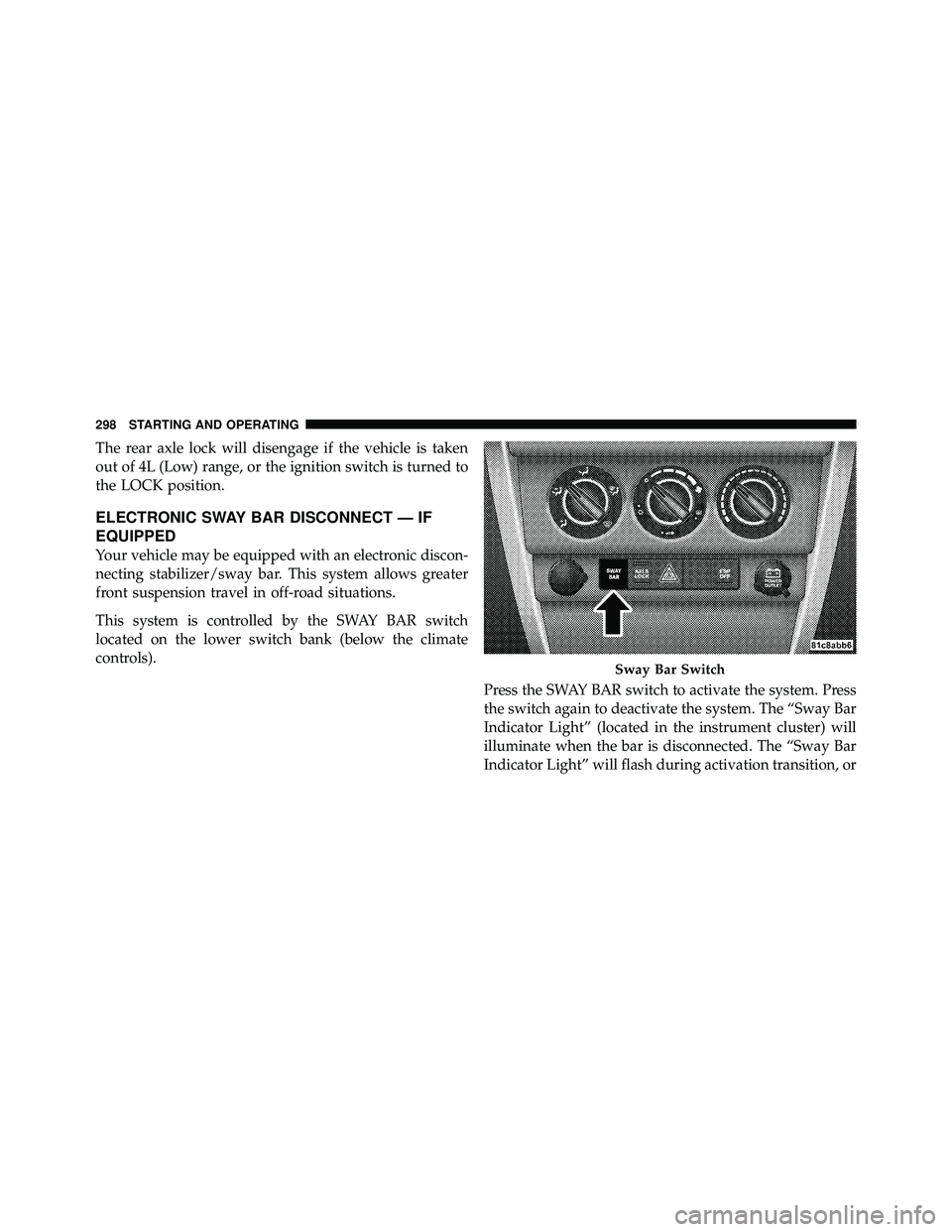
This system is controlled by the SWAY BAR switch
located on the lower switch bank (below the climate
controls).Press the SWAY BAR switch to activate the system. Press
the switch again to deactivate the system. The “Sway Bar
Indicator Light” (located in the instrument cluster) will
illuminate when the bar is disconnected. The “Sway Bar
Indicator Light” will flash during activation transition, or
Page 366 of 502
Gross Axle Weight Rating (GAWR)
The GAWR is the maximum permissible load on the front
and rear axles. The load must be distributed in the cargo
area so that the GAWR of each axle is not exceeded.
Each axle’s GAWR is determined by the components in
the system with the lowest load carrying capacity (axle,
springs, tires, or wheels). Heavier axles or suspension
components, sometimes specified by purchasers for in-
creased durability, does not necessarily increase the ve-
hicle’s GVWR.
Tire Size
The tire size on the label represents the actual tire size on
your vehicle. Replacement tires must be equal to the load
capacity of this tire size.
Rim Size
This is the rim size that is appropriate for the tire size
listed.
Inflation Pressure
This is the cold tire inflation pressure for your vehicle for
all loading conditions up to full GAWR.
Curb Weight
The curb weight of a vehicle is defined as the total weight
of the vehicle with all fluids, including vehicle fuel, at full
capacity conditions, and with no occupants or cargo
loaded into the vehicle. The front and rear curb weight
values are determined by weighing your vehicle on a
commercial scale before any occupants or cargo are
added.
Loading
The actual total weight and the weight of the front and
rear of your vehicle at the ground can best be determined
by weighing it when it is loaded and ready for operation.
364 STARTING AND OPERATING
Page 430 of 502
Selection of Lubricant
Use only manufacturer’s recommended fluid. Refer to
“Fluids, Lubricants, and Genuine Parts” in this section
for the correct fluid type.
Maintenance After Off-Road Driving
After extended operation in mud, sand or water, or
similar dirty conditions, have your brake drums, brake
linings, and axle joints inspected and cleaned as soon as
possible. This will prevent any abrasive material from
causing excessive wear or unpredictable braking action.
Following off-road usage, completely inspect the under-
body of your vehicle. Check the tires, body structure,
steering, suspension and exhaust system for damage.
Check the threaded fasteners for looseness, particularly
on the chassis, drivetrain components, steering and sus-
pension. Retighten, if required, to torque values specified
in the Service Manual. Also check for accumulations of
vegetation or brush that could become a fire hazard, orconceal damage to fuel lines, brake hoses, axle pinion
seals, and propeller shafts. Check the air conditioning
drain tube on the lower dash wall in the engine compart-
ment for mud or debris, and clean as required. A plugged
tube will adversely affect air conditioning performance.