instrument panel JEEP WRANGLER 2010 JK / 3.G Owners Manual
[x] Cancel search | Manufacturer: JEEP, Model Year: 2010, Model line: WRANGLER, Model: JEEP WRANGLER 2010 JK / 3.GPages: 554, PDF Size: 10.76 MB
Page 2 of 554
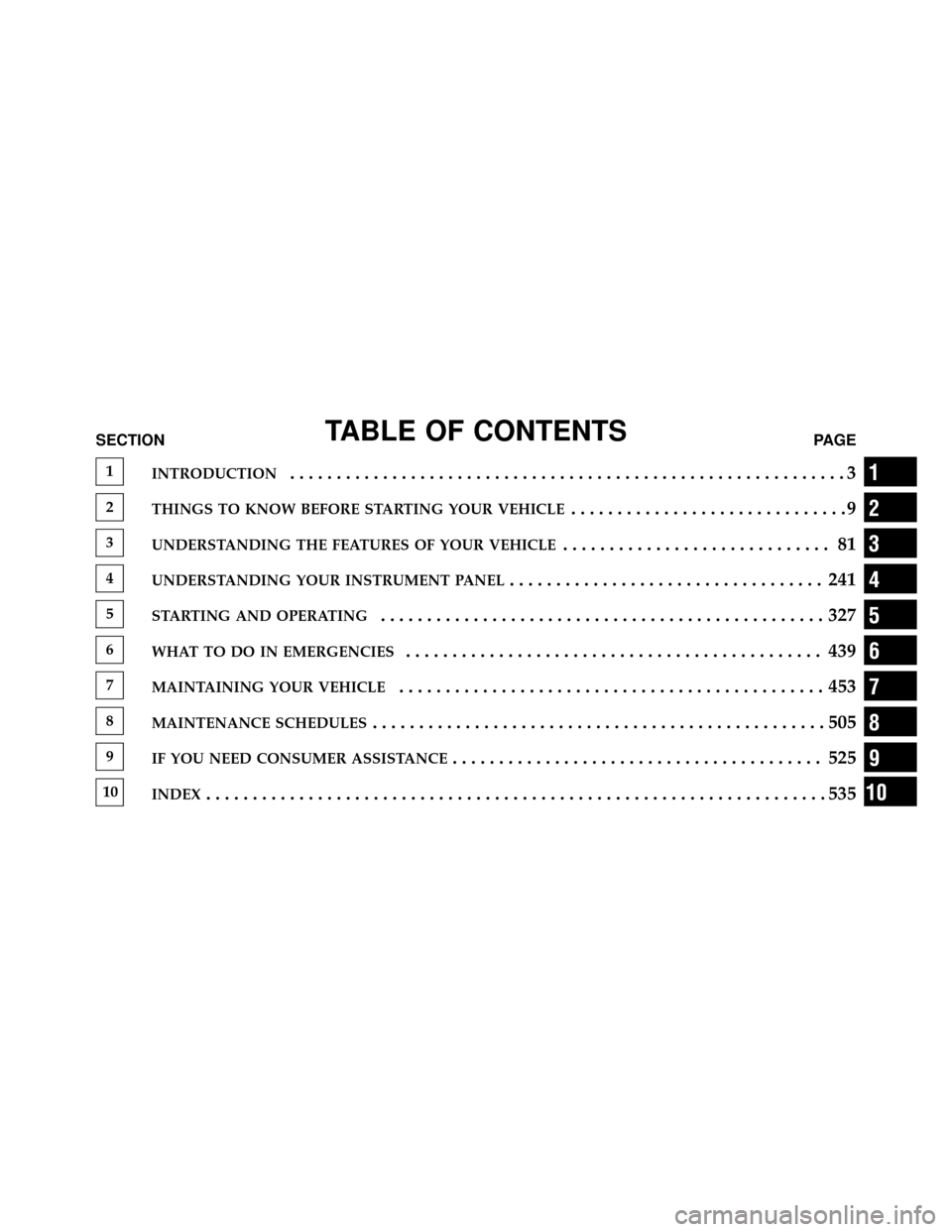
TABLE OF CONTENTSSECTIONPAGE
1INTRODUCTION............................................................3
2THINGS TO KNOW BEFORE STARTING YOUR VEHICLE..............................9
3UNDERSTANDING THE FEATURES OF YOUR VEHICLE............................. 81
4UNDERSTANDING YOUR INSTRUMENT PANEL.................................. 241
5STARTING AND OPERATING................................................327
6WHAT TO DO IN EMERGENCIES............................................. 439
7MAINTAINING YOUR VEHICLE..............................................453
8MAINTENANCE SCHEDULES.................................................505
9IF YOU NEED CONSUMER ASSISTANCE........................................ 525
10INDEX...................................................................535
1
2
3
4
5
6
7
8
9
10
Page 9 of 554
WARNINGS AND CAUTIONS
This Owner’s Manual containsWARNINGSagainst op-
erating procedures that could result in an accident or
bodily injury. It also contains CAUTIONSagainst proce-
dures that could result in damage to your vehicle. If you
do not read this entire manual, you may miss important
information. Observe all Warnings and Cautions.
VEHICLE IDENTIFICATION NUMBER
The Vehicle Identification Number (VIN) is found on the
left front corner of the instrument panel pad, visible from
outside of the vehicle through the windshield. This
number also appears on the Automobile Information
Disclosure Label affixed to a window on your vehicle.
Save this label for a convenient record of your vehicle
identification number and optional equipment.
NOTE: It is illegal to remove or alter the VIN plate.
VEHICLE MODIFICATIONS/ALTERATIONS
WARNING!
Any modifications or alterations to this vehicle could
seriously affect its roadworthiness and safety and
may lead to an accident resulting in serious injury or
death.
8 INTRODUCTION
Page 51 of 554
Supplemental Restraint System (SRS) — Airbags
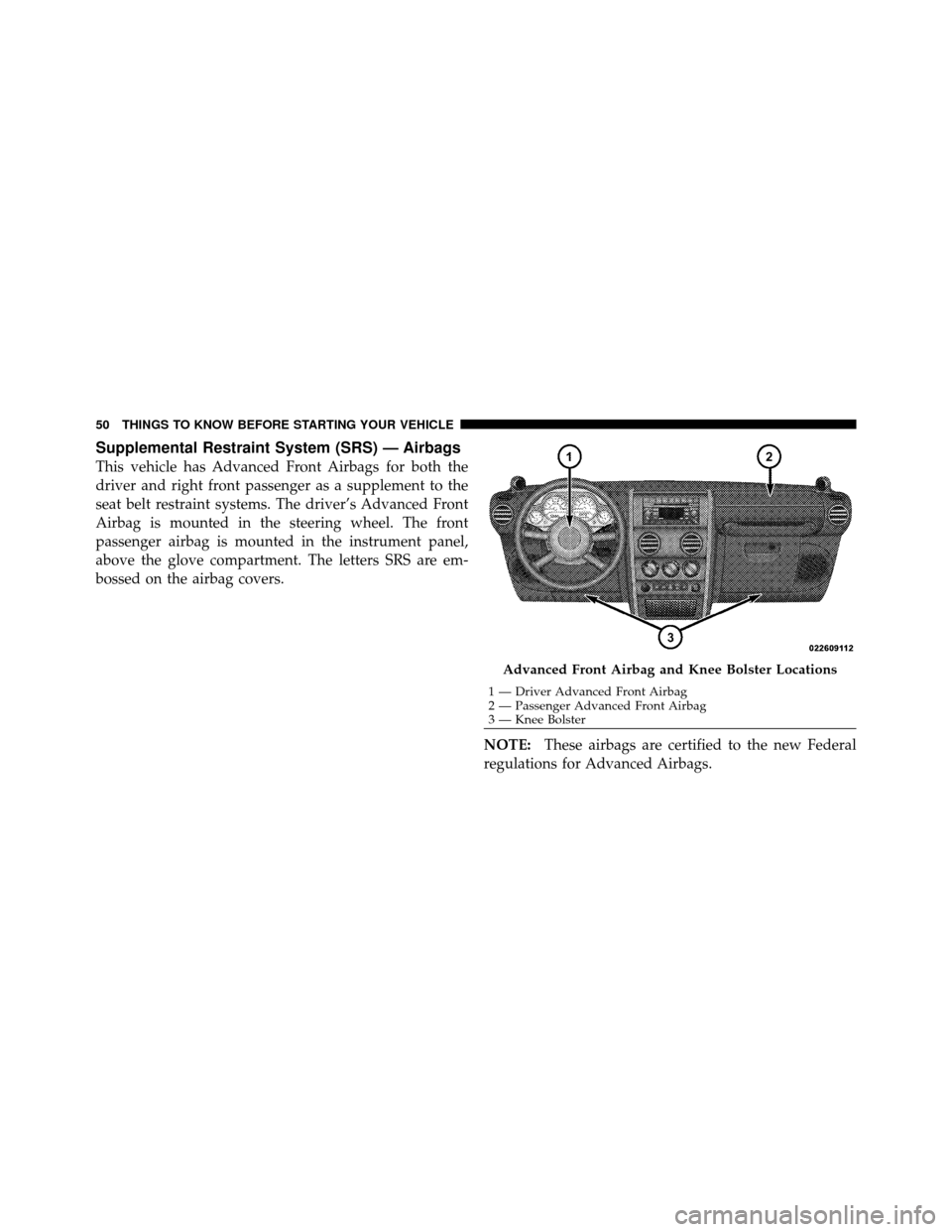
This vehicle has Advanced Front Airbags for both the
driver and right front passenger as a supplement to the
seat belt restraint systems. The driver’s Advanced Front
Airbag is mounted in the steering wheel. The front
passenger airbag is mounted in the instrument panel,
above the glove compartment. The letters SRS are em-
bossed on the airbag covers.NOTE:These airbags are certified to the new Federal
regulations for Advanced Airbags.
Advanced Front Airbag and Knee Bolster Locations
1 — Driver Advanced Front Airbag
2 — Passenger Advanced Front Airbag
3 — Knee Bolster
50 THINGS TO KNOW BEFORE STARTING YOUR VEHICLE
Page 53 of 554
WARNING!
•No objects should be placed over or near the
airbag on the instrument panel, because any such
objects could cause harm if the vehicle is in a
collision severe enough to cause the airbag to
inflate.
•Do not put anything on or around the Advanced
Front Airbag covers or attempt to manually open
them. You may damage the airbags and you could
be injured because the airbags may no longer be
functional. These protective covers for the airbag
cushions are designed to open only when the
airbags are inflating.(Continued)
WARNING! (Continued)
•If your vehicle is equipped with side airbags, do
not use accessory seat covers or place objects
between you and the side airbags; the performance
could be adversely affected and/or objects could
be pushed into you, causing serious injury.
•If your vehicle is equipped with Supplemental
Seat-Mounted Side Airbags (SAB), do not attach
cupholders or any other objects on or around the
door. The inflating side airbag could drive the
objects into occupants, causing serious injury.
•Do not cover or place items on the airbag covers.
These items may cause serious injury during in-
flation.
•Do not store or place items under the front seats.
You may damage the airbag wiring harnesses.
52 THINGS TO KNOW BEFORE STARTING YOUR VEHICLE
Page 54 of 554
The Advanced Front Airbags have a multistage inflator
design. This allows the airbag to have different rates of
inflation that are based on the severity and type of
collision. Along with the seat belts, Advanced Front
Airbags work with the instrument panel knee bolsters to
provide improved protection for the driver and front
passenger. Side airbags also work with seat belts to
improve occupant protection.
Here are some simple steps you can take to minimize the
risk of harm from a deploying airbag:
1. Children 12 years and under should always ride
buckled up in a rear seat.
Infants in rear facing child restraints shouldNEVERride
in the front seat of a vehicle with a passenger airbag. An
airbag deployment could cause severe injury or death to
infants in that position. Children that are not big enough to properly wear the
vehicle seat belt should be secured in the rear seat, in a
child restraint or belt-positioning booster seat. Older
children who do not use child restraints or belt-
positioning booster seats should ride properly buckled
up in the rear seat. Never allow children to slide the
shoulder belt behind them or under their arm.
If a child from 1 to 12 years old (not in a rear facing child
seat) must ride in the front passenger seat, move the seat
as far back as possible and use the proper child restraint.
(Refer to “Child Restraints”)
You should read the instructions provided with your
child restraint to make sure that you are using it properly.
2. All occupants should ALWAYS use their lap and
shoulder belts properly.
2
THINGS TO KNOW BEFORE STARTING YOUR VEHICLE 53
Page 55 of 554
3. The driver and front passenger seats should be moved
back as far as practical to allow the Advanced Front
Airbags room to inflate.
4. Do not lean against the door or window. If your
vehicle has side airbags, and deployment occurs, the side
airbags will inflate forcefully into the space between you
and the door.
5. If the airbag system in this vehicle needs to be
modified to accommodate a disabled person, contact the
Customer Center. Phone numbers are provided under “If
You Need Assistance”.WARNING!
•Relying on the airbags alone could lead to more
severe injuries in a collision. The airbags work
with your seat belt to restrain you properly. In
some collisions, the airbags won’t deploy at all.
Always wear your seat belts even though you have
airbags.
•Being too close to the steering wheel or instrument
panel during airbag deployment could cause seri-
ous injury, including death. Airbags need room to
inflate. Sit back, comfortably extending your arms
to reach the steering wheel or instrument panel.
•If the vehicle has side airbags, they also need room
to inflate. Do not lean against the door or window.
Sit upright in the center of the seat.
NOTE: After any collision, the vehicle should be taken
to an authorized dealer immediately.
54 THINGS TO KNOW BEFORE STARTING YOUR VEHICLE
Page 56 of 554
Airbag System Components
Your vehicle may be equipped with the following airbag
system components:
•Occupant Restraint Controller (ORC)
•Airbag Warning Light
•Steering Wheel and Column
•Instrument Panel
•Knee Impact Bolster
•Driver Advanced Front Airbag
•Passenger Advanced Front Airbag
•Supplemental Seat-Mounted Side Airbags (SAB)
•Front and Side Impact Sensors
•Front Seat Belt Pretensioners, Seat Belt Buckle Switch,
and Seat Track Position Sensors
•Supplemental Active Head Restraint for Driver and
Front Passenger
Airbag Deployment Sensors and Controls
Occupant Restraint Controller (ORC)
TheORC is part of a Federally regulated safety system
required for this vehicle.
The ORC determines if deployment of the front and/or
side airbags is required in a frontal or side collision.
Based on the impact sensors signals, a central electronic
ORC deploys the Advanced Front Airbags, side airbags
— if equipped, and front seat belt pretensioners — if
equipped, as required, depending on each type of impact.
Advanced Front Airbags are designed to provide addi-
tional protection by supplementing the seat belts in
certain frontal collisions depending on the severity and
type of collision. Advanced Front Airbags are not ex-
pected to reduce the risk of injury in rear, side, or rollover
collisions.2
THINGS TO KNOW BEFORE STARTING YOUR VEHICLE 55
Page 58 of 554
It also includes diagnostics that will illuminate the
instrument cluster Airbag Warning Light if a malfunc-
tion is noted that could affect the airbag system. The
diagnostics also record the nature of the malfunction.
WARNING!
Ignoring the Airbag Warning Light in your instru-
ment panel could mean you won’t have the airbags to
protect you in a collision. If the light does not come
on, stays on after you start the vehicle, or if it comes
on as you drive, have the airbag system checked
immediately.
•TheDriver and Passenger Airbag Inflator Units are
located in the center of the steering wheel and the right
side of the instrument panel. When the ORC detects a
collision requiring the Advanced Front Airbags, it
signals the inflator units. A large quantity of non-toxic
gas is generated to inflate the Advanced Front Airbags. Different airbag inflation rates are possible, based on
the collision type and severity. The steering wheel hub
trim cover and the upper right side of the instrument
panel separate and fold out of the way as the airbags
inflate to their full size. The airbags fully inflate in
about 50 to 70 milliseconds. This is about half of the
time it takes to blink your eyes. The airbags then
quickly deflate while helping to restrain the driver and
front passenger.
The Advanced Front Airbag gas is vented through the
vent holes in the sides of the airbag. In this way, the
airbags do not interfere with your control of the
vehicle.•The
Supplemental Seat-Mounted Side Airbags Infla-
tor Units (If Equipped) are designed to activate only
in certain side collisions.
2
THINGS TO KNOW BEFORE STARTING YOUR VEHICLE 57
Page 61 of 554
Maintaining Your Airbag System
WARNING!
•Modifications to any part of the airbag system
could cause it to fail when you need it. You could
be injured if the airbag system is not there to
protect you. Do not modify the components or
wiring, including adding any kind of badges or
stickers to the steering wheel hub trim cover or the
upper right side of the instrument panel. Do not
modify the front bumper or vehicle body struc-
ture.
•You need proper knee impact protection in a
collision. Do not mount or locate any aftermarket
equipment on or behind the knee bolsters.
•It is dangerous to try to repair any part of the
airbag system yourself. Be sure to tell anyone who
works on your vehicle that it has an airbag system.
Airbag Warning Light
You will want to have the airbag system ready to inflate
for your protection in an impact. The airbag system is
designed to be maintenance free. If any of the following
occurs, have an authorized dealer service the system
promptly:
•Does not come on during the four to eight seconds
after the ignition switch is first turned on.
•Remains on after the four to eight second interval.
•Comes on for any period of time while driving.
Event Data Recorder (EDR)
This vehicle is equipped with an event data recorder
(EDR). The main purpose of an EDR is to record, in
certain crash or near crash-like situations, such as an air
bag deployment or hitting a road obstacle, data that will
assist in understanding how a vehicle’s systems per-
formed. The EDR is designed to record data related to
60 THINGS TO KNOW BEFORE STARTING YOUR VEHICLE
Page 80 of 554
WARNING! (Continued)
Failure to properly follow floor mat installation or
mounting can cause interference with the brake
pedal and accelerator pedal operation causing loss of
control of the vehicle.
Periodic Safety Checks You Should Make Outside
the Vehicle
Tires
Examine tires for excessive tread wear and uneven wear
patterns. Check for stones, nails, glass, or other objects
lodged in the tread. Inspect the tread and sidewall for
cuts and cracks. Check the wheel nuts for tightness.
Check the tires (including spare) for proper pressure.
Lights
Have someone observe the operation of exterior lights
while you work the controls. Check turn signal and high
beam indicator lights on the instrument panel.
Door Latches
Check for positive closing, latching, and locking.
Fluid Leaks
Check area under vehicle after overnight parking for fuel,
engine coolant, oil, or other fluid leaks. Also, if gasoline
fumes are detected or if fuel, power steering fluid, or
brake fluid leaks are suspected, the cause should be
located and corrected immediately.
2
THINGS TO KNOW BEFORE STARTING YOUR VEHICLE 79