airbag JEEP WRANGLER 2010 Owners Manual
[x] Cancel search | Manufacturer: JEEP, Model Year: 2010, Model line: WRANGLER, Model: JEEP WRANGLER 2010Pages: 554, PDF Size: 10.16 MB
Page 39 of 554
If you will be carrying children too small for adult-sized
seat belts, the seat belts or the Lower Anchors and Tether
for CHildren (LATCH) feature also can be used to hold
infant and child restraint systems. For more information
on LATCH, see Lower Anchors and Tether for CHildren
(LATCH).
NOTE:The Advanced Front Airbags have a multistage
inflator design. This allows the airbag to have different
rates of inflation based on the severity and type of
collision.
Please pay close attention to the information in this
section. It tells you how to use your restraint system
properly, to keep you and your passengers as safe as
possible.
Page 51 of 554
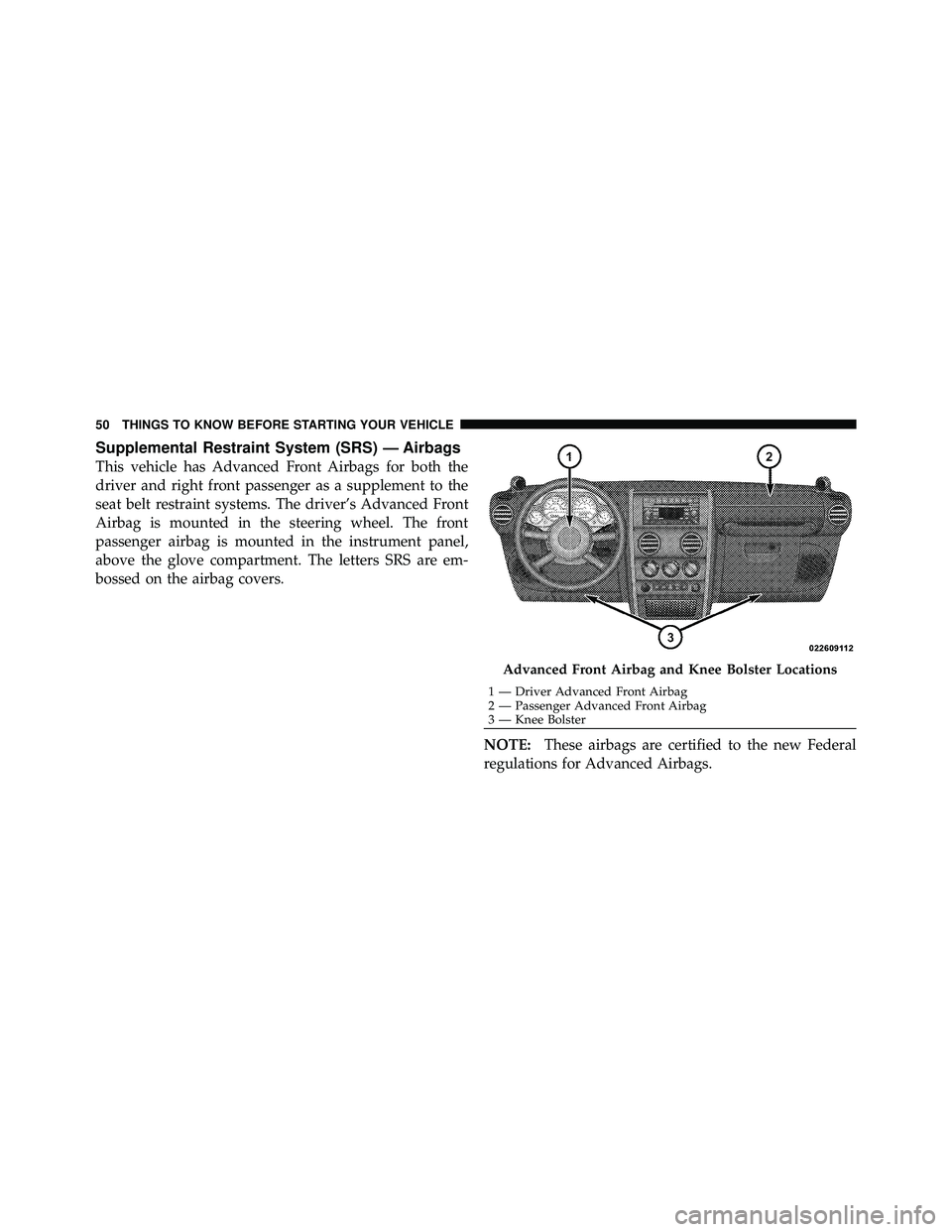
Supplemental Restraint System (SRS) — Airbags
This vehicle has Advanced Front Airbags for both the
driver and right front passenger as a supplement to the
seat belt restraint systems. The driver’s Advanced Front
Airbag is mounted in the steering wheel. The front
passenger airbag is mounted in the instrument panel,
above the glove compartment. The letters SRS are em-
bossed on the airbag covers.NOTE:These airbags are certified to the new Federal
regulations for Advanced Airbags.
Page 53 of 554
WARNING!
•No objects should be placed over or near the
airbag on the instrument panel, because any such
objects could cause harm if the vehicle is in a
collision severe enough to cause the airbag to
inflate.
•Do not put anything on or around the Advanced
Front Airbag covers or attempt to manually open
them. You may damage the airbags and you could
be injured because the airbags may no longer be
functional. These protective covers for the airbag
cushions are designed to open only when the
airbags are inflating.(Continued)
Page 55 of 554
3. The driver and front passenger seats should be moved
back as far as practical to allow the Advanced Front
Airbags room to inflate.
4. Do not lean against the door or window. If your
vehicle has side airbags, and deployment occurs, the side
airbags will inflate forcefully into the space between you
and the door.
5. If the airbag system in this vehicle needs to be
modified to accommodate a disabled person, contact the
Customer Center. Phone numbers are provided under “If
You Need Assistance”.
Page 57 of 554
The Advanced Front Airbags will not deploy in all frontal
collisions, including some that may produce substantial
vehicle damage — for example, some pole collisions,
truck underrides, and angle offset collisions. On the other
hand, depending on the type and location of impact,
Advanced Front Airbags may deploy in crashes with
little vehicle front-end damage but that produce a severe
initial deceleration.
The side airbags will not deploy in all side collisions. Side
airbag deployment will depend on the severity and type
of collision.
Because airbag sensors measure vehicle deceleration over
time, vehicle speed and damage by themselves are not
good indicators of whether or not an airbag should have
deployed.
Seat belts are necessary for your protection in all crashes,
and also are needed to help keep you in position, away
from an inflating airbag.The ORC also monitors the readiness of the electronic
parts of the airbag system whenever the ignition switch is
in the START or ON positions. If the key is in the LOCK
position, in the ACC position, or not in the ignition, the
airbag system is not on and the airbags will not inflate.
The ORC contains a backup power supply system that
may deploy the airbags even if the battery loses power or
it becomes disconnected prior to deployment.
•Also, the ORC turns on the Airbag Warning
Light for four to eight seconds for a self-
check when the ignition is first turned on.
After the self-check, the Airbag Warning
Light will turn off. If the ORC detects a malfunction in
any part of the system, it turns on the Airbag Warning
Light either momentarily or continuously. A single
chime will sound if the light comes on again after
initial startup.
Page 59 of 554
The ORC determines if a side collision requires the
side airbags to inflate based on the severity and type of
collision.
Based on the severity and type of collision, the side
airbag inflator on the crash side of the vehicle is trig-
gered, releasing a quantity of non-toxic gas. The inflating
side airbag exits through the seat seam into the space
between the occupant and the door. The side airbags fully
inflate in about 10 milliseconds. The side airbag moves at
a very high speed and with such a high force, that it
could injure you if you are not seated properly, or if items
are positioned in the area where the side airbag inflates.
This especially applies to children.
•The Knee Impact Bolsters help protect the knees of
the driver and the front passenger, and position front
occupants for the best interaction with the Advanced
Front Airbag.
Enhanced Accident Response System
In the event of an impact causing airbag deployment, if
the communication network remains intact, and the
power remains intact, depending on the nature of the
event the ORC will determine whether to have the
Enhanced Accident Response System perform the follow-
ing functions:
•Cut off fuel to the engine.
•Flash hazard lights as long as the battery has power or
until the ignition key is turned off.
•Turn on the interior lights, which remain on as long as
the battery has power or until the ignition key is
removed.
•Unlock the doors automatically.
If a Deployment Occurs
The front airbags are designed to deflate immediately
after deployment.
58 THINGS TO KNOW BEFORE STARTING YOUR VEHICLE
Page 61 of 554
Maintaining Your Airbag System
Page 75 of 554
WARNING!
An incorrectly anchored tether strap could lead to
increased head motion and possible injury to the
child. Use only the anchor positions directly behind
the child seat to secure a child restraint top tether
strap.
Vehicles With Rear Web Buckles That May Need
To Be Twisted
•
In the rear seat, you may have trouble tightening the
lap/shoulder belt on the child restraint because the
buckle or latch plate is too close to the belt path
opening on the restraint. Disconnect the latch plate
from the buckle and twist the short buckle-end belt
several times to shorten it. Insert the latch plate into
the buckle with the release button facing out.
•If the belt still can’t be tightened, or if pulling and
pushing on the restraint loosens the belt, disconnect
the latch plate from the buckle, turn the buckle
around, and insert the latch plate into the buckle
again. If you still can’t make the child restraint secure,
try a different seating position.
Transporting Pets
Airbags deploying in the front seat could harm your pet.
An unrestrained pet will be thrown about and possibly
injured, or injure a passenger during panic braking or in
a collision.
Pets should be restrained in the rear seat in pet harnesses
or pet carriers that are secured by seat belts.
74 THINGS TO KNOW BEFORE STARTING YOUR VEHICLE
Page 251 of 554
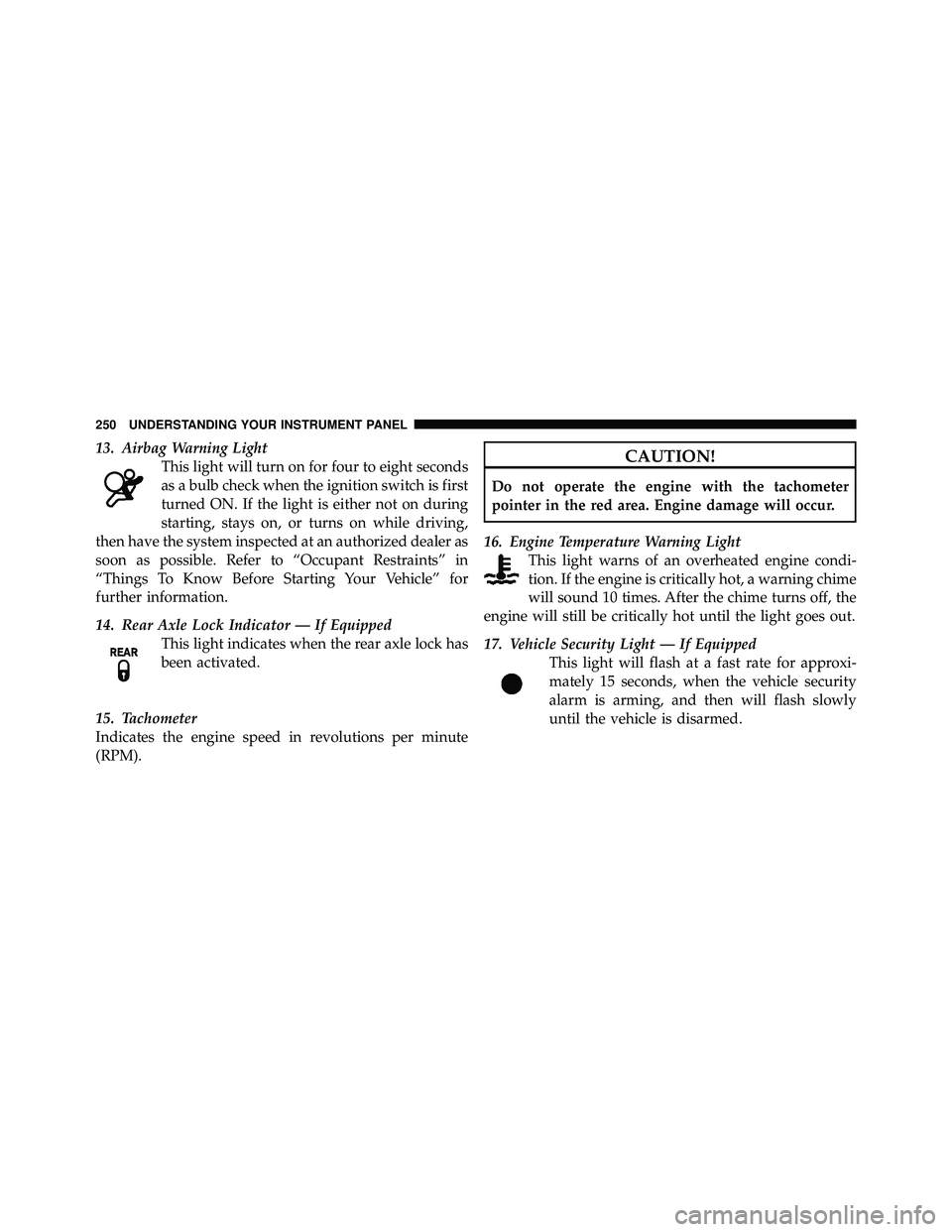
13. Airbag Warning LightThis light will turn on for four to eight seconds
as a bulb check when the ignition switch is first
turned ON. If the light is either not on during
starting, stays on, or turns on while driving,
then have the system inspected at an authorized dealer as
soon as possible. Refer to “Occupant Restraints” in
“Things To Know Before Starting Your Vehicle” for
further information.
14. Rear Axle Lock Indicator — If Equipped This light indicates when the rear axle lock has
been activated.
15. Tachometer
Indicates the engine speed in revolutions per minute
(RPM).
Page 537 of 554
ABS (Anti-Lock Brake System)............249,371
Adding Engine Coolant (Antifreeze) .......... 472
Adding Fuel ........................... 416
Air Cleaner, Engine (Engine Air Cleaner Filter) . . . 463
Air Conditioner Maintenance ............... 465
Air Conditioning ..................... 319,323
Air Conditioning Controls ................. 323
Air Conditioning, Operating Tips ............ 324
Air Conditioning Refrigerant ............... 466
Air Conditioning System .................. 323
Air Filter .............................. 463
Air Pressure, Tires ....................... 398
Airbag ................................ 50
Airbag Deployment ....................... 58
Airbag Light ....................... 60,77,250
Airbag Maintenance ....................... 60
Airbag, Side ............................ 57
Alarm Light ........................... 250
Alarm (Security Alarm) .................... 17 Alterations/Modifications, Vehicle
............. 8
Antenna, Satellite Radio ................308,313
Antifreeze (Engine Coolant) ................ 501
Anti-Lock Brake System (ABS) ............371,373
Anti-Lock Warning Light .................. 249
Appearance Care ........................ 482
Arming Theft System (Security Alarm) ......... 18
Assistance Towing ....................... 103
Auto Down Power Windows ................ 35
Automatic Transmission ................... 478
Fluid and Filter Changes ................. 478
Fluid Level Check ..................... 478
Fluid Type ........................... 478
Gear Ranges ......................... 342
Shifting ............................. 341
Special Additives ...................... 480
Torque Converter ...................... 345
Auxiliary Electrical Outlet (Power Outlet) ...... 150
Auxiliary Power Outlet ................... 150
536 INDEX