child lock JEEP WRANGLER 2010 Owners Manual
[x] Cancel search | Manufacturer: JEEP, Model Year: 2010, Model line: WRANGLER, Model: JEEP WRANGLER 2010Pages: 554, PDF Size: 10.16 MB
Page 33 of 554
WARNING! (Continued)
•Never leave children alone in a vehicle. Leaving
unattended children in a vehicle is dangerous for a
number of reasons. A child or others could be
seriously or fatally injured. Do not leave the key in
the ignition. A child could operate power win-
dows, other controls, or move the vehicle.
Automatic Unlock Doors On Exit
The doors will unlock automatically on vehicles with
power door locks if:
1. The “Automatic Unlock Doors On Exit” feature is
enabled.
2. The transmission was in gear and the vehicle speed
returned to 0 mph (0 km/h).
3. The transmission shift lever is in NEUTRAL or PARK.
4. The driver door is opened.5. The doors were not previously unlocked.
6. The vehicle speed is 0 mph (0 km/h).
Automatic Unlock Doors on Exit Programming
The “Automatic Unlock Doors On Exit” feature can be
enabled or disabled as follows:
1. Close all doors and place the key in the ignition.
2. Cycle the ignition switch between LOCK and ON and
then back to LOCK four times ending up in the LOCK
position.
3. Press the power door unlock switch to unlock the
doors.
4. A single chime will indicate the completion of the
programming.
5. Repeat these steps if you want to return this feature to
its previous setting.
32 THINGS TO KNOW BEFORE STARTING YOUR VEHICLE
Page 47 of 554
Automatic Locking Retractors (ALR) Mode — If
Equipped
In this mode, the shoulder belt is automatically pre-
locked. The belt will still retract to remove any slack in
the shoulder belt. The Automatic Locking Mode is avail-
able on all passenger-seating positions with a combina-
tion lap/shoulder belt.
When To Use The Automatic Locking Mode
Use the Automatic Locking Mode anytime a child safety
seat is installed in a seating position that has a belt with
this feature. Children 12 years old and under should
always be properly restrained in the rear seat.
How To Engage The Automatic Locking Mode
1. Buckle the combination lap and shoulder belt.
2. Grasp the shoulder portion and pull downward until
the entire belt is extracted.3. Allow the belt to retract. As the belt retracts, you will
hear a clicking sound. This indicates the safety belt is
now in the Automatic Locking Mode.
How To Disengage The Automatic Locking Mode
Unbuckle the combination lap/shoulder belt and allow it
to retract completely to disengage the Automatic Locking
Mode and activate the vehicle sensitive (emergency)
locking mode.
Seat Belts In Passenger Seating Positions
The seat belts in the passenger seating positions are
equipped with Automatic Locking Retractors (ALR)
which are used to secure a child restraint system. For
additional information refer to “Installing Child Re-
straints Using the Vehicle Seat Belt” under the “Child
Restraints” section. The chart below defines the type of
feature for each seating position.
46 THINGS TO KNOW BEFORE STARTING YOUR VEHICLE
Page 59 of 554
The ORC determines if a side collision requires the
side airbags to inflate based on the severity and type of
collision.
Based on the severity and type of collision, the side
airbag inflator on the crash side of the vehicle is trig-
gered, releasing a quantity of non-toxic gas. The inflating
side airbag exits through the seat seam into the space
between the occupant and the door. The side airbags fully
inflate in about 10 milliseconds. The side airbag moves at
a very high speed and with such a high force, that it
could injure you if you are not seated properly, or if items
are positioned in the area where the side airbag inflates.
This especially applies to children.
•The Knee Impact Bolsters help protect the knees of
the driver and the front passenger, and position front
occupants for the best interaction with the Advanced
Front Airbag.
Enhanced Accident Response System
In the event of an impact causing airbag deployment, if
the communication network remains intact, and the
power remains intact, depending on the nature of the
event the ORC will determine whether to have the
Enhanced Accident Response System perform the follow-
ing functions:
•Cut off fuel to the engine.
•Flash hazard lights as long as the battery has power or
until the ignition key is turned off.
•Turn on the interior lights, which remain on as long as
the battery has power or until the ignition key is
removed.
•Unlock the doors automatically.
If a Deployment Occurs
The front airbags are designed to deflate immediately
after deployment.
58 THINGS TO KNOW BEFORE STARTING YOUR VEHICLE
Page 65 of 554
Here are some tips for getting the most out of your child
restraint:
•Before buying any restraint system, make sure that it
has a label certifying that it meets all applicable Safety
Standards. The manufacturer also recommends that
you try a child restraint in the vehicle seats where you
will use it before you buy it.
•The restraint must be appropriate for your child’s
weight and height. Check the label on the restraint for
weight and height limits.
•Carefully follow the instructions that come with the
restraint. If you install the restraint improperly, it may
not work when you need it.
•The seat belts in the passenger seating positions are
equipped with either an Automatic Locking Retractor
(ALR) or a cinching latch plate or both. Both types of
seat belts are designed to keep the lap portion of the
seat belt tight around the child restraint so that it is notnecessary to use a locking clip. The ALR will make a
ratcheting noise if you extract the entire belt from the
retractor and then allow the belt to retract into the
retractor. For additional information on ALR, refer to
“Automatic Locking Mode”.
•In the rear seat, you may have trouble tightening the
lap/shoulder belt on the child restraint because the
buckle or latch plate is too close to the belt path
opening on the restraint. Disconnect the latch plate
from the buckle and twist the short buckle-end belt
several times to shorten it. Insert the latch plate into
the buckle with the release button facing out.
•If the belt still cannot be tightened, or if pulling and
pushing on the restraint loosens the belt, disconnect
the latch plate from the buckle, turn the buckle
around, and insert the latch plate into the buckle
again. If you still cannot make the child restraint
secure, try a different seating position.
64 THINGS TO KNOW BEFORE STARTING YOUR VEHICLE
Page 73 of 554
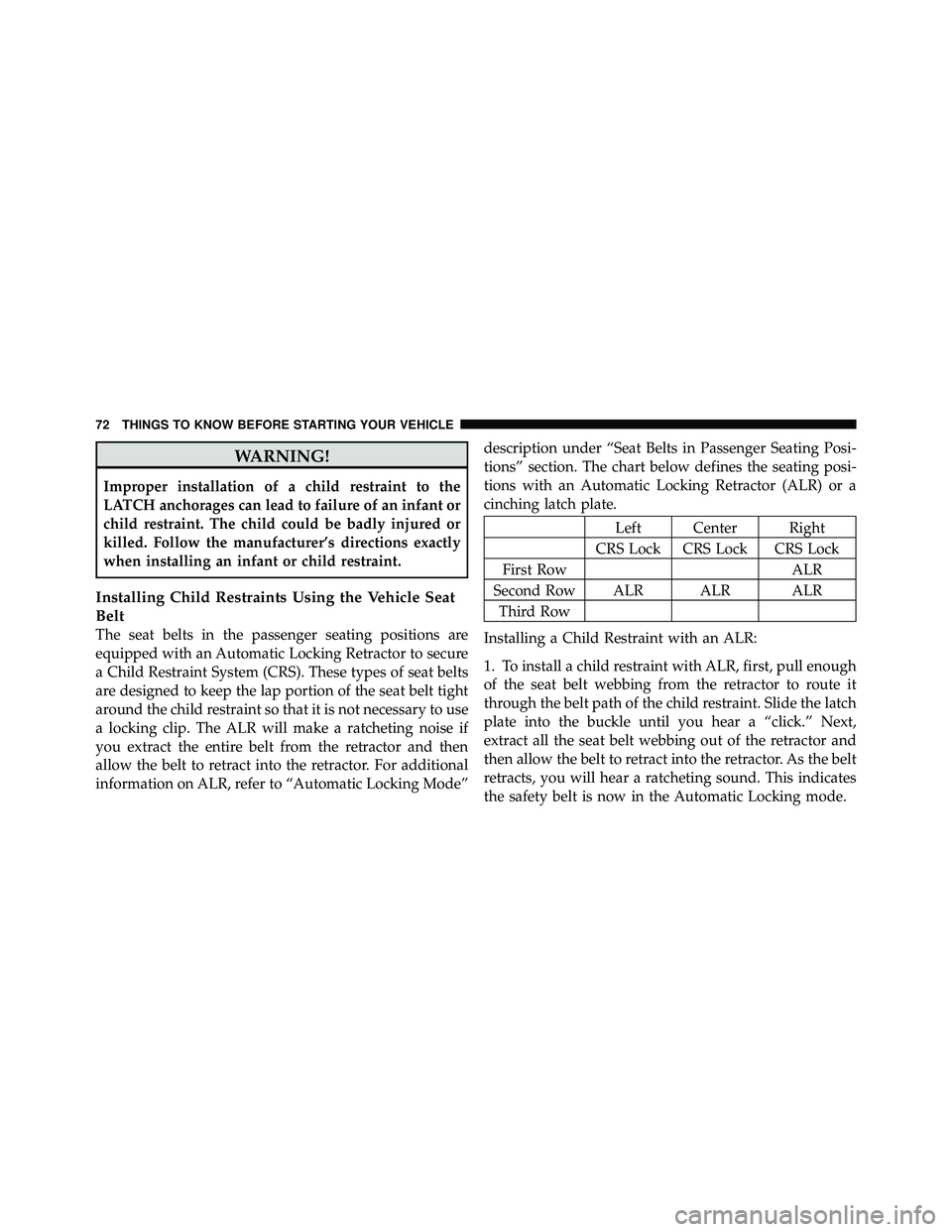
WARNING!
Improper installation of a child restraint to the
LATCH anchorages can lead to failure of an infant or
child restraint. The child could be badly injured or
killed. Follow the manufacturer’s directions exactly
when installing an infant or child restraint.
Installing Child Restraints Using the Vehicle Seat
Belt
The seat belts in the passenger seating positions are
equipped with an Automatic Locking Retractor to secure
a Child Restraint System (CRS). These types of seat belts
are designed to keep the lap portion of the seat belt tight
around the child restraint so that it is not necessary to use
a locking clip. The ALR will make a ratcheting noise if
you extract the entire belt from the retractor and then
allow the belt to retract into the retractor. For additional
information on ALR, refer to “Automatic Locking Mode”description under “Seat Belts in Passenger Seating Posi-
tions” section. The chart below defines the seating posi-
tions with an Automatic Locking Retractor (ALR) or a
cinching latch plate.
Page 539 of 554
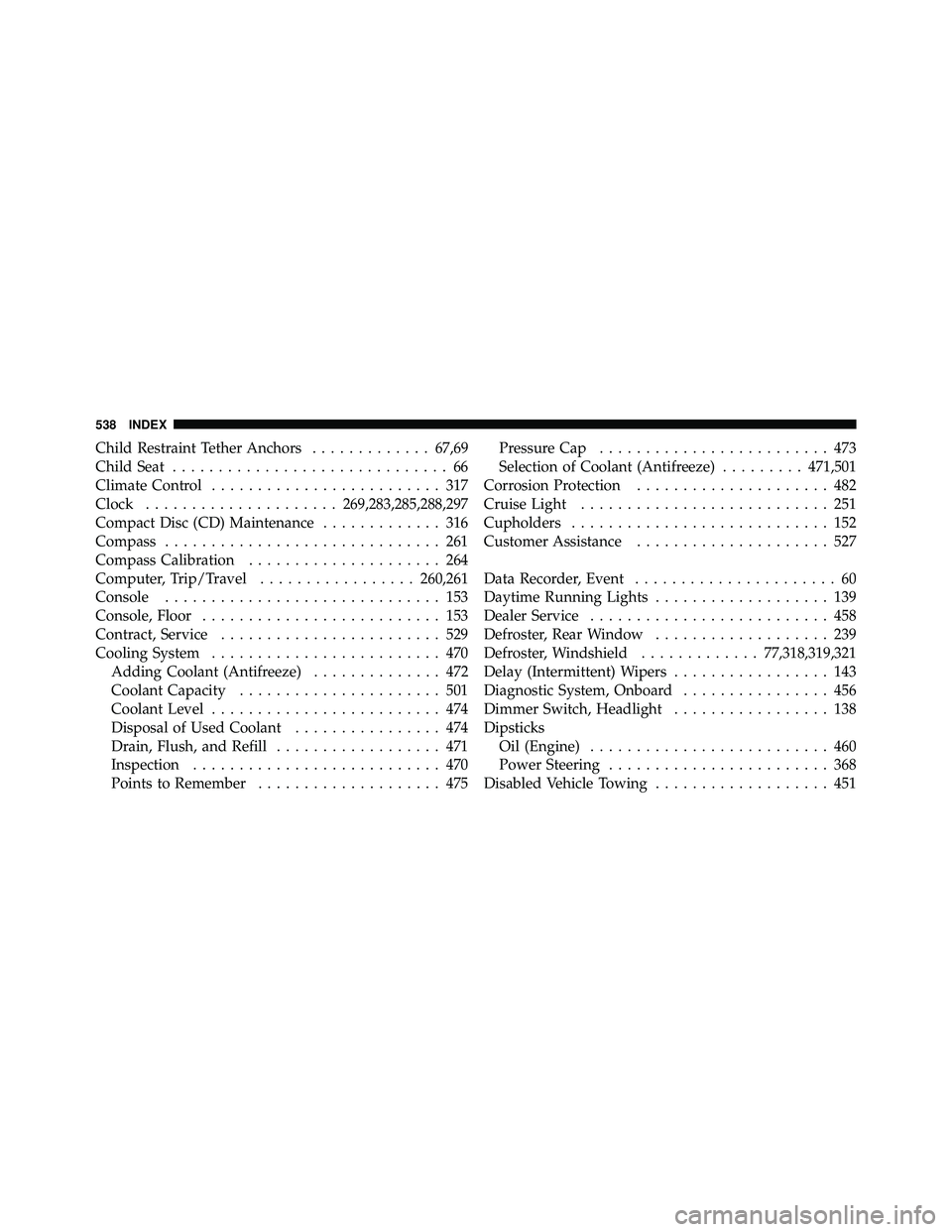
Child Restraint Tether Anchors.............67,69
Child Seat .............................. 66
Climate Control ......................... 317
Clock ..................... 269,283,285,288,297
Compact Disc (CD) Maintenance ............. 316
Compass .............................. 261
Compass Calibration ..................... 264
Computer, Trip/Travel .................260,261
Console .............................. 153
Console, Floor .......................... 153
Contract, Service ........................ 529
Cooling System ......................... 470
Adding Coolant (Antifreeze) .............. 472
Coolant Capacity ...................... 501
Coolant Level ......................... 474
Disposal of Used Coolant ................ 474
Drain, Flush, and Refill .................. 471
Inspection ........................... 470
Points to Remember .................... 475 Pressure Cap
......................... 473
Selection of Coolant (Antifreeze) .........471,501
Corrosion Protection ..................... 482
Cruise Light ........................... 251
Cupholders ............................ 152
Customer Assistance ..................... 527
Data Recorder, Event ...................... 60
Daytime Running Lights ................... 139
Dealer Service .......................... 458
Defroster, Rear Window ................... 239
Defroster, Windshield .............77,318,319,321
Delay (Intermittent) Wipers ................. 143
Diagnostic System, Onboard ................ 456
Dimmer Switch, Headlight ................. 138
Dipsticks Oil (Engine) .......................... 460
Power Steering ........................ 368
Disabled Vehicle Towing ................... 451
538 INDEX
Page 545 of 554
Electronic Throttle Control Warning......... 260
Engine Temperature Warning .............. 250
Exterior .............................. 79
Fog ............................. 138,499
Hazard Warning Flasher ................. 440
Headlight Switch ...................... 136
Headlights ........................... 498
High Beam .......................... 247
High Beam Indicator .................... 247
Instrument Cluster ..................... 136
Interior ............................. 140
Lights On Reminder .................... 138
Low Fuel ............................ 246
Oil Pressure .......................... 247
Passing ............................. 138
Rear Servicing ........................ 500
Rear Tail ............................ 500
Seat Belt Reminder ..................... 247
Security Alarm (Theft Alarm) .............. 250Service
............................. 498
Side Marker .......................... 500
Theft Alarm (Security Alarm) .............. 250
Tire Pressure Monitoring (TPMS) ........... 252
Turn Signal ................ 79,137,247,499,500
Voltage ............................. 246
Warning (Instrument Cluster Description) ..... 246
Loading Vehicle ......................... 418
Tires ............................... 393
Locking Axle ........................ 350,351
Locks Door ................................ 30
Power Door ........................... 31
Steering Wheel ......................... 13
Lower Anchors and Tether for CHildren
(LATCH) ............................ 67,69
Lubrication, Body ....................... 466
Maintenance Free Battery .................. 463
544 INDEX