heating JEEP WRANGLER 2011 JK / 3.G User Guide
[x] Cancel search | Manufacturer: JEEP, Model Year: 2011, Model line: WRANGLER, Model: JEEP WRANGLER 2011 JK / 3.GPages: 603, PDF Size: 7.55 MB
Page 438 of 603
WARNING!
Overloading of your tires is dangerous. Overloading
can cause tire failure, affect vehicle handling, and
increase your stopping distance. Use tires of the
recommended load capacity for your vehicle. Never
overload them.
TIRES — GENERAL INFORMATION
Tire Pressure
Proper tire inflation pressure is essential to the safe and
satisfactory operation of your vehicle. Three primary
areas are affected by improper tire pressure:
Safety
WARNING!
•Under-inflation increases tire flexing and can re-
sult in over-heating and tire failure.
•Over-inflation reduces a tire’s ability to cushion
shock. Objects on the road and chuck holes can
cause damage that results in tire failure.
•Over-inflated or under-inflated tires can affect
vehicle handling and can fail suddenly, resulting
in loss of vehicle control.
•Unequal tire pressures can cause steering prob-
lems. You could lose control of your vehicle.
•Unequal tire pressures from one side of the ve-
hicle to the other can cause the vehicle to drift to
the right or left.
436 STARTING AND OPERATING
Page 478 of 603
Towing Tips
Before setting out on a trip, practice turning, stopping
and backing the trailer in an area away from heavy
traffic.
If using a manual transmission vehicle for trailer towing,
all starts must be in first gear to avoid excessive clutch
slippage.
Automatic Transmission – If Equipped
The DRIVE range can be selected when towing. How-
ever, if frequent shifting occurs while in this range, the
“O/D OFF” feature should be selected.
NOTE:Using “O/D OFF” while operating the vehicle
under heavy operating conditions will improve perfor-
mance and extend transmission life by reducing exces-
sive shifting and heat build up. This action will also
provide better engine braking. The automatic transmission fluid and filter should be
changed if you REGULARLY tow a trailer for more than
45 minutes of continuous operation. Refer to “Mainte-
nance Schedule” for the proper maintenance intervals.
NOTE:
Check the automatic transmission fluid level
before towing.
O/D Off
To reduce the potential for automatic transmission over-
heating, select the “O/D OFF” feature when driving in
hilly areas or shift the transmission to DRIVE position 2
on more severe grades. Refer to “Automatic Transmis-
sion” in “Starting and Operating” for further
information.
476 STARTING AND OPERATING
Page 479 of 603
Electronic Speed Control – If Equipped
Do not use in hilly terrain or with heavy loads.
When using the speed control, if you experience speed
drops greater than 10 mph (16 km/h), disengage until
you can get back to cruising speed.
Use speed control in flat terrain and with light loads to
maximize fuel efficiency.
Cooling System
To reduce potential for engine and transmission over-
heating, take the following actions:
Highway Driving
Reduce speed.
Air Conditioning
Turn off temporarily.
5
STARTING AND OPERATING 477
Page 486 of 603
HAZARD WARNING FLASHERS
The Hazard Warning flasher switch is located on the
instrument panel below the climate controls.Press the switch to turn on the Hazard Warning
flasher. When the switch is activated, all directional
turn signals will flash on and off to warn oncoming
traffic of an emergency. Press the switch a second time to
turn off the Hazard Warning flashers.
This is an emergency warning system and it should not
be used when the vehicle is in motion. Use it when your
vehicle is disabled and it is creating a safety hazard for
other motorists.
When you must leave the vehicle to seek assistance, the
Hazard Warning flashers will continue to operate even
though the ignition is placed in the OFF position.
NOTE: With extended use the Hazard Warning flashers
may wear down your battery.
IF YOUR ENGINE OVERHEATS
In any of the following situations, you can reduce the
potential for overheating by taking the appropriate ac-
tion.
•On the highways — slow down.
•In city traffic — while stopped, shift transmission into
NEUTRAL, but do not increase engine idle speed.
CAUTION!
Driving with a hot cooling system could damage
your vehicle. If the temperature gauge reads HOT
(H), pull over and stop the vehicle. Idle the vehicle
with the air conditioner turned off until the pointer
drops back into the normal range. If the pointer
remains on HOT (H), and you hear continuous
chimes, turn the engine off immediately, and call for
service.
484 WHAT TO DO IN EMERGENCIES
Page 497 of 603
8. Disconnect the opposite end of the positive(+)jumper
cable from the positive (+)post of the booster battery.
9. Disconnect the positive (+)end of the jumper cable
from the positive (+)post of the discharged vehicle.
If frequent jump-starting is required to start your vehicle
you should have the battery and charging system in-
spected at your authorized dealer.
CAUTION!
Accessories that can be plugged into the vehicle
power outlets draw power from the vehicle’s battery,
even when not in use (i.e., cellular phones, etc.).
Eventually, if plugged in long enough, the vehicle’s
battery will discharge sufficiently to degrade battery
life and/or prevent the engine from starting.
FREEING A STUCK VEHICLE
If your vehicle becomes stuck in mud, sand or snow, it
can often be moved by a rocking motion. Turn your
steering wheel right and left to clear the area around the
front wheels. Then shift back and forth between DRIVE/
1st gear and REVERSE. Using minimal accelerator pedal
pressure to maintain the rocking motion, without spin-
ning the wheels, is most effective.
CAUTION!
Racing the engine or spinning the wheels may lead to
transmission overheating and failure. Allow the en-
gine to idle with the shift lever in NEUTRAL for at
least one minute after every five rocking-motion
cycles. This will minimize overheating and reduce
the risk of transmission failure during prolonged
efforts to free a stuck vehicle.6
WHAT TO DO IN EMERGENCIES 495
Page 498 of 603
NOTE:If your vehicle is equipped with Traction Con-
trol or Electronic Stability Control (ESC), turn the system
OFF before attempting to “rock” the vehicle.
CAUTION!
•When “rocking” a stuck vehicle by moving be-
tween DRIVE/1st gear and REVERSE, do not spin
the wheels faster than 15 mph (24 km/h), or drive-
train damage may result.
•Revving the engine or spinning the wheels too fast
may lead to transmission overheating and failure.
It can also damage the tires. Do not spin the
wheels above 30 mph (48 km/h) while in gear (no
transmission shifting occurring).
WARNING!
Fast spinning tires can be dangerous. Forces gener-
ated by excessive wheel speeds may cause damage, or
even failure, of the axle and tires. A tire could
explode and injure someone. Do not spin your vehi-
cle’s wheels faster than 30 mph (48 km/h) or for
longer than 30 seconds continuously without stop-
ping when you are stuck and do not let anyone near
a spinning wheel, no matter what the speed.
EMERGENCY TOW HOOKS — IF EQUIPPED
If your vehicle is equipped with tow hooks, they are
mounted in the front and the rear.
NOTE: For off-road recovery, it is recommended to use
both of the front tow hooks to minimize the risk of
damage to the vehicle.
496 WHAT TO DO IN EMERGENCIES
Page 521 of 603
Under normal operating conditions, the catalytic con-
verter will not require maintenance. However, it is im-
portant to keep the engine properly tuned to assure
proper catalyst operation and prevent possible catalyst
damage.
NOTE:Intentional tampering with emissions control
systems can result in civil penalties being assessed
against you.
In unusual situations involving grossly malfunctioning
engine operation, a scorching odor may suggest severe
and abnormal catalyst overheating. If this occurs, stop
the vehicle, turn off the engine and allow it to cool.
Service, including a tune-up to manufacturer’s specifica-
tions, should be obtained immediately. To minimize the possibility of catalytic converter dam-
age:
•Do not shut off the engine or interrupt the ignition,
when the transmission is in gear and the vehicle is in
motion.
•Do not try to start the engine by pushing or towing the
vehicle.
•Do not idle the engine with any spark plug wires
disconnected or removed, such as when diagnostic
testing, or for prolonged periods during very rough
idle or malfunctioning operating conditions.
7
MAINTAINING YOUR VEHICLE 519
Page 588 of 603
Emergency Brake........................ 406
Emergency, In Case of Jacking ............................ 485
Jump Starting ....................... 491
Tow Hooks ......................... 496
Emission Control System Maintenance ......... 507
Engine Air Cleaner ......................... 512
Block Heater ........................ 373
Break-In Recommendations .............. 85
Compartment ....................... 505
Compartment Identification ............. 505
Exhaust Gas Caution ................86,456
Fails to Start ........................ 371
Flooded, Starting ..................... 371
Fuel Requirements ................. 452,549
Jump Starting ....................... 491
Oil ............................ 510,549Oil Change Interval
................... 289
Oil Disposal ........................ 512
Oil Filter ........................... 512
Oil Selection ........................ 549
Overheating ........................ 484
Starting ........................... 370
Temperature Gauge ................... 271
Engine Oil Viscosity ...................... 511
Engine Oil Viscosity Chart ................. 511
Enhanced Accident Response Feature .......... 67
Entry System, Illuminated .................. 20
Ethanol ............................... 453
Event Data Recorder ...................... 70
Exhaust Gas Caution ................... 86,456
Exhaust System ....................... 86,517
Extender, Seat Belt ........................ 58
Exterior Finish Care ...................... 533
Exterior Lights .......................... 89
586 INDEX
Page 595 of 603
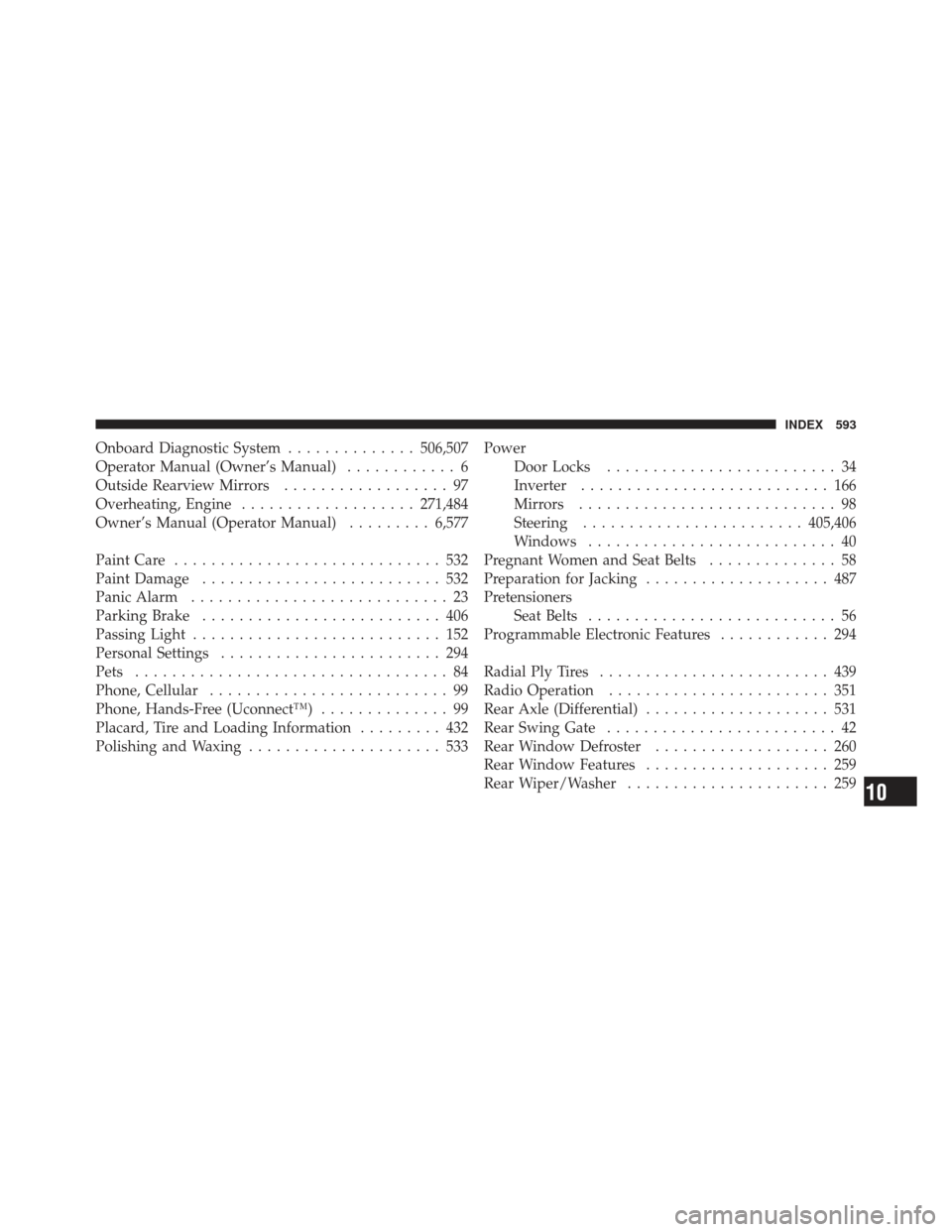
Onboard Diagnostic System..............506,507
Operator Manual (Owner’s Manual) ............ 6
Outside Rearview Mirrors .................. 97
Overheating, Engine ................... 271,484
Owner’s Manual (Operator Manual) .........6,577
Paint Care ............................. 532
Paint Damage .......................... 532
Panic Alarm ............................ 23
Parking Brake .......................... 406
Passing Light ........................... 152
Personal Settings ........................ 294
Pets .................................. 84
Phone, Cellular .......................... 99
Phone, Hands-Free (Uconnect™) .............. 99
Placard, Tire and Loading Information ......... 432
Polishing and Waxing ..................... 533 Power
Door Locks ......................... 34
Inverter ........................... 166
Mirrors ............................ 98
Steering ........................ 405,406
Windows ........................... 40
Pregnant Women and Seat Belts .............. 58
Preparation for Jacking .................... 487
Pretensioners Seat Belts ........................... 56
Programmable Electronic Features ............ 294
Radial Ply Tires ......................... 439
Radio Operation ........................ 351
Rear Axle (Differential) .................... 531
Rear Swing Gate ......................... 42
Rear Window Defroster ................... 260
Rear Window Features .................... 259
Rear Wiper/Washer ...................... 259
10
INDEX 593