Electrical JEEP WRANGLER 2012 JK / 3.G User Guide
[x] Cancel search | Manufacturer: JEEP, Model Year: 2012, Model line: WRANGLER, Model: JEEP WRANGLER 2012 JK / 3.GPages: 613, PDF Size: 17.14 MB
Page 504 of 613
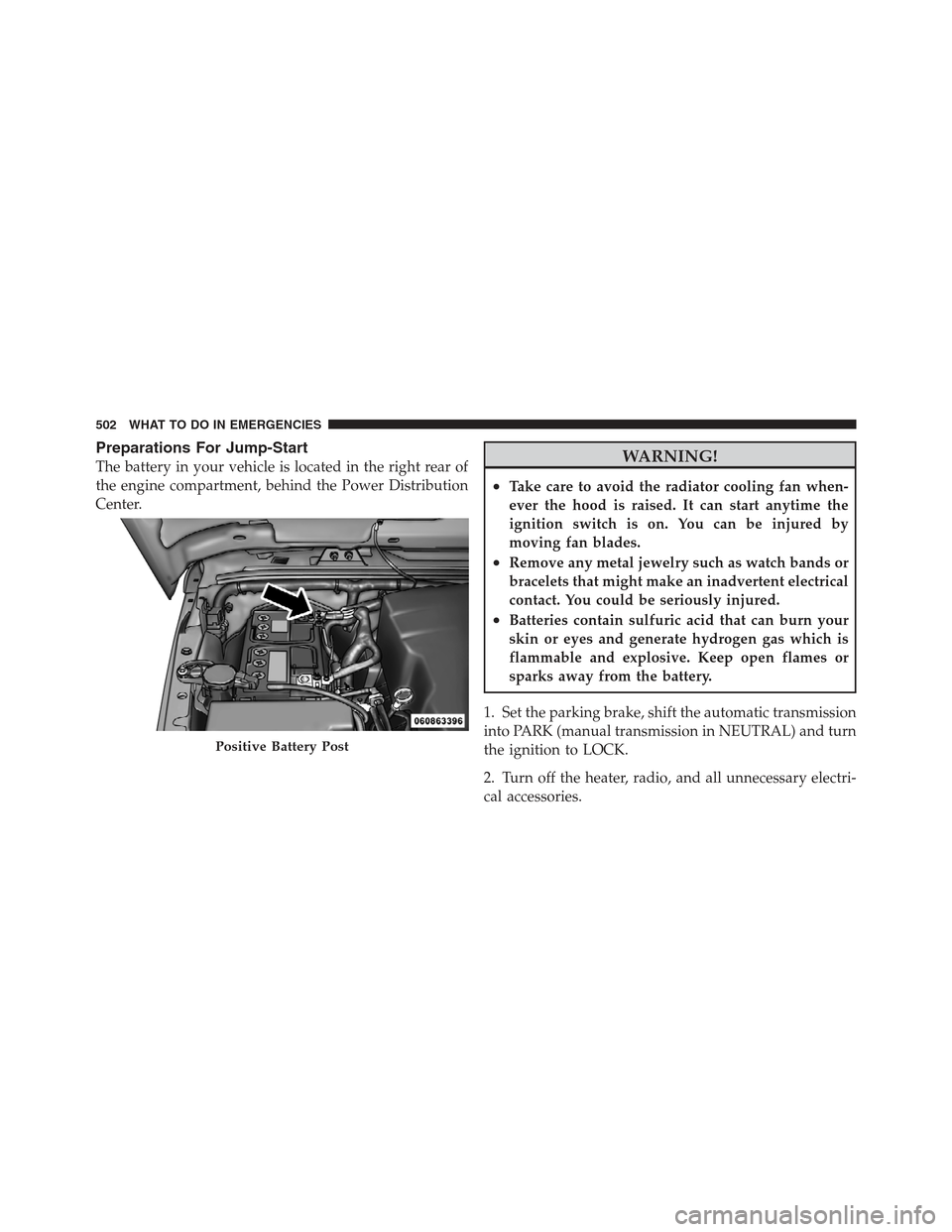
Preparations For Jump-Start
The battery in your vehicle is located in the right rear of
the engine compartment, behind the Power Distribution
Center.WARNING!
•Take care to avoid the radiator cooling fan when-
ever the hood is raised. It can start anytime the
ignition switch is on. You can be injured by
moving fan blades.
•Remove any metal jewelry such as watch bands or
bracelets that might make an inadvertent electrical
contact. You could be seriously injured.
•Batteries contain sulfuric acid that can burn your
skin or eyes and generate hydrogen gas which is
flammable and explosive. Keep open flames or
sparks away from the battery.
1. Set the parking brake, shift the automatic transmission
into PARK (manual transmission in NEUTRAL) and turn
the ignition to LOCK.
2. Turn off the heater, radio, and all unnecessary electri-
cal accessories.
Positive Battery Post
502 WHAT TO DO IN EMERGENCIES
Page 506 of 613
WARNING!
Do not connect the cable to the negative post (-) of the
discharged battery. The resulting electrical spark
could cause the battery to explode and could result in
personal injury.
5. Start the engine in the vehicle that has the booster
battery, let the engine idle a few minutes, and then start
the engine in the vehicle with the discharged battery.
Once the engine is started, remove the jumper cables in
the reverse sequence:
6. Disconnect the negative (-)jumper cable from the
engine ground of the vehicle with the discharged battery.
7. Disconnect the negative end (-)of the jumper cable
from the negative (-)post of the booster battery. 8. Disconnect the opposite end of the positive
(+)jumper
cable from the positive (+)post of the booster battery.
9. Disconnect the positive (+)end of the jumper cable
from the positive (+)post of the discharged vehicle.
If frequent jump-starting is required to start your vehicle
you should have the battery and charging system in-
spected at your authorized dealer.
CAUTION!
Accessories that can be plugged into the vehicle
power outlets draw power from the vehicle’s battery,
even when not in use (i.e., cellular phones, etc.).
Eventually, if plugged in long enough, the vehicle’s
battery will discharge sufficiently to degrade battery
life and/or prevent the engine from starting.
504 WHAT TO DO IN EMERGENCIES
Page 556 of 613
Cavity CartridgeFuseMini
Fuse Description
M37 10 Amp RedAnti-Lock Brake Sys-
tem, Electronic Stabil-
ity Control, Stop
Lamp Switch, Fuel
Pump Relay
M38 25 Amp NaturalLock/Unlock Motors
CAUTION!
•When installing the Integrated Power Module
cover, it is important to ensure the cover is prop-
erly positioned and fully latched. Failure to do so
may allow water to get into the Integrated Power
Module, and possibly result in an electrical system
failure.
(Continued)
CAUTION! (Continued)
•When replacing a blown fuse, it is important to
use only a fuse having the correct amperage rating.
The use of a fuse with a rating other than indicated
may result in a dangerous electrical system over-
load. If a properly rated fuse continues to blow, it
indicates a problem in the circuit that must be
corrected.
VEHICLE STORAGE
If you are leaving your vehicle dormant for more than
21 days, you may want to take steps to protect your
battery. You may:
•Remove Cartridge fuse #J13 in the Power Distribution
Center (PDC) labeled Ignition-Off Draw (IOD) and
store it in a safe location within the PDC.
•Or, disconnect the negative cable from the battery.
554 MAINTAINING YOUR VEHICLE
Page 568 of 613
Once A Month
•Check tire pressure and look for unusual wear or
damage.
•Inspect the battery and clean and tighten the terminals
as required.
•Check the fluid levels of coolant reservoir, brake
master cylinder, power steering and transmission and
add as needed.
•Check all lights and other electrical items for correct
operation.At Each Oil Change
•Change the engine oil filter.
•Inspect the brake hoses and lines.
•Check the manual transmission fluid level.
CAUTION!
Failure to perform the required maintenance items
may result in damage to the vehicle.
Required Maintenance Intervals
Refer to the Maintenance Schedules on the following
pages for the required maintenance intervals.
8
M
A I
N T
E
N A
N CE
S
C
H E
D
U L
E
S566 MAINTENANCE SCHEDULES
Page 595 of 613
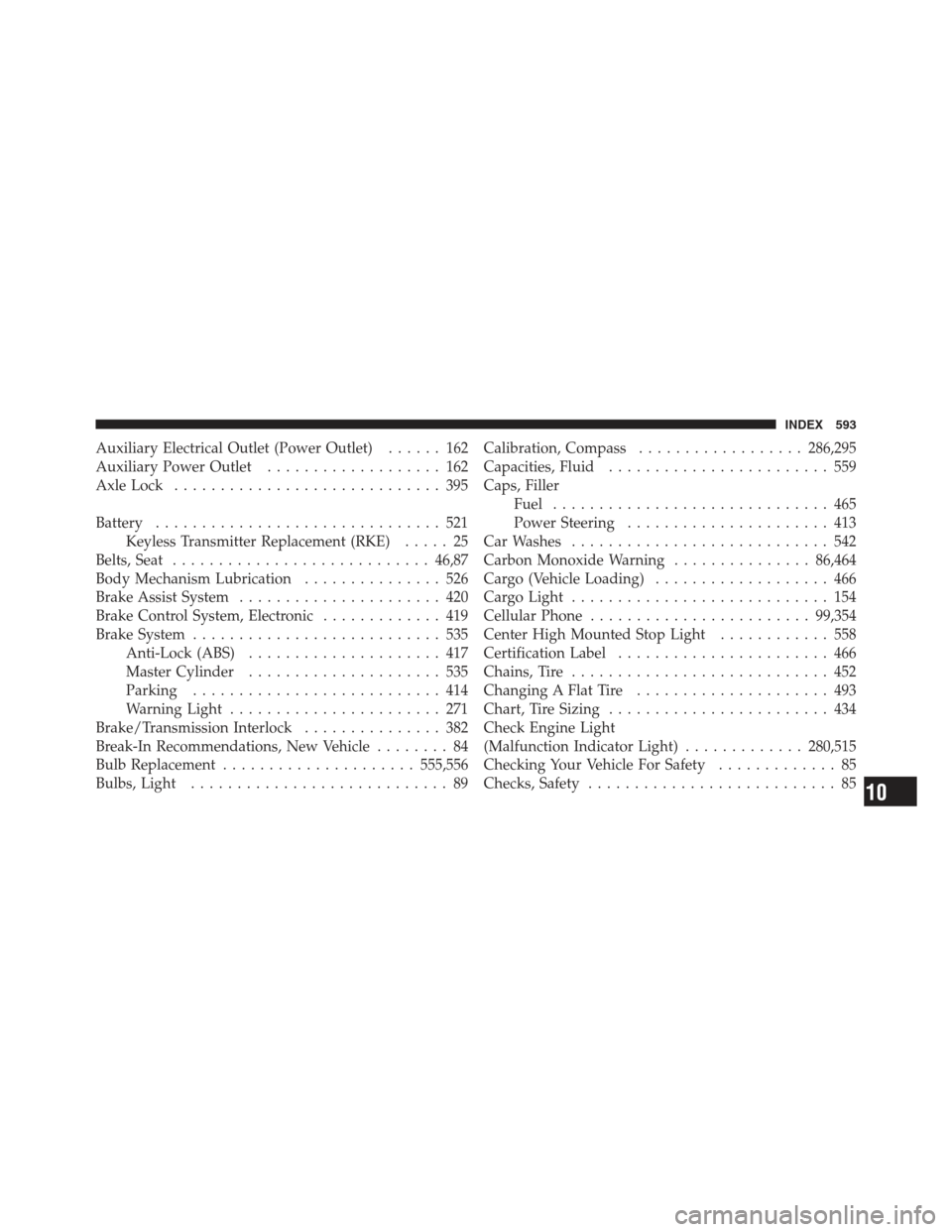
Auxiliary Electrical Outlet (Power Outlet)...... 162
Auxiliary Power Outlet ................... 162
Axle Lock ............................. 395
Battery ............................... 521
Keyless Transmitter Replacement (RKE) ..... 25
Belts, Seat ............................ 46,87
Body Mechanism Lubrication ............... 526
Brake Assist System ...................... 420
Brake Control System, Electronic ............. 419
Brake System ........................... 535
Anti-Lock (ABS) ..................... 417
Master Cylinder ..................... 535
Parking ........................... 414
Warning Light ....................... 271
Brake/Transmission Interlock ............... 382
Break-In Recommendations, New Vehicle ........ 84
Bulb Replacement ..................... 555,556
Bulbs, Light ............................ 89 Calibration, Compass
.................. 286,295
Capacities, Fluid ........................ 559
Caps, Filler Fuel .............................. 465
Power Steering ...................... 413
Car Washes ............................ 542
Carbon Monoxide Warning ...............86,464
Cargo (Vehicle Loading) ................... 466
Cargo Light ............................ 154
Cellular Phone ........................ 99,354
Center High Mounted Stop Light ............ 558
Certification Label ....................... 466
Chains, Tire ............................ 452
Changing A Flat Tire ..................... 493
Chart, Tire Sizing ........................ 434
Check Engine Light
(Malfunction Indicator Light) .............280,515
Checking Your Vehicle For Safety ............. 85
Checks, Safety ........................... 85
10
INDEX 593
Page 597 of 613
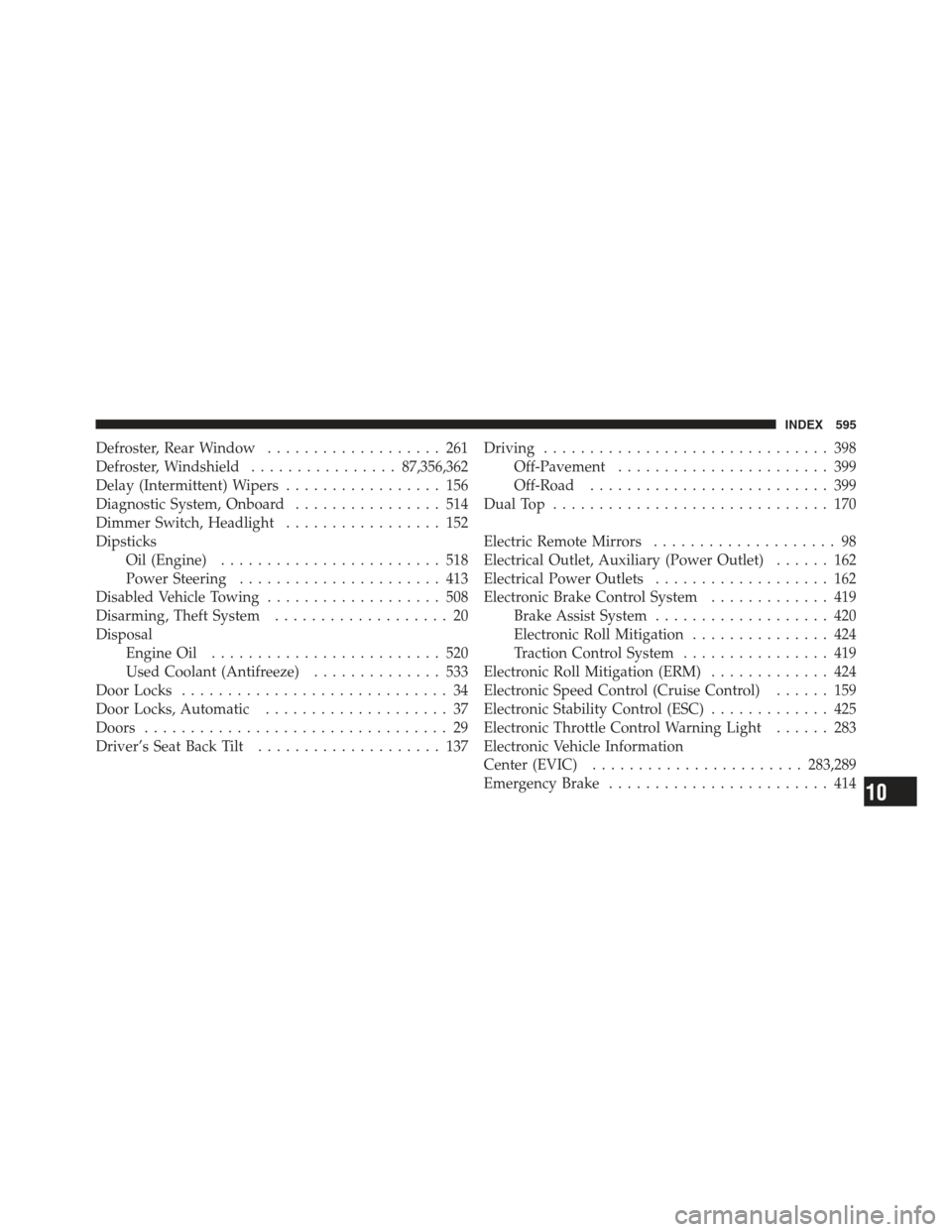
Defroster, Rear Window................... 261
Defroster, Windshield ................87,356,362
Delay (Intermittent) Wipers ................. 156
Diagnostic System, Onboard ................ 514
Dimmer Switch, Headlight ................. 152
Dipsticks Oil (Engine) ........................ 518
Power Steering ...................... 413
Disabled Vehicle Towing ................... 508
Disarming, Theft System ................... 20
Disposal Engine Oil ......................... 520
Used Coolant (Antifreeze) .............. 533
Door Locks ............................. 34
Door Locks, Automatic .................... 37
Doors ................................. 29
Driver’s Seat Back Tilt .................... 137 Driving
............................... 398
Off-Pavement ....................... 399
Off-Road .......................... 399
Dual Top .............................. 170
Electric Remote Mirrors .................... 98
Electrical Outlet, Auxiliary (Power Outlet) ...... 162
Electrical Power Outlets ................... 162
Electronic Brake Control System ............. 419
Brake Assist System ................... 420
Electronic Roll Mitigation ............... 424
Traction Control System ................ 419
Electronic Roll Mitigation (ERM) ............. 424
Electronic Speed Control (Cruise Control) ...... 159
Electronic Stability Control (ESC) ............. 425
Electronic Throttle Control Warning Light ...... 283
Electronic Vehicle Information
Center (EVIC) ....................... 283,289
Emergency Brake ........................ 414
10
INDEX 595