radiator JEEP WRANGLER 2012 JK / 3.G User Guide
[x] Cancel search | Manufacturer: JEEP, Model Year: 2012, Model line: WRANGLER, Model: JEEP WRANGLER 2012 JK / 3.GPages: 613, PDF Size: 17.14 MB
Page 535 of 613
Cooling System Pressure Cap
The cap must be fully tightened to prevent loss of engine
coolant (antifreeze), and to ensure that engine coolant
(antifreeze) will return to the radiator from the coolant
reserve tank.
The cap should be inspected and cleaned if there is any
accumulation of foreign material on the sealing surfaces.
WARNING!
The warning words DO NOT OPEN HOT on the
cooling system pressure cap are a safety precaution.
Never add engine coolant (antifreeze) when the en-
gine is overheated. Do not loosen or remove the cap
to cool an overheated engine. Heat causes pressure to
build up in the cooling system. To prevent scalding
or injury, do not remove the pressure cap while the
system is hot or under pressure.
Disposal Of Used Engine Coolant
Used ethylene glycol based engine coolant (antifreeze) is
a regulated substance requiring proper disposal. Check
with your local authorities to determine the disposal
rules for your community. To prevent ingestion by ani-
mals or children, do not store ethylene glycol based
engine coolant (antifreeze) in open containers or allow it
to remain in puddles on the ground. If ingested by a child
or pet, seek emergency assistance immediately. Clean up
any ground spills immediately.
Engine Coolant Level
The coolant bottle provides a quick visual method for
determining that the coolant level is adequate. With the
engine idling, and warm to normal operating tempera-
ture, the level of the engine coolant (antifreeze) in the
bottle should be between the ranges indicated on the
bottle.
7
MAINTAINING YOUR VEHICLE 533
Page 536 of 613
The radiator normally remains completely full, so there is
no need to remove the radiator cap unless checking for
engine coolant (antifreeze) freeze point or replacing en-
gine coolant (antifreeze). Advise your service attendant
of this. As long as the engine operating temperature is
satisfactory, the coolant bottle need only be checked once
a month.
When additional engine coolant (antifreeze) is needed to
maintain the proper level, it should be added to the
coolant bottle. Do not overfill.
Points To Remember
NOTE:When the vehicle is stopped after a few miles/
kilometers of operation, you may observe vapor coming
from the front of the engine compartment. This is nor-
mally a result of moisture from rain, snow, or high
humidity accumulating on the radiator and being vapor-
ized when the thermostat opens, allowing hot engine
coolant (antifreeze) to enter the radiator. If an examination of your engine compartment shows no
evidence of radiator or hose leaks, the vehicle may be
safely driven. The vapor will soon dissipate.
•Do not overfill the coolant bottle.
•Check the engine coolant (antifreeze) freeze point in
the radiator and in the coolant recovery bottle. If
engine coolant (antifreeze) needs to be added, the
contents of the coolant recovery bottle must also be
protected against freezing.
•If frequent engine coolant (antifreeze) additions are
required, or if the level in the recovery bottle does not
drop when the engine cools, the cooling system should
be pressure-tested for leaks.
•Maintain the engine coolant (antifreeze) concentration
at 50% HOAT engine coolant (antifreeze) (minimum)
and distilled water for proper corrosion protection of
your engine which contains aluminum components.
534 MAINTAINING YOUR VEHICLE
Page 537 of 613
•Make sure that the radiator and coolant recovery
bottle hoses are not kinked or obstructed.
•Keep the front of the radiator clean. If your vehicle is
equipped with air conditioning, keep the front of the
condenser clean.
•Do not change the thermostat for Summer or Winter
operation. If replacement is ever necessary, install
ONLY the correct type thermostat. Other designs may
result in unsatisfactory cooling performance, poor gas
mileage, and increased emissions.
Brake System
In order to assure brake system performance, all brake
system components should be inspected periodically.
Refer to the “Maintenance Schedule” for the proper
maintenance intervals.
WARNING!
Riding the brakes can lead to brake failure and
possibly a collision. Driving with your foot resting or
riding on the brake pedal can result in abnormally
high brake temperatures, excessive lining wear, and
possible brake damage. You would not have your full
braking capacity in an emergency.
Power Disc Brakes
Disc brakes do not require adjustment; however, several
hard stops during the break-in period are recommended
to seat the linings and wear off any foreign material.
Brake Master Cylinder
The fluid level in the master cylinders should be checked
whenever the vehicle is serviced. If necessary, add fluid
to bring level to the full level mark on the side of the
reservoir of the brake master cylinder. With disc brakes,
7
MAINTAINING YOUR VEHICLE 535
Page 552 of 613
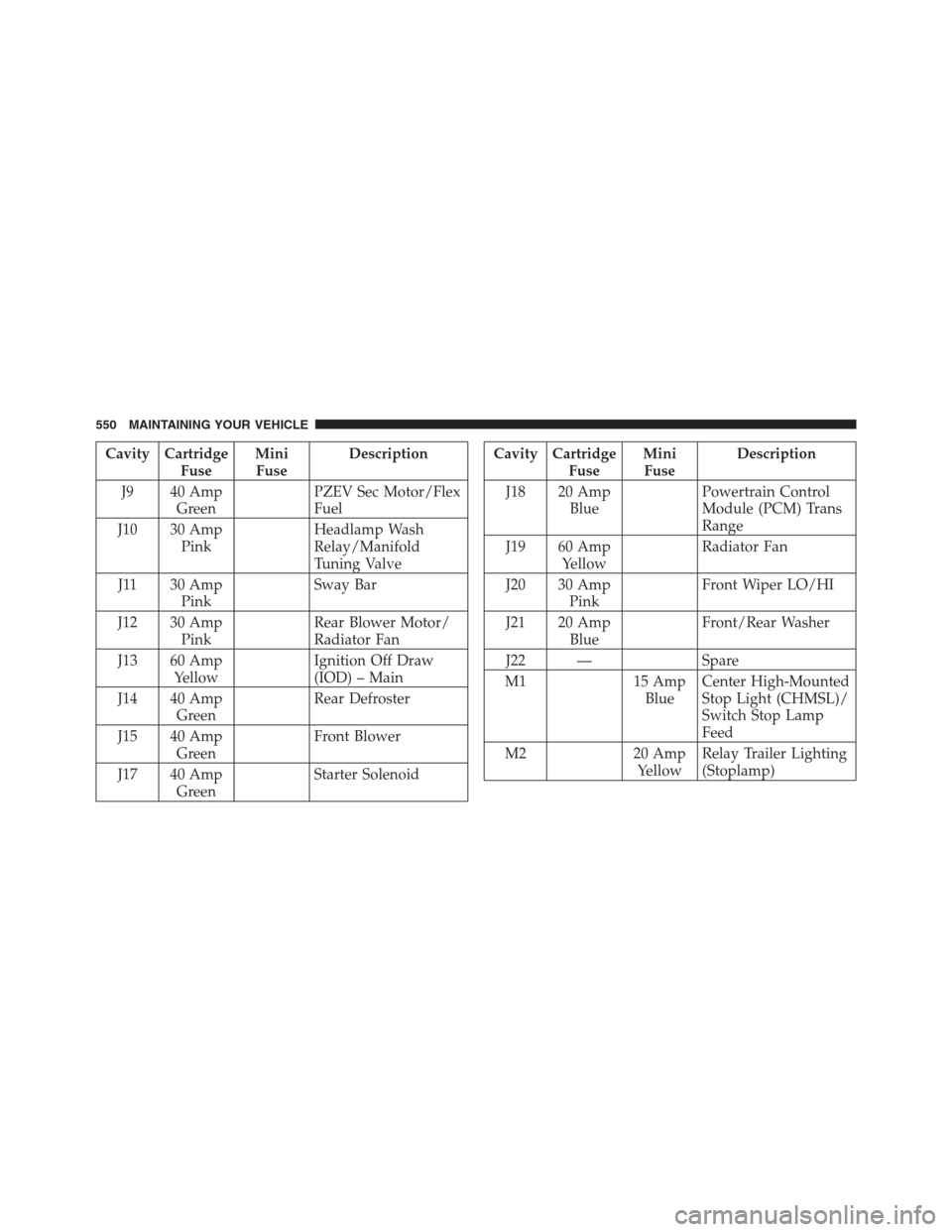
Cavity CartridgeFuseMini
Fuse Description
J9 40 Amp Green PZEV Sec Motor/Flex
Fuel
J10 30 Amp Pink Headlamp Wash
Relay/Manifold
Tuning Valve
J11 30 Amp Pink Sway Bar
J12 30 Amp Pink Rear Blower Motor/
Radiator Fan
J13 60 Amp Yellow Ignition Off Draw
(IOD) – Main
J14 40 Amp Green Rear Defroster
J15 40 Amp Green Front Blower
J17 40 Amp Green Starter SolenoidCavity Cartridge
FuseMini
Fuse Description
J18 20 Amp Blue Powertrain Control
Module (PCM) Trans
Range
J19 60 Amp Yellow Radiator Fan
J20 30 Amp Pink Front Wiper LO/HI
J21 20 Amp Blue Front/Rear Washer
J22 — Spare
M1 15 Amp
Blue Center High-Mounted
Stop Light (CHMSL)/
Switch Stop Lamp
Feed
M2 20 Amp
Yellow Relay Trailer Lighting
(Stoplamp)
550 MAINTAINING YOUR VEHICLE