traction control JEEP WRANGLER 2012 JK / 3.G User Guide
[x] Cancel search | Manufacturer: JEEP, Model Year: 2012, Model line: WRANGLER, Model: JEEP WRANGLER 2012 JK / 3.GPages: 613, PDF Size: 17.14 MB
Page 421 of 613
ELECTRONIC BRAKE CONTROL SYSTEM
Your vehicle is equipped with an advanced electronic
brake control system that includes Anti-Lock Brake Sys-
tem (ABS), Traction Control System (TCS), Brake Assist
System (BAS), Hill Start Assist (HSA), Electronic Roll
Mitigation (ERM), Electronic Stability Control (ESC),
Trailer Sway Control (TSC), and Hill Descent Control
(HDC). All of these systems work together to enhance
vehicle stability and control in various driving condi-
tions, and are commonly referred to as ESC.WARNING!
The Anti-Lock Brake System (ABS) cannot prevent
the natural laws of physics from acting on the ve-
hicle, nor can they increase the traction afforded by
prevailing road conditions. The ABS cannot prevent
collisions, including those resulting from excessive
speed in turns, driving on very slippery surfaces, or
hydroplaning. The capabilities of an ABS-equipped
vehicle must never be exploited in a reckless or
dangerous manner which could jeopardize the user’s
safety or the safety of others.
Traction Control System (TCS)
This system monitors the amount of wheel spin of each of
the driven wheels. If wheel spin is detected, brake
pressure is applied to the slipping wheel(s) to provide
enhanced acceleration and stability. A feature of the TCS
system functions similar to a limited slip differential and
5
STARTING AND OPERATING 419
Page 422 of 613
controls the wheel spin across a driven axle. If one wheel
on a driven axle is spinning faster than the other, the
system will apply the brake of the spinning wheel. This
will allow more engine torque to be applied to the wheel
that is not spinning. This feature remains active even if
TCS and ESC are in either the “Partial Off” or “Full Off”
modes. Refer to “Electronic Stability Control (ESC)” in
this section for further information.
Brake Assist System (BAS)
The BAS is designed to optimize the vehicle’s braking
capability during emergency braking maneuvers. The
system detects an emergency braking situation by sens-
ing the rate and amount of brake application and then
applies optimum pressure to the brakes. This can help
reduce braking distances. The BAS complements the
anti-lock brake system (ABS). Applying the brakes very
quickly results in the best BAS assistance. To receive the
benefit of the system, you must apply continuous brak-
ing pressure during the stopping sequence. Do notreduce brake pedal pressure unless braking is no longer
desired. Once the brake pedal is released, the BAS is
deactivated.
WARNING!
The Brake Assist System (BAS) cannot prevent the
natural laws of physics from acting on the vehicle,
nor can it increase the traction afforded by prevailing
road conditions. The BAS cannot prevent collisions,
including those resulting from excessive speed in
turns, driving on very slippery surfaces, or hydro-
planing. The capabilities of a BAS-equipped vehicle
must never be exploited in a reckless or dangerous
manner which could jeopardize the user’s safety or
the safety of others.
Hill Start Assist (HSA)
The HSA system is designed to assist the driver when
starting a vehicle from a stop on a hill. HSA will maintain
420 STARTING AND OPERATING
Page 427 of 613
WARNING!
Many factors, such as vehicle loading, road conditions
and driving conditions, influence the chance that
wheel lift or rollover may occur. Electronic Roll Miti-
gation (ERM) cannot prevent all wheel lift or rollovers,
especially those that involve leaving the roadway or
striking objects or other vehicles. The capabilities of an
ERM-equipped vehicle must never be exploited in a
reckless or dangerous manner which could jeopardize
the user’s safety or the safety of others.
Electronic Stability Control (ESC)
This system enhances directional control and stability of
the vehicle under various driving conditions. The ESC
corrects for over/under steering of the vehicle by apply-
ing the brake of the appropriate wheel to assist in
counteracting the over/under steer condition. Engine
power may also be reduced to help the vehicle maintain
the desired path.ESC uses sensors in the vehicle to determine the vehicle
path intended by the driver and compares it to the actual
path of the vehicle. When the actual path does not match
the intended path, ESC applies the brake of the appro-
priate wheel to assist in counteracting the oversteer or
understeer condition.
•Oversteer - when the vehicle is turning more than
appropriate for the steering wheel position.
•Understeer - when the vehicle is turning less than
appropriate for the steering wheel position.
The “ESC Activation/Malfunction Indicator Light” (lo-
cated in the instrument cluster), starts to flash as soon as
the tires lose traction and the ESC system becomes active.
The “ESC Activation/Malfunction Indicator Light” also
flashes when TCS is active. If the “ESC Activation/
Malfunction Indicator Light” begins to flash during ac-
celeration, ease up on the accelerator and apply as little
throttle as possible. Be sure to adapt your speed and
driving to the prevailing road conditions.5
STARTING AND OPERATING 425
Page 428 of 613
WARNING!
Electronic Stability Control (ESC) cannot prevent the
natural laws of physics from acting on the vehicle,
nor can it increase the traction afforded by prevailing
road conditions. ESC cannot prevent accidents, in-
cluding those resulting from excessive speed in
turns, driving on very slippery surfaces, or hydro-
planing. ESC also cannot prevent accidents resulting
from loss of vehicle control due to inappropriate
driver input for the conditions. Only a safe, attentive,
and skillful driver can prevent accidents. The capa-
bilities of an ESC equipped vehicle must never be
exploited in a reckless or dangerous manner which
could jeopardize the user ’s safety or the safety of
others.The ESC system has three available operating modes in
4H range. The system has one operating mode in 4L
range. Two-wheel drive vehicles and four-wheel drive
vehicles in 2H range have two operating modes.
4H Range (4WD Models) Or 2WD Models
On
This is the normal operating mode for ESC in 4H and
2WD vehicles.
Partial Off
This mode is entered by momentarily pressing the ESC
OFF switch.
426 STARTING AND OPERATING
Page 434 of 613
Enabling HDC
1. Shift the transfer case into 4WD LOW range. Refer to
“Four-Wheel Drive Operation” in “Starting and Operat-
ing” for further information.
2. Press the “Hill Descent” button. The “Hill Descent
Control Indicator Light” in the instrument cluster will
turn on solid.
NOTE:If the transfer case is not in 4WD LOW range,
the “Hill Descent Control Indicator Light” will flash for
five seconds and HDC will not be enabled.
Disabling HDC
1. Press the “Hill Descent” button or shift the transfer
case out of 4WD LOW range. The “Hill Descent Control
Indicator” light in the instrument cluster will turn off.TIRE SAFETY INFORMATION
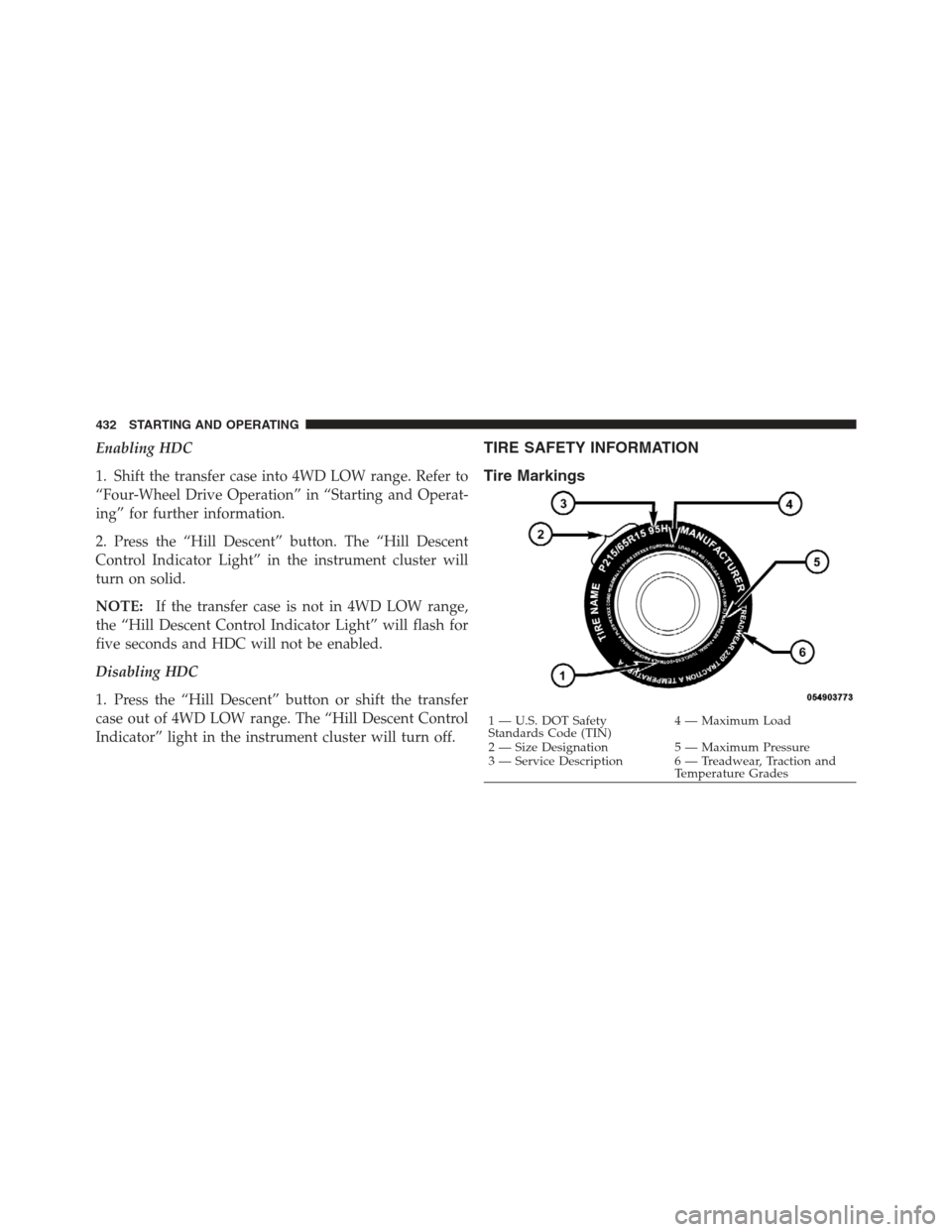
Tire Markings
1 — U.S. DOT Safety
Standards Code (TIN) 4 — Maximum Load
2 — Size Designation 5 — Maximum Pressure
3 — Service Description 6 — Treadwear, Traction and Temperature Grades
432 STARTING AND OPERATING
Page 507 of 613
FREEING A STUCK VEHICLE
If your vehicle becomes stuck in mud, sand or snow, it
can often be moved by a rocking motion. Turn your
steering wheel right and left to clear the area around the
front wheels. Then shift back and forth between DRIVE
and REVERSE (with automatic transmission) or 1st gear
and REVERSE (with manual transmission). Using mini-
mal accelerator pedal pressure to maintain the rocking
motion, without spinning the wheels, is most effective.
CAUTION!
Racing the engine or spinning the wheels may lead to
transmission overheating and failure. Allow the en-
gine to idle with the shift lever in NEUTRAL for at
least one minute after every five rocking-motion
cycles. This will minimize overheating and reduce
the risk of transmission failure during prolonged
efforts to free a stuck vehicle.NOTE:
If your vehicle is equipped with Traction Con-
trol or Electronic Stability Control (ESC), turn the system
OFF before attempting to “rock” the vehicle.
CAUTION!
•When “rocking” a stuck vehicle by moving be-
tween DRIVE and REVERSE (with automatic
transmission) or 1st gear and REVERSE (with
manual transmission), do not spin the wheels
faster than 15 mph (24 km/h), or drivetrain damage
may result.
•Revving the engine or spinning the wheels too fast
may lead to transmission overheating and failure.
It can also damage the tires. Do not spin the
wheels above 30 mph (48 km/h) while in gear (no
transmission shifting occurring).6
WHAT TO DO IN EMERGENCIES 505
Page 591 of 613
DEPARTMENT OF TRANSPORTATION UNIFORM
TIRE QUALITY GRADES
The following tire grading categories were established by
the National Highway Traffic Safety Administration. The
specific grade rating assigned by the tire’s manufacturer
in each category is shown on the sidewall of the tires on
your vehicle.
All passenger car tires must conform to Federal safety
requirements in addition to these grades.
Treadwear
The Treadwear grade is a comparative rating, based on
the wear rate of the tire when tested under controlled
conditions on a specified government test course. For
example, a tire graded 150 would wear one and one-half
times as well on the government course as a tire graded
100. The relative performance of tires depends upon the
actual conditions of their use, however, and may departsignificantly from the norm due to variations in driving
habits, service practices, and differences in road charac-
teristics and climate.
Traction Grades
The Traction grades, from highest to lowest, are AA, A, B,
and C. These grades represent the tire’s ability to stop on
wet pavement, as measured under controlled conditions
on specified government test surfaces of asphalt and
concrete. A tire marked C may have poor traction perfor-
mance.
WARNING!
The traction grade assigned to this tire is based on
straight-ahead braking traction tests, and does not
include acceleration, cornering, hydroplaning, or
peak traction characteristics.
9
IF YOU NEED CONSUMER ASSISTANCE 589
Page 597 of 613
Defroster, Rear Window................... 261
Defroster, Windshield ................87,356,362
Delay (Intermittent) Wipers ................. 156
Diagnostic System, Onboard ................ 514
Dimmer Switch, Headlight ................. 152
Dipsticks Oil (Engine) ........................ 518
Power Steering ...................... 413
Disabled Vehicle Towing ................... 508
Disarming, Theft System ................... 20
Disposal Engine Oil ......................... 520
Used Coolant (Antifreeze) .............. 533
Door Locks ............................. 34
Door Locks, Automatic .................... 37
Doors ................................. 29
Driver’s Seat Back Tilt .................... 137 Driving
............................... 398
Off-Pavement ....................... 399
Off-Road .......................... 399
Dual Top .............................. 170
Electric Remote Mirrors .................... 98
Electrical Outlet, Auxiliary (Power Outlet) ...... 162
Electrical Power Outlets ................... 162
Electronic Brake Control System ............. 419
Brake Assist System ................... 420
Electronic Roll Mitigation ............... 424
Traction Control System ................ 419
Electronic Roll Mitigation (ERM) ............. 424
Electronic Speed Control (Cruise Control) ...... 159
Electronic Stability Control (ESC) ............. 425
Electronic Throttle Control Warning Light ...... 283
Electronic Vehicle Information
Center (EVIC) ....................... 283,289
Emergency Brake ........................ 414
10
INDEX 595
Page 603 of 613
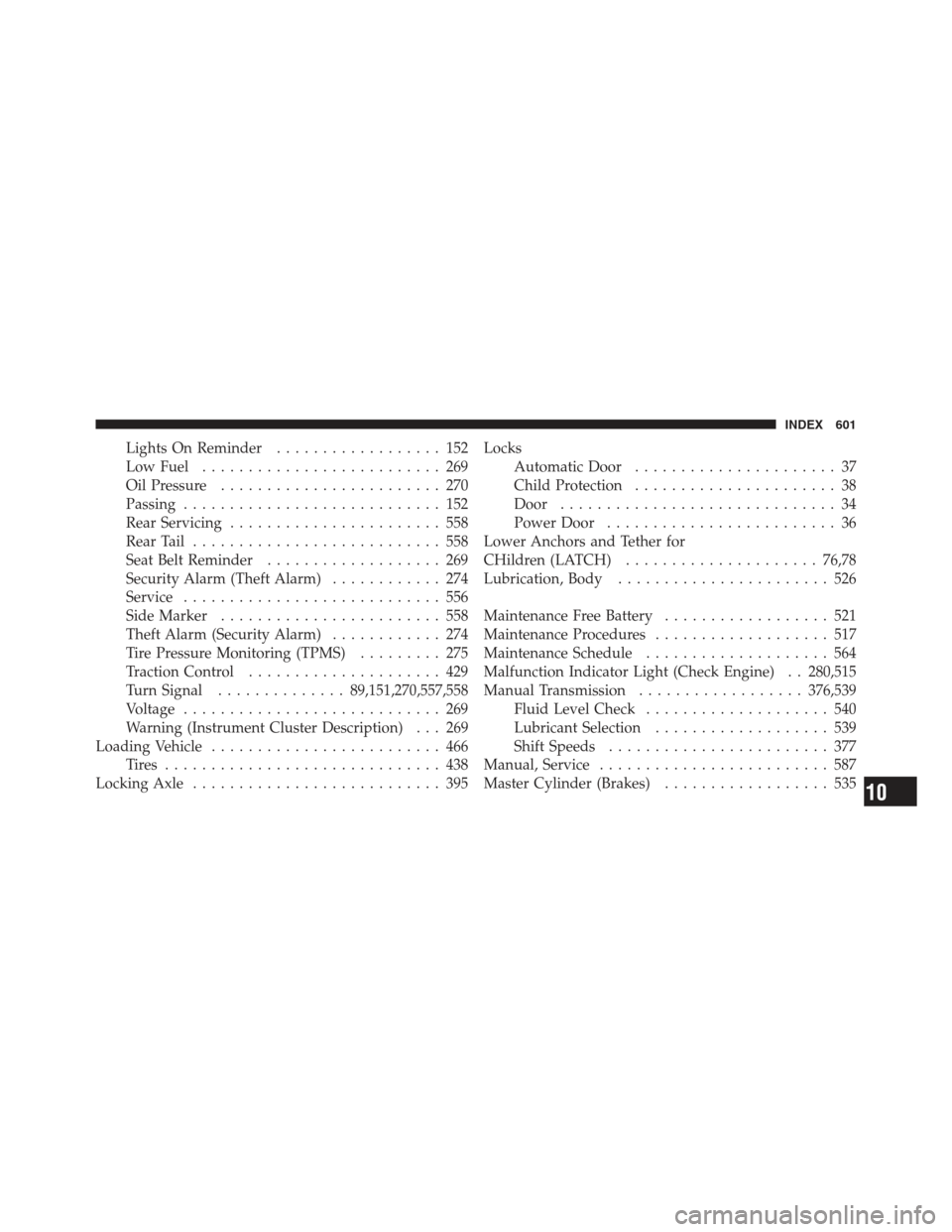
Lights On Reminder.................. 152
Low Fuel .......................... 269
Oil Pressure ........................ 270
Passing ............................ 152
Rear Servicing ....................... 558
Rear Tail ........................... 558
Seat Belt Reminder ................... 269
Security Alarm (Theft Alarm) ............ 274
Service ............................ 556
Side Marker ........................ 558
Theft Alarm (Security Alarm) ............ 274
Tire Pressure Monitoring (TPMS) ......... 275
Traction Control ..................... 429
Turn Signal .............. 89,151,270,557,558
Voltage ............................ 269
Warning (Instrument Cluster Description) . . . 269
Loading Vehicle ......................... 466
Tires .............................. 438
Locking Axle ........................... 395 Locks
Automatic Door ...................... 37
Child Protection ...................... 38
Door .............................. 34
Power Door ......................... 36
Lower Anchors and Tether for
CHildren (LATCH) ..................... 76,78
Lubrication, Body ....................... 526
Maintenance Free Battery .................. 521
Maintenance Procedures ................... 517
Maintenance Schedule .................... 564
Malfunction Indicator Light (Check Engine) . . 280,515
Manual Transmission .................. 376,539
Fluid Level Check .................... 540
Lubricant Selection ................... 539
Shift Speeds ........................ 377
Manual, Service ......................... 587
Master Cylinder (Brakes) .................. 535
10
INDEX 601
Page 610 of 613
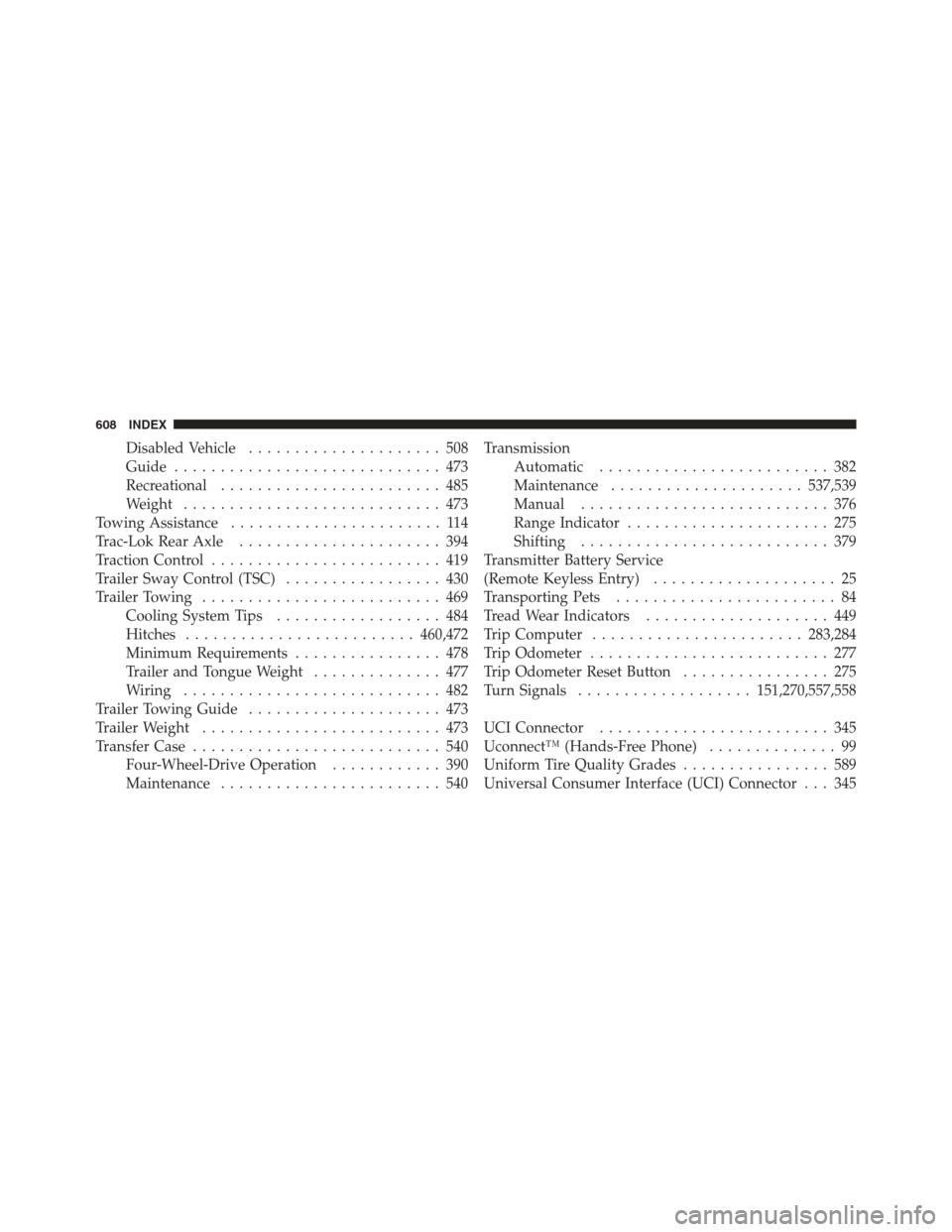
Disabled Vehicle..................... 508
Guide ............................. 473
Recreational ........................ 485
Weight ............................ 473
Towing Assistance ....................... 114
Trac-Lok Rear Axle ...................... 394
Traction Control ......................... 419
Trailer Sway Control (TSC) ................. 430
Trailer Towing .......................... 469
Cooling System Tips .................. 484
Hitches ......................... 460,472
Minimum Requirements ................ 478
Trailer and Tongue Weight .............. 477
Wiring ............................ 482
Trailer Towing Guide ..................... 473
Trailer Weight .......................... 473
Transfer Case ........................... 540
Four-Wheel-Drive Operation ............ 390
Maintenance ........................ 540 Transmission
Automatic ......................... 382
Maintenance ..................... 537,539
Manual ........................... 376
Range Indicator ...................... 275
Shifting ........................... 379
Transmitter Battery Service
(Remote Keyless Entry) .................... 25
Transporting Pets ........................ 84
Tread Wear Indicators .................... 449
Trip Computer ....................... 283,284
Trip Odometer .......................... 277
Trip Odometer Reset Button ................ 275
Turn Signals ................... 151,270,557,558
UCI Connector ......................... 345
Uconnect™ (Hands-Free Phone) .............. 99
Uniform Tire Quality Grades ................ 589
Universal Consumer Interface (UCI) Connector . . . 345
608 INDEX