Cooling system JEEP WRANGLER 2014 JK / 3.G User Guide
[x] Cancel search | Manufacturer: JEEP, Model Year: 2014, Model line: WRANGLER, Model: JEEP WRANGLER 2014 JK / 3.GPages: 678, PDF Size: 4.97 MB
Page 599 of 678
To minimize the possibility of catalytic converter dam-
age:
•Do not shut off the engine or interrupt the ignition,
when the transmission is in gear and the vehicle is in
motion.
• Do not try to start the engine by pushing or towing the
vehicle.
• Do not idle the engine with any spark plug wires
disconnected or removed, such as when diagnostic
testing, or for prolonged periods during very rough
idle or malfunctioning operating conditions.Cooling System
WARNING!
You or others can be badly burned by hot engine
coolant (antifreeze) or steam from your radiator. If
you see or hear steam coming from under the hood,
do not open the hood until the radiator has had time
to cool. Never try to open a cooling system pressure
cap when the radiator or coolant bottle is hot.
Engine Coolant Checks
Check the engine coolant (antifreeze) protection every 12
months (before the onset of freezing weather, where
applicable). If the engine coolant (antifreeze) is dirty or
rusty in appearance, the system should be drained,
flushed and refilled with fresh engine coolant (anti-
freeze). Check the front of the A/C condenser (if
equipped) or radiator for any accumulation of bugs,
7
MAINTAINING YOUR VEHICLE 597
Page 600 of 678
leaves, etc. If dirty, clean by gently spraying water from a
garden hose vertically down the face of the A/C con-
denser (if equipped) or the back of the radiator core.
Check the engine cooling system hoses for brittle rubber,
cracking, tears, cuts, and tightness of the connection at
the coolant recovery bottle and radiator. Inspect the
entire system for leaks.
With the engine at normal operating temperature (but
not running), check the cooling system pressure cap for
proper vacuum sealing by draining a small amount of
engine coolant (antifreeze) from the radiator drain cock.
If the cap is sealing properly, the engine coolant (anti-
freeze) will begin to drain from the coolant recovery
bottle. DO NOT REMOVE THE COOLANT PRESSURE
CAP WHEN THE COOLING SYSTEM IS HOT.Cooling System — Drain, Flush And Refill
If the engine coolant (antifreeze) is dirty or contains
visible sediment, have an authorized dealer clean and
flush with OAT coolant (antifreeze) (conforming to
MS-12106).
Refer to the “Maintenance Schedule” for the proper
maintenance intervals.
NOTE:Some vehicles require special tools to add coolant
properly. Failure to fill these systems properly could lead
to severe internal engine damage. If any coolant is
needed to be added to the system please contact your
local authorized dealer.
Selection Of Coolant
Refer to “Fluids, Lubricants, and Genuine Parts” in
“Maintaining Your Vehicle” for further information.
598 MAINTAINING YOUR VEHICLE
Page 601 of 678
CAUTION!
•Mixing of engine coolant (antifreeze) other than
specified Organic Additive Technology (OAT) en-
gine coolant (antifreeze), may result in engine
damage and may decrease corrosion protection.
Organic Additive Technology (OAT) engine cool-
ant is different and should not be mixed with
Hybrid Organic Additive Technology (HOAT) en-
gine coolant (antifreeze) or any “globally compat-
ible” coolant (antifreeze). If a non-OAT engine
coolant (antifreeze) is introduced into the cooling
system in an emergency, the cooling system will
need to be drained, flushed, and refilled with fresh
OAT coolant (conforming to MS-12106), by an
authorized dealer as soon as possible.
(Continued)
CAUTION! (Continued)
•Do not use water alone or alcohol-based engine
coolant (antifreeze) products. Do not use additional
rust inhibitors or antirust products, as they may not
be compatible with the radiator engine coolant and
may plug the radiator.
• This vehicle has not been designed for use with
propylene glycol-based engine coolant (antifreeze).
Use of propylene glycol-based engine coolant (an-
tifreeze) is not recommended.
Adding Coolant
Your vehicle has been built with an improved engine
coolant (OAT coolant conforming to MS-12106) that allows
extended maintenance intervals. This engine coolant (anti-
freeze) can be used up to ten years or 150,000 miles
(240,000 km) before replacement. To prevent reducing this
extended maintenance period, it is important that you use7
MAINTAINING YOUR VEHICLE 599
Page 602 of 678
the same engine coolant (OAT coolant conforming to
MS-12106) throughout the life of your vehicle.
Please review these recommendations for using Organic
Additive Technology (OAT) engine coolant (antifreeze)
that meets the requirements of Chrysler Material Stan-
dard MS-12106. When adding engine coolant (antifreeze):
•We recommend using MOPAR® Antifreeze/Coolant
10 Year/150,000 Mile Formula OAT (Organic Additive
Technology) that meets the requirements of Chrysler
Material Standard MS-12106.
• Mix a minimum solution of 50% OAT engine coolant
that meets the requirements of Chrysler Material Stan-
dard MS-12106 and distilled water. Use higher concen-
trations (not to exceed 70%) if temperatures below
34° F (37° C) are anticipated. •
Use only high purity water such as distilled or deion-
ized water when mixing the water/engine coolant
(antifreeze) solution. The use of lower quality water
will reduce the amount of corrosion protection in the
engine cooling system.
Please note that it is the owner’s responsibility to main-
tain the proper level of protection against freezing ac-
cording to the temperatures occurring in the area where
the vehicle is operated.
NOTE:
• Some vehicles require special tools to add coolant
properly. Failure to fill these systems properly could
lead to severe internal engine damage. If any coolant is
needed to be added to the system please contact your
local authorized dealer.
600 MAINTAINING YOUR VEHICLE
Page 603 of 678
•Mixing engine coolant (antifreeze) types is not recom-
mended and can result in cooling system damage. If
HOAT and OAT coolant are mixed in an emergency,
have a authorized dealer drain, flush, and refill with
OAT coolant (conforming to MS-12106) as soon as
possible.
Cooling System Pressure Cap
The cap must be fully tightened to prevent loss of engine
coolant (antifreeze), and to ensure that engine coolant
(antifreeze) will return to the radiator from the coolant
recovery tank.
The cap should be inspected and cleaned if there is any
accumulation of foreign material on the sealing surfaces.
WARNING!
• Do not open hot engine cooling system. Never add
engine coolant (antifreeze) when the engine is
overheated. Do not loosen or remove the cap to cool
an overheated engine. Heat causes pressure to
build up in the cooling system. To prevent scalding
or injury, do not remove the pressure cap while the
system is hot or under pressure.
• Do not use a pressure cap other than the one
specified for your vehicle. Personal injury or en-
gine damage may result.
Disposal Of Used Engine Coolant
Used ethylene glycol-based engine coolant (antifreeze) is
a regulated substance requiring proper disposal. Check
with your local authorities to determine the disposal
rules for your community. To prevent ingestion by ani-
mals or children, do not store ethylene glycol-based
7
MAINTAINING YOUR VEHICLE 601
Page 605 of 678
•Check the coolant freeze point in the radiator and in
the coolant expansion bottle. If engine coolant (anti-
freeze) needs to be added, the contents of the coolant
expansion bottle must also be protected against freez-
ing.
• If frequent engine coolant (antifreeze) additions are
required, the cooling system should be pressure tested
for leaks.
• Maintain engine coolant (antifreeze) concentration at a
minimum of 50% OAT coolant (conforming to
MS-12106) and distilled water for proper corrosion
protection of your engine which contains aluminum
components.
• Make sure that the coolant expansion bottle overflow
hoses are not kinked or obstructed.
• Keep the front of the radiator clean. If your vehicle is
equipped with air conditioning, keep the front of the
condenser clean. •
Do not change the thermostat for Summer or Winter
operation. If replacement is ever necessary, install
ONLY the correct type thermostat. Other designs may
result in unsatisfactory engine coolant (antifreeze)
performance, poor gas mileage, and increased emis-
sions.
Brake System
In order to assure brake system performance, all brake
system components should be inspected periodically.
Refer to the “Maintenance Schedule” for the proper
maintenance intervals.
WARNING!
Riding the brakes can lead to brake failure and
possibly a collision. Driving with your foot resting or
riding on the brake pedal can result in abnormally
(Continued)
7
MAINTAINING YOUR VEHICLE 603
Page 634 of 678
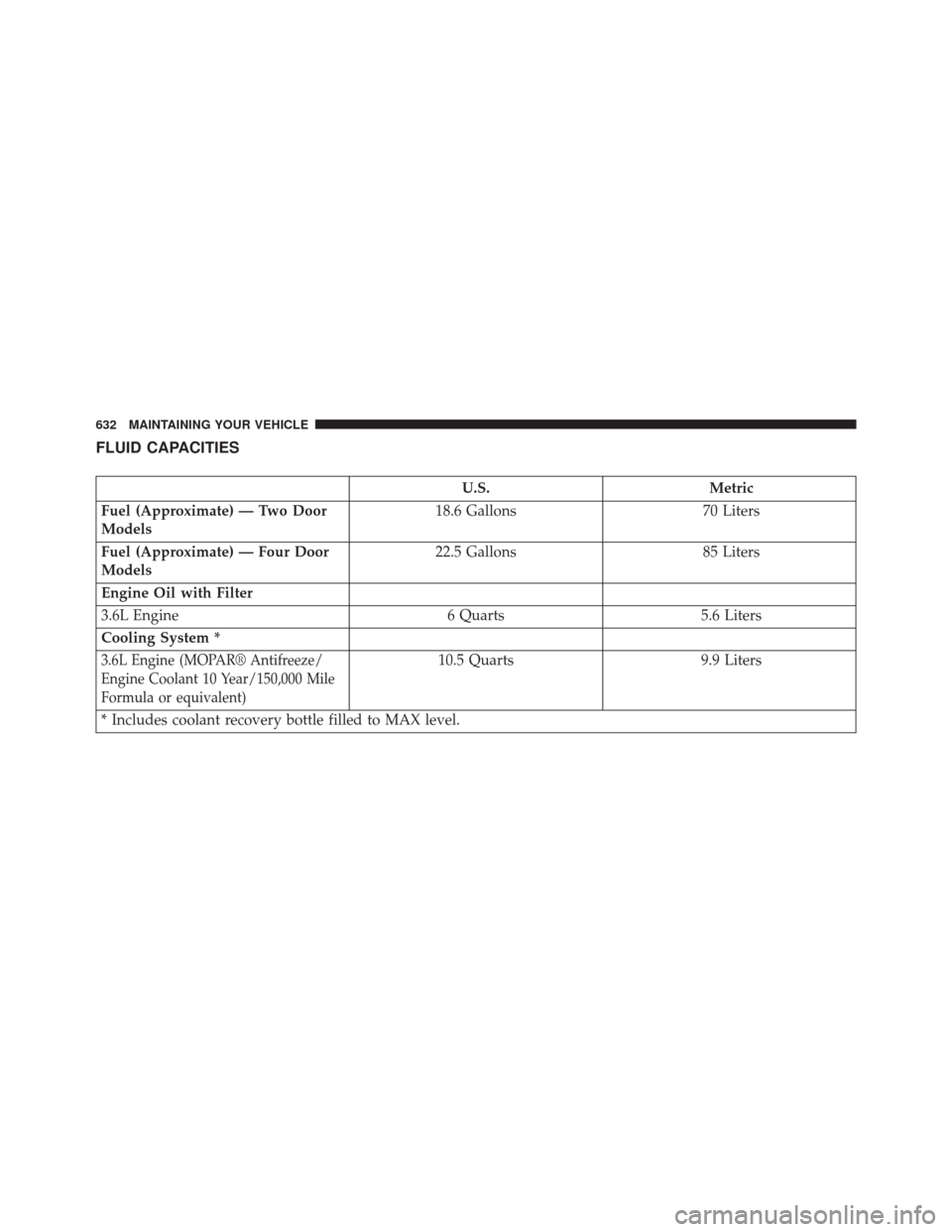
FLUID CAPACITIES
U.S.Metric
Fuel (Approximate) — Two Door
Models 18.6 Gallons
70 Liters
Fuel (Approximate) — Four Door
Models 22.5 Gallons
85 Liters
Engine Oil with Filter
3.6L Engine 6 Quarts5.6 Liters
Cooling System *
3.6L Engine (MOPAR® Antifreeze/
Engine Coolant 10 Year/150,000 Mile
Formula or equivalent)10.5 Quarts 9.9 Liters
* Includes coolant recovery bottle filled to MAX level.
632 MAINTAINING YOUR VEHICLE
Page 640 of 678
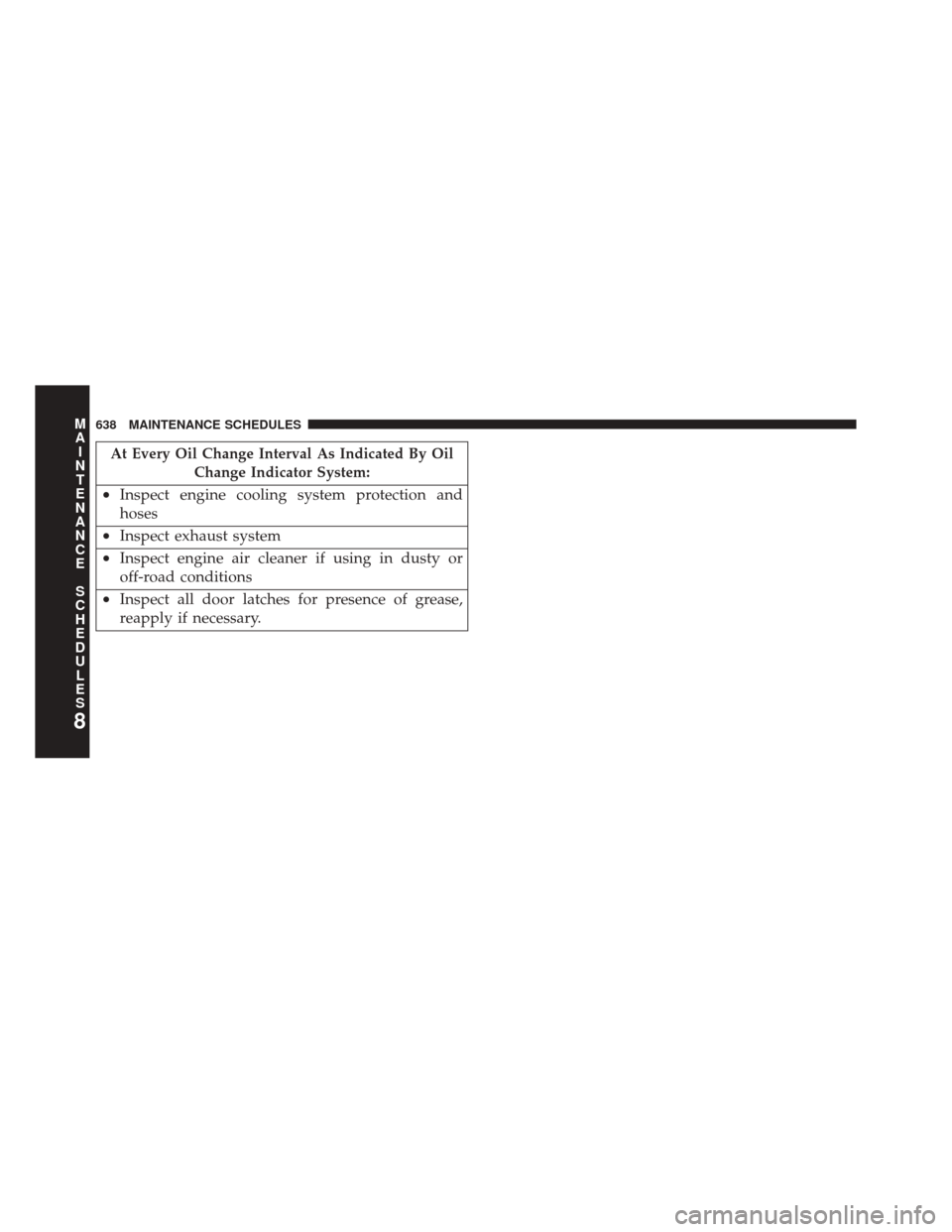
At Every Oil Change Interval As Indicated By OilChange Indicator System:
•Inspect engine cooling system protection and
hoses
• Inspect exhaust system
• Inspect engine air cleaner if using in dusty or
off-road conditions
• Inspect all door latches for presence of grease,
reapply if necessary.
8
M
A I
N T
E
N
A
N
C E
S
C
H E
D
U L
E
S638 MAINTENANCE SCHEDULES
Page 660 of 678
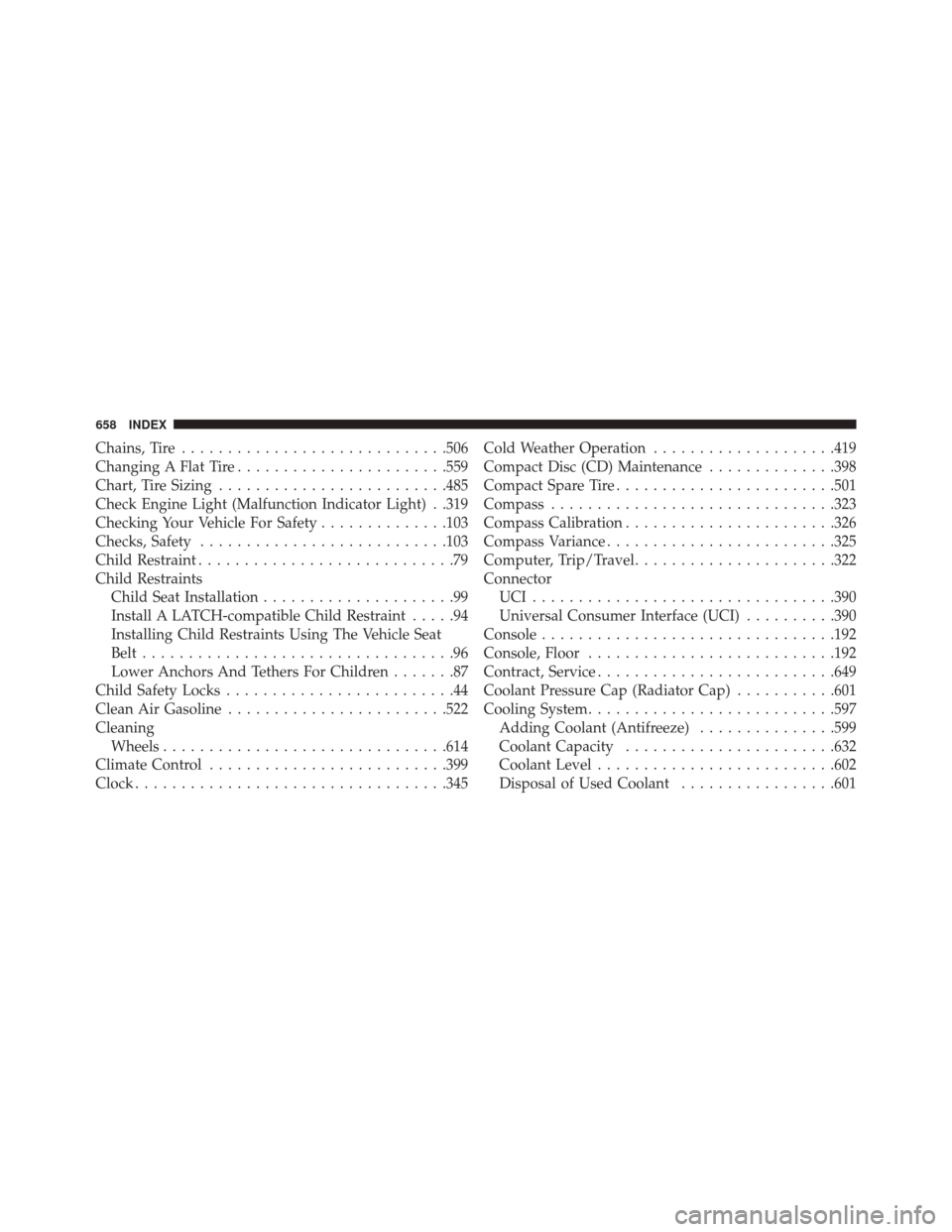
Chains, Tire............................ .506
Changing A Flat Tire ...................... .559
Chart, Tire Sizing ........................ .485
Check Engine Light (Malfunction Indicator Light) . .319
Checking Your Vehicle For Safety ..............103
Checks, Safety .......................... .103
Child Restraint ............................79
Child Restraints Child Seat Installation .....................99
Install A LATCH-compatible Child Restraint .....94
Installing Child Restraints Using The Vehicle Seat
Belt ..................................96
Lower Anchors And Tethers For Children .......87
Child Safety Locks .........................44
Clean Air Gasoline ....................... .522
Cleaning Wheels .............................. .614
Climate Control ......................... .399
Clock ................................. .345Cold Weather Operation
....................419
Compact Disc (CD) Maintenance ..............398
Compact Spare Tire ....................... .501
Compass .............................. .323
Compass Calibration ...................... .326
Compass Variance ........................ .325
Computer, Trip/Travel ..................... .322
Connector UCI................................ .390
Universal Consumer Interface (UCI) ..........390
Console ............................... .192
Console, Floor .......................... .192
Contract, Service ......................... .649
Coolant Pressure Cap (Radiator Cap) ...........601
Cooling System .......................... .597
Adding Coolant (Antifreeze) ...............599
Coolant Capacity ...................... .632
Coolant Level ......................... .602
Disposal of Used Coolant .................601
658 INDEX
Page 662 of 678
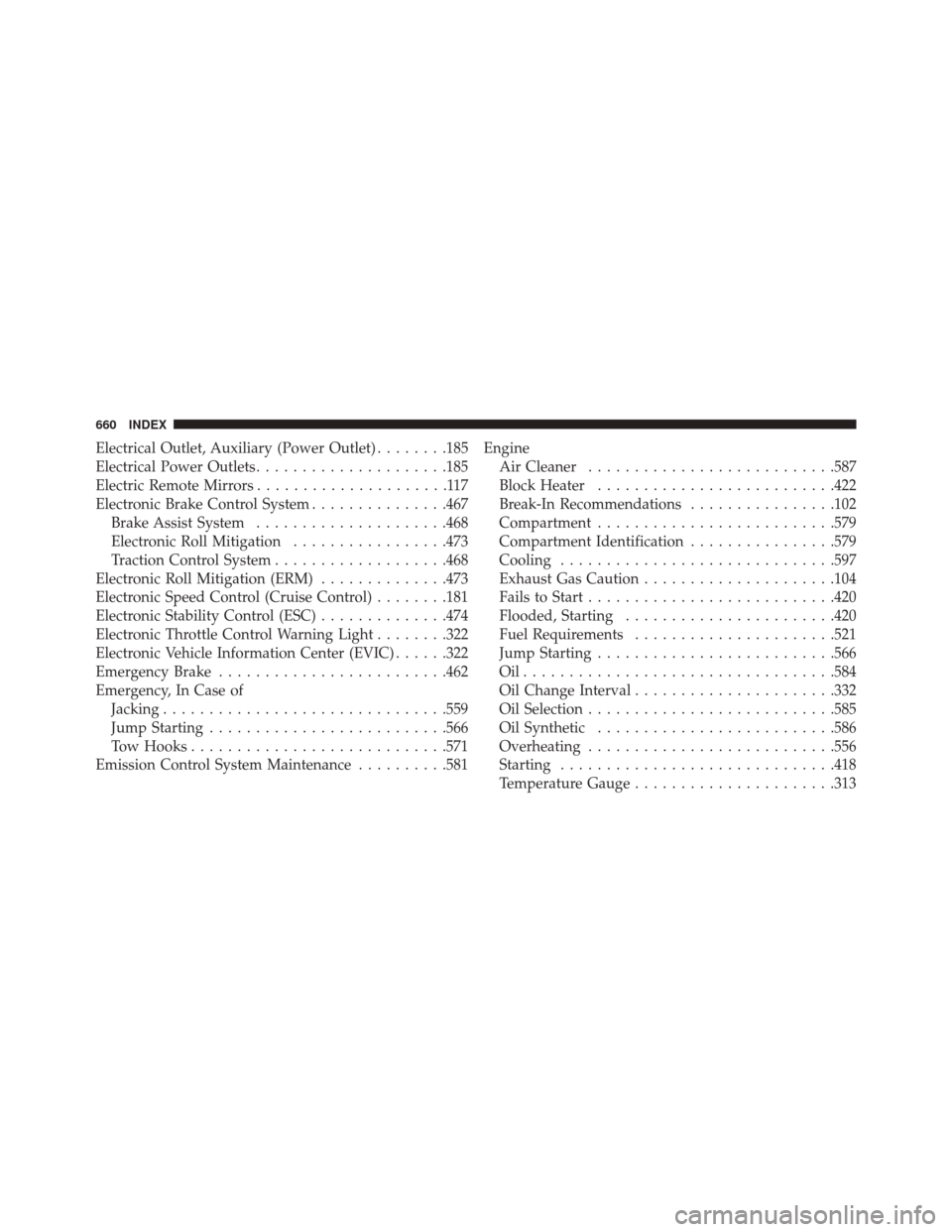
Electrical Outlet, Auxiliary (Power Outlet)........185
Electrical Power Outlets .....................185
Electric Remote Mirrors .....................117
Electronic Brake Control System ...............467
Brake Assist System .....................468
Electronic Roll Mitigation .................473
Traction Control System ...................468
Electronic Roll Mitigation (ERM) ..............473
Electronic Speed Control (Cruise Control) ........181
Electronic Stability Control (ESC) ..............474
Electronic Throttle Control Warning Light ........322
Electronic Vehicle Information Center (EVIC) ......322
Emergency Brake ........................ .462
Emergency, In Case of Jacking .............................. .559
Jump Starting ......................... .566
Tow Hooks ........................... .571
Emission Control System Maintenance ..........581Engine
Air Cleaner .......................... .587
Block Heater ......................... .422
Break-In Recommendations ................102
Compartment ......................... .579
Compartment Identification ................579
Cooling ............................. .597
Exhaust Gas Caution .....................104
Fails to Start .......................... .420
Flooded, Starting ...................... .420
Fuel Requirements ..................... .521
Jump Starting ......................... .566
Oil................................. .584
Oil Change Interval ..................... .332
Oil Selection .......................... .585
Oil Synthetic ......................... .586
Overheating .......................... .556
Starting ............................. .418
T
emperature Gauge ..................... .313
660 INDEX