belt JEEP WRANGLER 2015 JK / 3.G Owner's Manual
[x] Cancel search | Manufacturer: JEEP, Model Year: 2015, Model line: WRANGLER, Model: JEEP WRANGLER 2015 JK / 3.GPages: 695, PDF Size: 20.64 MB
Page 69 of 695
Advanced Front Air Bag Operation
Advanced Front Air Bags are designed to provide addi-
tional protection by supplementing the seat belts. Ad-
vanced Front Air Bags are not expected to reduce the risk
of injury in rear, side, or rollover collisions. The Ad-
vanced Front Air Bags will not deploy in all frontal
collisions, including some that may produce substantial
vehicle damage — for example, some pole collisions,
truck underrides, and angle offset collisions.
On the other hand, depending on the type and location of
impact, Advanced Front Air Bags may deploy in crashes
with little vehicle front-end damage but that produce a
severe initial deceleration.
Because air bag sensors measure vehicle deceleration
over time, vehicle speed and damage by themselves are
not good indicators of whether or not an air bag should
have deployed.
Seat belts are necessary for your protection in all colli-
sions, and also are needed to help keep you in position,
away from an inflating air bag.
When the ORC detects a collision requiring the Ad-
vanced Front Air Bags, it signals the inflator units. A large
quantity of non-toxic gas is generated to inflate the
Advanced Front Air Bags.
The steering wheel hub trim cover and the upper right
side of the instrument panel separate and fold out of the
way as the air bags inflate to their full size. The Advanced
Front Air Bags fully inflate in less time than it takes to
blink your eyes. The air bags then quickly deflate while
helping to restrain the driver and front passenger.
2
THINGS TO KNOW BEFORE STARTING YOUR VEHICLE 67
Page 70 of 695
Knee Impact Bolsters
The Knee Impact Bolsters help protect the knees of the
driver and front passenger, and position the front occu-
pants for improved interaction with the Advanced Front
Air Bags.
WARNING!
•Do not drill, cut, or tamper with the knee impact
bolsters in any way.
•Do not mount any accessories to the knee impact
bolsters such as alarm lights, stereos, citizen band
radios, etc.
Supplemental Seat-Mounted Side Air Bags (SABs)
Your vehicle is equipped with Supplemental Seat-
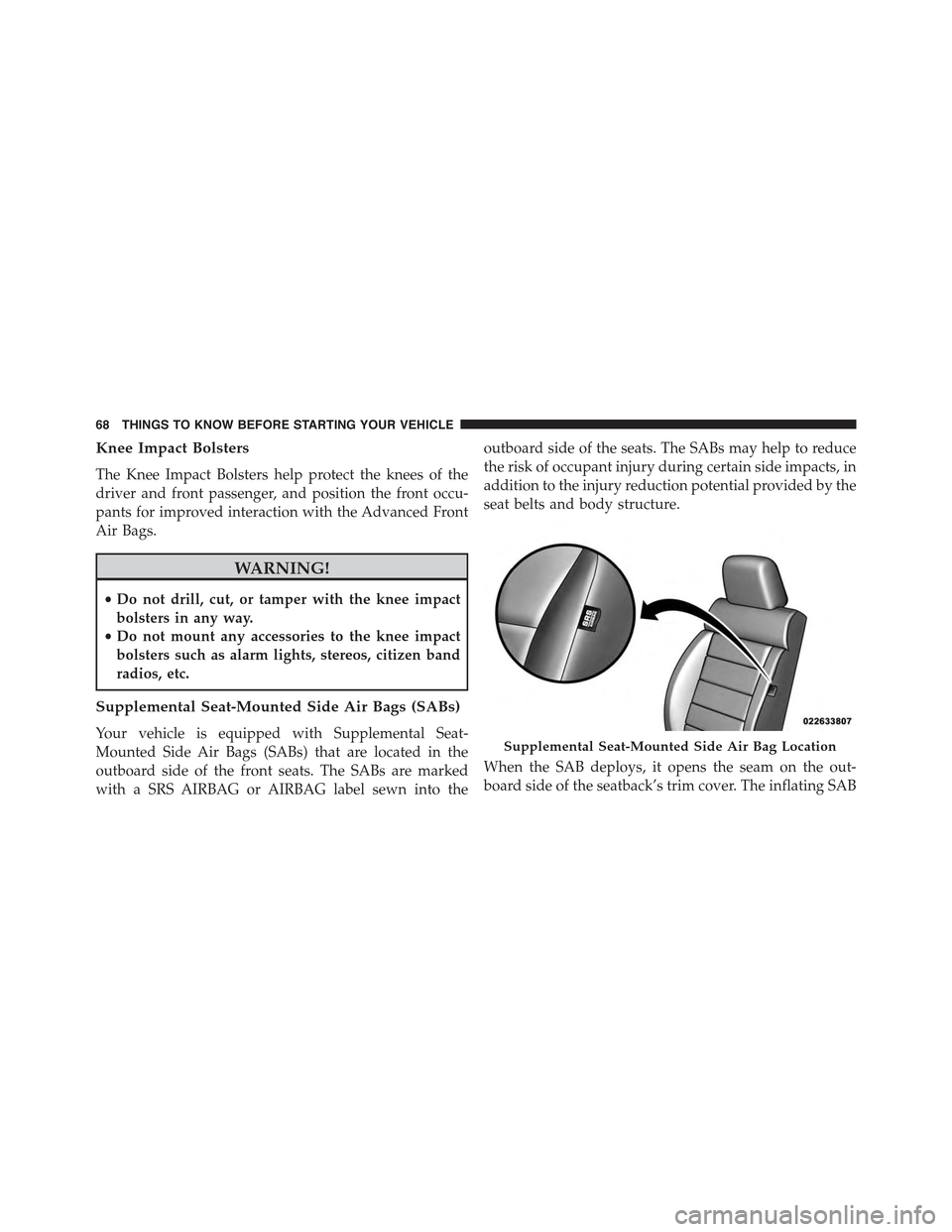
Mounted Side Air Bags (SABs) that are located in the
outboard side of the front seats. The SABs are marked
with a SRS AIRBAG or AIRBAG label sewn into the
outboard side of the seats. The SABs may help to reduce
the risk of occupant injury during certain side impacts, in
addition to the injury reduction potential provided by the
seat belts and body structure.
When the SAB deploys, it opens the seam on the out-
board side of the seatback’s trim cover. The inflating SAB
Supplemental Seat-Mounted Side Air Bag Location
68 THINGS TO KNOW BEFORE STARTING YOUR VEHICLE
Page 71 of 695
deploys through the seat seam into the space between the
occupant and the door. The SAB moves at a very high
speed and with such a high force that it could injure you
if you are not seated properly, or if items are positioned
in the area where the SAB inflates. Children are at an
even greater risk of injury from a deploying air bag.
WARNING!
Do not use accessory seat covers or place objects
between you and the Side Air Bags; the performance
could be adversely affected and/or objects could be
pushed into you, causing serious injury.
SABs are designed to activate in certain side impacts. The
Occupant Restraint Controller (“ORC”) determines
whether the deployment of the SAB in a particular
impact event is appropriate, based on the severity and
type of collision. The side impact sensors aid the ORC in
determining the appropriate response to impact events.
The system is calibrated to deploy the SAB on the impact
side of the vehicle during impacts that require SAB
occupant protection. In side impacts, the SABs deploy
independently; a left side impact deploys the left SAB
only and a right side impact deploys the right side SAB
only. Vehicle damage by itself is not a good indicator of
whether or not SABs should have deployed.
The SABs will not deploy in all side collisions, including
some collisions at certain angles, or some side collisions
that do not impact the area of the passenger compart-
ment.
SABs are a supplement to the seat belt restraint system.
SABs deploy in less time than it takes to blink your eyes.
Occupants, including children, who are up against or very
close to SABs can be seriously injured or killed. Occupants,
including children, should never lean on or sleep against
the door, side windows, or area where the SABs inflate,
even if they are in an infant or child restraint.
2
THINGS TO KNOW BEFORE STARTING YOUR VEHICLE 69
Page 72 of 695

Seat belts (and child restraints where appropriate) are
necessary for your protection in all collisions. They also
help keep you in position, away from an inflating SAB.
To get the best protection from the SABs, occupants must
wear their seat belts properly and sit upright with their
backs against the seats. Children must be properly re-
strained in a child restraint or booster seat that is
appropriate for the size of the child.
WARNING!
•SABs need room to inflate. Do not lean against the
door or window. Sit upright in the center of the
seat.
•Being too close to the SABs during deployment
could cause you to be severely injured or killed.
(Continued)
WARNING!(Continued)
•Relying on the SABs alone could lead to more
severe injuries in a collision. The SABs work with
your seat belt to restrain you properly. In some
collisions, SABs won’t deploy at all. Always wear
your seat belt even though you have SABs.
NOTE:Air bag covers may not be obvious to you, but
they will open during air bag deployment.
If A Deployment Occurs
The Advanced Front Air Bags are designed to deflate
immediately after deployment.
NOTE:Front and/or side air bags will not deploy in all
collisions. This does not mean something is wrong with
the air bag system.
70 THINGS TO KNOW BEFORE STARTING YOUR VEHICLE
Page 73 of 695
If you do have a collision, which deploys the air bags, any
or all of the following may occur:
•The air bag material may sometimes cause abrasions
and/or skin reddening to the occupants as the air bags
deploy and unfold. The abrasions are similar to fric-
tion rope burns or those you might get sliding along a
carpet or gymnasium floor. They are not caused by
contact with chemicals. They are not permanent and
normally heal quickly. However, if you haven’t healed
significantly within a few days, or if you have any
blistering, see your doctor immediately.
•As the air bags deflate, you may see some smoke-like
particles. The particles are a normal by-product of the
process that generates the non-toxic gas used for air
bag inflation. These airborne particles may irritate the
skin, eyes, nose, or throat. If you have skin or eye
irritation, rinse the area with cool water. For nose or
throat irritation, move to fresh air. If the irritation
continues, see your doctor. If these particles settle on
your clothing, follow the garment manufacturer ’s in-
structions for cleaning.
Do not drive your vehicle after the air bags have de-
ployed. If you are involved in another collision, the air
bags will not be in place to protect you.
WARNING!
Deployed air bags and seat belt pretensioners cannot
protect you in another collision. Have the air bags,
seat belt pretensioners, and the seat belt retractor
assemblies replaced by an authorized dealer imme-
diately. Also, have the Occupant Restraint Controller
System serviced as well.
NOTE:
•Air bag covers may not be obvious in the interior trim,
but they will open during air bag deployment.
2
THINGS TO KNOW BEFORE STARTING YOUR VEHICLE 71
Page 77 of 695
WARNING!(Continued)
•Do not attempt to modify any part of your air bag
system. The air bag may inflate accidentally or may
not function properly if modifications are made.
Take your vehicle to an authorized dealer for any
air bag system service. If your seat, including your
trim cover and cushion, needs to be serviced in any
way (including removal or loosening/tightening of
seat attachment bolts), take the vehicle to your
authorized dealer. Only manufacturer approved
seat accessories may be used. If it is necessary to
modify the air bag system for persons with dis-
abilities, contact your authorized dealer.
Event Data Recorder (EDR)
This vehicle is equipped with an event data recorder
(EDR). The main purpose of an EDR is to record, in
certain crash or near crash-like situations, such as an air
bag deployment or hitting a road obstacle, data that will
assist in understanding how a vehicle’s systems per-
formed. The EDR is designed to record data related to
vehicle dynamics and safety systems for a short period of
time, typically 30 seconds or less. The EDR in this vehicle
is designed to record such data as:
•How various systems in your vehicle were operating;
•Whether or not the driver and passenger safety belts
were buckled/fastened;
•How far (if at all) the driver was pushing the accelera-
tor and/or brake pedal; and,
•How fast the vehicle was traveling.
2
THINGS TO KNOW BEFORE STARTING YOUR VEHICLE 75
Page 79 of 695

WARNING!(Continued)
great that you could not hold the child, no matter
how strong you are. The child and others could be
badly injured. Any child riding in your vehicle
should be in a proper restraint for the child’s size.
There are different sizes and types of restraints for
children from newborn size to the child almost large
enough for an adult seat belt. Always check the child seat
Owner ’s Manual to make sure you have the correct seat
for your child. Carefully read and follow all the instruc-
tions and warnings in the child restraint Owner ’s Manual
and on all the labels attached to the child restraint.
Before buying any restraint system, make sure that it has
a label certifying that it meets all applicable Safety
Standards. You should also make sure that you can install
it in the vehicle where you will use it.
NOTE:
•For additional information, refer to www.seatcheck.org
or call 1–866–SEATCHECK (732–8243). Canadian resi-
dents should refer to Transport Canada’s website for
additional information:
•www.tc.gc.ca/eng/roadsafety/safedrivers-
childsafety-index-53.htm
2
THINGS TO KNOW BEFORE STARTING YOUR VEHICLE 77
Page 80 of 695

Summary Of Recommendations For Restraining Children In Vehicles
Child Size, Height, Weight Or Age Recommended Type Of Child Restraint
Infants and Toddlers Children who are two years old or
younger and who have not reached the
height or weight limits of their child
restraint
Either an Infant Carrier or a Convertible
Child Restraint, facing rearward in the
rear seat of the vehicle
Small Children Children who are at least two years old
or who have out-grown the height or
weight limit of their rear-facing child
restraint
Forward-Facing Child Restraint with a
five-point Harness, facing forward in the
rear seat of the vehicle
Larger Children Children who have out-grown their
forward-facing child restraint, but are
too small to properly fit the vehicle’s
seat belt
Belt Positioning Booster Seat and the
vehicle seat belt, seated in the rear seat
of the vehicle
Children Too Large for
Child Restraints
Children 12 years old or younger, who
have out-grown the height or weight
limit of their booster seat
Vehicle Seat Belt, seated in the rear seat
of the vehicle
78 THINGS TO KNOW BEFORE STARTING YOUR VEHICLE
Page 82 of 695

All children whose weight or height is above the
forward-facing limit for the child seat should use a
belt-positioning booster seat until the vehicle’s seat belts
fit properly. If the child cannot sit with knees bent over
the vehicle’s seat cushion while the child’s back is against
the seatback, they should use a belt-positioning booster
seat. The child and belt-positioning booster seat are held
in the vehicle by the seat belt.
WARNING!
•Improper installation can lead to failure of an infant
or child restraint. It could come loose in a collision.
The child could be badly injured or killed. Follow
the child restraint manufacturer ’s directions exactly
when installing an infant or child restraint.
(Continued)
WARNING!(Continued)
•After a child restraint is installed in the vehicle, do
not move the vehicle seat forward or rearward
because it can loosen the child restraint attach-
ments. Remove the child restraint before adjusting
the vehicle seat position. When the vehicle seat has
been adjusted, reinstall the child restraint.
•When your child restraint is not in use, secure it in
the vehicle with the seat belt or LATCH anchor-
ages, or remove it from the vehicle. Do not leave it
loose in the vehicle. In a sudden stop or accident, it
could strike the occupants or seatbacks and cause
serious personal injury.
80 THINGS TO KNOW BEFORE STARTING YOUR VEHICLE
Page 83 of 695

Children Too Large For Booster Seats
Children who are large enough to wear the shoulder belt
comfortably, and whose legs are long enough to bend
over the front of the seat when their back is against the
seatback, should use the seat belt in a rear seat. Use this
simple 5-step test to decide whether the child can use the
vehicle’s seat belt alone:
1. Can the child sit all the way back against the back of
the vehicle seat?
2. Do the child’s knees bend comfortably over the front
of the vehicle seat – while they are still sitting all the
way back?
3. Does the shoulder belt cross the child’s shoulder
between their neck and arm?
4. Is the lap part of the seat belt as low as possible,
touching the child’s thighs and not their stomach?
5. Can the child stay seated like this for the whole trip?
If the answer to any of these questions was “no,” then the
child still needs to use a booster seat in this vehicle. If the
child is using the lap/shoulder belt, check seat belt fit
periodically and make sure the seat belt buckle is latched.
A child’s squirming or slouching can move the seat belt
out of position. If the shoulder belt contacts the face or
neck, move the child closer to the center of the vehicle, or
use a booster seat to position the seat belt on the child
correctly.
WARNING!
Never allow a child to put the shoulder belt under an
arm or behind their back. In a crash, the shoulder belt
will not protect a child properly, which may result in
serious injury or death. A child must always wear
both the lap and shoulder portions of the seat belt
correctly.
2
THINGS TO KNOW BEFORE STARTING YOUR VEHICLE 81