radiator JEEP WRANGLER 2016 JK / 3.G User Guide
[x] Cancel search | Manufacturer: JEEP, Model Year: 2016, Model line: WRANGLER, Model: JEEP WRANGLER 2016 JK / 3.GPages: 705, PDF Size: 5.5 MB
Page 627 of 705
Check the engine cooling system hoses for brittle rubber,
cracking, tears, cuts, and tightness of the connection at
the coolant recovery bottle and radiator. Inspect the
entire system for leaks.
With the engine at normal operating temperature (but
not running), check the cooling system pressure cap for
proper vacuum sealing by draining a small amount of
engine coolant (antifreeze) from the radiator drain cock.
If the cap is sealing properly, the engine coolant (anti-
freeze) will begin to drain from the coolant recovery
bottle. DO NOT REMOVE THE COOLANT PRESSURE
CAP WHEN THE COOLING SYSTEM IS HOT.
Cooling System — Drain, Flush And Refill
NOTE:Some vehicles require special tools to add coolant
properly. Failure to fill these systems properly could lead
to severe internal engine damage. If any coolant is
needed to be added to the system please contact your
local authorized dealer. If the engine coolant (antifreeze) is dirty or contains
visible sediment, have an authorized dealer clean and
flush with OAT coolant (antifreeze) (conforming to
MS.90032).
Refer to the “Maintenance Schedule” for the proper
maintenance intervals.
Selection Of Coolant
Refer to “Fluids, Lubricants, And Genuine Parts” in
“Maintaining Your Vehicle” for further information.
CAUTION!
•
Mixing of engine coolant (antifreeze) other than
specified Organic Additive Technology (OAT) en-
gine coolant (antifreeze), may result in engine
damage and may decrease corrosion protection.
(Continued)
7
MAINTAINING YOUR VEHICLE 625
Page 628 of 705

CAUTION!(Continued)
Organic Additive Technology (OAT) engine cool-
ant is different and should not be mixed with
Hybrid Organic Additive Technology (HOAT) en-
gine coolant (antifreeze) or any “globally compat-
ible” coolant (antifreeze). If a non-OAT engine
coolant (antifreeze) is introduced into the cooling
system in an emergency, the cooling system will
need to be drained, flushed, and refilled with fresh
OAT coolant (conforming to MS.90032), by an au-
thorized dealer as soon as possible.
• Do not use water alone or alcohol-based engine
coolant (antifreeze) products. Do not use additional
rust inhibitors or antirust products, as they may not
be compatible with the engine coolant and may
plug the radiator.
(Continued)
CAUTION! (Continued)
•This vehicle has not been designed for use with
propylene glycol-based engine coolant (antifreeze).
Use of propylene glycol-based engine coolant (an-
tifreeze) is not recommended.
Adding Coolant
Your vehicle has been built with an improved engine
coolant (OAT coolant conforming to MS.90032) that al-
lows extended maintenance intervals. This engine cool-
ant (antifreeze) can be used up to ten years or 150,000
miles (240,000 km) before replacement. To prevent reduc-
ing this extended maintenance period, it is important that
you use the same engine coolant (OAT coolant conform-
ing to MS.90032) throughout the life of your vehicle.
Please review these recommendations for using Organic
Additive Technology (OAT) engine coolant (antifreeze)
626 MAINTAINING YOUR VEHICLE
Page 630 of 705

Cooling System Pressure Cap
The cap must be fully tightened to prevent loss of engine
coolant (antifreeze), and to ensure that engine coolant
(antifreeze) will return to the radiator from the coolant
recovery tank.
The cap should be inspected and cleaned if there is any
accumulation of foreign material on the sealing surfaces.
WARNING!
•Do not open hot engine cooling system. Never add
engine coolant (antifreeze) when the engine is
overheated. Do not loosen or remove the cap to cool
an overheated engine. Heat causes pressure to
build up in the cooling system. To prevent scalding
or injury, do not remove the pressure cap while the
system is hot or under pressure.
(Continued)
WARNING! (Continued)
•Do not use a pressure cap other than the one
specified for your vehicle. Personal injury or en-
gine damage may result.
Disposal Of Used Engine Coolant
Used ethylene glycol-based engine coolant (antifreeze) is
a regulated substance requiring proper disposal. Check
with your local authorities to determine the disposal
rules for your community. To prevent ingestion by ani-
mals or children, do not store ethylene glycol-based
engine coolant in open containers or allow it to remain in
puddles on the ground. If ingested by a child or pet, seek
emergency assistance immediately. Clean up any ground
spills immediately.
628 MAINTAINING YOUR VEHICLE
Page 631 of 705

Engine Coolant Level
The coolant bottle provides a quick visual method for
determining that the coolant level is adequate. With the
engine idling, and warm to normal operating tempera-
ture, the level of the engine coolant (antifreeze) in the
bottle should be between the ranges indicated on the
bottle.
The radiator normally remains completely full, so there is
no need to remove the radiator cap unless checking for
engine coolant (antifreeze) freeze point or replacing en-
gine coolant (antifreeze). Advise your service attendant
of this. As long as the engine operating temperature is
satisfactory, the coolant bottle need only be checked once
a month.
When additional engine coolant (antifreeze) is needed to
maintain the proper level, it should be added to the
coolant bottle. Do not overfill.
Points To Remember
NOTE:When the vehicle is stopped after a few miles/
kilometers of operation, you may observe vapor coming
from the front of the engine compartment. This is nor-
mally a result of moisture from rain, snow, or high
humidity accumulating on the radiator and being vapor-
ized when the thermostat opens, allowing hot engine
coolant (antifreeze) to enter the radiator.
If an examination of your engine compartment shows no
evidence of radiator or hose leaks, the vehicle may be
safely driven. The vapor will soon dissipate.
• Do not overfill the coolant expansion bottle.
• Check the coolant freeze point in the radiator and in
the coolant expansion bottle. If engine coolant (anti-
freeze) needs to be added, the contents of the coolant
expansion bottle must also be protected against freez-
ing.
7
MAINTAINING YOUR VEHICLE 629
Page 632 of 705

•If frequent engine coolant (antifreeze) additions are
required, the cooling system should be pressure tested
for leaks.
• Maintain engine coolant (antifreeze) concentration at a
minimum of 50% OAT coolant (conforming to
MS.90032) and distilled water for proper corrosion
protection of your engine which contains aluminum
components.
• Make sure that the coolant expansion bottle overflow
hoses are not kinked or obstructed.
• Keep the front of the radiator clean. If your vehicle is
equipped with air conditioning, keep the front of the
condenser clean.
• Do not change the thermostat for Summer or Winter
operation. If replacement is ever necessary, install
ONLY the correct type thermostat. Other designs may result in unsatisfactory engine coolant (antifreeze)
performance, poor gas mileage, and increased emis-
sions.
Brake System
In order to assure brake system performance, all brake
system components should be inspected periodically.
Refer to the “Maintenance Schedule” for the proper
maintenance intervals.
WARNING!
Riding the brakes can lead to brake failure and
possibly a collision. Driving with your foot resting or
riding on the brake pedal can result in abnormally
high brake temperatures, excessive lining wear, and
possible brake damage. You would not have your full
braking capacity in an emergency.
630 MAINTAINING YOUR VEHICLE
Page 651 of 705
Cavity Cartridge Fuse Mini FuseDescription
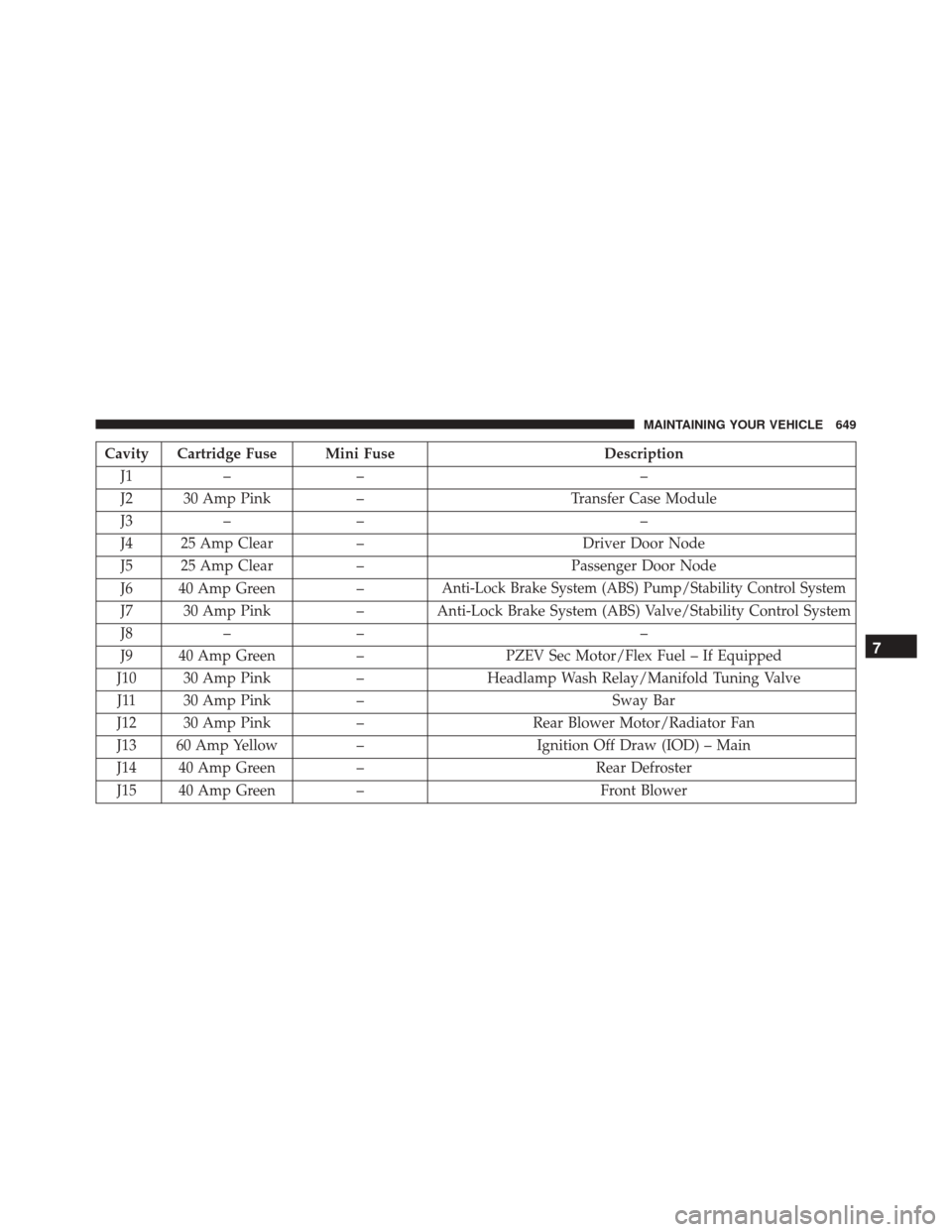
J1 – – –
J2 30 Amp Pink –Transfer Case Module
J3 – – –
J4 25 Amp Clear –Driver Door Node
J5 25 Amp Clear –Passenger Door Node
J6 40 Amp Green –
Anti-Lock Brake System (ABS) Pump/Stability Control System
J7 30 Amp Pink– Anti-Lock Brake System (ABS) Valve/Stability Control System
J8 – – –
J9 40 Amp Green –PZEV Sec Motor/Flex Fuel – If Equipped
J10 30 Amp Pink –Headlamp Wash Relay/Manifold Tuning Valve
J11 30 Amp Pink – Sway Bar
J12 30 Amp Pink –Rear Blower Motor/Radiator Fan
J13 60 Amp Yellow –Ignition Off Draw (IOD) – Main
J14 40 Amp Green –Rear Defroster
J15 40 Amp Green – Front Blower
7
MAINTAINING YOUR VEHICLE 649
Page 652 of 705
Cavity Cartridge Fuse Mini FuseDescription
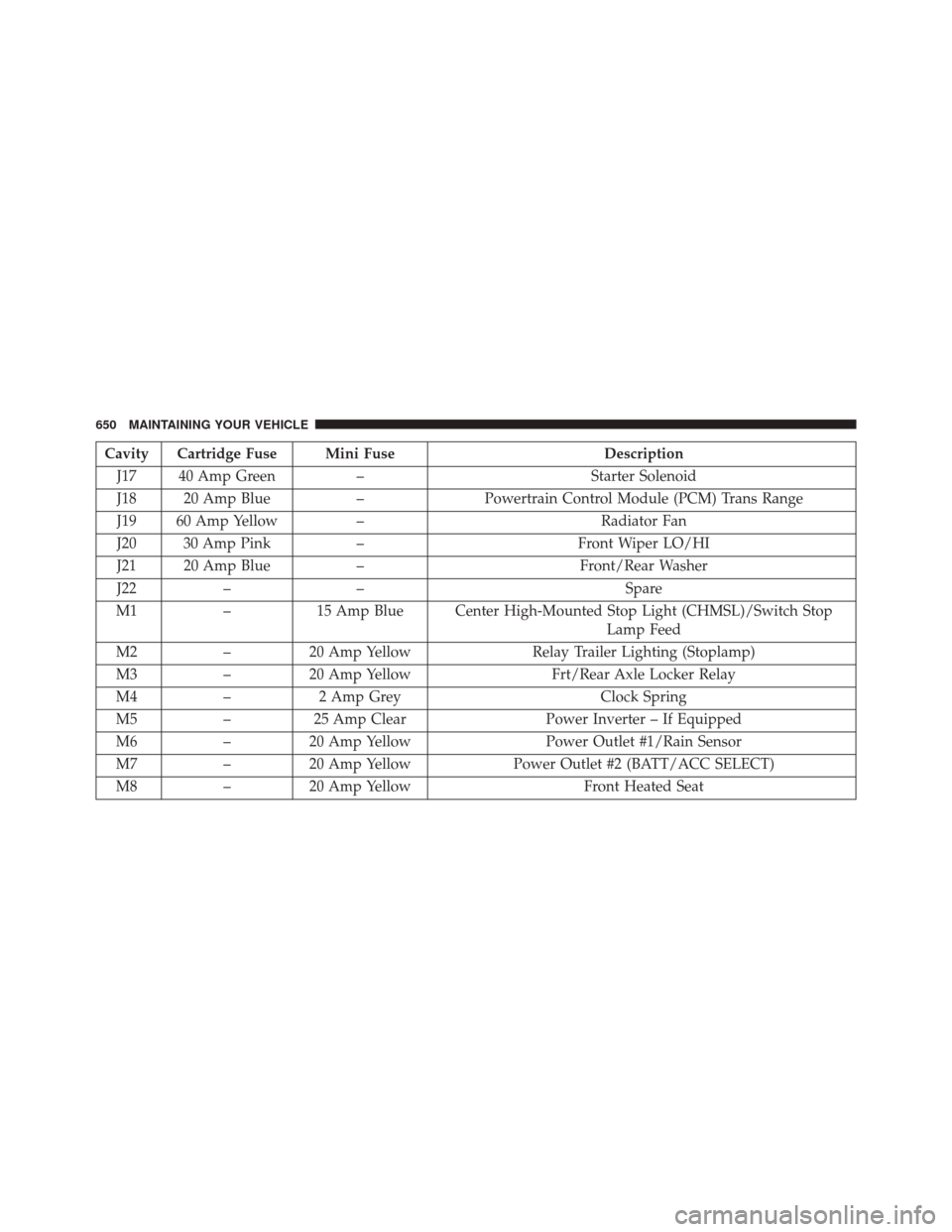
J17 40 Amp Green –Starter Solenoid
J18 20 Amp Blue –Powertrain Control Module (PCM) Trans Range
J19 60 Amp Yellow – Radiator Fan
J20 30 Amp Pink –Front Wiper LO/HI
J21 20 Amp Blue –Front/Rear Washer
J22 – – Spare
M1 –15 Amp Blue Center High-Mounted Stop Light (CHMSL)/Switch Stop
Lamp Feed
M2 –20 Amp Yellow Relay Trailer Lighting (Stoplamp)
M3 –20 Amp Yellow Frt/Rear Axle Locker Relay
M4 –2 Amp Grey Clock Spring
M5 –25 Amp Clear Power Inverter – If Equipped
M6 –20 Amp Yellow Power Outlet #1/Rain Sensor
M7 –20 Amp Yellow Power Outlet #2 (BATT/ACC SELECT)
M8 –20 Amp Yellow Front Heated Seat
650 MAINTAINING YOUR VEHICLE
Page 663 of 705
CAUTION!
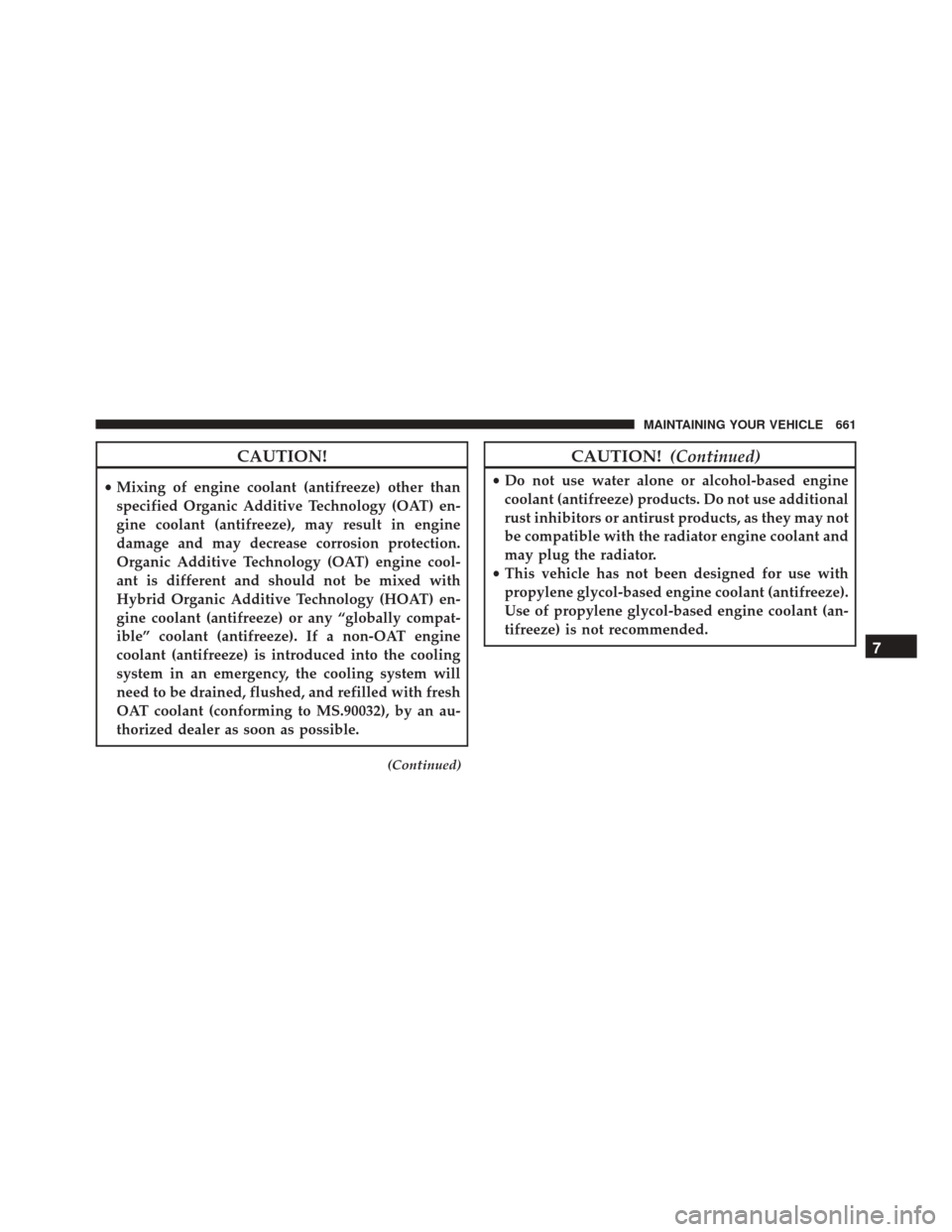
•Mixing of engine coolant (antifreeze) other than
specified Organic Additive Technology (OAT) en-
gine coolant (antifreeze), may result in engine
damage and may decrease corrosion protection.
Organic Additive Technology (OAT) engine cool-
ant is different and should not be mixed with
Hybrid Organic Additive Technology (HOAT) en-
gine coolant (antifreeze) or any “globally compat-
ible” coolant (antifreeze). If a non-OAT engine
coolant (antifreeze) is introduced into the cooling
system in an emergency, the cooling system will
need to be drained, flushed, and refilled with fresh
OAT coolant (conforming to MS.90032), by an au-
thorized dealer as soon as possible.
(Continued)
CAUTION! (Continued)
•Do not use water alone or alcohol-based engine
coolant (antifreeze) products. Do not use additional
rust inhibitors or antirust products, as they may not
be compatible with the radiator engine coolant and
may plug the radiator.
• This vehicle has not been designed for use with
propylene glycol-based engine coolant (antifreeze).
Use of propylene glycol-based engine coolant (an-
tifreeze) is not recommended.
7
MAINTAINING YOUR VEHICLE 661
Page 686 of 705
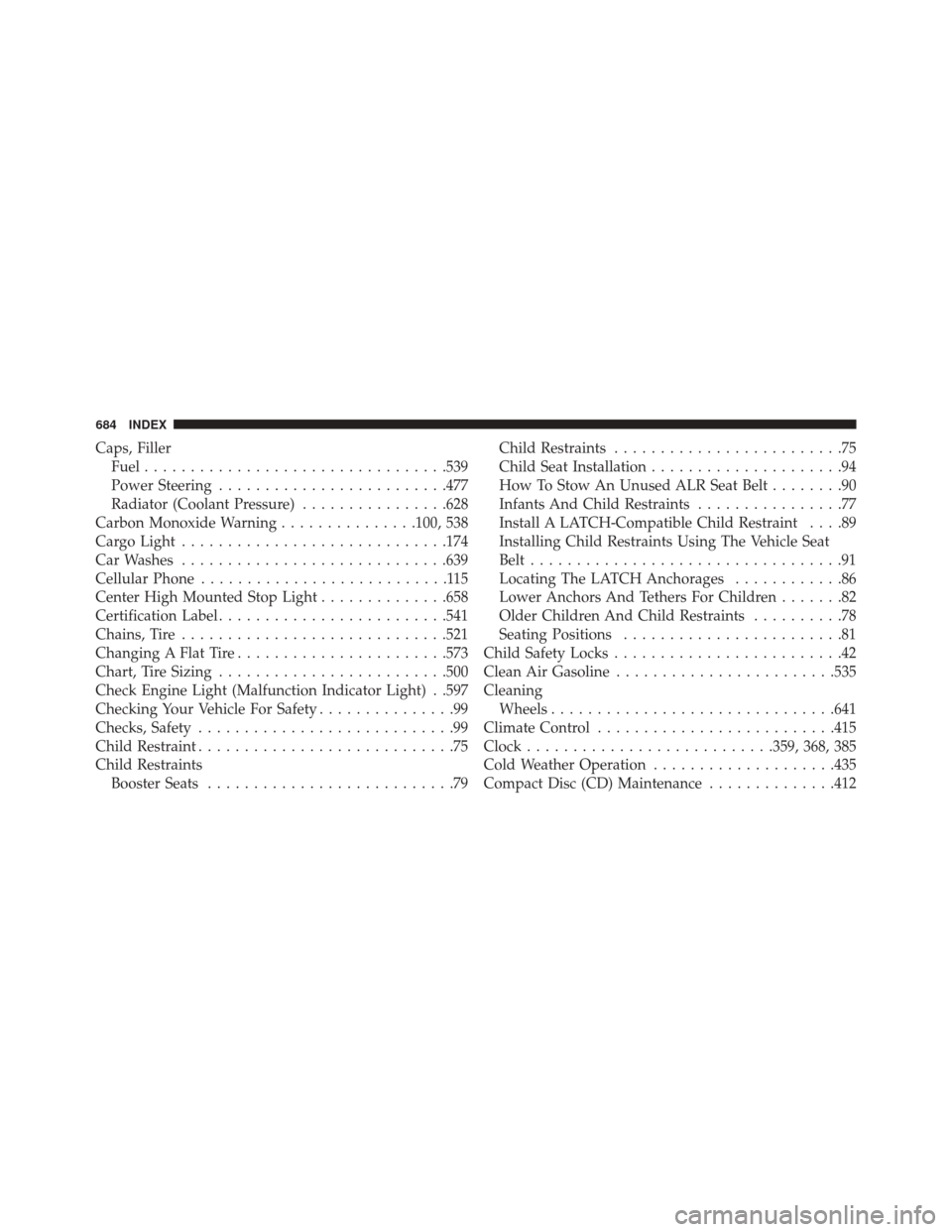
Caps, FillerFuel ................................ .539
Power Steering ........................ .477
Radiator (Coolant Pressure) ................628
Carbon Monoxide Warning ...............100, 538
Cargo Light ............................ .174
Car Washes ............................ .639
Cellular Phone ...........................115
Center High Mounted Stop Light ..............658
Certification Label ........................ .541
Chains, Tire ............................ .521
Changing A Flat Tire ...................... .573
Chart, Tire Sizing ........................ .500
Check Engine Light (Malfunction Indicator Light) . .597
Checking Your Vehicle For Safety ...............99
Checks, Safety ............................99
Child Restraint ............................75
Child Restraints Booster Seats ...........................79 Child Restraints
.........................75
Child Seat Installation .....................94
How To Stow An Unused ALR Seat Belt ........90
Infants And Child Restraints ................77
Install A LATCH-Compatible Child Restraint ....89
Installing Child Restraints Using The Vehicle Seat
Belt ..................................91
Locating The LATCH Anchorages ............86
Lower Anchors And Tethers For Children .......82
Older Children And Child Restraints ..........78
Seating Positions ........................81
Child Safety Locks .........................42
Clean Air Gasoline ....................... .535
Cleaning Wheels .............................. .641
Climate Control ......................... .415
Clock .......................... .359, 368, 385
Cold Weather Operation ....................435
Compact Disc (CD) Maintenance ..............412
684 INDEX
Page 687 of 705
Compact Spare Tire....................... .516
Compass ........................ .338, 341, 348
Compass Calibration ....................341, 349
Compass Variance .....................340, 350
Computer, Trip/Travel ..................... .347
Connector UCI................................ .404
Universal Consumer Interface (UCI) ..........404
Console ............................... .192
Console, Floor .......................... .192
Contract, Service ......................... .675
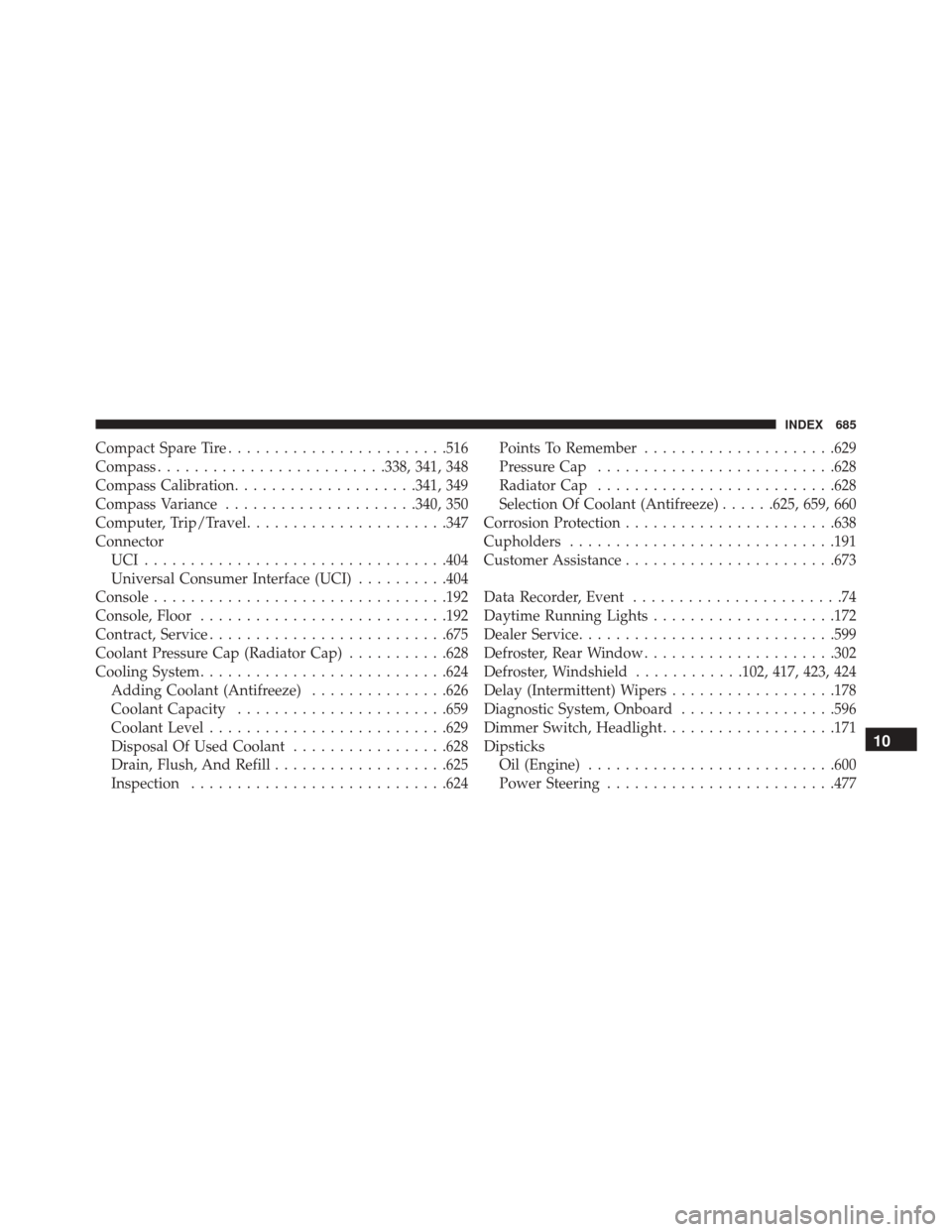
Coolant Pressure Cap (Radiator Cap) ...........628
Cooling System .......................... .624
Adding Coolant (Antifreeze) ...............626
Coolant Capacity ...................... .659
Coolant Level ......................... .629
Disposal Of Used Coolant .................628
Drain, Flush, And Refill ...................625
Inspection ........................... .624Points To Remember
.....................629
Pressure Cap ......................... .628
Radiator Cap ......................... .628
Selection Of Coolant (Antifreeze) ......625, 659, 660
Corrosion Protection ...................... .638
Cupholders ............................ .191
Customer Assistance ...................... .673
Data Recorder, Event .......................74
Daytime Running Lights ....................172
Dealer Service ........................... .599
Defroster, Rear Window .....................302
Defroster, Windshield ............102, 417, 423, 424
Delay (Intermittent) Wipers ..................178
Diagnostic System, Onboard .................596
Dimmer Switch, Headlight ...................171
Dipsticks Oil (Engine) .......................... .600
Power
Steering ........................ .477
10
INDEX 685