tire pressure JEEP WRANGLER 2017 JK / 3.G Owner's Guide
[x] Cancel search | Manufacturer: JEEP, Model Year: 2017, Model line: WRANGLER, Model: JEEP WRANGLER 2017 JK / 3.GPages: 527, PDF Size: 5.34 MB
Page 417 of 527
pressure should be increased by 3 psi (21 kPa), which
equals 1 psi (7 kPa) for every 12°F (7°C) for this outside
temperature condition.
Tire pressure may increase from 2 to 6 psi (13 to 40 kPa)
during operation. DO NOT reduce this normal pressure
build up or your tire pressure will be too low.
Tire Pressures For High Speed Operation
The manufacturer advocates driving at safe speeds and
within posted speed limits. Where speed limits or condi-
tions are such that the vehicle can be driven at high speeds,
maintaining correct tire inflation pressure is very impor-
tant. Increased tire pressure and reduced vehicle loading
may be required for high-speed vehicle operation. Refer to
your authorized tire dealer or original equipment vehicle
dealer for recommended safe operating speeds, loading
and cold tire inflation pressures.
WARNING!
High speed driving with your vehicle under maximum
load is dangerous. The added strain on your tires could
cause them to fail. You could have a serious collision.
Do not drive a vehicle loaded to the maximum capacity
at continuous speeds above 75 mph (120 km/h).
Radial Ply Tires
WARNING!
Combining radial ply tires with other types of tires on
your vehicle will cause your vehicle to handle poorly.
The instability could cause a collision. Always use
radial ply tires in sets of four. Never combine them
with other types of tires.
Tire Repair
If your tire becomes damaged, it may be repaired if it meets
the following criteria:
• The tire has not been driven on when flat.
• The damage is only on the tread section of your tire
(sidewall damage is not repairable).
• The puncture is no greater thana¼ofaninch (6 mm).
Consult an authorized tire dealer for tire repairs and
additional information.
8
SERVICING AND MAINTENANCE 415
Page 418 of 527
Damaged Run Flat tires, or Run Flat tires that have
experienced a loss of pressure should be replaced immedi-
ately with another Run Flat tire of identical size and service
description (Load Index and Speed Symbol).
Run Flat Tires — If Equipped
Run Flat tires allow you the capability to drive 50 miles
(80 km) at 50 mph (80 km/h) after a rapid loss of inflation
pressure. This rapid loss of inflation is referred to as the
Run Flat mode. A Run Flat mode occurs when the tire
inflation pressure is of/or below 14 psi (96 kPa). Once a
Run Flat tire reaches the run flat mode it has limited
driving capabilities and needs to be replaced immediately.
A Run Flat tire is not repairable.
It is not recommended driving a vehicle loaded at full
capacity or to tow a trailer while a tire is in the run flat
mode.
See the tire pressure monitoring section for more informa-
tion.
Tire Spinning
When stuck in mud, sand, snow, or ice conditions, do not
spin your vehicle’s wheels above 30 mph (48 km/h) or for
longer than 30 seconds continuously without stopping.
Refer to “Freeing A Stuck Vehicle” in “In Case Of Emer-
gency” for further information.
WARNING!
Fast spinning tires can be dangerous. Forces generated
by excessive wheel speeds may cause tire damage or
failure. A tire could explode and injure someone. Do
not spin your vehicle’s wheels faster than 30 mph
(48 km/h) for more than 30 seconds continuously when
you are stuck, and do not let anyone near a spinning
wheel, no matter what the speed.
Tread Wear Indicators
Tread wear indicators are in the original equipment tires to
help you in determining when your tires should be re-
placed.
416 SERVICING AND MAINTENANCE
Page 419 of 527
These indicators are molded into the bottom of the tread
grooves. They will appear as bands when the tread depth
becomes a 1/16 of an inch (1.6 mm). When the tread is
worn to the tread wear indicators, the tire should be
replaced. Refer to “Replacement Tires” in this section for
further information.
Life Of Tire
The service life of a tire is dependent upon varying factors
including, but not limited to:
•Driving style.
• Tire pressure - Improper cold tire inflation pressures can
cause uneven wear patterns to develop across the tire
tread. These abnormal wear patterns will reduce tread
life, resulting in the need for earlier tire replacement.
• Distance driven.
• Performance tires, tires with a speed rating of V or
higher, and Summer tires typically have a reduced tread
life. Rotation of these tires per the vehicle maintenance
schedule is highly recommended.
WARNING!
Tires and the spare tire should be replaced after six
years, regardless of the remaining tread. Failure to
follow this warning can result in sudden tire failure.
You could lose control and have a collision resulting in
serious injury or death.
Tire Tread
1—WornTire
2—NewTire
8
SERVICING AND MAINTENANCE 417
Page 420 of 527
Keep dismounted tires in a cool, dry place with as little
exposure to light as possible. Protect tires from contact with
oil, grease, and gasoline.
Replacement Tires
The tires on your new vehicle provide a balance of many
characteristics. They should be inspected regularly for
wear and correct cold tire inflation pressures. The manu-
facturer strongly recommends that you use tires equivalent
to the originals in size, quality and performance when
replacement is needed. Refer to the paragraph on “Tread
Wear Indicators” in this section. Refer to the Tire and
Loading Information placard or the Vehicle Certification
Label for the size designation of your tire. The Load Index
and Speed Symbol for your tire will be found on the
original equipment tire sidewall.
See the Tire Sizing Chart example found in the “Tire Safety
Information” section of this manual for more information
relating to the Load Index and Speed Symbol of a tire.
It is recommended to replace the two front tires or two rear
tires as a pair. Replacing just one tire can seriously affect
your vehicle’s handling. If you ever replace a wheel, make
sure that the wheel’s specifications match those of the
original wheels.It is recommended you contact your authorized tire dealer
or original equipment dealer with any questions you may
have on tire specifications or capability. Failure to use
equivalent replacement tires may adversely affect the
safety, handling, and ride of your vehicle.
WARNING!
•
Do not use a tire, wheel size, load rating, or speed
rating other than that specified for your vehicle.
Some combinations of unapproved tires and wheels
may change suspension dimensions and perfor-
mance characteristics, resulting in changes to steer-
ing, handling, and braking of your vehicle. This can
cause unpredictable handling and stress to steering
and suspension components. You could lose control
and have a collision resulting in serious injury or
death. Use only the tire and wheel sizes with load
ratings approved for your vehicle.
• Never use a tire with a smaller load index or capacity,
other than what was originally equipped on your
vehicle. Using a tire with a smaller load index could
result in tire overloading and failure. You could lose
control and have a collision.
(Continued)
418 SERVICING AND MAINTENANCE
Page 422 of 527
Snow Tires
Some areas of the country require the use of snow tires
during the Winter. Snow tires can be identified by a
“mountain/snowflake” symbol on the tire sidewall.If you need snow tires, select tires
equivalent in size and type to the origi-
nal equipment tires. Use snow tires only
in sets of four; failure to do so may
adversely affect the safety and handling
of your vehicle.
Snow tires generally have lower speed ratings than what
was originally equipped with your vehicle and should not
be operated at sustained speeds over 75 mph (120 km/h).
For speeds above 75 mph (120 km/h) refer to original
equipment or an authorized tire dealer for recommended
safe operating speeds, loading and cold tire inflation
pressures.
While studded tires improve performance on ice, skid and
traction capability on wet or dry surfaces may be poorer
than that of non-studded tires. Some states prohibit stud-
ded tires; therefore, local laws should be checked before
using these tire types.
Spare Tires — If Equipped
NOTE: For vehicles equipped with Tire Service Kit instead
of a spare tire, please refer to “Tire Service Kit” in “In Case
Of Emergency” for further information.
CAUTION!
Because of the reduced ground clearance, do not take
your vehicle through an automatic car wash with a
compact or limited use temporary spare installed.
Damage to the vehicle may result.
Spare Tire Matching Original Equipped Tire And
Wheel — If Equipped
Your vehicle may be equipped with a spare tire and wheel
equivalent in look and function to the original equipment
tire and wheel found on the front or rear axle of your
vehicle. This spare tire may be used in the tire rotation for
your vehicle. If your vehicle has this option, refer to an
authorized tire dealer for the recommended tire rotation
pattern.
420 SERVICING AND MAINTENANCE
Page 424 of 527
Limited Use Spare — If Equipped
The limited use spare tire is for temporary emergency use
only. This tire is identified by a label located on the limited
use spare wheel. This label contains the driving limitations
for this spare. This tire may look like the original equipped
tire on the front or rear axle of your vehicle, but it is not.
Installation of this limited use spare tire affects vehicle
handling. Since it is not the same as your original equip-
ment tire, replace (or repair) the original equipment tire
and reinstall on the vehicle at the first opportunity.
WARNING!
Limited use spares are for emergency use only. Instal-
lation of this limited use spare tire affects vehicle
handling. With this tire, do not drive more than the
speed listed on the limited use spare wheel. Keep
inflated to the cold tire inflation pressures listed on
your Tire and Loading Information Placard located on
the driver ’s side B-Pillar or the rear edge of the driver ’s
side door. Replace (or repair) the original equipment
tire at the first opportunity and reinstall it on your
vehicle. Failure to do so could result in loss of vehicle
control.
Wheel And Wheel Trim Care
All wheels and wheel trim, especially aluminum and
chrome plated wheels, should be cleaned regularly using
mild (neutral Ph) soap and water to maintain their luster
and to prevent corrosion. Wash wheels with the same soap
solution recommended for the body of the vehicle.
Your wheels are susceptible to deterioration caused by salt,
sodium chloride, magnesium chloride, calcium chloride,
etc., and other road chemicals used to melt ice or control
dust on dirt roads. Use a soft cloth or sponge and mild soap
to wipe away promptly. Do not use harsh chemicals or a
stiff brush. They can damage the wheel’s protective coating
that helps keep them from corroding and tarnishing.
NOTE:Many aftermarket wheel cleaners contain strong
acids or strong alkaline additives that can harm the wheel
surface.
CAUTION!
Avoid products or automatic car washes that use acidic
solutions or strong alkaline additives or harsh brushes.
These products and automatic car washes may damage
the wheel’s protective finish. Such damage is not
(Continued)
422 SERVICING AND MAINTENANCE
Page 429 of 527
•Disconnect the negative (-) terminal from the battery
post and be sure that the battery is fully charged. During
storage check battery charge quarterly.
• If you do not disconnect the battery from the electrical
system, check the battery charge every thirty days, also
we recommend you use storage mode for more infor-
mation refer to (“Instrument Cluster Display Menu
Items” in “Getting To Know Your Instrument Panel”).
• Clean and protect the painted parts by applying protec-
tive waxes.
• Clean and protect polished metal parts by applying
protective waxes.
• Apply talcum powder to the front and rear wiper blades
and leave raised from the glass.
• Cover the vehicle with an appropriate cover taking care
not to damage the painted surface by dragging across
dirty surfaces. Do not use plastic sheeting which will not
allow the evaporation of moisture present on the surface
of the vehicle.
• Inflate the tires at a pressure of +7.25 psi (+0.5 bar)
higher than recommended on the tire placard and check
it periodically. •
Do not drain the engine cooling system.
• Whenever you leave the vehicle is stationary for two
weeks or more, run idle the engine for approximately
five minutes, with the air conditioning system on and
high fan speed. This will ensure a proper lubrication of
the system, thus minimizing the possibility of damage to
the compressor when the vehicle is put back into opera-
tion.
CAUTION!
Before removal of the positive and negative terminals
to the battery, wait at least a minute with ignition
switch in the OFF position and close the driver ’s door.
When reconnecting the positive and negative terminals
to the battery be sure the ignition switch is in the OFF
position and the driver ’s door is closed.
BODYWORK
Protection From Atmospheric Agents
Vehicle body care requirements vary according to geo-
graphic locations and usage. Chemicals that make roads
passable in snow and ice and those that are sprayed on
trees and road surfaces during other seasons are highly
8
SERVICING AND MAINTENANCE 427
Page 432 of 527
•Do not use harsh cleaners or bleaching agents on top
material, as damage may result.
• Do not allow any vinyl cleaner to run down and dry on
the paint, leaving a streak.
• After cleaning your vehicle’s fabric top, always make
sure it is completely dry before lowering.
• Be especially careful when washing the windows by
following the directions for “Care of Fabric Top Win-
dows.”
Washing – Use MOPAR Car Wash or equivalent, or mild
soap suds, lukewarm water, and a brush with soft bristles.
If extra cleaning is required, use MOPAR Convertible Cloth
Top Cleaner or equivalent, or a mild foaming cleaner on the
entire top, but support the top from underneath.
Rinsing – Be sure to remove all traces of cleaner by rinsing
the top thoroughly with clean water. Remember to allow
the top to dry before lowering it.CAUTION!
Failure to follow these cautions may cause interior
water damage, stains or mildew on the top material:
• Avoid high-pressure car washes, as they can damage
the top material. Also, increased water pressure may
force past the weather strips.
• It is recommended that the top be free of water prior
to opening it. Operating the top, opening a door or
lowering a window while the top is wet may allow
water to drip into the vehicle’s interior.
• Use care when washing the vehicle, water pressure
directed at the weather strip seals may cause water to
leak into the vehicle’s interior.
• Careless handling and storage of the removable roof
panels may damage the seals, causing water to leak
into the vehicle’s interior.
• The front panel(s) must be positioned properly to
ensure sealing. Improper installation can cause water
to leak into the vehicle’s interior.
430 SERVICING AND MAINTENANCE
Page 512 of 527
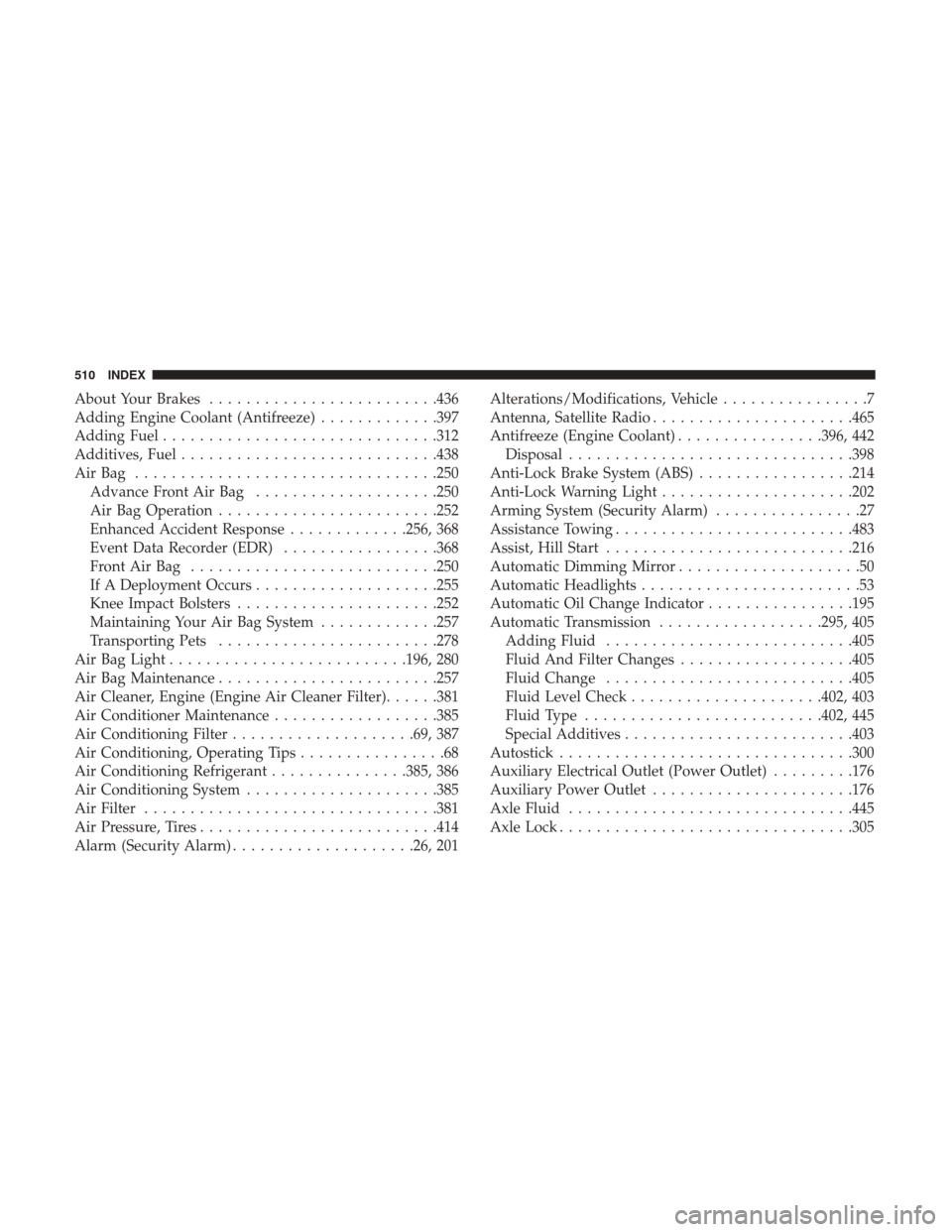
About Your Brakes........................ .436
Adding Engine Coolant (Antifreeze) .............397
Adding Fuel ............................. .312
Additives, Fuel ........................... .438
AirBag ................................ .250
Advance Front Air Bag ....................250
Air Bag Operation ....................... .252
Enhanced Accident Response .............256, 368
Event Data Recorder (EDR) .................368
FrontAirBag .......................... .250
If A Deployment Occurs ....................255
Knee Impact Bolsters ..................... .252
Maintaining Your Air Bag System .............257
Transporting Pets ....................... .278
Air Bag Light ......................... .196, 280
Air Bag Maintenance ....................... .257
Air Cleaner, Engine (Engine Air Cleaner Filter) ......381
Air Conditioner Maintenance ..................385
Air Conditioning Filter ....................69, 387
Air Conditioning, Operating Tips ................68
Air Conditioning Refrigerant ...............385, 386
Air Conditioning System .....................385
Air Filter ............................... .381
Air Pressure, Tires ......................... .414
Alarm (Security Alarm) ....................26, 201 Alterations/Modifications, Vehicle
................7
Antenna, Satellite Radio ..................... .465
Antifreeze (Engine Coolant) ................396, 442
Disposal .............................. .398
Anti-Lock Brake System (ABS) .................214
Anti-Lock Warning Light .....................202
Arming System (Security Alarm) ................27
Assistance Towing ......................... .483
Assist, Hill Start .......................... .216
Automatic Dimming Mirror ....................50
Automatic Headlights ........................53
Automatic Oil Change Indicator ................195
Automatic
Transmission ..................295, 405
Adding Fluid .......................... .405
Fluid And Filter Changes ...................405
Fluid Change .......................... .405
Fluid Level Check .....................402, 403
Fluid Type ......................... .402, 445
Special Additives ........................ .403
Autostick ............................... .300
Auxiliary Electrical Outlet (Power Outlet) .........176
Auxiliary Power Outlet ..................... .176
Axle Fluid .............................. .445
Axle Lock ............................... .305
510 INDEX
Page 513 of 527
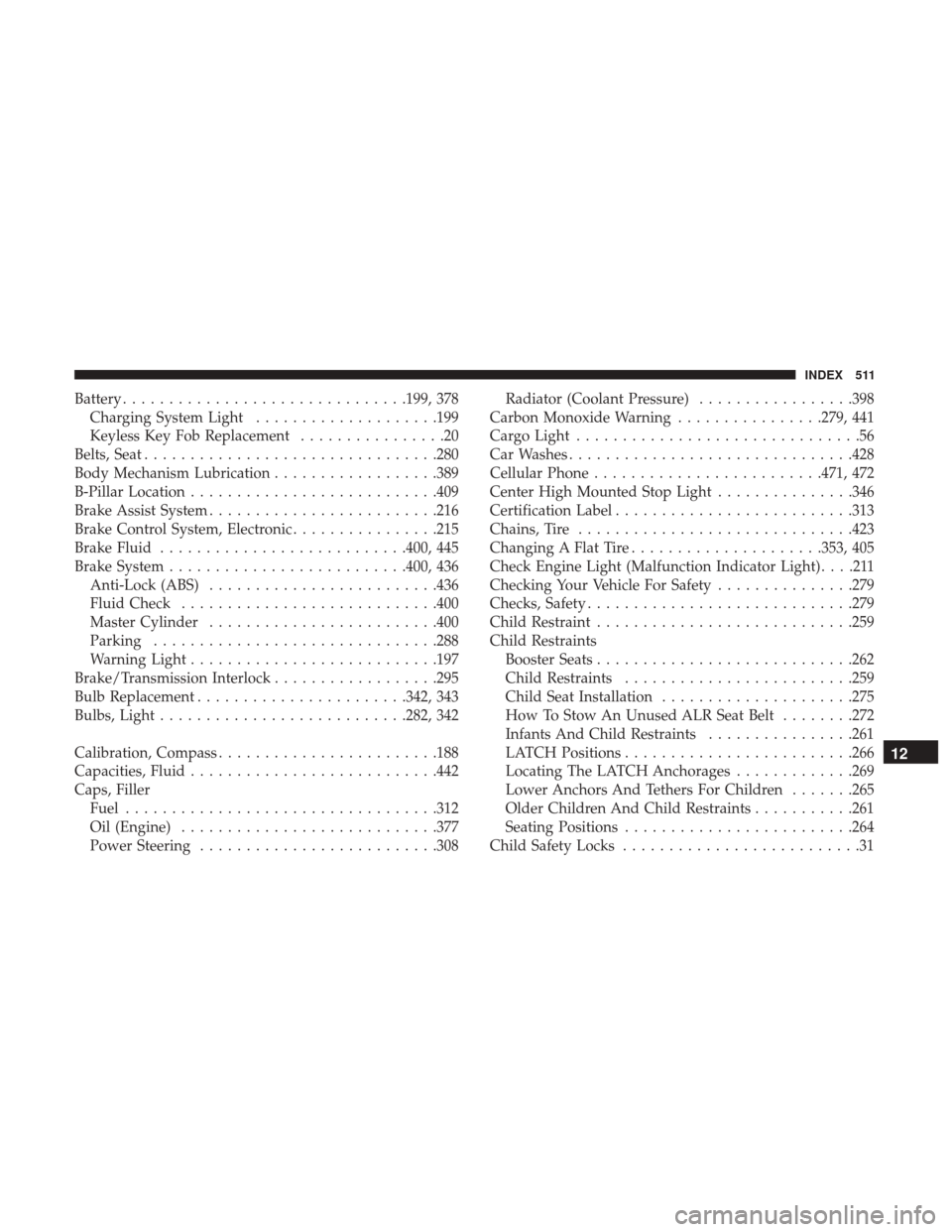
Battery.............................. .199, 378
Charging System Light ....................199
Keyless Key Fob Replacement ................20
Belts, Seat ............................... .280
Body Mechanism Lubrication ..................389
B-Pillar Location .......................... .409
Brake Assist System ........................ .216
Brake Control System, Electronic ................215
Brake Fluid .......................... .400, 445
Brake System ......................... .400, 436
Anti-Lock (ABS) ........................ .436
Fluid Check ........................... .400
Master Cylinder ........................ .400
Parking .............................. .288
Warning Light .......................... .197
Brake/Transmission Interlock ..................295
Bulb Replacement ...................... .342, 343
Bulbs, Light .......................... .282, 342
Calibration, Compass ....................... .188
Capacities, Fluid .......................... .442
Caps, Filler Fuel ................................. .312
Oil (Engine) ........................... .377
Power Steering ......................... .308Radiator (Coolant Pressure)
.................398
Carbon Monoxide Warning ................279, 441
Cargo Light ...............................56
Car Washes .............................. .428
Cellular Phone ........................ .471, 472
Center High Mounted Stop Light ...............346
Certification Label ......................... .313
Chains, Tire ............................. .423
Changing A Flat Tire .....................353, 405
Check Engine Light (Malfunction Indicator Light) . . . .211
Checking Your Vehicle For Safety ...............279
Checks, Safety ............................ .279
Child
Restraint ........................... .259
Child Restraints Booster Seats ........................... .262
Child Restraints ........................ .259
Child Seat Installation .....................275
How To Stow An Unused ALR Seat Belt ........272
Infants And Child Restraints ................261
LATCH Positions ........................ .266
Locating The LATCH Anchorages .............269
Lower Anchors And Tethers For Children .......265
Older Children And Child Restraints ...........261
Seating Positions ........................ .264
Child Safety Locks ..........................31
12
INDEX 511