fuel cap JEEP WRANGLER 2023 User Guide
[x] Cancel search | Manufacturer: JEEP, Model Year: 2023, Model line: WRANGLER, Model: JEEP WRANGLER 2023Pages: 396, PDF Size: 25.15 MB
Page 172 of 396

170STARTING AND OPERATING
Payload
The payload of a vehicle is defined as the allowable load
weight a truck can carry, including the weight of the driver,
all passengers, options and cargo.
Gross Axle Weight Rating (GAWR)
The GAWR is the maximum permissible load on the front
and rear axles. The load must be distributed in the cargo
area so that the GAWR of each axle is not exceeded.
Each axle GAWR is determined by the components in the
system with the lowest load carrying capacity (axle,
springs, tires or wheels). Heavier axles or suspension
components sometimes specified by purchasers for
increased durability do not necessarily increase the
vehicle's GVWR.
Tire Size
The tire size on the Vehicle Certification Label represents
the actual tire size on your vehicle. Replacement tires
must be equal to the load capacity of this tire size.
Rim Size
This is the rim size that is appropriate for the tire size
listed.
Inflation Pressure
This is the cold tire inflation pressure for your vehicle for
all loading conditions up to full GAWR.
Curb Weight
The curb weight of a vehicle is defined as the total weight
of the vehicle with all fluids, including vehicle fuel, at full
capacity conditions, and with no occupants or cargo
loaded into the vehicle. The front and rear curb weight values are determined by weighing your vehicle on a
commercial scale before any occupants or cargo are
added.
Loading
The actual total weight and the weight of the front and rear
of your vehicle at the ground can best be determined by
weighing it when it is loaded and ready for operation.
The entire vehicle should first be weighed on a commercial
scale to ensure that the GVWR has not been exceeded.
The weight on the front and rear of the vehicle should then
be determined separately to be sure that the load is
properly distributed over the front and rear axle. Weighing
the vehicle may show that the GAWR of either the front or
rear axles has been exceeded but the total load is within
the specified GVWR. If so, weight must be shifted from
front to rear or rear to front as appropriate until the
specified weight limitations are met. Store the heavier
items down low and be sure that the weight is distributed
equally. Stow all loose items securely before driving.
Improper weight distributions can have an adverse effect
on the way your vehicle steers and handles and the way
the brakes operate.
TRAILER TOWING
In this section you will find safety tips and information on
limits to the type of towing you can reasonably do with your
vehicle. Before towing a trailer, carefully review this
information to tow your load as efficiently and safely as
possible.
To maintain the New Vehicle Limited Warranty coverage,
follow the requirements and recommendations in this
manual concerning vehicles used for trailer towing.
COMMON TOWING DEFINITIONS
The following trailer towing related definitions will assist
you in understanding the following information:
Gross Vehicle Weight Rating (GVWR)
The GVWR is the total allowable weight of your vehicle.
This includes driver, passengers, cargo and tongue
weight. The total load must be limited so that you do not
exceed the GVWR
Úpage 169.
Gross Trailer Weight (GTW)
The GTW is the weight of the trailer plus the weight of all
cargo, consumables and equipment (permanent or
temporary) loaded in or on the trailer in its "loaded and
ready for operation" condition.
The recommended way to measure GTW is to put your fully
loaded trailer on a vehicle scale. The entire weight of the
trailer must be supported by the scale.
WARNING!
Do not load your vehicle any heavier than the GVWR or
the maximum front and rear GAWR. If you do, parts on
your vehicle can break, or it can change the way your
vehicle handles. This could cause you to lose control.
Overloading can shorten the life of your vehicle.
23_JL_OM_EN_USC_t.book Page 170
Page 301 of 396
IN CASE OF EMERGENCY299
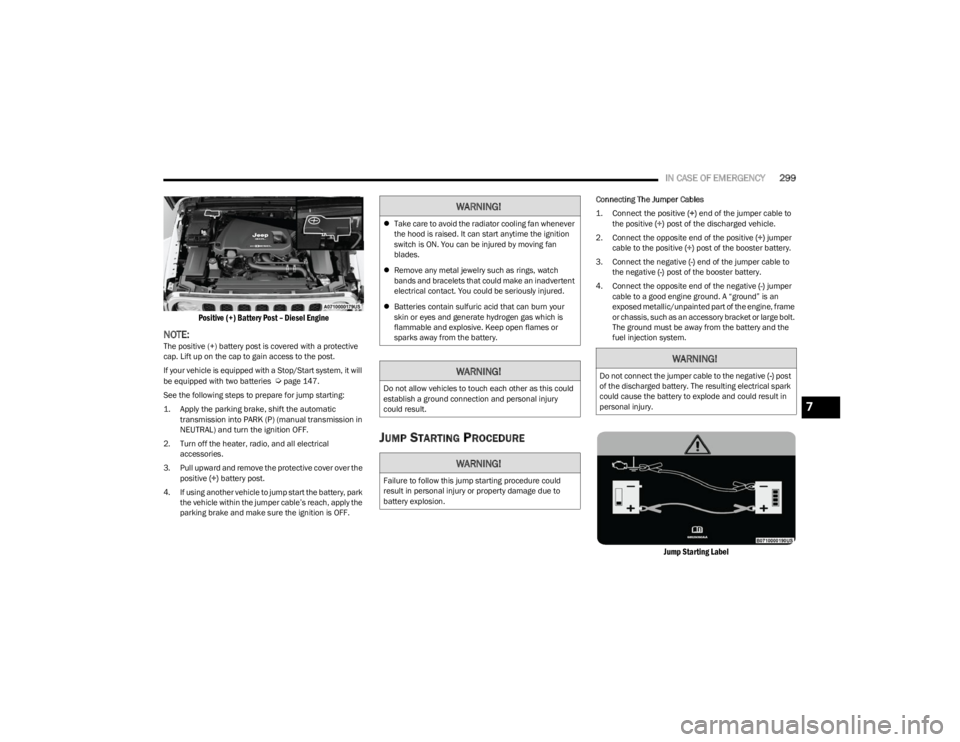
Positive (+) Battery Post – Diesel Engine
NOTE:The positive (+) battery post is covered with a protective
cap. Lift up on the cap to gain access to the post.
If your vehicle is equipped with a Stop/Start system, it will
be equipped with two batteries
Úpage 147.
See the following steps to prepare for jump starting:
1. Apply the parking brake, shift the automatic transmission into PARK (P) (manual transmission in
NEUTRAL) and turn the ignition OFF.
2. Turn off the heater, radio, and all electrical accessories.
3. Pull upward and remove the protective cover over the positive (+) battery post.
4. If using another vehicle to jump start the battery, park the vehicle within the jumper cable’s reach, apply the
parking brake and make sure the ignition is OFF.
JUMP STARTING PROCEDURE
Connecting The Jumper Cables
1. Connect the positive
(+) end of the jumper cable to
the positive (+)
post of the discharged vehicle.
2. Connect the opposite end of the positive (+) jumper
cable to the positive (+) post of the booster battery.
3. Connect the negative (-) end of the jumper cable to
the negative (-) post of the booster battery.
4. Connect the opposite end of the negative (-) jumper
cable to a good engine ground. A “ground” is an
exposed metallic/unpainted part of the engine, frame
or chassis, such as an accessory bracket or large bolt.
The ground must be away from the battery and the
fuel injection system.
Jump Starting Label
WARNING!
Take care to avoid the radiator cooling fan whenever
the hood is raised. It can start anytime the ignition
switch is ON. You can be injured by moving fan
blades.
Remove any metal jewelry such as rings, watch
bands and bracelets that could make an inadvertent
electrical contact. You could be seriously injured.
Batteries contain sulfuric acid that can burn your
skin or eyes and generate hydrogen gas which is
flammable and explosive. Keep open flames or
sparks away from the battery.
WARNING!
Do not allow vehicles to touch each other as this could
establish a ground connection and personal injury
could result.
WARNING!
Failure to follow this jump starting procedure could
result in personal injury or property damage due to
battery explosion.
WARNING!
Do not connect the jumper cable to the negative (-) post
of the discharged battery. The resulting electrical spark
could cause the battery to explode and could result in
personal injury.
7
23_JL_OM_EN_USC_t.book Page 299
Page 302 of 396

300IN CASE OF EMERGENCY
5. Start the engine in the vehicle that has the booster
battery, let the engine idle a few minutes, and then
start the engine in the vehicle with the discharged
battery.
6. Once the engine is started, remove the jumper cables in the reverse sequence.
Disconnecting The Jumper Cables
1. Disconnect the negative
(-)
end of the jumper cable
from the engine ground of the vehicle with the
discharged battery.
2. Disconnect the opposite end of the negative (-)
jumper cable from the negative (-) post of the booster
battery.
3. Disconnect the positive (+) end of the jumper cable
from the positive (+) post of the booster battery. 4. Disconnect the opposite end of the positive
(+)
jumper cable from the positive (+) post of the
discharged vehicle.
5. Reinstall the protective cover over the positive (+)
post of the discharged vehicle.
NOTE:If frequent jump starting is required to start your vehicle
you should have the battery and charging system tested at
an authorized dealer.
IF YOUR ENGINE OVERHEATS
If the vehicle is overheating, it will need to be serviced by
an authorized dealer.
Potential signs of vehicle overheating:
Temperature gauge is at HOT (H)
Strong smell of coolant
White smoke coming from engine or exhaust
Coolant bottle coolant has bubbles present In the event it is observed that the temperature gauge is
moving towards or close to the HOT (H) position, you can
reduce the potential for overheating by taking the
appropriate action.
On the highways — slow down.
In city traffic — while stopped, place the transmission in
NEUTRAL (N), but do not increase the engine idle speed
while preventing vehicle motion with the brakes.
If your Air Conditioner (A/C) is on, turn it off. The A/C
system adds heat to the engine cooling system and
turning the A/C off can help remove this heat.
You can also turn the temperature control to maximum
heat, the mode control to floor and the blower control
to high. This allows the heater core to act as a supple -
ment to the radiator and aids in removing heat from the
engine cooling system.
CAUTION!
Make sure at all times that unused ends of jumper
cables are not contacting each other or either vehicle
while making connections. Failure to follow these
procedures could result in damage to the charging
system of the booster vehicle or the discharged vehicle.
CAUTION!
Do not run the booster vehicle engine above 2,000 RPM
since it provides no charging benefit, wastes fuel, and
can damage booster vehicle engine.
CAUTION!
Accessories plugged into the vehicle power outlets draw
power from the vehicle’s battery, even when not in use
(i.e., cellular devices, etc.). Eventually, if plugged in long
enough without engine operation, the vehicle’s battery
will discharge sufficiently to degrade battery life and/or
prevent the engine from starting.
WARNING!
You or others can be badly burned by hot engine
coolant (antifreeze) or steam from your radiator. If you
see or hear steam coming from under the hood, do not
open the hood until the radiator has had time to cool.
Never try to open a cooling system pressure cap when
the radiator or coolant bottle is hot.
23_JL_OM_EN_USC_t.book Page 300
Page 324 of 396
322SERVICING AND MAINTENANCE
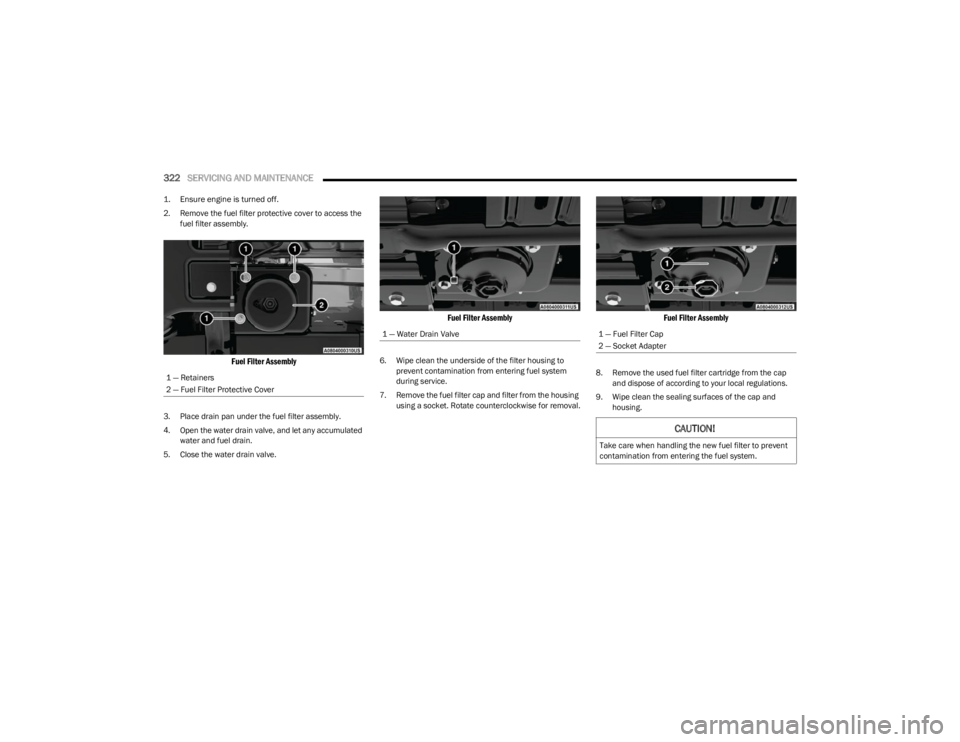
1. Ensure engine is turned off.
2. Remove the fuel filter protective cover to access the
fuel filter assembly.
Fuel Filter Assembly
3. Place drain pan under the fuel filter assembly.
4. Open the water drain valve, and let any accumulated water and fuel drain.
5. Close the water drain valve.
Fuel Filter Assembly
6. Wipe clean the underside of the filter housing to prevent contamination from entering fuel system
during service.
7. Remove the fuel filter cap and filter from the housing using a socket. Rotate counterclockwise for removal.
Fuel Filter Assembly
8. Remove the used fuel filter cartridge from the cap and dispose of according to your local regulations.
9. Wipe clean the sealing surfaces of the cap and housing.
1 — Retainers
2 — Fuel Filter Protective Cover
1 — Water Drain Valve1 — Fuel Filter Cap
2 — Socket Adapter
CAUTION!
Take care when handling the new fuel filter to prevent
contamination from entering the fuel system.
23_JL_OM_EN_USC_t.book Page 322
Page 325 of 396

SERVICING AND MAINTENANCE323
10. Lubricate o-ring on the cap with clean engine oil.
11. Install the new fuel filter cartridge onto the cap.
12. Insert the cap and filter into the housing with
clockwise rotation, use a socket to tighten.
13. Push the ignition switch twice without your foot on the brake to place vehicle in RUN position. This will
activate the in tank fuel pump for approximately 30
seconds. Repeat this process twice to prime the fuel
system. Start the engine using the Normal Starting
procedure. After engine start, verify the fuel filter cap
does not leak.
PRIMING IF THE ENGINE HAS RUN OUT
O
F FUEL — DIESEL ENGINE
1. Add a substantial amount of fuel to the tank, approx -
imately 2 to 5 gal (8L to 19L).
2. Push ignition switch twice without your foot on brake to put vehicle in RUN position. This will activate the in
tank fuel pump for approximately 30 seconds.
Repeat this process twice to prime the fuel system.
3. Start the engine using the Normal Starting procedure
Úpage 130.
NOTE:The engine may run rough until the air is forced from all
the fuel lines.
NOTE:
Use of biodiesel mixture in excess of 20% can nega -
tively impact the fuel filter's ability to separate water
from the fuel, resulting in high pressure fuel system
corrosion or damage.
In addition, commercially available fuel additives are
not necessary for the proper operation of your diesel
engine.
For extreme cold conditions, "Mopar® Premium Diesel
Fuel Treatment" is recommended to assist with cold
starting.
INTERVENTION REGENERATION
S
TRATEGY — MESSAGE PROCESS FLOW
This engine meets all required diesel engine emissions
standards. To achieve these emissions standards, your
vehicle is equipped with a state-of-the-art engine and
exhaust system. These systems are seamlessly integrated
into your vehicle and managed by the Powertrain Control
Module (PCM). The PCM manages engine combustion to
allow the exhaust system’s catalyst to trap and burn
Particulate Matter (PM) pollutants, with no input or
interaction on your part.
Additionally, your vehicle has the ability to alert you to
additional maintenance required on your vehicle or
engine.
Refer to Instrument Cluster Display for further information
Úpage 108.
DIESEL EXHAUST FLUID
Diesel Exhaust Fluid (DEF) sometimes known simply by
the name of its active component, UREA—is a key
component of Selective Catalytic Reduction (SCR)
systems, which help diesel vehicles meet stringent
emission regulations. DEF is a liquid reducing agent that
WARNING!
Do not open the high pressure fuel system with the
engine running. Engine operation causes high fuel
pressure. High pressure fuel spray can cause serious
injury or death.
CAUTION!
The starter motor will engage for approximately
30 seconds at a time. Allow two minutes between
cranking intervals.
WARNING!
Do not use alcohol or gasoline as a fuel blending agent.
They can be unstable under certain conditions and be
hazardous or explosive when mixed with diesel fuel.
CAUTION!
Due to lack of lubricants in alcohol or gasoline, the use
of these fuels can cause damage to the fuel system.WARNING!
A hot exhaust system can start a fire if you park over
materials that can burn. Such materials might be grass
or leaves coming into contact with your exhaust system.
Do not park or operate your vehicle in areas where your
exhaust system can contact anything that can burn.
8
23_JL_OM_EN_USC_t.book Page 323
Page 330 of 396

328SERVICING AND MAINTENANCE
(Continued)
(Continued)
Installing The Rear Wiper
1. Lift the wiper arm off of the glass.
2. Insert the wiper blade pivot pin into the opening on
the end of the wiper arm and rotate the wiper in to
place.
3. Place with wiper on the glass and close the tail gate.
EXHAUST SYSTEM
The best protection against carbon monoxide entry into
the vehicle body is a properly maintained engine exhaust
system.
If you notice a change in the sound of the exhaust system;
or if the exhaust fumes can be detected inside the vehicle;
or when the underside or rear of the vehicle is damaged;
have an authorized technician inspect the complete
exhaust system and adjacent body areas for broken,
damaged, deteriorated, or mispositioned parts. Open
seams or loose connections could permit exhaust fumes
to seep into the passenger compartment. In addition, have
the exhaust system inspected each time the vehicle is
raised for lubrication or oil change. Replace as required.
Under normal operating conditions, the catalytic converter
will not require maintenance. However, it is important to
keep the engine properly tuned to ensure proper catalyst
operation and prevent possible catalyst damage.
NOTE:Intentional tampering with emissions control systems can
result in civil penalties being assessed against you.
In unusual situations involving grossly malfunctioning
engine operation, a scorching odor may suggest severe
and abnormal catalyst overheating. If this occurs, stop the
vehicle, turn off the engine and allow it to cool. Service,
including a tune-up to manufacturer's specifications,
should be obtained immediately.
To minimize the possibility of catalytic converter damage:
Do not interrupt the ignition when the transmission is
in gear and the vehicle is in motion.
Do not try to start the vehicle by pushing or towing the
vehicle.
Do not idle the engine with any ignition components
disconnected or removed, such as when diagnostic
testing, or for prolonged periods during very rough idle
or malfunctioning operating conditions.
COOLING SYSTEM
WARNING!
Exhaust gases can injure or kill. They contain Carbon
Monoxide (CO), which is colorless and odorless.
Breathing it can make you unconscious and can
eventually poison you
Úpage 288.
A hot exhaust system can start a fire if you park over
materials that can burn. Such materials might be
grass or leaves coming into contact with your
exhaust system. Do not park or operate your vehicle
in areas where your exhaust system can contact
anything that can burn.
CAUTION!
The catalytic converter requires the use of unleaded
fuel only. Leaded gasoline will destroy the effective -
ness of the catalyst as an emissions control device
and may seriously reduce engine performance and
cause serious damage to the engine.
Damage to the catalytic converter can result if your
vehicle is not kept in proper operating condition. In
the event of engine malfunction, particularly
involving engine misfire or other apparent loss of
performance, have your vehicle serviced promptly.
Continued operation of your vehicle with a severe
malfunction could cause the converter to overheat,
resulting in possible damage to the converter and
vehicle.
WARNING!
WARNING!
You or others can be badly burned by hot engine
coolant (antifreeze) or steam from your radiator. If
you see or hear steam coming from under the hood,
do not open the hood until the radiator has had time
to cool. Never open a cooling system pressure cap
when the radiator or coolant bottle is hot.
Keep hands, tools, clothing, and jewelry away from
the radiator cooling fan when the hood is raised. The
fan starts automatically and may start at any time,
whether the engine is running or not.
23_JL_OM_EN_USC_t.book Page 328
Page 354 of 396

352SERVICING AND MAINTENANCE
(Continued)
TIRES — GENERAL INFORMATION
Tire Pressure
Proper tire inflation pressure is essential to the safe and
satisfactory operation of your vehicle. Four primary areas
are affected by improper tire pressure:
Safety
Fuel Economy
Tread Wear
Ride Comfort and Vehicle Stability
Safety Both underinflation and overinflation affect the stability of
the vehicle and can produce a feeling of sluggish response
or over responsiveness in the steering.
NOTE:
Unequal tire pressures from side to side may cause
erratic and unpredictable steering response.
Unequal tire pressure from side to side may cause the
vehicle to drift left or right.
Fuel Economy
Underinflated tires will increase tire rolling resistance
resulting in higher fuel consumption.
Tread Wear
Improper cold tire inflation pressures can cause abnormal
wear patterns and reduced tread life, resulting in the need
for earlier tire replacement.
Ride Comfort And Vehicle Stability
Proper tire inflation contributes to a comfortable ride.
Overinflation produces a jarring and uncomfortable ride.
Tire Inflation Pressures
The proper cold tire inflation pressure is listed on the
driver's side B-pillar or rear edge of the driver's side door. At least once a month:
Check and adjust tire pressure with a good quality
pocket-type pressure gauge. Do not make a visual
judgement when determining proper inflation. Tires
may look properly inflated even when they are
under-inflated.
Inspect tires for signs of tire wear or visible damage.
Inflation pressures specified on the placard are always
“cold tire inflation pressure”. Cold tire inflation pressure is
defined as the tire pressure after the vehicle has not been
driven for at least three hours, or driven less than 1 mile
(1.6 km) after sitting for a minimum of three hours. The
cold tire inflation pressure must not exceed the maximum
inflation pressure molded into the tire sidewall.
Check tire pressures more often if subject to a wide range
of outdoor temperatures, as tire pressures vary with
temperature changes.
Tire pressures change by approximately 1 psi (7 kPa) per
12°F (7°C) of air temperature change. Keep this in mind
when checking tire pressure inside a garage, especially in
the Winter.
WARNING!
Improperly inflated tires are dangerous and can
cause collisions.
Underinflation increases tire flexing and can result in
overheating and tire failure.
Overinflation reduces a tire's ability to cushion shock.
Objects on the road and chuckholes can cause
damage that result in tire failure.
Overinflated or underinflated tires can affect vehicle
handling and can fail suddenly, resulting in loss of
vehicle control.
Unequal tire pressures can cause steering problems.
You could lose control of your vehicle.
Unequal tire pressures from one side of the vehicle
to the other can cause the vehicle to drift to the right
or left.
Always drive with each tire inflated to the recom -
mended cold tire inflation pressure.
WARNING!
CAUTION!
After inspecting or adjusting the tire pressure, always
reinstall the valve stem cap. This will prevent moisture
and dirt from entering the valve stem, which could
damage the valve stem.
23_JL_OM_EN_USC_t.book Page 352
Page 374 of 396

372TECHNICAL SPECIFICATIONS
Biodiesel Fuel Properties — Low Ambient
Temperatures
Biodiesel fuel may gel or solidify at low ambient
temperatures, which may pose problems for both storage
and operation. Precautions can be necessary at low
ambient temperatures, such as storing the fuel in a
heated building or a heated storage tank, or using cold
temperature additives.
Fuel Quality — Must Comply With ASTM
Standards
The quality of Biodiesel fuel may vary widely. Only fuel
produced by a BQ9000 supplier to the following
specifications may be blended to meet Biodiesel blend
B6 – B20 fuel meeting ASTM specification D-7467:
Petrodiesel fuel meeting ASTM specification D-975
and Biodiesel fuel (B100) meeting ASTM specification
D-6751
Fuel Oxidation Stability — Must Use Fuel
Within Six Months Of Manufacture
Biodiesel fuel has poor oxidation stability which can result
in long term storage problems. Fuel produced to approved
ASTM standards, if stored properly, provides for protection
against fuel oxidation for up to six months.
Fuel Water Separation — Must Use
Mopar® Approved Fuel Filter Elements
Biodiesel fuel has a natural affinity to water and water
accelerates microbial growth. Your Mopar® filtration
system is designed to provide adequate fuel water
separation capabilities.
Fuel In Oil Dilution — Must Adhere To
Required Oil Change Interval
Fuel dilution of lubricating oil has been observed with the
use of Biodiesel fuel. Fuel in oil must not exceed 5%. To
ensure this limit is met your oil change interval must be
maintained within the suggested schedule. The regular
use of biodiesel between 6% and 20% requires intervals
shorter than the outlined 10,000 miles (16,000 km) and
must not exceed the suggested schedule. When routinely
operating on biodiesel between 6% and 20%, oil and filter
replacement intervals must not exceed 8,000 miles
(12,875 km) or six months, whichever comes first.
Biodiesel Fuel Filter Change Intervals
The use of biodiesel requires more frequent fuel filter
change intervals. When operating on biodiesel between
6% and 20%, fuel filter replacement intervals should be
every second oil change, and must not exceed
16,000 miles (25,750 km).
NOTE:Under no circumstances should oil change intervals
exceed 8,000 miles (12,875 km) or 6 months, if regular
operation occurs with 6% - 20% biodiesel blends. Under no
circumstances should fuel filter replacement intervals
exceed every second oil change and must not exceed
16,000 miles (25,750 km), if regular operation occurs
with 6% - 20% biodiesel blends. Failure to comply with
these Oil Change and fuel filter requirements for vehicles
operating on biodiesel blends up to B20 may result in
premature engine wear. Such wear is not covered by the
New Vehicle Limited Warranty. The engine may suffer
severe damage if operated with concentrations of
biodiesel higher than 20%.
CAUTION!
In the event that the vehicle is filled with biodiesel and
not used for more than a month, the fuel should either
be used up by driving (up to quarter tank) and filled with
standard diesel blends with less than 5% that is
normally available. This will help prevent the fuel filter
clogging and potential damage to the fuel injection
system due to degraded biodiesel, which is not covered
by the New Vehicle Limited Warranty.
23_JL_OM_EN_USC_t.book Page 372
Page 375 of 396

TECHNICAL SPECIFICATIONS373
FLUID CAPACITIES
USMetric
Fuel (Approximate)
Two Door Models 17.5 gal66 L
Four Door Models 21.5 gal81 L
3.0L Diesel Engine 18.3 gal69 L
Diesel Exhaust Fluid Tank 5.1 gal19.3 L
Engine Oil with Filter
2.0L Engine 5 qt4.73 L
3.6L Engine 5 qt4.73 L
3.0L Diesel Engine 9 qt8.5 L
Cooling System *
2.0L Engine 11.8 qt11.2 L
2.0L Engine Intercooler 3.7 qt3.5 L
3.6L Engine 13.4 qt12.7 L
3.6L Motor Generator Unit (MGU) 2.3 qt2.2 L
3.6L Power Pack Unit (PPU) Coolant 3.1 qt2.9 L
3.0L Diesel Engine 14 qt13.2 L
* Includes coolant recovery bottle filled to MAX level.9
23_JL_OM_EN_USC_t.book Page 373
Page 385 of 396

383
Bulb Replacement .............................................. 342, 343
Bulbs, Light.......................................................... 290, 342
Bumper End Cap Removal .......................................... 178
CCamera, Rear ............................................................... 163
Capacities, Fluid ........................................................... 373
Caps, Filler Fuel .......................................................................... 165
Oil (Engine) .............................................................. 314
Radiator (Coolant Pressure)................................... 330
Car Washes .................................................................. 361
Carbon Monoxide Warning .......................................... 290
Cargo Load Floor .......................................................... 102
Cargo Tie-Downs .......................................................... 102
Carpeting ...................................................................... 363
CD.................................................................................. 210
Cellular Phone .............................................................. 240
Center High Mounted Stop Light................................. 345
Certification Label ........................................................ 169
Chains, Tire................................................................... 357
Chart, Tire Sizing .......................................................... 346
Check Engine Light (Malfunction Indicator Light) ...... 125
Checking Your Vehicle For Safety ............................... 288
Checks, Safety.............................................................. 288
Child Restraint.............................................................. 277
Child Restraints Booster Seats.......................................................... 279
Child Seat Installation ............................................ 286
How To Stow An unused ALR Seat Belt ................. 284
Infant And Child Restraints .................................... 278Locating The LATCH Anchorages ........................... 282Lower Anchors And Tethers For Children .............. 280 Older Children And Child Restraints....................... 278
Seating Positions ..................................................... 280
Clean Air Gasoline ........................................................ 369
Cleaning Wheels .....................................................................356
Climate Control Automatic ................................................................... 54
Manual ....................................................................... 57
Cold Weather Operation ............................................... 128
Compact Spare Tire ...................................................... 355
Connected Services ................ 225
, 226, 227, 228, 237
Connector UCI .............................................................................. 61
Universal Consumer Interface (UCI) ......................... 61
Console............................................................................ 60 Floor ........................................................................... 60
Contract, Service .......................................................... 379
Controls ......................................................................... 201
Cooling Pressure Cap (Radiator Cap) ..........................330
Cooling System ............................................................. 328 Adding Coolant (Antifreeze) ....................................329
Coolant Level ...........................................................330
Cooling Capacity ...................................................... 373
Disposal Of Used Coolant ....................................... 330Drain, Flush, And Refill............................................329
Inspection ...................................................... 329
, 330
Points To Remember............................................... 331
Pressure Cap ...........................................................330
Radiator Cap ............................................................330 Selection Of Coolant (Antifreeze) ........ 329
, 373, 374
Corrosion Protection ..................................................... 360
Cruise Control (Speed Control) .......................... 151
, 152
Cruise Light ......................................................... 123, 124 Customer Assistance ................................................... 377
Customer Programmable Features ............................. 184
Cybersecurity ................................................................ 184
DDaytime Running Lights ................................................. 51
Dealer Service .............................................................. 318
Defroster, Windshield .................................................. 289
Delay (Intermittent) Wipers............................................ 53
Deleting A Phone .......................................................... 216
Diagnostic System, Onboard ....................................... 124
Diesel Display Messages ................................................... 115
Diesel Fuel .................................................................... 371
Diesel Fuel Requirements ........................................... 371 Bulk Storage Of ....................................................... 167
Diesel Fuel System, Re-Priming .................................. 323
Dimmer Switch Headlight ................................................................... 51
Dipsticks Oil (Engine) .............................................................. 317
Disable Vehicle Towing ................................................ 303
Disc Drive ...................................................................... 210
Disconnecting ............................................................... 216
Disposal Antifreeze (Engine Coolant) .................................... 330
Disturb........................................................................... 219
Door Ajar .............................................................. 117
, 119
Door Ajar Light ..................................................... 117, 119
Door Frame ..................................................................... 95 Installation ................................................................. 95
Removal..................................................................... 95
11
23_JL_OM_EN_USC_t.book Page 383