belt JEEP WRANGLER 2023 Workshop Manual
[x] Cancel search | Manufacturer: JEEP, Model Year: 2023, Model line: WRANGLER, Model: JEEP WRANGLER 2023Pages: 396, PDF Size: 25.15 MB
Page 284 of 396
282SAFETY
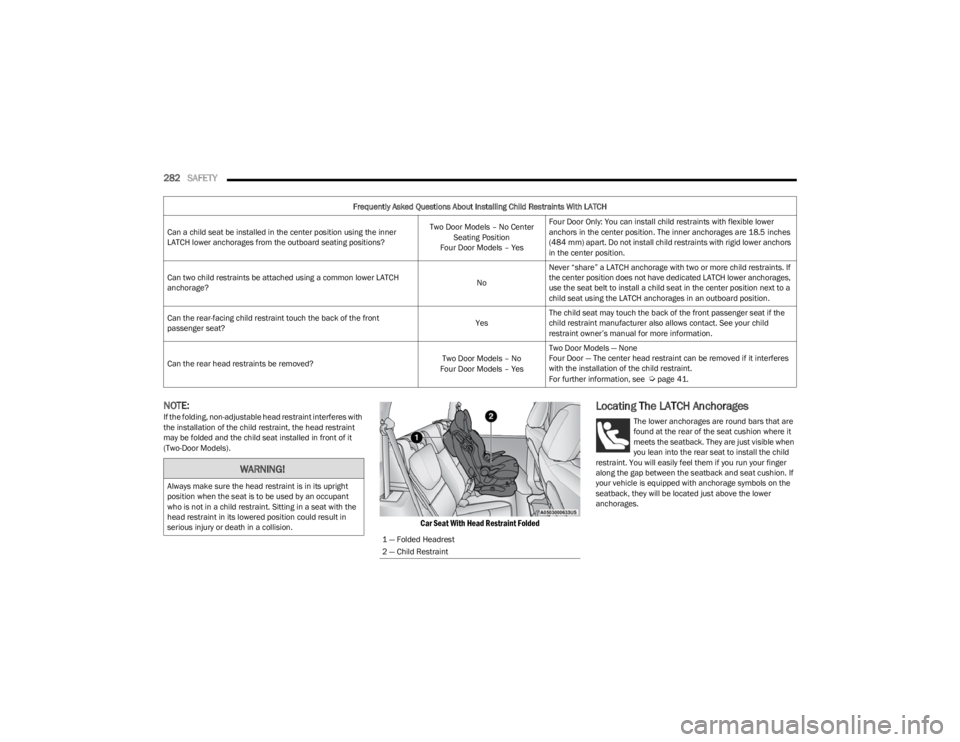
NOTE:If the folding, non-adjustable head restraint interferes with
the installation of the child restraint, the head restraint
may be folded and the child seat installed in front of it
(Two-Door Models).
Car Seat With Head Restraint Folded
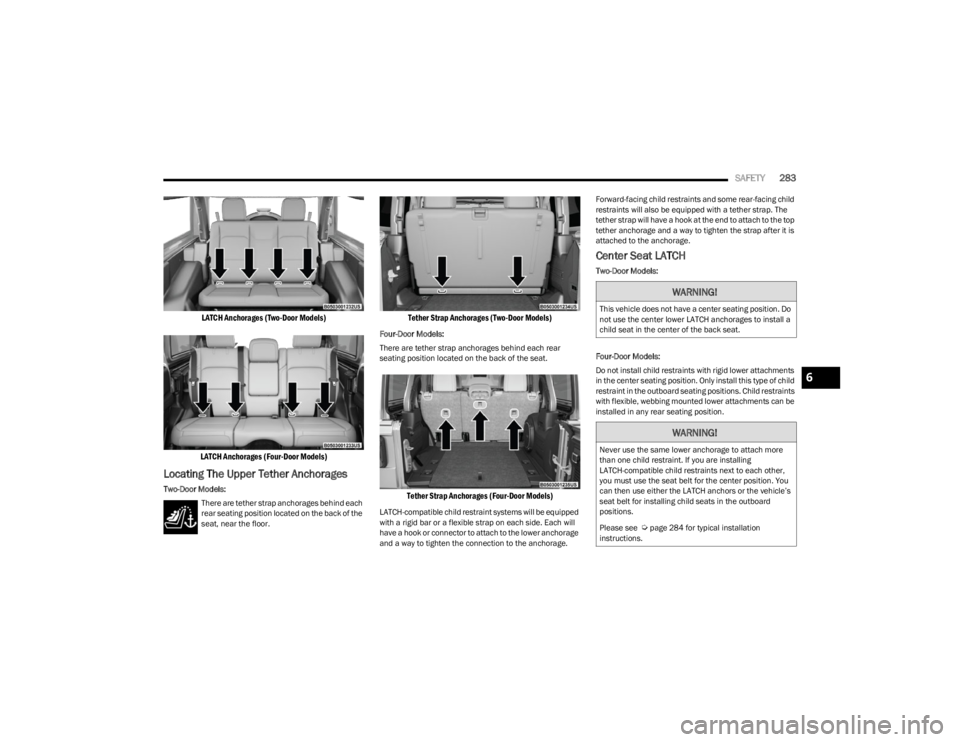
Locating The LATCH Anchorages
The lower anchorages are round bars that are
found at the rear of the seat cushion where it
meets the seatback. They are just visible when
you lean into the rear seat to install the child
restraint. You will easily feel them if you run your finger
along the gap between the seatback and seat cushion. If
your vehicle is equipped with anchorage symbols on the
seatback, they will be located just above the lower
anchorages.
Can a child seat be installed in the center position using the inner
LATCH lower anchorages from the outboard seating positions?
Two Door Models – No Center
Seating Position
Four Door Models – Yes Four Door Only: You can install child restraints with flexible lower
anchors in the center position. The inner anchorages are 18.5 inches
(484 mm) apart. Do not install child restraints with rigid lower anchors
in the center position.
Can two child restraints be attached using a common lower LATCH
anchorage? NoNever “share” a LATCH anchorage with two or more child restraints. If
the center position does not have dedicated LATCH lower anchorages,
use the seat belt to install a child seat in the center position next to a
child seat using the LATCH anchorages in an outboard position.
Can the rear-facing child restraint touch the back of the front
passenger seat? YesThe child seat may touch the back of the front passenger seat if the
child restraint manufacturer also allows contact. See your child
restraint owner’s manual for more information.
Can the rear head restraints be removed? Two Door Models – No
Four Door Models – Yes Two Door Models — None
Four Door — The center head restraint can be removed if it interferes
with the installation of the child restraint.
For further information, see
Úpage 41.
Frequently Asked Questions About Installing Child Restraints With LATCH
WARNING!
Always make sure the head restraint is in its upright
position when the seat is to be used by an occupant
who is not in a child restraint. Sitting in a seat with the
head restraint in its lowered position could result in
serious injury or death in a collision.
1 — Folded Headrest
2 — Child Restraint
23_JL_OM_EN_USC_t.book Page 282
Page 285 of 396
SAFETY283
LATCH Anchorages (Two-Door Models)
LATCH Anchorages (Four-Door Models)
Locating The Upper Tether Anchorages
Two-Door Models: There are tether strap anchorages behind each
rear seating position located on the back of the
seat, near the floor.
Tether Strap Anchorages (Two-Door Models)
Four-Door Models:
There are tether strap anchorages behind each rear
seating position located on the back of the seat.
Tether Strap Anchorages (Four-Door Models)
LATCH-compatible child restraint systems will be equipped
with a rigid bar or a flexible strap on each side. Each will
have a hook or connector to attach to the lower anchorage
and a way to tighten the connection to the anchorage. Forward-facing child restraints and some rear-facing child
restraints will also be equipped with a tether strap. The
tether strap will have a hook at the end to attach to the top
tether anchorage and a way to tighten the strap after it is
attached to the anchorage.
Center Seat LATCH
Two-Door Models:
Four-Door Models:
Do not install child restraints with rigid lower attachments
in the center seating position. Only install this type of child
restraint in the outboard seating positions. Child restraints
with flexible, webbing mounted lower attachments can be
installed in any rear seating position.
WARNING!
This vehicle does not have a center seating position. Do
not use the center lower LATCH anchorages to install a
child seat in the center of the back seat.
WARNING!
Never use the same lower anchorage to attach more
than one child restraint. If you are installing
LATCH-compatible child restraints next to each other,
you must use the seat belt for the center position. You
can then use either the LATCH anchors or the vehicle’s
seat belt for installing child seats in the outboard
positions.
Please see
Úpage 284 for typical installation
instructions.
6
23_JL_OM_EN_USC_t.book Page 283
Page 286 of 396
284SAFETY
Always follow the directions of the child restraint
manufacturer when installing your child restraint. Not all
child restraint systems will be installed as described here.
To Install A LATCH-Compatible Child
Restraint
If the selected seating position has a Switchable
Automatic Locking Retractor (ALR) seat belt, stow the seat
belt, following the instructions below. See
Úpage 284 to
check what type of seat belt each seating position has.
1. Loosen the adjusters on the lower straps and on the tether strap of the child seat so that you can more
easily attach the hooks or connectors to the vehicle
anchorages.
2. Place the child seat between the lower anchorages for that seating position. If the second row seat can
be reclined, you may recline the seat and/or raise the
head restraint (if adjustable) to get a better fit. If the
rear seat can be moved forward and rearward in the
vehicle, you may wish to move it to its rear-most
position to make room for the child seat. You may
also move the front seat forward to allow more room
for the child seat.
3. Attach the lower hooks or connectors of the child restraint to the lower anchorages in the selected
seating position.
4. If the child restraint has a tether strap, connect it to the top tether anchorage. See
Úpage 287 for
directions to attach a tether anchor.
5. Tighten all of the straps as you push the child restraint rearward and downward into the seat.
Remove slack in the straps according to the child
restraint manufacturer’s instructions. 6. Test that the child restraint is installed tightly by
pulling back and forth on the child seat at the belt
path. It should not move more than 1 inch (25.4 mm) in any direction.
How To Stow An Unused Switchable-ALR
(ALR) Seat Belt:
When using the LATCH attaching system to install a child
restraint, stow all ALR seat belts that are not being used
by other occupants or being used to secure child
restraints. An unused belt could injure a child if they play
with it and accidentally lock the seat belt retractor. Before
installing a child restraint using the LATCH system, buckle
the seat belt behind the child restraint and out of the
child’s reach. If the buckled seat belt interferes with the
child restraint installation, instead of buckling it behind
the child restraint, route the seat belt through the child
restraint belt path and then buckle it. Do not lock the seat
belt. Remind all children in the vehicle that the seat belts
are not toys and that they should not play with them.
Installing Child Restraints Using The
Vehicle Seat Belt
Child restraint systems are designed to be secured in
vehicle seats by lap belts or the lap belt portion of a lap/
shoulder belt.
The seat belts in the passenger seating positions are
equipped with a Switchable Automatic Locking Retractor
(ALR) that is designed to keep the lap portion of the seat
belt tight around the child restraint so that it is not
necessary to use a locking clip. The ALR retractor can be
“switched” into a locked mode by pulling all of the webbing
out of the retractor and then letting the webbing retract
back into the retractor. If it is locked, the ALR will make a
clicking noise while the webbing is pulled back into the
retractor.
Refer to the “Automatic Locking Mode” description in
“Switchable Automatic Locking Retractors (ALR)”
Úpage 265 for additional information on ALR.
Please see the table below and the following sections for
more information.
WARNING!
Improper installation of a child restraint to the LATCH
anchorages can lead to failure of the restraint. The
child could be badly injured or killed. Follow the child
restraint manufacturer’s directions exactly when
installing an infant or child restraint.
Child restraint anchorages are designed to withstand
only those loads imposed by correctly-fitted child
restraints. Under no circumstances are they to be
used for adult seat belts, harnesses, or for attaching
other items or equipment to the vehicle.
WARNING!
Improper installation or failure to properly secure a
child restraint can lead to failure of the restraint. The
child could be badly injured or killed.
Follow the child restraint manufacturer’s directions
exactly when installing an infant or child restraint.
23_JL_OM_EN_USC_t.book Page 284
Page 287 of 396
SAFETY285
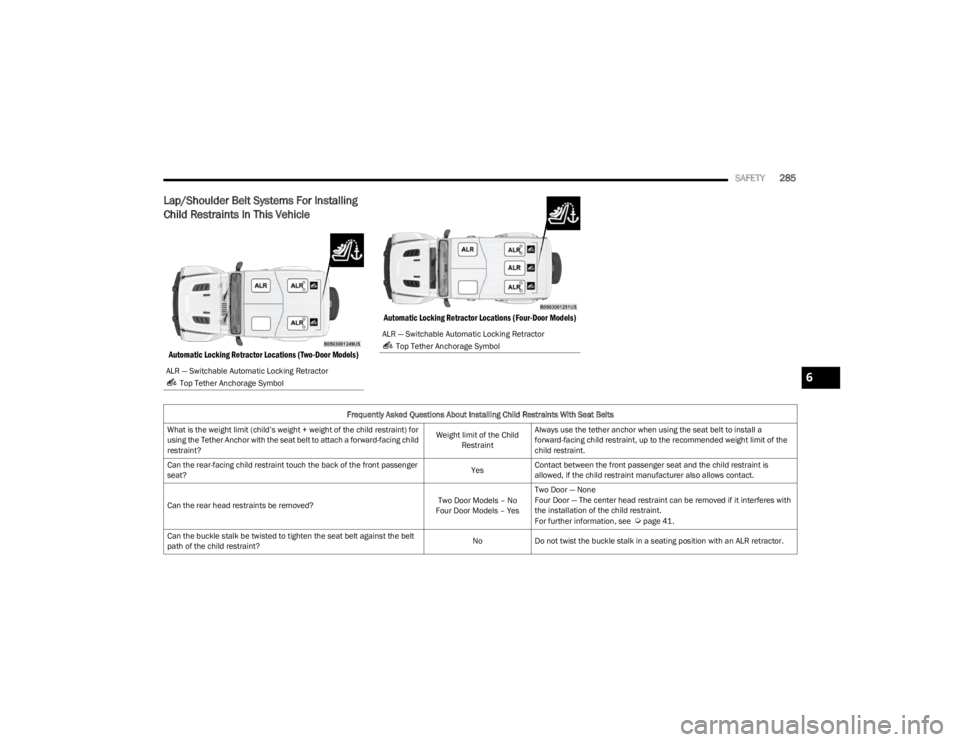
Lap/Shoulder Belt Systems For Installing
Child Restraints In This Vehicle
Automatic Locking Retractor Locations (Two-Door Models) Automatic Locking Retractor Locations (Four-Door Models)
ALR — Switchable Automatic Locking Retractor
Top Tether Anchorage Symbol
ALR — Switchable Automatic Locking Retractor Top Tether Anchorage Symbol
Frequently Asked Questions About Installing Child Restraints With Seat Belts
What is the weight limit (child’s weight + weight of the child restraint) for
using the Tether Anchor with the seat belt to attach a forward-facing child
restraint? Weight limit of the Child
Restraint Always use the tether anchor when using the seat belt to install a
forward-facing child restraint, up to the recommended weight limit of the
child restraint.
Can the rear-facing child restraint touch the back of the front passenger
seat? YesContact between the front passenger seat and the child restraint is
allowed, if the child restraint manufacturer also allows contact.
Can the rear head restraints be removed? Two Door Models – No
Four Door Models – Yes Two Door — None
Four Door — The center head restraint can be removed if it interferes with
the installation of the child restraint.
For further information, see
Úpage 41.
Can the buckle stalk be twisted to tighten the seat belt against the belt
path of the child restraint? No
Do not twist the buckle stalk in a seating position with an ALR retractor.
6
23_JL_OM_EN_USC_t.book Page 285
Page 288 of 396
286SAFETY
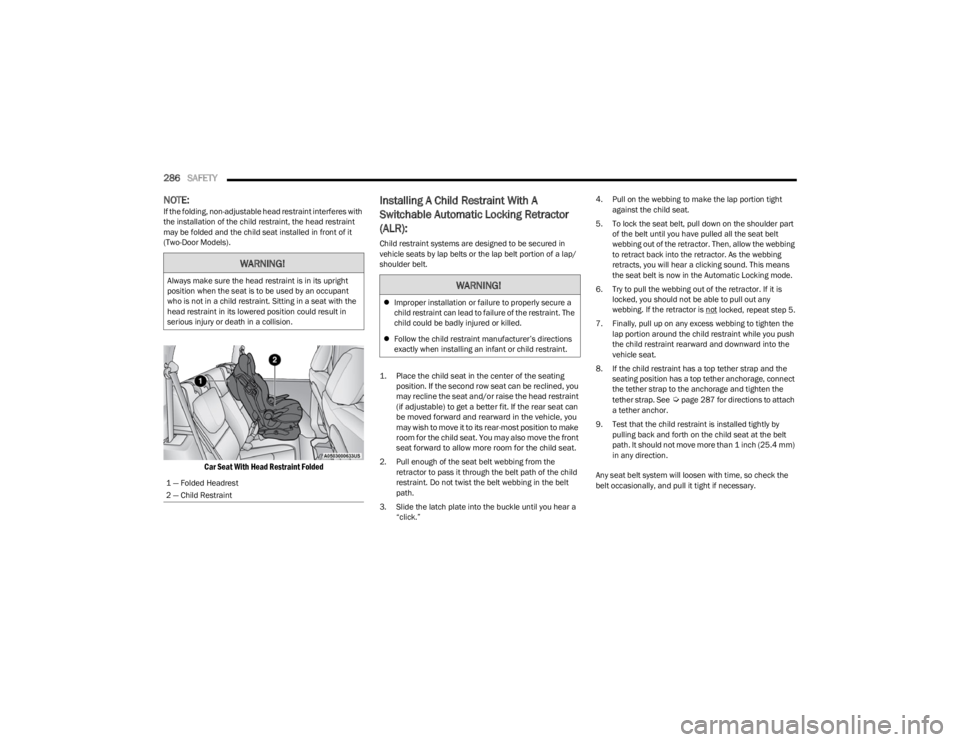
NOTE:If the folding, non-adjustable head restraint interferes with
the installation of the child restraint, the head restraint
may be folded and the child seat installed in front of it
(Two-Door Models).
Car Seat With Head Restraint Folded
Installing A Child Restraint With A
Switchable Automatic Locking Retractor
(ALR):
Child restraint systems are designed to be secured in
vehicle seats by lap belts or the lap belt portion of a lap/
shoulder belt.
1. Place the child seat in the center of the seating
position. If the second row seat can be reclined, you
may recline the seat and/or raise the head restraint
(if adjustable) to get a better fit. If the rear seat can
be moved forward and rearward in the vehicle, you
may wish to move it to its rear-most position to make
room for the child seat. You may also move the front
seat forward to allow more room for the child seat.
2. Pull enough of the seat belt webbing from the retractor to pass it through the belt path of the child
restraint. Do not twist the belt webbing in the belt
path.
3. Slide the latch plate into the buckle until you hear a “click.” 4. Pull on the webbing to make the lap portion tight
against the child seat.
5. To lock the seat belt, pull down on the shoulder part of the belt until you have pulled all the seat belt
webbing out of the retractor. Then, allow the webbing
to retract back into the retractor. As the webbing
retracts, you will hear a clicking sound. This means
the seat belt is now in the Automatic Locking mode.
6. Try to pull the webbing out of the retractor. If it is locked, you should not be able to pull out any
webbing. If the retractor is not
locked, repeat step 5.
7. Finally, pull up on any excess webbing to tighten the lap portion around the child restraint while you push
the child restraint rearward and downward into the
vehicle seat.
8. If the child restraint has a top tether strap and the seating position has a top tether anchorage, connect
the tether strap to the anchorage and tighten the
tether strap. See
Úpage 287 for directions to attach
a tether anchor.
9. Test that the child restraint is installed tightly by pulling back and forth on the child seat at the belt
path. It should not move more than 1 inch (25.4 mm) in any direction.
Any seat belt system will loosen with time, so check the
belt occasionally, and pull it tight if necessary.
WARNING!
Always make sure the head restraint is in its upright
position when the seat is to be used by an occupant
who is not in a child restraint. Sitting in a seat with the
head restraint in its lowered position could result in
serious injury or death in a collision.
1 — Folded Headrest
2 — Child RestraintWARNING!
Improper installation or failure to properly secure a
child restraint can lead to failure of the restraint. The
child could be badly injured or killed.
Follow the child restraint manufacturer’s directions
exactly when installing an infant or child restraint.
23_JL_OM_EN_USC_t.book Page 286
Page 290 of 396
288SAFETY
Center Tether Attachment — Four-Door
Without Center Armrest
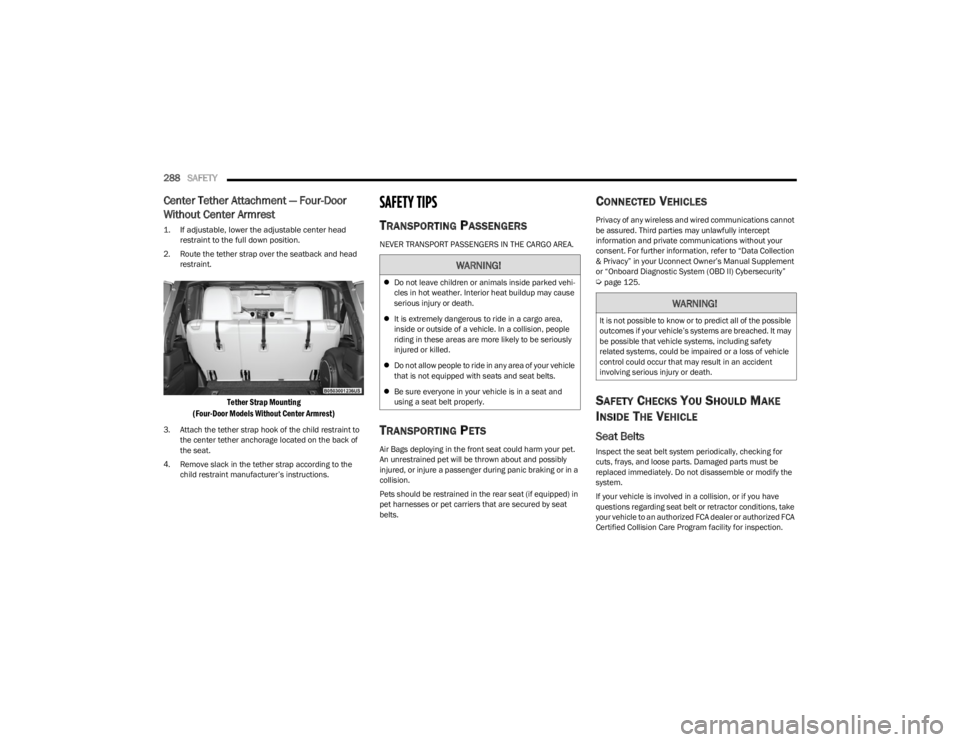
1. If adjustable, lower the adjustable center head
restraint to the full down position.
2. Route the tether strap over the seatback and head restraint.
Tether Strap Mounting
(Four-Door Models Without Center Armrest)
3. Attach the tether strap hook of the child restraint to the center tether anchorage located on the back of
the seat.
4. Remove slack in the tether strap according to the child restraint manufacturer’s instructions.
SAFETY TIPS
TRANSPORTING PASSENGERS
NEVER TRANSPORT PASSENGERS IN THE CARGO AREA.
TRANSPORTING PETS
Air Bags deploying in the front seat could harm your pet.
An unrestrained pet will be thrown about and possibly
injured, or injure a passenger during panic braking or in a
collision.
Pets should be restrained in the rear seat (if equipped) in
pet harnesses or pet carriers that are secured by seat
belts.
CONNECTED VEHICLES
Privacy of any wireless and wired communications cannot
be assured. Third parties may unlawfully intercept
information and private communications without your
consent. For further information, refer to “Data Collection
& Privacy” in your Uconnect Owner’s Manual Supplement
or “Onboard Diagnostic System (OBD II) Cybersecurity”
Úpage 125.
SAFETY CHECKS YOU SHOULD MAKE
I
NSIDE THE VEHICLE
Seat Belts
Inspect the seat belt system periodically, checking for
cuts, frays, and loose parts. Damaged parts must be
replaced immediately. Do not disassemble or modify the
system.
If your vehicle is involved in a collision, or if you have
questions regarding seat belt or retractor conditions, take
your vehicle to an authorized FCA dealer or authorized FCA
Certified Collision Care Program facility for inspection.
WARNING!
Do not leave children or animals inside parked vehi -
cles in hot weather. Interior heat buildup may cause
serious injury or death.
It is extremely dangerous to ride in a cargo area,
inside or outside of a vehicle. In a collision, people
riding in these areas are more likely to be seriously
injured or killed.
Do not allow people to ride in any area of your vehicle
that is not equipped with seats and seat belts.
Be sure everyone in your vehicle is in a seat and
using a seat belt properly.
WARNING!
It is not possible to know or to predict all of the possible
outcomes if your vehicle’s systems are breached. It may
be possible that vehicle systems, including safety
related systems, could be impaired or a loss of vehicle
control could occur that may result in an accident
involving serious injury or death.
23_JL_OM_EN_USC_t.book Page 288
Page 315 of 396
SERVICING AND MAINTENANCE313
ADDITIONAL MAINTENANCE — B6 TO B20 BIODIESEL
NOTE:
Under no circumstances should oil change intervals exceed 8,000 miles (12,875 km) or six months, whichever comes first when using biodiesel blends greater than 5% (B5).
The owner is required to monitor mileage for B6-B20 biodiesel, the automatic oil change indicator system does not reflect the use of biofuels.
Fuel filter change interval is maintained at every second oil change. This is especially important with biodiesel usage.
For more information on using biodiesel
Úpage 371.
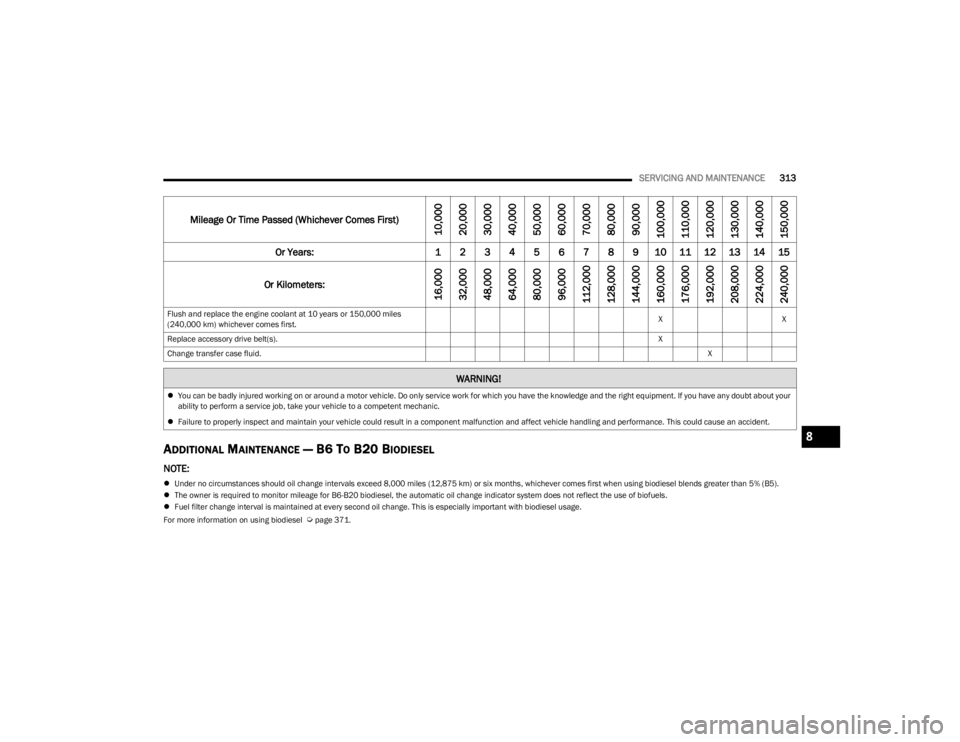
Flush and replace the engine coolant at 10 years or 150,000 miles
(240,000 km) whichever comes first.
X
X
Replace accessory drive belt(s). X
Change transfer case fluid. X
Mileage Or Time Passed (Whichever Comes First)
10,000
20,000
30,000
40,000
50,000
60,000
70,000
80,000
90,000
100,000
110,000
120,000
130,000
140,000
150,000
Or Years: 1 2 3 4 5 6 7 8 9 10 11 12 13 14 15
Or Kilometers:
16,000
32,000
48,000
64,000
80,000
96,000
112,000
128,000
144,000
160,000
176,000
192,000
208,000
224,000
240,000
WARNING!
You can be badly injured working on or around a motor vehicle. Do only service work for which you have the knowledge and the right equipment. If you have any doubt about your
ability to perform a service job, take your vehicle to a competent mechanic.
Failure to properly inspect and maintain your vehicle could result in a component malfunction and affect vehicle handling and performance. This could cause an accident.
8
23_JL_OM_EN_USC_t.book Page 313
Page 326 of 396
324SERVICING AND MAINTENANCE
reacts with engine exhaust in the presence of a catalyst to
convert smog-forming Nitrogen Oxides (NOx) into
harmless nitrogen and water vapor.
For further information
Úpage 374.
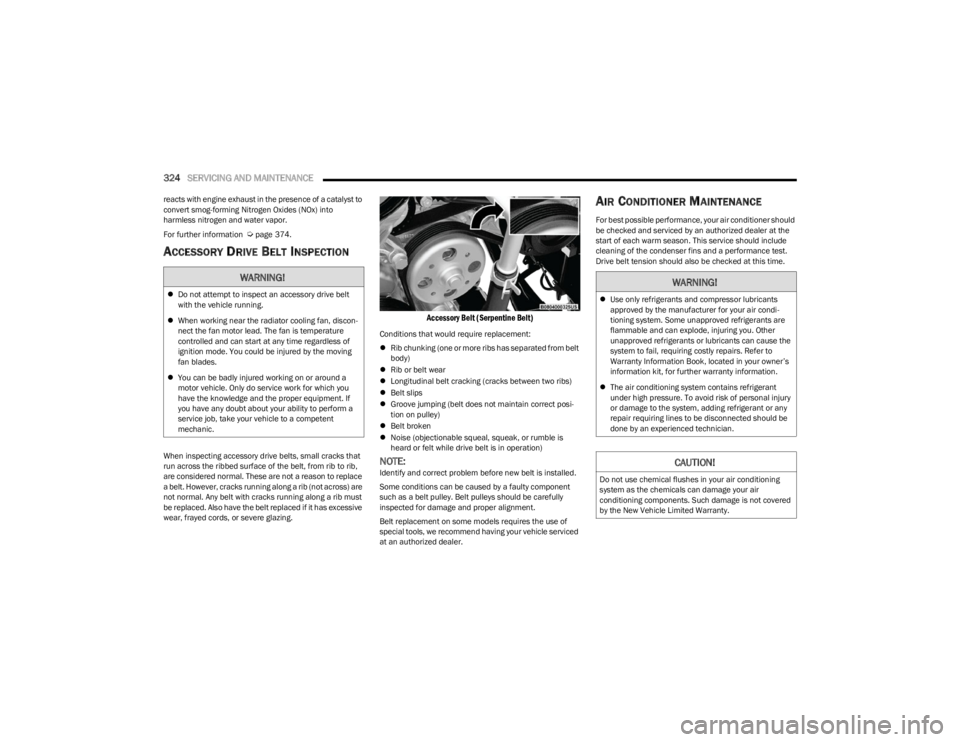
ACCESSORY DRIVE BELT INSPECTION
When inspecting accessory drive belts, small cracks that
run across the ribbed surface of the belt, from rib to rib,
are considered normal. These are not a reason to replace
a belt. However, cracks running along a rib (not across) are
not normal. Any belt with cracks running along a rib must
be replaced. Also have the belt replaced if it has excessive
wear, frayed cords, or severe glazing.
Accessory Belt (Serpentine Belt)
Conditions that would require replacement:
Rib chunking (one or more ribs has separated from belt
body)
Rib or belt wear
Longitudinal belt cracking (cracks between two ribs)
Belt slips
Groove jumping (belt does not maintain correct posi -
tion on pulley)
Belt broken
Noise (objectionable squeal, squeak, or rumble is
heard or felt while drive belt is in operation)
NOTE:Identify and correct problem before new belt is installed.
Some conditions can be caused by a faulty component
such as a belt pulley. Belt pulleys should be carefully
inspected for damage and proper alignment.
Belt replacement on some models requires the use of
special tools, we recommend having your vehicle serviced
at an authorized dealer.
AIR CONDITIONER MAINTENANCE
For best possible performance, your air conditioner should
be checked and serviced by an authorized dealer at the
start of each warm season. This service should include
cleaning of the condenser fins and a performance test.
Drive belt tension should also be checked at this time.
WARNING!
Do not attempt to inspect an accessory drive belt
with the vehicle running.
When working near the radiator cooling fan, discon -
nect the fan motor lead. The fan is temperature
controlled and can start at any time regardless of
ignition mode. You could be injured by the moving
fan blades.
You can be badly injured working on or around a
motor vehicle. Only do service work for which you
have the knowledge and the proper equipment. If
you have any doubt about your ability to perform a
service job, take your vehicle to a competent
mechanic.WARNING!
Use only refrigerants and compressor lubricants
approved by the manufacturer for your air condi -
tioning system. Some unapproved refrigerants are
flammable and can explode, injuring you. Other
unapproved refrigerants or lubricants can cause the
system to fail, requiring costly repairs. Refer to
Warranty Information Book, located in your owner’s
information kit, for further warranty information.
The air conditioning system contains refrigerant
under high pressure. To avoid risk of personal injury
or damage to the system, adding refrigerant or any
repair requiring lines to be disconnected should be
done by an experienced technician.
CAUTION!
Do not use chemical flushes in your air conditioning
system as the chemicals can damage your air
conditioning components. Such damage is not covered
by the New Vehicle Limited Warranty.
23_JL_OM_EN_USC_t.book Page 324
Page 342 of 396
340SERVICING AND MAINTENANCE
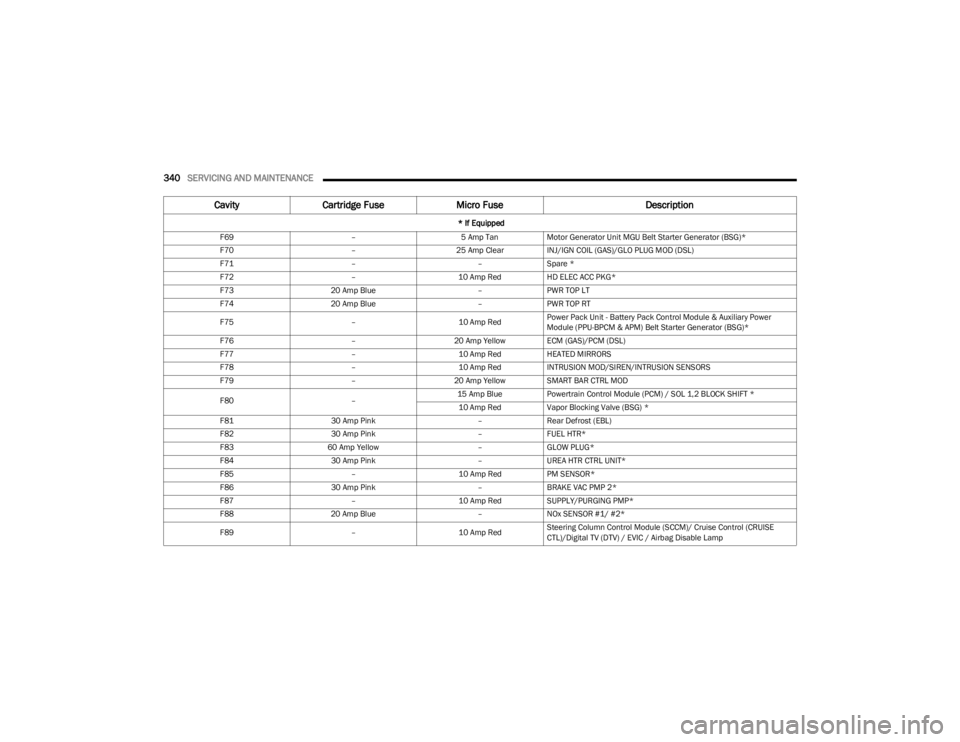
F69 –5 Amp TanMotor Generator Unit MGU Belt Starter Generator (BSG)*
F70 –25 Amp ClearINJ/IGN COIL (GAS)/GLO PLUG MOD (DSL)
F71 ––Spare *
F72 –10 Amp RedHD ELEC ACC PKG*
F73 20 Amp Blue –PWR TOP LT
F74 20 Amp Blue –PWR TOP RT
F75 –10 Amp RedPower Pack Unit - Battery Pack Control Module & Auxiliary Power
Module (PPU-BPCM & APM) Belt Starter Generator (BSG)*
F76 –20 Amp Yellow ECM (GAS)/PCM (DSL)
F77 –10 Amp RedHEATED MIRRORS
F78 –10 Amp RedINTRUSION MOD/SIREN/INTRUSION SENSORS
F79 –20 Amp Yellow SMART BAR CTRL MOD
F80 –15 Amp Blue
Powertrain Control Module (PCM) / SOL 1,2 BLOCK SHIFT *
10 Amp Red Vapor Blocking Valve (BSG) *
F81 30 Amp Pink –Rear Defrost (EBL)
F82 30 Amp Pink –FUEL HTR*
F83 60 Amp Yellow –GLOW PLUG*
F84 30 Amp Pink –UREA HTR CTRL UNIT*
F85 –10 Amp RedPM SENSOR*
F86 30 Amp Pink –BRAKE VAC PMP 2*
F87 –10 Amp RedSUPPLY/PURGING PMP*
F88 20 Amp Blue –NOx SENSOR #1/ #2*
F89 –10 Amp RedSteering Column Control Module (SCCM)/ Cruise Control (CRUISE
CTL)/Digital TV (DTV) / EVIC / Airbag Disable Lamp
Cavity
Cartridge Fuse Micro Fuse Description
* If Equipped
23_JL_OM_EN_USC_t.book Page 340
Page 367 of 396
SERVICING AND MAINTENANCE365
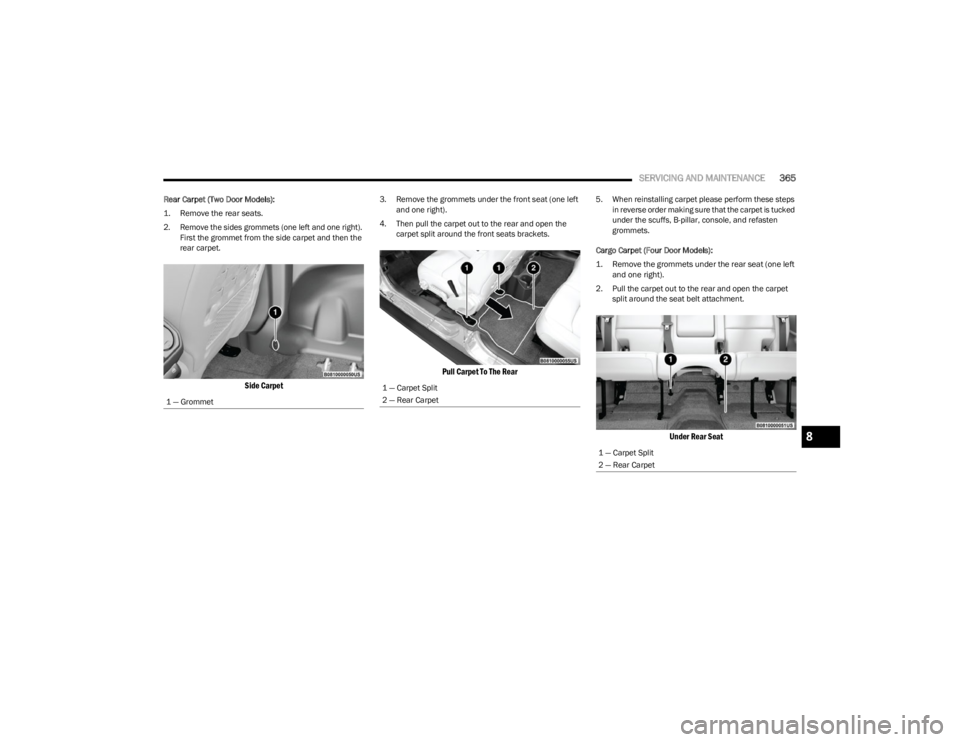
Rear Carpet (Two Door Models):
1. Remove the rear seats.
2. Remove the sides grommets (one left and one right).
First the grommet from the side carpet and then the
rear carpet.
Side Carpet
3. Remove the grommets under the front seat (one left and one right).
4. Then pull the carpet out to the rear and open the carpet split around the front seats brackets.
Pull Carpet To The Rear
5. When reinstalling carpet please perform these steps in reverse order making sure that the carpet is tucked
under the scuffs, B-pillar, console, and refasten
grommets.
Cargo Carpet (Four Door Models):
1. Remove the grommets under the rear seat (one left and one right).
2. Pull the carpet out to the rear and open the carpet split around the seat belt attachment.
Under Rear Seat
1 — Grommet
1 — Carpet Split
2 — Rear Carpet
1 — Carpet Split
2 — Rear Carpet
8
23_JL_OM_EN_USC_t.book Page 365