tire pressure JEEP WRANGLER 2DOORS 2020 Owner handbook (in English)
[x] Cancel search | Manufacturer: JEEP, Model Year: 2020, Model line: WRANGLER 2DOORS, Model: JEEP WRANGLER 2DOORS 2020Pages: 330, PDF Size: 9.16 MB
Page 235 of 330
233
Tread Wear
Improper cold tire inflation pressures can
cause abnormal wear patterns and reduced
tread life, resulting in the need for earlier tire
replacement.
Ride Comfort And Vehicle Stability
Proper tire inflation contributes to a comfort-
able ride. Overinflation produces a jarring
and uncomfortable ride.
Tire Inflation Pressures
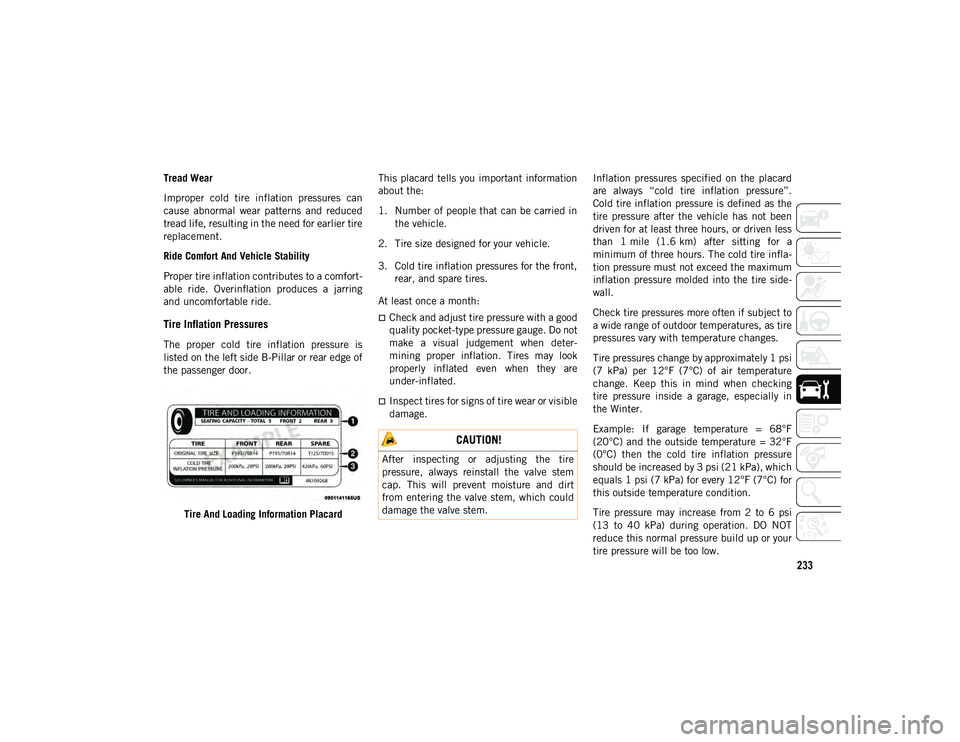
The proper cold tire inflation pressure is
listed on the left side B-Pillar or rear edge of
the passenger door.
Tire And Loading Information Placard This placard tells you important information
about the:
1. Number of people that can be carried in
the vehicle.
2. Tire size designed for your vehicle.
3. Cold tire inflation pressures for the front, rear, and spare tires.
At least once a month:
Check and adjust tire pressure with a good
quality pocket-type pressure gauge. Do not
make a visual judgement when deter -
mining proper inflation. Tires may look
properly inflated even when they are
under-inflated.
Inspect tires for signs of tire wear or visible
damage. Inflation pressures specified on the placard
are always “cold tire inflation pressure”.
Cold tire inflation pressure is defined as the
tire pressure after the vehicle has not been
driven for at least three hours, or driven less
than 1 mile (1.6 km) after sitting for a
minimum of three hours. The cold tire infla
-
tion pressure must not exceed the maximum
inflation pressure molded into the tire side -
wall.
Check tire pressures more often if subject to
a wide range of outdoor temperatures, as tire
pressures vary with temperature changes.
Tire pressures change by approximately 1 psi
(7 kPa) per 12°F (7°C) of air temperature
change. Keep this in mind when checking
tire pressure inside a garage, especially in
the Winter.
Example: If garage temperature = 68°F
(20°C) and the outside temperature = 32°F
(0°C) then the cold tire inflation pressure
should be increased by 3 psi (21 kPa), which
equals 1 psi (7 kPa) for every 12°F (7°C) for
this outside temperature condition.
Tire pressure may increase from 2 to 6 psi
(13 to 40 kPa) during operation. DO NOT
reduce this normal pressure build up or your
tire pressure will be too low.
CAUTION!
After inspecting or adjusting the tire
pressure, always reinstall the valve stem
cap. This will prevent moisture and dirt
from entering the valve stem, which could
damage the valve stem.
2020_JEEP_JL_WRANGLER_UG_RHD_UK.book Page 233
Page 236 of 330
SERVICING AND MAINTENANCE
234
Tire Pressures For High Speed Operation
The manufacturer advocates driving at safe
speeds and within posted speed limits.
Where speed limits or conditions are such
that the vehicle can be driven at high speeds,
maintaining correct tire inflation pressure is
very important. Increased tire pressure and
reduced vehicle loading may be required for
high-speed vehicle operation. Refer to an
authorized tire dealer or original equipment
vehicle dealer for recommended safe oper-
ating speeds, loading and cold tire inflation
pressures.
Radial Ply Tires
Tire Repair
If your tire becomes damaged, it may be
repaired if it meets the following criteria:
The tire has not been driven on when flat.
The damage is only on the tread section of
your tire (sidewall damage is not repairable).
The puncture is no greater than a ¼ of an
inch (6 mm).
Consult an authorized tire dealer for tire
repairs and additional information.
Damaged Run Flat tires, or Run Flat tires
that have experienced a loss of pressure
should be replaced immediately with another
Run Flat tire of identical size and service
description (Load Index and Speed Symbol).
Replace the tire pressure sensor as well as it
is not designed to be reused.
Run Flat Tires — If Equipped
Run Flat tires allow you the capability to
drive 50 miles (80 km) at 50 mph (80 km/h)
after a rapid loss of inflation pressure. This
rapid loss of inflation is referred to as the
Run Flat mode. A Run Flat mode occurs
when the tire inflation pressure is of/or below
14 psi (96 kPa). Once a Run Flat tire reaches
the run flat mode it has limited driving capa -
bilities and needs to be replaced immedi -
ately. A Run Flat tire is not repairable. When
a run flat tire is changed after driving with
underinflated tire condition, please replace
the TPM sensor as it is not designed to be
reused when driven under run flat mode 14
psi (96 kPa) condition.
NOTE:
TPM Sensor must be replaced after driving
the vehicle on a flat tire condition.
It is not recommended driving a vehicle
loaded at full capacity or to tow a trailer
while a tire is in the run flat mode.
See the tire pressure monitoring section for
more information.
WARNING!
High speed driving with your vehicle under
maximum load is dangerous. The added
strain on your tires could cause them to
fail. You could have a serious collision. Do
not drive a vehicle loaded to the maximum
capacity at continuous speeds above
75 mph (120 km/h).
WARNING!
Combining radial ply tires with other types
of tires on your vehicle will cause your
vehicle to handle poorly. The instability
could cause a collision. Always use radial
ply tires in sets of four. Never combine
them with other types of tires.
2020_JEEP_JL_WRANGLER_UG_RHD_UK.book Page 234
Page 237 of 330
235
Tire Spinning
When stuck in mud, sand, snow, or ice
conditions, do not spin your vehicle's wheels
above 30 mph (48 km/h) or for longer than
30 seconds continuously without stopping.
Refer to “Freeing A Stuck Vehicle” in “In
Case Of Emergency” for further information.
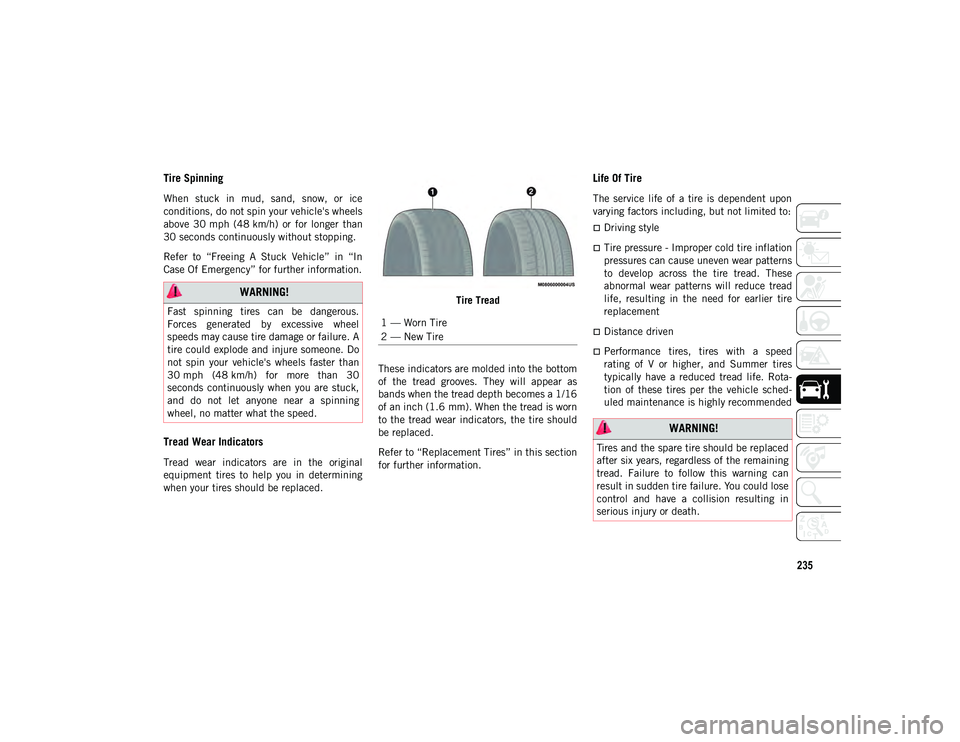
Tread Wear Indicators
Tread wear indicators are in the original
equipment tires to help you in determining
when your tires should be replaced.Tire Tread
These indicators are molded into the bottom
of the tread grooves. They will appear as
bands when the tread depth becomes a 1/16
of an inch (1.6 mm). When the tread is worn
to the tread wear indicators, the tire should
be replaced.
Refer to “Replacement Tires” in this section
for further information.
Life Of Tire
The service life of a tire is dependent upon
varying factors including, but not limited to:
Driving style
Tire pressure - Improper cold tire inflation
pressures can cause uneven wear patterns
to develop across the tire tread. These
abnormal wear patterns will reduce tread
life, resulting in the need for earlier tire
replacement
Distance driven
Performance tires, tires with a speed
rating of V or higher, and Summer tires
typically have a reduced tread life. Rota-
tion of these tires per the vehicle sched -
uled maintenance is highly recommended
WARNING!
Fast spinning tires can be dangerous.
Forces generated by excessive wheel
speeds may cause tire damage or failure. A
tire could explode and injure someone. Do
not spin your vehicle's wheels faster than
30 mph (48 km/h) for more than 30
seconds continuously when you are stuck,
and do not let anyone near a spinning
wheel, no matter what the speed.1 — Worn Tire
2 — New Tire
WARNING!
Tires and the spare tire should be replaced
after six years, regardless of the remaining
tread. Failure to follow this warning can
result in sudden tire failure. You could lose
control and have a collision resulting in
serious injury or death.
2020_JEEP_JL_WRANGLER_UG_RHD_UK.book Page 235
Page 238 of 330
SERVICING AND MAINTENANCE
236
(Continued)
NOTE:
Wheel Valve Stem must be replaced as well
when installing new tires due to wear and
tear in existing tires.
Keep dismounted tires in a cool, dry place
with as little exposure to light as possible.
Protect tires from contact with oil, grease,
and gasoline.
Replacement Tires
The tires on your new vehicle provide a
balance of many characteristics. They should
be inspected regularly for wear and correct
cold tire inflation pressures. The manufac-
turer strongly recommends that you use tires
equivalent to the originals in size, quality
and performance when replacement is
needed. Refer to the paragraph on “Tread
Wear Indicators” in this section. Refer to the
Tire and Loading Information placard or the
Vehicle Certification Label for the size desig -
nation of your tire. The Load Index and
Speed Symbol for your tire will be found on
the original equipment tire sidewall.
It is recommended to replace the two front
tires or two rear tires as a pair. Replacing just
one tire can seriously affect your vehicle’s handling. If you ever replace a wheel, make
sure that the wheel’s specifications match
those of the original wheels.
It is recommended you contact an authorized
tire dealer or original equipment dealer with
any questions you may have on tire specifica
-
tions or capability. Failure to use equivalent
replacement tires may adversely affect the
safety, handling, and ride of your vehicle. WARNING!
Do not use a tire, wheel size, load rating,
or speed rating other than that specified
for your vehicle. Some combinations of
unapproved tires and wheels may change
suspension dimensions and performance
characteristics, resulting in changes to
steering, handling, and braking of your
vehicle. This can cause unpredictable
handling and stress to steering and
suspension components. You could lose
control and have a collision resulting in
serious injury or death. Use only the tire
and wheel sizes with load ratings
approved for your vehicle.
Never use a tire with a smaller load index
or capacity, other than what was origi -
nally equipped on your vehicle. Using a
tire with a smaller load index could result
in tire overloading and failure. You could
lose control and have a collision.
Failure to equip your vehicle with tires
having adequate speed capability can
result in sudden tire failure and loss of
vehicle control.
CAUTION!
Replacing original tires with tires of a
different size may result in false
speedometer and odometer readings.
WARNING! (Continued)
2020_JEEP_JL_WRANGLER_UG_RHD_UK.book Page 236
Page 241 of 330
239
Wheel And Wheel Trim Care
All wheels and wheel trim, especially
aluminum and chrome plated wheels, should
be cleaned regularly using mild (neutral Ph)
soap and water to maintain their luster and
to prevent corrosion. Wash wheels with the
same soap solution recommended for the
body of the vehicle and remember to always
wash when the surfaces are not hot to the
touch.Your wheels are susceptible to deterioration
caused by salt, sodium chloride, magnesium
chloride, calcium chloride, etc., and other
road chemicals used to melt ice or control
dust on dirt roads. Use a soft cloth or sponge
and mild soap to wipe away promptly. Do not
use harsh chemicals or a stiff brush. They
can damage the wheel’s protective coating
that helps keep them from corroding and
tarnishing.
When cleaning extremely dirty wheels
including excessive brake dust, care must be
taken in the selection of tire and wheel
cleaning chemicals and equipment to
prevent damage to the wheels. Select a
non-abrasive, non-acidic cleaner for
aluminum or chrome wheels.
NOTE:
If you intend parking or storing your vehicle
for an extended period after cleaning the
wheels with wheel cleaner, drive your vehicle
and apply the brakes to remove the water
droplets from the brake components. This
activity will remove the red rust on the brake
rotors and prevent vehicle vibration when
braking.
WARNING!
Limited use spares are for emergency use
only. Installation of this limited use spare
tire affects vehicle handling. With this tire,
do not drive more than the speed listed on
the limited use spare wheel. Keep inflated
to the cold tire inflation pressures listed on
your Tire and Loading Information Placard
located on the driver’s side B-Pillar or the
rear edge of the driver’s side door. Replace
(or repair) the original equipment tire at
the first opportunity and reinstall it on your
vehicle. Failure to do so could result in
loss of vehicle control.
CAUTION!
Avoid products or automatic car washes that
use acidic solutions or strong alkaline
additives or harsh brushes. Many aftermarket
wheel cleaners and automatic car washes
may damage the wheel's protective finish.
Such damage is not covered by the New
Vehicle Limited Warranty. Only car wash soap
is recommended.
CAUTION!
Do not use scouring pads, steel wool, a
bristle brush, metal polishes or oven
cleaner. These products may damage the
wheel's protective finish. Such damage is
not covered by the New Vehicle Limited
Warranty. Only car wash soap is
recommended.
2020_JEEP_JL_WRANGLER_UG_RHD_UK.book Page 239
Page 246 of 330
SERVICING AND MAINTENANCE
244(Continued)
(Continued)
Appearance Care For Fabric Top Models
To maintain the appearance of your vehicle's inte
-
rior trim and top, follow these precautions:
Avoid leaving your vehicle unattended
with the top down, as exposure to sun or
rain may damage interior trim.
Do not use harsh cleaners or bleaching
agents on top material, as damage may
result.
Do not allow any vinyl cleaner to run down
and dry on the paint, leaving a streak.
After cleaning your vehicle's fabric top,
always make sure it is completely dry
before lowering.
Be especially careful when washing the
windows by following the directions for
“Care of Fabric Top Windows.”
Washing – Use mild soap suds, lukewarm
water, and a brush with soft bristles. If extra
cleaning is required, use a mild foaming
cleaner on the entire top, but support the top
from underneath.
Rinsing – Be sure to remove all traces of
cleaner by rinsing the top thoroughly with
clean water. Remember to allow the top to
dry before lowering it. Some parts of the vehicle may be painted
with a matte paintwork which requires
special care for its preservation.
CAUTION!
Failure to follow these cautions may cause
interior and exterior vehicle water damage,
stains or mildew on the top material or
electrical components damage:
Avoid high-pressure car washes for the
exterior and interior of the vehicle, as
they can damage the top material and
electrical connectors. Also, increased
water pressure may force past the
weather strips.
It is recommended that the top be free of
water prior to opening it. Operating the
top, opening a door or lowering a window
while the top is wet may allow water to
drip into the vehicle’s interior.
Use care when washing the vehicle,
water pressure directed at the weather
strip seals may cause water to leak into
the vehicle’s interior.
Careless handling and storage of the
removable roof panels may damage the
seals, causing water to leak into the
vehicle’s interior.
The front panel(s) must be positioned
properly to ensure sealing. Improper
installation can cause water to leak into
the vehicle’s interior.
CAUTION!
Avoid washing with rollers and/or
brushes in washing stations. Wash the
vehicle only by hand using neutral pH
detergents; dry it with a wet chamois
leather. Abrasive products and/or
polishes should not be used for cleaning
the car. Bird droppings must be washed
off immediately and thoroughly as the
acid they contain is particularly aggres-
sive.
Avoid (if at all possible) parking the
vehicle under trees; remove vegetable
resins immediately as, when dried, it
may only be possible to remove them
with abrasive products and/or polishes,
which is highly inadvisable as they could
alter the typical opaqueness of the paint.
CAUTION! (Continued)
2020_JEEP_JL_WRANGLER_UG_RHD_UK.book Page 244
Page 250 of 330
TECHNICAL SPECIFICATIONS
248
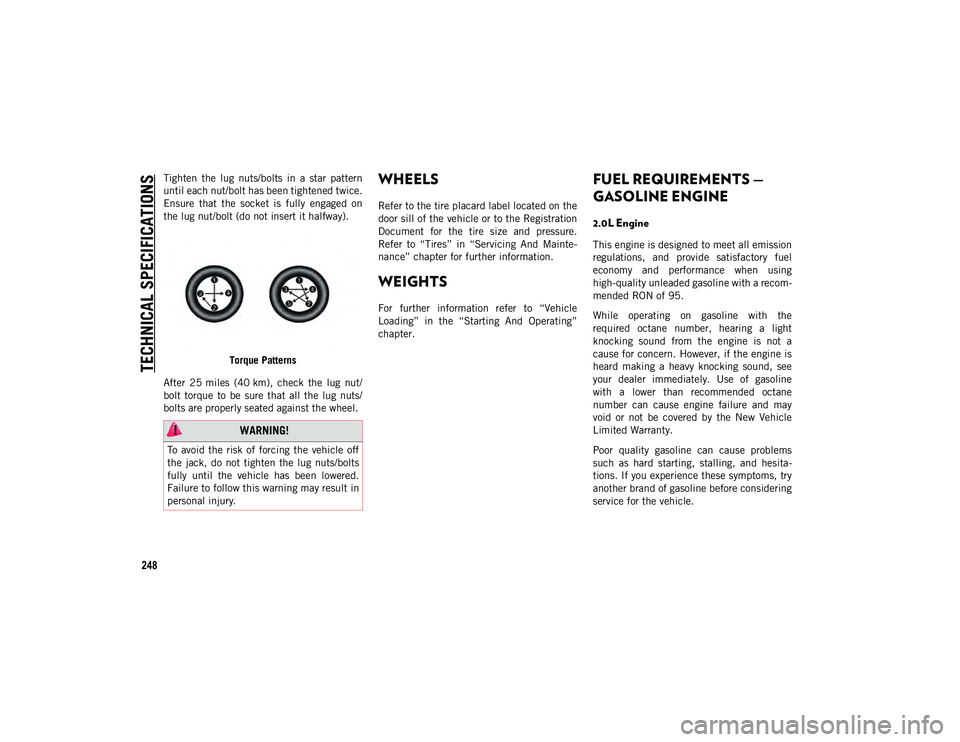
Tighten the lug nuts/bolts in a star pattern
until each nut/bolt has been tightened twice.
Ensure that the socket is fully engaged on
the lug nut/bolt (do not insert it halfway).Torque Patterns
After 25 miles (40 km), check the lug nut/
bolt torque to be sure that all the lug nuts/
bolts are properly seated against the wheel.WHEELS
Refer to the tire placard label located on the
door sill of the vehicle or to the Registration
Document for the tire size and pressure.
Refer to “Tires” in “Servicing And Mainte -
nance” chapter for further information.
WEIGHTS
For further information refer to “Vehicle
Loading” in the “Starting And Operating”
chapter.
FUEL REQUIREMENTS —
GASOLINE ENGINE
2.0L Engine
This engine is designed to meet all emission
regulations, and provide satisfactory fuel
economy and performance when using
high-quality unleaded gasoline with a recom -
mended RON of 95.
While operating on gasoline with the
required octane number, hearing a light
knocking sound from the engine is not a
cause for concern. However, if the engine is
heard making a heavy knocking sound, see
your dealer immediately. Use of gasoline
with a lower than recommended octane
number can cause engine failure and may
void or not be covered by the New Vehicle
Limited Warranty.
Poor quality gasoline can cause problems
such as hard starting, stalling, and hesita -
tions. If you experience these symptoms, try
another brand of gasoline before considering
service for the vehicle.
WARNING!
To avoid the risk of forcing the vehicle off
the jack, do not tighten the lug nuts/bolts
fully until the vehicle has been lowered.
Failure to follow this warning may result in
personal injury.
2020_JEEP_JL_WRANGLER_UG_RHD_UK.book Page 248
Page 321 of 330
319
INDEX
A
Accessories ....................................... 258Mopar ........................................... 258
Active Speed Limiter .......................... 156
Adaptive Cruise Control (ACC)
(Cruise Control) ................................. 158
Adding Fuel ...................................... 169
Additives, Fuel .................................. 249
Air Bag Air Bag Operation ........................... 107Air Bag Warning Light ..................... 105
Disable, Passenger Air Bag.............. 107
Enhanced Accident Response ... 115 , 209
Event Data Recorder (EDR) ............. 209
Front Air Bag ................................. 106
If Deployment Occurs ..................... 114
Knee Impact Bolsters ..................... 112
Maintaining Your Air Bag System ..... 116
Maintenance .................................. 116
Redundant Air Bag Warning Light .... 105
Transporting Pets ........................... 134
Air Bag Light ........................65 , 105 , 136
Air Conditioning................................... 44
Air Conditioning Filter .......................... 46
Air Conditioning System ....................... 44
Air Conditioning, Operating Tips ............ 45 Air Pressure
Tires ............................................. 233
Alarm Arm The System .............................. 15
Disarm The System .......................... 15
Security Alarm ............................15 , 68
Alarm (Security Alarm) ......................... 16
Alterations/Modifications Vehicle ............................................. 2
Android Auto...................... 266 , 271 , 302
Apps ............................................. 274
Communication ............................. 273
Maps ............................................ 272
Music ........................................... 273
Antifreeze (Engine Coolant) ................ 253
Anti-Lock Brake System (ABS) .............. 78
Anti-Lock Warning Light ....................... 68
Apple CarPlay .................... 267 , 274 , 303
Apps ............................................. 276
Maps ............................................ 276
Messages ...................................... 275
Music ........................................... 275
Phone ........................................... 275
Assist, Hill Start .................................. 85
Audio Systems (Radio) ................260 , 262
Auto Down Power Windows ................... 46
Automatic Headlights .......................... 33 Automatic High Beams .........................33
Automatic Temperature Control (ATC) ....44
Automatic Transmission......................145
Fluid Level Check ................... 231 , 232
Fluid Type ............................. 231 , 257
Special Additives ............................231
Auxiliary Electrical Outlet (Power Outlet)... 56
Auxiliary Power Outlet ..........................56
Auxiliary Switches ................................58
Axle Fluid..........................................257
Axle Lock ..........................................151
B
Battery ........................................ 66 , 225
Charging System Light ......................66
Belts, Seat ........................................136
Blind Spot Monitoring ..........................87
Brake Assist System .............................79
Brake Control System ...........................79
Brake Fluid ............................... 230 , 257
Brake System ....................................230 Fluid Check ...................................230
Master Cylinder ..............................230
Warning Light...................................65
Brake/Transmission Interlock...............144
Bulb Replacement ..................... 179 , 181
Bulbs, Light .............................. 137 , 179
2020_JEEP_JL_WRANGLER_UG_RHD_UK.book Page 319
Page 324 of 330
322
INDEX
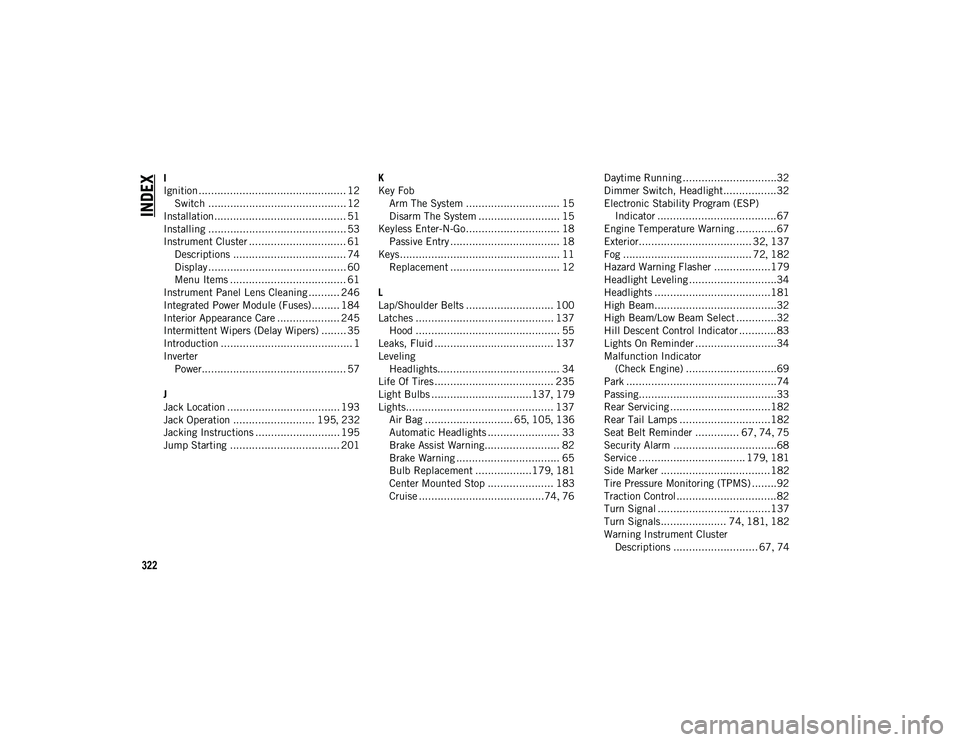
I
Ignition ............................................... 12Switch ............................................ 12
Installation.......................................... 51
Installing ............................................ 53
Instrument Cluster ............................... 61 Descriptions .................................... 74
Display ............................................ 60
Menu Items ..................................... 61
Instrument Panel Lens Cleaning .......... 246
Integrated Power Module (Fuses)......... 184
Interior Appearance Care .................... 245
Intermittent Wipers (Delay Wipers) ........ 35
Introduction .......................................... 1
Inverter Power.............................................. 57
J
Jack Location .................................... 193
Jack Operation .......................... 195 , 232
Jacking Instructions ........................... 195
Jump Starting ................................... 201 K
Key Fob
Arm The System .............................. 15
Disarm The System .......................... 15
Keyless Enter-N-Go.............................. 18 Passive Entry ................................... 18
Keys................................................... 11 Replacement ................................... 12
L
Lap/Shoulder Belts ............................ 100
Latches ............................................ 137 Hood .............................................. 55
Leaks, Fluid ...................................... 137
Leveling Headlights....................................... 34
Life Of Tires...................................... 235
Light Bulbs ................................137 , 179
Lights............................................... 137 Air Bag ............................ 65 , 105 , 136
Automatic Headlights ....................... 33
Brake Assist Warning........................ 82
Brake Warning ................................. 65
Bulb Replacement ..................179 , 181
Center Mounted Stop ..................... 183 Cruise ........................................74 , 76 Daytime Running ..............................32
Dimmer Switch, Headlight.................32
Electronic Stability Program (ESP)
Indicator ......................................67
Engine Temperature Warning .............67 Exterior.................................... 32 , 137
Fog ......................................... 72 , 182
Hazard Warning Flasher ..................179
Headlight Leveling ............................34
Headlights .....................................181
High Beam.......................................32
High Beam/Low Beam Select .............32 Hill Descent Control Indicator ............83Lights On Reminder ..........................34
Malfunction Indicator (Check Engine) .............................69
Park ................................................74
Passing............................................33 Rear Servicing ................................182
Rear Tail Lamps .............................182
Seat Belt Reminder .............. 67 , 74 , 75
Security Alarm .................................68
Service .................................. 179 , 181
Side Marker ...................................182
Tire Pressure Monitoring (TPMS) ........92
Traction Control................................82
Turn Signal ....................................137
Turn Signals..................... 74 , 181 , 182
Warning Instrument Cluster Descriptions ........................... 67 , 74
2020_JEEP_JL_WRANGLER_UG_RHD_UK.book Page 322
Page 325 of 330
323
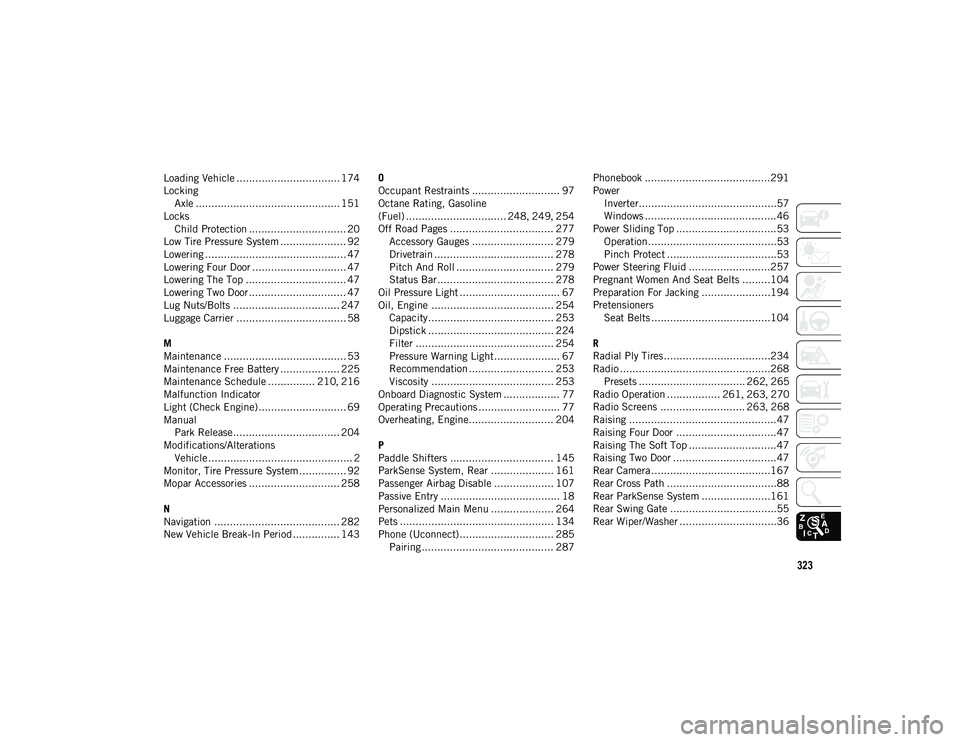
Loading Vehicle ................................. 174
LockingAxle .............................................. 151
Locks Child Protection ............................... 20
Low Tire Pressure System ..................... 92
Lowering ............................................. 47
Lowering Four Door .............................. 47
Lowering The Top ................................ 47
Lowering Two Door ............................... 47
Lug Nuts/Bolts .................................. 247
Luggage Carrier ................................... 58
M
Maintenance ....................................... 53
Maintenance Free Battery ................... 225
Maintenance Schedule ............... 210 , 216
Malfunction Indicator
Light (Check Engine)............................ 69
Manual Park Release.................................. 204
Modifications/Alterations Vehicle .............................................. 2
Monitor, Tire Pressure System ............... 92
Mopar Accessories ............................. 258
N
Navigation ........................................ 282
New Vehicle Break-In Period ............... 143 O
Occupant Restraints ............................ 97
Octane Rating, Gasoline
(Fuel) ................................ 248
, 249 , 254
Off Road Pages ................................. 277 Accessory Gauges .......................... 279
Drivetrain ...................................... 278
Pitch And Roll ............................... 279
Status Bar ..................................... 278
Oil Pressure Light ................................ 67
Oil, Engine ....................................... 254 Capacity........................................ 253
Dipstick ........................................ 224
Filter ............................................ 254
Pressure Warning Light..................... 67Recommendation ........................... 253
Viscosity ....................................... 253
Onboard Diagnostic System .................. 77
Operating Precautions .......................... 77
Overheating, Engine........................... 204
P
Paddle Shifters ................................. 145
ParkSense System, Rear .................... 161
Passenger Airbag Disable ................... 107
Passive Entry ...................................... 18
Personalized Main Menu .................... 264
Pets ................................................. 134
Phone (Uconnect).............................. 285 Pairing .......................................... 287 Phonebook ........................................291
Power
Inverter............................................57Windows ..........................................46
Power Sliding Top ................................53 Operation.........................................53
Pinch Protect ...................................53
Power Steering Fluid ..........................257
Pregnant Women And Seat Belts .........104
Preparation For Jacking ......................194
Pretensioners Seat Belts ......................................104
R
Radial Ply Tires..................................234
Radio ................................................268 Presets .................................. 262 , 265
Radio Operation ................. 261 , 263 , 270
Radio Screens ........................... 263 , 268
Raising ...............................................47
Raising Four Door ................................47
Raising The Soft Top ............................47
Raising Two Door .................................47
Rear Camera......................................167
Rear Cross Path ...................................88
Rear ParkSense System ......................161
Rear Swing Gate ..................................55
Rear Wiper/Washer ...............................36
2020_JEEP_JL_WRANGLER_UG_RHD_UK.book Page 323