transmission JEEP WRANGLER 2DOORS 2021 Owner handbook (in English)
[x] Cancel search | Manufacturer: JEEP, Model Year: 2021, Model line: WRANGLER 2DOORS, Model: JEEP WRANGLER 2DOORS 2021Pages: 330, PDF Size: 9.16 MB
Page 88 of 330
SAFETY
86
Towing With HSA
HSA will also provide assistance to mitigate
roll back while towing a trailer.
Ready Alert Braking (RAB)
Ready Alert Braking (RAB) may reduce the
time required to reach full braking during
emergency braking situations. It anticipates
when an emergency braking situation may
occur by monitoring how fast the throttle is
released by the driver. The Electronic Brake
Control (EBC) system will prepare the brake
system for a panic stop.
Rain Brake Support (RBS)
Rain Brake Support (RBS) may improve
braking performance in wet conditions. It
will periodically apply a small amount of
brake pressure to remove any water buildup
on the front brake rotors. It functions when
the windshield wipers are in LO or HI speed.
When RBS is active, there is no notification
to the driver and no driver interaction is
required.
Trailer Sway Control (TSC)
Trailer Sway Control (TSC) uses sensors in
the vehicle to recognize an excessively
swaying trailer and will take the appropriate
actions to attempt to stop the sway. TSC will
become active automatically once an exces-
sively swaying trailer is recognized.
NOTE:
TSC cannot stop all trailers from swaying.
Always use caution when towing a trailer and
follow the trailer tongue weight recommenda-
tions. Refer to “Trailer Towing” in “Starting
And Operating” for further information.
When TSC is functioning, the “ESC Activa -
tion/Malfunction Indicator Light” will flash,
the engine power may be reduced and you
may feel the brakes being applied to indi -
vidual wheels to attempt to stop the trailer
from swaying. TSC is disabled when the ESC
system is in the “Partial Off” or “Full Off”
modes.
WARNING!
If you use a trailer brake controller with
your trailer, the trailer brakes may be
activated and deactivated with the brake
switch. If so, there may not be enough
brake pressure to hold both the vehicle
and the trailer on a hill when the brake
pedal is released. In order to avoid
rolling down an incline while resuming
acceleration, manually activate the
trailer brake or apply more vehicle brake
pressure prior to releasing the brake
pedal.
HSA is not a parking brake. Always apply
the parking brake fully when exiting your
vehicle. Also, be certain to place the
transmission in PARK (P).
Failure to follow these warnings can
result in a collision or serious personal
injury. WARNING!
If TSC activates while driving, slow the
vehicle down, stop at the nearest safe
location, and adjust the trailer load to
eliminate trailer sway.
2020_JEEP_JL_WRANGLER_UG_RHD_UK.book Page 86
Page 117 of 330
115
As the air bags deflate, you may see some
smoke-like particles. The particles are a
normal by-product of the process that
generates the non-toxic gas used for air
bag inflation. These airborne particles may
irritate the skin, eyes, nose, or throat. If
you have skin or eye irritation, rinse the
area with cool water. For nose or throat irri-
tation, move to fresh air. If the irritation
continues, see your doctor. If these parti -
cles settle on your clothing, follow the
garment manufacturer’s instructions for
cleaning.
Do not drive your vehicle after the air bags
have deployed. If you are involved in another
collision, the air bags will not be in place to
protect you. NOTE:
Air bag covers may not be obvious in the
interior trim, but they will open during air
bag deployment.
After any collision, the vehicle should be
taken to an authorized dealer immediately.
Enhanced Accident Response System
In the event of an impact, if the communica
-
tion network remains intact, and the power
remains intact, depending on the nature of
the event, the Occupant Restraint Controller
(ORC) will determine whether to have the
Enhanced Accident Response System
perform the following functions:
Cut off fuel to the engine (If Equipped)
Cut off battery power to the electric motor
(If Equipped)
Flash hazard lights as long as the battery
has power
Turn on the interior lights, which remain
on as long as the battery has power or for
15 minutes from the intervention of the
Enhanced Accident Response System.
Unlock the power door locks. Your vehicle may also be designed to perform
any of these other functions in response to
the Enhanced Accident Response System:
Turn off the Fuel Filter Heater, Turn off
the HVAC Blower Motor, Close the HVAC
Circulation Door
Cut off battery power to the:
Engine
Electric Motor (if equipped)
Electric power steering
Brake booster
Electric park brake
Automatic transmission gear selector
Horn
Front wiper
Headlamp washer pump
WARNING!
Deployed air bags and seat belt
pretensioners cannot protect you in
another collision. Have the air bags, seat
belt pretensioners, and the seat belt
retractor assemblies replaced by an
authorized dealer immediately. Also, have
the Occupant Restraint Controller System
serviced as well.
2020_JEEP_JL_WRANGLER_UG_RHD_UK.book Page 115
Page 140 of 330
138
STARTING AND OPERATING
STARTING THE ENGINE
Before starting your vehicle, adjust your seat,
adjust both inside and outside mirrors, and
fasten your seat belts.
Normal Starting — Gasoline Engine
To Turn On The Engine Using The ENGINE
START/STOP Button
1. The transmission must be in PARK (P) orNEUTRAL (N).
2. Press and hold the brake pedal while pushing the ENGINE START/STOP
button once.
3. The system takes over and attempts to start the vehicle. If the vehicle fails to
start, the starter will disengage automat -
ically after 10 seconds.
4. If you wish to stop the cranking of the engine prior to the engine starting, push
the ENGINE START/STOP button again.
NOTE:
Normal starting of either a cold or a warm
engine is obtained without pumping or
pressing the accelerator pedal.
To Turn Off The Engine Using ENGINE START/
STOP Button
1. Place the gear selector in PARK, then push and release the ENGINE START/
STOP button. 2. The ignition will return to the OFF mode.
3. If the gear selector is not in PARK (with
vehicle stopped) and the ENGINE
START/STOP button is pushed once, the
transmission will automatically select
PARK and the engine will turn off,
however the ignition will remain in the
ACC mode (NOT the OFF mode). Never
leave a vehicle out of the PARK position,
or it could roll.
4. If the gear selector is in NEUTRAL, and the vehicle speed is below 5 mph (8 km/h),
pushing the ENGINE START/STOP button
once will turn the engine off. The ignition
will remain in the ACC mode.
5. If the vehicle speed is above 5 mph (8 km/h), the ENGINE START/STOP
button must be held for two seconds (or
three short pushes in a row) to turn the
engine off. The ignition will remain in the
ACC mode (NOT the OFF mode) if the
engine is turned off when the transmis -
sion is not in PARK.
WARNING!
When exiting the vehicle, always remove
the key fob from the ignition and lock
your vehicle.
Never leave children alone in a vehicle,
or with access to an unlocked vehicle.
Allowing children to be in a vehicle unat -
tended is dangerous for a number of
reasons. A child or others could be seri -
ously or fatally injured. Children should
be warned not to touch the parking
brake, brake pedal or the gear selector.
Do not leave the key fob in or near the
vehicle, or in a location accessible to
children. A child could operate power
windows, other controls, or move the
vehicle.
Do not leave children or animals inside
parked vehicles in hot weather. Interior
heat build-up may cause serious injury or
death.
2020_JEEP_JL_WRANGLER_UG_RHD_UK.book Page 138
Page 141 of 330
139
NOTE:
The system will automatically time out and
the ignition will cycle to the OFF mode after
30 minutes of inactivity if the ignition is left
in the ACC or RUN (engine not running)
mode and the transmission is in PARK.
ENGINE START/STOP Button Functions — With
Driver’s Foot OFF The Brake Pedal (In PARK Or
NEUTRAL Position)
The ENGINE START/STOP button operates
similar to an ignition switch. It has three
modes: OFF, ACC, and RUN. To change the
ignition modes without starting the vehicle
and use the accessories, follow these steps:
1. Starting with the ignition in the OFF mode,
2. Push the ENGINE START/STOP button onceto place the ignition to the ACC mode (instru -
ment cluster will display “ACC”),
3. Push the ENGINE START/STOP button a second time to place the ignition to the
RUN mode (instrument cluster will
display “ON/RUN”),
4. Push the ENGINE START/STOP button a third time to return the ignition to the
OFF mode (instrument cluster will
display “OFF”).AutoPark
AutoPark is a supplemental feature to assist
in placing the vehicle in PARK should the
situations on the following pages occur. It is
a back up system and should not be relied
upon as the primary method by which the
driver shifts the vehicle into PARK.
The conditions under which AutoPark will
engage are outlined on the following pages. If the vehicle is not in PARK and the driver turns
off the engine, the vehicle may AutoPark.
AutoPark will engage when all of these
conditions are met:
Vehicle is equipped with an 8-speed trans-
mission
Driver’s door is ajar or in conditions where
driver door is removed an additional
trigger would be if the driver is off the seat
(seat pad sensor detects driver missing).
Vehicle is not in PARK
Vehicle speed is 0 mph (0 km/h)
Ignition switched from RUN to OFF
NOTE:
For Keyless Enter-N-Go equipped vehicles,
The engine will turn off and the ignition
switch will change to ACC mode. After
30 minutes the ignition switches to OFF
automatically, unless the driver turns the
ignition switch OFF.
WARNING!
Driver inattention could lead to failure to
place the vehicle in PARK. ALWAYS DO
A VISUAL CHECK that your vehicle is in
PARK by verifying that a solid (not
blinking) “P” is indicated in the instru -
ment cluster display and on the gear
selector. If the "P" indicator is blinking,
your vehicle is not in PARK. As an added
precaution, always apply the parking
brake when exiting the vehicle.
AutoPark is a supplemental feature. It is
not designed to replace the need to shift
your vehicle into PARK. It is a back up
system and should not be relied upon as
the primary method by which the driver
shifts the vehicle into PARK.
2020_JEEP_JL_WRANGLER_UG_RHD_UK.book Page 139
Page 142 of 330
STARTING AND OPERATING
140
If the vehicle is not in PARK and the driver exits
the vehicle with the engine running, the vehicle
may AutoPark.
AutoPark will engage when all of these
conditions are met:
Vehicle is equipped with an 8-speed trans-
mission
Driver’s door is ajar or in conditions where
driver door is removed an additional
trigger would be if the driver is off the seat
(seat pad sensor detects driver missing).
Vehicle is not in PARK
Driver’s door is removed
Vehicle speed is 1.2 mph (2.0 km/h) orless
Driver’s seat belt is unbuckled
Driver’s door is ajar
Brake pedal is not depressed
The MESSAGE “AutoPark Engaged Shift to P
then Shift to Gear ” will display in the instru -
ment cluster. NOTE:
In some cases the ParkSense graphic will be
displayed in the instrument cluster. In these
cases, the shifter must be returned to “P” to
select desired gear.
If the driver shifts into PARK while moving, the
vehicle may AutoPark.
AutoPark will engage
ONLY when vehicle
speed is 1.2 mph (2.0 km/h) or less.
The MESSAGE “Vehicle Speed is Too High to
Shift to P ” will be displayed in the instrument
cluster if vehicle speed is above 1.2 mph
(2.0 km/h). 4WD LOW
AutoPark will be disabled when operating the
vehicle in 4WD LOW.
The MESSAGE “
AutoPark Disabled ” will be
displayed in the instrument cluster.
Additional customer warnings will be given
when both of these conditions are met:
Vehicle is not in PARK
Driver’s door is ajar
The MESSAGE “ AutoPark Not Engaged ” will
be displayed in the instrument cluster. A
warning chime will continue until you shift
the vehicle into PARK or the driver’s door is
closed.
ALWAYS DO A VISUAL CHECK
that your vehicle
is in PARK by looking for the "P" in the
instrument cluster display and on the shifter.
As an added precaution, always apply the
parking brake when exiting the vehicle.
WARNING!
If vehicle speed is above 1.2 mph
(2.0 km/h), the transmission will default
to NEUTRAL until the vehicle speed drops
below 1.2 mph (1.9 km/h). A vehicle left
in the NEUTRAL position can roll. As an
added precaution, always apply the
parking brake when exiting the vehicle.
2020_JEEP_JL_WRANGLER_UG_RHD_UK.book Page 140
Page 145 of 330
143
(Continued)
ENGINE BREAK-IN
RECOMMENDATIONS
A long break-in period is not required for the
engine and drivetrain (transmission and axle)
in your vehicle.
Drive moderately during the first 300 miles
(500 km). After the initial 60 miles
(100 km), speeds up to 50 or 55 mph (80 or
90 km/h) are desirable.
While cruising, brief full-throttle accelera-
tion within the limits of local traffic laws
contributes to a good break-in. Wide-open
throttle acceleration in low gear can be detri -
mental and should be avoided.
The engine oil installed in the engine at the
factory is a high-quality energy conserving
type lubricant. Oil changes should be consis -
tent with anticipated climate conditions
under which vehicle operations will occur.
For the recommended viscosity and quality
grades, refer to “Fluids And Lubricants” in
“Technical Specifications”. NOTE:
A new engine may consume some oil during
its first few thousand miles (kilometers) of
operation. This should be considered a
normal part of the break-in and not inter
-
preted as a problem.
AUTOMATIC
TRANSMISSION
NOTE:
You must press and hold the brake pedal
while shifting out of PARK. CAUTION!
Never use Non-Detergent Oil or Straight
Mineral Oil in the engine or damage may
result.
CAUTION!
Shift into or out of PARK or REVERSE
only after the vehicle has come to a
complete stop.
Do not shift between PARK, REVERSE,
NEUTRAL, or DRIVE when the engine is
above idle speed.
Before shifting into any gear, make sure
your foot is firmly pressing the brake
pedal.
WARNING!
Never use the PARK position as a substi -
tute for the parking brake. Always apply
the parking brake fully when exiting the
vehicle to guard against vehicle move-
ment and possible injury or damage.
Your vehicle could move and injure you
and others if it is not in PARK. Check by
trying to move the transmission gear
selector out of PARK with the brake
pedal released. Make sure the transmis-
sion is in PARK before exiting the
vehicle.
The transmission may not engage PARK
if the vehicle is moving. Always bring the
vehicle to a complete stop before
shifting to PARK, and verify that the
transmission gear position indicator
solidly indicates PARK (P) without
blinking. Ensure that the vehicle is
completely stopped, and the PARK posi -
tion is properly indicated, before exiting
the vehicle.
2020_JEEP_JL_WRANGLER_UG_RHD_UK.book Page 143
Page 146 of 330
STARTING AND OPERATING
144
(Continued)
Ignition Park Interlock
This vehicle is equipped with an Ignition
Park Interlock which requires the transmis-
sion to be in PARK before the ignition can be
turned to the OFF mode. This helps the
driver avoid inadvertently leaving the vehicle
without placing the transmission in PARK.
This system also locks the transmission in
PARK whenever the ignition is in the OFF
mode. NOTE:
The transmission is NOT locked in PARK
when the ignition is in the ACC mode (even
though the engine will be off). Ensure that
the transmission is in PARK, and the ignition
is
OFF (not in ACC mode) before exiting the
vehicle.
Brake/Transmission Shift Interlock
System
This vehicle is equipped with a Brake Trans -
mission Shift Interlock system (BTSI) that
holds the transmission gear selector in PARK
unless the brakes are applied. To shift the
transmission out of PARK, the engine must
be running and the brake pedal must be
pressed. The brake pedal must also be
pressed to shift from NEUTRAL into DRIVE
or REVERSE when the vehicle is stopped or
moving at low speeds.
It is dangerous to shift out of PARK or
NEUTRAL if the engine speed is higher
than idle speed. If your foot is not firmly
pressing the brake pedal, the vehicle
could accelerate quickly forward or in
reverse. You could lose control of the
vehicle and hit someone or something.
Only shift into gear when the engine is
idling normally and your foot is firmly
pressing the brake pedal.
Unintended movement of a vehicle could
injure those in or near the vehicle. As
with all vehicles, you should never exit a
vehicle while the engine is running.
Before exiting a vehicle, always come to
a complete stop, then apply the parking
brake, shift the transmission into PARK,
and turn the ignition OFF. When the igni -
tion is in the OFF mode, the transmis-
sion is locked in PARK, securing the
vehicle against unwanted movement.
When exiting the vehicle, always make
sure the ignition is in the OFF mode,
remove the key fob from the vehicle, and
lock the vehicle.
WARNING! (Continued)
Never leave children alone in a vehicle,
or with access to an unlocked vehicle.
Allowing children to be in a vehicle unat -
tended is dangerous for a number of
reasons. A child or others could be seri -
ously or fatally injured. Children should
be warned not to touch the parking
brake, brake pedal or the transmission
gear selector.
Do not leave the key fob in or near the
vehicle (or in a location accessible to
children), and do not leave the ignition
in the ACC or ON/RUN mode. A child
could operate power windows, other
controls, or move the vehicle.
WARNING! (Continued)
2020_JEEP_JL_WRANGLER_UG_RHD_UK.book Page 144
Page 147 of 330
145
Eight–Speed Automatic Transmission
Your vehicle is equipped with a fuel efficient
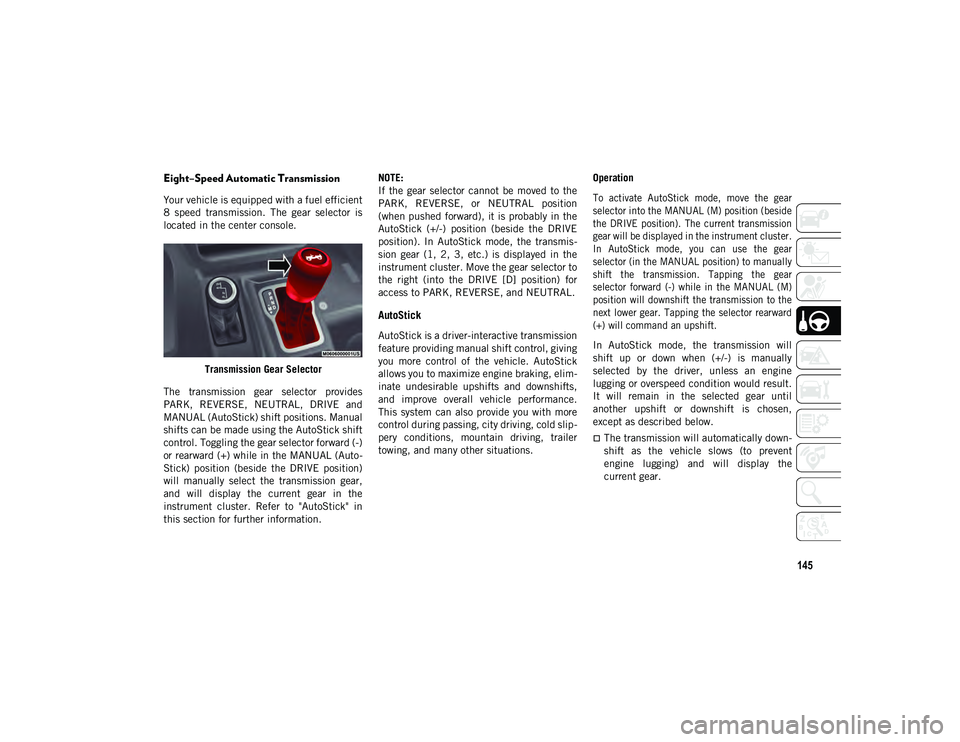
8 speed transmission. The gear selector is
located in the center console.Transmission Gear Selector
The transmission gear selector provides
PARK, REVERSE, NEUTRAL, DRIVE and
MANUAL (AutoStick) shift positions. Manual
shifts can be made using the AutoStick shift
control. Toggling the gear selector forward (-)
or rearward (+) while in the MANUAL (Auto -
Stick) position (beside the DRIVE position)
will manually select the transmission gear,
and will display the current gear in the
instrument cluster. Refer to "AutoStick" in
this section for further information. NOTE:
If the gear selector cannot be moved to the
PARK, REVERSE, or NEUTRAL position
(when pushed forward), it is probably in the
AutoStick (+/-) position (beside the DRIVE
position). In AutoStick mode, the transmis
-
sion gear (1, 2, 3, etc.) is displayed in the
instrument cluster. Move the gear selector to
the right (into the DRIVE [D] position) for
access to PARK, REVERSE, and NEUTRAL.
AutoStick
AutoStick is a driver-interactive transmission
feature providing manual shift control, giving
you more control of the vehicle. AutoStick
allows you to maximize engine braking, elim -
inate undesirable upshifts and downshifts,
and improve overall vehicle performance.
This system can also provide you with more
control during passing, city driving, cold slip -
pery conditions, mountain driving, trailer
towing, and many other situations. Operation
To activate AutoStick mode, move the gear
selector into the MANUAL (M) position (beside
the DRIVE position). The current transmission
gear will be displayed in the instrument cluster.
In AutoStick mode, you can use the gear
selector (in the MANUAL position) to manually
shift the transmission. Tapping the gear
selector forward (-) while in the MANUAL (M)
position will downshift the transmission to the
next lower gear. Tapping the selector rearward
(+) will command an upshift.
In AutoStick mode, the transmission will
shift up or down when (+/-) is manually
selected by the driver, unless an engine
lugging or overspeed condition would result.
It will remain in the selected gear until
another upshift or downshift is chosen,
except as described below.
The transmission will automatically down
-
shift as the vehicle slows (to prevent
engine lugging) and will display the
current gear.
2020_JEEP_JL_WRANGLER_UG_RHD_UK.book Page 145
Page 148 of 330
STARTING AND OPERATING
146
The transmission will automatically down-
shift to FIRST gear when coming to a stop.
After a stop, the driver should manually
upshift (+) the transmission as the vehicle
is accelerated.
You can start out, from a stop, in FIRST or
SECOND gear (or THIRD gear, in 4L
range). Tapping (+) (at a stop) will allow
starting in SECOND gear. Starting out in
SECOND or THIRD gear can be helpful in
snowy or icy conditions.
If a requested downshift would cause the
engine to over-speed, that shift will not
occur.
The system will ignore attempts to upshift
at too low of a vehicle speed.
Holding the gear selector in the (-) posi -
tion will downshift the transmission to the
lowest gear possible at the current speed.
Transmission shifting will be more notice-
able when AutoStick is enabled.
The system may revert to automatic shift
mode if a fault or overheat condition is
detected. NOTE:
When Hill Descent Control is enabled, Auto
-
Stick is not active.
To disengage AutoStick mode, return the
gear selector to the DRIVE position. You can
shift in or out of the AutoStick position at any
time without taking your foot off the acceler -
ator pedal.
FOUR–WHEEL DRIVE
OPERATION
Four-Position Transfer Case
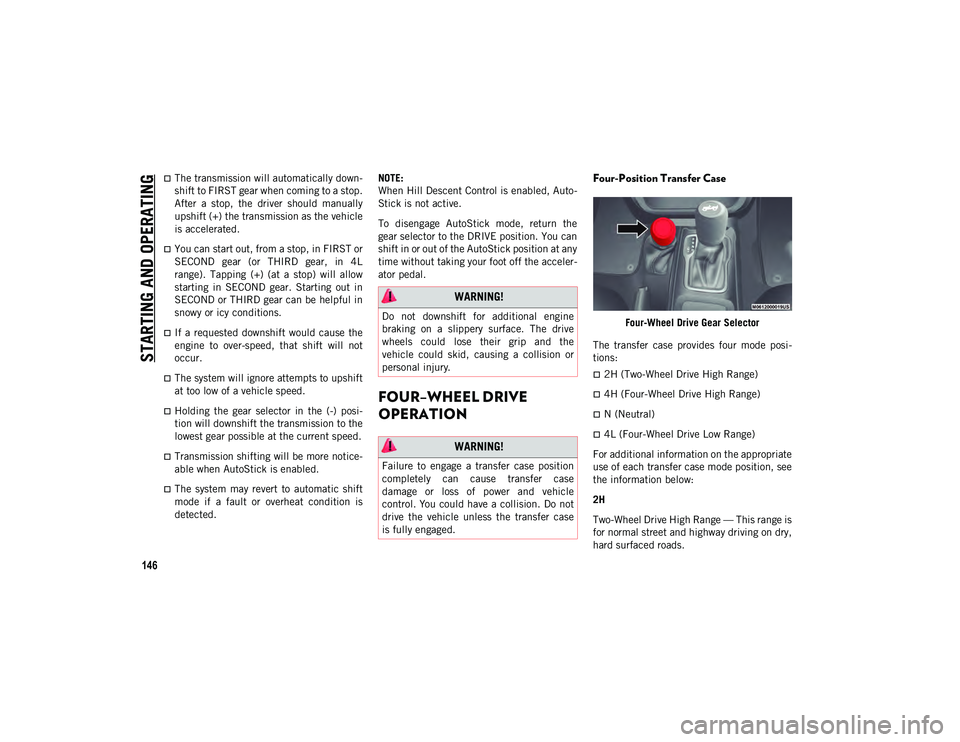
Four-Wheel Drive Gear Selector
The transfer case provides four mode posi -
tions:
2H (Two-Wheel Drive High Range)
4H (Four-Wheel Drive High Range)
N (Neutral)
4L (Four-Wheel Drive Low Range)
For additional information on the appropriate
use of each transfer case mode position, see
the information below:
2H
Two-Wheel Drive High Range — This range is
for normal street and highway driving on dry,
hard surfaced roads.
WARNING!
Do not downshift for additional engine
braking on a slippery surface. The drive
wheels could lose their grip and the
vehicle could skid, causing a collision or
personal injury.
WARNING!
Failure to engage a transfer case position
completely can cause transfer case
damage or loss of power and vehicle
control. You could have a collision. Do not
drive the vehicle unless the transfer case
is fully engaged.
2020_JEEP_JL_WRANGLER_UG_RHD_UK.book Page 146
Page 149 of 330
147
4H
Four-Wheel Drive High Range — This range
maximizes torque to the front driveshaft,
forcing the front and rear wheels to rotate at
the same speed. This range provides addi-
tional traction for loose, slippery road
surfaces only.
NEUTRAL (N)
Neutral — This range disengages both the
front and rear driveshafts from the power -
train. To be used for flat towing behind
another vehicle.
Refer to “Recreational Towing” in this
chapter for further information. 4L
Four-Wheel Drive Low Range — This range
provides low speed four-wheel drive. It maxi
-
mizes torque to the front driveshaft, forcing
the front and rear wheels to rotate at the
same speed. This range provides additional
traction and maximum pulling power for
loose, slippery road surfaces only. Do not
exceed 25 mph (40 km/h).
The transfer case is intended to be driven in
the 2H position for normal street and
highway conditions, such as hard-surfaced
roads.
In the event that additional traction is
required, the transfer case 4H and 4L posi -
tions can be used to lock the front and rear
driveshafts together, forcing the front and
rear wheels to rotate at the same speed. The
4H and 4L positions are intended for loose,
slippery road surfaces only and not intended
for normal driving. Driving in the 4H and 4L
positions on hard-surfaced roads will cause
increased tire wear and damage to the drive -
line components. Refer to “Shifting Proce -
dures” in this section for further information
on shifting into 4H or 4L. The instrument cluster alerts the driver that
the vehicle is in four-wheel drive, and the
front and rear driveshafts are locked
together. The light will illuminate when the
transfer case is shifted into the 4H position.
When operating your vehicle in 4L, the
engine speed will be approximately three
times (four times for Rubicon models) that of
the 2H or 4H positions at a given road speed.
Take care not to overspeed the engine.
Proper operation of four-wheel drive vehicles
depends on tires of equal size, type, and
circumference on each wheel. Any difference
will adversely affect shifting and cause
damage to the transfer case.
Because four-wheel drive provides improved
traction, there is a tendency to exceed safe
turning and stopping speeds. Do not go
faster than road conditions permit.
Shifting Procedures
2H To 4H Or 4H To 2H
Shifting between 2H and 4H can be made
with the vehicle stopped or in motion. The
preferred shifting speed would be 0 to
45 mph (72 km/h). With the vehicle in
motion, the transfer case will engage/disen
-
WARNING!
You or others could be injured or killed if
you leave the vehicle unattended with the
transfer case in the NEUTRAL (N) position
without first fully engaging the parking
brake. The transfer case NEUTRAL (N)
position disengages both the front and rear
driveshafts from the powertrain, and will
allow the vehicle to roll, even if the
automatic transmission is in PARK. The
parking brake should always be applied
when the driver is not in the vehicle.
2020_JEEP_JL_WRANGLER_UG_RHD_UK.book Page 147