lock JEEP WRANGLER UNLIMITED 2008 User Guide
[x] Cancel search | Manufacturer: JEEP, Model Year: 2008, Model line: WRANGLER UNLIMITED, Model: JEEP WRANGLER UNLIMITED 2008Pages: 466, PDF Size: 8.61 MB
Page 39 of 466
Wind Buffeting
Wind buffeting can be described as the perception of
pressure on the ears or a helicopter type sound in the
ears. Your vehicle may exhibit wind buffeting with the
windows down in certain open or partially open posi-
tions. This is a normal occurrence and can be minimized
by adjusting window opening.
REAR SWING GATE
The vacuum fluorescent (VF) display located in the
odometer area displays the word “gATE” as an indica-
tion of when the swing gate is not completely closed.
When the vehicle is not moving, and the swing gate is not
completely closed, the VF display will show the word
“gATE.”If any other active warnings are present, they will be
shown in the VF display and will also continue to cycle.
If the vehicle is moving, three single chimes will occur if
the rear swing gate is open (one chime for each complete
display cycle). After this, the VF display will continue to
sequence only (no chimes).
If the trip/reset button is pressed while the VF warnings
are being displayed, the VF display will revert back to
only displaying the odometer/trip odometer mileage.
The swing gate can be unlocked by using the key, remote
keyless entry (RKE) key fob, or by activating the power
door lock switches located on the front doors.
To open the swing gate, press the button on the gate
handle.
38 THINGS TO KNOW BEFORE STARTING YOUR VEHICLE
Page 49 of 466
WARNING!
Position the shoulder belt height adjusters so that the
belt rests across the middle of your shoulder. Failure
to adjust the safety belt properly could reduce the
effectiveness of the seat belt and increase the risk of
injury in a collision.
As a guide, if you are shorter than average, you will
prefer a lower position, and if you are taller than average,
you’ll prefer a higher position. When you release the
anchorage, try to move it up or down to make sure that
it is locked in position.
Seat Belt Pretensioners
The driver and front passenger seat belts are equipped
with a pretensioning device that is designed to remove
any slack from the seat belt systems in the event of a
collision. This device improves the performance of the
seat belt by assuring that the belt is tight around the
occupant early in a collision. Pretensioners work for all
size occupants, including those in child restraints.
NOTE: These devices are not a substitute for proper seat
belt placement by the occupant. The seat belt must still be
worn snugly and positioned properly.
The pretensioners are triggered by the Occupant Re-
straint Control (ORC) Module. Like the front airbags, the
pretensioners are a single use item. After a collision that
is severe enough to deploy the airbags and pretensioners,
they must be replaced.
48 THINGS TO KNOW BEFORE STARTING YOUR VEHICLE
Page 65 of 466
WARNING!
•Improper installation can lead to failure of an
infant or child restraint. It could come loose in a
collision. The child could be badly injured or
killed. Follow the manufacturer’s directions ex-
actly when installing an infant or child restraint.
•A rearward facing infant restraint should only be
used in a rear seat. A rearward facing infant
restraint in the front seat may be struck by a
deploying passenger airbag which may cause se-
vere or fatal injury to the infant.
Here are some tips for getting the most out of your child
restraint:
•Before buying any restraint system, make sure that it
has a label certifying that it meets all applicable Safety Standards. The manufacturer also recommends that
you try a child restraint in the vehicle seats where you
will use it before you buy it.
•The restraint must be appropriate for your child’s
weight and height. Check the label on the restraint for
weight and height limits.
•Carefully follow the instructions that come with the
restraint. If you install the restraint improperly, it may
not work when you need it.
•All seating positions (except for driver) have a auto-
matic locking retractor identified by a distinctive label.
The seat belts are designed to keep the lap portion
tight around the child restraint so that it is not
necessary to use a locking clip. For the seat belt with
the automatic locking retractor, pull the belt from the
retractor until there is enough to allow you to pass
through the child restraint and slide the latch plate
into the buckle. Then, pull the belt until it is fully
64 THINGS TO KNOW BEFORE STARTING YOUR VEHICLE
Page 67 of 466
vehicle by the lap/shoulder belt or the LATCH child
restraint anchorage system (Refer to LATCH — Child
Seat Anchorage System in this section).
The belt-positioning booster seat is for children weighing
more than 40 lbs (18 kg), but who are still too small to fit
the vehicle’s seat belts properly. If the child cannot sit
with knees bent over the vehicle’s seat cushion while the
child’s back is against the seatback, they should use a
belt-positioning booster seat. The child and belt-
positioning booster seat are held in the vehicle by the
lap/shoulder belt.
Children Too Large for Booster Seats
Children who are large enough to wear the shoulder belt
comfortably, and whose legs are long enough to bend
over the front of the seat when their back is against the
seatback, should use the lap/shoulder belt in a rear seat.
•Make sure that the child is upright in the seat.
•The lap portion should be low on the hips and as snug
as possible.
•Check belt fit periodically. A child’s squirming or
slouching can move the belt out of position.
•If the shoulder belt contacts the face or neck, move the
child closer to the center of the vehicle. Never allow a
child to put the shoulder belt under an arm or behind
the back.
Automatic-Locking Retractor (ALR)
To operate the switchable retractor, pull the belt from the
retractor until there is enough to allow you to pass
through the child restraint and slide the latch plate into
the buckle. Then pull on the belt until it is fully extended
from the retractor. Allow the belt to return into the
retractor, pulling on the excess webbing to tighten the lap
portion about the child restraint. Follow the instructions
of the child restraint manufacture.
66 THINGS TO KNOW BEFORE STARTING YOUR VEHICLE
Page 89 of 466
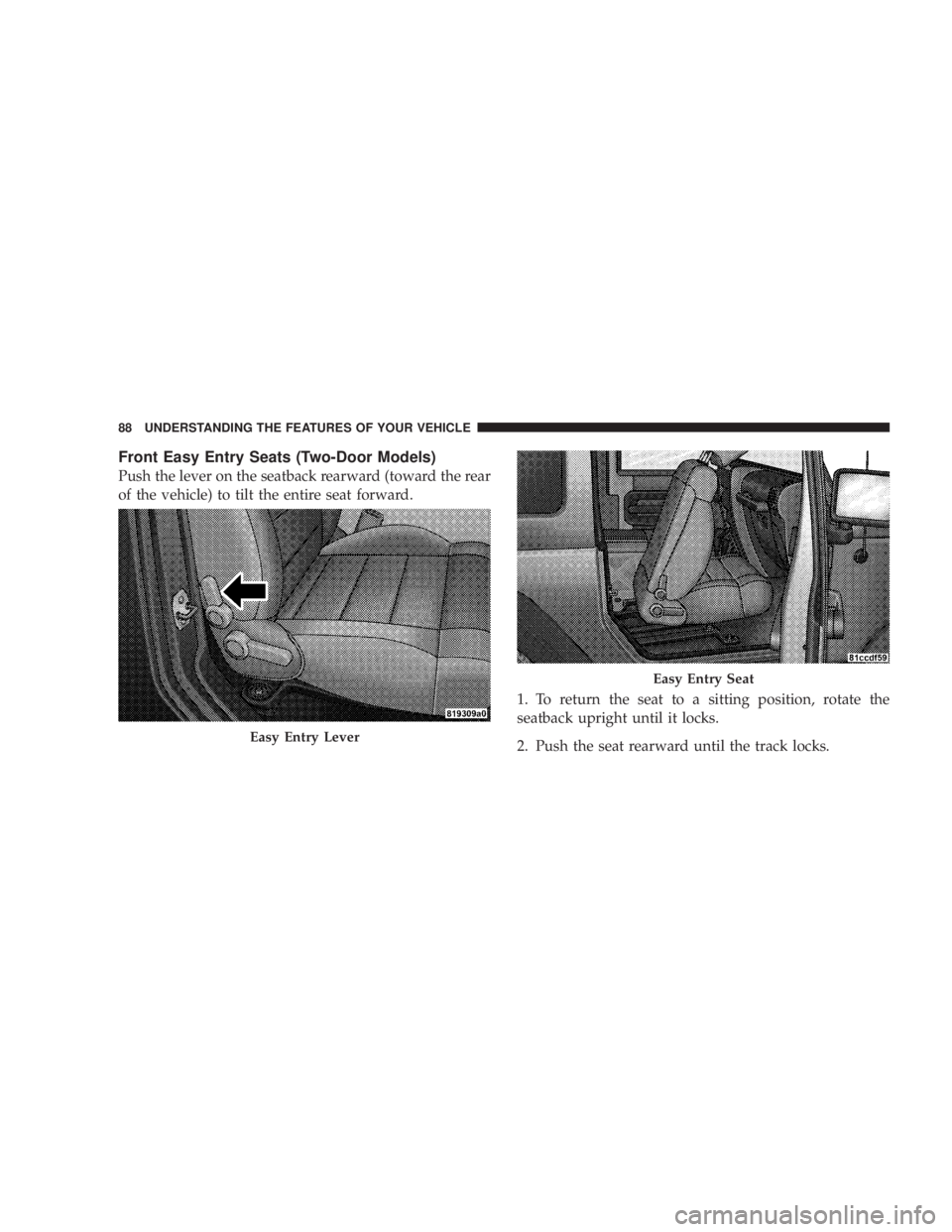
Front Easy Entry Seats (Two-Door Models)
Push the lever on the seatback rearward (toward the rear
of the vehicle) to tilt the entire seat forward.1. To return the seat to a sitting position, rotate the
seatback upright until it locks.
2. Push the seat rearward until the track locks.
Page 91 of 466

Also, be sure that the front seats are fully upright and
positioned forward. This will allow the rear seat to fold
down easily.
1. Lift the seatback release lever and fold seatback for-
ward.
2. Slowly flip the entire seat forward.3. When completed, return the seat to its normal posi-
tion.
4. Raise the rear seatback using the assist strap and
firmly lock seat into position.
Page 95 of 466

To Raise the Rear Seat
1. Raise the seatback and lock it into place. If interference
from the cargo area prevents the seatback from fully
locking, you will have difficulty returning the seat to its
proper position.
NOTE:If the rear seatback is not fully latched, the
center shoulder belt will not be able to be extended for
use. If you cannot extend the center shoulder belt, please
make sure your seatback is fully latched.
Page 103 of 466
WARNING!
Tilting the steering column while the vehicle is
moving is dangerous. Without a stable steering col-
umn, you could lose control of the vehicle and have
an accident. Adjust the column only while the ve-
hicle is stopped. Be sure it is locked before driving.
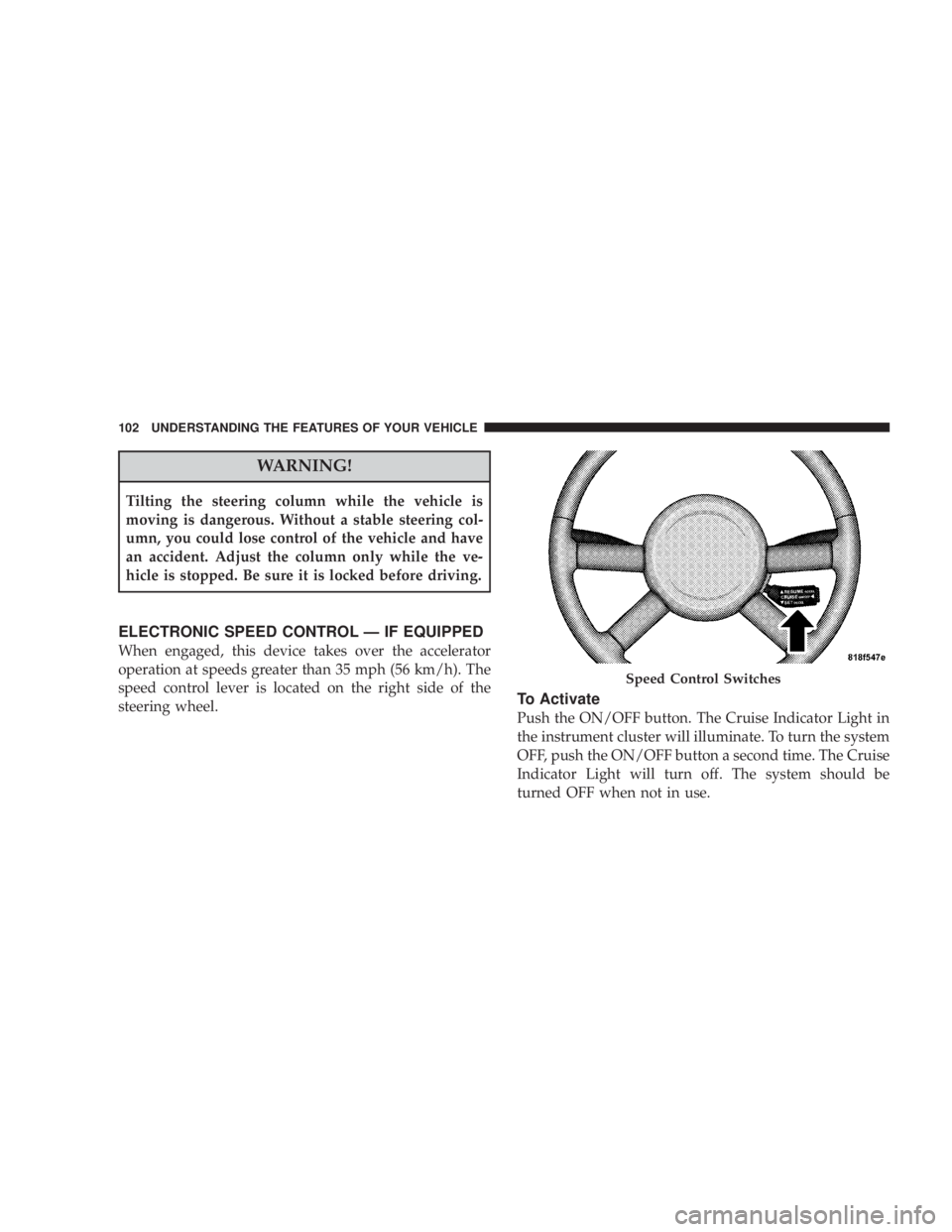
ELECTRONIC SPEED CONTROL — IF EQUIPPED
When engaged, this device takes over the accelerator
operation at speeds greater than 35 mph (56 km/h). The
speed control lever is located on the right side of the
steering wheel.
To Activate
Push the ON/OFF button. The Cruise Indicator Light in
the instrument cluster will illuminate. To turn the system
OFF, push the ON/OFF button a second time. The Cruise
Indicator Light will turn off. The system should be
turned OFF when not in use.
Page 107 of 466
WARNING!
ABS (Anti-Lock Brake System) cannot prevent the
natural laws of physics from acting on the vehicle,
nor can it increase the traction afforded by prevailing
road conditions. ABS cannot prevent accidents, in-
cluding those resulting from excessive speed in
turns, driving on very slippery surfaces, or hydro-
planing. Only a safe, attentive, and skillful driver can
prevent accidents. The capabilities of an ABS-
equipped vehicle must never be exploited in a reck-
less or dangerous manner which could jeopardize the
user’s safety or the safety of others.
TCS (Traction Control System)
This system monitors the amount of wheel spin of each of
the driven wheels. If wheel spin is detected, brake
pressure is applied to the slipping wheel(s) to provide
enhanced acceleration and stability. A feature of the TCS
system functions similar to a limited slip differential and
controls the wheel spin across a driven axle. If one wheel
on a driven axle is spinning faster than the other, the
system will apply the brake of the spinning wheel. This
will allow more engine torque to be applied to the wheel
that is not spinning. This feature remains active even if
TCS and ESP are in either the “Partial Off” or “Full Off”
modes. Refer to “ESP (Electronic Stability Program)” in
this section.
106 UNDERSTANDING THE FEATURES OF YOUR VEHICLE
Page 119 of 466
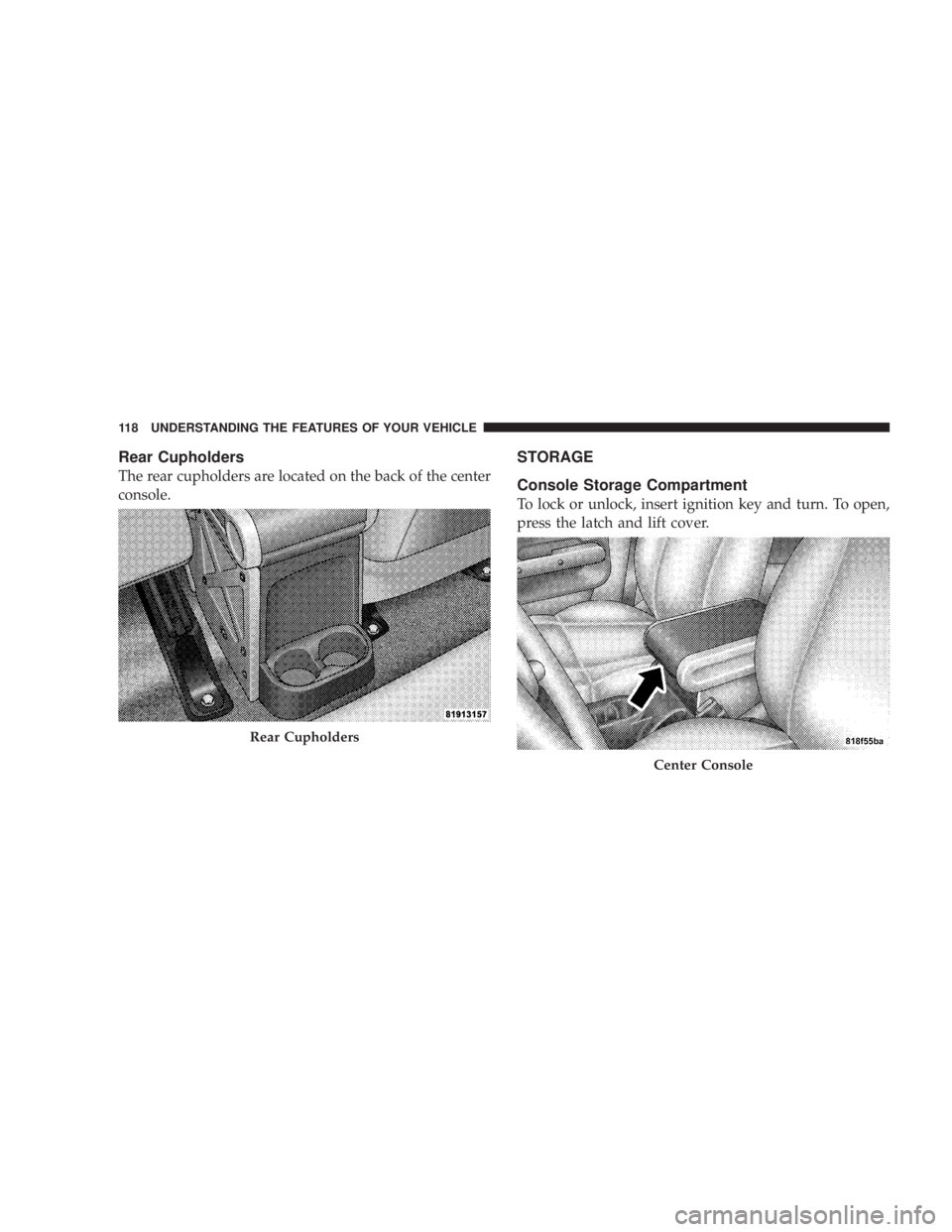
Rear Cupholders
The rear cupholders are located on the back of the center
console.
STORAGE
Console Storage Compartment
To lock or unlock, insert ignition key and turn. To open,
press the latch and lift cover.