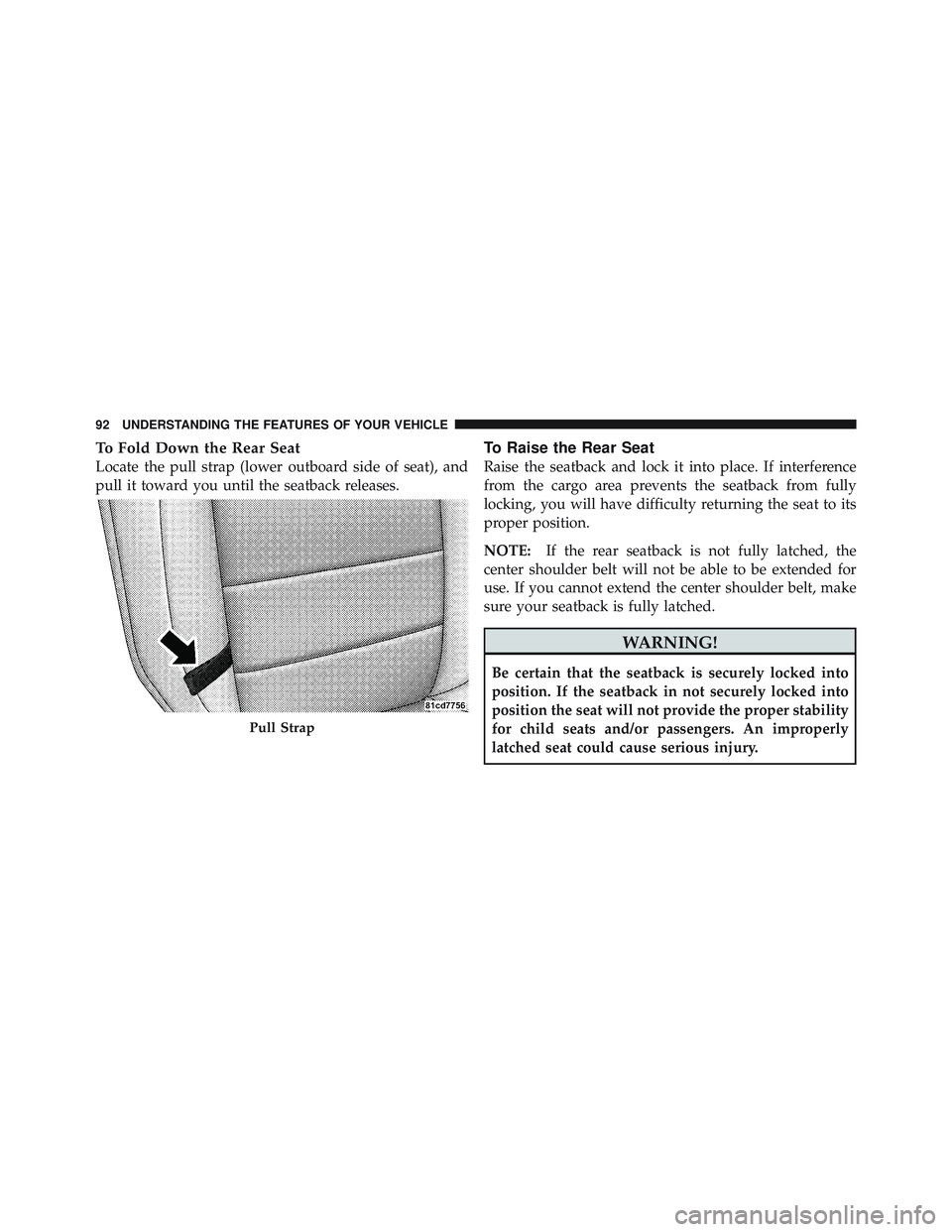
To Fold Down the Rear Seat
Locate the pull strap (lower outboard side of seat), and
pull it toward you until the seatback releases.
To Raise the Rear Seat
Raise the seatback and lock it into place. If interference
from the cargo area prevents the seatback from fully
locking, you will have difficulty returning the seat to its
proper position.
NOTE:If the rear seatback is not fully latched, the
center shoulder belt will not be able to be extended for
use. If you cannot extend the center shoulder belt, make
sure your seatback is fully latched.
WARNING!
•Do not drive the vehicle with the rear window
curtain up unless the side curtains are also open.
Dangerous exhaust gases which can kill could
enter the vehicle.
•The fabric upper doors and fabric top are designed
only for protection against the elements. Do not
rely on them to contain occupants within the
vehicle or to protect against injury during an
accident. Remember, always wear seat belts.
Raise the windshield and reinstall the side bars as soon as
the task that required their removal is completed and
before you return to on-road driving. Both you and your
passenger should wear seat belts at all times, on-road and
off-road, regardless of whether the windshield is raised
or folded down.
Outside rearview mirrors are mounted on the doors. If
you choose to remove the doors, see your authorized
dealer for a replacement cowl-mounted outside mirror.
Federal law requires outside mirrors on vehicles for
on-road use.
WARNING!
Always wear your seat belt and firmly tie down
cargo. Unsecured cargo can become projectiles in an
off-road situation.
When to Use 4L (Low) Range
When off-road driving, shift into 4L (Low) for additional
traction and control on slippery or difficult terrain,
ascending or descending steep hills, and to increase low
speed pulling power. This range should be limited to
extreme situations such as deep snow, mud, steep in-
clines, or sand where additional low speed pulling power
is needed. Vehicle speeds in excess of 25 mph (40 km/h)
should be avoided when in 4L (Low) range.
Simultaneous Brake and Throttle Operation
Many off-road driving conditions require the simulta-
neous use of the brake and throttle (two-footed driving).
When climbing rocks, logs, or other stepped objects,using light brake pressure with light throttle will keep the
vehicle from jerking or lurching. This technique is also
used when you need to stop and restart a vehicle on a
steep incline.
Driving In Snow, Mud and Sand
Snow
In heavy snow or for additional control and traction at
slower speeds, shift the transmission into a low gear and
the transfer case into 4L (Low) if necessary. Do not shift to
a lower gear than necessary to maintain headway. Over-
revving the engine can spin the wheels and traction will
be lost. If you start to slow to a stop, try turning your
steering wheel no more than a 1/4 turn quickly back and
forth, while still applying throttle. This will allow the
tires to get a fresh
�bite�and help maintain your momen-
tum.
300 STARTING AND OPERATING