engine JEEP WRANGLER UNLIMITED 2014 Owners Manual
[x] Cancel search | Manufacturer: JEEP, Model Year: 2014, Model line: WRANGLER UNLIMITED, Model: JEEP WRANGLER UNLIMITED 2014Pages: 140, PDF Size: 12.72 MB
Page 3 of 140
INTRODUCTION/WELCOME WELCOME FROM CHRYSLER
GROUP LLC ................. 89
CONTROLS AT A GLANCE DRIVER COCKPIT ............... 6
INSTRUMENT CLUSTER .......... 8
GETTING STARTED KEYFOB ................... 10
REMOTE START .............. 11
THEFT ALARM ............... 11
SEATBELT .................. 12
SUPPLEMENTAL RESTRAINT SYSTEM
(SRS) — AIR BAGS ............ 13
CHILD RESTRAINTS ............ 14
FRONT SEATS ................ 19
REAR SEATS ................. 20
TILT STEERING COLUMN ......... 21
HEATEDSEATS ............... 22
OPERATING YOUR VEHICLE ENGINE BREAK-IN
RECOMMENDATIONS ........... 23
TURN SIGNAL/LIGHTS LEVER ...... 23
WIPER/WASHER LEVER .......... 25
SPEED CONTROL .............. 26
MANUAL CLIMATE CONTROLS ...... 27
AUTOMATIC TEMPERATURE
CONTROLS (ATC) .............. 28
SUNRIDER ®
AND SOFT TOP ....... 29
HARD TOP AND FREEDOM TOP ®
.... 38
DUAL TOP — IF EQUIPPED ........ 41
WIND BUFFETING ............. 41
ELECTRONICS YOUR VEHICLE'S SOUND SYSTEM . . . 42
Uconnect ®
130 ............... 44
Uconnect ®
130 WITH SiriusXM
SATELLITE RADIO .............. 46
Uconnect ®
230 ............... 49
Uconnect ®
430/430N ........... 52
Uconnect ®
730N .............. 62
SiriusXM SATELLITE RADIO/TRAVEL
LINK ...................... 73
STEERING WHEEL AUDIO
CONTROLS ................. 77 iPod ®
/USB/MP3 CONTROL ........ 77
Uconnect ®
Phone .............. 78
Uconnect ®
VOICE COMMAND ....... 81
Bluetooth ®
STREAMING AUDIO ..... 84
ELECTRONIC VEHICLE INFORMATION
CENTER (EVIC) ............... 84
PROGRAMMABLE FEATURES ....... 86
POWER INVERTER ............. 87
POWER OUTLETS ............. 88
OFF-ROAD CAPABILITIES
(4WD OPERATION) COMMAND-TRAC ®
/ROCK-TRAC ®
..... 89
AXLE LOCK (TRU-LOK ®
) RUBICON
ONLY ...................... 89
ELECTRONIC SWAY BAR DISCONNECT –
RUBICON ONLY ............... 90
UTILITY TRAILER TOWING WEIGHTS (MAXIMUM
TRAILER WEIGHT RATINGS) ....... 91
RECREATIONAL TOWING (BEHIND
MOTORHOME, ETC.) ............ 93
WHAT TO DO IN EMERGENCIES ROADSIDE ASSISTANCE .......... 96
INSTRUMENT CLUSTER WARNING
LIGHTS .................... 96
IF YOUR ENGINE OVERHEATS ..... 101
JACKING AND TIRE CHANGING .... 102
JUMP-STARTING ............. 107
EMERGENCY TOW HOOKS ....... 109
SHIFT LEVER OVERRIDE ........ 109
TOWING A DISABLED VEHICLE .... 110
FREEING A STUCK VEHICLE ...... 110
EVENT DATA RECORDER (EDR) .... 111
MAINTAINING YOUR VEHICLE OPENING THE HOOD .......... 112
ENGINE COMPARTMENT ........ 113
FLUIDS AND CAPACITIES ........ 114
MAINTENANCE SCHEDULE ...... 115
MAINTENANCE RECORD ........ 119
FUSES .................... 120
TIRE PRESSURES ............ 123
WHEEL AND WHEEL TRIM CARE . . . 125
EXTERIOR BULBS ............ 125
TABLE OF CONTENTS
Page 10 of 140
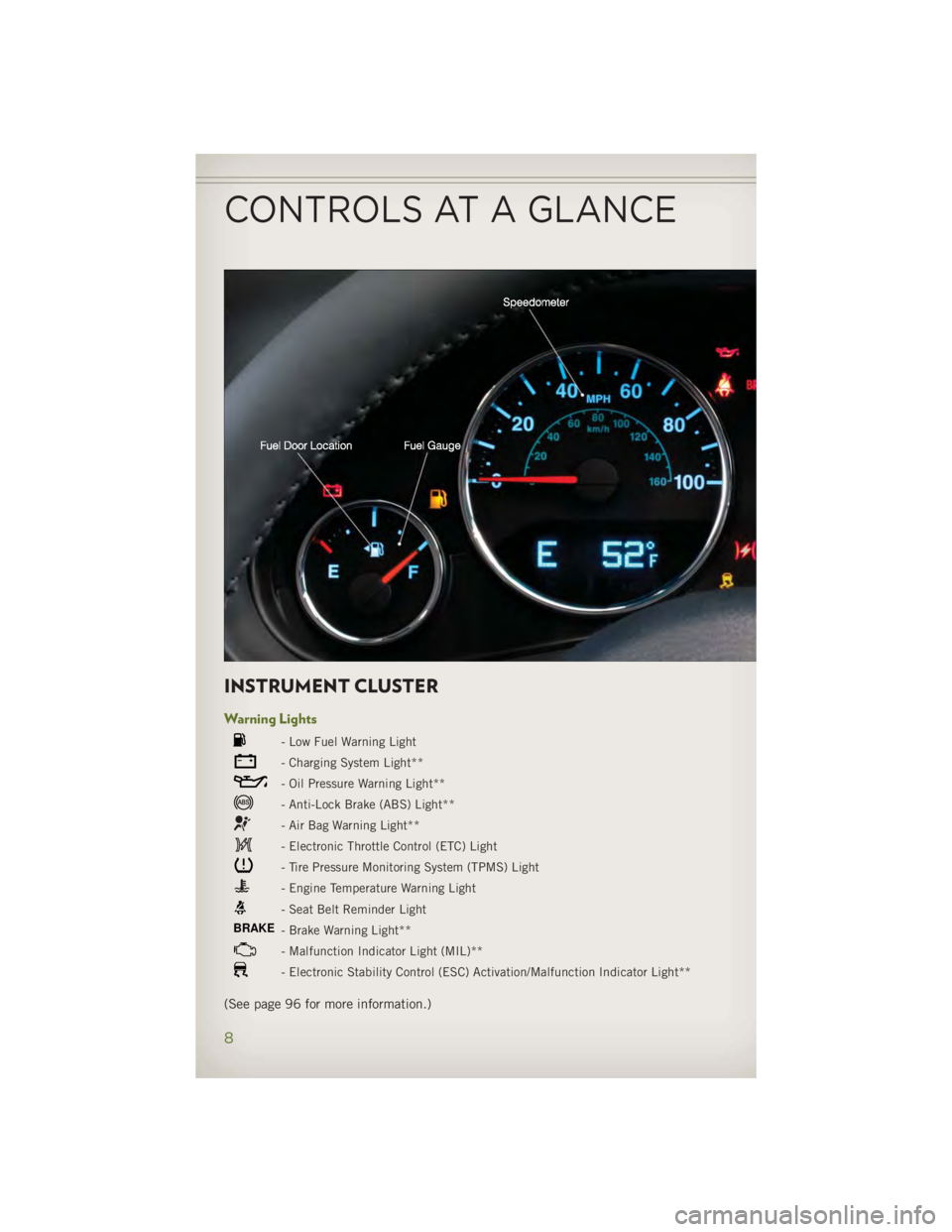
INSTRUMENT CLUSTER Warning Lights - Low Fuel Warning Light
- Charging System Light**
- Oil Pressure Warning Light**
- Anti-Lock Brake (ABS) Light**
- Air Bag Warning Light**
- Electronic Throttle Control (ETC) Light
- Tire Pressure Monitoring System (TPMS) Light
- Engine Temperature Warning Light
- Seat Belt Reminder Light
BRAKE
- Brake Warning Light**
- Malfunction Indicator Light (MIL)**
- Electronic Stability Control (ESC) Activation/Malfunction Indicator Light**
(See page 96 for more information.)CONTROLS AT A GLANCE
8
Page 11 of 140
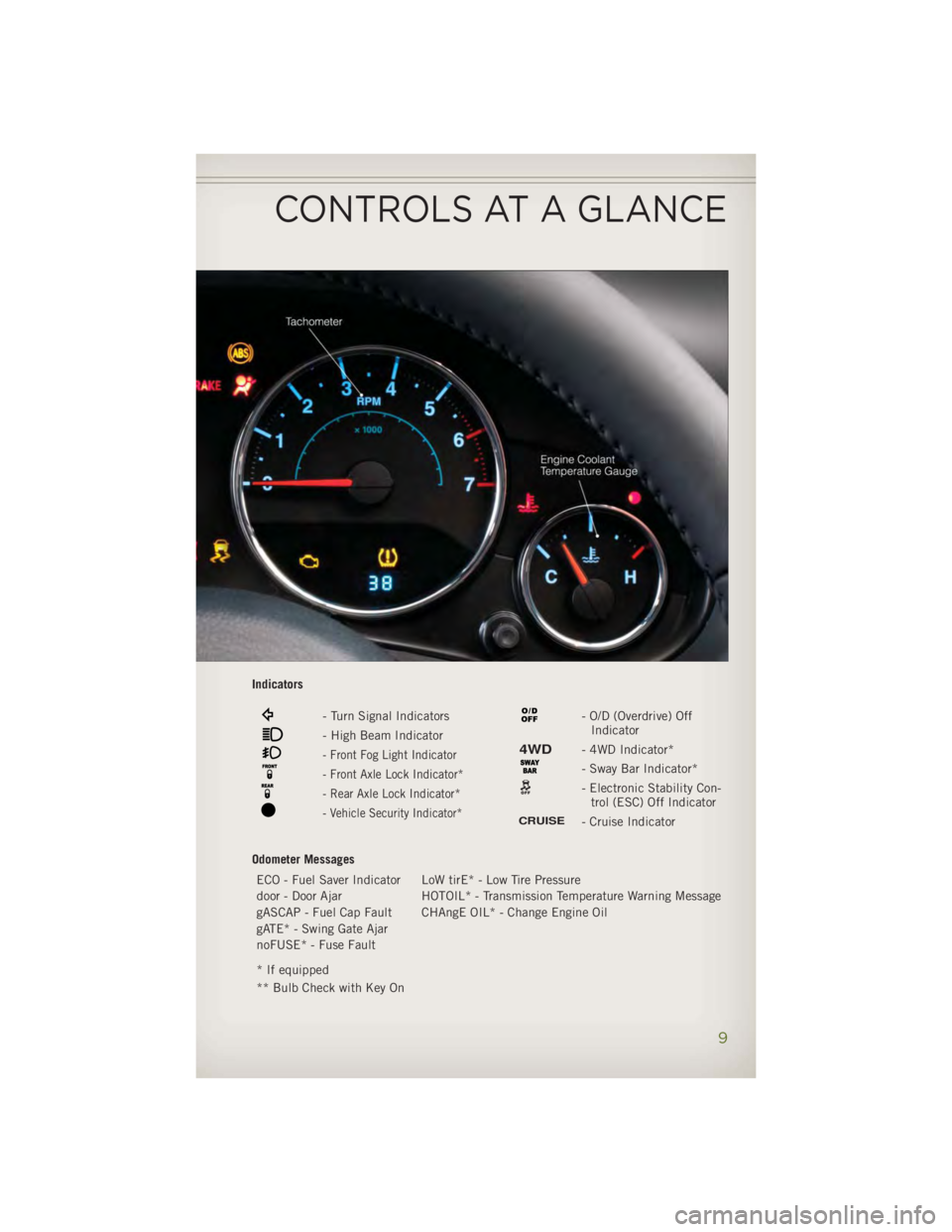
Indicators
- Turn Signal Indicators
- High Beam Indicator
- Front Fog Light Indicator
- Front Axle Lock Indicator*
- Rear Axle Lock Indicator*
- Vehicle Security Indicator* - O/D (Overdrive) Off
Indicator
4WD - 4WD Indicator*
- Sway Bar Indicator*
- Electronic Stability Con-
trol (ESC) Off IndicatorCRUISE
- Cruise Indicator
Odometer Messages
ECO - Fuel Saver Indicator LoW tirE* - Low Tire Pressure
door - Door Ajar HOTOIL* - Transmission Temperature Warning Message
gASCAP - Fuel Cap Fault CHAngE OIL* - Change Engine Oil
gATE* - Swing Gate Ajar
noFUSE* - Fuse Fault
* If equipped
** Bulb Check with Key OnCONTROLS AT A GLANCE
9
Page 13 of 140
REMOTE START • Press the REMOTE START button x
2
on the Key Fob twice within five seconds.
Pressing the REMOTE START button a third time shuts the engine off.
• To drive the vehicle, press the UNLOCK button, insert the key in the ignition and
turn to the ON/RUN position.
• With remote start, the engine will only run for 15 minutes (timeout) unless the
ignition key is placed in the ON/RUN position.
• The vehicle must be started with the key after two consecutive timeouts.
WARNING!• Do not start or run an engine in a closed garage or confined area. Exhaust gas
contains Carbon Monoxide (CO) which is odorless and colorless. Carbon
Monoxide is poisonous and can cause you or others to be severely injured or
killed when inhaled.
• Keep Key Fob transmitters away from children. Operation of the Remote Start
System, windows, door locks or other controls could cause you and others to be
severely injured or killed.
THEFT ALARM To Arm: • Lock the door using either the power door lock switch (one door must be open) or
the LOCK button on the Remote Keyless Entry (RKE) transmitter (doors can be
open or closed), and close all doors.
NOTE:
The Vehicle Security Alarm will not arm if you lock the doors with the manual door
lock plungers.
• The Vehicle Security Light in the instrument cluster will flash for 16 seconds. This
shows that the Vehicle Security Alarm is arming. During this period, if a door is
opened, the ignition is cycled to ON/RUN, or the power door locks are unlocked in
any manner, the Vehicle Security Alarm will automatically disarm.
NOTE:
• During the 16-second arming period, if a door is opened or the ignition is cycled
to ON/RUN, the Vehicle Security Alarm will automatically disarm.
• Once armed, the Vehicle Security Alarm disables the unlock switch on the driver
door trim panel and passenger door trim panel.GETTING STARTED
11
Page 25 of 140
ENGINE BREAK-IN RECOMMENDATIONS • A long break-in period is not required for the engine and drivetrain (transmission
and axle) in your vehicle.
• Drive moderately during the first 300 miles (500 km). After the initial 60 miles
(100 km), speeds up to 50 or 55 mph (80 or 90 km/h) are desirable.
• While cruising, brief full-throttle acceleration within the limits of local traffic laws
contributes to a good break-in. Wide-open throttle acceleration in low gear can be
detrimental and should be avoided.
• The engine oil installed in the engine at the factory is a high-quality energy
conserving type lubricant. Oil changes should be consistent with anticipated
climate conditions under which vehicle operations will occur. For the recom-
mended viscosity and quality grades, refer to “Maintaining Your Vehicle”.
NOTE:
A new engine may consume some oil during its first few thousand miles (kilome-
ters) of operation. This should be considered a normal part of the break-in and not
interpreted as an indication to an engine problem or malfunction.
CAUTION!Never use Non-Detergent Oil or Straight Mineral Oil in the engine or damage may
result.
TURN SIGNAL/LIGHTS LEVER
Headlights/Parking Lights/Automatic Headlights
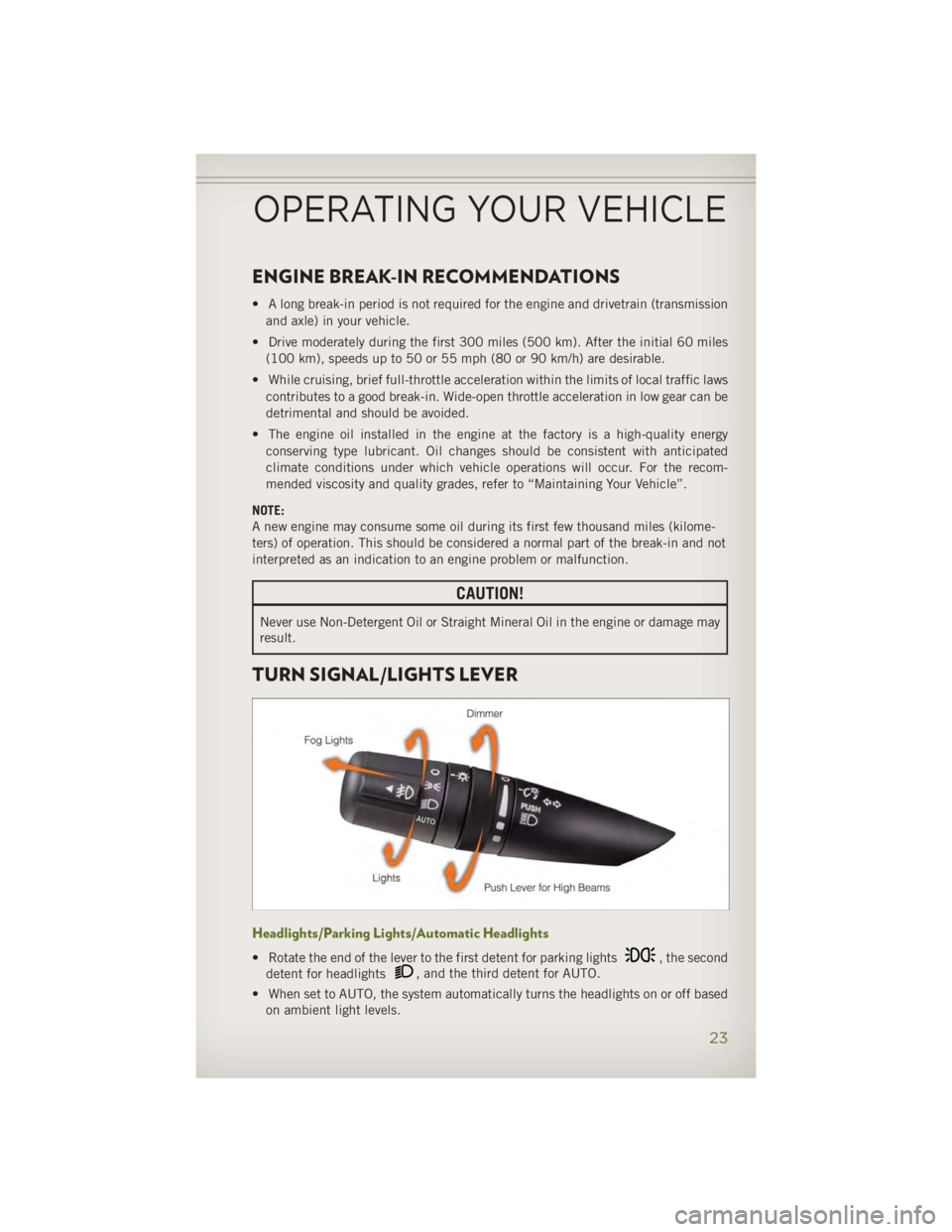
• Rotate the end of the lever to the first detent for parking lights , the second
detent for headlights , and the third detent for AUTO.
• When set to AUTO, the system automatically turns the headlights on or off based
on ambient light levels.OPERATING YOUR VEHICLE
23
Page 93 of 140
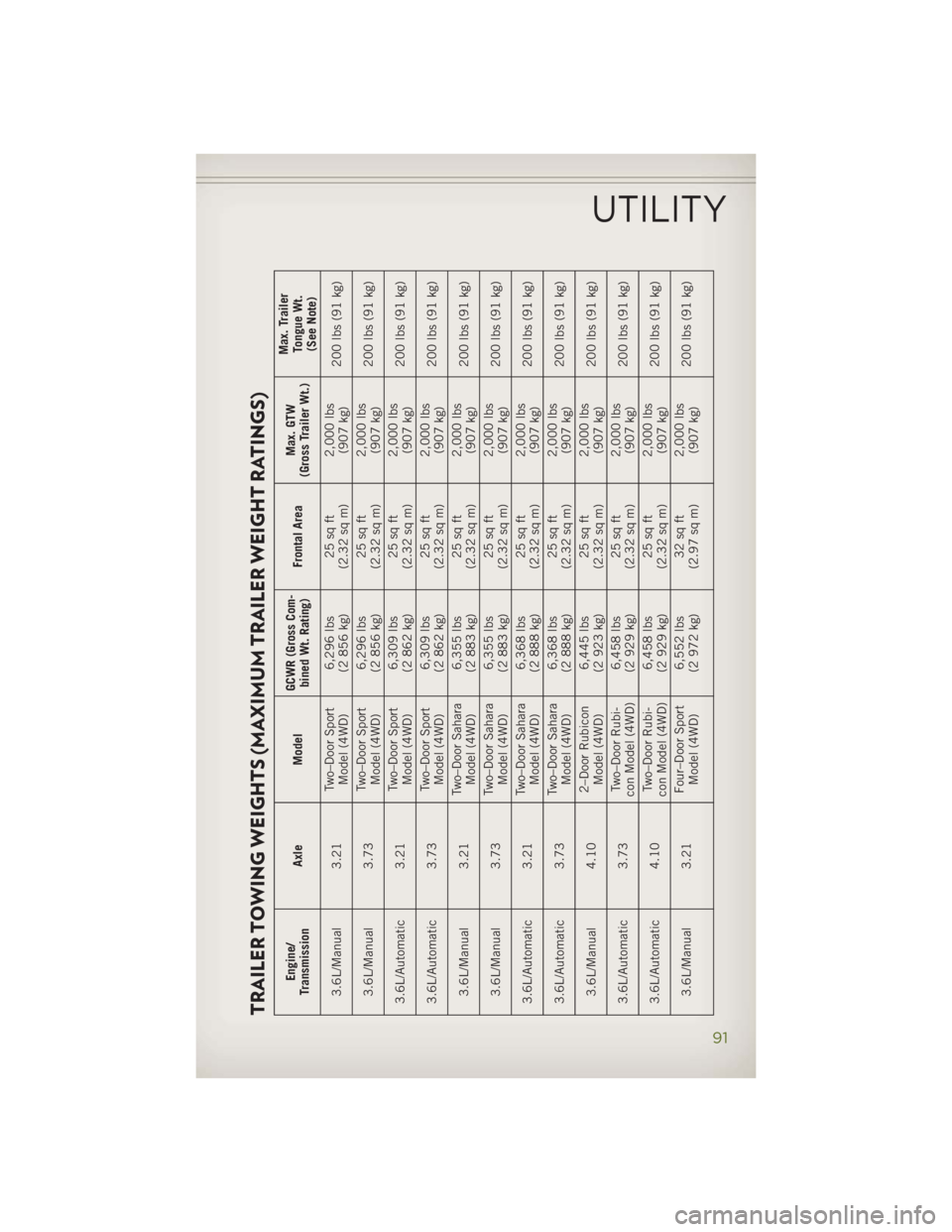
TRAILER TOWING WEIGHTS (MAXIMUM TRAILER WEIGHT RATINGS)
Engine/
Transmission Axle Model GCWR (Gross Com-
bined Wt. Rating) Frontal Area Max. GTW
(Gross Trailer Wt.) Max. Trailer
Tongue Wt.
(See Note)
3.6L/Manual 3.21 Two–Door Sport
Model (4WD) 6,296 lbs
(2 856 kg) 25 sq ft
(2.32 sq m) 2,000 lbs
(907 kg) 200 lbs (91 kg)
3.6L/Manual 3.73 Two–Door Sport
Model (4WD) 6,296 lbs
(2 856 kg) 25 sq ft
(2.32 sq m) 2,000 lbs
(907 kg) 200 lbs (91 kg)
3.6L/Automatic 3.21 Two–Door Sport
Model (4WD) 6,309 lbs
(2 862 kg) 25 sq ft
(2.32 sq m) 2,000 lbs
(907 kg) 200 lbs (91 kg)
3.6L/Automatic 3.73 Two–Door Sport
Model (4WD) 6,309 lbs
(2 862 kg) 25 sq ft
(2.32 sq m) 2,000 lbs
(907 kg) 200 lbs (91 kg)
3.6L/Manual 3.21 Two–Door Sahara
Model (4WD) 6,355 lbs
(2 883 kg) 25 sq ft
(2.32 sq m) 2,000 lbs
(907 kg) 200 lbs (91 kg)
3.6L/Manual 3.73 Two–Door Sahara
Model (4WD) 6,355 lbs
(2 883 kg) 25 sq ft
(2.32 sq m) 2,000 lbs
(907 kg) 200 lbs (91 kg)
3.6L/Automatic 3.21 Two–Door Sahara
Model (4WD) 6,368 lbs
(2 888 kg) 25 sq ft
(2.32 sq m) 2,000 lbs
(907 kg) 200 lbs (91 kg)
3.6L/Automatic 3.73 Two–Door Sahara
Model (4WD) 6,368 lbs
(2 888 kg) 25 sq ft
(2.32 sq m) 2,000 lbs
(907 kg) 200 lbs (91 kg)
3.6L/Manual 4.10 2–Door Rubicon
Model (4WD) 6,445 lbs
(2 923 kg) 25 sq ft
(2.32 sq m) 2,000 lbs
(907 kg) 200 lbs (91 kg)
3.6L/Automatic 3.73 T wo–Door Rubi-
con Model (4WD) 6,458 lbs
(2 929 kg) 25 sq ft
(2.32 sq m) 2,000 lbs
(907 kg) 200 lbs (91 kg)
3.6L/Automatic 4.10 Two–Door Rubi-
con Model (4WD) 6,458 lbs
(2 929 kg) 25 sq ft
(2.32 sq m) 2,000 lbs
(907 kg) 200 lbs (91 kg)
3.6L/Manual 3.21 Four–Door Sport
Model (4WD) 6,552 lbs
(2 972 kg) 32 sq ft
(2.97 sq m) 2,000 lbs
(907 kg) 200 lbs (91 kg)UTILITY
91
Page 94 of 140
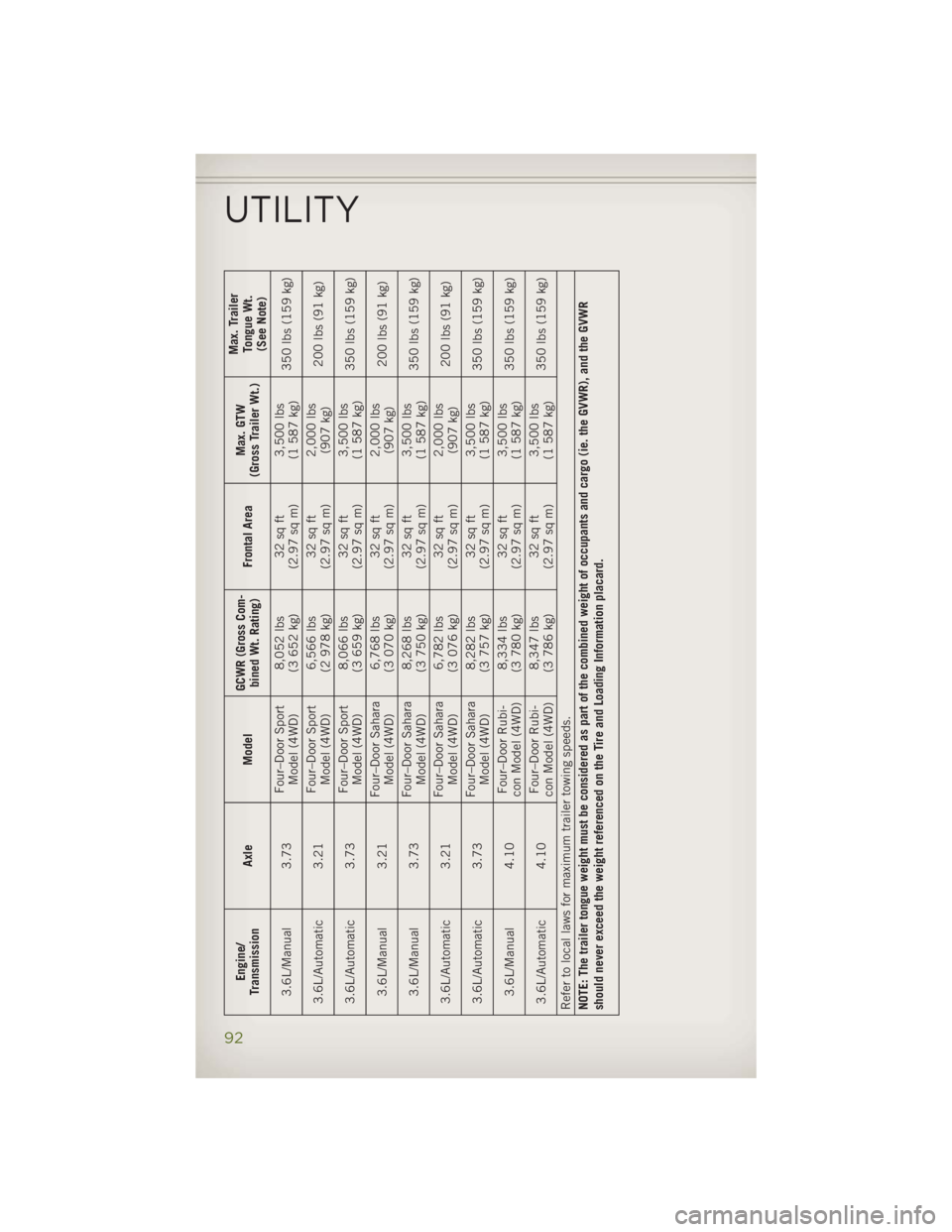
Engine/
Transmission Axle Model GCWR (Gross Com-
bined Wt. Rating) Frontal Area Max. GTW
(Gross Trailer Wt.) Max. Trailer
Tongue Wt.
(See Note)
3.6L/Manual 3.73 Four–Door Sport
Model (4WD) 8,052 lbs
(3 652 kg) 32 sq ft
(2.97 sq m) 3,500 lbs
(1 587 kg) 350 lbs (159 kg)
3.6L/Automatic 3.21 Four–Door Sport
Model (4WD) 6,566 lbs
(2 978 kg) 32 sq ft
(2.97 sq m) 2,000 lbs
(907 kg) 200 lbs (91 kg)
3.6L/Automatic 3.73 Four–Door Sport
Model (4WD) 8,066 lbs
(3 659 kg) 32 sq ft
(2.97 sq m) 3,500 lbs
(1 587 kg) 350 lbs (159 kg)
3.6L/Manual 3.21 Four–Door Sahara
Model (4WD) 6,768 lbs
(3 070 kg) 32 sq ft
(2.97 sq m) 2,000 lbs
(907 kg) 200 lbs (91 kg)
3.6L/Manual 3.73 Four–Door Sahara
Model (4WD) 8,268 lbs
(3 750 kg) 32 sq ft
(2.97 sq m) 3,500 lbs
(1 587 kg) 350 lbs (159 kg)
3.6L/Automatic 3.21 Four–Door Sahara
Model (4WD) 6,782 lbs
(3 076 kg) 32 sq ft
(2.97 sq m) 2,000 lbs
(907 kg) 200 lbs (91 kg)
3.6L/Automatic 3.73 Four–Door Sahara
Model (4WD) 8,282 lbs
(3 757 kg) 32 sq ft
(2.97 sq m) 3,500 lbs
(1 587 kg) 350 lbs (159 kg)
3.6L/Manual 4.10 Four–Door Rubi-
con Model (4WD) 8,334 lbs
(3 780 kg) 32 sq ft
(2.97 sq m) 3,500 lbs
(1 587 kg) 350 lbs (159 kg)
3.6L/Automatic 4.10 Four–Door Rubi-
con Model (4WD) 8,347 lbs
(3 786 kg) 32 sq ft
(2.97 sq m) 3,500 lbs
(1 587 kg) 350 lbs (159 kg)
Refer to local laws for maximum trailer towing speeds.
NOTE: The trailer tongue
weight must be considered as part of the combined weight of occupants and cargo (ie. the GVWR), and the GVWR
should never exceed the weight referenced on the Tire and Loading Information placard.UTILITY
92
Page 96 of 140
Recreational Towing – Four-Wheel Drive Models NOTE:
The transfer case must be shifted into NEUTRAL (N),
automatic transmission must be
shifted into
PARK, and manual transmission must be placed in gear (NOT in NEUTRAL)
for recreational towing. Shifting Into NEUTRAL (N)
Use the following procedure to prepare your vehicle for recreational towing.
1. Bring the vehicle to a complete stop.
2. Press and hold the brake pedal.
3. Shift the automatic transmission into NEUTRAL or depress the clutch pedal on a
manual transmission.
4. Turn OFF the engine.
5. Shift the transfer case lever into NEUTRAL (N).
6. Start the engine.
7. Shift the transmission into REVERSE.
8. Release the brake pedal (and clutch pedal on manual transmissions) for five
seconds and ensure that there is no vehicle movement.
9. Repeat steps 7 and 8 with automatic transmission in DRIVE or manual transmis-
sion in first gear.
10. Turn OFF the engine.
11. Firmly apply the parking brake.
12. Shift the transmission into PARK or place manual transmission in gear (NOT in
Neutral).
13. Attach the vehicle to the tow vehicle using a suitable tow bar.
14. Release the parking brake.
Shifting Out of NEUTRAL (N)
Use the following procedure to prepare your vehicle for normal usage.
1. Bring the vehicle to a complete stop, leaving it connected to the tow vehicle.
2. Firmly apply the parking brake.
3. Turn the ignition switch to the LOCK/OFF position.
4. Turn the ignition switch to the ON/RUN position, but do not start the engine.
5. Press and hold the brake pedal.
6. Shift the transmission into NEUTRAL.
7. Shift the transfer case lever to the desired position.UTILITY
94
Page 97 of 140
NOTE:
When shifting out of transfer case NEUTRAL (N), turning the engine OFF may be
required to avoid gear clash.
8.
Shift the automatic transmission into PARK, or place manual transmission in Neutral.
9. Release the brake pedal.
10. Disconnect vehicle from the tow vehicle.
11. Start the engine.
12. Press and hold the brake pedal.
13. Release the parking brake.
14. Shift the transmission into gear, release the brake pedal (and clutch pedal on
manual transmissions), and check that the vehicle operates normally.
CAUTION!• It is necessary to follow these steps to be certain that the transfer case is fully in
NEUTRAL (N) before recreational towing to prevent damage to internal parts.
• Damage to the transmission may occur if the transmission is shifted into PARK with
the transfer case in NEUTRAL (N) and the engine running. With the transfer case in
NEUTRAL (N) ensure that the engine is OFF prior to shifting the transmission into
PARK.
• Front or rear wheel lifts should not be used. Internal damage to the transmission or
transfer case will occur if a front or rear wheel lift is used when recreational towing.
• Tow only in the forward direction. Towing this vehicle backwards can cause severe
damage to the transfer case.
• Automatic transmissions must be placed in the PARK position for recreational
towing.
• Manual transmissions must be placed in gear (not in Neutral) for recreational
towing.
• Before recreational towing, perform the procedure outlined under “Shifting Into
NEUTRAL (N)” to be certain that the transfer case is fully in NEUTRAL (N).
Otherwise, internal damage will result.
• Towing this vehicle in violation of the above requirements can cause severe
transmission and/or transfer case damage. Damage from improper towing is not
covered under the New Vehicle Limited Warranty.
• Do not use a bumper-mounted clamp-on tow bar on your vehicle. The bumper face
bar will be damaged.
WARNING!You or others could be injured if you leave the vehicle unattended with the transfer
case in the NEUTRAL (N) position without first fully engaging the parking brake.
The transfer case NEUTRAL (N) position disengages both the front and rear
driveshafts from the powertrain and will allow the vehicle to move, even if the
transmission is in PARK. The parking brake should always be applied when the
driver is not in the vehicle.UTILITY
95
Page 98 of 140
ROADSIDE ASSISTANCE • Dial toll-free 1-800-521-2779 for U.S. Residents or 1-800-363-4869 for Cana-
dian Residents.
• Provide your name, vehicle identification number, license plate number, and your
location, including the telephone number from which you are calling.
• Briefly describe the nature of the problem and answer a few simple questions.
• You will be given the name of the service provider and an estimated time of arrival.
If you feel you are in an “unsafe situation”, please let us know. With your consent,
we will contact local police or safety authorities.
INSTRUMENT CLUSTER WARNING LIGHTS - Electronic Stability Control (ESC) Activation/Malfunction Indicator Light• If the “ESC Activation/Malfunction Indicator Light” comes on continuously with
the engine running, a malfunction has been detected in the ESC system. If this
light remains on after several ignition cycles, and the vehicle has been driven
several miles (kilometers) at speeds greater than 30 mph (48 km/h), we recom-
mend you drive to the nearest service center and have the vehicle serviced
immediately.
• The “ESC Activation/Malfunction Indicator Light” starts to flash as soon as the
tires lose traction and the ESC system becomes active. If the light begins to flash
during acceleration, ease up on the accelerator and apply as little throttle as
possible. Be sure to adapt your speed and driving to the prevailing road conditions.
The light also flashes when TCS is active. To improve the vehicle's traction when
starting off in deep snow, sand or gravel, it may be desirable to switch the ESC
system to Partial Off mode by momentarily pressing the ESC Off switch.
- Tire Pressure Monitoring System (TPMS) Light• Each tire, including the spare (if provided), should be checked monthly, when cold
and inflated to the inflation pressure recommended by the vehicle manufacturer
on the vehicle placard or tire inflation pressure label. (If your vehicle has tires of
a different size than the size indicated on the vehicle placard or tire inflation
pressure label, you should determine the proper tire inflation pressure for those
tires.)
• As an added safety feature, your vehicle has been equipped with a Tire Pressure
Monitoring System (TPMS) that illuminates a low tire pressure telltale when one or
more of your tires is significantly under-inflated. Accordingly, when the low tire
pressure telltale illuminates, you should stop and check your tires as soon as
possible, and inflate them to the proper pressure. Driving on a significantly
under-inflated tire causes the tire to overheat and can lead to tire failure.
Under-inflation also reduces fuel efficiency and tire tread life, and may affect the
vehicle’s handling and stopping ability.WHAT TO DO IN EMERGENCIES
96