fuel JEEP WRANGLER UNLIMITED 2019 Owner handbook (in English)
[x] Cancel search | Manufacturer: JEEP, Model Year: 2019, Model line: WRANGLER UNLIMITED, Model: JEEP WRANGLER UNLIMITED 2019Pages: 348, PDF Size: 6.5 MB
Page 232 of 348
WARNING!
Overloading of your tires is dangerous.
Overloading can cause tire failure, affect
vehicle handling, and increase your stop-
ping distance. Use tires of the recom-
mended load capacity for your vehicle.
Never overload them.
Tires — General Information
Tire Pressure
Proper tire inflation pressure is essential to
the safe and satisfactory operation of your
vehicle. Four primary areas are affected by
improper tire pressure:
• Safety and Vehicle Stability
• Economy
• Tread Wear
• Ride ComfortSafety
WARNING!
• Improperly inflated tires are dangerous
and can cause collisions.
• Underinflation increases tire flexing and
can result in overheating and tire failure.
• Overinflation reduces a tire's ability to
cushion shock. Objects on the road and
chuckholes can cause damage that re-
sult in tire failure.
• Overinflated or underinflated tires can
affect vehicle handling and can fail sud-
denly, resulting in loss of vehicle con-
trol.
• Unequal tire pressures can cause steer-
ing problems. You could lose control of
your vehicle.
• Unequal tire pressures from one side of
the vehicle to the other can cause the
vehicle to drift to the right or left.
• Always drive with each tire inflated to
the recommended cold tire inflation
pressure.Both under-inflation and over-inflation affect
the stability of the vehicle and can produce a
feeling of sluggish response or over respon-
siveness in the steering.
NOTE:
• Unequal tire pressures from side to side
may cause erratic and unpredictable steer-
ing response.
• Unequal tire pressure from side to side may
cause the vehicle to drift left or right.
Fuel Economy
Underinflated tires will increase tire rolling
resistance resulting in higher fuel consump-
tion.
Tread Wear
Improper cold tire inflation pressures can
cause abnormal wear patterns and reduced
tread life, resulting in the need for earlier tire
replacement.
Ride Comfort And Vehicle Stability
Proper tire inflation contributes to a comfort-
able ride. Over-inflation produces a jarring
and uncomfortable ride.
SERVICING AND MAINTENANCE
230
Page 247 of 348
TECHNICAL SPECIFICATIONS
VEHICLE IDENTIFICATION
NUMBER.................246
WHEEL AND TIRE TORQUE
SPECIFICATIONS...........246
Torque Specifications............246
DIMENSIONS...............247
WHEELS..................250
WEIGHTS.................250FUEL REQUIREMENTS — GASOLINE
ENGINE...................252
2.0L Engine.................252
3.6L Engine.................252
Materials Added To Fuel.........253
Fuel Icon Identification Compliant To
EN16942...................253
FUEL REQUIREMENTS — DIESEL
ENGINE..................255
Fuel Icon Identification Compliant To
EN16942...................256
FLUID CAPACITIES..........257
FLUIDS AND LUBRICANTS.....259
Engine....................259
Chassis....................261
FUEL CONSUMPTION AND CO2EMISSIONS................262
MOPAR ACCESSORIES.......262
Authentic Accessories And Jeep
Performance Parts By Mopar.......262
TECHNICAL SPECIFICATIONS
245
Page 254 of 348
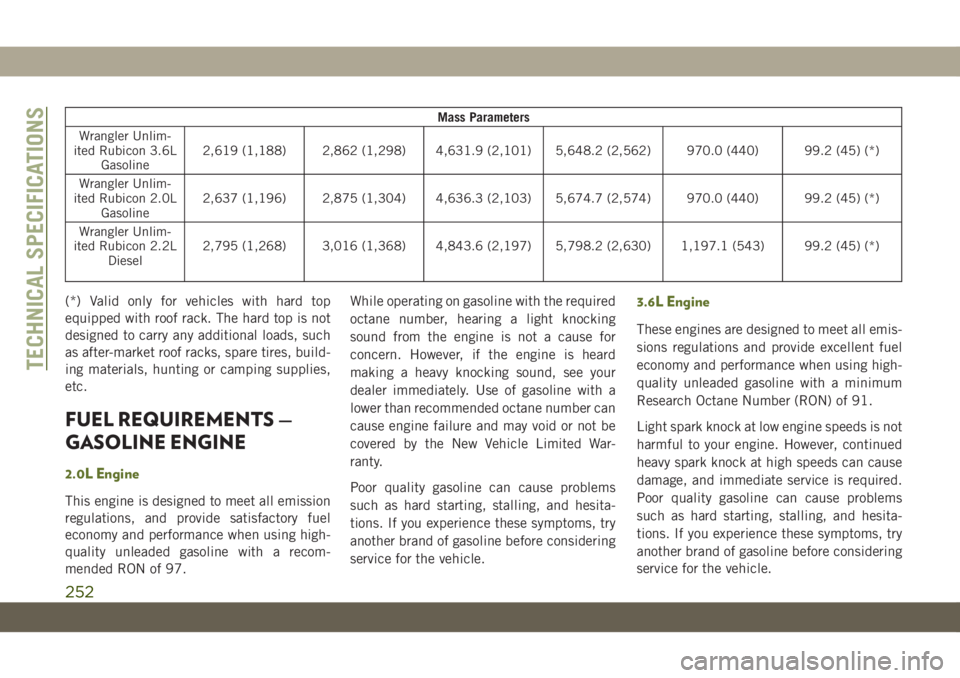
Mass Parameters
Wrangler Unlim-
ited Rubicon 3.6L
Gasoline2,619 (1,188) 2,862 (1,298) 4,631.9 (2,101) 5,648.2 (2,562) 970.0 (440) 99.2 (45) (*)
Wrangler Unlim-
ited Rubicon 2.0L
Gasoline2,637 (1,196) 2,875 (1,304) 4,636.3 (2,103) 5,674.7 (2,574) 970.0 (440) 99.2 (45) (*)
Wrangler Unlim-
ited Rubicon 2.2L
Diesel2,795 (1,268) 3,016 (1,368) 4,843.6 (2,197) 5,798.2 (2,630) 1,197.1 (543) 99.2 (45) (*)
(*) Valid only for vehicles with hard top
equipped with roof rack. The hard top is not
designed to carry any additional loads, such
as after-market roof racks, spare tires, build-
ing materials, hunting or camping supplies,
etc.
FUEL REQUIREMENTS —
GASOLINE ENGINE
2.0L Engine
This engine is designed to meet all emission
regulations, and provide satisfactory fuel
economy and performance when using high-
quality unleaded gasoline with a recom-
mended RON of 97.While operating on gasoline with the required
octane number, hearing a light knocking
sound from the engine is not a cause for
concern. However, if the engine is heard
making a heavy knocking sound, see your
dealer immediately. Use of gasoline with a
lower than recommended octane number can
cause engine failure and may void or not be
covered by the New Vehicle Limited War-
ranty.
Poor quality gasoline can cause problems
such as hard starting, stalling, and hesita-
tions. If you experience these symptoms, try
another brand of gasoline before considering
service for the vehicle.
3.6L Engine
These engines are designed to meet all emis-
sions regulations and provide excellent fuel
economy and performance when using high-
quality unleaded gasoline with a minimum
Research Octane Number (RON) of 91.
Light spark knock at low engine speeds is not
harmful to your engine. However, continued
heavy spark knock at high speeds can cause
damage, and immediate service is required.
Poor quality gasoline can cause problems
such as hard starting, stalling, and hesita-
tions. If you experience these symptoms, try
another brand of gasoline before considering
service for the vehicle.
TECHNICAL SPECIFICATIONS
252
Page 255 of 348
Besides using unleaded gasoline with the
proper octane rating, gasolines that contain
detergents, corrosion and stability additives
are recommended. Using gasolines that have
these additives may help improve fuel
economy, reduce emissions, and maintain
vehicle performance.
Poor quality gasoline can cause problems
such as hard starting, stalling, and hesita-
tions. If you experience these symptoms, try
another brand of gasoline before considering
service for the vehicle.
Materials Added To Fuel
Indiscriminate use of fuel system cleaning
agents should be avoided. Many of these
materials intended for gum and varnish re-
moval may contain active solvents or similar
ingredients. These can harm fuel system gas-
ket and diaphragm materials.
Fuel Icon Identification Compliant To
EN16942
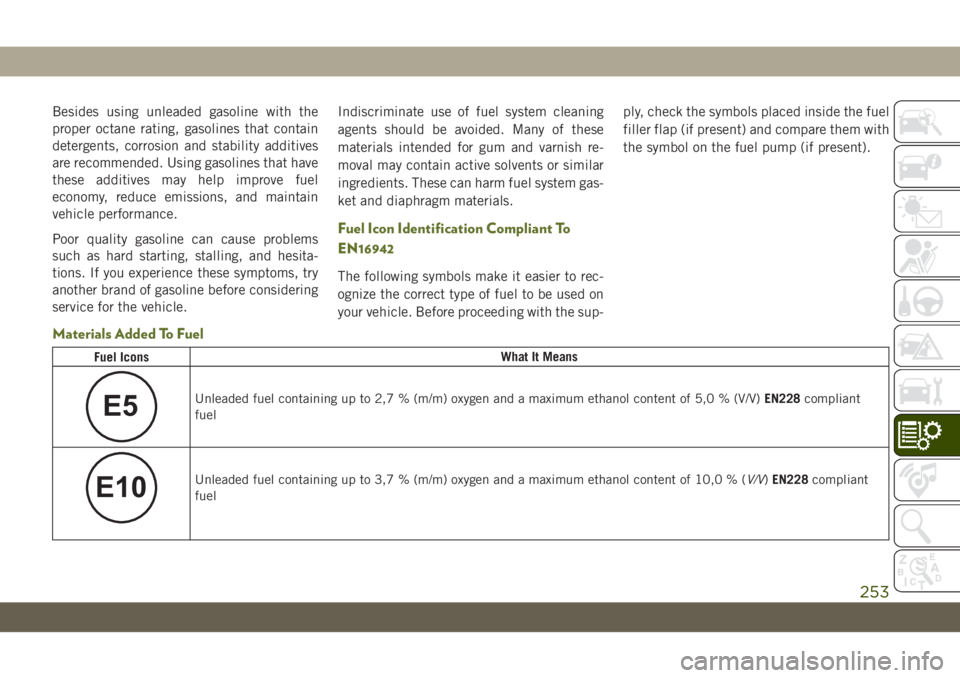
The following symbols make it easier to rec-
ognize the correct type of fuel to be used on
your vehicle. Before proceeding with the sup-ply, check the symbols placed inside the fuel
filler flap (if present) and compare them with
the symbol on the fuel pump (if present).
Fuel IconsWhat It Means
E5Unleaded fuel containing up to 2,7 % (m/m) oxygen and a maximum ethanol content of 5,0 % (V/V)EN228compliant
fuel
E10Unleaded fuel containing up to 3,7 % (m/m) oxygen and a maximum ethanol content of 10,0 % (V/V)EN228compliant
fuel
253
Page 256 of 348
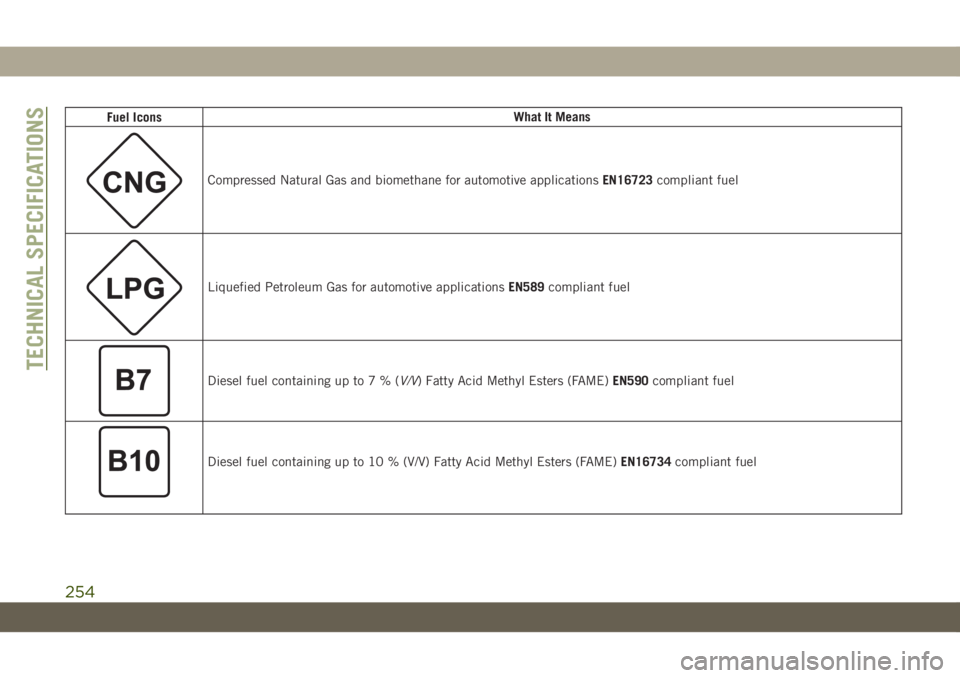
Fuel IconsWhat It Means
Compressed Natural Gas and biomethane for automotive applicationsEN16723compliant fuel
Liquefied Petroleum Gas for automotive applicationsEN589compliant fuel
Diesel fuel containing up to7%(V/V) Fatty Acid Methyl Esters (FAME)EN590compliant fuel
Diesel fuel containing up to 10 % (V/V) Fatty Acid Methyl Esters (FAME)EN16734compliant fuel
TECHNICAL SPECIFICATIONS
254
Page 257 of 348
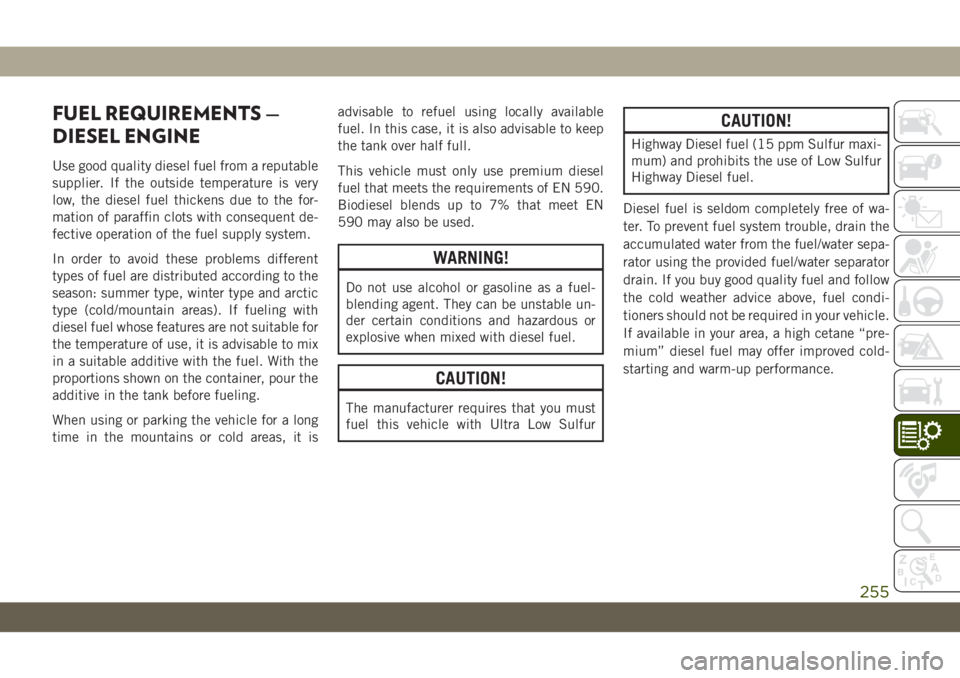
FUEL REQUIREMENTS —
DIESEL ENGINE
Use good quality diesel fuel from a reputable
supplier. If the outside temperature is very
low, the diesel fuel thickens due to the for-
mation of paraffin clots with consequent de-
fective operation of the fuel supply system.
In order to avoid these problems different
types of fuel are distributed according to the
season: summer type, winter type and arctic
type (cold/mountain areas). If fueling with
diesel fuel whose features are not suitable for
the temperature of use, it is advisable to mix
in a suitable additive with the fuel. With the
proportions shown on the container, pour the
additive in the tank before fueling.
When using or parking the vehicle for a long
time in the mountains or cold areas, it isadvisable to refuel using locally available
fuel. In this case, it is also advisable to keep
the tank over half full.
This vehicle must only use premium diesel
fuel that meets the requirements of EN 590.
Biodiesel blends up to 7% that meet EN
590 may also be used.
WARNING!
Do not use alcohol or gasoline as a fuel-
blending agent. They can be unstable un-
der certain conditions and hazardous or
explosive when mixed with diesel fuel.
CAUTION!
The manufacturer requires that you must
fuel this vehicle with Ultra Low Sulfur
CAUTION!
Highway Diesel fuel (15 ppm Sulfur maxi-
mum) and prohibits the use of Low Sulfur
Highway Diesel fuel.
Diesel fuel is seldom completely free of wa-
ter. To prevent fuel system trouble, drain the
accumulated water from the fuel/water sepa-
rator using the provided fuel/water separator
drain. If you buy good quality fuel and follow
the cold weather advice above, fuel condi-
tioners should not be required in your vehicle.
If available in your area, a high cetane “pre-
mium” diesel fuel may offer improved cold-
starting and warm-up performance.
255
Page 258 of 348
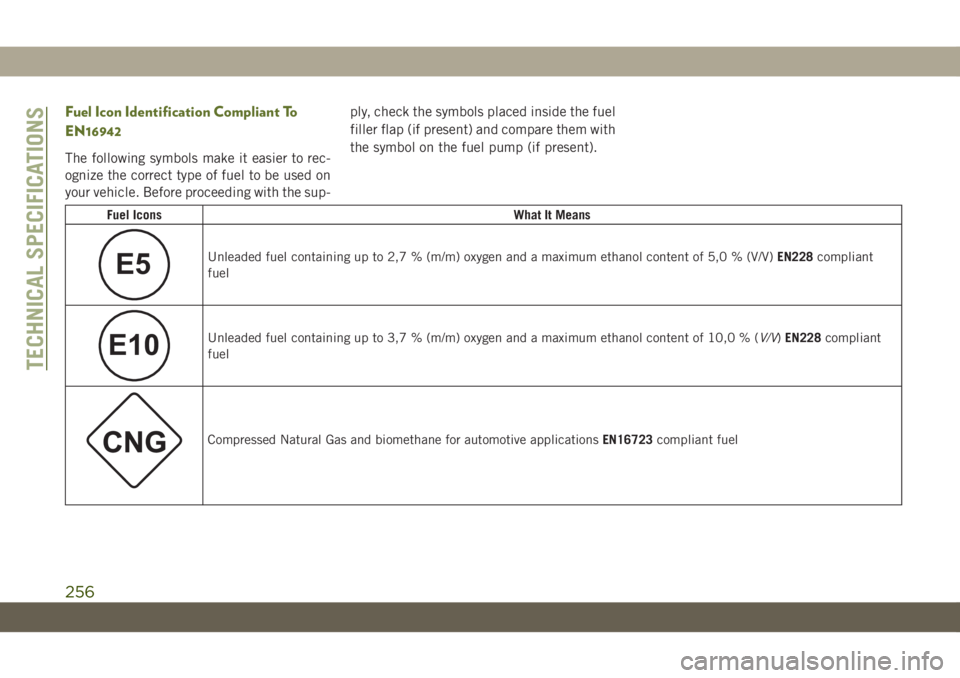
Fuel Icon Identification Compliant To
EN16942
The following symbols make it easier to rec-
ognize the correct type of fuel to be used on
your vehicle. Before proceeding with the sup-ply, check the symbols placed inside the fuel
filler flap (if present) and compare them with
the symbol on the fuel pump (if present).
Fuel IconsWhat It Means
E5Unleaded fuel containing up to 2,7 % (m/m) oxygen and a maximum ethanol content of 5,0 % (V/V)EN228compliant
fuel
E10Unleaded fuel containing up to 3,7 % (m/m) oxygen and a maximum ethanol content of 10,0 % (V/V)EN228compliant
fuel
Compressed Natural Gas and biomethane for automotive applicationsEN16723compliant fuel
TECHNICAL SPECIFICATIONS
256
Page 259 of 348
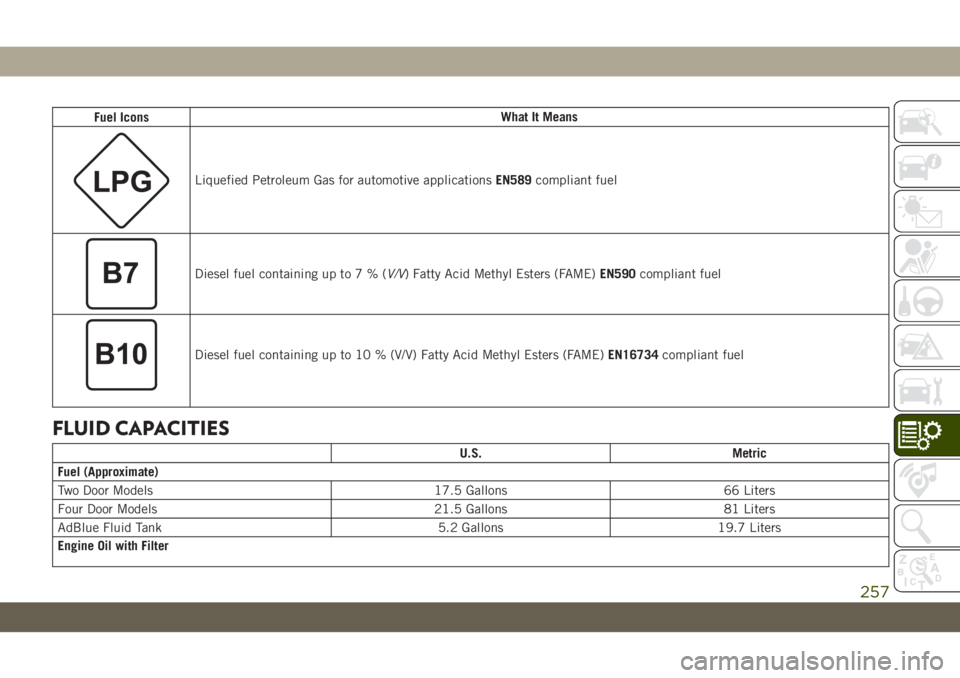
Fuel IconsWhat It Means
Liquefied Petroleum Gas for automotive applicationsEN589compliant fuel
Diesel fuel containing up to7%(V/V) Fatty Acid Methyl Esters (FAME)EN590compliant fuel
Diesel fuel containing up to 10 % (V/V) Fatty Acid Methyl Esters (FAME)EN16734compliant fuel
FLUID CAPACITIES
U.S. Metric
Fuel (Approximate)
Two Door Models 17.5 Gallons 66 Liters
Four Door Models 21.5 Gallons 81 Liters
AdBlue Fluid Tank 5.2 Gallons 19.7 Liters
Engine Oil with Filter
257
Page 261 of 348
FLUIDS AND LUBRICANTS
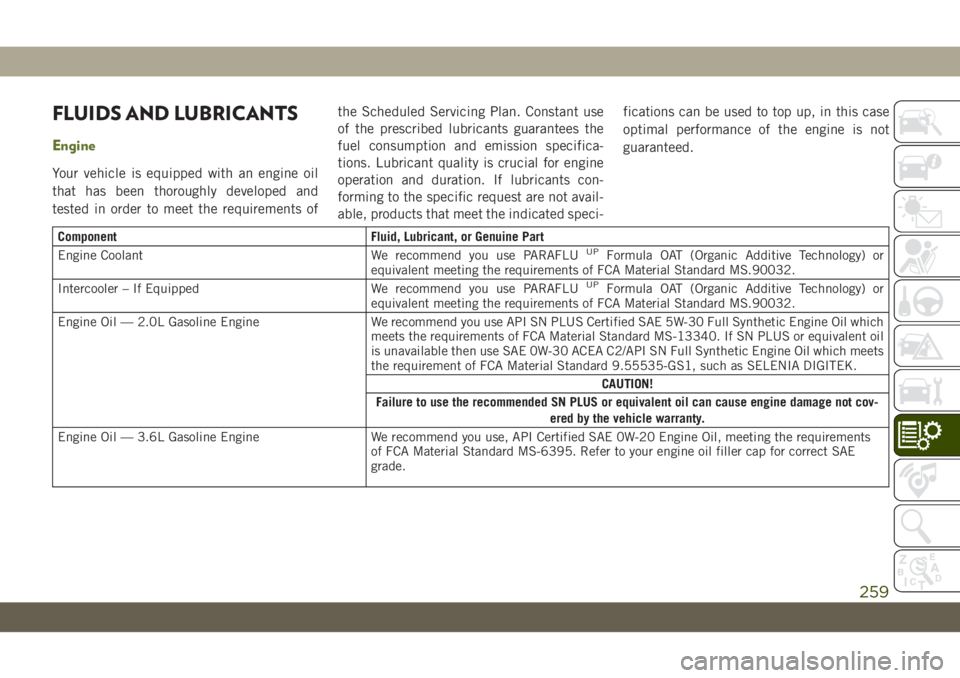
Engine
Your vehicle is equipped with an engine oil
that has been thoroughly developed and
tested in order to meet the requirements ofthe Scheduled Servicing Plan. Constant use
of the prescribed lubricants guarantees the
fuel consumption and emission specifica-
tions. Lubricant quality is crucial for engine
operation and duration. If lubricants con-
forming to the specific request are not avail-
able, products that meet the indicated speci-fications can be used to top up, in this case
optimal performance of the engine is not
guaranteed.
Component Fluid, Lubricant, or Genuine Part
Engine Coolant We recommend you use PARAFLUUPFormula OAT (Organic Additive Technology) or
equivalent meeting the requirements of FCA Material Standard MS.90032.
Intercooler – If Equipped We recommend you use PARAFLU
UPFormula OAT (Organic Additive Technology) or
equivalent meeting the requirements of FCA Material Standard MS.90032.
Engine Oil — 2.0L Gasoline Engine We recommend you use API SN PLUS Certified SAE 5W-30 Full Synthetic Engine Oil which
meets the requirements of FCA Material Standard MS-13340. If SN PLUS or equivalent oil
is unavailable then use SAE 0W-30 ACEA C2/API SN Full Synthetic Engine Oil which meets
the requirement of FCA Material Standard 9.55535-GS1, such as SELENIA DIGITEK.
CAUTION!
Failure to use the recommended SN PLUS or equivalent oil can cause engine damage not cov-
ered by the vehicle warranty.
Engine Oil — 3.6L Gasoline Engine We recommend you use, API Certified SAE 0W-20 Engine Oil, meeting the requirements
of FCA Material Standard MS-6395. Refer to your engine oil filler cap for correct SAE
grade.
259
Page 262 of 348
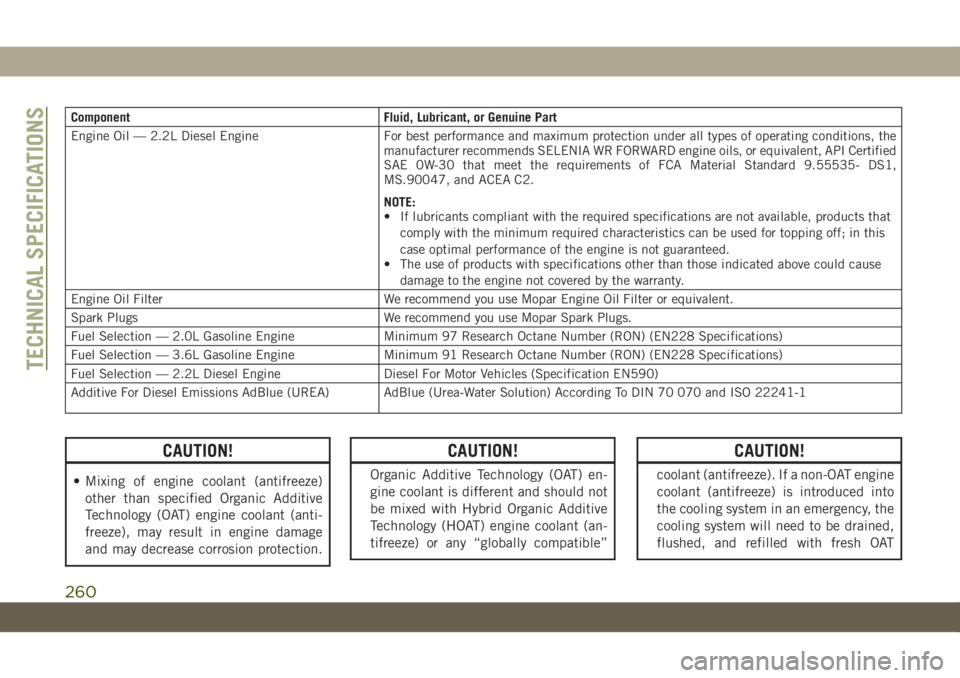
Component Fluid, Lubricant, or Genuine Part
Engine Oil — 2.2L Diesel Engine For best performance and maximum protection under all types of operating conditions, the
manufacturer recommends SELENIA WR FORWARD engine oils, or equivalent, API Certified
SAE 0W-30 that meet the requirements of FCA Material Standard 9.55535- DS1,
MS.90047, and ACEA C2.
NOTE:
• If lubricants compliant with the required specifications are not available, products that
comply with the minimum required characteristics can be used for topping off; in this
case optimal performance of the engine is not guaranteed.
• The use of products with specifications other than those indicated above could cause
damage to the engine not covered by the warranty.
Engine Oil Filter We recommend you use Mopar Engine Oil Filter or equivalent.
Spark Plugs We recommend you use Mopar Spark Plugs.
Fuel Selection — 2.0L Gasoline Engine Minimum 97 Research Octane Number (RON) (EN228 Specifications)
Fuel Selection — 3.6L Gasoline Engine Minimum 91 Research Octane Number (RON) (EN228 Specifications)
Fuel Selection — 2.2L Diesel Engine Diesel For Motor Vehicles (Specification EN590)
Additive For Diesel Emissions AdBlue (UREA) AdBlue (Urea-Water Solution) According To DIN 70 070 and ISO 22241-1
CAUTION!
• Mixing of engine coolant (antifreeze)
other than specified Organic Additive
Technology (OAT) engine coolant (anti-
freeze), may result in engine damage
and may decrease corrosion protection.
CAUTION!
Organic Additive Technology (OAT) en-
gine coolant is different and should not
be mixed with Hybrid Organic Additive
Technology (HOAT) engine coolant (an-
tifreeze) or any “globally compatible”
CAUTION!
coolant (antifreeze). If a non-OAT engine
coolant (antifreeze) is introduced into
the cooling system in an emergency, the
cooling system will need to be drained,
flushed, and refilled with fresh OAT
TECHNICAL SPECIFICATIONS
260