tire size JEEP XJ 1995 Service And User Guide
[x] Cancel search | Manufacturer: JEEP, Model Year: 1995, Model line: XJ, Model: JEEP XJ 1995Pages: 2158, PDF Size: 81.9 MB
Page 1320 of 2158
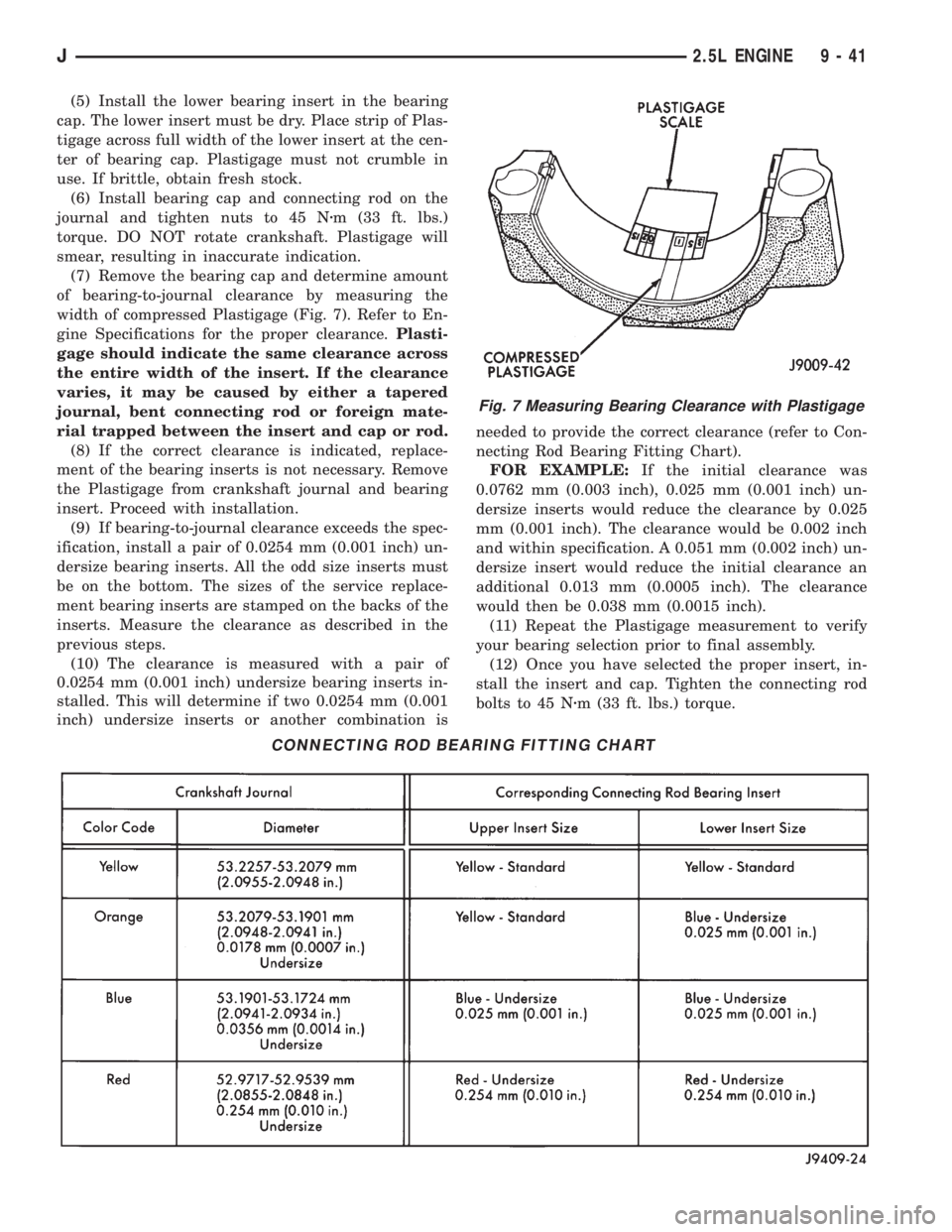
(5) Install the lower bearing insert in the bearing
cap. The lower insert must be dry. Place strip of Plas-
tigage across full width of the lower insert at the cen-
ter of bearing cap. Plastigage must not crumble in
use. If brittle, obtain fresh stock.
(6) Install bearing cap and connecting rod on the
journal and tighten nuts to 45 Nzm (33 ft. lbs.)
torque. DO NOT rotate crankshaft. Plastigage will
smear, resulting in inaccurate indication.
(7) Remove the bearing cap and determine amount
of bearing-to-journal clearance by measuring the
width of compressed Plastigage (Fig. 7). Refer to En-
gine Specifications for the proper clearance.Plasti-
gage should indicate the same clearance across
the entire width of the insert. If the clearance
varies, it may be caused by either a tapered
journal, bent connecting rod or foreign mate-
rial trapped between the insert and cap or rod.
(8) If the correct clearance is indicated, replace-
ment of the bearing inserts is not necessary. Remove
the Plastigage from crankshaft journal and bearing
insert. Proceed with installation.
(9) If bearing-to-journal clearance exceeds the spec-
ification, install a pair of 0.0254 mm (0.001 inch) un-
dersize bearing inserts. All the odd size inserts must
be on the bottom. The sizes of the service replace-
ment bearing inserts are stamped on the backs of the
inserts. Measure the clearance as described in the
previous steps.
(10) The clearance is measured with a pair of
0.0254 mm (0.001 inch) undersize bearing inserts in-
stalled. This will determine if two 0.0254 mm (0.001
inch) undersize inserts or another combination isneeded to provide the correct clearance (refer to Con-
necting Rod Bearing Fitting Chart).
FOR EXAMPLE:If the initial clearance was
0.0762 mm (0.003 inch), 0.025 mm (0.001 inch) un-
dersize inserts would reduce the clearance by 0.025
mm (0.001 inch). The clearance would be 0.002 inch
and within specification. A 0.051 mm (0.002 inch) un-
dersize insert would reduce the initial clearance an
additional 0.013 mm (0.0005 inch). The clearance
would then be 0.038 mm (0.0015 inch).
(11) Repeat the Plastigage measurement to verify
your bearing selection prior to final assembly.
(12) Once you have selected the proper insert, in-
stall the insert and cap. Tighten the connecting rod
bolts to 45 Nzm (33 ft. lbs.) torque.
Fig. 7 Measuring Bearing Clearance with Plastigage
CONNECTING ROD BEARING FITTING CHART
J2.5L ENGINE 9 - 41
Page 1325 of 2158
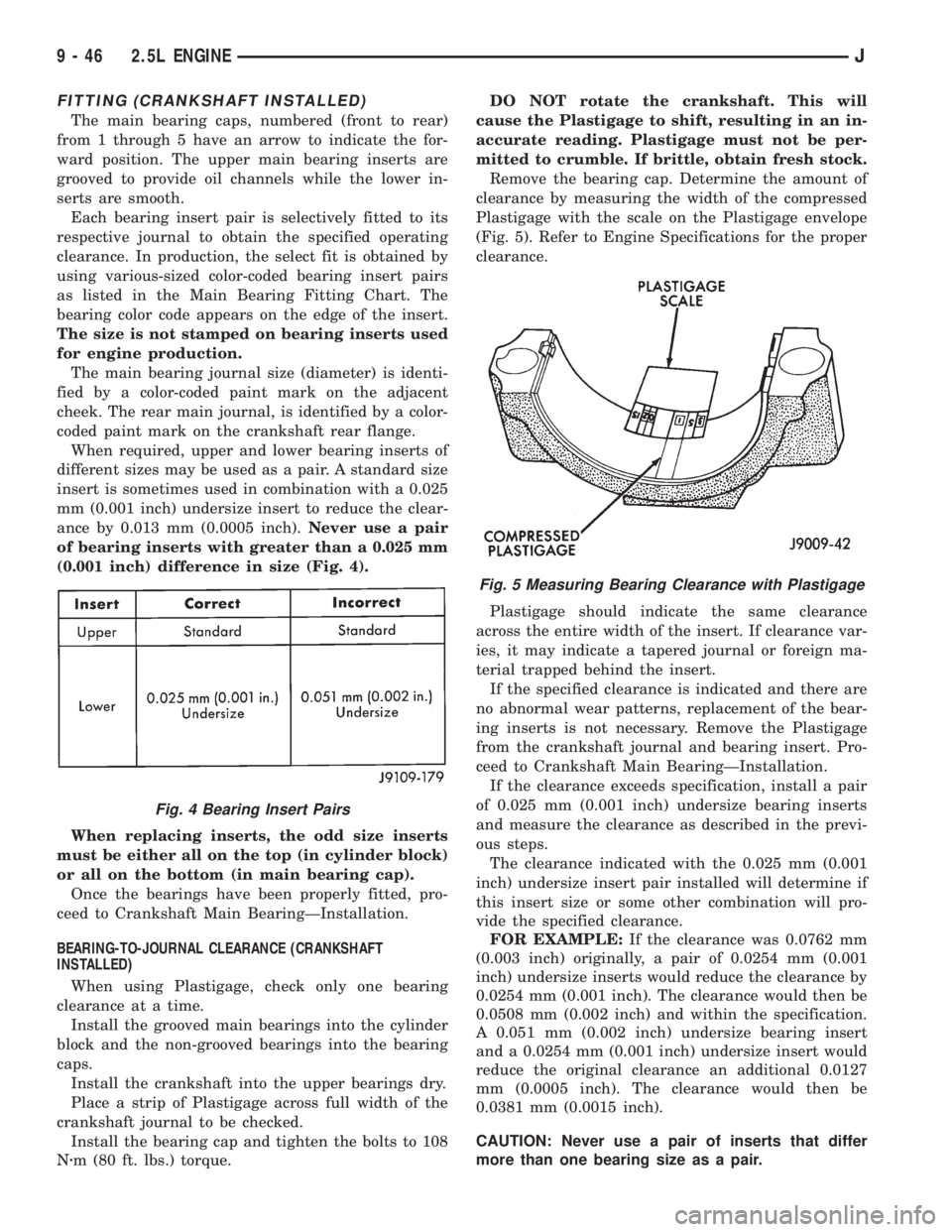
FITTING (CRANKSHAFT INSTALLED)
The main bearing caps, numbered (front to rear)
from 1 through 5 have an arrow to indicate the for-
ward position. The upper main bearing inserts are
grooved to provide oil channels while the lower in-
serts are smooth.
Each bearing insert pair is selectively fitted to its
respective journal to obtain the specified operating
clearance. In production, the select fit is obtained by
using various-sized color-coded bearing insert pairs
as listed in the Main Bearing Fitting Chart. The
bearing color code appears on the edge of the insert.
The size is not stamped on bearing inserts used
for engine production.
The main bearing journal size (diameter) is identi-
fied by a color-coded paint mark on the adjacent
cheek. The rear main journal, is identified by a color-
coded paint mark on the crankshaft rear flange.
When required, upper and lower bearing inserts of
different sizes may be used as a pair. A standard size
insert is sometimes used in combination with a 0.025
mm (0.001 inch) undersize insert to reduce the clear-
ance by 0.013 mm (0.0005 inch).Never use a pair
of bearing inserts with greater than a 0.025 mm
(0.001 inch) difference in size (Fig. 4).
When replacing inserts, the odd size inserts
must be either all on the top (in cylinder block)
or all on the bottom (in main bearing cap).
Once the bearings have been properly fitted, pro-
ceed to Crankshaft Main BearingÐInstallation.
BEARING-TO-JOURNAL CLEARANCE (CRANKSHAFT
INSTALLED)
When using Plastigage, check only one bearing
clearance at a time.
Install the grooved main bearings into the cylinder
block and the non-grooved bearings into the bearing
caps.
Install the crankshaft into the upper bearings dry.
Place a strip of Plastigage across full width of the
crankshaft journal to be checked.
Install the bearing cap and tighten the bolts to 108
Nzm (80 ft. lbs.) torque.DO NOT rotate the crankshaft. This will
cause the Plastigage to shift, resulting in an in-
accurate reading. Plastigage must not be per-
mitted to crumble. If brittle, obtain fresh stock.
Remove the bearing cap. Determine the amount of
clearance by measuring the width of the compressed
Plastigage with the scale on the Plastigage envelope
(Fig. 5). Refer to Engine Specifications for the proper
clearance.
Plastigage should indicate the same clearance
across the entire width of the insert. If clearance var-
ies, it may indicate a tapered journal or foreign ma-
terial trapped behind the insert.
If the specified clearance is indicated and there are
no abnormal wear patterns, replacement of the bear-
ing inserts is not necessary. Remove the Plastigage
from the crankshaft journal and bearing insert. Pro-
ceed to Crankshaft Main BearingÐInstallation.
If the clearance exceeds specification, install a pair
of 0.025 mm (0.001 inch) undersize bearing inserts
and measure the clearance as described in the previ-
ous steps.
The clearance indicated with the 0.025 mm (0.001
inch) undersize insert pair installed will determine if
this insert size or some other combination will pro-
vide the specified clearance.
FOR EXAMPLE:If the clearance was 0.0762 mm
(0.003 inch) originally, a pair of 0.0254 mm (0.001
inch) undersize inserts would reduce the clearance by
0.0254 mm (0.001 inch). The clearance would then be
0.0508 mm (0.002 inch) and within the specification.
A 0.051 mm (0.002 inch) undersize bearing insert
and a 0.0254 mm (0.001 inch) undersize insert would
reduce the original clearance an additional 0.0127
mm (0.0005 inch). The clearance would then be
0.0381 mm (0.0015 inch).
CAUTION: Never use a pair of inserts that differ
more than one bearing size as a pair.
Fig. 4 Bearing Insert Pairs
Fig. 5 Measuring Bearing Clearance with Plastigage
9 - 46 2.5L ENGINEJ
Page 1362 of 2158
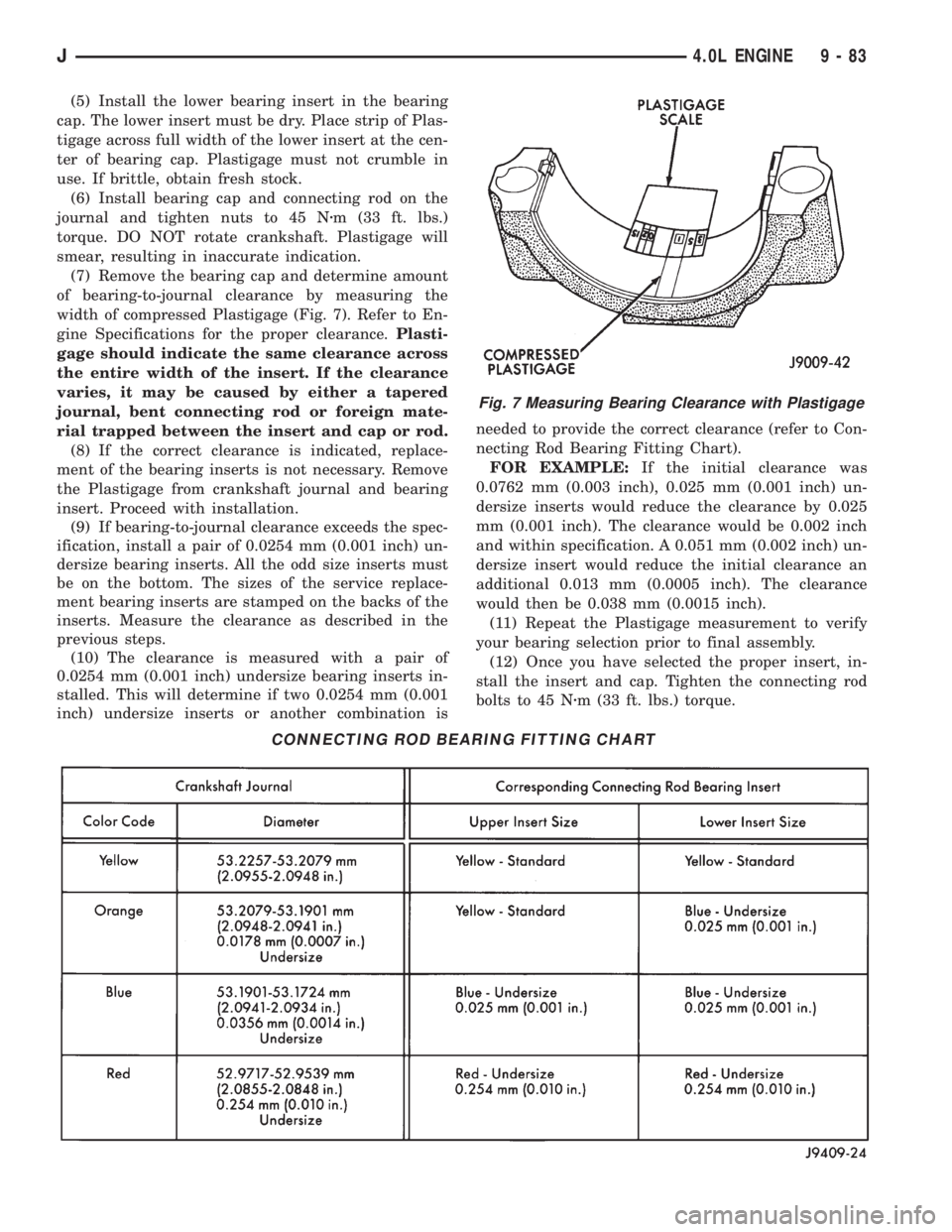
(5) Install the lower bearing insert in the bearing
cap. The lower insert must be dry. Place strip of Plas-
tigage across full width of the lower insert at the cen-
ter of bearing cap. Plastigage must not crumble in
use. If brittle, obtain fresh stock.
(6) Install bearing cap and connecting rod on the
journal and tighten nuts to 45 Nzm (33 ft. lbs.)
torque. DO NOT rotate crankshaft. Plastigage will
smear, resulting in inaccurate indication.
(7) Remove the bearing cap and determine amount
of bearing-to-journal clearance by measuring the
width of compressed Plastigage (Fig. 7). Refer to En-
gine Specifications for the proper clearance.Plasti-
gage should indicate the same clearance across
the entire width of the insert. If the clearance
varies, it may be caused by either a tapered
journal, bent connecting rod or foreign mate-
rial trapped between the insert and cap or rod.
(8) If the correct clearance is indicated, replace-
ment of the bearing inserts is not necessary. Remove
the Plastigage from crankshaft journal and bearing
insert. Proceed with installation.
(9) If bearing-to-journal clearance exceeds the spec-
ification, install a pair of 0.0254 mm (0.001 inch) un-
dersize bearing inserts. All the odd size inserts must
be on the bottom. The sizes of the service replace-
ment bearing inserts are stamped on the backs of the
inserts. Measure the clearance as described in the
previous steps.
(10) The clearance is measured with a pair of
0.0254 mm (0.001 inch) undersize bearing inserts in-
stalled. This will determine if two 0.0254 mm (0.001
inch) undersize inserts or another combination isneeded to provide the correct clearance (refer to Con-
necting Rod Bearing Fitting Chart).
FOR EXAMPLE:If the initial clearance was
0.0762 mm (0.003 inch), 0.025 mm (0.001 inch) un-
dersize inserts would reduce the clearance by 0.025
mm (0.001 inch). The clearance would be 0.002 inch
and within specification. A 0.051 mm (0.002 inch) un-
dersize insert would reduce the initial clearance an
additional 0.013 mm (0.0005 inch). The clearance
would then be 0.038 mm (0.0015 inch).
(11) Repeat the Plastigage measurement to verify
your bearing selection prior to final assembly.
(12) Once you have selected the proper insert, in-
stall the insert and cap. Tighten the connecting rod
bolts to 45 Nzm (33 ft. lbs.) torque.
Fig. 7 Measuring Bearing Clearance with Plastigage
CONNECTING ROD BEARING FITTING CHART
J4.0L ENGINE 9 - 83
Page 1367 of 2158
ward position. The upper main bearing inserts are
grooved to provide oil channels while the lower in-
serts are smooth.
Each bearing insert pair is selectively fitted to its
respective journal to obtain the specified operating
clearance. In production, the select fit is obtained by
using various-sized color-coded bearing insert pairs
as listed in the Main Bearing Fitting Chart. The
bearing color code appears on the edge of the insert.
The size is not stamped on bearing inserts used
for engine production.
The main bearing journal size (diameter) is identi-
fied by a color-coded paint mark on the adjacent
cheek. The rear main journal, is identified by a color-
coded paint mark on the crankshaft rear flange.
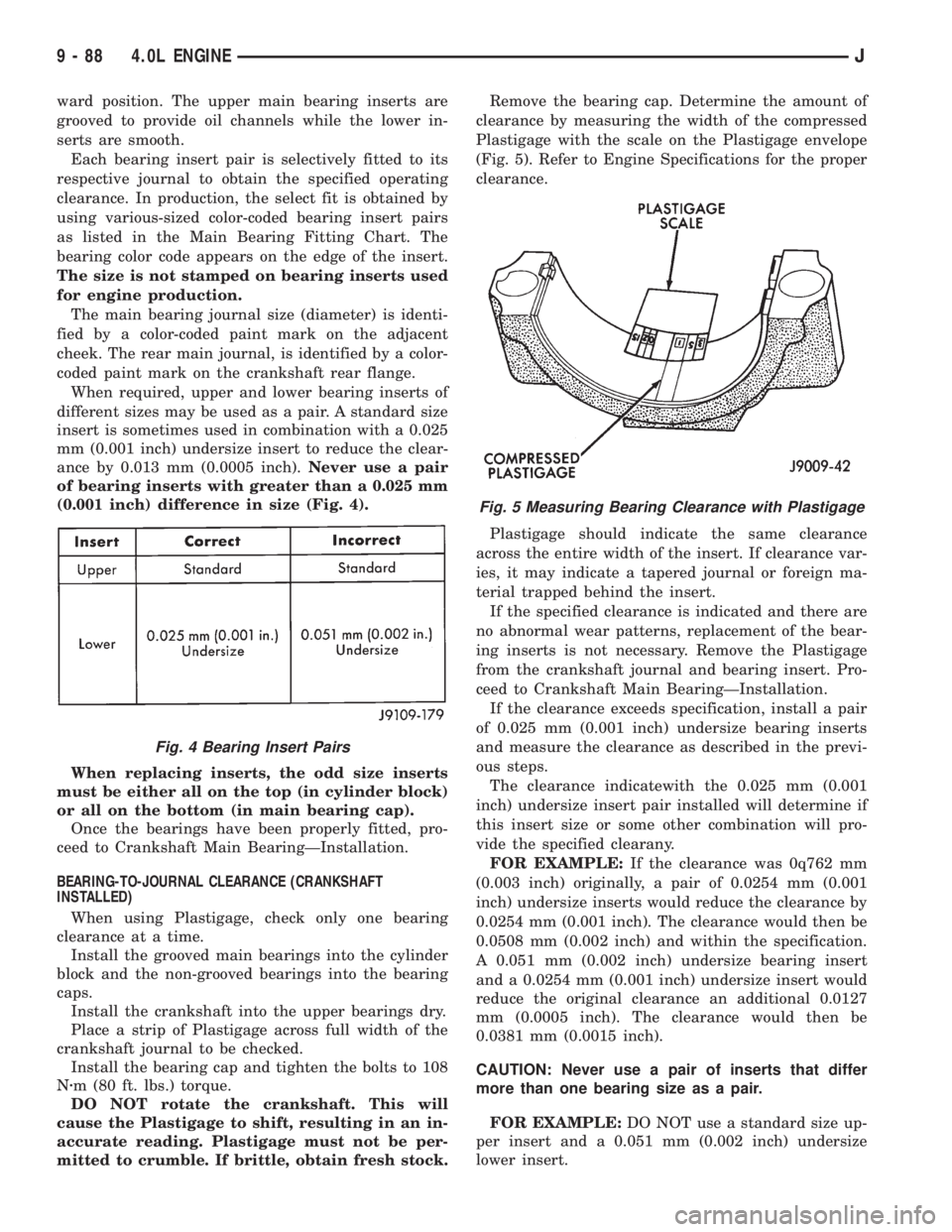
When required, upper and lower bearing inserts of
different sizes may be used as a pair. A standard size
insert is sometimes used in combination with a 0.025
mm (0.001 inch) undersize insert to reduce the clear-
ance by 0.013 mm (0.0005 inch).Never use a pair
of bearing inserts with greater than a 0.025 mm
(0.001 inch) difference in size (Fig. 4).
When replacing inserts, the odd size inserts
must be either all on the top (in cylinder block)
or all on the bottom (in main bearing cap).
Once the bearings have been properly fitted, pro-
ceed to Crankshaft Main BearingÐInstallation.
BEARING-TO-JOURNAL CLEARANCE (CRANKSHAFT
INSTALLED)
When using Plastigage, check only one bearing
clearance at a time.
Install the grooved main bearings into the cylinder
block and the non-grooved bearings into the bearing
caps.
Install the crankshaft into the upper bearings dry.
Place a strip of Plastigage across full width of the
crankshaft journal to be checked.
Install the bearing cap and tighten the bolts to 108
Nzm (80 ft. lbs.) torque.
DO NOT rotate the crankshaft. This will
cause the Plastigage to shift, resulting in an in-
accurate reading. Plastigage must not be per-
mitted to crumble. If brittle, obtain fresh stock.Remove the bearing cap. Determine the amount of
clearance by measuring the width of the compressed
Plastigage with the scale on the Plastigage envelope
(Fig. 5). Refer to Engine Specifications for the proper
clearance.
Plastigage should indicate the same clearance
across the entire width of the insert. If clearance var-
ies, it may indicate a tapered journal or foreign ma-
terial trapped behind the insert.
If the specified clearance is indicated and there are
no abnormal wear patterns, replacement of the bear-
ing inserts is not necessary. Remove the Plastigage
from the crankshaft journal and bearing insert. Pro-
ceed to Crankshaft Main BearingÐInstallation.
If the clearance exceeds specification, install a pair
of 0.025 mm (0.001 inch) undersize bearing inserts
and measure the clearance as described in the previ-
ous steps.
The clearance indicatewith the 0.025 mm (0.001
inch) undersize insert pair installed will determine if
this insert size or some other combination will pro-
vide the specified clearany.
FOR EXAMPLE:If the clearance was 0q762 mm
(0.003 inch) originally, a pair of 0.0254 mm (0.001
inch) undersize inserts would reduce the clearance by
0.0254 mm (0.001 inch). The clearance would then be
0.0508 mm (0.002 inch) and within the specification.
A 0.051 mm (0.002 inch) undersize bearing insert
and a 0.0254 mm (0.001 inch) undersize insert would
reduce the original clearance an additional 0.0127
mm (0.0005 inch). The clearance would then be
0.0381 mm (0.0015 inch).
CAUTION: Never use a pair of inserts that differ
more than one bearing size as a pair.
FOR EXAMPLE:DO NOT use a standard size up-
per insert and a 0.051 mm (0.002 inch) undersize
lower insert.
Fig. 4 Bearing Insert Pairs
Fig. 5 Measuring Bearing Clearance with Plastigage
9 - 88 4.0L ENGINEJ
Page 1671 of 2158
Inspection
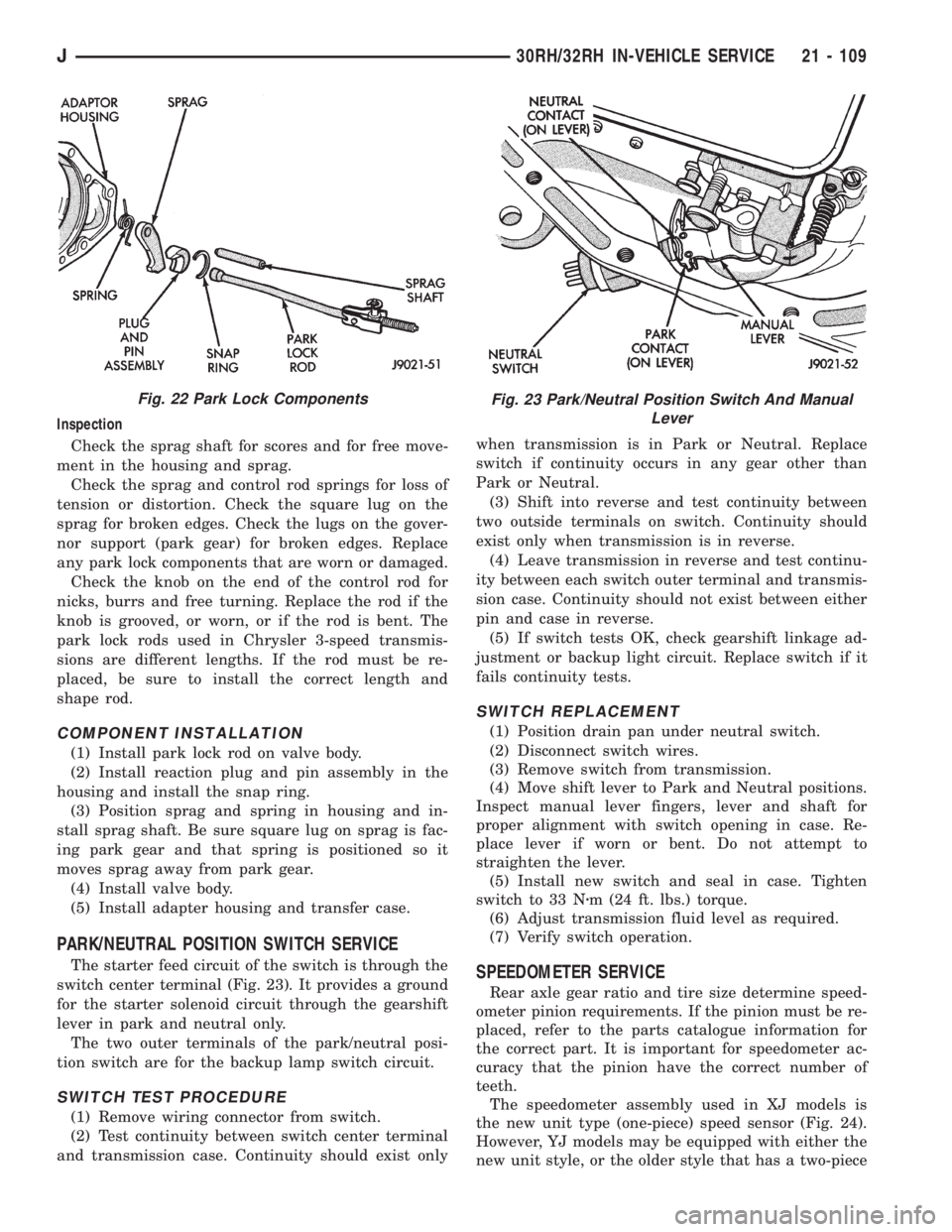
Check the sprag shaft for scores and for free move-
ment in the housing and sprag.
Check the sprag and control rod springs for loss of
tension or distortion. Check the square lug on the
sprag for broken edges. Check the lugs on the gover-
nor support (park gear) for broken edges. Replace
any park lock components that are worn or damaged.
Check the knob on the end of the control rod for
nicks, burrs and free turning. Replace the rod if the
knob is grooved, or worn, or if the rod is bent. The
park lock rods used in Chrysler 3-speed transmis-
sions are different lengths. If the rod must be re-
placed, be sure to install the correct length and
shape rod.
COMPONENT INSTALLATION
(1) Install park lock rod on valve body.
(2) Install reaction plug and pin assembly in the
housing and install the snap ring.
(3) Position sprag and spring in housing and in-
stall sprag shaft. Be sure square lug on sprag is fac-
ing park gear and that spring is positioned so it
moves sprag away from park gear.
(4) Install valve body.
(5) Install adapter housing and transfer case.
PARK/NEUTRAL POSITION SWITCH SERVICE
The starter feed circuit of the switch is through the
switch center terminal (Fig. 23). It provides a ground
for the starter solenoid circuit through the gearshift
lever in park and neutral only.
The two outer terminals of the park/neutral posi-
tion switch are for the backup lamp switch circuit.
SWITCH TEST PROCEDURE
(1) Remove wiring connector from switch.
(2) Test continuity between switch center terminal
and transmission case. Continuity should exist onlywhen transmission is in Park or Neutral. Replace
switch if continuity occurs in any gear other than
Park or Neutral.
(3) Shift into reverse and test continuity between
two outside terminals on switch. Continuity should
exist only when transmission is in reverse.
(4) Leave transmission in reverse and test continu-
ity between each switch outer terminal and transmis-
sion case. Continuity should not exist between either
pin and case in reverse.
(5) If switch tests OK, check gearshift linkage ad-
justment or backup light circuit. Replace switch if it
fails continuity tests.
SWITCH REPLACEMENT
(1) Position drain pan under neutral switch.
(2) Disconnect switch wires.
(3) Remove switch from transmission.
(4) Move shift lever to Park and Neutral positions.
Inspect manual lever fingers, lever and shaft for
proper alignment with switch opening in case. Re-
place lever if worn or bent. Do not attempt to
straighten the lever.
(5) Install new switch and seal in case. Tighten
switch to 33 Nzm (24 ft. lbs.) torque.
(6) Adjust transmission fluid level as required.
(7) Verify switch operation.
SPEEDOMETER SERVICE
Rear axle gear ratio and tire size determine speed-
ometer pinion requirements. If the pinion must be re-
placed, refer to the parts catalogue information for
the correct part. It is important for speedometer ac-
curacy that the pinion have the correct number of
teeth.
The speedometer assembly used in XJ models is
the new unit type (one-piece) speed sensor (Fig. 24).
However, YJ models may be equipped with either the
new unit style, or the older style that has a two-piece
Fig. 22 Park Lock ComponentsFig. 23 Park/Neutral Position Switch And Manual
Lever
J30RH/32RH IN-VEHICLE SERVICE 21 - 109
Page 1907 of 2158
WHEELS AND TIRES
CONTENTS
page page
SPECIFICATIONS........................ 12
TIRES.................................. 1VEHICLE VIBRATION..................... 10
WHEELS................................ 6
TIRES
INDEX
page page
Cleaning of Tires.......................... 2
General Information........................ 1
Pressure Gauges.......................... 2
Repairing Leaks........................... 3
Replacement Tires......................... 2Rotation................................. 3
Tire Inflation Pressures...................... 2
Tire Noise or Vibration...................... 4
Tire Wear Patterns......................... 4
Tread Wear Indicators....................... 3
GENERAL INFORMATION
Tires are designed for each specific vehicle. They
provide the best overall performance for normal oper-
ation. The ride and handling characteristics match
the vehicle's requirements. With proper care they
will give excellent reliability, traction, skid resis-
tance, and tread life. These tires have specific load
carrying capacities. When correctly inflated, they will
operate properly.
Tires used in cool climates, and with light loads
will have a longer life than tires used in hot climates
with heavy loads. Abrasive road surfaces will acceler-
ate tire wear.
Driving habits have more effect on tire life than
any other factor. Careful drivers will obtain much
greater mileage than careless drivers.
Driving habits that shorten the life of any tire;
²Rapid acceleration and deceleration
²Severe application of brakes
²High-speed driving
²Taking turns at excessive speeds
²Striking curbs and other obstacles
It is very important to follow the tire rotation in-
terval
IDENTIFICATION
Tire type, size, aspect ratio and speed rating are
encoded in the letters and numbers imprinted on the
side wall of the tire. Refer to the chart to decipher
the tire identification code (Fig. 1).Performance tires will have a speed rating letter
after the aspect ratio number. The speed rating is not
always printed on the tire sidewall. The letterSin-
dicates that the tire is speed rated up to 112 mph.
²Qup to 100 mph
²Tup to 118 mph
²Uup to 124 mph
²Hup to 130 mph
²Vup to 149 mph
²Zmore than 149 mph (consult the tire manufac-
turer for the specific speed rating)
An All Season type tire will have eitherM+S,M
&SorMÐS(indicating mud and snow traction) im-
printed on the side wall.
RADIAL-PLY TIRES
Radial-ply tires improve handling, tread life, ride
quality and decrease rolling resistance.
Radial-ply tires must always be used in sets of
four. Under no circumstances should they be used on
the front only. They may be mixed with temporary
spare tires when necessary, but reduced speeds are
recommended.
Radial-ply tires have the same load-carrying capac-
ity as other types of tires of the same size. They use
the same recommended inflation pressures.
SPARE TIRE (TEMPORARY)
The compact spare tire is designed for emergency
use only. The original tire should be repaired and re-
installed at the first opportunity. Refer to Owner's
Manual for complete details.
JWHEELS AND TIRES 22 - 1
Page 1908 of 2158
TIRE CHAINS
Tire snow chains may be used on certain models.
Refer to Owner's Manual for more information.
CLEANING OF TIRES
Steam cleaning may be used for cleaning.
DO NOT use gasoline or wire brush for cleaning.
DO NOT use mineral oil or an oil-based solvent.
PRESSURE GAUGES
High-quality, dial-type, air-pressure gauges are rec-
ommended. After checking with the gauge, replace
valve cap and finger tight.
TIRE INFLATION PRESSURES
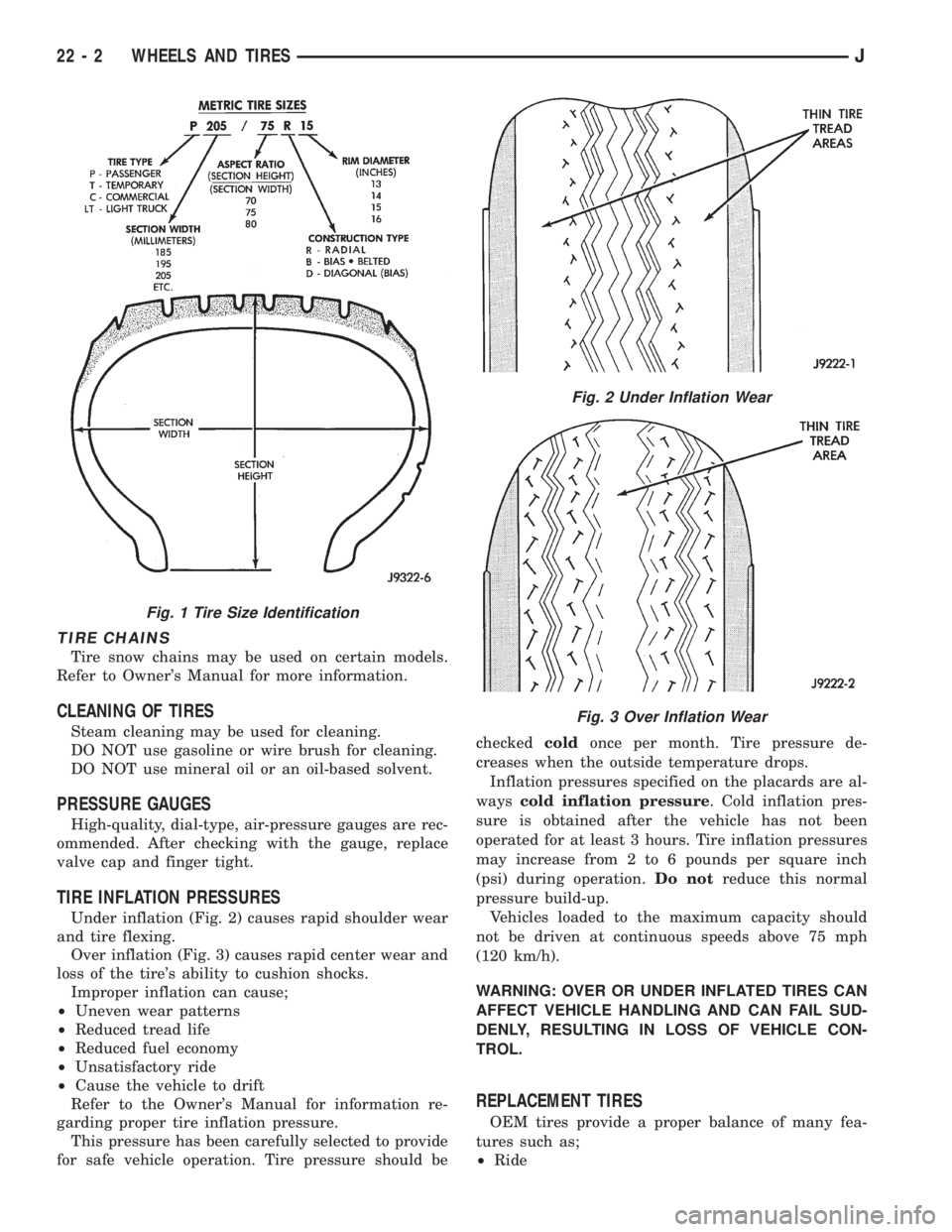
Under inflation (Fig. 2) causes rapid shoulder wear
and tire flexing.
Over inflation (Fig. 3) causes rapid center wear and
loss of the tire's ability to cushion shocks.
Improper inflation can cause;
²Uneven wear patterns
²Reduced tread life
²Reduced fuel economy
²Unsatisfactory ride
²Cause the vehicle to drift
Refer to the Owner's Manual for information re-
garding proper tire inflation pressure.
This pressure has been carefully selected to provide
for safe vehicle operation. Tire pressure should becheckedcoldonce per month. Tire pressure de-
creases when the outside temperature drops.
Inflation pressures specified on the placards are al-
wayscold inflation pressure. Cold inflation pres-
sure is obtained after the vehicle has not been
operated for at least 3 hours. Tire inflation pressures
may increase from 2 to 6 pounds per square inch
(psi) during operation.Do notreduce this normal
pressure build-up.
Vehicles loaded to the maximum capacity should
not be driven at continuous speeds above 75 mph
(120 km/h).
WARNING: OVER OR UNDER INFLATED TIRES CAN
AFFECT VEHICLE HANDLING AND CAN FAIL SUD-
DENLY, RESULTING IN LOSS OF VEHICLE CON-
TROL.
REPLACEMENT TIRES
OEM tires provide a proper balance of many fea-
tures such as;
²Ride
Fig. 1 Tire Size Identification
Fig. 2 Under Inflation Wear
Fig. 3 Over Inflation Wear
22 - 2 WHEELS AND TIRESJ
Page 1909 of 2158
²Noise
²Handling
²Durability
²Tread life
²Traction
²Rolling resistance
²Speed capability
Original equipment tires should be used when re-
placement is needed.
Refer to the placard on the vehicle or the
Owner's Manual for the correct replacement
tire.
Failure to use original or equivalent replacement
tires may adversely affect the handling of the vehicle.
The use of oversize tiresis not recommended.
They may cause interference with vehicle suspension
and steering travel. This can cause tire damage or
failure.
WARNING: FAILURE TO EQUIP THE VEHICLE WITH
TIRES HAVING ADEQUATE LOAD CAPABILITY CAN
RESULT IN SUDDEN TIRE FAILURE.
ROTATION
Tires on the front and rear axles operate at differ-
ent loads and perform different steering, driving, and
braking functions. For these reasons, the tires wear
at unequal rates. They may also develop irregular
wear patterns. These effects can be reduced by rotat-
ing the tires according to the maintenance schedule
in the Owners Manual. This will improve tread life,
traction and maintain a smooth quiet ride.
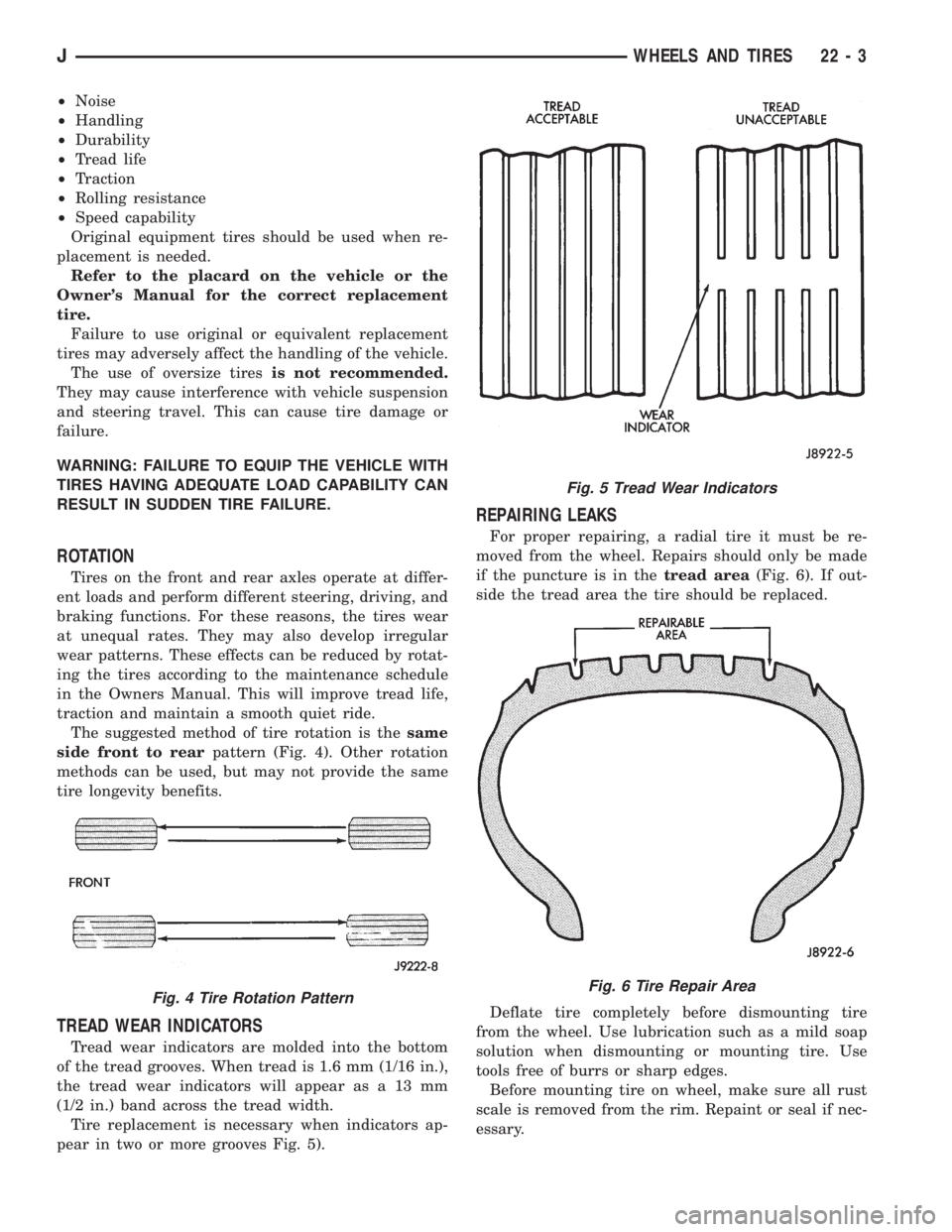
The suggested method of tire rotation is thesame
side front to rearpattern (Fig. 4). Other rotation
methods can be used, but may not provide the same
tire longevity benefits.
TREAD WEAR INDICATORS
Tread wear indicators are molded into the bottom
of the tread grooves. When tread is 1.6 mm (1/16 in.),
the tread wear indicators will appear as a 13 mm
(1/2 in.) band across the tread width.
Tire replacement is necessary when indicators ap-
pear in two or more grooves Fig. 5).
REPAIRING LEAKS
For proper repairing, a radial tire it must be re-
moved from the wheel. Repairs should only be made
if the puncture is in thetread area(Fig. 6). If out-
side the tread area the tire should be replaced.
Deflate tire completely before dismounting tire
from the wheel. Use lubrication such as a mild soap
solution when dismounting or mounting tire. Use
tools free of burrs or sharp edges.
Before mounting tire on wheel, make sure all rust
scale is removed from the rim. Repaint or seal if nec-
essary.
Fig. 4 Tire Rotation Pattern
Fig. 5 Tread Wear Indicators
Fig. 6 Tire Repair Area
JWHEELS AND TIRES 22 - 3
Page 1995 of 2158
TRAILER HITCH
TRAILER HITCHÐXJ
CLASS III HITCH
A class III weight-distributing/equalizer type hitch
can be used to tow a trailer:
²Having a maximum gross weight of 5,000 lbs/2250
kg.
²Having a maximum tongue weight of 750 lbs/332
kg).
The following vehicle basic equipment is required
for class III trailer towing:
²P205/75R15 or larger tires.
²Full size spare tire.
²Trailer sway control.
²Trailer tow wire harness and connector.
²Heavy duty turn signal flasher element.
²Heavy duty axle (with synthetic lubricant).
²Heavy duty cooling system.
²Heavy duty generator/battery.
²Auxiliary automatic transmission fluid cooler.
²I-6, 4.0L engine.
Wide-angle type door mirrors are recommended but
not required.
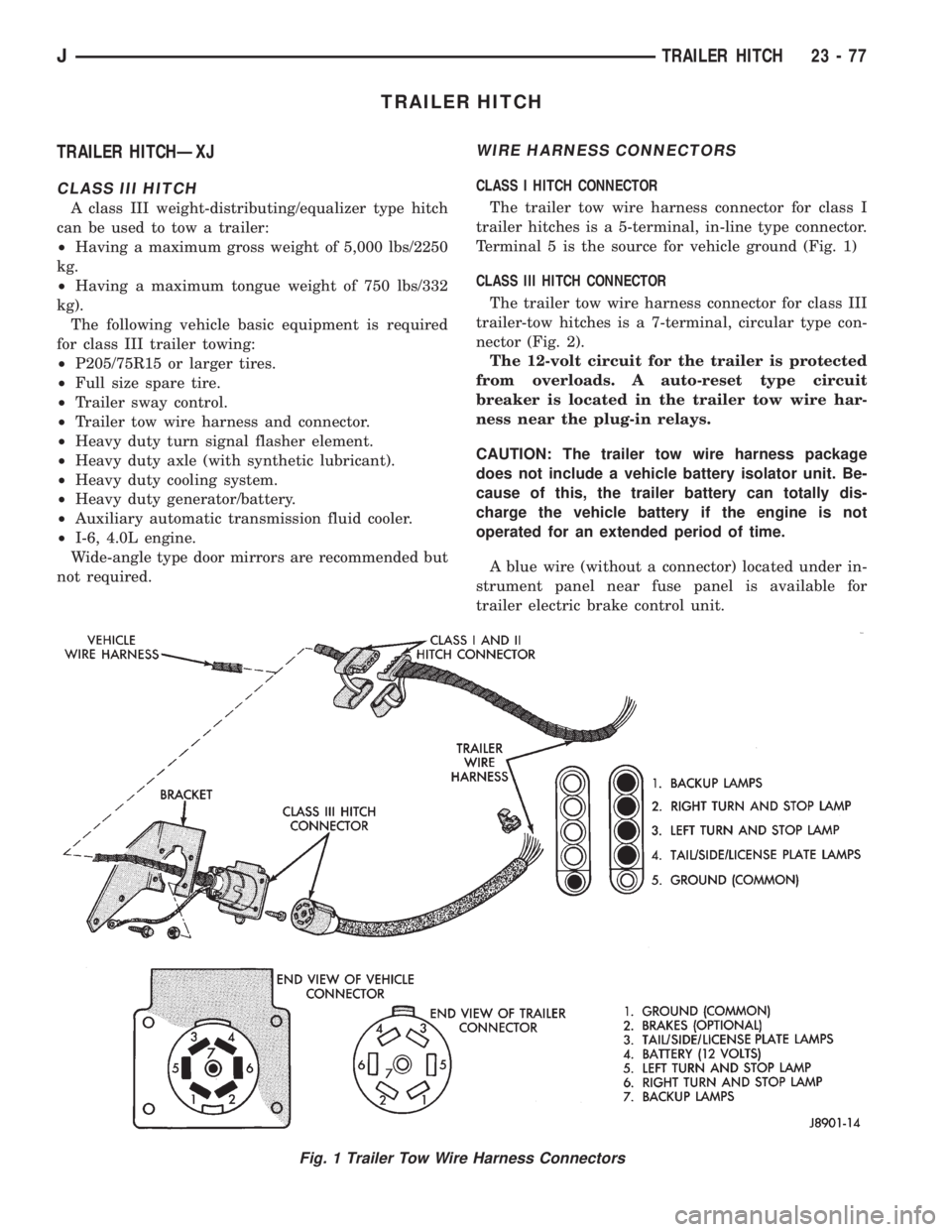
WIRE HARNESS CONNECTORS
CLASS I HITCH CONNECTOR
The trailer tow wire harness connector for class I
trailer hitches is a 5-terminal, in-line type connector.
Terminal 5 is the source for vehicle ground (Fig. 1)
CLASS III HITCH CONNECTOR
The trailer tow wire harness connector for class III
trailer-tow hitches is a 7-terminal, circular type con-
nector (Fig. 2).
The 12-volt circuit for the trailer is protected
from overloads. A auto-reset type circuit
breaker is located in the trailer tow wire har-
ness near the plug-in relays.
CAUTION: The trailer tow wire harness package
does not include a vehicle battery isolator unit. Be-
cause of this, the trailer battery can totally dis-
charge the vehicle battery if the engine is not
operated for an extended period of time.
A blue wire (without a connector) located under in-
strument panel near fuse panel is available for
trailer electric brake control unit.
Fig. 1 Trailer Tow Wire Harness Connectors
JTRAILER HITCH 23 - 77
Page 2138 of 2158
INDEX, DIAGRAM; FRONT LIGHTING
(XJ).............................8W-50-2
INDEX, DIAGRAM; FRONT LIGHTING
(XJ-RHD).........................8W-50-3
INDEX, DIAGRAM; FRONT LIGHTING
(YJ).............................8W-50-2
INDEX, DIAGRAM; FUEL/IGNITION (YJ) . 8W-30-5
INDEX, DIAGRAM; FUSE/FUSE BLOCK
(XJ).............................8W-10-1
INDEX, DIAGRAM; FUSE/FUSE BLOCK
(XJ-RHD).........................8W-10-1
INDEX, DIAGRAM; FUSE/FUSE BLOCK
(YJ).............................8W-10-1
INDEX, DIAGRAM; GROUND
DISTRIBUTION (XJ)................8W-15-1
INDEX, DIAGRAM; GROUND
DISTRIBUTION (XJ-RHD)............8W-15-1
INDEX, DIAGRAM; GROUND
DISTRIBUTION (YJ)................8W-15-1
INDEX, DIAGRAM; HEATED REAR
WINDOW (XJ).....................8W-48-1
INDEX, DIAGRAM; HEATED REAR
WINDOW (XJ-RHD).................8W-48-1
INDEX, DIAGRAM; HEATED REAR
WINDOW (YJ).....................8W-48-1
INDEX, DIAGRAM; HORN/CIGAR
LIGHTER............................8E-1
INDEX, DIAGRAM; HORN/CIGAR
LIGHTER (YJ).....................8W-41-1
INDEX, DIAGRAM; INSTRUMENT
CLUSTER (XJ).............8W-40-1,8W-40-3
INDEX, DIAGRAM; INSTRUMENT
CLUSTER (XJ-RHD)................8W-40-3
INDEX, DIAGRAM; INSTRUMENT
CLUSTER (YJ).....................8W-40-2
INDEX, DIAGRAM; INTERIOR LIGHTING
(XJ).............................8W-44-2
INDEX, DIAGRAM; INTERIOR LIGHTING
(XJ-RHD).........................8W-44-2
INDEX, DIAGRAM; INTERIOR LIGHTING
(YJ).............................8W-44-2
INDEX, DIAGRAM; OVERHEAD CONSOLE
(XJ).............................8W-49-1
INDEX, DIAGRAM; OVERHEAD CONSOLE
(XJ-RHD).........................8W-49-1
INDEX, DIAGRAM; POWER
DISTRIBUTION (XJ)................8W-11-1
INDEX, DIAGRAM; POWER
DISTRIBUTION (XJ-RHD)............8W-11-1
INDEX, DIAGRAM; POWER
DISTRIBUTION (YJ)................8W-11-1
INDEX, DIAGRAM; POWER DOOR LOCKS
(XJ).............................8W-61-1
INDEX, DIAGRAM; POWER DOOR LOCKS
(XJ-RHD).........................8W-61-1
INDEX, DIAGRAM; POWER MIRRORS
(XJ).............................8W-62-1
INDEX, DIAGRAM; POWER MIRRORS
(XJ-RHD).........................8W-62-1
INDEX, DIAGRAM; POWER SEAT (XJ) . . 8W-63-1
INDEX, DIAGRAM; POWER SEAT
(XJ-RHD).........................8W-63-1
INDEX, DIAGRAM; POWER WINDOWS
(XJ).............................8W-60-2
INDEX, DIAGRAM; POWER WINDOWS
(XJ-RHD).........................8W-60-2
INDEX, DIAGRAM; REAR LIGHTING
(XJ).............................8W-51-1
INDEX, DIAGRAM; REAR LIGHTING
(XJ-RHD).........................8W-51-1
INDEX, DIAGRAM; REAR LIGHTING
(YJ).............................8W-51-1
INDEX, DIAGRAM; STARTING SYSTEM
(XJ).............................8W-21-1
INDEX, DIAGRAM; STARTING SYSTEM
(XJ-RHD).........................8W-21-1
INDEX, DIAGRAM; STARTING SYSTEM
(YJ).............................8W-21-1
INDEX, DIAGRAM; TRAILER TOW (XJ) . . 8W-54-1
INDEX, DIAGRAM; TRAILER TOW
(XJ-RHD)
.........................8W-54-1
INDEX, DIAGRAM; TRANSMISSION
CONTROLS (XJ)
...................8W-31-1
INDEX, DIAGRAM; TRANSMISSION
CONTROLS (XJ-RHD)
...............8W-31-1
INDEX, DIAGRAM; TRANSMISSION
CONTROLS (YJ)
...................8W-31-1
INDEX, DIAGRAM; TURN SIGNALS (XJ)
. 8W-52-1INDEX, DIAGRAM; TURN SIGNALS
(XJ-RHD).........................8W-52-1
INDEX, DIAGRAM; TURN SIGNALS (YJ) . 8W-52-1
INDEX, DIAGRAM; VEHICLE SPEED
CONTROL (XJ)....................8W-33-1
INDEX, DIAGRAM; VEHICLE SPEED
CONTROL (XJ-RHD)................8W-33-1
INDEX, DIAGRAM; WIPERS (XJ).......8W-53-2
INDEX, DIAGRAM; WIPERS (XJ-RHD) . . 8W-53-2
INDEX, DIAGRAM; WIPERS (YJ).......8W-53-2
INDEX, DIAGRAM; FUEL/IGNITION
(XJ-RHD).........................8W-30-5
INDEX, GROUP; COOLING SYSTEM.......8E-1
INDEX, GROUP; INSTRUMENT PANEL
AND GAUGES........................8E-1
INDEX, SPLICE; SPLICE INFORMATION
(XJ).............................8W-70-1
INDEX, SPLICE; SPLICE INFORMATION
(XJ-RHD).........................8W-70-1
INDEX, SPLICE; SPLICE INFORMATION
(YJ).............................8W-70-1
INDEXÐ2.5L ENGINE, DIAGRAM......8W-30-6
INDEXÐ4.0L ENGINE, DIAGRAM......8W-30-6
INDICATOR LAMP, CHARGING SYSTEM . 8W-40-3
INDICATOR LAMP, HIGH-BEAM;
INSTRUMENT CLUSTER (XJ).........8W-40-2
INDICATOR LAMP, HIGH-BEAM;
INSTRUMENT CLUSTER (XJ-RHD).....8W-40-2
INDICATOR LAMP (MIL), MALFUNCTION;
FUEL/IGNITION (XJ)................8W-30-5
INDICATOR LAMP (MIL), MALFUNCTION;
FUEL/IGNITION (YJ)................8W-30-5
INDICATOR LAMP (MIL), MALFUNCTION;
INSTRUMENT CLUSTER (XJ).........8W-40-2
INDICATOR LAMP (MIL), MALFUNCTION;
INSTRUMENT CLUSTER (XJ-RHD).....8W-40-1
INDICATOR LAMP (MIL), MALFUNCTION;
FUEL/IGNITION (XJ-RHD)............8W-30-4
INDICATOR LAMPÐPCM OUTPUT,
MALFUNCTION......................14-28
INDICATOR LAMPS.....8E-12,8E-25,8E-32,8E-3
INDICATOR LAMPS, TURN SIGNAL;
INSTRUMENT CLUSTER (XJ).........8W-40-2
INDICATOR LAMPS, TURN SIGNAL;
INSTRUMENT CLUSTER (XJ-RHD).....8W-40-2
INDICATOR (SRI) LAMP, SERVICE
REMINDER..........................25-1
INDICATOR WARNING LAMP, SEAT BELT;
INSTRUMENT CLUSTER (XJ).........8W-40-2
INDICATOR WARNING LAMP, SEAT BELT;
INSTRUMENT CLUSTER (XJ-RHD).....8W-40-2
INDICATORÐPCM OUTPUT, SHIFT.......14-29
INDICATORS, TREAD WEAR.............22-3
INFLATION PRESSURES, TIRE...........22-2
INFORMATIONÐXJ, DOME/COURTESY
LAMP SERVICE......................8L-16
INFORMATIONÐXJ, UNDERHOOD LAMP
SERVICE...........................8L-12
INFORMATIONÐYJ, DOME/COURTESY
LAMP SERVICE......................8L-31
INFORMATIONÐYJ, SOFT TOP SERVICE . 23-127
INFORMATIONÐYJ, UNDERHOOD LAMP
SERVICE...........................8L-28
INITIALIZATION, ABS SYSTEM
POWER-UP..........................5-35
INJECTION (MFI)ÐCOMPONENT
DESCRIPTION/SYSTEM OPERATION,
MULTI-PORT FUEL...................14-19
INJECTION (MFI)ÐCOMPONENT
REMOVAL/INSTALLATION, MULTI-PORT
FUEL..............................14-58
INJECTION (MFI)ÐGENERAL
DIAGNOSIS, MULTI-PORT FUEL.........14-35
INJECTOR DIAGNOSISÐVEHICLE RUNS
ROUGH AND/OR HAS A MISS...........14-52
INJECTOR, FUEL.....................14-60
INJECTOR TEST, FUEL.................14-51
INJECTORS, FUEL; FUEL/IGNITION (XJ) . 8W-30-1
INJECTORS, FUEL; FUEL/IGNITION (YJ) . 8W-30-2
INJECTORS, FUEL; FUEL/IGNITION
(XJ-RHD).........................8W-30-1
INJECTORSÐPCM OUTPUT, FUEL
.......14-27
IN-LINE FUSE
........................8F-1
INNER AXLE SHAFT OIL SEAL
REPLACEMENT
.......................2-35
INNER SCUFF PLATE/COWL SIDE TRIM
PANELÐXJ, FRONT
...................23-86
INNER SPLASH SHIELDSÐYJ, FENDER
. . 23-116INPUT, AIR CONDITIONING (A/C)
CONTROLSÐPCM....................14-21
INPUT, AUTOMATIC SHUTDOWN (ASD)
SENSEÐPCM.......................14-21
INPUT, BATTERY VOLTAGEÐPCM........14-21
INPUT, BRAKE SWITCH; ANTI-LOCK
BRAKES (XJ)......................8W-32-2
INPUT, BRAKE SWITCH; ANTI-LOCK
BRAKES (XJ-RHD).................8W-32-2
INPUT, BRAKE SWITCH; ANTI-LOCK
BRAKES (YJ)......................8W-32-2
INPUT, BRAKE SWITCH; FUEL/IGNITION
(XJ).............................8W-30-5
INPUT, BRAKE SWITCH; FUEL/IGNITION
(YJ).............................8W-30-5
INPUT, BRAKE SWITCH; FUEL/IGNITION
(XJ-RHD).........................8W-30-5
INPUT, BRAKE SWITCHÐPCM..........14-22
INPUT, CAMSHAFT POSITION SENSORÐ
PCM...............................14-22
INPUT, CRANKSHAFT POSITION
SENSORÐPCM......................14-22
INPUT, DATA LINK CONNECTORÐPCM . . . 14-22
INPUT, ENGINE COOLANT
TEMPERATURE SENSORÐPCM.........14-23
INPUT, EXTENDED IDLE SWITCHÐPCM . . . 14-23
INPUT, IGNITION CIRCUIT SENSEÐPCM . . 14-23
INPUT, INTAKE MANIFOLD AIR
TEMPERATURE SENSORÐPCM.........14-22
INPUT, MANIFOLD ABSOLUTE
PRESSURE (MAP) SENSORÐPCM.......14-23
INPUT, OXYGEN (O2S) SENSORÐPCM.....14-24
INPUT, PARK/NEUTRAL SWITCHÐPCM . . . 14-24
INPUT, POWER STEERING PRESSURE
SWITCHÐPCM......................14-24
INPUT, SCI RECEIVEÐPCM............14-24
INPUT, SENSOR RETURNÐPCM.........14-25
INPUT SIGNALS, WHEEL/TIRE SIZE........5-3
INPUT, SPEED CONTROLÐPCM.........14-25
INPUT, THROTTLE POSITION SENSOR
(TPS)ÐPCM........................14-25
INPUT, VEHICLE SPEED SENSORÐPCM . . 14-25
INSERTÐXJ, REAR QUARTER WINDOW
GLASS/REAR QUARTER PLASTIC........23-73
INSIDE LATCH RELEASE AND LOCK
RODSÐXJ, DOOR....................23-50
INSIDE RELEASE AND LOCK HANDLEÐ
YJ, FULL-METAL DOOR LATCH.........23-137
INSPECTION AND ADJUSTMENT,
PRELIMINARY......................21-176
INSPECTION AND DIAGNOSIS CHARTS.....6-4
INSPECTION AND PARK LOCK
COMPONENT OVERHAUL, ADAPTER/
EXTENSION HOUSING................21-127
INSPECTION, CALIPER CLEANING........5-50
INSPECTION (ENGINE OIL LEAKS IN
GENERAL)............................9-6
INSPECTION, GEAR CLEANING..........19-42
INSPECTION, OVERHAUL CLEANING....21-294,
21-318
INSPECTION, PRE-ALIGNMENT............2-6
INSPECTION, RUBBER AND PLASTIC
COMPONENT.........................0-20
INSPECTION, TORQUE CONVERTER
STATOR CLUTCH....................21-199
INSPECTION, TRANSMISSION CASE
CLEANING.........................21-125
INSPECTION, VALVE BODY
DISASSEMBLY......................21-147
INSTALLATION, 30RH/32RH
TRANSMISSION REMOVAL............21-115
INSTALLATION, ACCELERATION SWITCH . . . 5-39
INSTALLATION AND ADJUSTMENT, REAR
WHEEL SENSOR......................5-38
INSTALLATION, AW-4 TRANSMISSION
REMOVAL.........................21-198
INSTALLATION, BRAKE PEDAL...........5-31
INSTALLATION, BRAKELIGHT SWITCH.....5-32
INSTALLATION, CALIPER................5-51
INSTALLATION, CLUTCH COVER AND
DISC...............................6-10
INSTALLATION, CLUTCH HYDRAULIC
LINKAGE
............................6-14
INSTALLATION, CLUTCH PEDAL
..........6-15
INSTALLATION, DIFFERENTIAL
...........2-44
INSTALLATION, DIFFERENTIAL
MEASUREMENT
.......................3-25
INSTALLATION, DISC BRAKESHOE
........5-47
14 INDEXJ
Description Group-Page Description Group-Page Description Group-Page