trailer JEEP XJ 1995 Service And User Guide
[x] Cancel search | Manufacturer: JEEP, Model Year: 1995, Model line: XJ, Model: JEEP XJ 1995Pages: 2158, PDF Size: 81.9 MB
Page 427 of 2158
TURN SIGNAL AND HAZARD WARNING SYSTEMS
CONTENTS
page page
DIAGNOSIS............................. 3
GENERAL INFORMATION.................. 1SERVICE PROCEDURES................... 5
GENERAL INFORMATION
Following are general descriptions of the major
components in the XJ (Cherokee)/YJ (Wrangler)
model turn signal and hazard warning systems. Refer
to Group 8W - Wiring Diagrams for complete circuit
descriptions and diagrams.
TURN SIGNAL SYSTEM
With the ignition switch in the ON or ACCESSORY
position and the turn signal switch lever (YJ) or
multi-function switch control lever (XJ) moved up
(right turn) or down (left turn), the turn signal sys-
tem is activated.
When the turn signal system is activated, the se-
lected (right or left) turn signal indicator lamp, front
park/turn signal lamp and rear tail/stop/turn signal
lamp bulb filaments will flash. With the headlamp
switch in the OFF position, the turn and front side
marker lamps flash in unison. With the headlamp
switch in the ON position, the turn and front side
marker lamps flash alternately.
HAZARD WARNING SYSTEM
The hazard warning is activated by a switch button
located below the ignition lock cylinder (YJ) or on the
top of the steering column (XJ) between the steering
wheel and the instrument panel. The hazard warning
flasher (YJ) or combination flasher (XJ) receives bat-
tery feed at all times, and the system is functional
regardless of ignition switch position. The hazard
warning switch button is identified with a double
triangle. On YJ models, push the switch button in to
activate the hazard warning system and pull the
button out to turn system off. On XJ models, push in
on the switch button to latch the switch and activate
the hazard warning system, and push in on the
switch button again to unlatch the switch and turn
the system off.
When the hazard warning system is activated, all
(right and left) turn signal indicator, front park/turn
signal lamp and rear tail/stop/turn signal lamp bulb
filaments will flash.
TURN SIGNAL FLASHER (YJ ONLY)
The turn signal flasher is located in the fuseblock
module. It contains one fixed contact point and one
contact point attached to a flexible bimetal arm. The
contact points are normally closed. When a turn sig-
nal is activated, current flows through the flasher. As
current flows through the bimetal arm it heats and
flexes to pull the contact points open, stopping cur-
rent flow. As the bimetal arm cools it straightens,
until the contact points close and the cycle repeats.
The standard flasher is designed to handle the cur-
rent flow requirements of the factory installed light-
ing. If supplemental lighting is added to the turn
signal circuits such as when towing a trailer with
lights, the current flow through the flasher increases.
This causes the flash rate to increase. It is recom-
mended that the standard flasher be replaced with a
heavy-duty (hazard warning) flasher when supple-
mental lighting is added.
However, when a turn signal bulb fails with a stan-
dard flasher, the remaining bulbs in that circuit will
light, but not flash. This will give the driver an indi-
cation to check the turn signal bulbs. Because a
heavy-duty flasher has different internal circuitry, a
failed bulb will not prevent the remaining bulbs in
the circuit from flashing. Therefore, it is recom-
mended that an occasional visual inspection of exte-
rior turn signal lamp operation be performed when a
heavy-duty flasher is installed.
HAZARD WARNING FLASHER (YJ ONLY)
The hazard warning flasher is located in the fuse-
block module. The hazard warning flasher contains
two normally open contact points mounted to two
flexible arms. A bimetal strip is attached between the
two arms. When the hazard warning is activated,
current flows through the flasher. As the current
flows through the bimetal strip it heats and pulls the
flexible arms together until the contact points close,
JTURN SIGNAL AND HAZARD WARNING SYSTEMS 8J - 1
Page 428 of 2158
allowing current flow to the lamps. As the bimetal
strip cools, the contact points are pushed open and
the cycle repeats.
COMBINATION FLASHER (XJ ONLY)
The combination flasher functions as both the turn
signal and hazard warning flasher on XJ models. The
combination flasher is a smart relay that is located in
the relay center under the lower instrument panel
and inboard of the steering column. The combination
flasher can not be repaired. If faulty, it must be
replaced.
The combination flasher is designed to handle the
current flow requirements of the factory installed
lighting. If supplemental lighting is added to the turn
signal circuits such as when towing a trailer with
lights, the combination flasher will automatically
compensate. This allows the flash rate to remain the
same, regardless of electrical load increases. However,
if a bulb fails in the turn signal or hazard warning
circuits, the flash rate of the remaining bulbs in that
circuit will increase to 120 flashes per minute or
higher.
TURN SIGNAL/HAZARD WARNING SWITCH
(YJ ONLY)
The turn signal and hazard warning switches are
combined into a single unit mounted within the upper
steering column bowl and beneath the steering wheel.
The turn signal lever on the left side of the steering
column is moved up or down to select the right or left
turn signal switch position. The turn signals will only
operate with the ignition switch in the ACCESSORY
or ON position.
The hazard warning button on the right side of the
steering column is pushed in to turn the hazard
warning system on, or pulled out to turn the system
off. The hazard warning system will operate regard-
less of ignition switch position. The turn signal/haz-
ard warning switch can not be repaired. If faulty, the
entire unit must be replaced.
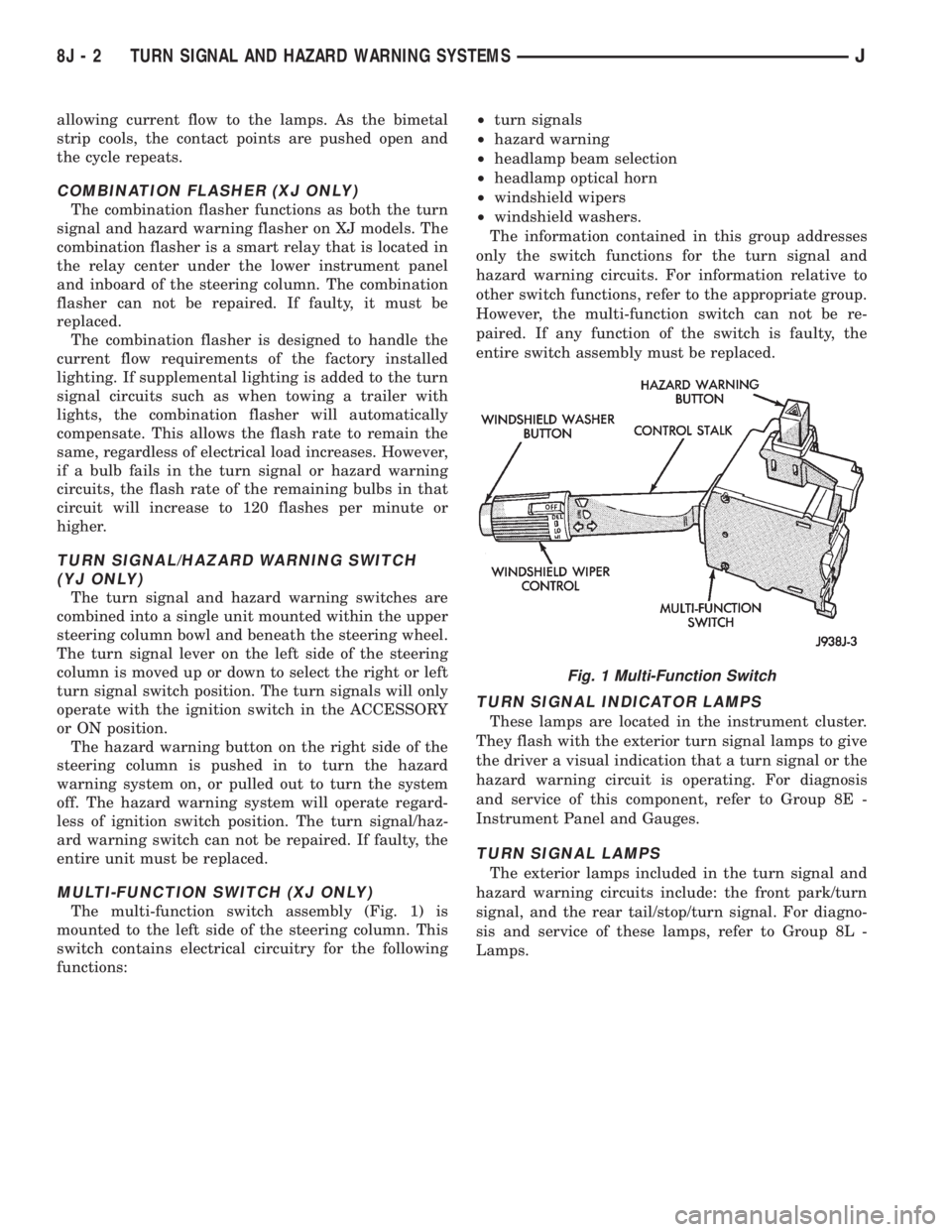
MULTI-FUNCTION SWITCH (XJ ONLY)
The multi-function switch assembly (Fig. 1) is
mounted to the left side of the steering column. This
switch contains electrical circuitry for the following
functions:²turn signals
²hazard warning
²headlamp beam selection
²headlamp optical horn
²windshield wipers
²windshield washers.
The information contained in this group addresses
only the switch functions for the turn signal and
hazard warning circuits. For information relative to
other switch functions, refer to the appropriate group.
However, the multi-function switch can not be re-
paired. If any function of the switch is faulty, the
entire switch assembly must be replaced.
TURN SIGNAL INDICATOR LAMPS
These lamps are located in the instrument cluster.
They flash with the exterior turn signal lamps to give
the driver a visual indication that a turn signal or the
hazard warning circuit is operating. For diagnosis
and service of this component, refer to Group 8E -
Instrument Panel and Gauges.
TURN SIGNAL LAMPS
The exterior lamps included in the turn signal and
hazard warning circuits include: the front park/turn
signal, and the rear tail/stop/turn signal. For diagno-
sis and service of these lamps, refer to Group 8L -
Lamps.
Fig. 1 Multi-Function Switch
8J - 2 TURN SIGNAL AND HAZARD WARNING SYSTEMSJ
Page 543 of 2158
WIRING DIAGRAMS
CONTENTS
page page
8W-01 GENERAL INFORMATIONÐWIRING
DIAGRAMS.................... 8W-01-1
8W-10 FUSE/FUSE BLOCK........... 8W-10-1
8W-11 POWER DISTRIBUTION........ 8W-11-1
8W-15 GROUND DISTRIBUTION....... 8W-15-1
8W-20 CHARGING SYSTEM.......... 8W-20-1
8W-21 STARTING SYSTEM........... 8W-21-1
8W-30 FUEL/IGNITION.............. 8W-30-1
8W-31 TRANSMISSION CONTROLS.... 8W-31-1
8W-32 ANTI-LOCK BRAKES.......... 8W-32-1
8W-33 VEHICLE SPEED CONTROL..... 8W-33-1
8W-40 INSTRUMENT CLUSTER....... 8W-40-1
8W-41 HORN/CIGAR LIGHTER......... 8W-41-1
8W-42 AIR CONDITIONING/HEATER.... 8W-42-1
8W-44 INTERIOR LIGHTING.......... 8W-44-1
8W-47 AUDIO SYSTEM.............. 8W-47-18W-48 HEATED REAR WINDOW....... 8W-48-1
8W-49 OVERHEAD CONSOLE......... 8W-49-1
8W-50 FRONT LIGHTING............. 8W-50-1
8W-51 REAR LIGHTING............. 8W-51-1
8W-52 TURN SIGNALS.............. 8W-52-1
8W-53 WIPERS..................... 8W-53-1
8W-54 TRAILER TOW................ 8W-54-1
8W-60 POWER WINDOWS.......... 8W-60-1
8W-61 POWER DOOR LOCKS......... 8W-61-1
8W-62 POWER MIRRORS............ 8W-62-1
8W-63 POWER SEAT................ 8W-63-1
8W-70 SPLICE INFORMATION........ 8W-70-1
8W-80 CONNECTOR PIN OUTS....... 8W-80-1
8W-90 CONNECTOR LOCATIONS...... 8W-90-1
8W-95 SPLICE LOCATIONS........... 8W-95-1
HOW TO USE THIS GROUP
The purpose of this group is to show the electrical
circuits in a clear, simple fashion and to make trou-
bleshooting easier. Components that work together
are shown together. All electrical components used in
a specific system are shown on one diagram. The feed
for a system is shown at the top of the page. All
wires, connectors, splices, and components are shown
in the flow of current to the bottom of the page. Wir-
ing which is not part of the circuit represented is ref-
erenced to another page/section, where the complete
circuit is shown. In addition, all switches, compo-
nents, and modules are shown in theat rest posi-
tion with the doors closed and the key removed
from the ignition.
If a component is part of several different circuits,
it is shown in the diagram for each. For example, the
headlamp switch is the main part of the exterior
lighting, but it also affects the interior lighting and
the chime warning system.
It is important to realize that no attempt is
made on the diagrams to represent components
and wiring as they appear on the vehicle. For
example, a short piece of wire is treated the
same as a long one. In addition, switches and
other components are shown as simply as pos-
sible, with regard to function only.
The wiring diagram show circuits for all wheel-
bases. If there is a difference in systems or compo-
nents between wheel-bases, an identifier is placed
next to the component.
SECTION IDENTIFICATION
Sections in Group 8W are organized by sub-sys-
tems. The sections contain circuit operation descrip-
tions, helpful information, and system diagrams. The
intention is to organize information by system, con-
sistently from year to year.
CONNECTOR LOCATIONS
Section 8W-90 contains Connector Location illus-
trations. The illustrations contain the connector
number and component identification. Connector Lo-
cation charts in Section 8W-90 reference the illustra-
tion number for components and connectors.
Section 8W-80 shows each connector and the cir-
cuits involved with that connector. The connectors
are identified using the number on the Diagram
pages.
SPLICE LOCATIONS
Splice Location charts in Section 8W-70 show the
entire splice, and provide references to other sections
the splice serves.
Section 8W-95 contains illustrations that show the
general location of the splices in each harness. The
illustrations show the splice by number, and provide
a written location.
JWIRING DIAGRAMSÐXJ VEHICLES 8W - 1 - 1
Page 677 of 2158
REAR LIGHTING
TAIL LAMPS AND REAR LICENSE PLATE LAMPS
Circuit A3 from fuse 5 in the Power Distribution
Center (PDC) connects to a bus bar in the fuse block
which feeds circuit L7. Fuse 15 in the fuse block pro-
tects circuit L7.
The headlamp switch has three positions: ON,
PARK (parking lamps) and OFF, plus a dimmer
switch. When the headlamp switch is in the PARK or
ON position, the switch connects circuit L7 to circuit
L90. From the headlamp switch, circuit L90 branches
to power the front parking lamps and rear tail
lamps, side marker lamps, and rear license plate
lamps.
GROUND CIRCUIT
Circuit Z1 provides a ground for the parking lamps,
tail lamps, and rear license plate lamps.
HELPFUL INFORMATION
²If the vehicle is equipped with factory installed
trailer tow, circuit L90 splices to the trailer tow har-
ness.
²Check fuse 5 in PDC.
²Check fuse 15 in the fuse block.
²When the headlamp switch is in the PARK or ON
position, circuit L7 also connects to circuit E2. Cir-
cuit E2 continues through fuse 19 in the fuse block.
Circuit E2 powers the illumination lamps.
STOP LAMPS AND CHMSL LAMPS
Circuit L9 from fuse 4 in the Power Distribution
Center (PDC) connects to the stop lamp switch.
When the operator depresses the brake pedal, the
stop lamp switch closes and connects circuit L9 to
circuit L50. Circuit L50 connects to the stop lamps
and Center High Mounted Stop Lamps (CHMSL).
Circuit Z1 provides a ground for the stop lamps and
CHMSL lamps.
HELPFUL INFORMATION
²Check fuse 4 in the PDC.
²Check for continuity across the stop lamp switch
when it is closed.
BACK-UP LAMPS
In the START or RUN position, the ignition switch
connects circuit A1 from fuse 6 in the Power Distri-
bution Center (PDC) to circuit A21. Circuit A21 feeds
a bus bar in the PDC that powers circuit F12
through fuse 11.
Circuit F20 supplies power to the back-up lamp
switch. On automatic transmission equipped vehicles,
the back-up lamp switch is part of an assembly that
includes the PARK/NEUTRAL position switch. When
the operator puts the transmission in REVERSE, the
back-up lamp switch connects circuit F20 to circuit
L10. Circuit L10 feeds the back-up lamps. Circuit Z1
provides ground for the back-up lamps.
HELPFUL INFORMATION
²Check fuses 6 and 11 in the PDC.
²Check for continuity across the back-up lamp
switch when it is closed.
DIAGRAM INDEX
Component Page
Back-Up Lamps........................8W-51-4, 5
Back-Up Lamp Switch.....................8W-51-2
Center High Mounted Stop Lamps (CHMSL).......8W-51-3
Fuse 15 (Fuse Block)......................8W-51-2
Fuse 4 (PDC)...........................8W-51-3
Fuse 6 (PDC)...........................8W-51-2
Fuse 7 (PDC)...........................8W-51-2
Fuse 11 (PDC)..........................8W-51-2
Headlamp Switch.........................8W-51-2
Ignition Switch..........................8W-51-2
License Plate Lamp.......................8W-51-3
Park/Neutral Position Switch.................8W-51-2
Side Marker Lamps.....................8W-51-4, 5
Stop Lamp Switch........................8W-51-3
Tail/Stop Lamps........................8W-51-4, 5
Turn Signal Lamps......................8W-51-4, 5
J8W-51 REAR LIGHTINGÐXJ VEHICLES 8W - 51 - 1
Page 691 of 2158
TRAILER TOW
TRAILER TOW
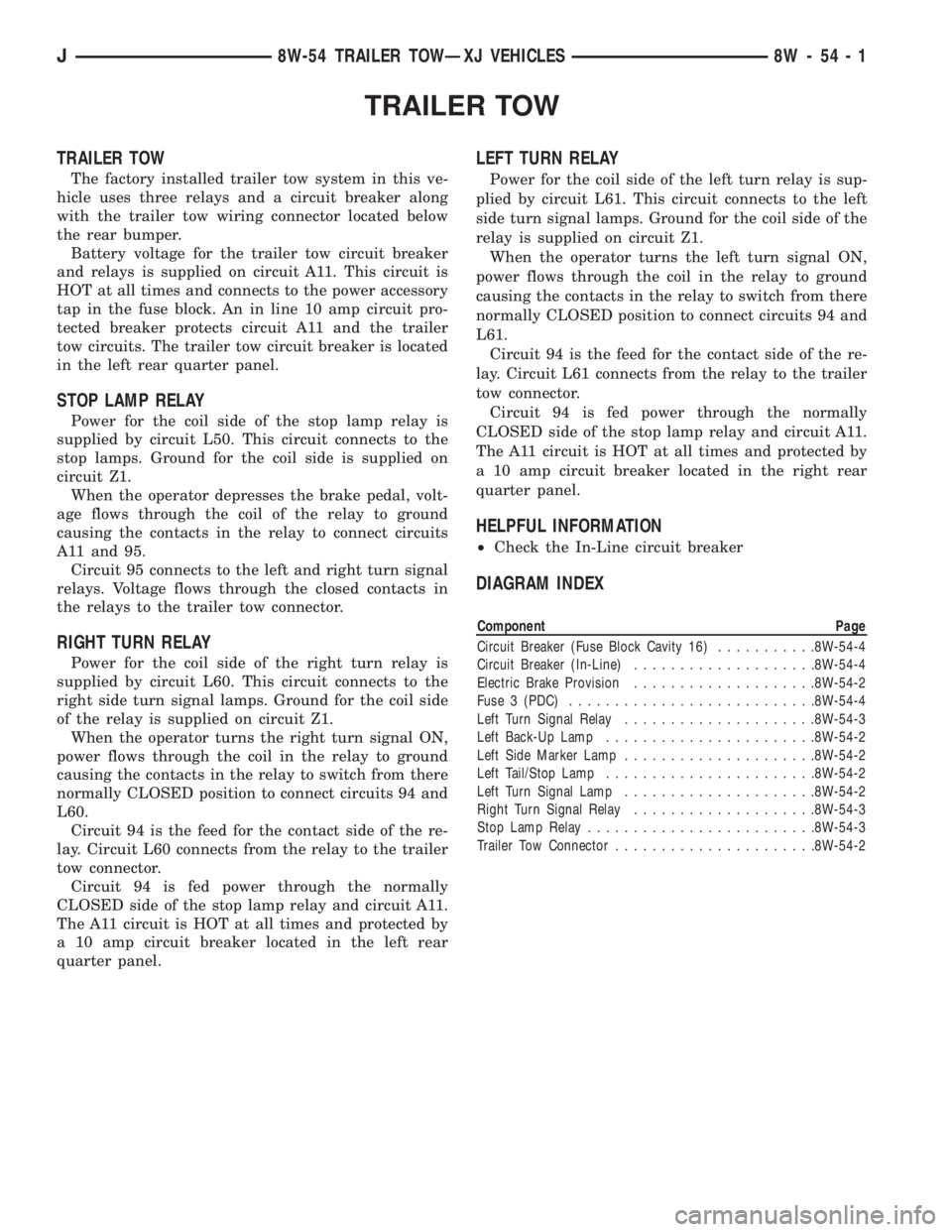
The factory installed trailer tow system in this ve-
hicle uses three relays and a circuit breaker along
with the trailer tow wiring connector located below
the rear bumper.
Battery voltage for the trailer tow circuit breaker
and relays is supplied on circuit A11. This circuit is
HOT at all times and connects to the power accessory
tap in the fuse block. An in line 10 amp circuit pro-
tected breaker protects circuit A11 and the trailer
tow circuits. The trailer tow circuit breaker is located
in the left rear quarter panel.
STOP LAMP RELAY
Power for the coil side of the stop lamp relay is
supplied by circuit L50. This circuit connects to the
stop lamps. Ground for the coil side is supplied on
circuit Z1.
When the operator depresses the brake pedal, volt-
age flows through the coil of the relay to ground
causing the contacts in the relay to connect circuits
A11 and 95.
Circuit 95 connects to the left and right turn signal
relays. Voltage flows through the closed contacts in
the relays to the trailer tow connector.
RIGHT TURN RELAY
Power for the coil side of the right turn relay is
supplied by circuit L60. This circuit connects to the
right side turn signal lamps. Ground for the coil side
of the relay is supplied on circuit Z1.
When the operator turns the right turn signal ON,
power flows through the coil in the relay to ground
causing the contacts in the relay to switch from there
normally CLOSED position to connect circuits 94 and
L60.
Circuit 94 is the feed for the contact side of the re-
lay. Circuit L60 connects from the relay to the trailer
tow connector.
Circuit 94 is fed power through the normally
CLOSED side of the stop lamp relay and circuit A11.
The A11 circuit is HOT at all times and protected by
a 10 amp circuit breaker located in the left rear
quarter panel.
LEFT TURN RELAY
Power for the coil side of the left turn relay is sup-
plied by circuit L61. This circuit connects to the left
side turn signal lamps. Ground for the coil side of the
relay is supplied on circuit Z1.
When the operator turns the left turn signal ON,
power flows through the coil in the relay to ground
causing the contacts in the relay to switch from there
normally CLOSED position to connect circuits 94 and
L61.
Circuit 94 is the feed for the contact side of the re-
lay. Circuit L61 connects from the relay to the trailer
tow connector.
Circuit 94 is fed power through the normally
CLOSED side of the stop lamp relay and circuit A11.
The A11 circuit is HOT at all times and protected by
a 10 amp circuit breaker located in the right rear
quarter panel.
HELPFUL INFORMATION
²Check the In-Line circuit breaker
DIAGRAM INDEX
Component Page
Circuit Breaker (Fuse Block Cavity 16)...........8W-54-4
Circuit Breaker (In-Line)....................8W-54-4
Electric Brake Provision....................8W-54-2
Fuse 3 (PDC)...........................8W-54-4
Left Turn Signal Relay.....................8W-54-3
Left Back-Up Lamp.......................8W-54-2
Left Side Marker Lamp.....................8W-54-2
Left Tail/Stop Lamp.......................8W-54-2
Left Turn Signal Lamp.....................8W-54-2
Right Turn Signal Relay....................8W-54-3
Stop Lamp Relay.........................8W-54-3
Trailer Tow Connector......................8W-54-2
J8W-54 TRAILER TOWÐXJ VEHICLES 8W - 54 - 1
Page 807 of 2158
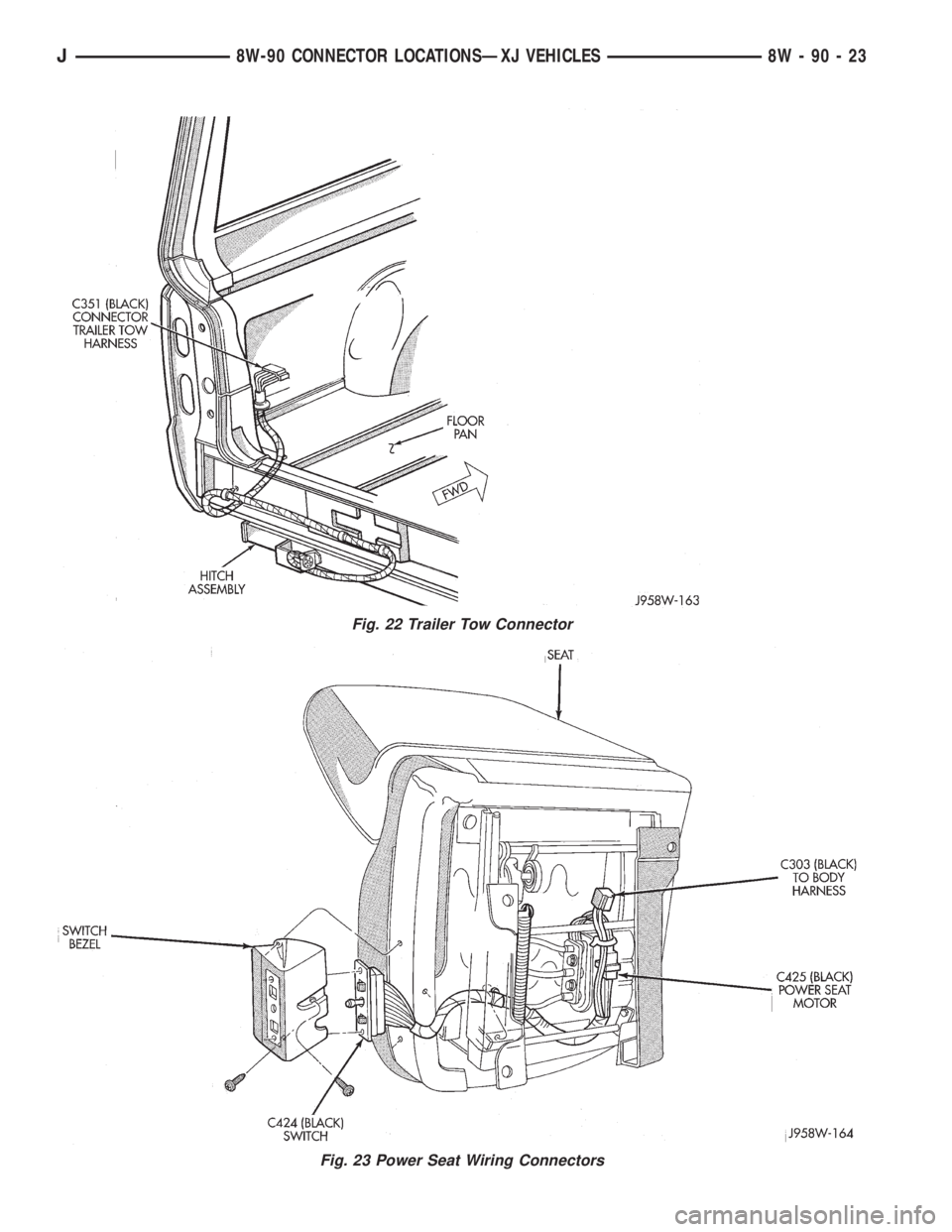
Fig. 22 Trailer Tow Connector
Fig. 23 Power Seat Wiring Connectors
J8W-90 CONNECTOR LOCATIONSÐXJ VEHICLES 8W - 90 - 23
Page 809 of 2158
SPLICE LOCATIONS
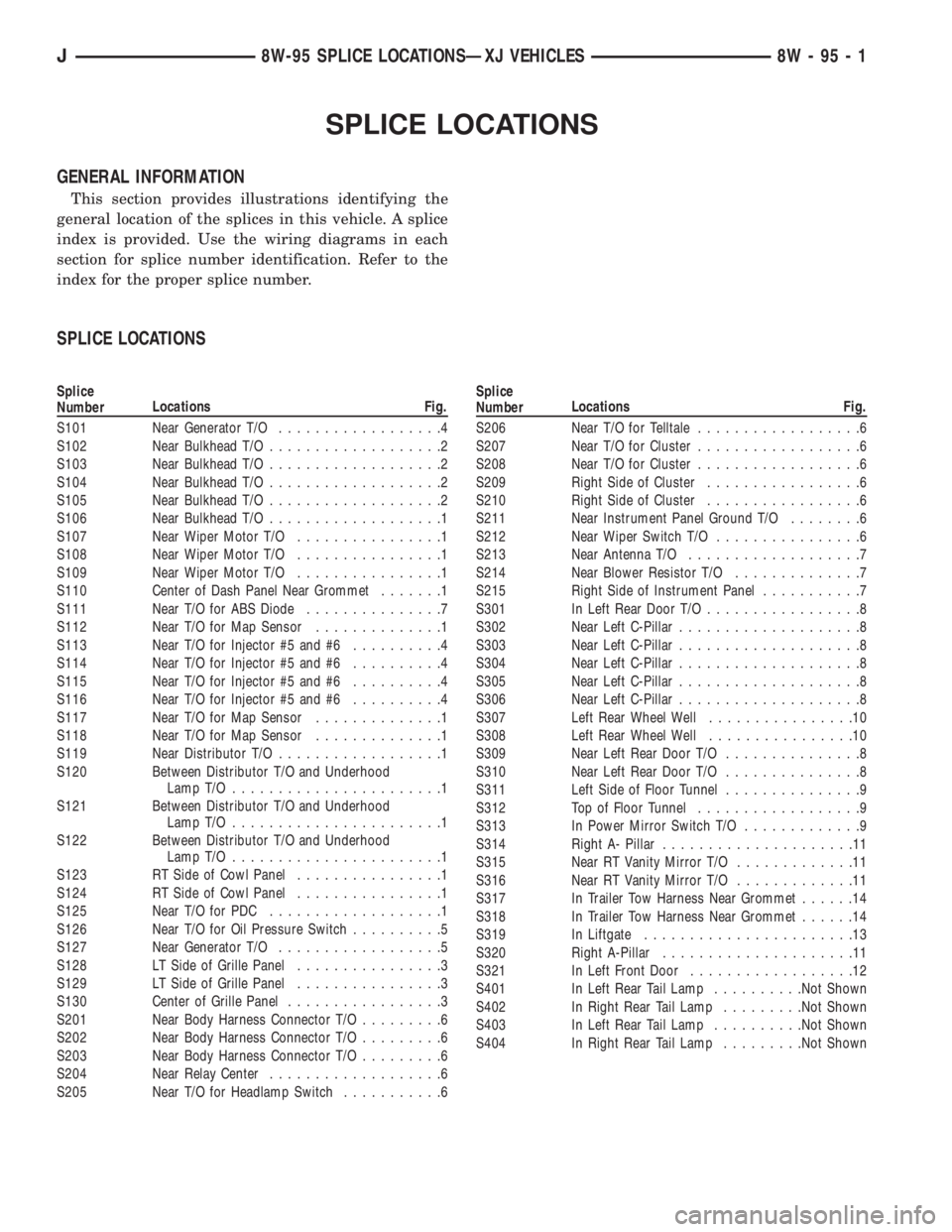
GENERAL INFORMATION
This section provides illustrations identifying the
general location of the splices in this vehicle. A splice
index is provided. Use the wiring diagrams in each
section for splice number identification. Refer to the
index for the proper splice number.
SPLICE LOCATIONS
Splice
NumberLocations Fig.
S101 Near Generator T/O..................4
S102 Near Bulkhead T/O...................2
S103 Near Bulkhead T/O...................2
S104 Near Bulkhead T/O...................2
S105 Near Bulkhead T/O...................2
S106 Near Bulkhead T/O...................1
S107 Near Wiper Motor T/O................1
S108 Near Wiper Motor T/O................1
S109 Near Wiper Motor T/O................1
S110 Center of Dash Panel Near Grommet.......1
S111 Near T/O for ABS Diode...............7
S112 Near T/O for Map Sensor..............1
S113 Near T/O for Injector #5 and #6..........4
S114 Near T/O for Injector #5 and #6..........4
S115 Near T/O for Injector #5 and #6..........4
S116 Near T/O for Injector #5 and #6..........4
S117 Near T/O for Map Sensor..............1
S118 Near T/O for Map Sensor..............1
S119 Near Distributor T/O..................1
S120 Between Distributor T/O and Underhood
Lamp T/O.......................1
S121 Between Distributor T/O and Underhood
Lamp T/O.......................1
S122 Between Distributor T/O and Underhood
Lamp T/O.......................1
S123 RT Side of Cowl Panel................1
S124 RT Side of Cowl Panel................1
S125 Near T/O for PDC...................1
S126 Near T/O for Oil Pressure Switch..........5
S127 Near Generator T/O..................5
S128 LT Side of Grille Panel................3
S129 LT Side of Grille Panel................3
S130 Center of Grille Panel.................3
S201 Near Body Harness Connector T/O.........6
S202 Near Body Harness Connector T/O.........6
S203 Near Body Harness Connector T/O.........6
S204 Near Relay Center...................6
S205 Near T/O for Headlamp Switch...........6Splice
NumberLocations Fig.
S206 Near T/O for Telltale..................6
S207 Near T/O for Cluster..................6
S208 Near T/O for Cluster..................6
S209 Right Side of Cluster.................6
S210 Right Side of Cluster.................6
S211 Near Instrument Panel Ground T/O........6
S212 Near Wiper Switch T/O................6
S213 Near Antenna T/O...................7
S214 Near Blower Resistor T/O..............7
S215 Right Side of Instrument Panel...........7
S301 In Left Rear Door T/O.................8
S302 Near Left C-Pillar....................8
S303 Near Left C-Pillar....................8
S304 Near Left C-Pillar....................8
S305 Near Left C-Pillar....................8
S306 Near Left C-Pillar....................8
S307 Left Rear Wheel Well................10
S308 Left Rear Wheel Well................10
S309 Near Left Rear Door T/O...............8
S310 Near Left Rear Door T/O...............8
S311 Left Side of Floor Tunnel...............9
S312 Top of Floor Tunnel..................9
S313 In Power Mirror Switch T/O.............9
S314 Right A- Pillar.....................11
S315 Near RT Vanity Mirror T/O.............11
S316 Near RT Vanity Mirror T/O.............11
S317 In Trailer Tow Harness Near Grommet......14
S318 In Trailer Tow Harness Near Grommet......14
S319 In Liftgate.......................13
S320 Right A-Pillar.....................11
S321 In Left Front Door..................12
S401 In Left Rear Tail Lamp..........Not Shown
S402 In Right Rear Tail Lamp.........Not Shown
S403 In Left Rear Tail Lamp..........Not Shown
S404 In Right Rear Tail Lamp.........Not Shown
J8W-95 SPLICE LOCATIONSÐXJ VEHICLES 8W - 95 - 1
Page 818 of 2158
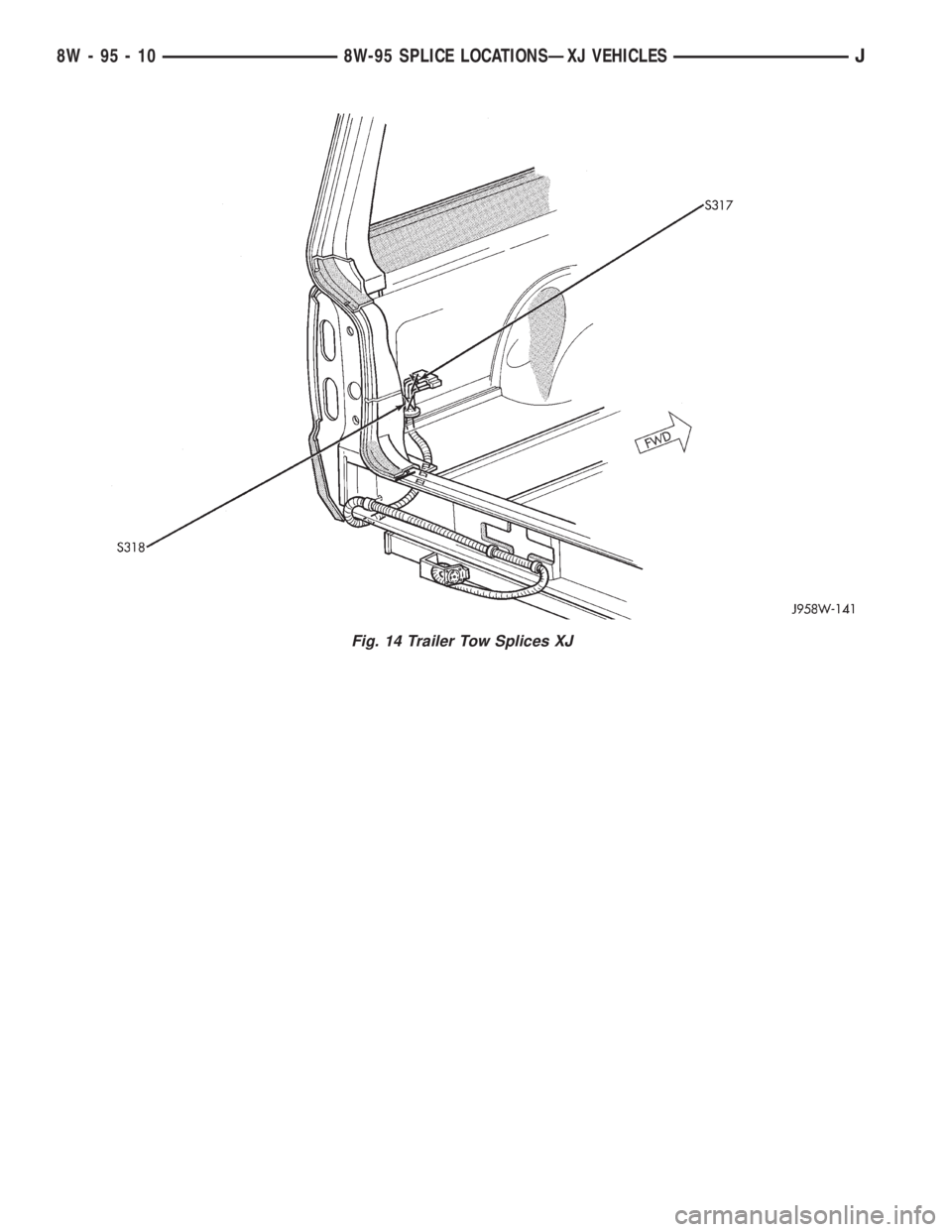
Fig. 14 Trailer Tow Splices XJ
8W - 95 - 10 8W-95 SPLICE LOCATIONSÐXJ VEHICLESJ
Page 819 of 2158
WIRING DIAGRAMS
CONTENTS
page page
8W-01 GENERAL INFORMATIONÐWIRING
DIAGRAMS...................... 8W-01-1
8W-10 FUSE/FUSE BLOCK........... 8W-10-1
8W-11 POWER DISTRIBUTION........ 8W-11-1
8W-15 GROUND DISTRIBUTION....... 8W-15-1
8W-20 CHARGING SYSTEM.......... 8W-20-1
8W-21 STARTING SYSTEM........... 8W-21-1
8W-30 FUEL/IGNITION.............. 8W-30-1
8W-31 TRANSMISSION CONTROLS.... 8W-31-1
8W-32 ANTI-LOCK BRAKES........... 8W-32-1
8W-33 VEHICLE SPEED CONTROL..... 8W-33-1
8W-40 INSTRUMENT CLUSTER....... 8W-40-1
8W-41 HORN/CIGAR LIGHTER........ 8W-41-1
8W-42 AIR CONDITIONING/HEATER.... 8W-42-1
8W-44 INTERIOR LIGHTING.......... 8W-44-1
8W-47 AUDIO SYSTEM.............. 8W-47-18W-48 HEATED REAR WINDOW....... 8W-48-1
8W-49 OVERHEAD CONSOLE.......... 8W-49-1
8W-50 FRONT LIGHTING............ 8W-50-1
8W-51 REAR LIGHTING............. 8W-51-1
8W-52 TURN SIGNALS.............. 8W-52-1
8W-53 WIPERS.................... 8W-53-1
8W-54 TRAILER TOW................ 8W-54-1
8W-60 POWER WINDOWS............ 8W-60-1
8W-61 POWER DOOR LOCKS......... 8W-61-1
8W-62 POWER MIRRORS............ 8W-62-1
8W-63 POWER SEAT................ 8W-63-1
8W-70 SPLICE INFORMATION........ 8W-70-1
8W-80 CONNECTOR PIN OUTS....... 8W-80-1
8W-90 CONNECTOR LOCATIONS...... 8W-90-1
8W-95 SPLICE LOCATIONS........... 8W-95-1
HOW TO USE THIS GROUP
The purpose of this group is to show the electrical
circuits in a clear, simple fashion and to make trou-
bleshooting easier. Components that work together
are shown together. All electrical components used in
a specific system are shown on one diagram. The feed
for a system is shown at the top of the page. All
wires, connectors, splices, and components are shown
in the flow of current to the bottom of the page. Wir-
ing which is not part of the circuit represented is ref-
erenced to another page/section, where the complete
circuit is shown. In addition, all switches, compo-
nents, and modules are shown in theat rest posi-
tion with the doors closed and the key removed
from the ignition.
If a component is part of several different circuits,
it is shown in the diagram for each. For example, the
headlamp switch is the main part of the exterior
lighting, but it also affects the interior lighting and
the chime warning system.
It is important to realize that no attempt is
made on the diagrams to represent components
and wiring as they appear on the vehicle. For
example, a short piece of wire is treated the
same as a long one. In addition, switches and
other components are shown as simply as pos-
sible, with regard to function only.
The wiring diagram show circuits for all wheel-
bases. If there is a difference in systems or compo-
nents between wheel-bases, an identifier is placed
next to the component.
SECTION IDENTIFICATION
Sections in Group 8W are organized by sub-sys-
tems. The sections contain circuit operation descrip-
tions, helpful information, and system diagrams. The
intention is to organize information by system, con-
sistently from year to year.
CONNECTOR LOCATIONS
Section 8W-90 contains Connector Location illus-
trations. The illustrations contain the connector
number and component identification. Connector Lo-
cation charts in Section 8W-90 reference the illustra-
tion number for components and connectors.
Section 8W-80 shows each connector and the cir-
cuits involved with that connector. The connectors
are identified using the number on the Diagram
pages.
SPLICE LOCATIONS
Splice Location charts in Section 8W-70 show the
entire splice, and provide references to other sections
the splice serves.
Section 8W-95 contains illustrations that show the
general location of the splices in each harness. The
illustrations show the splice by number, and provide
a written location.
JWIRING DIAGRAMSÐXJ-RHD 8W - 1 - 1
Page 965 of 2158
TRAILER TOW
TRAILER TOW
The factory installed trailer tow system in this ve-
hicle uses three relays and a circuit breaker along
with the trailer tow wiring connector located below
the rear bumper.
Battery voltage for the trailer tow circuit breaker
and relays is supplied on circuit A11. This circuit is
HOT at all times and connects to the power accessory
tap in the fuse block. An in line 10 amp circuit pro-
tected breaker protects circuit A11 and the trailer
tow circuits. The trailer tow circuit breaker is located
in the left rear quarter panel.
STOP LAMP RELAY
Power for the coil side of the stop lamp relay is
supplied by circuit L50. This circuit connects to the
stop lamps. Ground for the coil side is supplied on
circuit Z1.
When the operator depresses the brake pedal, volt-
age flows through the coil of the relay to ground
causing the contacts in the relay to close connecting
circuits A11 and 95.
Circuit 95 connects to the left and right turn signal
relays. Voltage flows through the closed contacts in
the relays to the trailer tow connector.
RIGHT TURN RELAY
Power for the coil side of the right turn relay is
supplied by circuit L60. This circuit connects to the
right side turn signal lamps. Ground for the coil side
of the relay is supplied on circuit Z1.
When the operator turns the right turn signal ON,
power flows through the coil in the relay to ground
causing the contacts in the relay to switch from there
normally CLOSED position to connect circuits 94 and
L60.
Circuit 94 is the feed for the contact side of the re-
lay. Circuit L60 connects from the relay to the trailer
tow connector.
Circuit 94 is fed power through the normally
CLOSED side of the stop lamp relay and circuit A11.
The A11 circuit is HOT at all times and protected by
a 10 amp circuit breaker located in the left rear
quarter panel.
LEFT TURN RELAY
Power for the coil side of the left turn relay is sup-
plied by circuit L61. This circuit connects to the left
side turn signal lamps. Ground for the coil side of the
relay is supplied on circuit Z1.
When the operator turns the left turn signal ON,
power flows through the coil in the relay to ground
causing the contacts in the relay to switch from there
normally CLOSED position to connect circuits 94 and
L61.
Circuit 94 is the feed for the contact side of the re-
lay. Circuit L61 connects from the relay to the trailer
tow connector.
Circuit 94 is fed power through the normally
CLOSED side of the stop lamp relay and circuit A11.
The A11 circuit is HOT at all times and protected by
a 10 amp circuit breaker located in the right rear
quarter panel.
HELPFUL INFORMATION
²Check the In-Line circuit breaker
DIAGRAM INDEX
Component Page
Circuit Breaker (In-Line)....................8W-54-4
Electric Brake Provision....................8W-54-2
Fuse 1 (Fuse Block).......................8W-54-4
Fuse 3 (PDC)...........................8W-54-4
Left Turn Signal Relay.....................8W-54-3
Left Back-Up Lamp.......................8W-54-2
Left Side Marker Lamp.....................8W-54-2
Left Tail/Stop Lamp.......................8W-54-2
Left Turn Signal Lamp.....................8W-54-2
Right Turn Signal Relay....................8W-54-3
Stop Lamp Relay.........................8W-54-3
Trailer Tow Connector......................8W-54-2
J8W-54 TRAILER TOWÐXJ-RHD 8W - 54 - 1