tires KIA AMANTI 2006 User Guide
[x] Cancel search | Manufacturer: KIA, Model Year: 2006, Model line: AMANTI, Model: KIA AMANTI 2006Pages: 322, PDF Size: 44.16 MB
Page 241 of 322
621
In case of an emergency
1
2
3
4
5
6
7
8
910
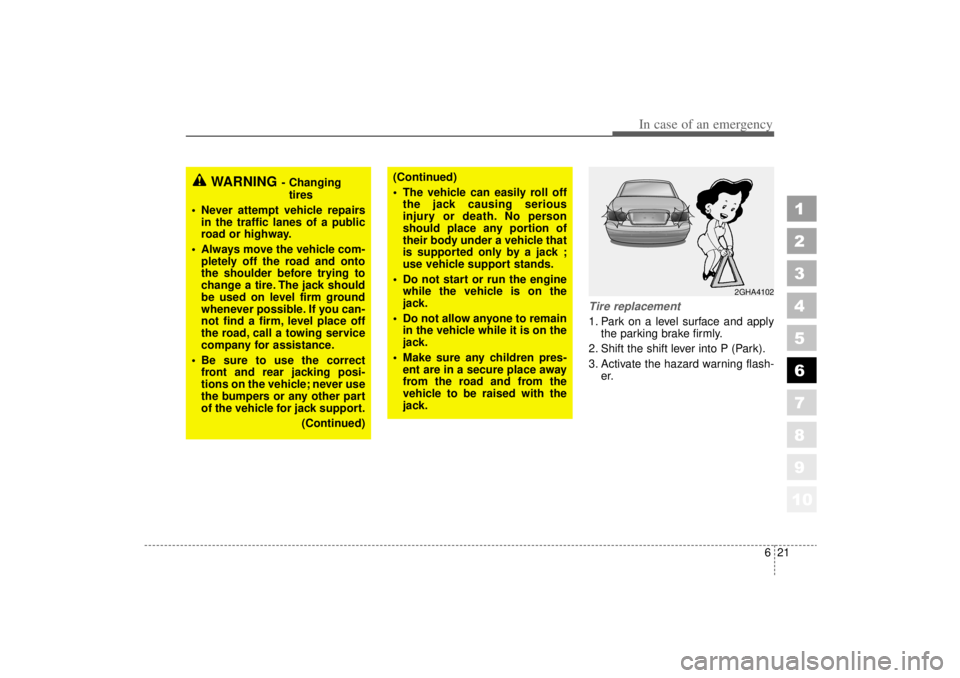
Tire replacement 1. Park on a level surface and applythe parking brake firmly.
2. Shift the shift lever into P (Park).
3. Activate the hazard warning flash- er.
WARNING
- Changing
tires
Never attempt vehicle repairs in the traffic lanes of a public
road or highway.
Always move the vehicle com- pletely off the road and onto
the shoulder before trying to
change a tire. The jack should
be used on level firm ground
whenever possible. If you can-
not find a firm, level place off
the road, call a towing service
company for assistance.
Be sure to use the correct front and rear jacking posi-
tions on the vehicle; never use
the bumpers or any other part
of the vehicle for jack support.
(Continued)
(Continued)
The vehicle can easily roll offthe jack causing serious
injury or death. No person
should place any portion of
their body under a vehicle that
is supported only by a jack ;
use vehicle support stands.
Do not start or run the engine while the vehicle is on the
jack.
Do not allow anyone to remain in the vehicle while it is on the
jack.
Make sure any children pres- ent are in a secure place away
from the road and from the
vehicle to be raised with the
jack.
2GHA4102
Page 245 of 322
1
2
3
4
5
6
7
8
9101
2
3
4
5
6
7
8
910
Maintenance services / 7-3
Normal maintenance schedule / 7-5
Severe maintenance schedule / 7-8
Owner maintenance / 7-11
Engine compartment / 7-14
Engine oil and oil filter / 7-15
Engine cooling system / 7-18
Brakes / 7-21
Parking brake / 7-22
Drive belts / 7-23
Power steering / 7-24
Steering wheel / 7-25
Automatic transaxle / 7-25
Lubricants and fluids / 7-28
Air cleaner / 7-29
Air conditioner air filter / 7-30
Wiper blades / 7-32
Battery / 7-34
Tires and wheels / 7-37
Bulb replacement / 7-44
Lubricant specifications / 7-51
Exterior care / 7-53
Maintenance
Page 251 of 322
1
2
3
4
5
6
7
8
910
77
Maintenance
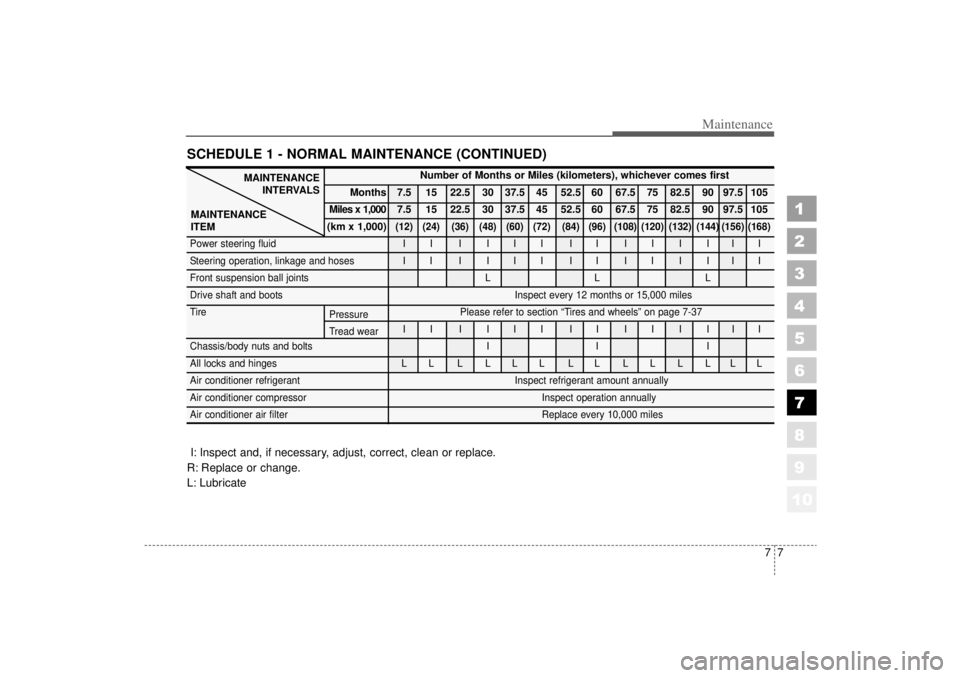
SCHEDULE 1 - NORMAL MAINTENANCE (CONTINUED)
MAINTENANCEINTERVALS
MAINTENANCE
ITEM
Number of Months or Miles (kilometers), whichever comes first
Months 7.5 15 22.5 30 37.5 45 52.5 60 67.5 75 82.5 90 97.5 105
Miles x 1,000 7.5 15 22.5 30 37.5 45 52.5 60 67.5 75 82.5 90 97.5 105
(km x 1,000)
(12) (24) (36) (48) (60) (72) (84) (96) (108) (120) (132) (144) (156) (168)
Power steering fluid I I I I I I I I I I I I I I
Steering operation, linkage and hoses I I I I I I I I I I I I I I
Front suspension ball joints L L L
Drive shaft and boots Inspect every 12 months or 15,000 miles
Tire Please refer to section “Tires and wheels” on page 7-37 II I III II II I III
Chassis/body nuts and bolts I I I
All locks and hinges L L L L L L L L L L L L L L
Air conditioner refrigerant Inspect refrigerant amount annually
Air conditioner compressor Inspect operation annually
Air conditioner air filter Replace every 10,000 miles
I: Inspect and, if necessary, adjust, correct, clean or replace.
R: Replace or change.
L: Lubricate
Pressure
Tread wear
Page 254 of 322
1
2
3
4
5
6
7
8
910
Maintenance10
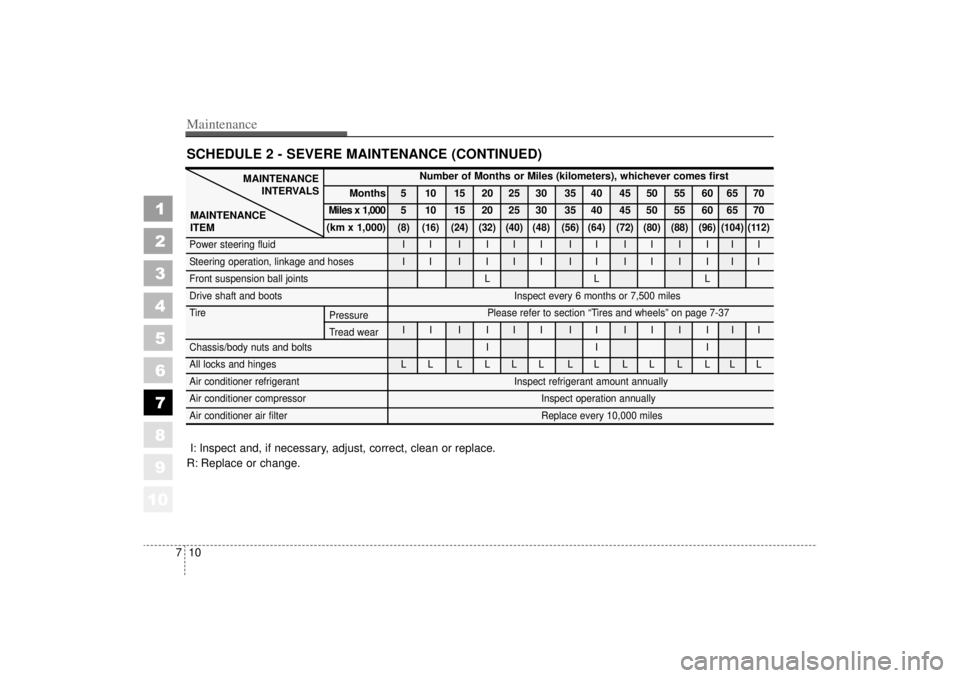
7SCHEDULE 2 - SEVERE MAINTENANCE (CONTINUED)
MAINTENANCE
INTERVALS
MAINTENANCE
ITEM
Number of Months or Miles (kilometers), whichever comes first
Months 5 10 15 20 25 30 35 40 45 50 55 60 65 70
Miles x 1,000 5 10 15 20 25 30 35 40 45 50 55 60 65 70
(km x 1,000)
(8) (16) (24) (32) (40) (48) (56) (64) (72) (80) (88) (96) (104) (112)
Power steering fluid I I I I I I I I I I I I I I
Steering operation, linkage and hoses I I I I I I I I I I I I I I
Front suspension ball joints L L L
Drive shaft and boots Inspect every 6 months or 7,500 miles
Tire Please refer to section “Tires and wheels” on page 7-37 II I III II II I III
Chassis/body nuts and bolts I I I
All locks and hinges L L L L L L L L L L L L L L
Air conditioner refrigerant Inspect refrigerant amount annually
Air conditioner compressor Inspect operation annually
Air conditioner air filter Replace every 10,000 miles
I: Inspect and, if necessary, adjust, correct, clean or replace.
R: Replace or change.
Pressure
Tread wear
Page 255 of 322
711
Maintenance
OWNER MAINTENANCE Owner maintenance schedule The following lists are vehicle checks
and inspections that should be per-
formed by the owner or qualified
service technician at the frequencies
indicated to help ensure safe,
dependable operation of your vehi-
cle.
Any adverse conditions should be
brought to the attention of your deal-
er or qualified service technician or
service advice as soon as possible.
These Owner Maintenance Checks
are generally not covered by war-
ranties and you may be charged for
labor, parts and lubricants used.
When you stop for fuel: Check the engine oil level.
Check coolant level in coolantreservoir.
Check the windshield washer fluid level.
Look for low or under-inflated tires.
While operating your vehicle: Note any changes in the sound of the exhaust or any smell of
exhaust fumes in the vehicle.
Check for vibrations in the steering wheel. Notice any increased steer-
ing effort or looseness in the steer-
ing wheel, or change in its straight-
ahead position.
Notice if your vehicle constantly turns slightly or “pulls” to one side
when traveling on smooth, level
road.
When stopping, listen and check for strange sounds, pulling to one
side, increased brake pedal travel
or “hard-to-push” brake pedal.
If any slipping or changes in the operation of your transaxle occurs,
check the transaxle fluid level.
Check automatic transaxle P (Park) function.
Check parking brake.
Check for fluid leaks under your vehicle (water dripping from the air
conditioning system after use is
normal).
1
2
3
4
5
6
7
8
910
WARNING
Be careful when checking your
engine coolant level when the
engine is hot. Scalding hot
coolant and steam may blow out
under pressure. This could
cause serious injury.
Page 256 of 322
Maintenance12
7At least monthly: Check coolant level in the coolant
recovery reservoir.
Check the operation of all exterior lights, including the stoplights, turn
signals and hazard warning flash-
ers.
Check the inflation pressures of all tires including the spare.
At least twice a year
(i.e., every Spring and Fall) : Check radiator, heater and air con- ditioning hoses for leaks or da-
mage.
Check windshield washer spray and wiper operation. Clean wiper
blades with clean cloth dampened
with washer fluid.
Check headlight alignment.
Check muffler, exhaust pipes, shields and clamps.
Check the lap/shoulder belts for wear and function.
Check for worn tires and loose wheel lug nuts.
At least once a year : Clean body and door drain holes.
Lubricate door hinges and checks,and hood hinges.
Lubricate door and hood locks and latches.
Lubricate door rubber weather- strips.
Check the air conditioning system before the warm weather season.
Check the power steering fluid level.
Inspect and lubricate automatic transaxle linkage and controls.
Clean battery and terminals.
Check the brake fluid level.
1
2
3
4
5
6
7
8
910
Page 281 of 322
737
Maintenance
1
2
3
4
5
6
7
8
910
TIRES AND WHEELS Tires care For proper maintenance, safety, and
maximum fuel economy, you must
always maintain recommended tire
inflation pressures and stay within
the load limits and weight distribution
recommended for your vehicle.Inflation pressures All tire pressures (including the
spare) should be checked every day
when the tires are cold.“Cold Tires”
means the vehicle has not been driv-
en for at least three hours or driven
less than one mile (1.6 km).
Recommended pressures must be
maintained for the best ride, top vehi-
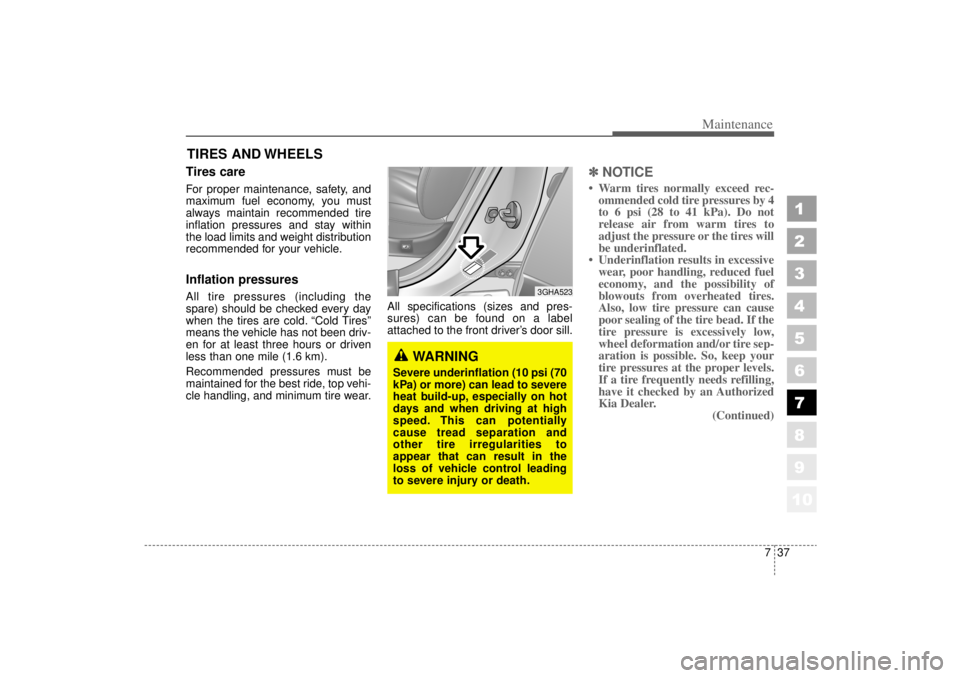
cle handling, and minimum tire wear. All specifications (sizes and pres-
sures) can be found on a label
attached to the front driver’
s door sill.
✽ ✽
NOTICE• Warm tires normally exceed rec-
ommended cold tire pressures by 4
to 6 psi (28 to 41 kPa). Do not
release air from warm tires to
adjust the pressure or the tires will
be underinflated.
• Underinflation results in excessive wear, poor handling, reduced fuel
economy, and the possibility of
blowouts from overheated tires.
Also, low tire pressure can cause
poor sealing of the tire bead. If the
tire pressure is excessively low,
wheel deformation and/or tire sep-
aration is possible. So, keep your
tire pressures at the proper levels.
If a tire frequently needs refilling,
have it checked by an Authorized
Kia Dealer. (Continued)
3GHA523
WARNING
Severe underinflation (10 psi (70
kPa) or more) can lead to severe
heat build-up, especially on hot
days and when driving at high
speed. This can potentially
cause tread separation and
other tire irregularities to
appear that can result in the
loss of vehicle control leading
to severe injury or death.
Page 282 of 322
Maintenance38
7
1
2
3
4
5
6
7
8
910
(Continued)
• Overinflation produces a harsh
ride, handling problems, excessive
wear at the center of the tire tread,
and a greater possibility of dam-
age from road hazards.
• Be sure to reinstall the tire infla- tion valve caps. Without the valve
cap, dirt or moisture could get into
the valve core and cause air leak-
age. If the cap have been lost,
install new one as soon as possible.
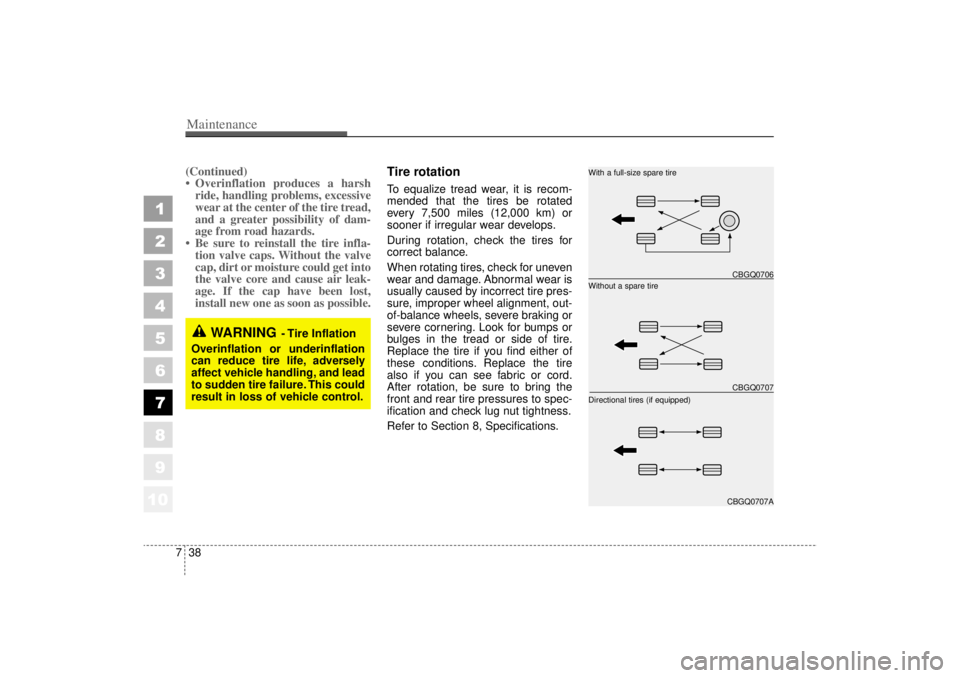
Tire rotation To equalize tread wear, it is recom-
mended that the tires be rotated
every 7,500 miles (12,000 km) or
sooner if irregular wear develops.
During rotation, check the tires for
correct balance.
When rotating tires, check for uneven
wear and damage. Abnormal wear is
usually caused by incorrect tire pres-
sure, improper wheel alignment, out-
of-balance wheels, severe braking or
severe cornering. Look for bumps or
bulges in the tread or side of tire.
Replace the tire if you find either of
these conditions. Replace the tire
also if you can see fabric or cord.
After rotation, be sure to bring the
front and rear tire pressures to spec-
ification and check lug nut tightness.
Refer to Section 8, Specifications.
WARNING
- Tire Inflation
Overinflation or underinflation
can reduce tire life, adversely
affect vehicle handling, and lead
to sudden tire failure. This could
result in loss of vehicle control.
CBGQ0706CBGQ0707CBGQ0707A
Without a spare tire With a full-size spare tire
Directional tires (if equipped)
Page 283 of 322
739
Maintenance
1
2
3
4
5
6
7
8
910
Disc brake pads should be inspectedfor wear whenever tires are rotated.✽ ✽ NOTICERotate radial tires that have an
asymmetric tread pattern only from
front to rear and not from right to
left.
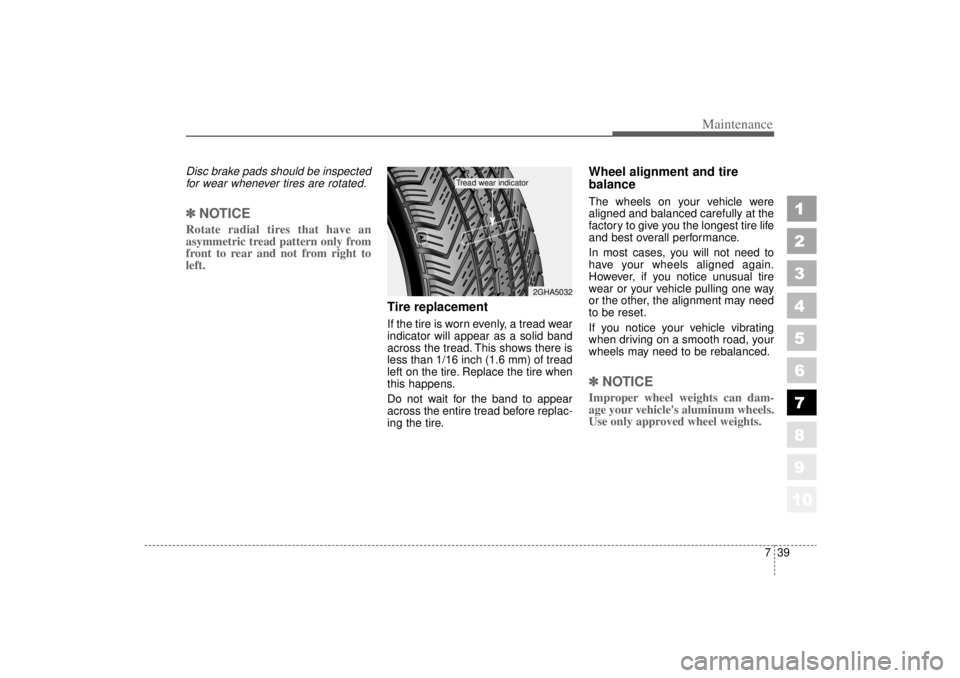
Tire replacementIf the tire is worn evenly, a tread wear
indicator will appear as a solid band
across the tread. This shows there is
less than 1/16 inch (1.6 mm) of tread
left on the tire. Replace the tire when
this happens.
Do not wait for the band to appear
across the entire tread before replac-
ing the tire.
Wheel alignment and tire
balance The wheels on your vehicle were
aligned and balanced carefully at the
factory to give you the longest tire life
and best overall performance.
In most cases, you will not need to
have your wheels aligned again.
However, if you notice unusual tire
wear or your vehicle pulling one way
or the other, the alignment may need
to be reset.
If you notice your vehicle vibrating
when driving on a smooth road, your
wheels may need to be rebalanced.✽ ✽NOTICEImproper wheel weights can dam-
age your vehicle's aluminum wheels.
Use only approved wheel weights.
2GHA5032
Tread wear indicator
Page 284 of 322
Maintenance40
7
1
2
3
4
5
6
7
8
910
WARNING
A wheel that is not the correct
size may adversely affect wheel
and bearing life, braking and
stopping abilities, handling
characteristics, ground clear-
ance, body-to-tire clearance,
snow chain clearance,
speedometer calibration, head-
light aim and bumper height.Wheel replacement When replacing the metal wheels for
any reason, make sure the new
wheels are equivalent to the original
factory units in diameter, rim width
and offset.
WARNING
When replacing tires, never
mix radial, bias-belted, and
bias-type tires. All four tires
should be of the same size,
design and construction. Use
only the tire sizes listed on the
Tire Label found below the
door striker on the driver’ s
side. Make sure that all tires
and wheels are the same size
and have the same load-carry-
ing capacity. Use only tire and
wheel combinations recom-
mended on the Tire Label or
by an Authorized Kia Dealer.
Failure to follow these precau-
tions can adversely affect the
safety and handling of your
vehicle.
(Continued)
(Continued)
The use of any other tire size
or type may seriously affect
ride, handling, ground clear-
ance, tire clearance, and
speedometer calibration.
Driving on worn-out tires is
very hazardous and will
reduce braking effectiveness,
steering accuracy, and trac-
tion.
It is best to replace all four
tires at the same time. If that is
not possible, or necessary,
then replace the two front or
two rear tires as a pair.
Replacing just one tire can
seriously affect your vehicle’ s
handling.