belt KIA AMANTI 2006 Owner's Manual
[x] Cancel search | Manufacturer: KIA, Model Year: 2006, Model line: AMANTI, Model: KIA AMANTI 2006Pages: 322, PDF Size: 44.16 MB
Page 63 of 322
Knowing your vehicle52
3
1
2
3
4
5
6
7
8
910
Installing a child restraint system For safety reasons, we recommend
that the child restraint system be
used in the rear seats. Never place
a rear-facing child restraint in the
front passenger seat, because of
the danger that an inflating pas-
senger side air bag could impact
the rear-facing child restraint and
kill the child.
Since all passenger’s (except dri-
ver’s) safety belts move freely under
normal conditions and only lock
under extreme or emergency condi-
tions (emergency lock mode), you
must manually change these safety
belts to the auto lock mode to secure
a child restraint.✽ ✽ NOTICEThe driver’s safety belt incorporates
the emergency lock mode only.
WARNING
Do not install any child
restraint system in the front
passenger seat. Should an
accident occur and cause the
passenger air bag to deploy, it
could severely injure or kill an
infant or child seated in an
infant or child seat. Therefore,
only use a child restraint sys-
tem in the rear seat of your
vehicle.
If the child restraint seat is not
anchored properly, the risk of
a child being seriously injured
or killed in a collision greatly
increases.
WARNING
Before installing the child
restraint system, read the
instructions supplied by the
child restraint system manu-
facturer.
If the seat belt does not oper-
ate as described, have the
system checked immediately
by your authorized Kia dealer.
Failure to observe this manual
instructions regarding child
restraint system and the
instructions provided with the
child restraint system could
increase the chance and/or
severity of injury in an acci-
dent.
Page 64 of 322
353
1
2
3
4
5
6
7
8
910
Knowing your vehicle
Placing a passenger safety
belt into the auto lock modeThe use of the auto lock mode will
ensure that the normal movement of
the child in the vehicle does not
cause the safety belt to be pulled out
and loosen the firmness of its hold
on the child restraint system. To
secure a child restraint system, use
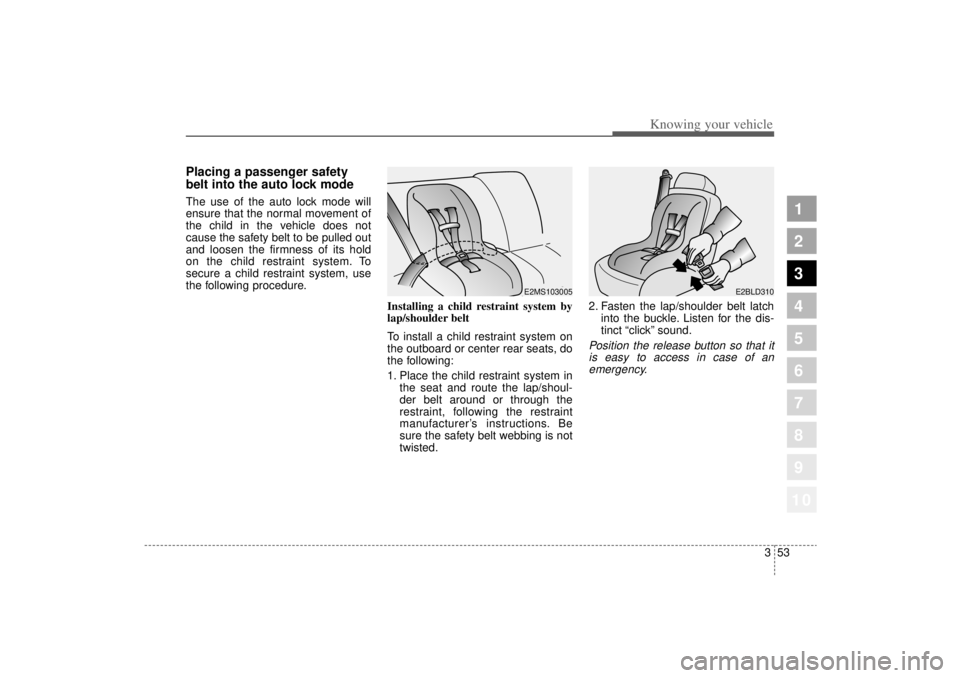
the following procedure.Installing a child restraint system by
lap/shoulder belt
To install a child restraint system on
the outboard or center rear seats, do
the following:
1. Place the child restraint system inthe seat and route the lap/shoul-
der belt around or through the
restraint, following the restraint
manufacturer’s instructions. Be
sure the safety belt webbing is not
twisted. 2. Fasten the lap/shoulder belt latch
into the buckle. Listen for the dis-
tinct “click” sound.
Position the release button so that itis easy to access in case of anemergency.
E2MS103005
E2BLD310
Page 65 of 322
Knowing your vehicle54
3
1
2
3
4
5
6
7
8
910
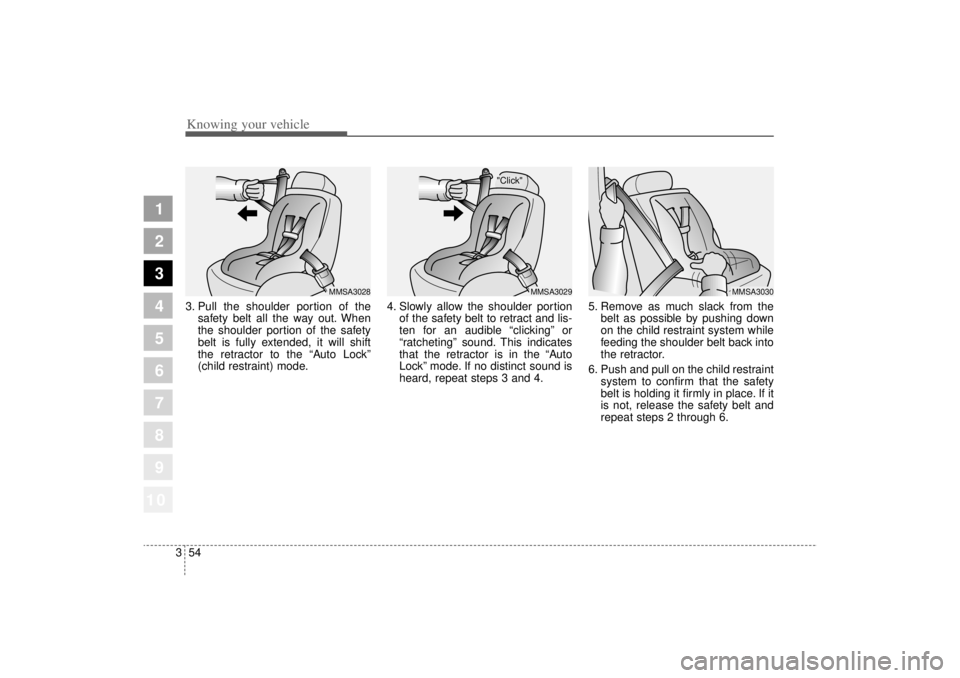
3. Pull the shoulder portion of the
safety belt all the way out. When
the shoulder portion of the safety
belt is fully extended, it will shift
the retractor to the “Auto Lock”
(child restraint) mode. 4. Slowly allow the shoulder portion
of the safety belt to retract and lis-
ten for an audible “clicking” or
“ratcheting” sound. This indicates
that the retractor is in the “Auto
Lock” mode. If no distinct sound is
heard, repeat steps 3 and 4. 5. Remove as much slack from the
belt as possible by pushing down
on the child restraint system while
feeding the shoulder belt back into
the retractor.
6. Push and pull on the child restraint system to confirm that the safety
belt is holding it firmly in place. If it
is not, release the safety belt and
repeat steps 2 through 6.
MMSA3028
"Click"
MMSA3029
MMSA3030
Page 66 of 322
355
1
2
3
4
5
6
7
8
910
Knowing your vehicle
7. Double check that the retractor isin the “Auto Lock” mode by
attempting to pull more of the safe-
ty belt out of the retractor. If you
cannot, the retractor is in the “Auto
Lock” mode.
To remove the child restraint, press
the release button on the buckle and
then pull the lap/shoulder belt out of
the restraint and allow the safety belt
to retract fully.
✽ ✽ NOTICEWhen the safety belt is allowed to
retract to its fully stowed position,
the retractor will automatically
switch from the “Auto Lock” mode
to the emergency lock mode for nor-
mal adult usage.
WARNING
- Auto lock
mode
The lap/shoulder belt automati-
cally returns to the “emergency
lock mode” whenever the belt is
allowed to retract fully.
Therefore, the preceding seven
steps must be followed each
time a child restraint is
installed.
If the safety belt is not placed in
the “auto lock” mode, severe
injury or death could occur to
the child and/or other occupants
in the vehicle in a collision,
since the child restraint will not
be effectively held in place.
Page 68 of 322
357
1
2
3
4
5
6
7
8
910
Knowing your vehicle
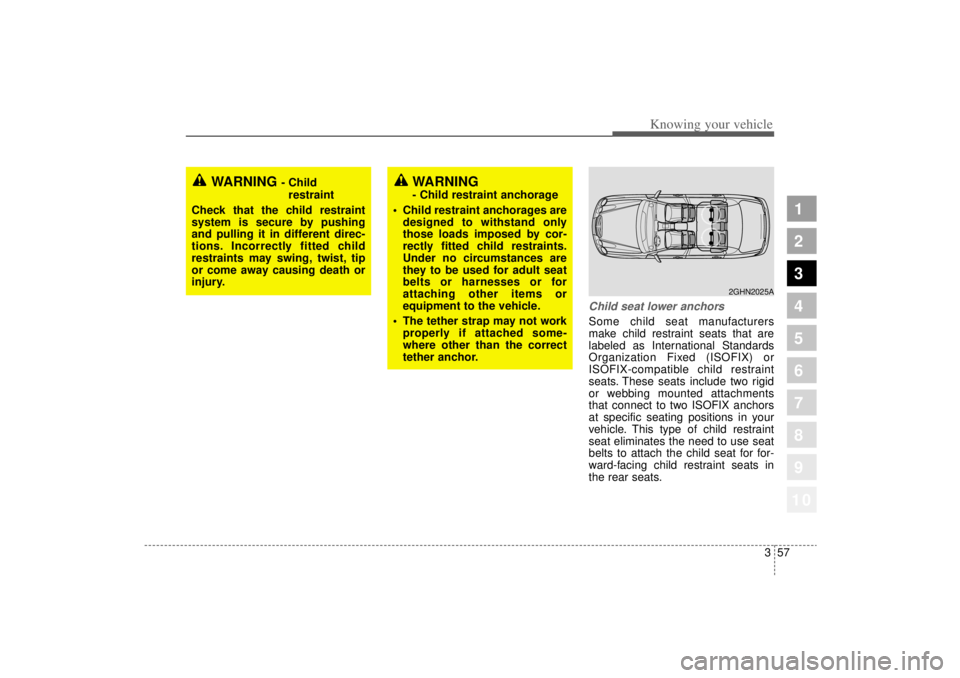
Child seat lower anchorsSome child seat manufacturers
make child restraint seats that are
labeled as International Standards
Organization Fixed (ISOFIX) or
ISOFIX-compatible child restraint
seats. These seats include two rigid
or webbing mounted attachments
that connect to two ISOFIX anchors
at specific seating positions in your
vehicle. This type of child restraint
seat eliminates the need to use seat
belts to attach the child seat for for-
ward-facing child restraint seats in
the rear seats.
2GHN2025A
WARNING
- Childrestraint
Check that the child restraint
system is secure by pushing
and pulling it in different direc-
tions. Incorrectly fitted child
restraints may swing, twist, tip
or come away causing death or
injury.
WARNING - Child restraint anchorage
Child restraint anchorages are
designed to withstand only
those loads imposed by cor-
rectly fitted child restraints.
Under no circumstances are
they to be used for adult seat
belts or harnesses or for
attaching other items or
equipment to the vehicle.
The tether strap may not work
properly if attached some-
where other than the correct
tether anchor.
Page 72 of 322
361
1
2
3
4
5
6
7
8
910
Knowing your vehicle
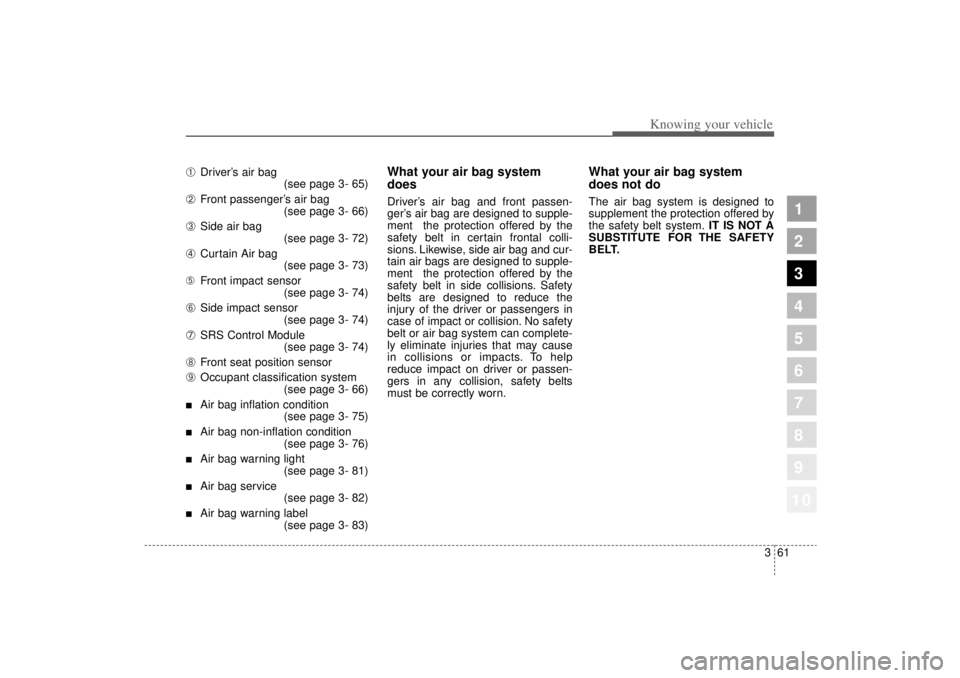
➀
Driver’s air bag
(see page 3- 65)
➁
Front passenger’ s air bag
(see page 3- 66)
➂
Side air bag (see page 3- 72)
➃
Curtain Air bag(see page 3- 73)
➄ Front impact sensor
(see page 3- 74)
\b
Side impact sensor(see page 3- 74)
➆
SRS Control Module(see page 3- 74)
➇
Front seat position sensor
\f
Occupant classification system(see page 3- 66)
Air bag inflation condition(see page 3- 75)
Air bag non-inflation condition(see page 3- 76)
Air bag warning light(see page 3- 81)
Air bag service(see page 3- 82)
Air bag warning label(see page 3- 83)
What your air bag system
doesDriver’s air bag and front passen-
ger’ s air bag are designed to supple-
ment the protection offered by the
safety belt in certain frontal colli-
sions. Likewise, side air bag and cur-
tain air bags are designed to supple-
ment the protection offered by the
safety belt in side collisions. Safety
belts are designed to reduce the
injury of the driver or passengers in
case of impact or collision. No safety
belt or air bag system can complete-
ly eliminate injuries that may cause
in collisions or impacts. To help
reduce impact on driver or passen-
gers in any collision, safety belts
must be correctly worn.
What your air bag system
does not doThe air bag system is designed to
supplement the protection offered by
the safety belt system. IT IS NOT A
SUBSTITUTE FOR THE SAFETY
BELT.
Page 73 of 322
Knowing your vehicle62
3
1
2
3
4
5
6
7
8
910
The importance of using
safety beltsThere are four very important rea-
sons to use safety belts even with an
air bag supplemental restraint sys-
tem. They:
help keep you in the proper posi-
tion (away from the air bag) when it
inflates.
reduce the risk of harm in rollover,
side impact (vehicles not equipped
with side and curtain air bags) or
rear impact collisions, because an
air bag is not designed to inflate in
such situations and even a side
curtain air bag is designed to
inflate only in certain side impact
collisions.
reduce the risk of harm in frontal or
side collisions which are not
severe enough to actuate the air
bag supplemental restraint system.
reduce the risk of being ejected
from your vehicle.
✽ ✽
NOTICEYour vehicle’s Supplemental
Restraint System Control Module is
equipped with a recording device
that may record the use or status of
the safety belt restraint system by
the driver and front passenger in
certain collisions.
WARNING
- Air bags &
safety belts
Even in vehicles with air bags,
you and your passengers
must always wear the safety
belts provided in order to min-
imize the risk and severity of
injury in the event of a colli-
sion or rollover.
Always wear your safety belt.
It can help keep you away
from the air bags during heavy
braking just before a collision.
(Continued)
(Continued)
If occupants are not wearing
safety belts or correctly seat-
ed, they cannot be protected,
and thus face serious injury or
death.
Driver’ s and front passenger ’s
air bag are designed to inflate
only in certain frontal colli-
sion, and side and curtain air
bags are designed to inflate in
certain side impacts. Frontal
air bags will generally not pro-
vide protection in side
impacts (vehicles not
equipped with side and cur-
tain air bags) or rear impacts,
rollovers, less severe frontal
collisions. They will not pro-
vide protection from later
impacts in a multi-impact col-
lision.
(Continued)
Page 74 of 322
363
1
2
3
4
5
6
7
8
910
Knowing your vehicle
Air bag system components The main components of your SRS
are:
To indicate that your vehicle is
equipped with air bags, the corre-
sponding air bag covers are
marked with “SRS AIR BAG”.
- Driver’ s air bag (see page 3- 65)
- Passenger’ s air bag(see page 3-
66)
- Side air bag (see page 3- 72)
- Curtain air bag (see page 3- 73)
A diagnostic system that continual-
ly monitors the system operation.
An indicator light to warn you of a
possible problem with the system.
Emergency power backup in case
your car’ s electrical system is dis-
connected in a crash. The SRS uses a collection of sen-
sors to gather information about the
driver’
s and front passenger’ s seat
position, the driver’ s and front pas-
senger’ s safety belt usage and
impact severity.
The driver’ s and front passenger’ s
seat position sensors, which are
installed on the seat track, determine
if the seats are fore or aft of a refer-
ence position. Similarly, the safety
belt usage sensors determine if the
driver and front passenger’ s safety
belts are fastened. These sensors
provide the ability to control the SRS
deployment based on how close the
driver’ s seat is to the steering wheel,
how close the passenger’ s seat is to
the instrument panel, whether or not
the safety belts are fastened, and the
severity of the impact.
(Continued)
If your vehicle has been sub-
jected to flood conditions (e.g.
soaked carpeting/standing
water on the floor of the vehi-
cle, etc.) or if your vehicle has
become flood damaged in any
way, do not attempt to start
the vehicle or put the key in
the ignition before discon-
necting the battery.
Disregarding this precaution
may cause air bag deploy-
ment, which could result in
serious personal injury or
death. If your vehicle is sub-
jected to flooded conditions,
before starting the vehicle,
have the vehicle towed to an
authorized Kia dealer for
inspection and necessary
repairs.
Page 75 of 322
Knowing your vehicle64
3
1
2
3
4
5
6
7
8
910
The advanced SRS offers the ability
to control the air bag inflation with
two levels. A first stage level is pro-
vided for moderate-severity impacts.
A second stage level is provided for
more severe impacts.
According to the impact severity,
seating position and safety belt
usage, the SRSCM (SRS Control
Module) controls the air bag inflation.
Failure to properly wear safety
belts can increase the risk or
severity of injury in an accident.
Additionally, your SRS is equipped
with an occupant classification sys-
tem in the front passenger’ s seat.
The occupant classification system
detects the presence of a passenger
in the front passenger’ s seat and will
turn off the front passenger ’s air bag
under certain conditions. For more
detail, see “Occupant Classification
System” later in this section.
CAUTION
If the seat position sensor is not
working properly, the SRS airbag warning light ( ) on theinstrument panel will illuminateeven if there is no malfunctionof the SRS air bag system,because the SRS air bag warn-ing light is connected with theseat position sensor. If the SRSair bag warning light does notilluminate when the ignition keyis turned to the "ON" position, ifit remains illuminated afterblinking for approximately 6seconds, or if it illuminateswhile the vehicle is being driv-en, have an authorized Kia deal-er inspect the seat position sen-sor and the advanced SRS airbag system as soon as possi-ble.
AIR
BAG
WARNING
Modification to the seat struc-
ture can adversely affect the
seat position sensor and
cause the air bag to deploy at
a different level than should
be provided.
Failure to properly wear safety
belts can increase the risk or
severity of injury by causing
the air bags to deploy at a dif-
ferent level than should be
provided.
Do not place any objects
underneath the front seats
which could damage the seat
position sensor or interfere
with the occupant classifica-
tion system.
Do not place any objects that
may cause magnetic fields
near the front seat. These may
cause a malfunction of the
seat position sensor.
(Continued)
Page 78 of 322
367
1
2
3
4
5
6
7
8
910
Knowing your vehicle
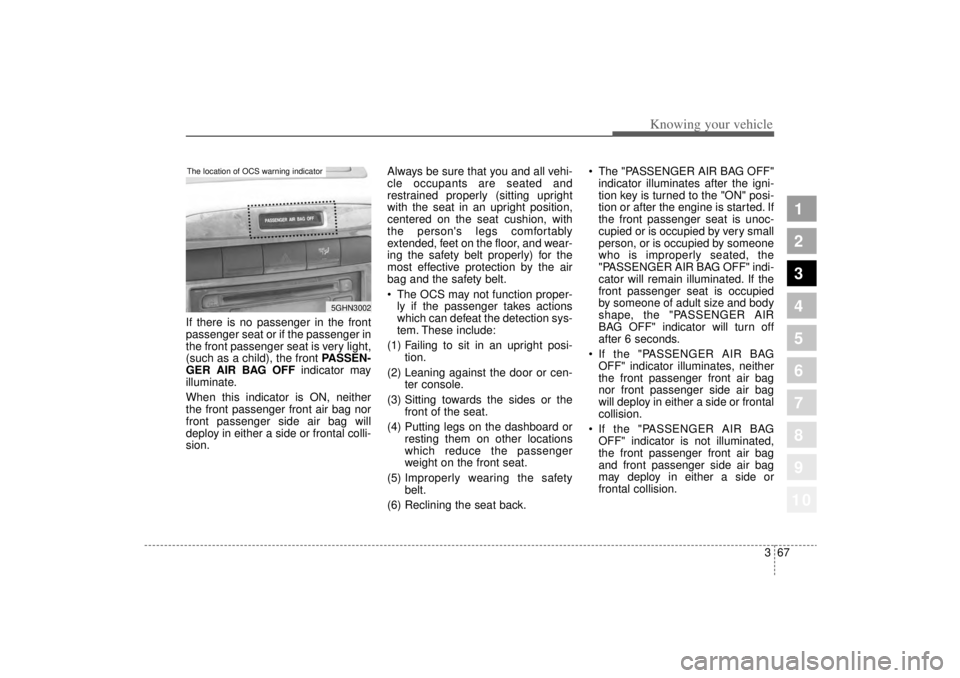
If there is no passenger in the front
passenger seat or if the passenger in
the front passenger seat is very light,
(such as a child), the front PASSEN-
GER AIR BAG OFF indicator may
illuminate.
When this indicator is ON, neither
the front passenger front air bag nor
front passenger side air bag will
deploy in either a side or frontal colli-
sion. Always be sure that you and all vehi-
cle occupants are seated and
restrained properly (sitting upright
with the seat in an upright position,
centered on the seat cushion, with
the person's legs comfortably
extended, feet on the floor, and wear-
ing the safety belt properly) for the
most effective protection by the air
bag and the safety belt.
The OCS may not function proper-
ly if the passenger takes actions
which can defeat the detection sys-
tem. These include:
(1) Failing to sit in an upright posi- tion.
(2) Leaning against the door or cen- ter console.
(3) Sitting towards the sides or the front of the seat.
(4) Putting legs on the dashboard or resting them on other locations
which reduce the passenger
weight on the front seat.
(5) Improperly wearing the safety
belt.
(6) Reclining the seat back.
The "PASSENGER AIR BAG OFF"
indicator illuminates after the igni-
tion key is turned to the "ON" posi-
tion or after the engine is started. If
the front passenger seat is unoc-
cupied or is occupied by very small
person, or is occupied by someone
who is improperly seated, the
"PASSENGER AIR BAG OFF" indi-
cator will remain illuminated. If the
front passenger seat is occupied
by someone of adult size and body
shape, the "PASSENGER AIR
BAG OFF" indicator will turn off
after 6 seconds.
If the "PASSENGER AIR BAG
OFF" indicator illuminates, neither
the front passenger front air bag
nor front passenger side air bag
will deploy in either a side or frontal
collision.
If the "PASSENGER AIR BAG
OFF" indicator is not illuminated,
the front passenger front air bag
and front passenger side air bag
may deploy in either a side or
frontal collision.
5GHN3002
The location of OCS warning indicator