tow KIA AMANTI 2006 Owner's Guide
[x] Cancel search | Manufacturer: KIA, Model Year: 2006, Model line: AMANTI, Model: KIA AMANTI 2006Pages: 322, PDF Size: 44.16 MB
Page 226 of 322
In case of an emergency66Jump starting procedure 1. Make sure the booster battery is12-volt and that its negative termi-
nal is grounded.
2. If the booster battery is in another vehicle, do not allow the vehicles
to touch.
3. Turn off all unnecessary electrical loads.
4. Connect the jumper cables in the exact sequence shown in the pre-
vious illustration. First connect one
end of a jumper cable to the posi-
tive terminal of the discharged bat-
tery (
➀), then connect the other
end to the positive terminal on the
booster battery (
➁). Proceed to
connect one end of the other
jumper cable to the negative ter-
minal of the booster battery (
➂),
then the other end to a solid, sta-
tionary, metallic point (for exam-
ple, the engine lifting bracket)
away from the battery (
➃). Do not
connect it to or near any part that
moves when the engine is
cranked. Do not connect the
jumper cable from the negative
terminal of the booster battery to
the negative terminal of the dis-
charged battery. Do not allow the jumper cables to
contact anything except the cor-
rect battery terminals or the cor-
rect ground. Do not lean over the
battery when making connections.
5. Start the engine of the vehicle with the booster battery and let it run at
2,000 rpm, then start the engine of
the vehicle with the discharged
battery.
If the cause of your battery discharg-ing is not apparent, you should haveyour vehicle checked by anAuthorized Kia Dealer.
Refer to illustration on page 6-5.
Push-starting Vehicles equipped with automatic
transaxle cannot be push-started.
Follow the directions in this section
for jump-starting.
1
2
3
4
5
6
7
8
910
CAUTION
Never tow a vehicle to start itbecause the sudden surge for-ward when the engine startscould cause a collision with thetow vehicle.
Page 229 of 322
69
In case of an emergency
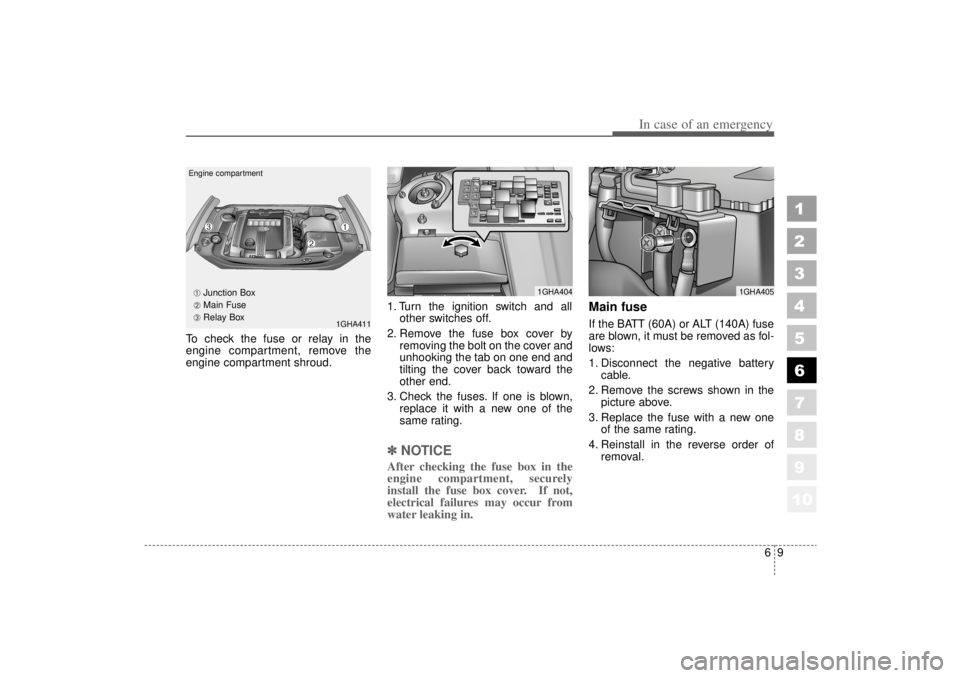
To check the fuse or relay in the
engine compartment, remove the
engine compartment shroud.1. Turn the ignition switch and all
other switches off.
2. Remove the fuse box cover by removing the bolt on the cover and
unhooking the tab on one end and
tilting the cover back toward the
other end.
3. Check the fuses. If one is blown, replace it with a new one of the
same rating.
✽ ✽NOTICEAfter checking the fuse box in the
engine compartment, securely
install the fuse box cover. If not,
electrical failures may occur from
water leaking in.
Main fuseIf the BATT (60A) or ALT (140A) fuse
are blown, it must be removed as fol-
lows:
1. Disconnect the negative battery
cable.
2. Remove the screws shown in the picture above.
3. Replace the fuse with a new one of the same rating.
4. Reinstall in the reverse order of removal.
1
2
3
4
5
6
7
8
910
1GHA404
1GHA411
1GHA405
Engine compartment
➀
➁
➂➀
Junction Box
➁ Main Fuse
➂ Relay Box
Page 235 of 322
615
In case of an emergency
1
2
3
4
5
6
7
8
910
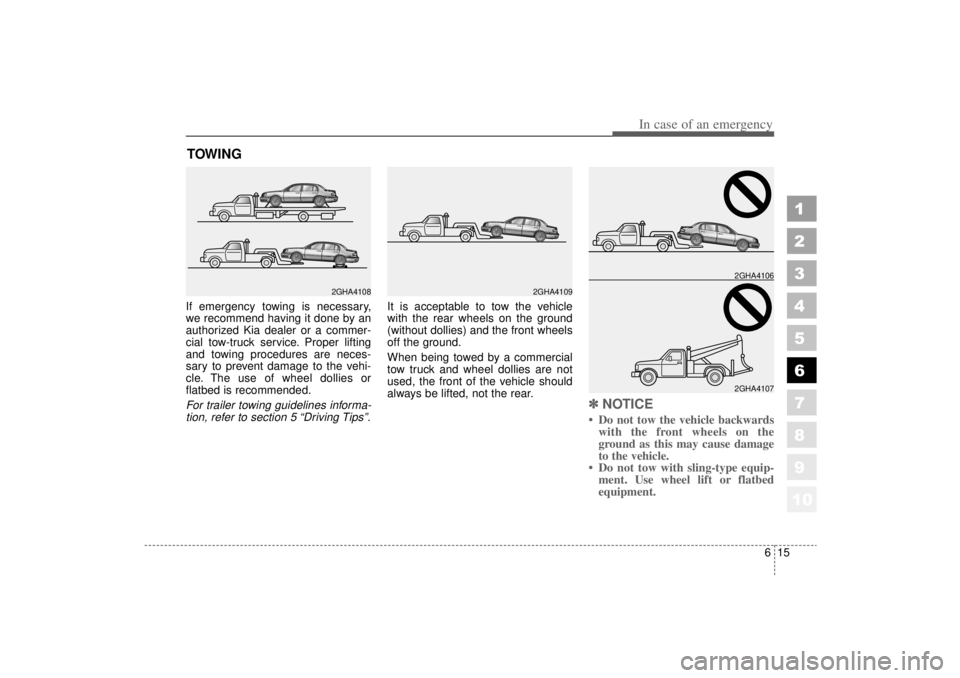
TOWING If emergency towing is necessary,
we recommend having it done by an
authorized Kia dealer or a commer-
cial tow-truck service. Proper lifting
and towing procedures are neces-
sary to prevent damage to the vehi-
cle. The use of wheel dollies or
flatbed is recommended.For trailer towing guidelines informa-tion, refer to section 5 “Driving Tips”.
It is acceptable to tow the vehicle
with the rear wheels on the ground
(without dollies) and the front wheels
off the ground.
When being towed by a commercial
tow truck and wheel dollies are not
used, the front of the vehicle should
always be lifted, not the rear.
✽ ✽
NOTICE• Do not tow the vehicle backwards
with the front wheels on the
ground as this may cause damage
to the vehicle.
• Do not tow with sling-type equip- ment. Use wheel lift or flatbed
equipment.
2GHA4107 2GHA4106
2GHA4108
2GHA4109
Page 236 of 322
In case of an emergency16
6
1
2
3
4
5
6
7
8
910
When towing your vehicle in an
emergency without wheel dollies :
1. Set the ignition switch in the ACC
position.
2. Place the transaxle shift lever in N (Neutral).
3. Release the parking brake.✽ ✽ NOTICEFailure to place the transaxle shift
lever in N (Neutral) may cause inter-
nal damage to the transaxle.
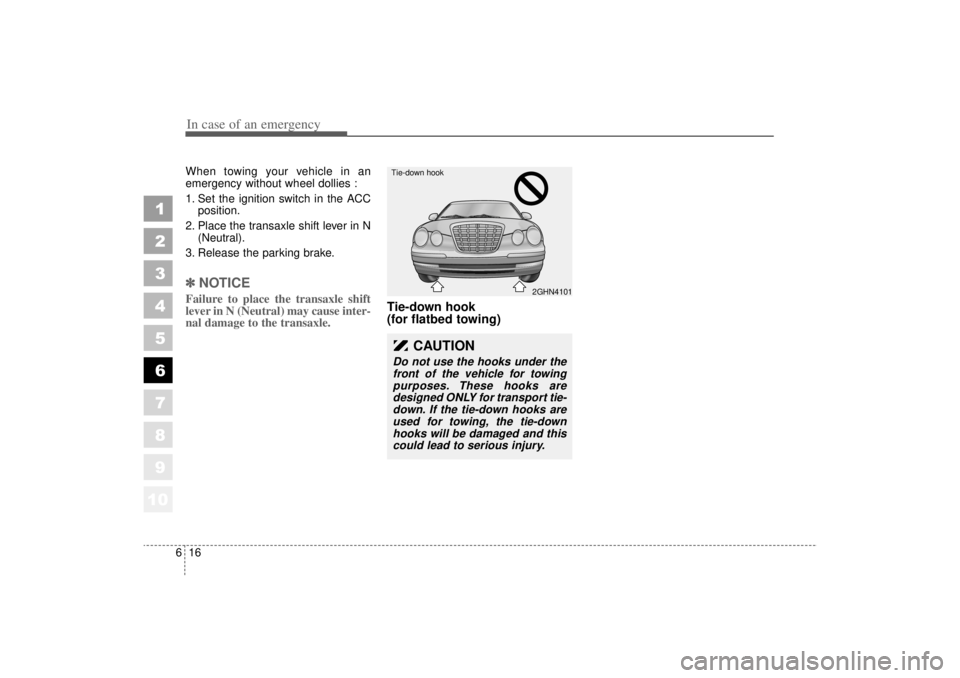
Tie-down hook
(for flatbed towing)
2GHN4101
Tie-down hook
CAUTION
Do not use the hooks under the
front of the vehicle for towingpurposes. These hooks aredesigned ONLY for transport tie-down. If the tie-down hooks areused for towing, the tie-downhooks will be damaged and thiscould lead to serious injury.
Page 237 of 322
617
In case of an emergency
1
2
3
4
5
6
7
8
910
Towing with a vehicle other
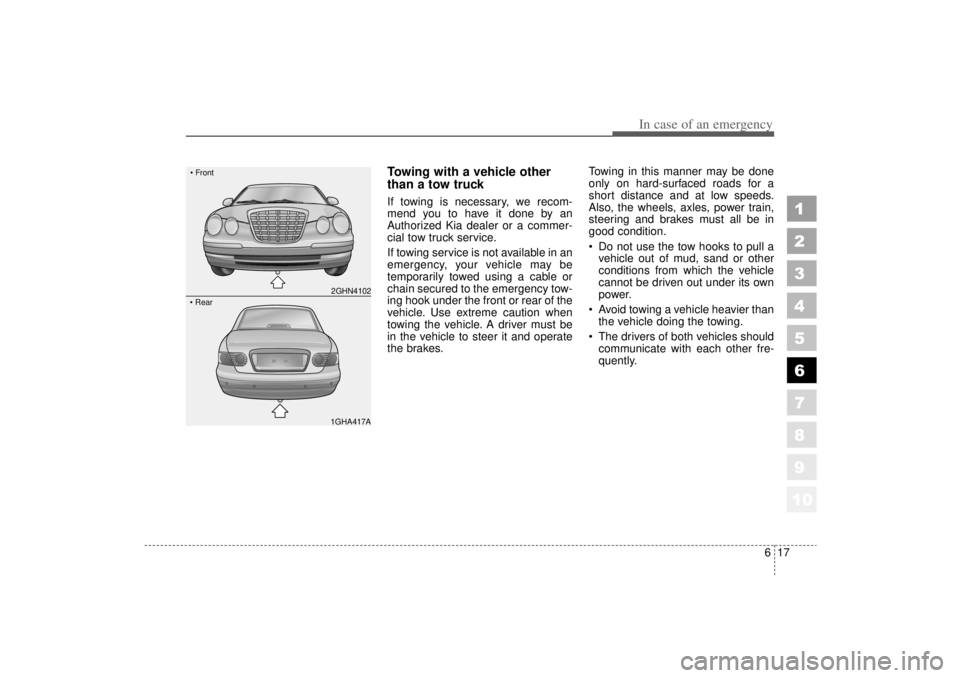
than a tow truck If towing is necessary, we recom-
mend you to have it done by an
Authorized Kia dealer or a commer-
cial tow truck service.
If towing service is not available in an
emergency, your vehicle may be
temporarily towed using a cable or
chain secured to the emergency tow-
ing hook under the front or rear of the
vehicle. Use extreme caution when
towing the vehicle. A driver must be
in the vehicle to steer it and operate
the brakes.Towing in this manner may be done
only on hard-surfaced roads for a
short distance and at low speeds.
Also, the wheels, axles, power train,
steering and brakes must all be in
good condition.
Do not use the tow hooks to pull a
vehicle out of mud, sand or other
conditions from which the vehicle
cannot be driven out under its own
power.
Avoid towing a vehicle heavier than
the vehicle doing the towing.
The drivers of both vehicles should
communicate with each other fre-
quently.
2GHN4102
Front1GHA417A
Rear
Page 238 of 322
In case of an emergency18
6
1
2
3
4
5
6
7
8
910
✽ ✽
NOTICE• Attach a towing strap to the tow
hook.
• Using a portion of the vehicle other than the tow hooks for tow-
ing may damage the body of your
vehicle.
• Use only a cable or chain specifi- cally intended for use in towing
vehicles. Securely fasten the cable
or chain to the towing hook pro-
vided. Before emergency towing, check
that the hook is not broken or dam-
aged.
Fasten the towing cable or chain
securely to the hook.
Do not jerk the hook. Apply steady
and even force.
To avoid damaging the hook, do
not pull from the side or at a verti-
cal angle. Always pull straight
ahead.
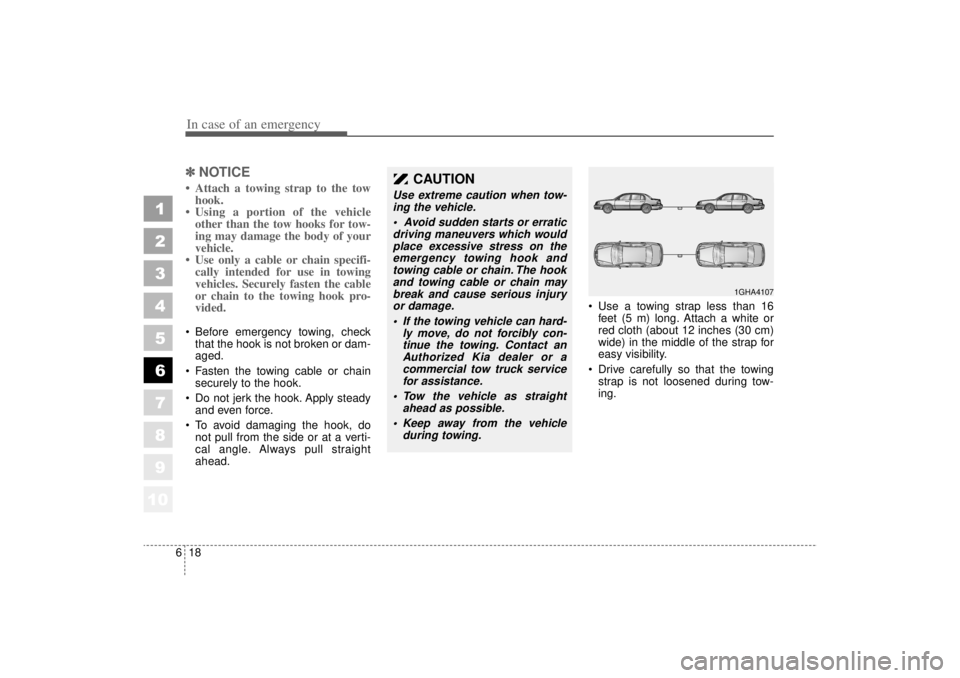
Use a towing strap less than 16
feet (5 m) long. Attach a white or
red cloth (about 12 inches (30 cm)
wide) in the middle of the strap for
easy visibility.
Drive carefully so that the towing
strap is not loosened during tow-
ing.
CAUTION
Use extreme caution when tow-
ing the vehicle.
Avoid sudden starts or erraticdriving maneuvers which wouldplace excessive stress on theemergency towing hook andtowing cable or chain. The hookand towing cable or chain maybreak and cause serious injuryor damage.
If the towing vehicle can hard- ly move, do not forcibly con-tinue the towing. Contact anAuthorized Kia dealer or acommercial tow truck servicefor assistance.
Tow the vehicle as straight ahead as possible.
Keep away from the vehicle during towing.
1GHA4107
Page 239 of 322
619
In case of an emergency
1
2
3
4
5
6
7
8
910
When your vehicle is being
towed by another vehicle
other than a tow truck (In case
of an emergency) Turn the ignition switch to ACC so
the steering wheel isn’t locked.
Place the transaxle shift lever in N
(Neutral).
Release the parking bake.
Vehicle equipped with automatic
transaxles should not exceed 28
mph (45 km/h) and should not be
towed more than 50 miles (80 km).
Press the brake pedal with more
force than normal since you will
have reduced brake performance.
More steering effort will be
required because the power steer-
ing system will be disabled.
If you are driving down a long hill,
the brakes may overheat and brake
performance will be reduced. Stop
often and let the brakes cool off.
✽ ✽
NOTICETo prevent internal damage to the
transaxle, never tow your vehicle
from the rear (backwards) with all
four tires in contact with the sur-
face.
Tips for towing a stuck vehicleThe following methods are effective
when your vehicle is stuck in mud,
sand or similar substances that pre-
vent the vehicle from being driven
out under its own power.
Remove the soil and sand, etc.
from the front and the back of the
tires.
Place a stone or wood under the
tires.
Page 241 of 322
621
In case of an emergency
1
2
3
4
5
6
7
8
910
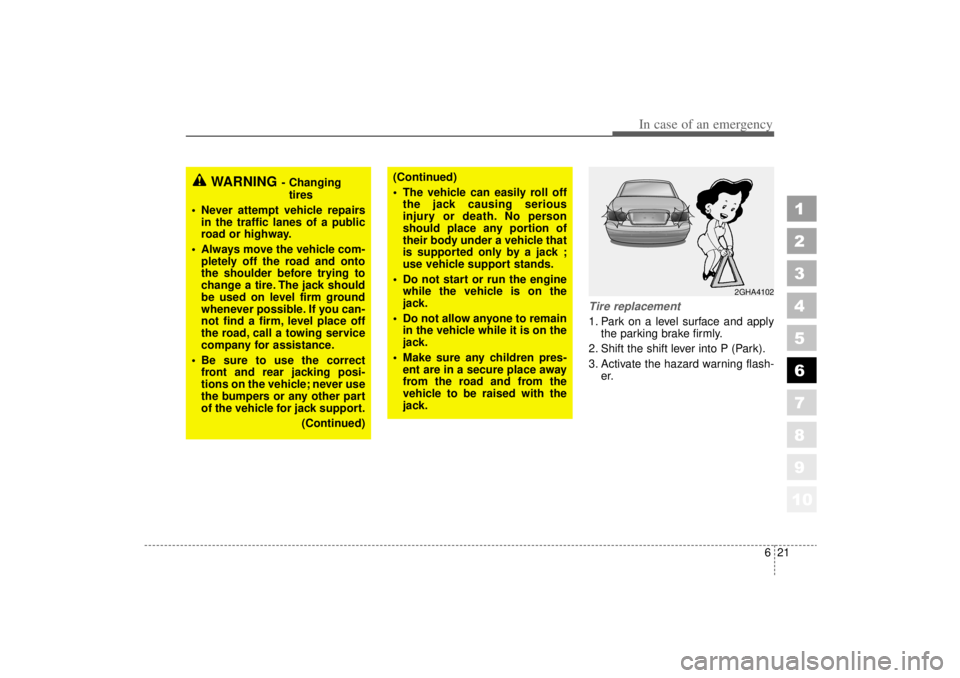
Tire replacement 1. Park on a level surface and applythe parking brake firmly.
2. Shift the shift lever into P (Park).
3. Activate the hazard warning flash- er.
WARNING
- Changing
tires
Never attempt vehicle repairs in the traffic lanes of a public
road or highway.
Always move the vehicle com- pletely off the road and onto
the shoulder before trying to
change a tire. The jack should
be used on level firm ground
whenever possible. If you can-
not find a firm, level place off
the road, call a towing service
company for assistance.
Be sure to use the correct front and rear jacking posi-
tions on the vehicle; never use
the bumpers or any other part
of the vehicle for jack support.
(Continued)
(Continued)
The vehicle can easily roll offthe jack causing serious
injury or death. No person
should place any portion of
their body under a vehicle that
is supported only by a jack ;
use vehicle support stands.
Do not start or run the engine while the vehicle is on the
jack.
Do not allow anyone to remain in the vehicle while it is on the
jack.
Make sure any children pres- ent are in a secure place away
from the road and from the
vehicle to be raised with the
jack.
2GHA4102
Page 262 of 322
Maintenance18
7
1
2
3
4
5
6
7
8
910
ENGINE COOLING SYSTEM The high-pressure cooling system
has a reservoir filled with year-round
antifreeze coolant. The reservoir is
filled at the factory.
Check the antifreeze protection and
coolant level at least once a year, at
the beginning of the winter season,
and before traveling to a colder cli-
mate.
Checking the coolant level
WARNING
- Removing
radiator cap
Never attempt to remove the radiator cap while the engine
is operating or hot. Doing so
might lead to cooling system
and engine damage and could
result in serious personal
injury from escaping hot
coolant or steam.
Turn the engine off and wait until it cools down. Even then,
use extreme care when
removing the radiator cap.
Wrap a thick towel around it,
and turn it counterclockwise
slowly to the first stop. Step
back while the pressure is
released from the cooling sys-
tem. When you are sure all the
pressure has been released,
press down on the cap, using
a thick towel, and continue
turning counterclockwise to
remove it.
(Continued)
(Continued)
Even if the engine is not oper-ating, do not remove the radi-
ator cap or the drain plug
while the engine and radiator
are hot. Hot coolant and steam
may still blow out under pres-
sure, causing serious injury.
Page 278 of 322
Maintenance34
7
1
2
3
4
5
6
7
8
910
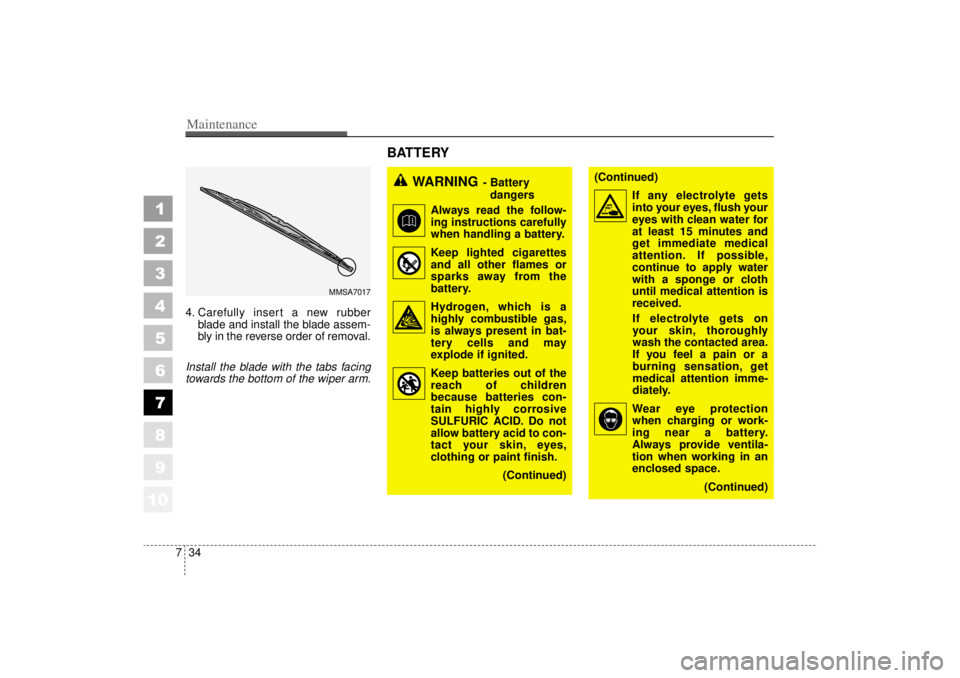
4. Carefully insert a new rubber
blade and install the blade assem-
bly in the reverse order of removal.Install the blade with the tabs facingtowards the bottom of the wiper arm.
BATTERY
MMSA7017
WARNING
- Battery
dangers
Always read the follow-
ing instructions carefully
when handling a battery.
Keep lighted cigarettes and all other flames or
sparks away from the
battery.
Hydrogen, which is a highly combustible gas,
is always present in bat-
tery cells and may
explode if ignited.
Keep batteries out of the reach of children
because batteries con-
tain highly corrosive
SULFURIC ACID. Do not
allow battery acid to con-
tact your skin, eyes,
clothing or paint finish.
(Continued)
(Continued)If any electrolyte getsinto your eyes, flush your
eyes with clean water for
at least 15 minutes and
get immediate medical
attention. If possible,
continue to apply water
with a sponge or cloth
until medical attention is
received.
If electrolyte gets on
your skin, thoroughly
wash the contacted area.
If you feel a pain or a
burning sensation, get
medical attention imme-
diately.
Wear eye protection when charging or work-
ing near a battery.
Always provide ventila-
tion when working in an
enclosed space.
(Continued)