brake KIA AMANTI 2006 Workshop Manual
[x] Cancel search | Manufacturer: KIA, Model Year: 2006, Model line: AMANTI, Model: KIA AMANTI 2006Pages: 322, PDF Size: 44.16 MB
Page 244 of 322
In case of an emergency24
6
1
2
3
4
5
6
7
8
910
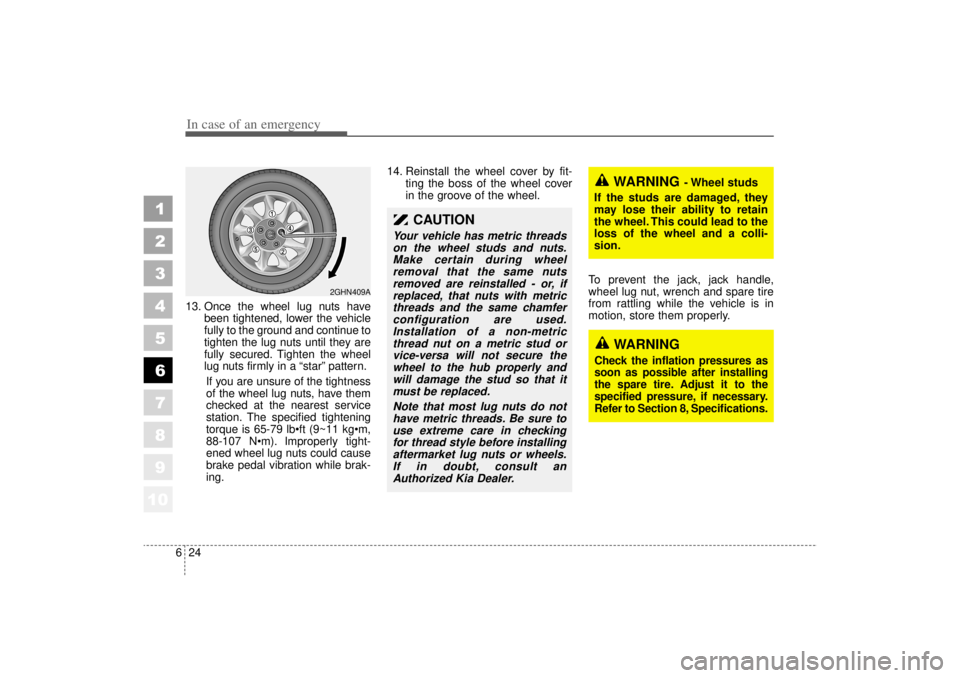
13. Once the wheel lug nuts have
been tightened, lower the vehicle
fully to the ground and continue to
tighten the lug nuts until they are
fully secured. Tighten the wheel
lug nuts firmly in a “star” pattern.
If you are unsure of the tightness
of the wheel lug nuts, have them
checked at the nearest service
station. The specified tightening
torque is 65-79 lb ft (9~11 kgm,
88-107 N m). Improperly tight-
ened wheel lug nuts could cause
brake pedal vibration while brak-
ing. 14. Reinstall the wheel cover by fit-
ting the boss of the wheel cover
in the groove of the wheel.
To prevent the jack, jack handle,
wheel lug nut, wrench and spare tire
from rattling while the vehicle is in
motion, store them properly.
2GHN409A
CAUTION
Your vehicle has metric threadson the wheel studs and nuts.Make certain during wheelremoval that the same nutsremoved are reinstalled - or, ifreplaced, that nuts with metricthreads and the same chamferconfiguration are used.Installation of a non-metricthread nut on a metric stud orvice-versa will not secure thewheel to the hub properly andwill damage the stud so that itmust be replaced.
Note that most lug nuts do nothave metric threads. Be sure touse extreme care in checkingfor thread style before installingaftermarket lug nuts or wheels.If in doubt, consult anAuthorized Kia Dealer.
WARNING
- Wheel studs
If the studs are damaged, they
may lose their ability to retain
the wheel. This could lead to the
loss of the wheel and a colli-
sion.
WARNING
Check the inflation pressures as
soon as possible after installing
the spare tire. Adjust it to the
specified pressure, if necessary.
Refer to Section 8, Specifications.
Page 245 of 322
1
2
3
4
5
6
7
8
9101
2
3
4
5
6
7
8
910
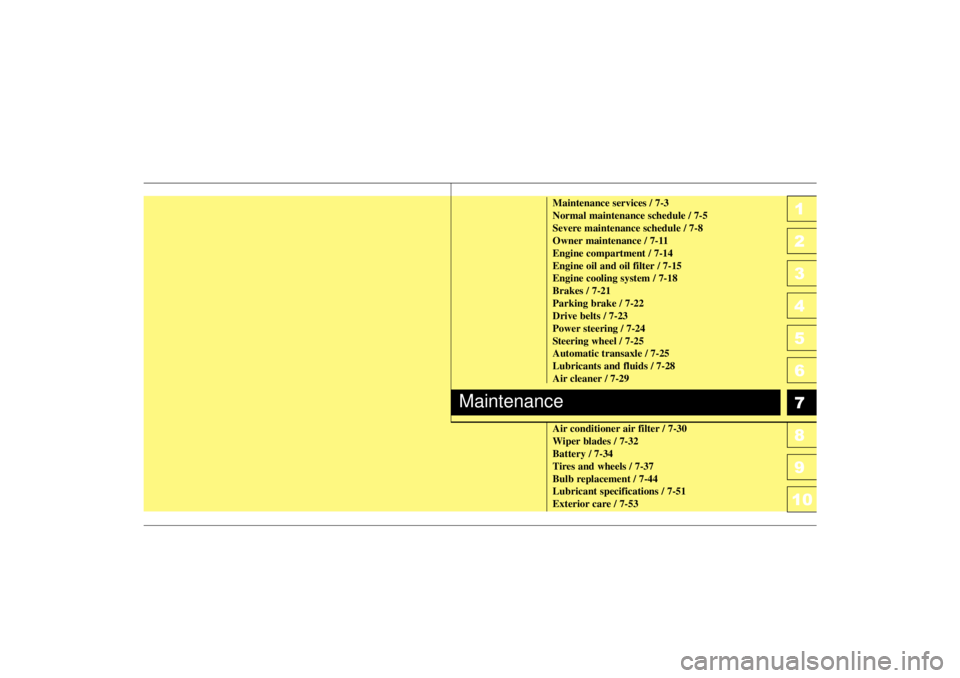
Maintenance services / 7-3
Normal maintenance schedule / 7-5
Severe maintenance schedule / 7-8
Owner maintenance / 7-11
Engine compartment / 7-14
Engine oil and oil filter / 7-15
Engine cooling system / 7-18
Brakes / 7-21
Parking brake / 7-22
Drive belts / 7-23
Power steering / 7-24
Steering wheel / 7-25
Automatic transaxle / 7-25
Lubricants and fluids / 7-28
Air cleaner / 7-29
Air conditioner air filter / 7-30
Wiper blades / 7-32
Battery / 7-34
Tires and wheels / 7-37
Bulb replacement / 7-44
Lubricant specifications / 7-51
Exterior care / 7-53
Maintenance
Page 248 of 322
Maintenance47Scheduled maintenance serv-
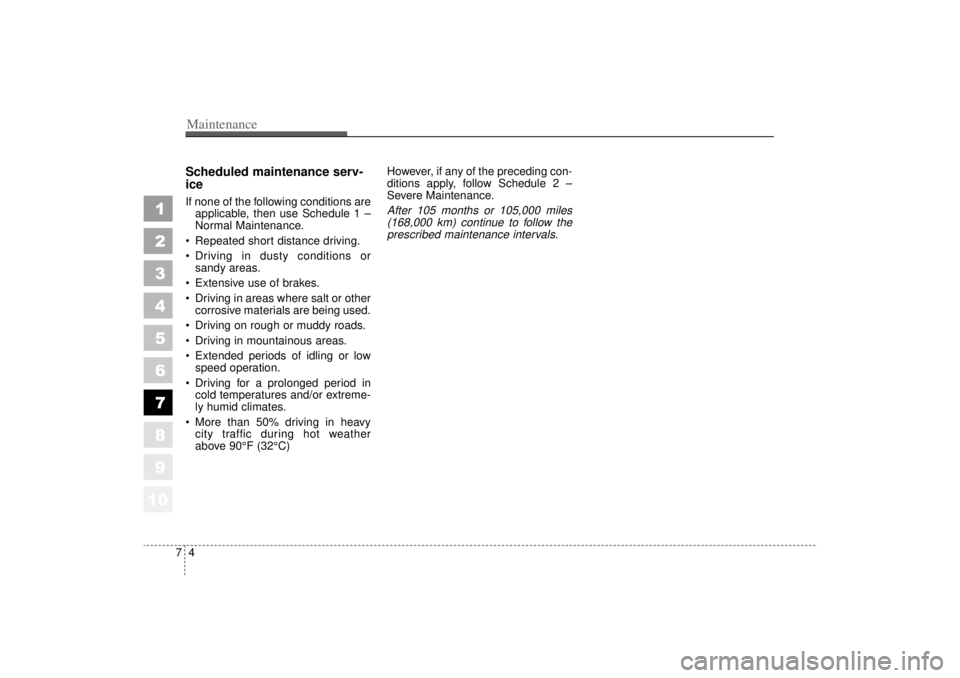
ice If none of the following conditions areapplicable, then use Schedule 1 –
Normal Maintenance.
Repeated short distance driving.
Driving in dusty conditions or sandy areas.
Extensive use of brakes.
Driving in areas where salt or other corrosive materials are being used.
Driving on rough or muddy roads.
Driving in mountainous areas.
Extended periods of idling or low speed operation.
Driving for a prolonged period in cold temperatures and/or extreme-
ly humid climates.
More than 50% driving in heavy city traffic during hot weather
above 90°F (32°C) However, if any of the preceding con-
ditions apply, follow Schedule 2 –
Severe Maintenance.
After 105 months or 105,000 miles
(168,000 km) continue to follow theprescribed maintenance intervals.
1
2
3
4
5
6
7
8
910
Page 250 of 322
1
2
3
4
5
6
7
8
910
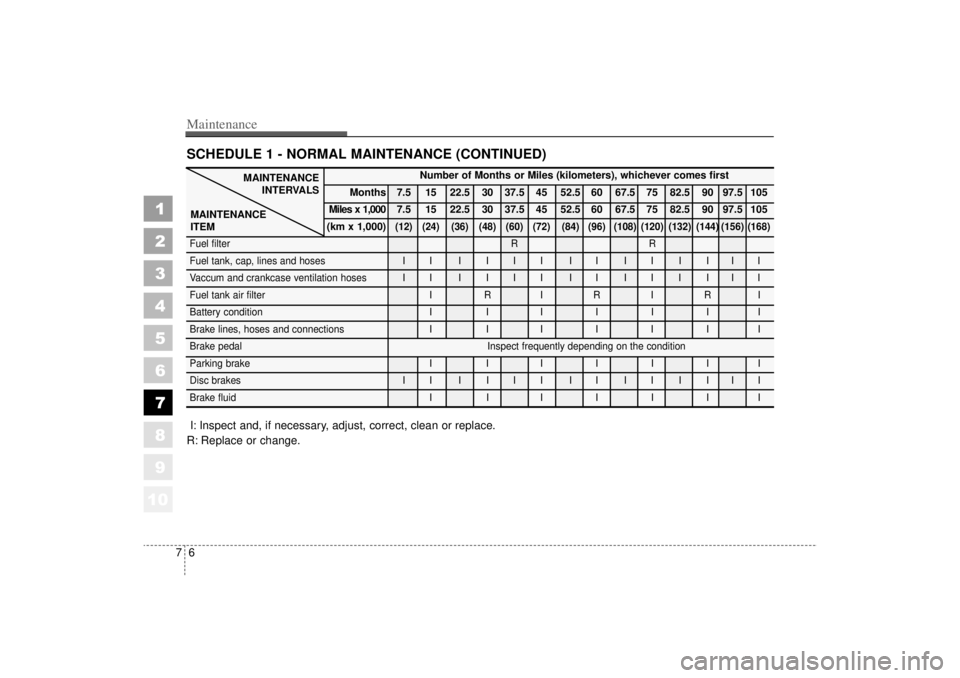
Maintenance67SCHEDULE 1 - NORMAL MAINTENANCE (CONTINUED)
MAINTENANCEINTERVALS
MAINTENANCE
ITEM
Number of Months or Miles (kilometers), whichever comes first
Months 7.5 15 22.5 30 37.5 45 52.5 60 67.5 75 82.5 90 97.5 105
Miles x 1,000 7.5 15 22.5 30 37.5 45 52.5 60 67.5 75 82.5 90 97.5 105
(km x 1,000)
(12) (24) (36) (48) (60) (72) (84) (96) (108) (120) (132) (144) (156) (168)
Fuel filter R R
Fuel tank, cap, lines and hoses I I I I I I I I I I I I I I
Vaccum and crankcase ventilation hoses I I I I I I I I I I I I I I
Fuel tank air filter I R I R I R I
Battery condition I I I I I I I
Brake lines, hoses and connections I I I I I I I
Brake pedal Inspect frequently depending on the condition
Parking brake I I I I I I I
Disc brakes I I I I I I I I I I I I I I
Brake fluid I I I I I I I
I: Inspect and, if necessary, adjust, correct, clean or replace.
R: Replace or change.
Page 253 of 322
1
2
3
4
5
6
7
8
910
79
Maintenance
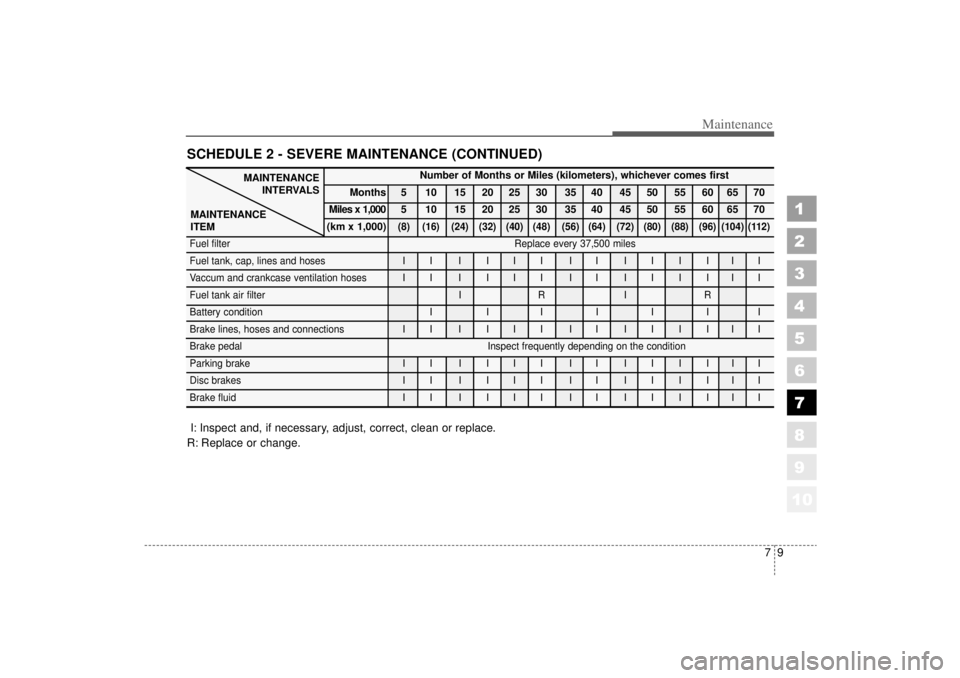
SCHEDULE 2 - SEVERE MAINTENANCE (CONTINUED)
MAINTENANCEINTERVALS
MAINTENANCE
ITEM
Number of Months or Miles (kilometers), whichever comes first
Months 5 10 15 20 25 30 35 40 45 50 55 60 65 70
Miles x 1,000 5 10 15 20 25 30 35 40 45 50 55 60 65 70
(km x 1,000)
(8) (16) (24) (32) (40) (48) (56) (64) (72) (80) (88) (96) (104) (112)
Fuel filter Replace every 37,500 miles
Fuel tank, cap, lines and hoses I I I I I I I I I I I I I I
Vaccum and crankcase ventilation hoses I I I I I I I I I I I I I I
Fuel tank air filter I R I R
Battery condition I I I I I I I
Brake lines, hoses and connections I I I I I I I I I I I I I I
Brake pedal Inspect frequently depending on the condition
Parking brake I I I I I I I I I I I I I I
Disc brakes I I I I I I I I I I I I I I
Brake fluid I I I I I I I I I I I I I I
I: Inspect and, if necessary, adjust, correct, clean or replace.
R: Replace or change.
Page 255 of 322
711
Maintenance
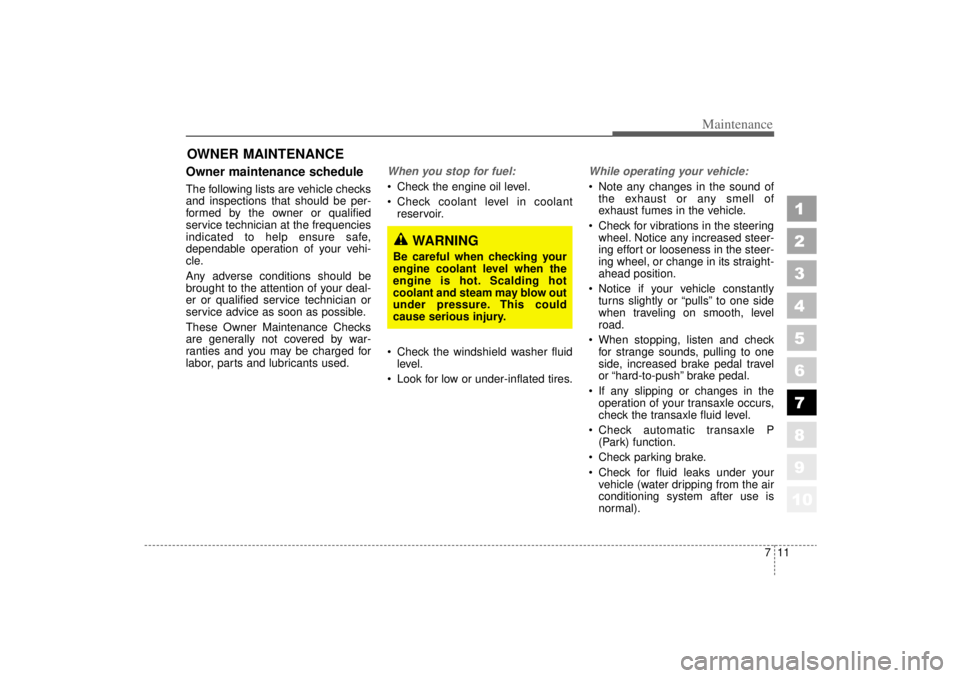
OWNER MAINTENANCE Owner maintenance schedule The following lists are vehicle checks
and inspections that should be per-
formed by the owner or qualified
service technician at the frequencies
indicated to help ensure safe,
dependable operation of your vehi-
cle.
Any adverse conditions should be
brought to the attention of your deal-
er or qualified service technician or
service advice as soon as possible.
These Owner Maintenance Checks
are generally not covered by war-
ranties and you may be charged for
labor, parts and lubricants used.
When you stop for fuel: Check the engine oil level.
Check coolant level in coolantreservoir.
Check the windshield washer fluid level.
Look for low or under-inflated tires.
While operating your vehicle: Note any changes in the sound of the exhaust or any smell of
exhaust fumes in the vehicle.
Check for vibrations in the steering wheel. Notice any increased steer-
ing effort or looseness in the steer-
ing wheel, or change in its straight-
ahead position.
Notice if your vehicle constantly turns slightly or “pulls” to one side
when traveling on smooth, level
road.
When stopping, listen and check for strange sounds, pulling to one
side, increased brake pedal travel
or “hard-to-push” brake pedal.
If any slipping or changes in the operation of your transaxle occurs,
check the transaxle fluid level.
Check automatic transaxle P (Park) function.
Check parking brake.
Check for fluid leaks under your vehicle (water dripping from the air
conditioning system after use is
normal).
1
2
3
4
5
6
7
8
910
WARNING
Be careful when checking your
engine coolant level when the
engine is hot. Scalding hot
coolant and steam may blow out
under pressure. This could
cause serious injury.
Page 256 of 322
Maintenance12
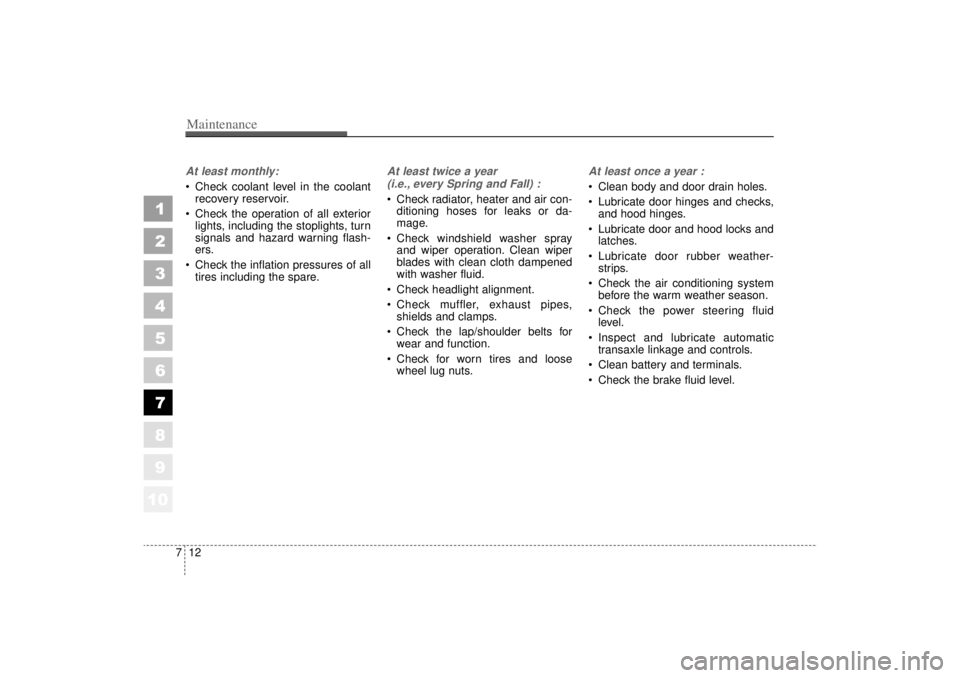
7At least monthly: Check coolant level in the coolant
recovery reservoir.
Check the operation of all exterior lights, including the stoplights, turn
signals and hazard warning flash-
ers.
Check the inflation pressures of all tires including the spare.
At least twice a year
(i.e., every Spring and Fall) : Check radiator, heater and air con- ditioning hoses for leaks or da-
mage.
Check windshield washer spray and wiper operation. Clean wiper
blades with clean cloth dampened
with washer fluid.
Check headlight alignment.
Check muffler, exhaust pipes, shields and clamps.
Check the lap/shoulder belts for wear and function.
Check for worn tires and loose wheel lug nuts.
At least once a year : Clean body and door drain holes.
Lubricate door hinges and checks,and hood hinges.
Lubricate door and hood locks and latches.
Lubricate door rubber weather- strips.
Check the air conditioning system before the warm weather season.
Check the power steering fluid level.
Inspect and lubricate automatic transaxle linkage and controls.
Clean battery and terminals.
Check the brake fluid level.
1
2
3
4
5
6
7
8
910
Page 258 of 322
Maintenance14
7
1
2
3
4
5
6
7
8
910
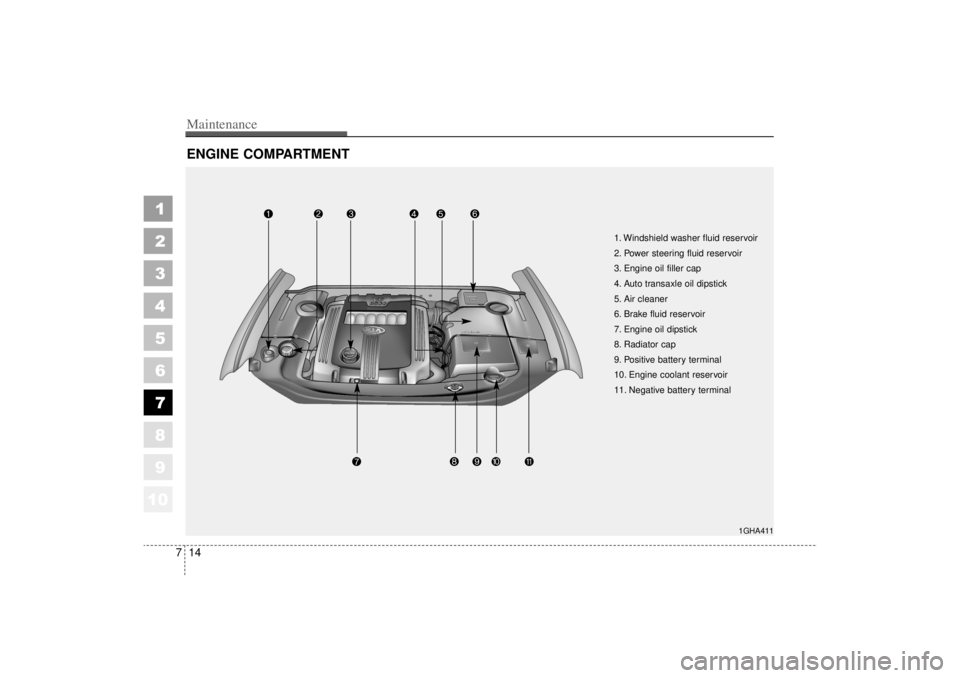
ENGINE COMPARTMENT
1GHA411
1. Windshield washer fluid reservoir
2. Power steering fluid reservoir
3. Engine oil filler cap
4. Auto transaxle oil dipstick
5. Air cleaner
6. Brake fluid reservoir
7. Engine oil dipstick
8. Radiator cap
9. Positive battery terminal
10. Engine coolant reservoir
11. Negative battery terminal
Page 265 of 322
721
Maintenance
1
2
3
4
5
6
7
8
910
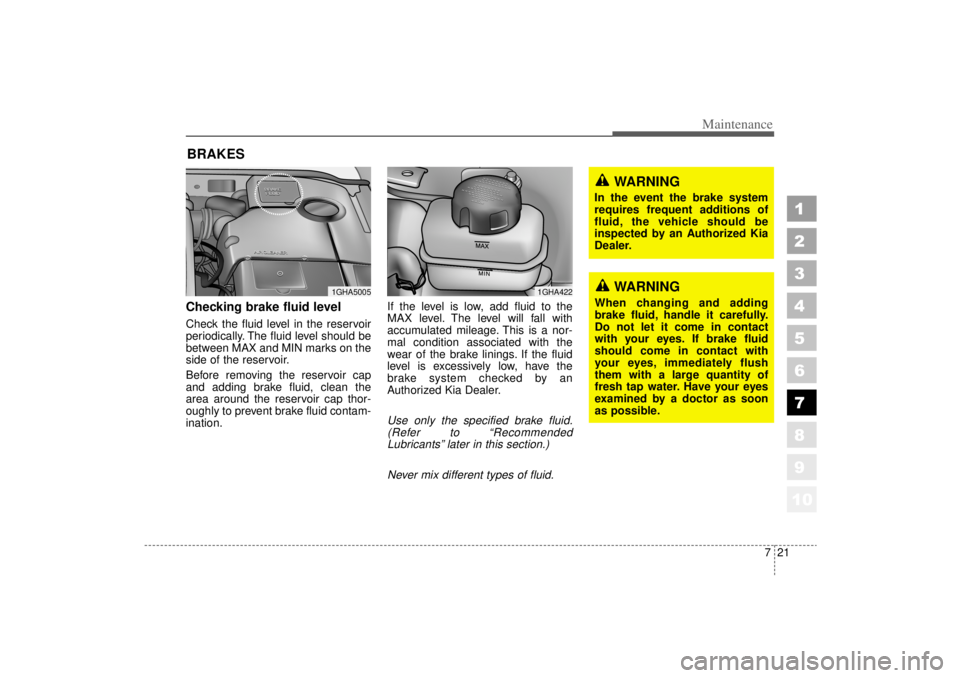
BRAKESChecking brake fluid level Check the fluid level in the reservoir
periodically. The fluid level should be
between MAX and MIN marks on the
side of the reservoir.
Before removing the reservoir cap
and adding brake fluid, clean the
area around the reservoir cap thor-
oughly to prevent brake fluid contam-
ination.If the level is low, add fluid to the
MAX level. The level will fall with
accumulated mileage. This is a nor-
mal condition associated with the
wear of the brake linings. If the fluid
level is excessively low, have the
brake system checked by an
Authorized Kia Dealer.
Use only the specified brake fluid.
(Refer to “RecommendedLubricants” later in this section.)
Never mix different types of fluid.
1GHA422
WARNING
When changing and adding
brake fluid, handle it carefully.
Do not let it come in contact
with your eyes. If brake fluid
should come in contact with
your eyes, immediately flush
them with a large quantity of
fresh tap water. Have your eyes
examined by a doctor as soon
as possible.
WARNING
In the event the brake system
requires frequent additions of
fluid, the vehicle should be
inspected by an Authorized Kia
Dealer.
1GHA5005
Page 266 of 322
Maintenance22
7
1
2
3
4
5
6
7
8
910
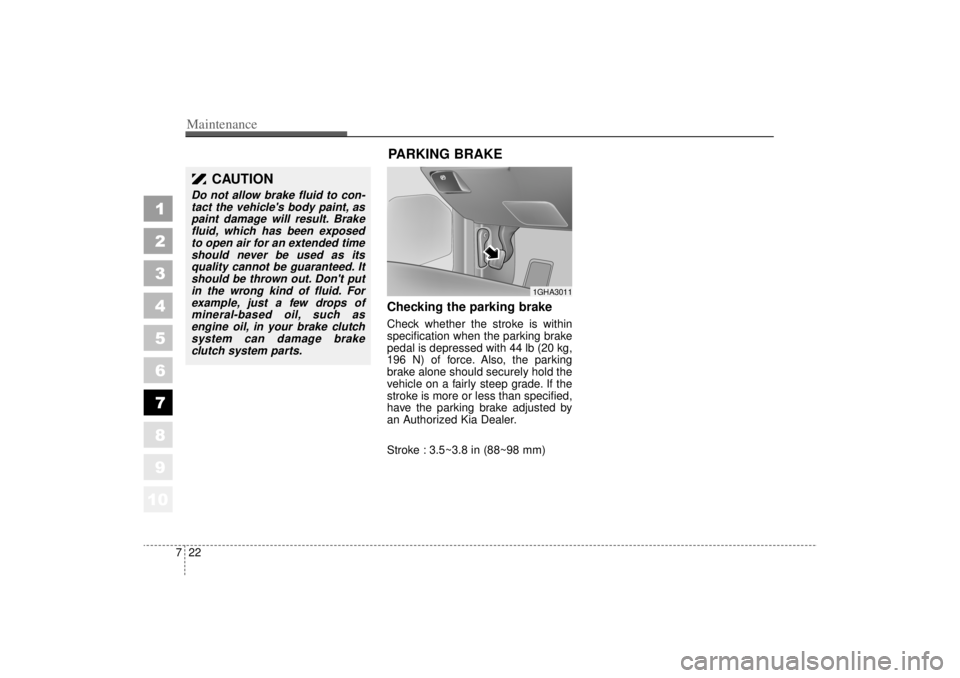
Checking the parking brake Check whether the stroke is within
specification when the parking brake
pedal is depressed with 44 lb (20 kg,
196 N) of force. Also, the parking
brake alone should securely hold the
vehicle on a fairly steep grade. If the
stroke is more or less than specified,
have the parking brake adjusted by
an Authorized Kia Dealer.
Stroke : 3.5~3.8 in (88~98 mm)
1GHA3011
PARKING BRAKE
CAUTION
Do not allow brake fluid to con-
tact the vehicle's body paint, aspaint damage will result. Brakefluid, which has been exposedto open air for an extended timeshould never be used as itsquality cannot be guaranteed. Itshould be thrown out. Don't putin the wrong kind of fluid. Forexample, just a few drops ofmineral-based oil, such asengine oil, in your brake clutchsystem can damage brakeclutch system parts.