ignition KIA AMANTI 2009 User Guide
[x] Cancel search | Manufacturer: KIA, Model Year: 2009, Model line: AMANTI, Model: KIA AMANTI 2009Pages: 321, PDF Size: 23.77 MB
Page 27 of 321
315
Knowing your vehicle
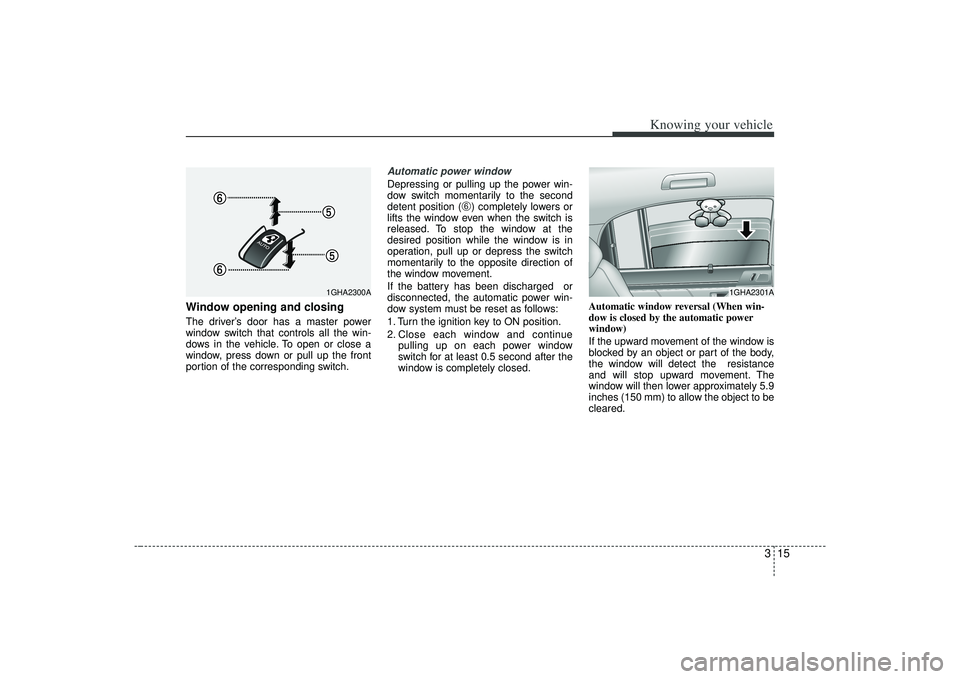
Window opening and closingThe driver’s door has a master power
window switch that controls all the win-
dows in the vehicle. To open or close a
window, press down or pull up the front
portion of the corresponding switch.
Automatic power windowDepressing or pulling up the power win-
dow switch momentarily to the second
detent position (
\b) completely lowers or
lifts the window even when the switch is
released. To stop the window at the
desired position while the window is in
operation, pull up or depress the switch
momentarily to the opposite direction of
the window movement.
If the battery has been discharged or
disconnected, the automatic power win-
dow system must be reset as follows:
1. Turn the ignition key to ON position.
2. Close each window and continue pulling up on each power window
switch for at least 0.5 second after the
window is completely closed. Automatic window reversal (When win-
dow is closed by the automatic power
window)
If the upward movement of the window is
blocked by an object or part of the body,
the window will detect the resistance
and will stop upward movement. The
window will then lower approximately 5.9
inches (150 mm) to allow the object to be
cleared.
1GHA2301A
1GHA2300A
Page 28 of 321

Knowing your vehicle16
3
Power window lock switch The driver can disable the power win-
dow switches on a passenger door by
depressing the power window lock
switch located on the driver’s door to
LOCK (pressed).
When the power window lock switch is ON, the driver’s master control cannot
operate the passenger door power
windows either.
Power window timer (if equipped)The power windows can be operated for
approximately 30 seconds after the igni-
tion key is removed or turned to the ACC
or LOCK position. However, if the front
doors are opened, the power windows
cannot be operated even within 30 sec-
onds after the ignition key is removed.
WARNING
The automatic window reversal feature (window lowers 5.9 inches
[150 mm] when a resistance is
detected) will only operate when
the automatic power window up
operation feature is used.
Automatic window reversal will
not operate if the window is
raised using the first detent posi-
tion (
➄) on the power window
switch. Always double check to
make sure all faces, arms, hands
and other obstructions are safely
out of the way before operating
the power window.
If an object less than 0.16 inch (4 mm) in diameter is caught
between the window glass and
the upper window channel, the
automatic reversal may not detect
the resistance and will not oper-
ate. Therefore, always check for
any obstructions before raising
any window.
Page 30 of 321
Knowing your vehicle18
3For a seating position more comfortable
to the driver and front passenger, adjust
the seat forward, backward, up and
down.
WARNING
Loose objects in the driver’s foot
area could interfere with the oper-
ation of the foot pedals, possibly
causing an accident. Loose
objects might interfere with the
seat slide mechanism. Do not
place anything under the front
seats.
The power seats are operable with the ignition OFF.
Therefore, children should never
be left unattended in the car.
WARNING
- Driver’s seat
Never attempt to adjust the seatwhile the vehicle is moving. This
could result in loss of control,
and an accident causing death,
serious injury, or property dam-
age.
with the normal position of the
seatback. Storing items against a
seatback or in any other way
interfering with proper locking of
a seatback could result in serious
or fatal injury in a sudden stop or
collision.
seatback upright and the lap por-
tion of the safety belt, or lap belt,
snug and low across the hips.
This position puts your safety
belts in the best position to pro-
tect you in case of an accident.
In order to avoid unnecessary air bag injuries including the possi-
bility of severe injury or death,
always sit as far back as possible
from the steering wheel so that
your chest is away at least 10
inches (250 mm) away from the
steering wheel.
CAUTION
Power seats are driven by electric motor. Stop operating when theadjustment is completed.
Excessive operation may damagethe electrical equipment.
When in operation, the power seats consume large amounts ofelectrical power. To preventunnecessary charging system drain, don’t adjust the powerseats longer than necessarywhile the engine is not running.
Do not operate two or more power seat control buttons at the sametime. Doing so may result inpower seat motor or electricalcomponent malfunction.
Page 35 of 321
323
Knowing your vehicle
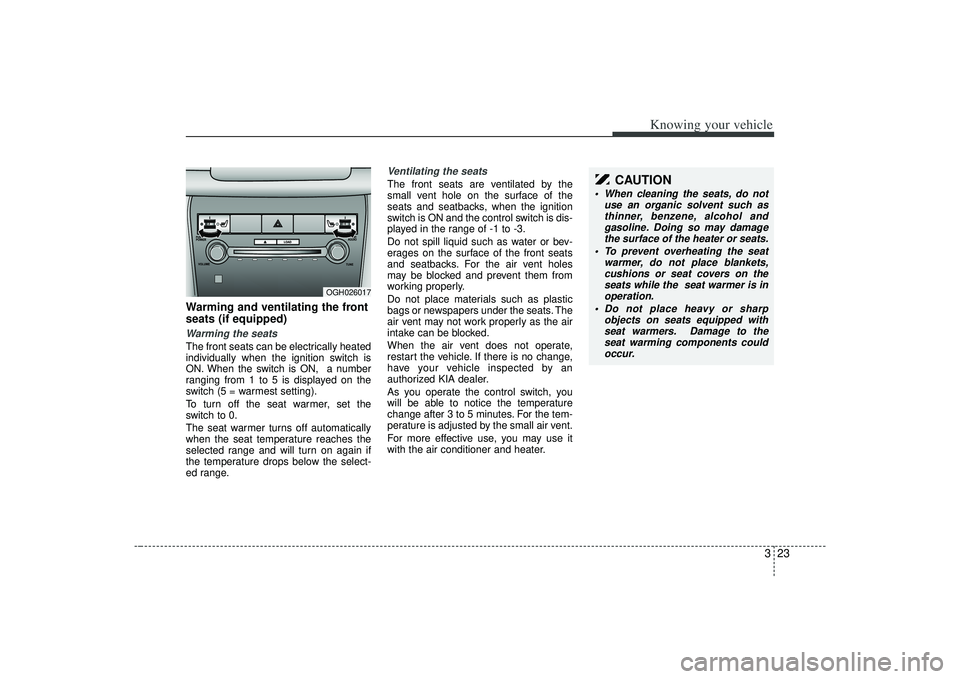
Warming and ventilating the front
seats (if equipped)Warming the seatsThe front seats can be electrically heated
individually when the ignition switch is
ON. When the switch is ON, a number
ranging from 1 to 5 is displayed on the
switch (5 = warmest setting).
To turn off the seat warmer, set the
switch to 0.
The seat warmer turns off automatically
when the seat temperature reaches the
selected range and will turn on again if
the temperature drops below the select-
ed range.
Ventilating the seatsThe front seats are ventilated by the
small vent hole on the surface of the
seats and seatbacks, when the ignition
switch is ON and the control switch is dis-
played in the range of -1 to -3.
Do not spill liquid such as water or bev-
erages on the surface of the front seats
and seatbacks. For the air vent holes
may be blocked and prevent them from
working properly.
Do not place materials such as plastic
bags or newspapers under the seats. The
air vent may not work properly as the air
intake can be blocked.
When the air vent does not operate,
restart the vehicle. If there is no change,
have your vehicle inspected by an
authorized KIA dealer.
As you operate the control switch, you
will be able to notice the temperature
change after 3 to 5 minutes. For the tem-
perature is adjusted by the small air vent.
For more effective use, you may use it
with the air conditioner and heater.
OGH026017
CAUTION
When cleaning the seats, do notuse an organic solvent such asthinner, benzene, alcohol and gasoline. Doing so may damagethe surface of the heater or seats.
To prevent overheating the seat warmer, do not place blankets,cushions or seat covers on the seats while the seat warmer is inoperation.
Do not place heavy or sharp objects on seats equipped withseat warmers. Damage to theseat warming components couldoccur.
Page 37 of 321
325
Knowing your vehicle
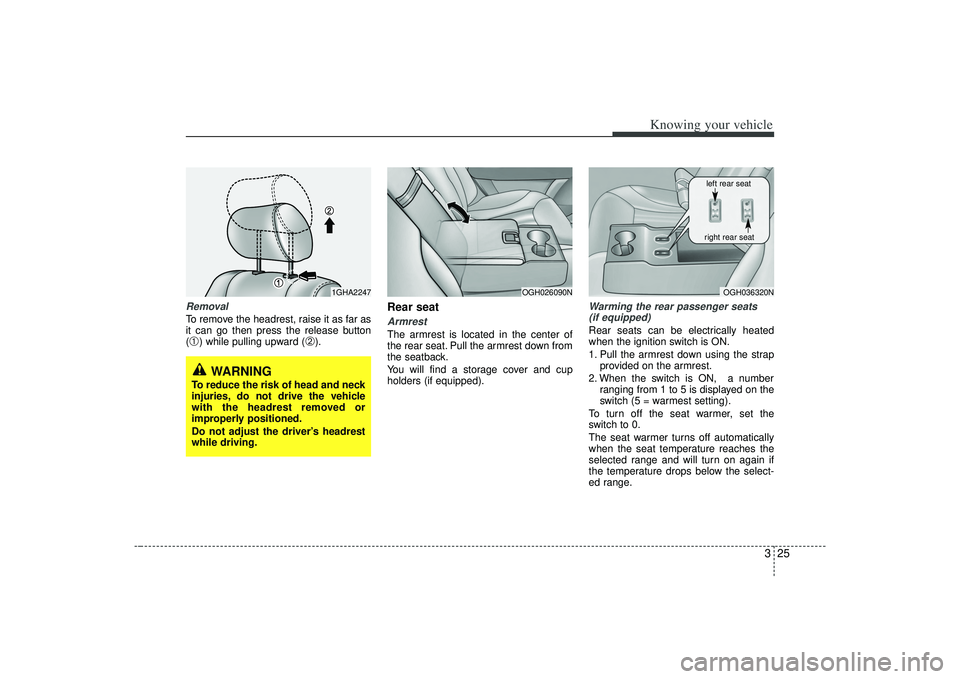
RemovalTo remove the headrest, raise it as far as
it can go then press the release button
(➀) while pulling upward (
➁).
Rear seatArmrestThe armrest is located in the center of
the rear seat. Pull the armrest down from
the seatback.
You will find a storage cover and cup
holders (if equipped).
Warming the rear passenger seats (if equipped)Rear seats can be electrically heated
when the ignition switch is ON.
1. Pull the armrest down using the strap provided on the armrest.
2. When the switch is ON, a number ranging from 1 to 5 is displayed on the
switch (5 = warmest setting).
To turn off the seat warmer, set the
switch to 0.
The seat warmer turns off automatically
when the seat temperature reaches the
selected range and will turn on again if
the temperature drops below the select-
ed range.
WARNING
To reduce the risk of head and neck
injuries, do not drive the vehicle
with the headrest removed or
improperly positioned.
Do not adjust the driver’s headrest
while driving.
1GHA2247
OGH026090N
OGH036320N
left rear seat
right rear seat
Page 40 of 321

Knowing your vehicle28
3A driver position memory system is pro-
vided to store and recall the seat and
outside mirror positions with a simple
button operation. By saving the desired
positions into the system memory, differ-
ent drivers can reposition the seat and
outside mirror based upon their driving
preference.
If battery is disconnected, the position
memory will be lost and the driving posi-
tions should be restored in the system.
Storing positions into memory
using the buttons on the doorStoring driver’s seat positions1. Shift the transaxle lever into P while
the ignition switch is ON.
2. Adjust the seat and outside rearview mirror to positions comfortable for the
driver.
3. Press the SET button on the control panel.
4. Press one of the memory buttons (1 or 2) within 5 seconds after pressing the
SET button. The system will beep
twice when memory has been suc-
cessfully stored.
The particular driver positions are mem-
orized in the button (1 or 2) selected.
Recalling positions from memory1. Shift the transaxle lever into P while the ignition switch is ON.
2. To recall the position in memory, press the desired memory button (1 or 2) the
system will beep once, then the seat
and outside rearview mirror will auto-
matically adjust to the stored positions.
Adjusting one of the control knobs for the
seat or outside rearview mirror while the
system is recalling the stored positions
will cause the movement for that compo-
nent to stop and move in the direction
that the control knob is moved. Other
components will continue position recall-
ing.
To stop the position recall at any point in
the recall process, press the STOP but-
ton once. Seat and outside rearview mir-
ror position recalling will stop.
DRIVER POSITION MEMORY SYSTEM (IF EQUIPPED)
OGH039901N
CAUTION
Use with caution when recalling adjustment memory while sitting in the vehicle. Press the STOP buttonimmediately if the seat moves too far in any direction.
Page 41 of 321
329
Knowing your vehicle
Storing and recalling with trans-
mitterStoring with the transmitterTurn the ignition switch to LOCK from ON
and lock all the doors using the transmit-
ter. The seat and outside rearview mirror
positions will be stored in the system
memory.
Driver’s position recalling with trans-mitterUnlock the door with the transmitter,
positions stored in the system memory
will be recalled automatically.
If using two transmitters, recalling times
may vary because stored positions in
each transmitter may be different.
Example) If doors are locked with trans-
mitter A and unlocked with transmitter B,
the positions memorized when unlocked
with transmitter B will be recalled and
may take slightly longer than if unlocked
with transmitter A.
Page 42 of 321
Knowing your vehicle30
3
WARNING
To obtain maximum benefit from a
pre-tensioner seat belt:
The seat belt must be worn cor-
rectly.
The seat belt must be adjusted to the correct position.
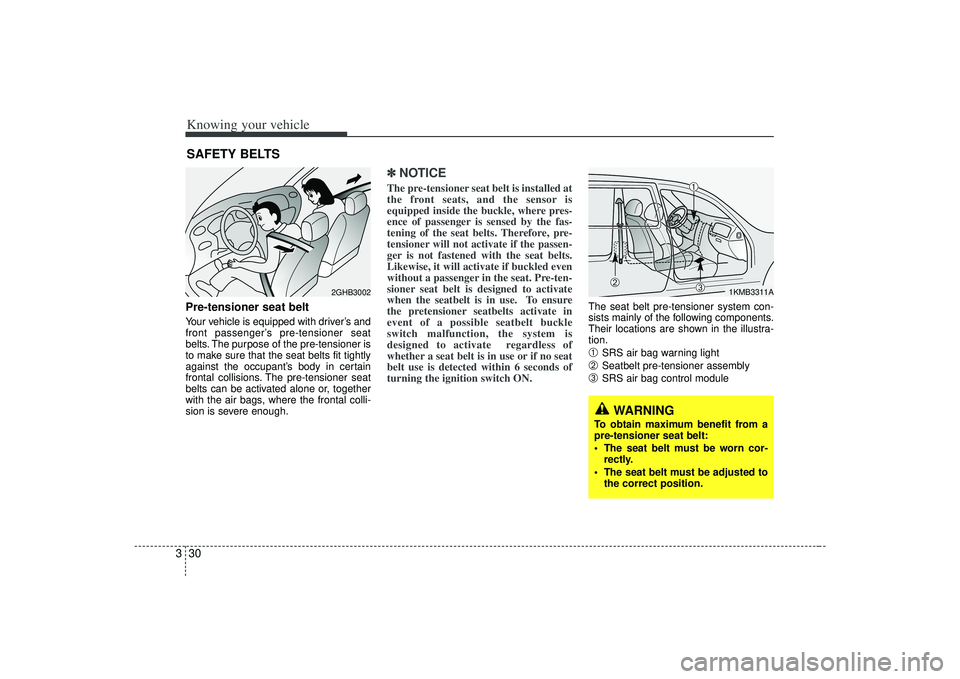
Pre-tensioner seat beltYour vehicle is equipped with driver’s and
front passenger’s pre-tensioner seat
belts. The purpose of the pre-tensioner is
to make sure that the seat belts fit tightly
against the occupant’s body in certain
frontal collisions. The pre-tensioner seat
belts can be activated alone or, together
with the air bags, where the frontal colli-
sion is severe enough.
✽ ✽ NOTICEThe pre-tensioner seat belt is installed at
the front seats, and the sensor is
equipped inside the buckle, where pres-
ence of passenger is sensed by the fas-
tening of the seat belts. Therefore, pre-
tensioner will not activate if the passen-
ger is not fastened with the seat belts.
Likewise, it will activate if buckled even
without a passenger in the seat. Pre-ten-
sioner seat belt is designed to activate
when the seatbelt is in use. To ensure
the pretensioner seatbelts activate in
event of a possible seatbelt buckle
switch malfunction, the system is
designed to activate regardless of
whether a seat belt is in use or if no seat
belt use is detected within 6 seconds of
turning the ignition switch ON.
The seat belt pre-tensioner system con-
sists mainly of the following components.
Their locations are shown in the illustra-
tion.➀
SRS air bag warning light
➁
Seatbelt pre-tensioner assembly
➂
SRS air bag control module
SAFETY BELTS
2GHB3002
1KMB3311A
➀
➁
➂
Page 43 of 321
331
Knowing your vehicle
Load limiter When the pre-tentioner activates, if the
system senses excessive seat belt ten-
sion on the driver or passenger’s seat
belt, the load limiter inside the pre-ten-
sioner will release some of the pressure
on the affected seat belt.
WARNING
Pre-tensioners are designed tooperate once. After activation,
pre-tensioner seat belts must be
replaced. All seat belts, of any
type, should always be replaced
after they have been worn during
a collision.
Do not attempt to inspect or replace the pre-tensioner seat
belts yourself. This must be done
by an authorized Kia dealer.
WARNING
The pre-tensioner seat belt assem-
bly mechanisms become hot during
activation. Do not touch the pre-ten-
sioner seat belt assembly for sever-
al minutes after they have been acti-
vated.
WARNING
Because the sensor that activatesthe SRS air bag is connected with
pre-tensioner seat belt, the SRS
air bag warning light on the
instrument panel will blink or illu-
minate for approximately 6 sec-
onds after the ignition key has
been turned to the “ON” position,
then the light should go off.
If the pre-tensioner seat belt is not working properly, this warn-
ing light will illuminate even if
there is no malfunction of SRS air
bag system. If the SRS air bag
warning light does not illuminate
when the ignition key is turned to
“ON” , or if it remains illuminated
after blinking or illuminating for
approximately 6 seconds, or if it
illuminates while the vehicle is
being driven, please have an
authorized Kia dealer inspect the
pre-tensioner seat belt or SRS air
bag system as soon as possible.
WARNING
When the pre-tensioner seat belts
are activated and the air bag is
deployed, a loud noise may be
heard and fine dust, which may
appear to be smoke, may be visible
in the passenger compartment and
are not toxic.
Although, it is harmless, the fine
dust may cause skin irritation and
should not be breathed for pro-
longed periods. Wash your hands
and face thoroughly after an acci-
dent in which the air bags and/or
pre-tensioner seat belts were acti-
vated.
Page 67 of 321
355
Knowing your vehicle
Air bag system components The SRS air bag consists of the fol-lowing components;
1. Driver's air bag module
2. Passenger's air bag module
3. Side air bag module
4. Curtain air bag module
5. Front impact sensors
6. Side impact sensors
7. SRS air bag control module
8. Driver's seat position sensor
9. Occupant Classification System (Front passenger's seat only)
10. "PASSENGER AIR BAG OFF" indicator (Front passenger's seat
only)
11. Driver's and front passenger's safety belt buckle sensors
12. Retractor Pre-tensioner Assemblies
13. SRS "AIR BAG" warning light
A diagnostic system that continually monitors the system operation.
An indicator light to warn you of a pos- sible problem with the system.
Emergency power backup in case your car’s electrical system is disconnected
in a crash. The SRS uses a collection of sensors to
gather information about the driver’s seat
position, the driver’s and front passen-
ger’s safety belt usage and impact sever-
ity.
The driver’s seat position sensor, which
is installed on the seat track, determines
if the seat is fore or aft of a reference
position. Similarly, the safety belt usage
sensors determine if the driver and front
passenger’s safety belts are fastened.
These sensors provide the ability to con-
trol the SRS deployment based on how
close the driver’s seat is to the steering
wheel, how close the passenger’s seat is
to the instrument panel, whether or not
the safety belts are fastened, and the
severity of the impact.
(Continued)
If your vehicle has been subject-
ed to flood conditions (e.g.
soaked carpeting/standing water
on the floor of the vehicle, etc.) or
if your vehicle has become flood
damaged in any way, do not
attempt to start the vehicle or put
the key in the ignition before dis-
connecting the battery.
Disregarding this precaution may
cause air bag deployment, which
could result in serious personal
injury or death. If your vehicle is
subjected to flooded conditions,
before starting the vehicle, have
the vehicle towed to an author-
ized Kia dealer for inspection and
necessary repairs.