warning KIA AMANTI 2009 User Guide
[x] Cancel search | Manufacturer: KIA, Model Year: 2009, Model line: AMANTI, Model: KIA AMANTI 2009Pages: 321, PDF Size: 23.77 MB
Page 30 of 321
Knowing your vehicle18
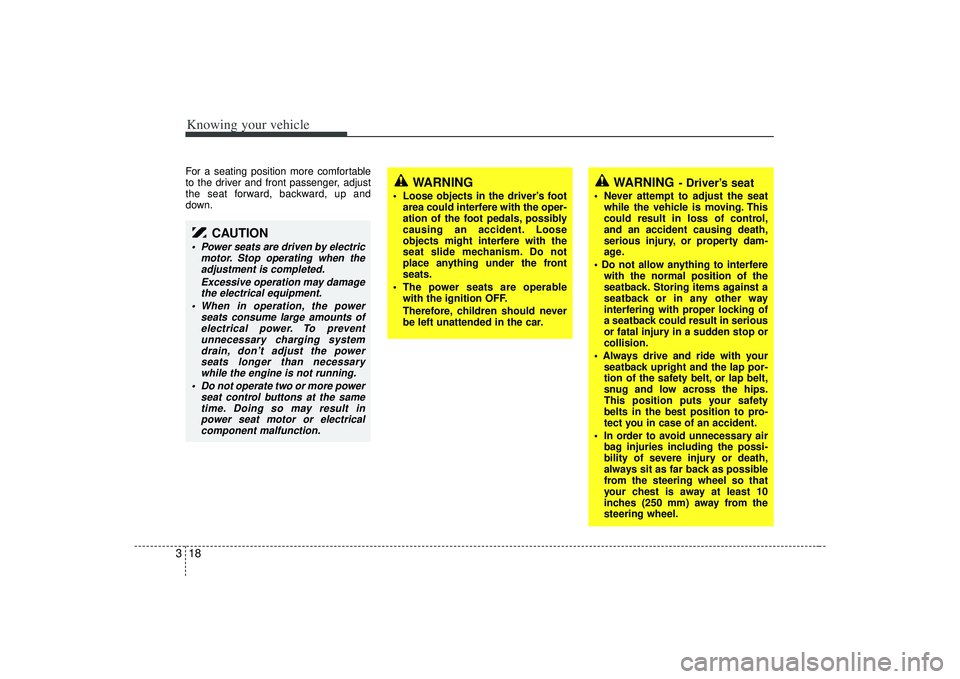
3For a seating position more comfortable
to the driver and front passenger, adjust
the seat forward, backward, up and
down.
WARNING
Loose objects in the driver’s foot
area could interfere with the oper-
ation of the foot pedals, possibly
causing an accident. Loose
objects might interfere with the
seat slide mechanism. Do not
place anything under the front
seats.
The power seats are operable with the ignition OFF.
Therefore, children should never
be left unattended in the car.
WARNING
- Driver’s seat
Never attempt to adjust the seatwhile the vehicle is moving. This
could result in loss of control,
and an accident causing death,
serious injury, or property dam-
age.
with the normal position of the
seatback. Storing items against a
seatback or in any other way
interfering with proper locking of
a seatback could result in serious
or fatal injury in a sudden stop or
collision.
seatback upright and the lap por-
tion of the safety belt, or lap belt,
snug and low across the hips.
This position puts your safety
belts in the best position to pro-
tect you in case of an accident.
In order to avoid unnecessary air bag injuries including the possi-
bility of severe injury or death,
always sit as far back as possible
from the steering wheel so that
your chest is away at least 10
inches (250 mm) away from the
steering wheel.
CAUTION
Power seats are driven by electric motor. Stop operating when theadjustment is completed.
Excessive operation may damagethe electrical equipment.
When in operation, the power seats consume large amounts ofelectrical power. To preventunnecessary charging system drain, don’t adjust the powerseats longer than necessarywhile the engine is not running.
Do not operate two or more power seat control buttons at the sametime. Doing so may result inpower seat motor or electricalcomponent malfunction.
Page 32 of 321

Knowing your vehicle20
3
WARNING
Driving or riding in a vehicle with a
front seatback reclined could lead
to serious or fatal injury in an acci-
dent. If a front seat is reclined dur-
ing an accident, the occupant’s hips
may slide under the lap portion of
the safety belt applying great force
to the unprotected abdomen or
neck or a passenger may be ejected
in a rollover. Serious or fatal inter-
nal injuries could result. Keep the
seatbacks in a comfortably upright
position whenever the vehicle is in
motion.
Adjusting the height of seat cushion
To raise or lower the seat cushion, pull up
or push down on the center of the corre-
sponding switch. Release the knob once
the seat reaches the desired position.
Adjusting the driver’s seatback
reclinerMove the lever forward or backward to
the desired angle and release the lever. If
the lever is released, seatback will lock in
place. After adjustment, make sure that
the lever has returned to its original
locked position.
5GHA2241
5GHA2242
Page 34 of 321

Knowing your vehicle22
3
Adjusting seatback reclinerMove the lever forward or backward to
the desired angle and release the lever. If
the lever is released, seatback will lock in
place. After adjustment, make sure that
the lever has returned to its original
locked position.
WARNING
In order to avoid unnecessary air
bag injuries including the possibili-
ty of severe injury or death, always
sit as far back as possible by mov-
ing the seat far back, while still
maintaining good vehicle control.
Serious injury or death may be
caused due to the deployment of
the passenger’s air bag.
5GHA2249
WARNING
Riding in a vehicle with a front seat-
back reclined could lead to serious
or fatal injury in an accident. If a
front seat is reclined, the occu-
pant’s hips may slide under the lap
portion of the safety belt applying
great force to the unprotected
abdomen or neck or a passenger
may be ejected in a rollover. Serious
or fatal internal injuries could
result. Keep the seatbacks in a
comfortably upright position when-
ever the vehicle is in motion.
Page 36 of 321

Knowing your vehicle24
3
Headrest adjustmentAdjusting forward and backwardThe headrest may be adjusted forward to
three different positions by pulling the
headrest forward. To adjust the headrest
backward, pull it fully forward to the far-
thest position and release it. Adjust the
headrest so that it properly supports the
head and neck.
Adjusting the height up and downThe headrest not only provides comfort
for the driver and passengers, but also
helps protect the head and neck in the
event of a collision.
To raise the headrest, pull it up to the
desired position (
➀). To lower the head-
rest, push and hold the release button
(
➁) on the headrest support and lower
the headrest to the desired position (
➂).
For best protection, adjust the headrest
so its center is as high as your ears. Also
adjust the headrest so its distance from
the head is as wide as your fist.
1GHA2245
WARNING
Passengers should use extreme
caution when using seat warmers
due to the possibility of excess
heating or burns. In particular, the
following types of passengers
should exercise extreme care:
1. Infants, children, elderly or dis- abled persons, or hospital outpa-
tients
2. Persons with sensitive skin or those that burn easily
3. Fatigued individuals
4. Intoxicated individuals
5. Individuals taking medication that can cause drowsiness or
sleepiness (sleeping pills, cold
tablets, etc.)
1GHA2246
Page 37 of 321
325
Knowing your vehicle
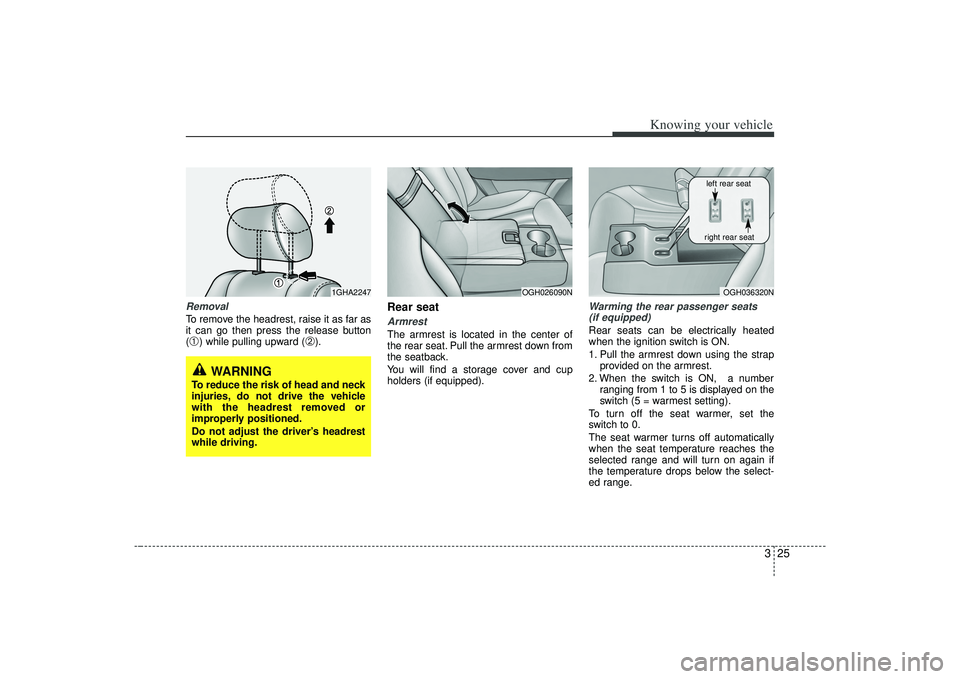
RemovalTo remove the headrest, raise it as far as
it can go then press the release button
(➀) while pulling upward (
➁).
Rear seatArmrestThe armrest is located in the center of
the rear seat. Pull the armrest down from
the seatback.
You will find a storage cover and cup
holders (if equipped).
Warming the rear passenger seats (if equipped)Rear seats can be electrically heated
when the ignition switch is ON.
1. Pull the armrest down using the strap provided on the armrest.
2. When the switch is ON, a number ranging from 1 to 5 is displayed on the
switch (5 = warmest setting).
To turn off the seat warmer, set the
switch to 0.
The seat warmer turns off automatically
when the seat temperature reaches the
selected range and will turn on again if
the temperature drops below the select-
ed range.
WARNING
To reduce the risk of head and neck
injuries, do not drive the vehicle
with the headrest removed or
improperly positioned.
Do not adjust the driver’s headrest
while driving.
1GHA2247
OGH026090N
OGH036320N
left rear seat
right rear seat
Page 38 of 321

Knowing your vehicle26
3
Headrest adjustmentAdjusting the height up and down
The headrest not only provides comfort
for the rear passengers, but also helps
protect the head and neck in the event of
a collision.
For best protection, adjust the headrest
so its center is as high as your ears. Also
adjust the headrest so its distance from
the head is as wide as your fist.
To raise the headrest, pull it up to the
desired position (
➀). To lower the head-
rest, push and hold the release button
(
➁) on the headrest support and lower
the headrest to the desired position (
➂).
WARNING
Passengers should use extreme
caution when using seat warmers
due to the possibility of excess
heating or burns. In particular, the
following types of passengers
should exercise extreme care:
1. Infants, children, elderly or dis- abled persons, or hospital outpa-
tients
2. Persons with sensitive skin or those that burn easily
3. Fatigued individuals
4. Intoxicated individuals
5. Individuals taking medication that can cause drowsiness or
sleepiness (sleeping pills, cold
tablets, etc.)
1GHA2254
CAUTION
When cleaning the seats, do not use an organic solvent such asthinner, benzene, alcohol and gasoline. Doing so may damagethe surface of the heater or seats.
To prevent overheating the seat warmer, do not place blankets,cushions or seat covers on the seats while the seat warmer is inoperation.
Do not place heavy or sharp objects on seats equipped withseat warmers. Damage to theseat warming components couldoccur.
Page 39 of 321

327
Knowing your vehicle
Removal
To remove the headrest, raise it as far as
it can go then press the release button
(➀) while pulling upward (
➁).
Storing long/narrow cargo with trunkclosed (if equipped)Pull the armrest down using the strap
provided on the armrest. Pull the cover
down while pushing the release lever
down. Additional cargo space is provided
to accommodate long/narrow cargo
(skis, poles, lumber, etc.) not able to fit
properly in the trunk when closed.
1GHA2255
WARNING
To reduce the risk of head and neck
injuries, do not drive the vehicle
with the headrest removed or
improperly positioned.
1GHA2108
CAUTION
Be careful when loading cargothrough the rear passenger seats to prevent damage to the vehicle inte-rior.
WARNING
Make sure the engine is off, the transaxle is in P and the parking
brake is applied whenever load-
ing or unloading cargo. Vehicle
may move if shift lever is inadver-
tently moved to another position.
When cargo is loaded through the rear passenger seats, ensure the
cargo is properly secured to pre-
vent it from moving while driving.
Unsecured cargo in the passen-
ger compartment can cause dam-
age to the vehicle or injury to its
occupants.
Page 42 of 321
Knowing your vehicle30
3
WARNING
To obtain maximum benefit from a
pre-tensioner seat belt:
The seat belt must be worn cor-
rectly.
The seat belt must be adjusted to the correct position.
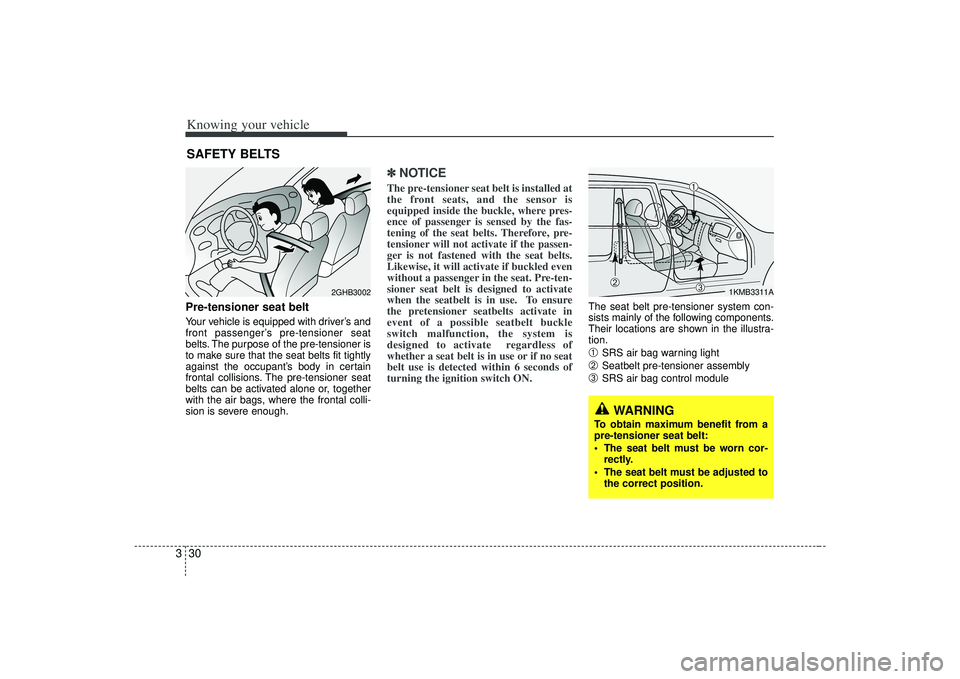
Pre-tensioner seat beltYour vehicle is equipped with driver’s and
front passenger’s pre-tensioner seat
belts. The purpose of the pre-tensioner is
to make sure that the seat belts fit tightly
against the occupant’s body in certain
frontal collisions. The pre-tensioner seat
belts can be activated alone or, together
with the air bags, where the frontal colli-
sion is severe enough.
✽ ✽ NOTICEThe pre-tensioner seat belt is installed at
the front seats, and the sensor is
equipped inside the buckle, where pres-
ence of passenger is sensed by the fas-
tening of the seat belts. Therefore, pre-
tensioner will not activate if the passen-
ger is not fastened with the seat belts.
Likewise, it will activate if buckled even
without a passenger in the seat. Pre-ten-
sioner seat belt is designed to activate
when the seatbelt is in use. To ensure
the pretensioner seatbelts activate in
event of a possible seatbelt buckle
switch malfunction, the system is
designed to activate regardless of
whether a seat belt is in use or if no seat
belt use is detected within 6 seconds of
turning the ignition switch ON.
The seat belt pre-tensioner system con-
sists mainly of the following components.
Their locations are shown in the illustra-
tion.➀
SRS air bag warning light
➁
Seatbelt pre-tensioner assembly
➂
SRS air bag control module
SAFETY BELTS
2GHB3002
1KMB3311A
➀
➁
➂
Page 43 of 321
331
Knowing your vehicle
Load limiter When the pre-tentioner activates, if the
system senses excessive seat belt ten-
sion on the driver or passenger’s seat
belt, the load limiter inside the pre-ten-
sioner will release some of the pressure
on the affected seat belt.
WARNING
Pre-tensioners are designed tooperate once. After activation,
pre-tensioner seat belts must be
replaced. All seat belts, of any
type, should always be replaced
after they have been worn during
a collision.
Do not attempt to inspect or replace the pre-tensioner seat
belts yourself. This must be done
by an authorized Kia dealer.
WARNING
The pre-tensioner seat belt assem-
bly mechanisms become hot during
activation. Do not touch the pre-ten-
sioner seat belt assembly for sever-
al minutes after they have been acti-
vated.
WARNING
Because the sensor that activatesthe SRS air bag is connected with
pre-tensioner seat belt, the SRS
air bag warning light on the
instrument panel will blink or illu-
minate for approximately 6 sec-
onds after the ignition key has
been turned to the “ON” position,
then the light should go off.
If the pre-tensioner seat belt is not working properly, this warn-
ing light will illuminate even if
there is no malfunction of SRS air
bag system. If the SRS air bag
warning light does not illuminate
when the ignition key is turned to
“ON” , or if it remains illuminated
after blinking or illuminating for
approximately 6 seconds, or if it
illuminates while the vehicle is
being driven, please have an
authorized Kia dealer inspect the
pre-tensioner seat belt or SRS air
bag system as soon as possible.
WARNING
When the pre-tensioner seat belts
are activated and the air bag is
deployed, a loud noise may be
heard and fine dust, which may
appear to be smoke, may be visible
in the passenger compartment and
are not toxic.
Although, it is harmless, the fine
dust may cause skin irritation and
should not be breathed for pro-
longed periods. Wash your hands
and face thoroughly after an acci-
dent in which the air bags and/or
pre-tensioner seat belts were acti-
vated.
Page 44 of 321
Knowing your vehicle32
3
Safety belt restraint system
We strongly recommend that the driver
and all passengers be properly
restrained at all times by using the safety
belts provided with the vehicle. Proper
use of the safety belts decreases the risk
of severe injury or death in accidents or
sudden stops. In most states, and in
Canada, the law requires their use.
All seats have lap/shoulder belts. Inertial
locks in the safety belt retractors allow all
of the lap/shoulder safety belts to remain
unlocked during normal vehicle opera-
tion. This allows the occupants some
freedom of movement and increased
comfort while using the safety belts. If a
force is applied to the vehicle, such as a
strong stop, a sharp turn, or a collision,
the safety belt retractors will automatical-
ly lock the safety belts.
WARNING
Do not strike the pre-tensioner
seat belt assemblies.
Do not attempt to service or repair the pre-tensioner seat belt
system in any manner.
Improper handling of the pre-ten- sioner seat belt assemblies, and
failure to heed the warnings not
to strike, modify, inspect, place,
service or repair the pre-tension-
er seat belt assemblies may lead
to improper operation or inadver-
tent activation causing serious
injury.
Always wear the seat belts
when driving or riding in a motor
vehicle.
WARNING
- Safety belts
To minimize the risk of serious or
fatal injury in an accident, the driv-
er and all passengers should use
the appropriate safety restraints for
their age and size. The presence of
air bags does not change the need
to be properly restrained by a safe-
ty belt or size-appropriate child
restraint. In fact, air bags are
designed to work the best when
passengers are correctly restrained
in the vehicle. Be sure you are
familiar with the information in this
section, including the information
on infant and child restraints. Read
the safety warnings on the sun
visors of your vehicle also.