air condition KIA AMANTI 2009 Owner's Guide
[x] Cancel search | Manufacturer: KIA, Model Year: 2009, Model line: AMANTI, Model: KIA AMANTI 2009Pages: 321, PDF Size: 23.77 MB
Page 254 of 321
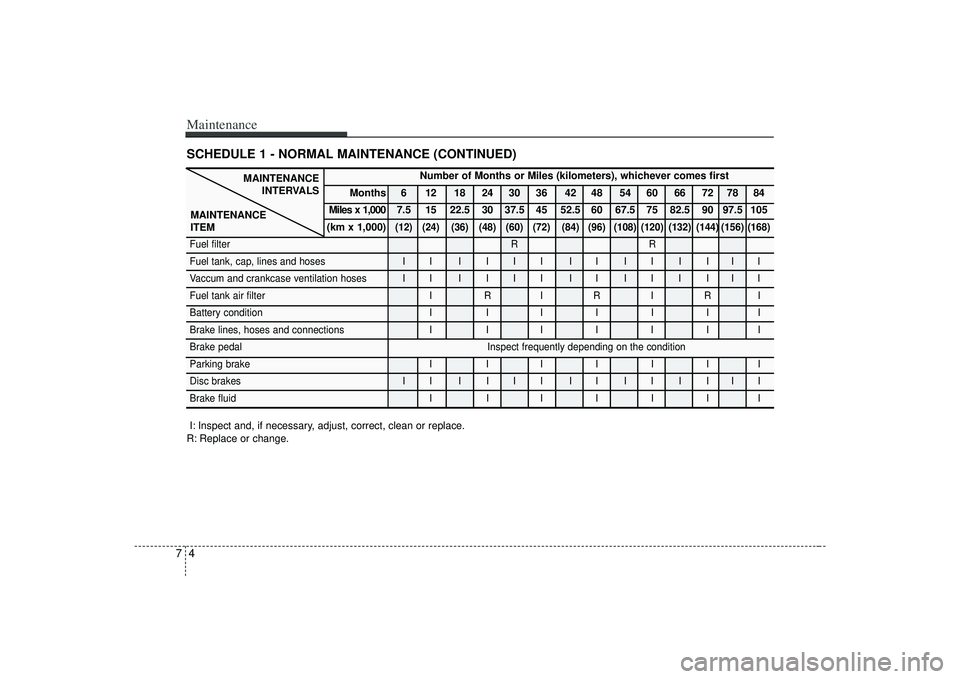
Maintenance47SCHEDULE 1 - NORMAL MAINTENANCE (CONTINUED)
MAINTENANCEINTERVALS
MAINTENANCE
ITEM
Number of Months or Miles (kilometers), whichever comes first
Months 6 12 18 24 30 36 42 48 54 60 66 72 78 84
Miles x 1,000 7.5 15 22.5 30 37.5 45 52.5 60 67.5 75 82.5 90 97.5 105
(km x 1,000)
(12) (24) (36) (48) (60) (72) (84) (96) (108) (120) (132) (144) (156) (168)
Fuel filter R R
Fuel tank, cap, lines and hoses I I I I I I I I I I I I I I
Vaccum and crankcase ventilation hoses I I I I I I I I I I I I I I
Fuel tank air filter I R I R I R I
Battery condition I I I I I I I
Brake lines, hoses and connections I I I I I I I
Brake pedal Inspect frequently depending on the condition
Parking brake I I I I I I I
Disc brakes I I I I I I I I I I I I I I
Brake fluid I I I I I I I
I: Inspect and, if necessary, adjust, correct, clean or replace.
R: Replace or change.
Page 255 of 321
75
Maintenance
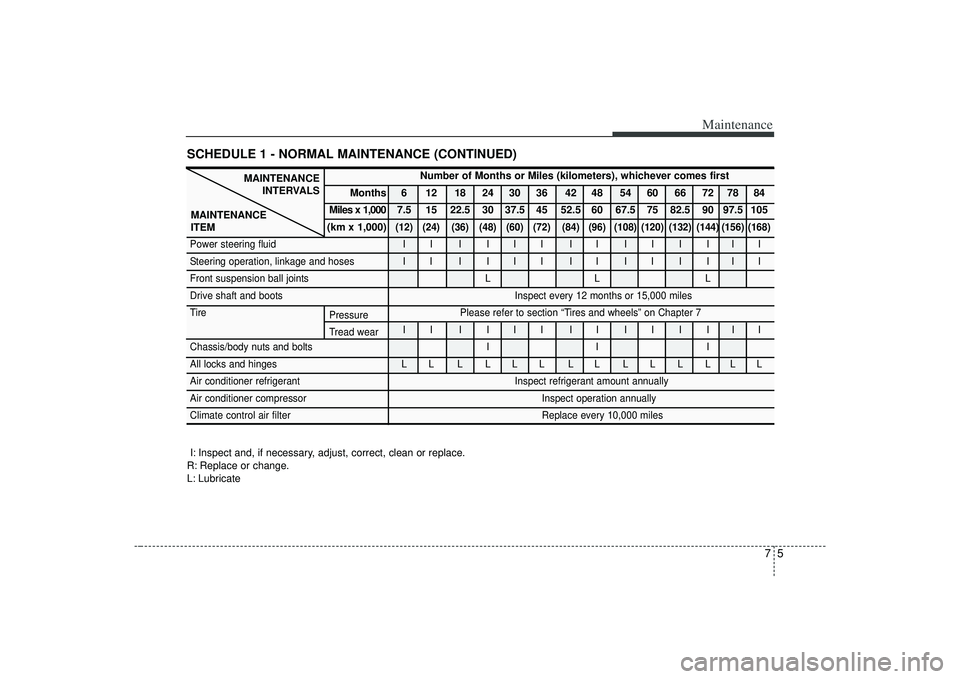
SCHEDULE 1 - NORMAL MAINTENANCE (CONTINUED)
MAINTENANCEINTERVALS
MAINTENANCE
ITEM
Number of Months or Miles (kilometers), whichever comes first
Months 6 12 18 24 30 36 42 48 54 60 66 72 78 84
Miles x 1,000 7.5 15 22.5 30 37.5 45 52.5 60 67.5 75 82.5 90 97.5 105
(km x 1,000)
(12) (24) (36) (48) (60) (72) (84) (96) (108) (120) (132) (144) (156) (168)
Power steering fluid I I I I I I I I I I I I I I
Steering operation, linkage and hoses I I I I I I I I I I I I I I
Front suspension ball joints L L L
Drive shaft and boots Inspect every 12 months or 15,000 miles
Tire Please refer to section “Tires and wheels” on Chapter 7 II I III II II I III
Chassis/body nuts and bolts I I I
All locks and hinges L L L L L L L L L L L L L L
Air conditioner refrigerant Inspect refrigerant amount annually
Air conditioner compressor Inspect operation annually
Climate control air filter Replace every 10,000 miles
I: Inspect and, if necessary, adjust, correct, clean or replace.
R: Replace or change.
L: Lubricate
Pressure
Tread wear
Page 256 of 321
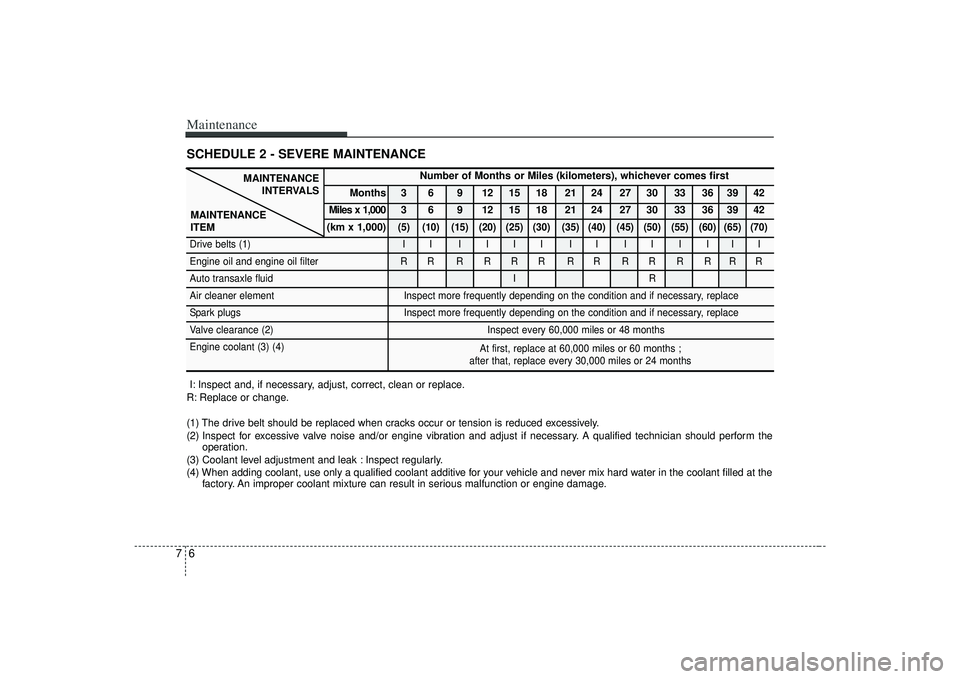
Maintenance67SCHEDULE 2 - SEVERE MAINTENANCE
MAINTENANCEINTERVALS
MAINTENANCE
ITEM
Number of Months or Miles (kilometers), whichever comes first
Months 3 6 9 12 15 18 21 24 27 30 33 36 39 42
Miles x 1,000 3 6 9 12 15 18 21 24 27 30 33 36 39 42
(km x 1,000)
(5) (10) (15) (20) (25) (30) (35) (40) (45) (50) (55) (60) (65) (70)
Drive belts (1) I I I I I I I I I I I I I I
Engine oil and engine oil filter R R R R R R R R R R R R R R
Auto transaxle fluid I R
Air cleaner element Inspect more frequently depending on the condition and if necessary, replace
Spark plugs Inspect more frequently depending on the condition and if necessary, replace
Valve clearance (2) Inspect every 60,000 miles or 48 months
Engine coolant (3) (4)
I: Inspect and, if necessary, adjust, correct, clean or replace.
R: Replace or change.
(1) The drive belt should be replaced when cracks occur or tension is reduced excessively.
(2) Inspect for excessive valve noise and/or engine vibration and adjust if necessary. A qualified technician should perform the operation.
(3) Coolant level adjustment and leak : Inspect regularly.
(4) When adding coolant, use only a qualified coolant additive for your vehicle and never mix hard water in the coolant filled at the factory. An improper coolant mixture can result in serious malfunction or engine damage.
At first, replace at 60,000 miles or 60 months ;
after that, replace every 30,000 miles or 24 months
Page 257 of 321
77
Maintenance
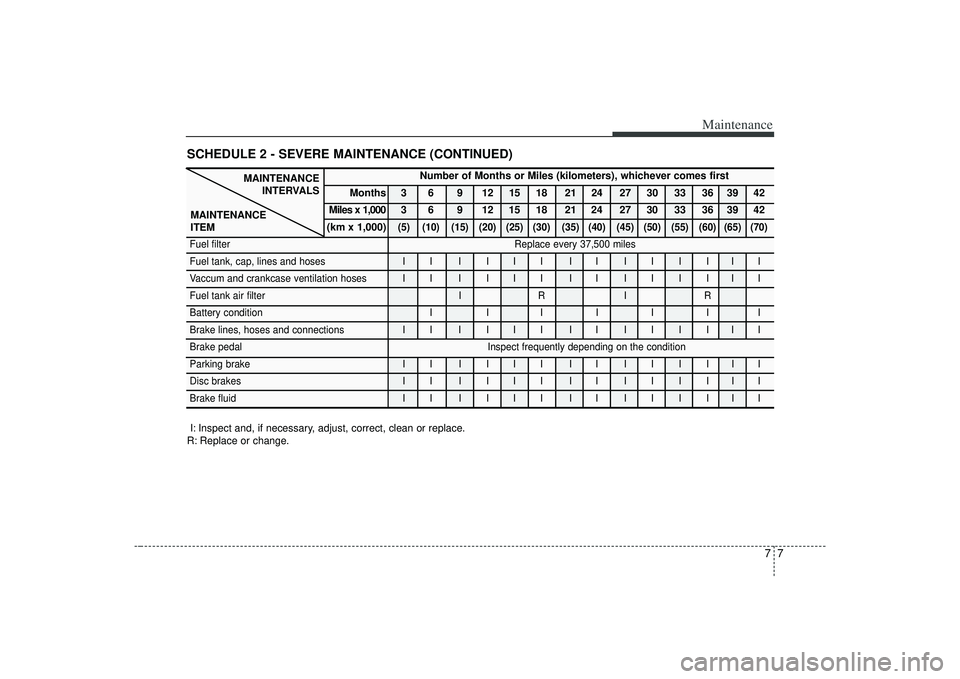
SCHEDULE 2 - SEVERE MAINTENANCE (CONTINUED)
MAINTENANCEINTERVALS
MAINTENANCE
ITEM
Number of Months or Miles (kilometers), whichever comes first
Months 3 6 9 12 15 18 21 24 27 30 33 36 39 42
Miles x 1,000 3 6 9 12 15 18 21 24 27 30 33 36 39 42
(km x 1,000)
(5) (10) (15) (20) (25) (30) (35) (40) (45) (50) (55) (60) (65) (70)
Fuel filter Replace every 37,500 miles
Fuel tank, cap, lines and hoses I I I I I I I I I I I I I I
Vaccum and crankcase ventilation hoses I I I I I I I I I I I I I I
Fuel tank air filter I R I R
Battery condition I I I I I I I
Brake lines, hoses and connections I I I I I I I I I I I I I I
Brake pedal Inspect frequently depending on the condition
Parking brake I I I I I I I I I I I I I I
Disc brakes I I I I I I I I I I I I I I
Brake fluid I I I I I I I I I I I I I I
I: Inspect and, if necessary, adjust, correct, clean or replace.
R: Replace or change.
Page 258 of 321
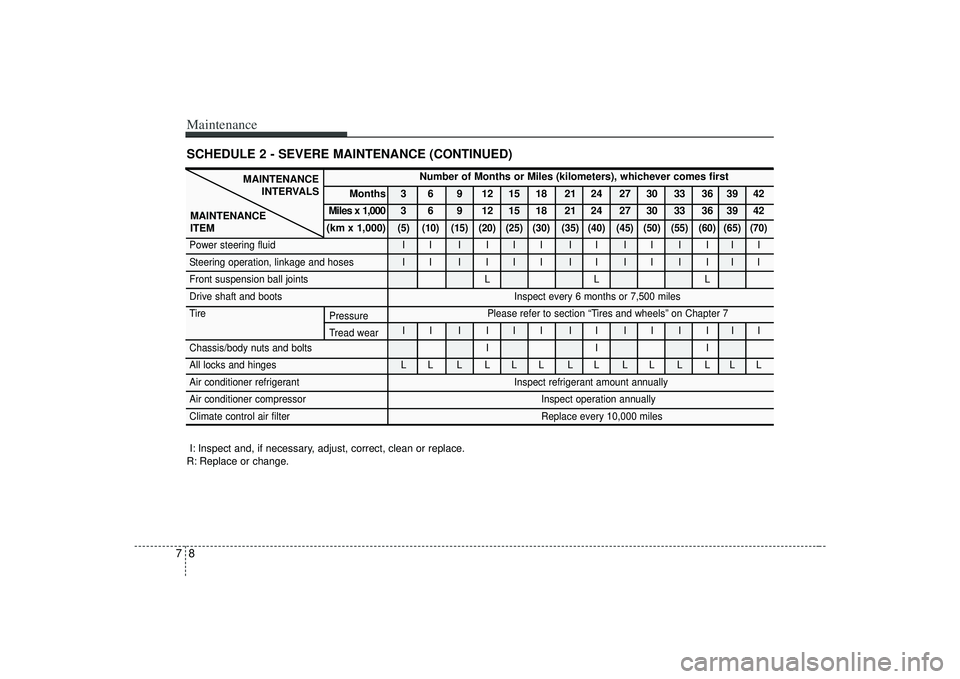
Maintenance87SCHEDULE 2 - SEVERE MAINTENANCE (CONTINUED)
MAINTENANCEINTERVALS
MAINTENANCE
ITEM
Number of Months or Miles (kilometers), whichever comes first
Months 3 6 9 12 15 18 21 24 27 30 33 36 39 42
Miles x 1,000 3 6 9 12 15 18 21 24 27 30 33 36 39 42
(km x 1,000)
(5) (10) (15) (20) (25) (30) (35) (40) (45) (50) (55) (60) (65) (70)
Power steering fluid I I I I I I I I I I I I I I
Steering operation, linkage and hoses I I I I I I I I I I I I I I
Front suspension ball joints L L L
Drive shaft and boots Inspect every 6 months or 7,500 miles
Tire Please refer to section “Tires and wheels” on Chapter 7 II I III II II I III
Chassis/body nuts and bolts I I I
All locks and hinges L L L L L L L L L L L L L L
Air conditioner refrigerant Inspect refrigerant amount annually
Air conditioner compressor Inspect operation annually
Climate control air filter Replace every 10,000 miles
I: Inspect and, if necessary, adjust, correct, clean or replace.
R: Replace or change.
Pressure
Tread wear
Page 259 of 321
79
Maintenance
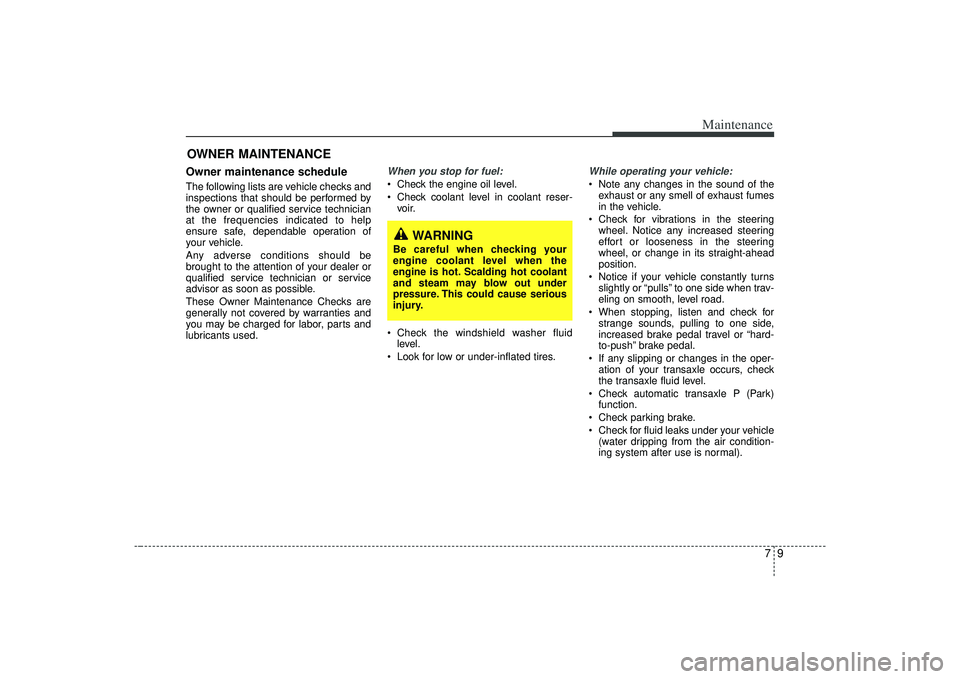
OWNER MAINTENANCE Owner maintenance schedule The following lists are vehicle checks and
inspections that should be performed by
the owner or qualified service technician
at the frequencies indicated to help
ensure safe, dependable operation of
your vehicle.
Any adverse conditions should be
brought to the attention of your dealer or
qualified service technician or service
advisor as soon as possible.
These Owner Maintenance Checks are
generally not covered by warranties and
you may be charged for labor, parts and
lubricants used.
When you stop for fuel: Check the engine oil level.
Check coolant level in coolant reser-voir.
Check the windshield washer fluid level.
Look for low or under-inflated tires.
While operating your vehicle: Note any changes in the sound of the exhaust or any smell of exhaust fumes
in the vehicle.
Check for vibrations in the steering wheel. Notice any increased steering
effort or looseness in the steering
wheel, or change in its straight-ahead
position.
Notice if your vehicle constantly turns slightly or “pulls” to one side when trav-
eling on smooth, level road.
When stopping, listen and check for strange sounds, pulling to one side,
increased brake pedal travel or “hard-
to-push” brake pedal.
If any slipping or changes in the oper- ation of your transaxle occurs, check
the transaxle fluid level.
Check automatic transaxle P (Park) function.
Check parking brake.
Check for fluid leaks under your vehicle (water dripping from the air condition-
ing system after use is normal).
WARNING
Be careful when checking your
engine coolant level when the
engine is hot. Scalding hot coolant
and steam may blow out under
pressure. This could cause serious
injury.
Page 260 of 321
Maintenance10
7At least monthly: Check coolant level in the coolant
recovery reservoir.
Check the operation of all exterior lights, including the stoplights, turn sig-
nals and hazard warning flashers.
Check the inflation pressures of all tires including the spare.
At least twice a year (i.e., every Spring and Fall) : Check radiator, heater and air condi- tioning hoses for leaks or da-mage.
Check windshield washer spray and wiper operation. Clean wiper blades
with clean cloth dampened with wash-
er fluid.
Check headlight alignment.
Check muffler, exhaust pipes, shields and clamps.
Check the lap/shoulder belts for wear and function.
Check for worn tires and loose wheel lug nuts.
At least once a year : Clean body and door drain holes.
Lubricate door hinges and checks, andhood hinges.
Lubricate door and hood locks and latches.
Lubricate door rubber weatherstrips.
Check the air conditioning system before the warm weather season.
Check the power steering fluid level.
Inspect and lubricate automatic transaxle linkage and controls.
Clean battery and terminals.
Check the brake fluid level.
Page 266 of 321
Maintenance16
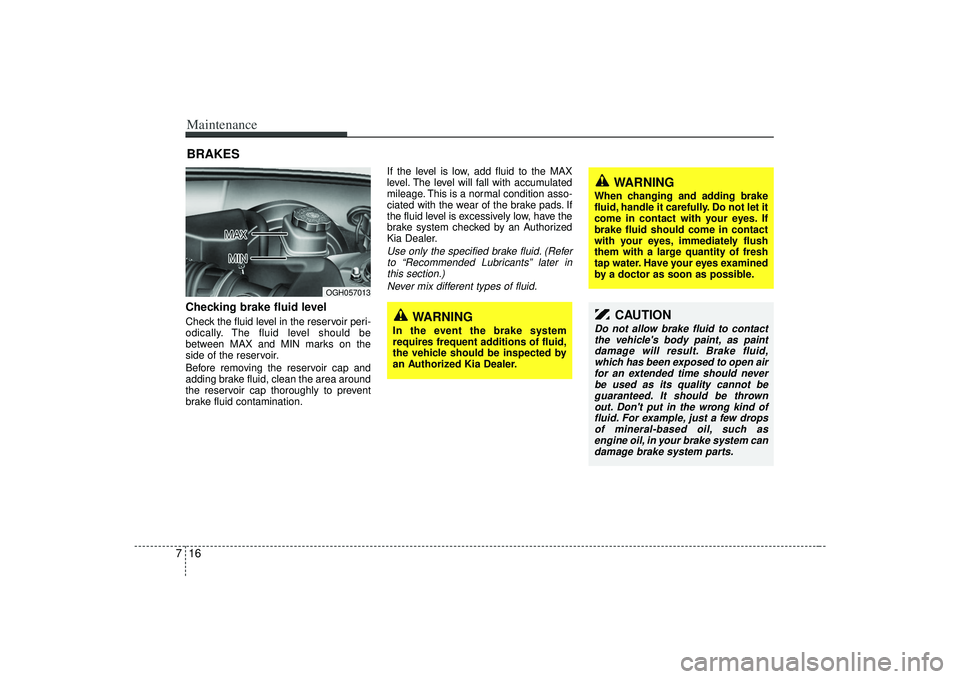
7BRAKESChecking brake fluid level Check the fluid level in the reservoir peri-
odically. The fluid level should be
between MAX and MIN marks on the
side of the reservoir.
Before removing the reservoir cap and
adding brake fluid, clean the area around
the reservoir cap thoroughly to prevent
brake fluid contamination. If the level is low, add fluid to the MAX
level. The level will fall with accumulated
mileage. This is a normal condition asso-
ciated with the wear of the brake pads. If
the fluid level is excessively low, have the
brake system checked by an Authorized
Kia Dealer.
Use only the specified brake fluid. (Refer
to “Recommended Lubricants” later inthis section.)
Never mix different types of fluid.
WARNING
When changing and adding brake
fluid, handle it carefully. Do not let it
come in contact with your eyes. If
brake fluid should come in contact
with your eyes, immediately flush
them with a large quantity of fresh
tap water. Have your eyes examined
by a doctor as soon as possible.
WARNING
In the event the brake system
requires frequent additions of fluid,
the vehicle should be inspected by
an Authorized Kia Dealer.
OGH057013
CAUTION
Do not allow brake fluid to contactthe vehicle's body paint, as paintdamage will result. Brake fluid,which has been exposed to open airfor an extended time should never be used as its quality cannot beguaranteed. It should be thrown out. Don't put in the wrong kind offluid. For example, just a few drops of mineral-based oil, such asengine oil, in your brake system candamage brake system parts.
Page 281 of 321
731
Maintenance
Remove the valve cap from the tire
valve stem. Press the tire gauge firm-
ly onto the valve to get a pressure
measurement. If the cold tire inflation
pressure matches the recommended
pressure on the tire and loading
information label, no further adjust-
ment is necessary. If the pressure is
low, add air until you reach the rec-
ommended amount.
If you overfill the tire, release air by
pushing on the metal stem in the cen-
ter of the tire valve. Recheck the tire
pressure with the tire gauge. Be sure
to put the valve caps back on the
valve stems. They help prevent leaks
by keeping out dirt and moisture. Tire rotation
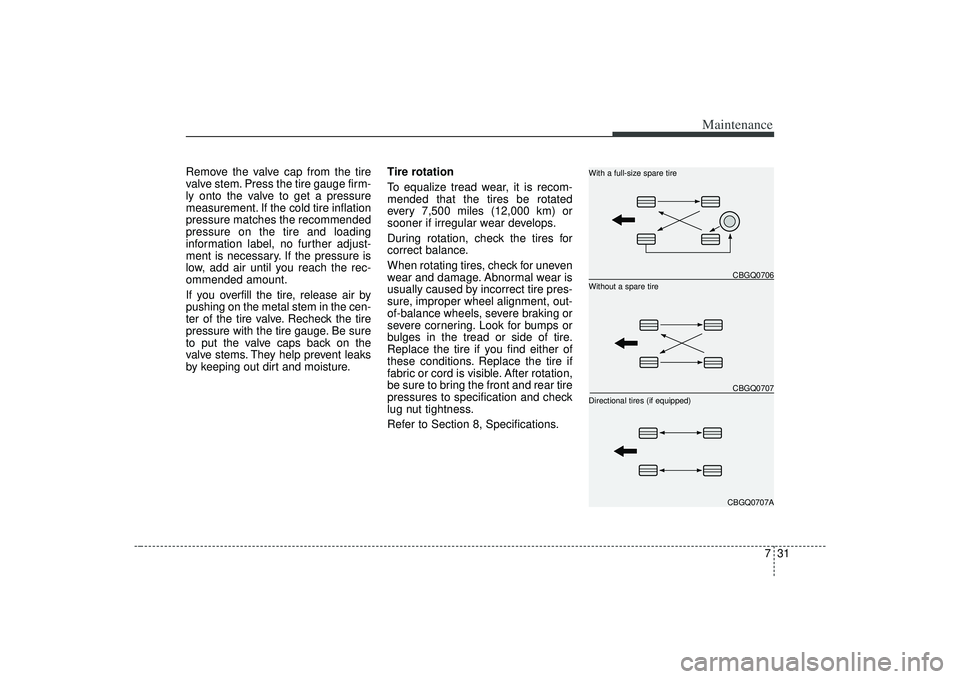
To equalize tread wear, it is recom-
mended that the tires be rotated
every 7,500 miles (12,000 km) or
sooner if irregular wear develops.
During rotation, check the tires for
correct balance.
When rotating tires, check for uneven
wear and damage. Abnormal wear is
usually caused by incorrect tire pres-
sure, improper wheel alignment, out-
of-balance wheels, severe braking or
severe cornering. Look for bumps or
bulges in the tread or side of tire.
Replace the tire if you find either of
these conditions. Replace the tire if
fabric or cord is visible. After rotation,
be sure to bring the front and rear tire
pressures to specification and check
lug nut tightness.
Refer to Section 8, Specifications.
CBGQ0706CBGQ0707CBGQ0707A
Without a spare tire With a full-size spare tire
Directional tires (if equipped)
Page 286 of 321
Maintenance36
74. Tire ply composition and materialThe number of layers or plies of rub-
ber-coated fabric in the tire. Tire
manufacturers also must indicate the
materials in the tire, which include
steel, nylon, polyester, and others.
The letter "R" means radial ply con-
struction; the letter "D" means diago-
nal or bias ply construction; and the
letter "B" means belted-bias ply con-
struction.
5. Maximum permissible inflation
pressureThis number is the greatest amount
of air pressure that should be put in
the tire. Do not exceed the maximum
permissible inflation pressure. Refer
to the Tire and Loading Information
label for recommended inflation
pressure.6. Maximum load ratingThis number indicates the maximum
load in kilograms and pounds that
can be carried by the tire. When
replacing the tires on the vehicle,
always use a tire that has the same
load rating as the factory installed
tire.7. Uniform tire quality grading The following information relates to
the tire grading system developed by
the National Highway Traffic Safety
Administration (NHTSA) for grading
tires by tread wear, traction and tem-
perature performance. Tread wear
The tread wear grade is a compara-
tive rating based on the wear rate of
the tire when tested under controlled
conditions on a specified govern-
ment test course. For example, a tire
graded 150 would wear one-and-a-
half times as well on the government
course as a tire graded 100.
The relative performance of tires
depends upon the actual conditions
of their use. However, performance
may differ from the norm because of
variations in driving habits, service
practices and differences in road
characteristics and climate.
These grades are molded on the
side-walls of passenger vehicle tires.
The tires available as standard or
optional equipment on Kia vehicles
may vary with respect to grade.
WARNING
Tires degrade over time, even
when they are not being used.
Regardless of the remaining
tread, it is recommended that
tires generally be replaced after
six (6) years of normal service.
Heat caused by hot climates or
frequent high loading condi-
tions can accelerate the aging
process. Failure to follow this
warning can result in sudden
tire failure, which could lead to a
loss of control and an accident
involving serious injury or
death.