maintenance KIA AMANTI 2009 Owners Manual
[x] Cancel search | Manufacturer: KIA, Model Year: 2009, Model line: AMANTI, Model: KIA AMANTI 2009Pages: 321, PDF Size: 23.77 MB
Page 4 of 321
ii
1
2
3
4
5
6
7
8
9
IntroductionYour vehicle at a glanceKnowing your vehicleDriving your vehicleDriving tipsIn case of an emergencyMaintenanceSpecificationsConsumer assistance, Reporting safety defects
10
Index
table of contents
Page 79 of 321
367
Knowing your vehicle
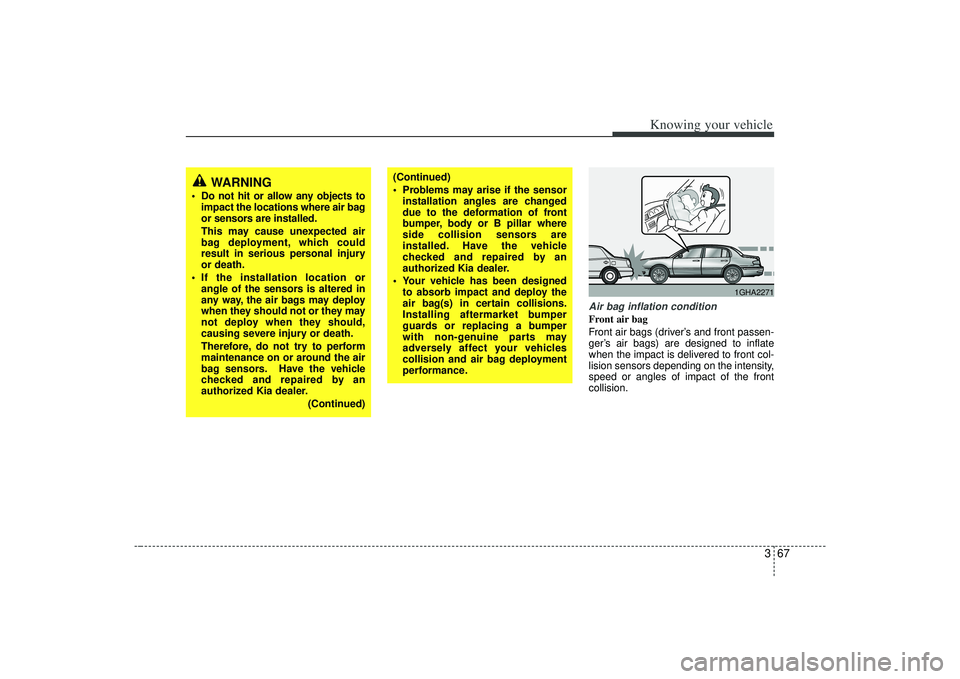
Air bag inflation conditionFront air bag
Front air bags (driver’s and front passen-
ger’s air bags) are designed to inflate
when the impact is delivered to front col-
lision sensors depending on the intensity,
speed or angles of impact of the front
collision.
WARNING
Do not hit or allow any objects toimpact the locations where air bag
or sensors are installed.
This may cause unexpected air
bag deployment, which could
result in serious personal injury
or death.
If the installation location or angle of the sensors is altered in
any way, the air bags may deploy
when they should not or they may
not deploy when they should,
causing severe injury or death.
Therefore, do not try to perform
maintenance on or around the air
bag sensors. Have the vehicle
checked and repaired by an
authorized Kia dealer.
(Continued)
(Continued)
Problems may arise if the sensorinstallation angles are changed
due to the deformation of front
bumper, body or B pillar where
side collision sensors are
installed. Have the vehicle
checked and repaired by an
authorized Kia dealer.
Your vehicle has been designed to absorb impact and deploy the
air bag(s) in certain collisions.
Installing aftermarket bumper
guards or replacing a bumper
with non-genuine parts may
adversely affect your vehicles
collision and air bag deployment
performance.
1GHA2271
Page 86 of 321
Knowing your vehicle74
3Air bag (Supplemental Restraint
System) service Your Supplemental Restraint System is
virtually maintenance-free. There are no
parts which you can service.
You must have the system serviced
under the following circumstances:
If an air bag ever inflates, the air bag
must be replaced. Do not try to remove
or discard the air bag by yourself. This
must be done by an authorized Kia
dealer.
If the air bag warning indicator light alerts you to a problem, have the air
bag system checked as soon as possi-
ble. Otherwise, your air bag system
may be ineffective.
When repairing or scrapping thevehicles Repairing steering wheel, instrument panel, center console or roofs, or
installing car audio around center con-
sole or painting front metal sheet could
disable the air bag system. Have them
checked by an authorized Kia dealer.
When leaving the vehicle at an author- ized Kia dealer, inform the facility that
the vehicle is equipped with an air bag
system, and leave the owner’s manual
in the vehicle.
Since the air bag system contains explosive chemical substances, con-
tact an authorized Kia dealer when
scrapping the vehicle.
WARNING
- No mainte-
nance or repair
Do not modify your steering
wheel, seat or any other part of
the Supplemental Restraint
System. Modification could make
the system inoperable.
Do not work on the system’s com- ponents or wiring. This could
cause the air bags to inflate inad-
vertently, possibly seriously injur-
ing someone. Working on the sys-
tem could also disable the sys-
tem so that the air bags would not
deploy in a collision.
Any work on the SRS system, such as removing, installing,
repairing, or any work on the
steering wheel must be per-
formed by a qualified Kia techni-
cian. Improper handling of the air
bag system may result in serious
personal injury or death.
CAUTION
- No modifica-tion
Do not modify any part of the air
bag system. Modification couldmake the air bag system ineffective or could cause unnecessarydeployment.
Page 197 of 321
55
Driving tips
BEFORE DRIVING Before entering vehicle: Be sure that all windows, outside mir-ror(s), and outside lights are clean.
Check the condition of the tires.
Check under the vehicle for any sign of leaks.
Be sure there are no obstacles behind you if you intend to back up.Necessary inspections Fluid levels, such as engine oil, engine
coolant, brake fluid, and washer fluid
should be checked on a regular basis,
with the exact interval depending on the
fluid. Further details are provided in
Section 7, Maintenance.
Before starting Close and lock all doors.
Position the seat so that all controls areeasily reached.
Adjust the inside and outside rearview mirrors.
Be sure that all lights work.
Check all gauges.
Check the operation of warning lights when the ignition switch is turned to
the ON position.
Release the parking brake and make sure the brake warning light goes out.
For safe operation, be sure you are famil-
iar with your vehicle and its equipment.
WARNING
- Driving under
the influence of alcohol or
drugs
Drinking and driving is dangerous.
Drunk driving is the number one
contributor to the highway death
toll each year. Even a small amount
of alcohol will affect your reflexes,
perceptions and judgement.
You are much more likely to have a
serious accident if you drink and
drive.
If you are drinking or taking drugs,
don’t drive. Do not ride with a driv-
er who has been drinking or taking
drugs. Choose a designated driver
or call a cab.
Driving while under the influence of
drugs is as dangerous or more dan-
gerous than driving drunk.
Page 198 of 321
Driving tips65SUGGESTIONS FOR ECONOMICAL OPERATIONYour vehicle's fuel economy depends
mainly on your style of driving, where you
drive and when you drive.
Each of these factors affects how many
kilometers (miles) you can get from a liter
(gallon) of fuel. To operate your vehicle
as economically as possible, use the fol-
lowing driving suggestions to help save
money in both fuel and repairs:
Avoid lengthy warm-up idling. Once theengine is running smoothly, begin driv-
ing. Remember, engine warm-up may
take a little longer on cold days.
Save fuel by accelerating slowly after stopping.
Keep the engine in tune and follow the recommended periodic maintenance
schedule. This will increase the life of
all parts and lower your operating
costs. Do not use the air conditioner unnec-
essarily.
Slow down when driving on rough roads.
For longer tire life and better fuel econ- omy, always keep the tires inflated to
the recommended pressures.
Maintain a safe distance from other vehicles to avoid sudden stops. This
will reduce wear on brake linings and
pads. Driving in such a way will also
save fuel because extra fuel is required
to accelerate back to driving speed.
Do not carry unnecessary weight in the vehicle.
Do not rest your foot on the brake pedal while driving. This can cause
needless wear, possible damage to the
brakes, and poor fuel economy.
Improper wheel alignment results in faster tire wear and lower fuel econo-
my. Open windows at high speeds can
reduce fuel economy.
Fuel economy is less in crosswinds and headwinds. To help offset some of
this loss, slow down when driving in
these conditions.
Keeping a vehicle in good operating con-
dition is important both for economy and
safety. Therefore, have an authorized Kia
dealer perform scheduled inspections
and maintenance.
WARNING
- Engine off dur-
ing motion
Never turn the engine off to coast
down hills or anytime the vehicle is
in motion. The power steering and
power brakes will not function with-
out the engine running. Instead,
downshift to an appropriate gear for
engine braking effect.
Page 216 of 321
Driving tips24
5However, if you ever have to park your
trailer on a hill, here’s how to do it:
1. Apply your brakes, but don’t shift into
gear.
2. Have someone place chocks under the trailer wheels.
3. When the wheel chocks are in place, release the brakes until the chocks
absorb the load.
4. Reapply the brakes. Apply your park- ing brake, and then shift to P (Park) for
an automatic transaxle.
5. Release the brakes.
When you are ready to leave after parking on a hill 1. With the automatic transaxle in P (Park), apply your brakes and hold the
brake pedal down while you:
and
2. Slowly remove your foot from the brake pedal.
3. Drive slowly until the trailer is clear of the chocks.
4. Stop and have someone pick up and store the chocks.
Maintenance when trailer towing Your vehicle will need service more often
when you regularly pull a trailer.
Important items to pay particular atten-
tion include engine oil, automatic
transaxle fluid, axle lubricant and cooling
system fluid. Brake condition is another
important item to frequently check. Each
item is covered in this manual, and the
Index will help you find them quickly. If
you’re trailering, it’s a good idea to review
these sections before you start your trip.
Don’t forget to also maintain your trailer
and hitch. Follow the maintenance
schedule that accompanied your trailer
and check it periodically. Preferably, con-
duct the check at the start of each day’s
driving. Most importantly, all hitch nuts
and bolts should be tight.
WARNING
- Parking brake
It can be dangerous to get out of
your vehicle if the parking brake is
not firmly set.
If you have left the engine running,
the vehicle can move suddenly. You
or others could be seriously or
fatally injured.
CAUTION
Due to higher load during trailerusage, overheating might occur inhot days or during uphill driving. Ifthe coolant gauge indicates over-heating, switch off the A/C and stop the vehicle in a safe area to cooldown the engine.
Page 251 of 321
7
Maintenance services / 7-2
Normal maintenance schedule / 7-3
Severe maintenance schedule / 7-6
Owner maintenance / 7-9
Engine compartment / 7-12
Engine oil and oil filter / 7-13
Engine cooling system / 7-14
Brakes / 7-16
Power steering / 7-17
Automatic transaxle / 7-18
Lubricants and fluids / 7-20
Air cleaner / 7-21
Climate control air filter / 7-22
Wiper blades / 7-24
Battery / 7-26
Tires and wheels / 7-29
Bulb replacement / 7-41
Lubricant specifications / 7-46
Exterior care / 7-48
Interior care / 7-51
California perchlorate notice / 7-52
Maintenance
Page 252 of 321
Maintenance27MAINTENANCE SERVICESYou should exercise the utmost care to
prevent damage to your vehicle and
injury to yourself whenever performing
any maintenance or inspection proce-
dures.
Should you have any doubts concerning
the inspection or servicing of your vehi-
cle, we strongly recommend that you
have an Authorized Kia Dealer perform
this work.
An Authorized Kia Dealer has factory-
trained technicians and genuine Kia
parts to service your vehicle properly. For
expert advice and quality service, see an
Authorized Kia Dealer.
Inadequate, incomplete or insufficient
servicing may result in operational prob-
lems with your vehicle that could lead to
vehicle damage, an accident, or person-
al injury.
Owner’s responsibility ✽ ✽NOTICEMaintenance Service and Record
Retention are the owner's responsibility. You should retain documents that show
proper maintenance has been performed
on your vehicle in accordance with the
scheduled maintenance service charts
shown on the following pages. You need
this information to establish your compli-
ance with the servicing and maintenance
requirements of your Kia warranties.
Detailed warranty information is provided
in your Warranty & Consumer
Information manual.
Repairs and adjustments required as a
result of improper maintenance or a lack
of required maintenance are not covered.
We recommend you have your vehicle
maintained and repaired by an
Authorized Kia Dealer. An Authorized Kia
Dealer meets Kia`s high service quality
standards and receives technical support
from Kia in order to provide you with a
high level of service satisfaction.
Scheduled maintenance service If none of the following conditions are
applicable, then use Schedule 1 –
Normal Maintenance.
Repeated short distance driving.
Driving in dusty conditions or sandy areas.
Extensive use of brakes.
Driving in areas where salt or other corrosive materials are being used.
Driving on rough or muddy roads.
Driving in mountainous areas.
Extended periods of idling or low speed operation.
Driving for a prolonged period in cold temperatures and/or extremely humid
climates.
More than 50% driving in heavy city traffic during hot weather above 90°F
(32°C)
If any of the preceding conditions apply,
follow Schedule 2 – Severe Maintenance.After 105 months or 105,000 miles (168,000 km) continue to follow the pre-scribed maintenance intervals.
Page 253 of 321
73
Maintenance
MAINTENANCEINTERVALS
MAINTENANCE
ITEM
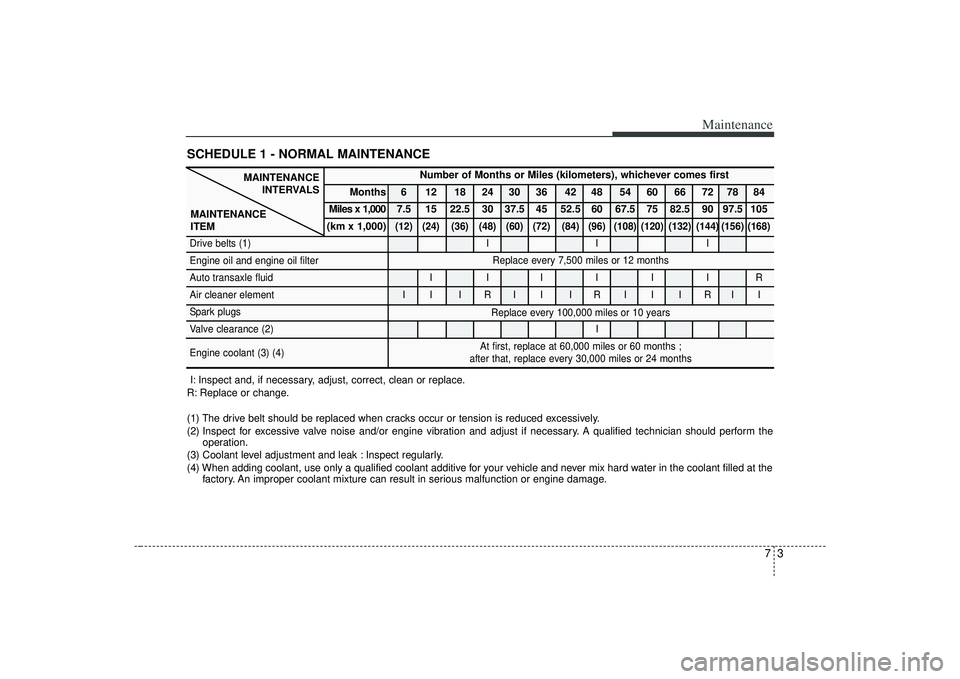
SCHEDULE 1 - NORMAL MAINTENANCE
Number of Months or Miles (kilometers), whichever comes first
Months 6 12 18 24 30 36 42 48 54 60 66 72 78 84
Miles x 1,000 7.5 15 22.5 30 37.5 45 52.5 60 67.5 75 82.5 90 97.5 105
(km x 1,000)
(12) (24) (36) (48) (60) (72) (84) (96) (108) (120) (132) (144) (156) (168)
Drive belts (1) I I I
Engine oil and engine oil filter
Auto transaxle fluid I I I I I I R
Air cleaner element I I I R I I I R I I I R I I
Spark plugs
Valve clearance (2) I
Engine coolant (3) (4)
I: Inspect and, if necessary, adjust, correct, clean or replace.
R: Replace or change.
(1) The drive belt should be replaced when cracks occur or tension is reduced excessively.
(2) Inspect for excessive valve noise and/or engine vibration and adjust if necessary. A qualified technician should perform the operation.
(3) Coolant level adjustment and leak : Inspect regularly.
(4) When adding coolant, use only a qualified coolant additive for your vehicle and never mix hard water in the coolant filled at the factory. An improper coolant mixture can result in serious malfunction or engine damage.
At first, replace at 60,000 miles or 60 months ;
after that, replace every 30,000 miles or 24 months Replace every 100,000 miles or 10 yearsReplace every 7,500 miles or 12 months
Page 254 of 321
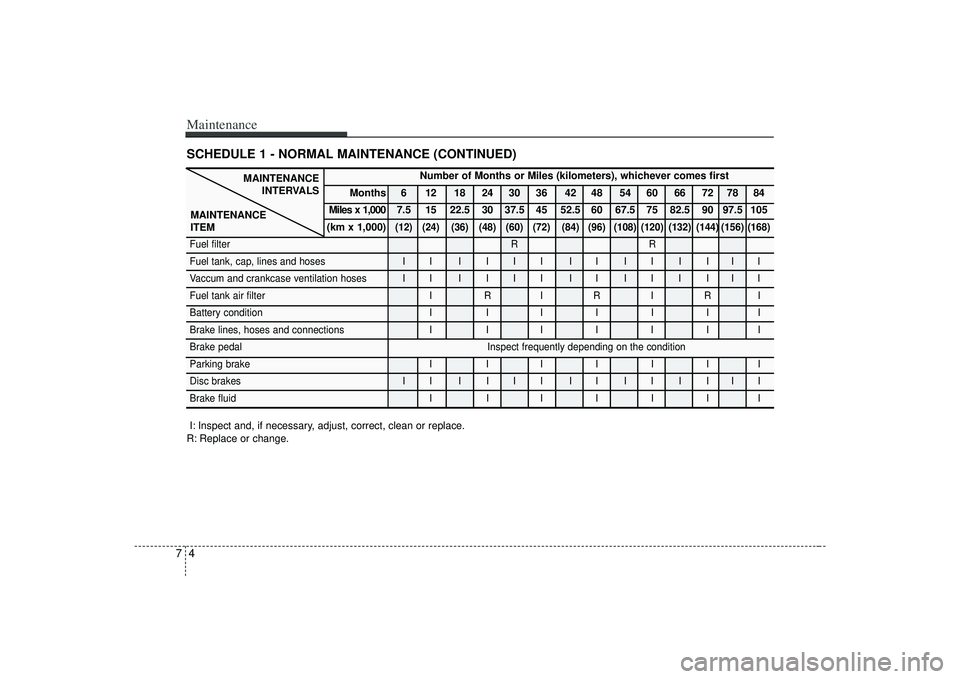
Maintenance47SCHEDULE 1 - NORMAL MAINTENANCE (CONTINUED)
MAINTENANCEINTERVALS
MAINTENANCE
ITEM
Number of Months or Miles (kilometers), whichever comes first
Months 6 12 18 24 30 36 42 48 54 60 66 72 78 84
Miles x 1,000 7.5 15 22.5 30 37.5 45 52.5 60 67.5 75 82.5 90 97.5 105
(km x 1,000)
(12) (24) (36) (48) (60) (72) (84) (96) (108) (120) (132) (144) (156) (168)
Fuel filter R R
Fuel tank, cap, lines and hoses I I I I I I I I I I I I I I
Vaccum and crankcase ventilation hoses I I I I I I I I I I I I I I
Fuel tank air filter I R I R I R I
Battery condition I I I I I I I
Brake lines, hoses and connections I I I I I I I
Brake pedal Inspect frequently depending on the condition
Parking brake I I I I I I I
Disc brakes I I I I I I I I I I I I I I
Brake fluid I I I I I I I
I: Inspect and, if necessary, adjust, correct, clean or replace.
R: Replace or change.