4WD LOW KIA Borrego 2009 1.G Owner's Manual
[x] Cancel search | Manufacturer: KIA, Model Year: 2009, Model line: Borrego, Model: KIA Borrego 2009 1.GPages: 425, PDF Size: 8.46 MB
Page 9 of 425
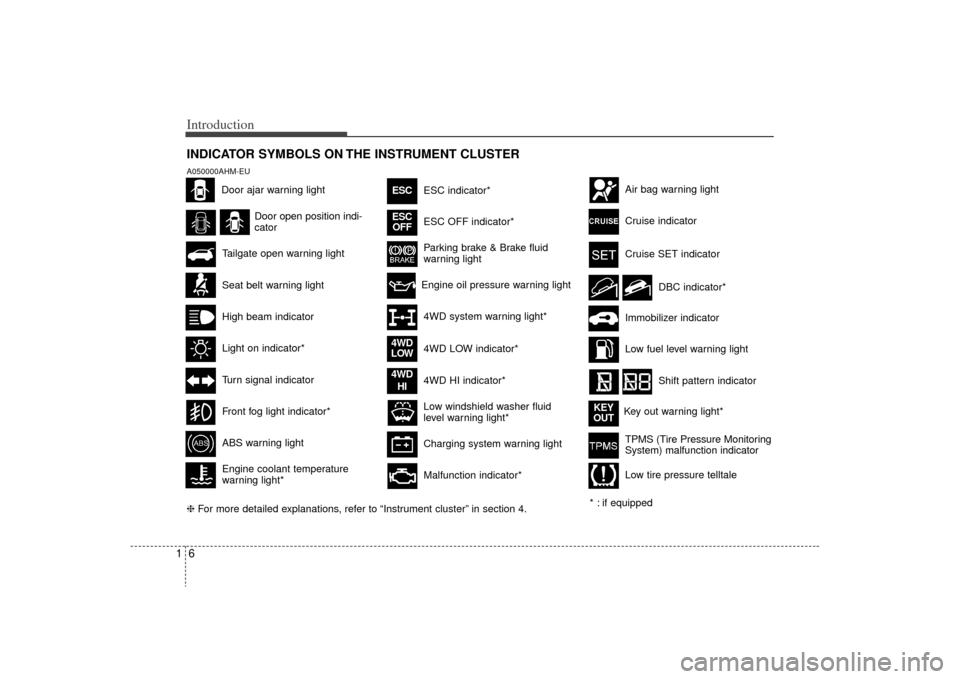
Introduction61INDICATOR SYMBOLS ON THE INSTRUMENT CLUSTER
Seat belt warning light
Door open position indi-
cator
Tailgate open warning lightHigh beam indicatorLight on indicator*Turn signal indicatorFront fog light indicator*ABS warning light
Parking brake & Brake fluid
warning lightEngine oil pressure warning light4WD system warning light*
4WD LOW indicator*
4WD HI indicator*Malfunction indicator*
Air bag warning lightCruise SET indicatorImmobilizer indicatorLow fuel level warning light
Shift pattern indicatorDBC indicator*
❈ For more detailed explanations, refer to “Instrument cluster” in section 4.
Charging system warning lightLow windshield washer fluid
level warning light*
Engine coolant temperature
warning light* ESC indicator*
A050000AHM-EU
Door ajar warning light
Key out warning light*
KEY
OUT
4WD
LOW4WD
HI
* : if equipped
Cruise indicator
ESC OFF indicator*
ESCESC
OFF
TPMS (Tire Pressure Monitoring
System) malfunction indicator Low tire pressure telltale
Page 141 of 425
Features of your vehicle64
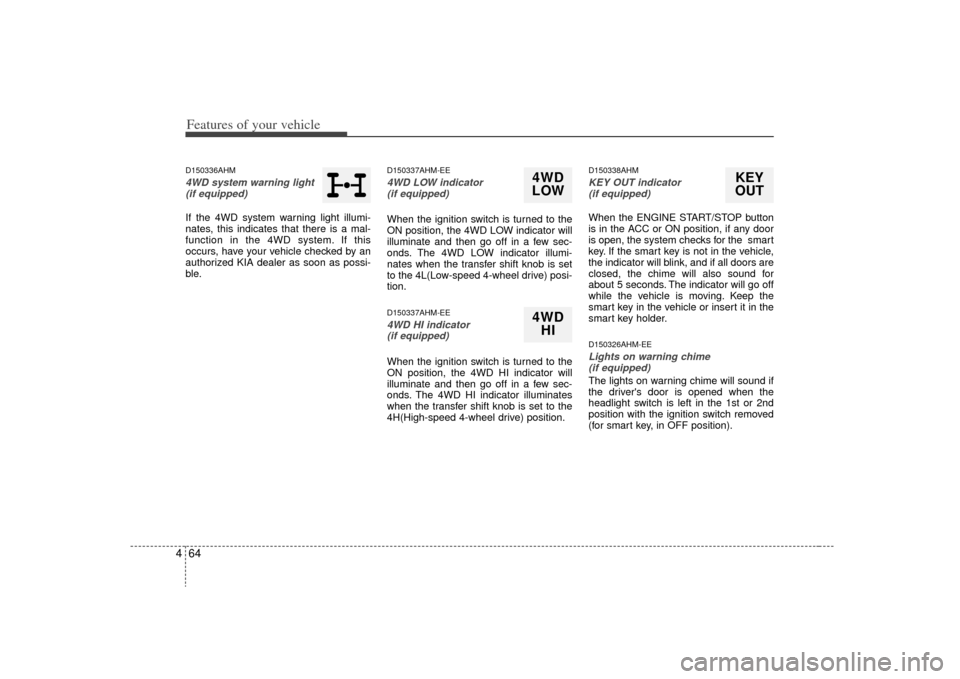
4D150336AHM4WD system warning light
(if equipped) If the 4WD system warning light illumi-
nates, this indicates that there is a mal-
function in the 4WD system. If this
occurs, have your vehicle checked by an
authorized KIA dealer as soon as possi-
ble.
D150337AHM-EE4WD LOW indicator (if equipped)When the ignition switch is turned to the
ON position, the 4WD LOW indicator will
illuminate and then go off in a few sec-
onds. The 4WD LOW indicator illumi-
nates when the transfer shift knob is set
to the 4L(Low-speed 4-wheel drive) posi-
tion.D150337AHM-EE4WD HI indicator (if equipped)When the ignition switch is turned to the
ON position, the 4WD HI indicator will
illuminate and then go off in a few sec-
onds. The 4WD HI indicator illuminates
when the transfer shift knob is set to the
4H(High-speed 4-wheel drive) position.
D150338AHMKEY OUT indicator (if equipped)When the ENGINE START/STOP button
is in the ACC or ON position, if any door
is open, the system checks for the smart
key. If the smart key is not in the vehicle,
the indicator will blink, and if all doors are
closed, the chime will also sound for
about 5 seconds. The indicator will go off
while the vehicle is moving. Keep the
smart key in the vehicle or insert it in the
smart key holder.D150326AHM-EELights on warning chime (if equipped)The lights on warning chime will sound if
the driver's door is opened when the
headlight switch is left in the 1st or 2nd
position with the ignition switch removed
(for smart key, in OFF position).
4WD
LOW4WD HI
KEY
OUT
Page 280 of 425
Driving your vehicle18
5E170000AHMEngine power can be delivered to all front
and rear wheels for maximum traction.
4WD is useful when extra traction is
required on road, such as, when driving
on slippery, muddy, wet, or snow-covered
roads. These vehicles are not designed
for challenging off-road use. Occasional
off-road use such as established
unpaved roads and trails are OK. It is
always important when traveling off-high-
way that the driver carefully reduces the
speed to a level that does not exceed the
safe operating speed for those condi-
tions. In general, off-road conditions pro-
vide less traction and braking effective-
ness than normal road conditions. The
driver must be especially alert to avoid
driving on slopes which tilt the vehicle to
either side.
These factors must be carefully consid-
ered when driving off-road. Keeping the
vehicle in contact with the driving surface
and under control in these conditions is
always the driver's responsibility for the
safety of him/herself and his or her pas-
sengers.
E170201AHMTight corner brake effectTight corner brake effect is a unique
characteristic of four-wheel drive vehicles
caused by the difference in tire rotation of
the four wheels and the zero-degree
alignment of the front wheels and sus-
pension.
Sharp turns at low speeds should be car-
ried out with caution.
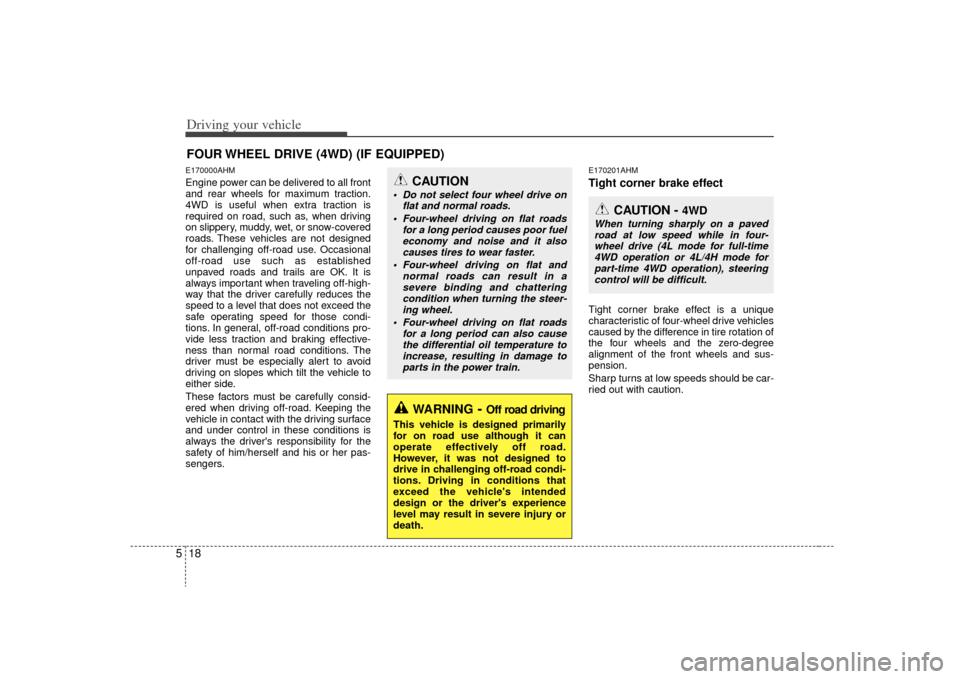
FOUR WHEEL DRIVE (4WD) (IF EQUIPPED)
WARNING
- Off road driving
This vehicle is designed primarily
for on road use although it can
operate effectively off road.
However, it was not designed to
drive in challenging off-road condi-
tions. Driving in conditions that
exceed the vehicle's intended
design or the driver's experience
level may result in severe injury or
death.
CAUTION -
4WD
When turning sharply on a paved
road at low speed while in four-wheel drive (4L mode for full-time 4WD operation or 4L/4H mode forpart-time 4WD operation), steeringcontrol will be difficult.
CAUTION
Do not select four wheel drive on flat and normal roads.
Four-wheel driving on flat roads for a long period causes poor fueleconomy and noise and it also causes tires to wear faster.
Four-wheel driving on flat and normal roads can result in asevere binding and chatteringcondition when turning the steer- ing wheel.
Four-wheel driving on flat roads for a long period can also causethe differential oil temperature to increase, resulting in damage toparts in the power train.
Page 281 of 425
519
Driving your vehicle
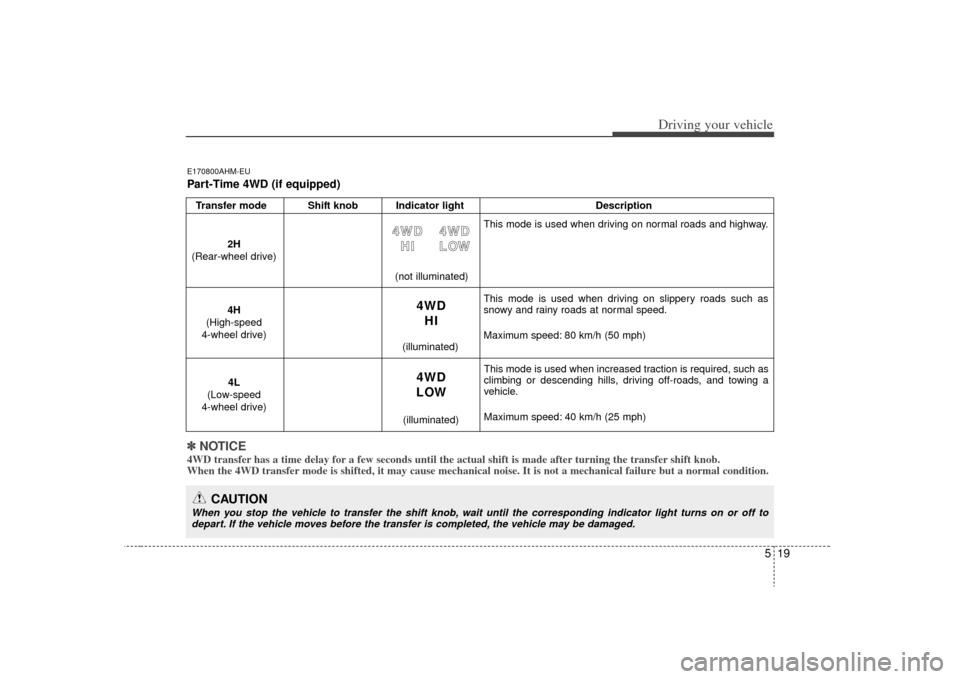
Transfer mode Shift knob Indicator lightDescription
This mode is used when driving on normal roads and highway.
This mode is used when driving on slippery roads such as
snowy and rainy roads at normal speed.
Maximum speed: 80 km/h (50 mph)
This mode is used when increased traction is required, such as
climbing or descending hills, driving off-roads, and towing a
vehicle.
Maximum speed: 40 km/h (25 mph)
4 4 W
W D
D
H
H I
I
4WD HI
4WD
LOW 4
4
W
W D
D
L
L O
O W
W
2H
(Rear-wheel drive)
4H
(High-speed
4-wheel drive)
4L
(Low-speed
4-wheel drive) (not illuminated)
✽
✽
NOTICE4WD transfer has a time delay for a few seconds until the actual shift is made after turning the transfer shift knob.
When the 4WD transfer mode is shifted, it may cause mechanical noise. It is not a mechanical f\
ailure but a normal condition.E170800AHM-EUPart-Time 4WD (if equipped)
CAUTION
When you stop the vehicle to transfer the shift knob, wait until the corresponding indicator light turns on or off to
depart. If the vehicle moves before the transfer is completed, the vehicle may be damaged.
(illuminated)
(illuminated)
Page 282 of 425

Driving your vehicle20
5E170802AHM-EUPart-time 4WD knob operation2H ↔
↔
4H
Turn the transfer knob from the 2H mode
to 4H mode or 4H mode to 2H mode at
the speed below 50 mph (80 km/h). It is
not necessary to put the shift lever into
the N (Neutral) position. Perform this
operation when driving straight. There
will be a few seconds of time delay
before shifting into the desired mode.
If the weather is extremely cold (-15°C/
5°F) and the engine is not heated, trans-
fer from 2H mode to 4H mode when the
vehicle is stopped or at low speed. 4H
↔ ↔
4L
1. Stop the vehicle.
2. Put the shift lever into the N (Neutral) position.
3. Turn the transfer knob to the 4H or 4L position.
4. Before shifting to other ranges from the N (Neutral) position, wait for the
corresponding indicator light to turn on
or off in the cluster.
✽ ✽NOTICEIf the mode is not shifted like the previ-
ous instructions, it will not transfer into
the selected mode and the correspon-
ding indicator light will continuously
blink.
OHM058010N
OHM058011
CAUTION -
4WD
Always check the 4WD shift knob
and cluster to see if the systemhas been activated unintentional-ly.
Do not speed over 80 km/h (50 mph) in the 4H mode and 40 km/h(25 mph) in the 4L mode.
Page 283 of 425
521
Driving your vehicle
Transfer mode Shift knob Indicator lightDescription
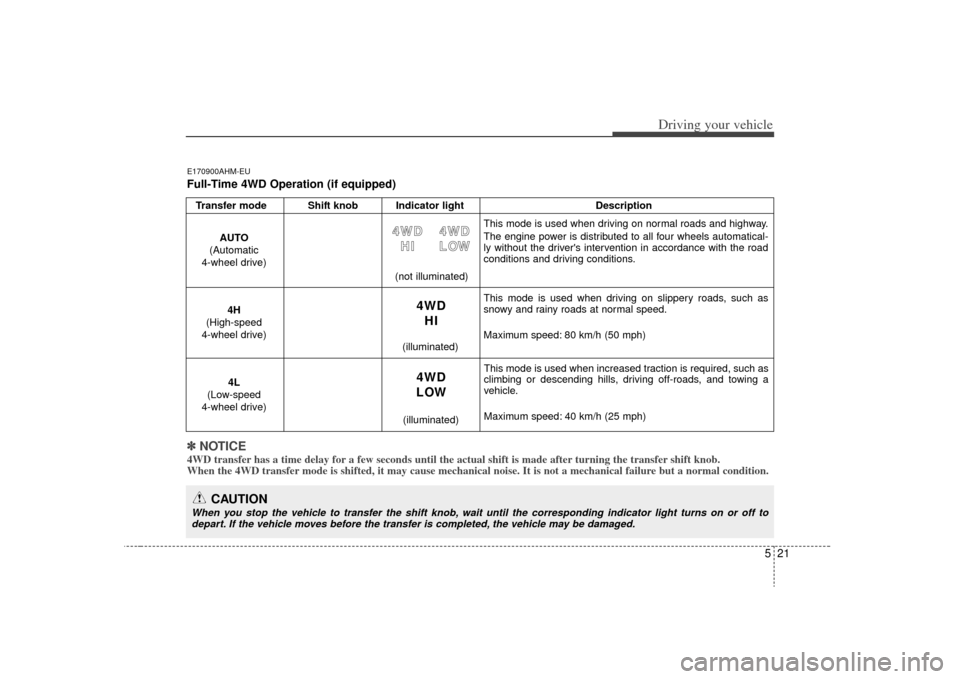
This mode is used when driving on normal roads and highway.
The engine power is distributed to all four wheels automatical-
ly without the driver's intervention in accordance with the road
conditions and driving conditions.
This mode is used when driving on slippery roads, such as
snowy and rainy roads at normal speed.
Maximum speed: 80 km/h (50 mph)
This mode is used when increased traction is required, such as
climbing or descending hills, driving off-roads, and towing a
vehicle.
Maximum speed: 40 km/h (25 mph)
4 4 W
W D
D
H
H I
I
4WD HI
4WD
LOW 4
4
W
W D
D
L
L O
O W
W
AUTO
(Automatic
4-wheel drive)
4H
(High-speed
4-wheel drive)
4L
(Low-speed
4-wheel drive) (not illuminated)
✽
✽
NOTICE4WD transfer has a time delay for a few seconds until the actual shift is made after turning the transfer shift knob.
When the 4WD transfer mode is shifted, it may cause mechanical noise. It is not a mechanical f\
ailure but a normal condition.E170900AHM-EUFull-Time 4WD Operation (if equipped)
CAUTION
When you stop the vehicle to transfer the shift knob, wait until the corresponding indicator light turns on or off to
depart. If the vehicle moves before the transfer is completed, the vehicle may be damaged.
(illuminated)
(illuminated)
Page 284 of 425

Driving your vehicle22
5E170902AHM-EUFull-time 4WD knob operationAUTO ↔
↔
4H
Turn the transfer knob from the AUTO
mode to 4H mode or 4H mode to AUTO
mode at the speed below 80 km/h (50
mph). It is not necessary to put the shift
lever into the N (Neutral) position.
Perform this operation when driving
straight. There will be a few seconds of
time delay before shifting into the desired
mode.
If the weather is extremely cold (-15°C/
5°F) and the engine is not heated, trans-
fer from AUTO mode to 4H mode when
the vehicle is stopped or at low speed. 4H
↔ ↔
4L
1. Stop the vehicle.
2. Put the shift lever into the N (Neutral) position.
3. Turn the transfer knob to the 4H or 4L position.
4. Before shifting to other ranges from the N (Neutral) position, wait for the
corresponding indicator light to turn on
or off in the cluster.
✽ ✽NOTICEIf the mode is not shifted like the previ-
ous instructions, it will not transfer into
the selected mode and the correspon-
ding indicator light will continuously
blink.
OHM058012N
OHM058013
CAUTION -
Mud or snow
Always check the 4WD shift knob
and cluster to see if the systemhas been activated unintentional-ly.
Do not speed over 80 km/h (50 mph) in the 4H mode and 40 km/h(25 mph) in the 4L mode.
Page 286 of 425
Driving your vehicle24
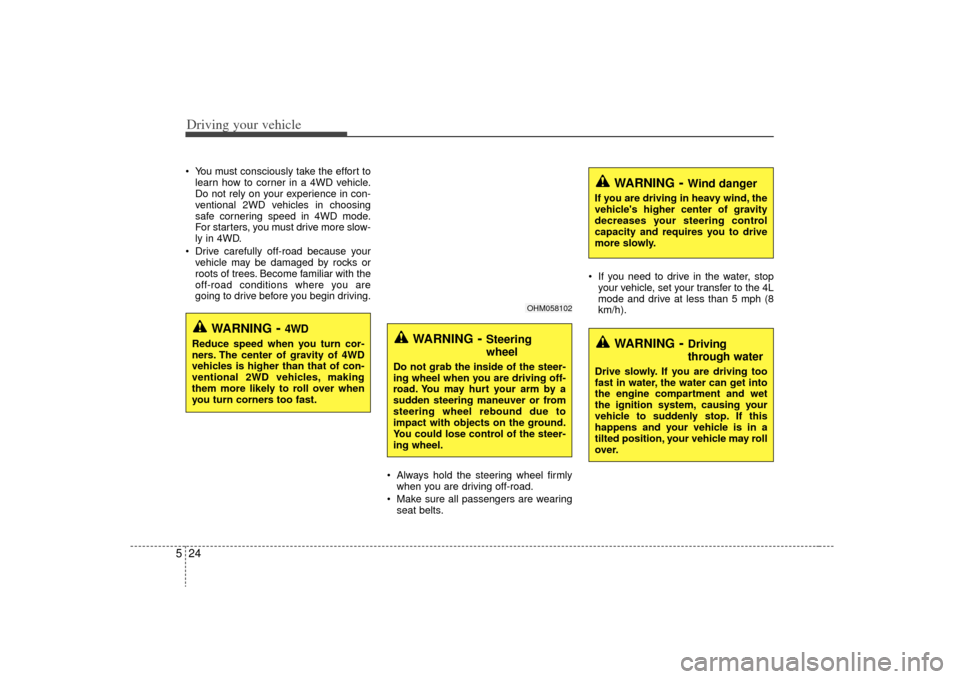
5 You must consciously take the effort to
learn how to corner in a 4WD vehicle.
Do not rely on your experience in con-
ventional 2WD vehicles in choosing
safe cornering speed in 4WD mode.
For starters, you must drive more slow-
ly in 4WD.
Drive carefully off-road because your vehicle may be damaged by rocks or
roots of trees. Become familiar with the
off-road conditions where you are
going to drive before you begin driving.
Always hold the steering wheel firmlywhen you are driving off-road.
Make sure all passengers are wearing seat belts. If you need to drive in the water, stop
your vehicle, set your transfer to the 4L
mode and drive at less than 5 mph (8
km/h).
WARNING
- Steering
wheel
Do not grab the inside of the steer-
ing wheel when you are driving off-
road. You may hurt your arm by a
sudden steering maneuver or from
steering wheel rebound due to
impact with objects on the ground.
You could lose control of the steer-
ing wheel.
WARNING
- Wind danger
If you are driving in heavy wind, the
vehicle's higher center of gravity
decreases your steering control
capacity and requires you to drive
more slowly.
WARNING
- Driving
through water
Drive slowly. If you are driving too
fast in water, the water can get into
the engine compartment and wet
the ignition system, causing your
vehicle to suddenly stop. If this
happens and your vehicle is in a
tilted position, your vehicle may roll
over.
OHM058102
WARNING
- 4WD
Reduce speed when you turn cor-
ners. The center of gravity of 4WD
vehicles is higher than that of con-
ventional 2WD vehicles, making
them more likely to roll over when
you turn corners too fast.
Page 287 of 425
525
Driving your vehicle
✽
✽NOTICE• Do not drive in water if the level is
higher than the bottom of the vehicle.
• Check your brake condition once you are out of mud or water. Press the
brake pedal several times as you move
slowly until you feel normal braking
forces return.
• Shorten your scheduled maintenance interval if you drive in off-road condi-
tions such as sand, mud or water.
Always wash your vehicle thoroughly
after off road use, especially cleaning
the bottom of the vehicle.
• Since the driving torque is always applied to the 4 wheels the perform-
ance of the 4WD vehicle is greatly
affected by the condition of the tires.
Be sure to equip the vehicle with four
tires of the same size and type.
• A full time four wheel drive vehicle cannot be towed by an ordinary tow
truck. Make sure that the vehicle is
placed on a flat bed truck for moving.
E170800AHMReducing the risk of a rolloverThis multi-purpose passenger vehicle is
defined as a Sports Utility Vehicle (SUV).
SUV’s have higher ground clearance and
a narrower track to make them capable
of performing in a wide variety of off-road
applications. Specific design characteris-
tics give them a higher center of gravity
than ordinary vehicles. An advantage of
the higher ground clearance is a better
view of the road, which allows you to
anticipate problems. They are not
designed for cornering at the same
speeds as conventional passenger vehi-
cles, any more than low-slung sports
vehicles are designed to perform satis-
factorily in off-road conditions. Due to this
risk, driver and passengers are strongly
recommended to buckle their seat belts.
In a rollover crash, an unbelted person is
more likely to die than a person wearing
a seat belt. There are steps that a driver
can make to reduce the risk of a rollover.
If at all possible, avoid sharp turns or
abrupt maneuvers, do not load your roof
rack with heavy cargo, and never modify
your vehicle in any way.
CAUTION -
Mud or snow
If one of the front or rear wheels
begins to spin in mud, snow, etc. the vehicle can sometimes be driv-en out by depressing the accelera- tor pedal further; however avoidrunning the engine continuously athigh rpm because doing so could damage the 4WD system.
Page 288 of 425
Driving your vehicle26
5
E170600AHM E170700AHM
Full-time 4WD vehicles must be tested
on a special four wheel chassis
dynamometer.
Part-time 4WD vehicles must be tested
on a 2WD roll tester with the transfer
shift knob in the 2H position.✽ ✽ NOTICENever engage the parking brake while
performing these tests. A full-time 4WD vehicle should not be
tested on a 2WD roll tester. If a 2WD
roll tester must be used, perform the
following:
WARNING -
Jacked vehicle
While the full-time 4WD vehicle is
being raised on a jack, never start
the engine or cause the tires to
rotate.
There is the danger that rotating
tires touching the ground could
cause the vehicle to go off the jack
and to jump forward.
WARNING
Your vehicle is equipped with tires
designed to provide safe ride and
handling capability. Do not use a
size and type of tire and wheel that
is different from the one that is
originally installed on your vehicle.
It can affect the safety and perform-
ance of your vehicle, which could
lead to steering failure or rollover
and serious injury. When replacing
the tires, be sure to equip all four
tires with the tire and wheel of the
same size, type, tread, brand and
load-carrying capacity. If you never-
theless decide to equip your vehi-
cle with any tire/wheel combination
not recommended by KIA for off
road driving, you should not use
these tires for highway driving.
WARNING -
Rollover
As with other Sports Utility Vehicle
(SUV), failure to operate this vehi-
cle correctly may result in loss of
control, an accident or vehicle
rollover.
Utility vehicles have a significant-ly higher rollover rate than other
types of vehicles.
Specific design characteristics (higher ground clearance, nar-
rower track, etc.) give this vehicle
a higher center of gravity than
ordinary vehicles.
A SUV is not designed for corner- ing at the same speeds as con-
ventional vehicles.
Avoid sharp turns or abrupt maneuvers.
In a rollover crash, an unbelted person is significantly more like-
ly to die than a person wearing a
seat belt. Make sure everyone in
the vehicle is properly buckled
up.