automatic transmission KIA Borrego 2010 1.G User Guide
[x] Cancel search | Manufacturer: KIA, Model Year: 2010, Model line: Borrego, Model: KIA Borrego 2010 1.GPages: 461, PDF Size: 12.25 MB
Page 340 of 461
Driving your vehicle42
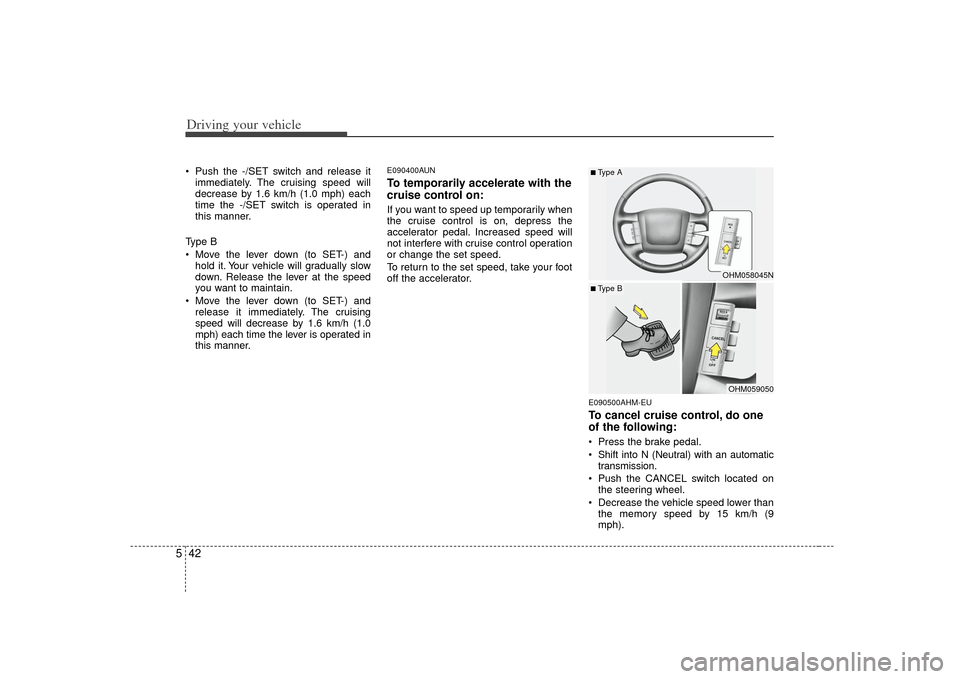
5 Push the -/SET switch and release it
immediately. The cruising speed will
decrease by 1.6 km/h (1.0 mph) each
time the -/SET switch is operated in
this manner.
Type B
Move the lever down (to SET-) and hold it. Your vehicle will gradually slow
down. Release the lever at the speed
you want to maintain.
Move the lever down (to SET-) and release it immediately. The cruising
speed will decrease by 1.6 km/h (1.0
mph) each time the lever is operated in
this manner.
E090400AUNTo temporarily accelerate with the
cruise control on:If you want to speed up temporarily when
the cruise control is on, depress the
accelerator pedal. Increased speed will
not interfere with cruise control operation
or change the set speed.
To return to the set speed, take your foot
off the accelerator.
E090500AHM-EUTo cancel cruise control, do one
of the following: Press the brake pedal.
Shift into N (Neutral) with an automatic transmission.
Push the CANCEL switch located on the steering wheel.
Decrease the vehicle speed lower than the memory speed by 15 km/h (9
mph).
OHM058045NOHM059050
■Type A■ Type B
Page 345 of 461
547
Driving your vehicle
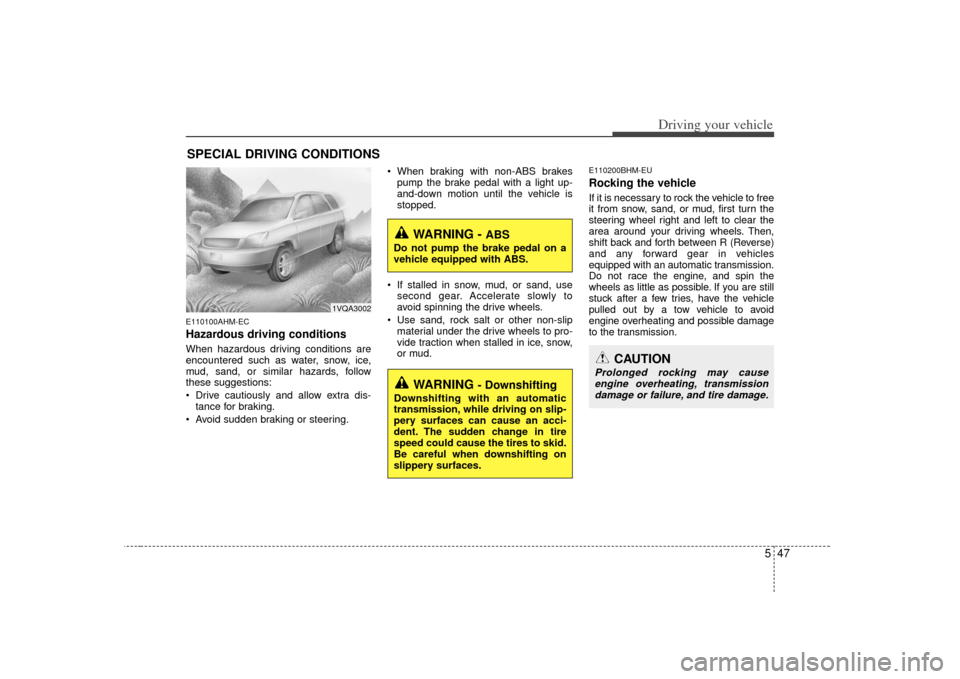
E110100AHM-ECHazardous driving conditions When hazardous driving conditions are
encountered such as water, snow, ice,
mud, sand, or similar hazards, follow
these suggestions:
Drive cautiously and allow extra dis-tance for braking.
Avoid sudden braking or steering. When braking with non-ABS brakes
pump the brake pedal with a light up-
and-down motion until the vehicle is
stopped.
If stalled in snow, mud, or sand, use second gear. Accelerate slowly to
avoid spinning the drive wheels.
Use sand, rock salt or other non-slip material under the drive wheels to pro-
vide traction when stalled in ice, snow,
or mud.
E110200BHM-EURocking the vehicle If it is necessary to rock the vehicle to free
it from snow, sand, or mud, first turn the
steering wheel right and left to clear the
area around your driving wheels. Then,
shift back and forth between R (Reverse)
and any forward gear in vehicles
equipped with an automatic transmission.
Do not race the engine, and spin the
wheels as little as possible. If you are still
stuck after a few tries, have the vehicle
pulled out by a tow vehicle to avoid
engine overheating and possible damage
to the transmission.
SPECIAL DRIVING CONDITIONS
1VQA3002
WARNING -
ABS
Do not pump the brake pedal on a
vehicle equipped with ABS.
WARNING
- Downshifting
Downshifting with an automatic
transmission, while driving on slip-
pery surfaces can cause an acci-
dent. The sudden change in tire
speed could cause the tires to skid.
Be careful when downshifting on
slippery surfaces.
CAUTION
Prolonged rocking may causeengine overheating, transmission damage or failure, and tire damage.
Page 355 of 461
557
Driving your vehicle
E140405AHM-EUTurn signals when towing a trailer When you tow a trailer, your vehicle has
to have a different turn signal flasher and
extra wiring. The green arrows on your
instrument panel will flash whenever you
signal a turn or lane change. Properly
connected, the trailer lights will also flash
to alert other drivers you’re about to turn,
change lanes, or stop.
When towing a trailer, the green arrows
on your instrument panel will flash for
turns even if the bulbs on the trailer are
burned out. Thus, you may think drivers
behind you are seeing your signals
when, in fact, they are not. It’s important
to check occasionally to be sure the trail-
er bulbs are still working. You must also
check the lights every time you discon-
nect and then reconnect the wires.Do not connect a trailer lighting system
directly to your vehicle’s lighting system.
Use only an approved trailer wiring har-
ness.
An authorized KIA dealer can assist you
in installing the wiring harness.
E140406AHMDriving on grades Reduce speed and shift to a lower gear
before you start down a long or steep
downgrade. If you don’t shift down, you
might have to use your brakes so much
that they would get hot and no longer
operate efficiently.
On a long uphill grade, shift down and
reduce your speed to around 70 km/h (45
mph) to reduce the possibility of engine
and transmission overheating.
If your trailer weighs more than the max-
imum trailer weight without trailer brakes
and you have an automatic transmission,
you should drive in D (Drive) when tow-
ing a trailer.
Operating your vehicle in D (Drive) when
towing a trailer will minimize heat build up
and extend the life of your transmission.
CAUTION -
Electrical cur-
rent limit of the light
Current of the trailer's light load
- Left turn & stop light: max. 5 A- Right turn & stop light: max.5 A- Back up light: max.15 A - Tail light: max. 15 AIf the current limit is exceeded, thetrailer light may not work properly.
WARNING
Failure to use an approved trailer
wiring harness could result in dam-
age to the vehicle electrical system
and/or personal injury.
Page 356 of 461
Driving your vehicle58
5
E140407AHMParking on hills Generally, if you have a trailer attached to
your vehicle, you should not park your
vehicle on a hill. People can be seriously
or fatally injured, and both your vehicle
and the trailer can be damaged if unex-
pectedly roll down the hill.
However, if you ever have to park your
trailer on a hill, here's how to do it:
1. Pull the vehicle into the parking space.
Turn the steering wheel in the direction
of the curb (right if headed down hill,
left if headed up hill).
2. Shift the vehicle to P (Park) for an automatic transmission.
3. Set the parking brake and shut off the vehicle.
4. Place chocks under the trailer wheels on the down hill side of the wheels. 5. Start the vehicle, hold the brakes, shift
to neutral, release the parking brake
and slowly release the brakes until the
trailer chocks absorb the load.
6. Reapply the brakes, reapply the park- ing brake and shift the vehicle to P
(Park) for automatic transmission.
7. Shut off the vehicle and release the vehicle brakes but leave the parking
brake set.
CAUTION
When towing a trailer on steep grades (in excess of 6%) payclose attention to the engine coolant temperature gauge toensure the engine does not over-heat. If the needle of the coolanttemperature gauge moves across the dial towards “H” (HOT), pullover and stop as soon as it is safeto do so, and allow the engine toidle until it cools down. You may proceed once the engine hascooled sufficiently.
You must decide the driving speed depending on trailerweight and uphill grade to reducethe possibility of engine andtransmission overheating.
WARNING
- Parking on a hill
Parking your vehicle on a hill with a
trailer attached could cause seri-
ous injury or death, should the trail-
er break loose.
WARNING
- Parking brake
It can be dangerous to get out of
your vehicle if the parking brake is
not firmly set.
If you have left the engine running,
the vehicle can move suddenly. You
or others could be seriously or
fatally injured.
Page 357 of 461
559
Driving your vehicle
When you are ready to leave after park-
ing on a hill
1. With the automatic transmission in P(Park), apply your brakes and hold the
brake pedal down while you:
and
2. Slowly remove your foot from the brake pedal.
3. Drive slowly until the trailer is clear of the chocks.
4. Stop and have someone pick up and store the chocks.
E140500AHMMaintenance when trailer towing Your vehicle will need service more often
when you regularly pull a trailer.
Important items to pay particular atten-
tion to include engine oil, automatic
transmission fluid, axle lubricant and
cooling system fluid. Brake condition is
another important item to frequently
check. Each item is covered in this man-
ual, and the index will help you find them
quickly. If you’re trailering, it’s a good idea
to review these sections before you start
your trip.
Don’t forget to also maintain your trailer
and hitch. Follow the maintenance
schedule that accompanied your trailer
and check it periodically. Preferably, con-
duct the check at the start of each day’s
driving. Most importantly, all hitch nuts
and bolts should be tight.
CAUTION
Due to higher load during trailer usage, overheating might occurin hot days or during uphill driv-ing. If the coolant gauge indicates over-heating, switch off the A/Cand stop the vehicle in a safe area to cool down the engine.
When towing check transmission fluid more frequently.
If your vehicle is not equipped with the air conditioner, youshould install a condenser fan toimprove engine performance when towing a trailer.
Page 389 of 461
623
What to do in an emergency
F080301AHM-EUEmergency towing precautions Turn the ignition switch to ACC so thesteering wheel isn’t locked.
Place the transmission shift lever in N (Neutral).
Release the parking bake.
Press the brake pedal with more force than usual since you will have reduced
brake performance.
More steering effort will be required because the power steering system
will be disabled.
If you are driving down a long hill, the brakes may overheat and brake per-
formance will be reduced. Stop often
and let the brakes cool off.
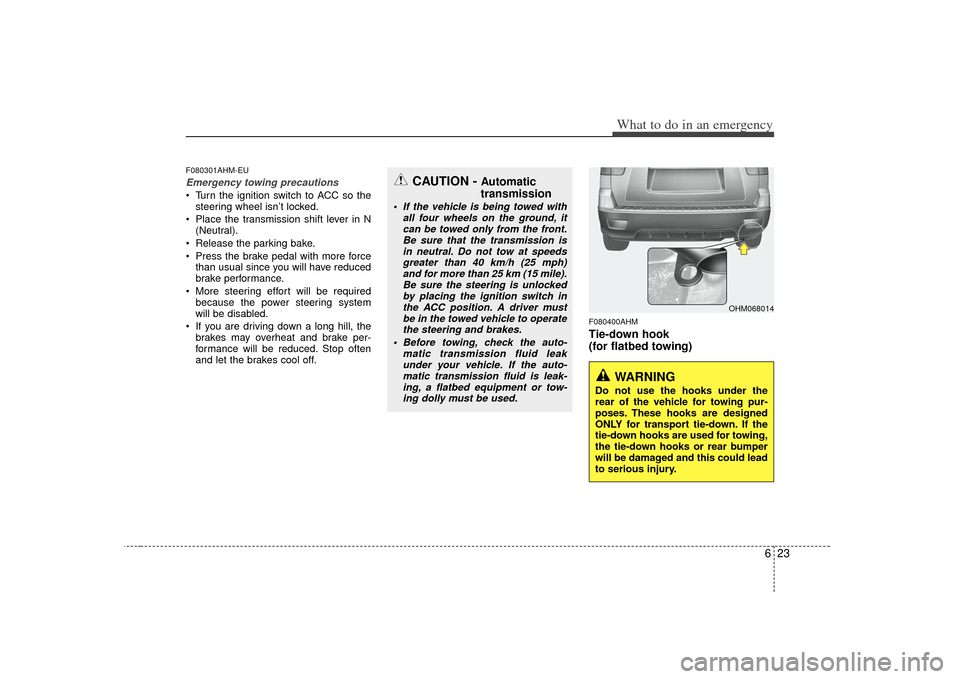
F080400AHMTie-down hook
(for flatbed towing)
OHM068014
CAUTION -
Automatic
transmission
If the vehicle is being towed with
all four wheels on the ground, itcan be towed only from the front. Be sure that the transmission isin neutral. Do not tow at speeds greater than 40 km/h (25 mph)and for more than 25 km (15 mile). Be sure the steering is unlockedby placing the ignition switch in the ACC position. A driver mustbe in the towed vehicle to operate the steering and brakes.
Before towing, check the auto- matic transmission fluid leakunder your vehicle. If the auto- matic transmission fluid is leak-ing, a flatbed equipment or tow- ing dolly must be used.
WARNING
Do not use the hooks under the
rear of the vehicle for towing pur-
poses. These hooks are designed
ONLY for transport tie-down. If the
tie-down hooks are used for towing,
the tie-down hooks or rear bumper
will be damaged and this could lead
to serious injury.
Page 395 of 461
Maintenance67G030102AHMWhile operating your vehicle: Note any changes in the sound of theexhaust or any smell of exhaust fumes
in the vehicle.
Check for vibrations in the steering wheel. Notice any increased steering
effort or looseness in the steering
wheel, or change in its straight-ahead
position.
Notice if your vehicle constantly turns slightly or “pulls” to one side when trav-
eling on smooth, level road.
When stopping, listen and check for unusual sounds, pulling to one side,
increased brake pedal travel or “hard-
to-push” brake pedal.
If any slipping or changes in the oper- ation of your transmission occurs,
check the transmission fluid level.
Check the automatic transmission P (Park) function.
Check the parking brake.
Check for fluid leaks under your vehicle (water dripping from the air condition-
ing system during or after use is nor-
mal).
G030103AHMAt least monthly: Check the coolant level in the enginecoolant reservoir.
Check the operation of all exterior lights, including the stoplights, turn sig-
nals and hazard warning flashers.
Check the inflation pressures of all tires including the spare.G030104AHMAt least twice a year (i.e., every Spring and Fall): Check the radiator, heater and air con- ditioning hoses for leaks or damage.
Check the windshield washer spray and wiper operation. Clean the wiper
blades with clean cloth dampened with
washer fluid.
Check the headlight alignment.
Check the muffler, exhaust pipes, shields and clamps.
Check the lap/shoulder belts for wear and function.
Check for worn tires and loose wheel lug nuts.
G030105AHMAt least once a year: Clean the body and door drain holes.
Lubricate the door hinges and checks,and hood hinges.
Lubricate the door and hood locks and latches.
Lubricate the door rubber weather- strips.
Check the air conditioning system.
Check the power steering fluid level.
Inspect and lubricate the automatic transmission linkage and controls.
Clean the battery and terminals.
Check the brake fluid level.
Page 398 of 461
79
Maintenance
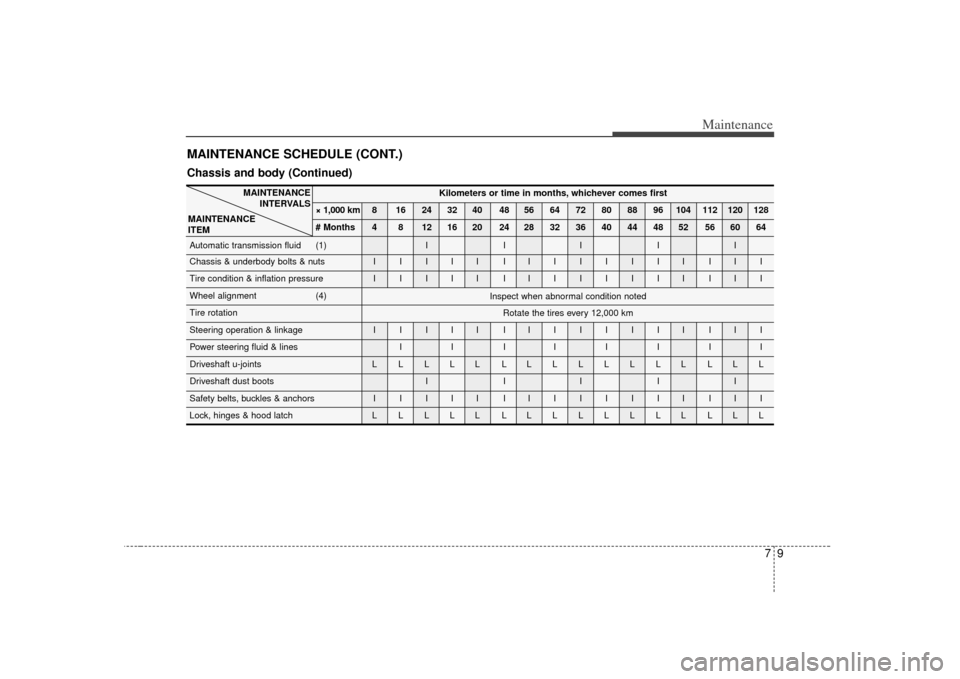
MAINTENANCE SCHEDULE (CONT.)
Kilometers or time in months, whichever comes first
× 1,000 km 8 16 24 32 40 48 56 64 72 80 88 96 104 112 120 128
# Months 4 8 12 16 20 24 28 32 36 40 44 48 52 56 60 64
Automatic transmission fluid (1) I I I I I
Chassis & underbody bolts & nuts I I I I I I IIIIIII III
Tire condition & inflation pressure I I I I I I IIIIIII III
Wheel alignment (4)
Tire rotation
Steering operation & linkage I I I I I I IIIIIII III
Power steering fluid & lines I I I IIIII
Driveshaft u-joints L L L L L L LLLLLLL LLL
Driveshaft dust boots I I I I I
Safety belts, buckles & anchors I I I I I I IIIIIII III
Lock, hinges & hood latch L L L L L L LLLLLLL LLL
MAINTENANCE
INTERVALS
MAINTENANCE
ITEM
Inspect when abnormal condition noted
Rotate the tires every 12,000 km
Chassis and body (Continued)
Page 454 of 461
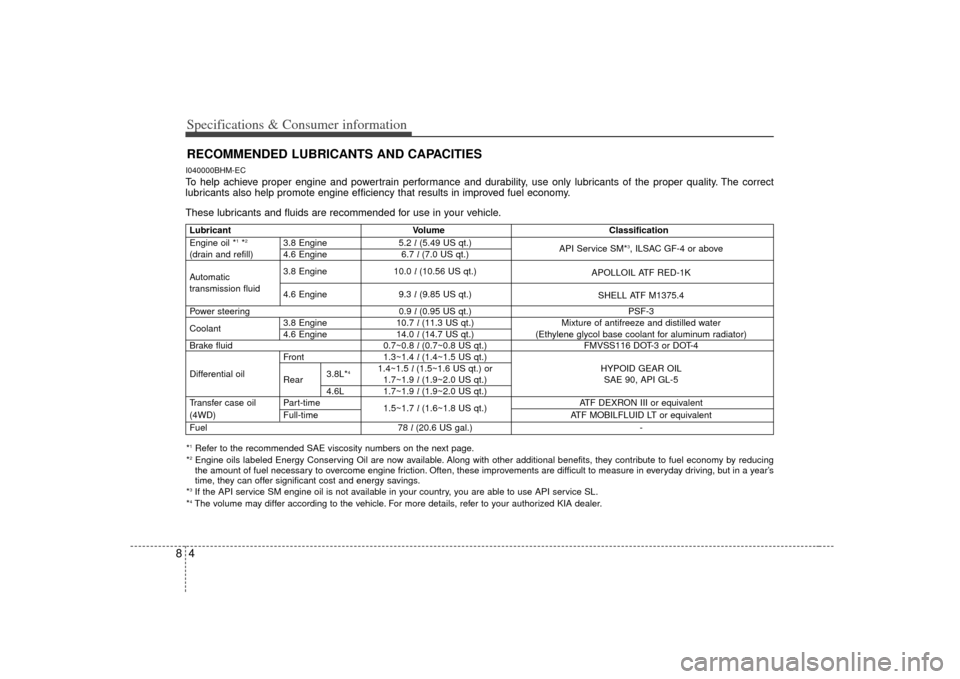
Specifications & Consumer information48RECOMMENDED LUBRICANTS AND CAPACITIESI040000BHM-ECTo help achieve proper engine and powertrain performance and durability, use only lubricants of the proper quality. The correct
lubricants also help promote engine efficiency that results in improved fuel economy.
These lubricants and fluids are recommended for use in your vehicle.*1Refer to the recommended SAE viscosity numbers on the next page.
*2Engine oils labeled Energy Conserving Oil are now available. Along with other additional benefits, they contribute to fuel econo my by reducing
the amount of fuel necessary to overcome engine friction. Often, these improvements are difficult to measure in everyday driving, but in a year’s
time, they can offer significant cost and energy savings.
*3If the API service SM engine oil is not available in your country, you are able to use API service SL.
*4The volume may differ according to the vehicle. For more details, refer to your authorized KIA dealer.Lubricant Volume Classification
Engine oil *
1*2
3.8 Engine 5.2 l(5.49 US qt.)
API Service SM*
3, ILSAC GF-4 or above
(drain and refill) 4.6 Engine 6.7 l (7.0 US qt.)
3.8 Engine 10.0 l (10.56 US qt.)
APOLLOIL ATF RED-1K
Automatic
transmission fluid
4.6 Engine 9.3 l (9.85 US qt.)
SHELL ATF M1375.4
Power steering 0.9 l (0.95 US qt.) PSF-3
Coolant 3.8 Engine 10.7 l
(11.3 US qt.) Mixture of antifreeze and distilled water
4.6 Engine 14.0 l (14.7 US qt.) (Ethylene glycol base coolant for aluminum radiator)
Brake fluid 0.7~0.8 l (0.7~0.8 US qt.) FMVSS116 DOT-3 or DOT-4
Differential oil Front
1.3~1.4 l (1.4~1.5 US qt.)
3.8L*
4
1.4~1.5 l (1.5~1.6 US qt.) or HYPOID GEAR OIL
Rear 1.7~1.9 l (1.9~2.0 US qt.) SAE 90, API GL-5
4.6L 1.7~1.9 l (1.9~2.0 US qt.)
Transfer case oil Part-time 1.5~1.7 l (1.6~1.8 US qt.) ATF DEXRON III or equivalent
(4WD) Full-time ATF MOBILFLUID LT or equivalent
Fuel 78 l (20.6 US gal.) -
Page 459 of 461

Index2I
Air bag - advanced supplemental restraint system ········3-40
Air cleaner ··················\
··················\
··················\
···············7-21
Appearance care··················\
··················\
··················\
·······7-53
Audio system ··················\
··················\
··················\
·········4-124
Automatic climate control system ··················\
···············4-98
Automatic transmission ··················\
··················\
·············5-12
Battery··················\
··················\
··················\
··················\
····7-25
Before driving ··················\
··················\
··················\
············5-3
Brake fluid ··················\
··················\
··················\
···············7-18
Brake system··················\
··················\
··················\
············5-27
Bulb wattage ··················\
··················\
··················\
··············8-2
Child restraint system ··················\
··················\
················3-32
Climate control air filter ··················\
··················\
············7-21
Cruise control system ··················\
··················\
················5-39
Defroster ··················\
··················\
··················\
··················\
4-83
Dimensions ··················\
··················\
··················\
················8-2
Door locks··················\
··················\
··················\
················4-15
Driver position memory system ··················\
··················\
4-34Economical operation ··················\
··················\
················5-45
Emergency starting ··················\
··················\
··················\
····6-4
Emission control system ··················\
··················\
············7-67
Engine compartment ··················\
··················\
············2-4, 7-2
Engine coolant ··················\
··················\
··················\
·········7-15
Engine number ··················\
··················\
··················\
···········8-7
Engine oil ··················\
··················\
··················\
·················7-14\
ENGINE START/STOP button ··················\
··················\
···5-6
Explanation of scheduled maintenance items················7-11
Exterior feature ··················\
··················\
··················\
······4-122
Four wheel drive (4WD) ··················\
··················\
···········5-18
Fuel filler lid ··················\
··················\
··················\
············4-27
Fuel requirements ··················\
··················\
··················\
······1-3
Fuses ··················\
··················\
··················\
··················\
······7-42
Hazard warning flasher··················\
··················\
··············4-71
Hood··················\
··················\
··················\
··················\
·······4-25
How to use this manual ··················\
··················\
···············1-2
If the engine overheats··················\
··················\
·················6-6A
EFHI
BCD