4WD KIA Borrego 2011 1.G User Guide
[x] Cancel search | Manufacturer: KIA, Model Year: 2011, Model line: Borrego, Model: KIA Borrego 2011 1.GPages: 464, PDF Size: 12.57 MB
Page 326 of 464
525
Driving your vehicle
✽
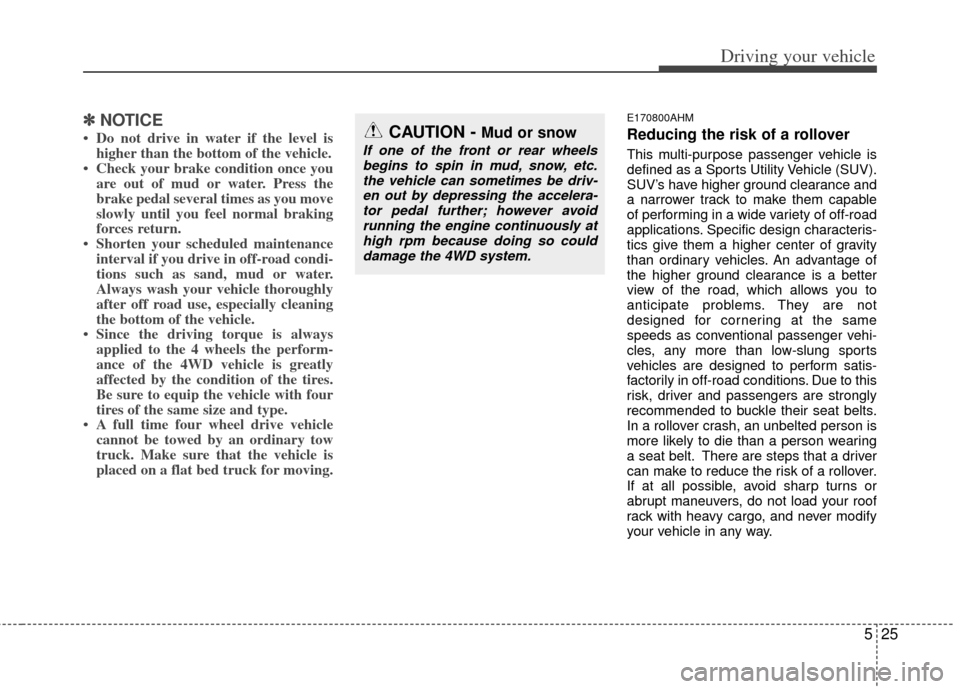
✽NOTICE
• Do not drive in water if the level is
higher than the bottom of the vehicle.
• Check your brake condition once you are out of mud or water. Press the
brake pedal several times as you move
slowly until you feel normal braking
forces return.
• Shorten your scheduled maintenance interval if you drive in off-road condi-
tions such as sand, mud or water.
Always wash your vehicle thoroughly
after off road use, especially cleaning
the bottom of the vehicle.
• Since the driving torque is always applied to the 4 wheels the perform-
ance of the 4WD vehicle is greatly
affected by the condition of the tires.
Be sure to equip the vehicle with four
tires of the same size and type.
• A full time four wheel drive vehicle cannot be towed by an ordinary tow
truck. Make sure that the vehicle is
placed on a flat bed truck for moving.
E170800AHM
Reducing the risk of a rollover
This multi-purpose passenger vehicle is
defined as a Sports Utility Vehicle (SUV).
SUV’s have higher ground clearance and
a narrower track to make them capable
of performing in a wide variety of off-road
applications. Specific design characteris-
tics give them a higher center of gravity
than ordinary vehicles. An advantage of
the higher ground clearance is a better
view of the road, which allows you to
anticipate problems. They are not
designed for cornering at the same
speeds as conventional passenger vehi-
cles, any more than low-slung sports
vehicles are designed to perform satis-
factorily in off-road conditions. Due to this
risk, driver and passengers are strongly
recommended to buckle their seat belts.
In a rollover crash, an unbelted person is
more likely to die than a person wearing
a seat belt. There are steps that a driver
can make to reduce the risk of a rollover.
If at all possible, avoid sharp turns or
abrupt maneuvers, do not load your roof
rack with heavy cargo, and never modify
your vehicle in any way.
CAUTION - Mud or snow
If one of the front or rear wheels
begins to spin in mud, snow, etc.the vehicle can sometimes be driv-en out by depressing the accelera-tor pedal further; however avoid running the engine continuously athigh rpm because doing so coulddamage the 4WD system.
Page 327 of 464
Driving your vehicle
26
5
E170600AHM E170700AHM
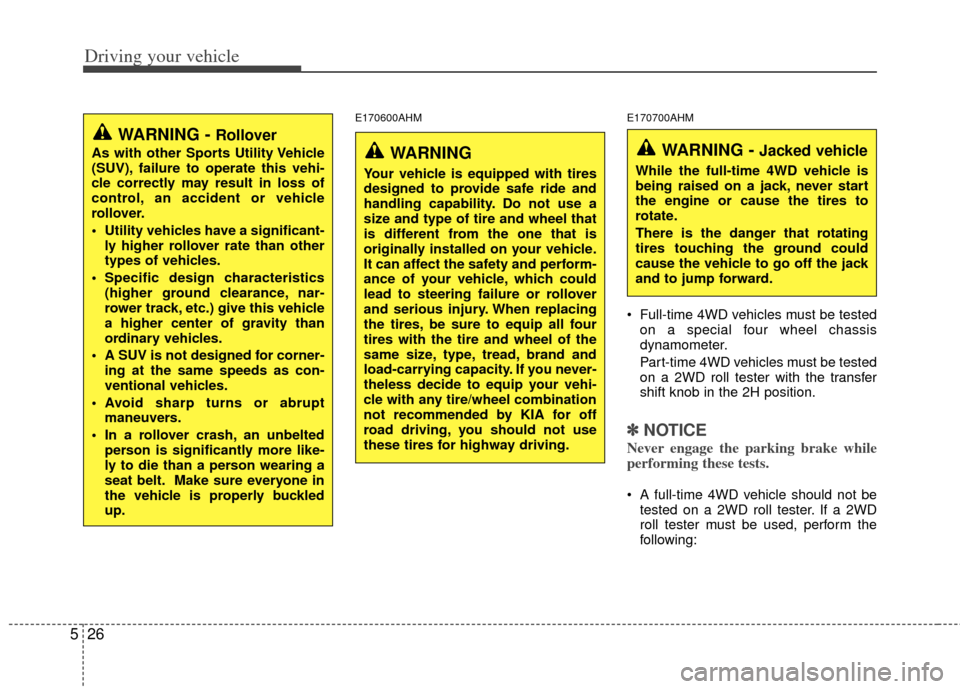
Full-time 4WD vehicles must be tested
on a special four wheel chassis
dynamometer.
Part-time 4WD vehicles must be tested
on a 2WD roll tester with the transfer
shift knob in the 2H position.
✽ ✽ NOTICE
Never engage the parking brake while
performing these tests.
A full-time 4WD vehicle should not be
tested on a 2WD roll tester. If a 2WD
roll tester must be used, perform the
following:
WARNING - Jacked vehicle
While the full-time 4WD vehicle is
being raised on a jack, never start
the engine or cause the tires to
rotate.
There is the danger that rotating
tires touching the ground could
cause the vehicle to go off the jack
and to jump forward.
WARNING
Your vehicle is equipped with tires
designed to provide safe ride and
handling capability. Do not use a
size and type of tire and wheel that
is different from the one that is
originally installed on your vehicle.
It can affect the safety and perform-
ance of your vehicle, which could
lead to steering failure or rollover
and serious injury. When replacing
the tires, be sure to equip all four
tires with the tire and wheel of the
same size, type, tread, brand and
load-carrying capacity. If you never-
theless decide to equip your vehi-
cle with any tire/wheel combination
not recommended by KIA for off
road driving, you should not use
these tires for highway driving.
WARNING - Rollover
As with other Sports Utility Vehicle
(SUV), failure to operate this vehi-
cle correctly may result in loss of
control, an accident or vehicle
rollover.
Utility vehicles have a significant-ly higher rollover rate than other
types of vehicles.
Specific design characteristics (higher ground clearance, nar-
rower track, etc.) give this vehicle
a higher center of gravity than
ordinary vehicles.
A SUV is not designed for corner- ing at the same speeds as con-
ventional vehicles.
Avoid sharp turns or abrupt maneuvers.
In a rollover crash, an unbelted person is significantly more like-
ly to die than a person wearing a
seat belt. Make sure everyone in
the vehicle is properly buckled
up.
Page 389 of 464

What to do in an emergency
20
6
TOWING
F080100AHM-EU
Towing service
If emergency towing is necessary, we
recommend having it done by an author-
ized KIA dealer or a commercial tow-
truck service. Proper lifting and towing
procedures are necessary to prevent
damage to the vehicle. The use of wheel
dollies or flatbed is recommended.
For trailer towing guidelines information,
refer to “Trailer towing” in section 5.
On full-time 4WD vehicles, your vehicle
must be towed with a wheel lift and dol-
lies or flatbed equipment with all the
wheels off the ground.
On 2WD or part-time 4WD (2H position)
vehicles, it is acceptable to tow the vehi-
cle with the front wheels on the ground
(without dollies) and the rear wheels off
the ground.
If any of the loaded wheels or suspen-
sion components are damaged or the
vehicle is being towed with the rear
wheels on the ground, use a towing dolly
under the rear wheels.
When being towed by a commercial tow
truck and wheel dollies are not used, the
rear of the vehicle should always be lift-
ed, not the front.
OHM068016 dolly
2WD or part-time 4WD (2H position) vehicles only
OHM068017
CAUTION
The full-time 4WD vehicle should
never be towed with the wheels onthe ground. This can cause serious damage to the transmission or the4WD system.
CAUTION
Do not tow with sling-type equip- ment. Use wheel lift or flatbedequipment.
Do not tow the vehicle forward with the rear wheels on theground as this may cause dam-age to the vehicle.
OHM068018
Page 390 of 464

621
What to do in an emergency
When towing your vehicle in an emer-
gency without wheel dollies :
1. Set the ignition switch in the ACC posi-tion.
2. Place the transmission shift lever in N (Neutral).
3. For part-time 4WD vehicle, set the transfer shift knob to 2H.
4. Release the parking brake.
F080300AHM-EU
Emergency towing
If towing is necessary, we recommend
you to have it done by an authorized
KIA dealer or a commercial tow truck
service. If towing service is not available in an
emergency, your vehicle may be tem-
porarily towed using a cable or chain
secured to the emergency towing hook
under the front of the vehicle. Use
extreme caution when towing the vehicle.
A driver must be in the vehicle to steer it
and operate the brakes.
Towing in this manner may be done only
on hard-surfaced roads for a short dis-
tance and at low speeds. Also, the
wheels, axles, power train, steering and
brakes must all be in good condition.
Do not use the tow hooks to pull a vehi-
cle out of mud, sand or other condi-
tions from which the vehicle cannot be
driven out under its own power.
Avoid towing a vehicle heavier than the vehicle doing the towing.
The drivers of both vehicles should communicate with each other frequent-
ly.
OHM068013NCAUTION
Failure to place the transmissionshift lever in N (Neutral) and thetransfer shift knob for part-time4WD operation to 2H may causeinternal damage to the transmis-sion.
Page 440 of 464

Maintenance
48
7
Description Fuse rating Protected component
START7.5A Burglar Alarm Relay, Start Relay
AIR BAG IND. 7.5A Instrument Cluster (Air Bag IND.)
ABS 7.5AABS Control Module, ESC Control Module, DBC Relay, Steering Angle Sensor, Crash Pad Switch LH,
Smart Key Control Module, Rear Parking Assist Control Module
Rheostat, Instrument Cluster (MICOM), Multifunction Switch (Cruise Remocon), Generator,
IGN 1 7.5A Rear Parking Assist Buzzer, Rear Parking Assist Switch, Audio, PODS Module,
Tire Pressure Monitoring Module
ENG 7.5AMultipurpose Check Connector, ECM, TCM, Front Wiper Motor, 4WD ECM, Stop Lamp Switch,
Free Running Differential Air Pump, Generator (G8BA)
AIR BAG 15A SRS Control Module, Telltale Lamp
DDM 30A Driver Door Module, Driver Safety Power Window Motor
ADM 30A Assistant Door Module, Passenger Safety Power Window Motor
Page 443 of 464

751
Maintenance
Description Fuse ratingProtected component
ABS 240A ABS Control Module
ABS 1 40A ABS Control Module
PDM 20A PDM
FRT WIPER 30A Front Wiper ON Relay, Front Wiper HI/LO Relay
KEY SW 2 30A Start Relay #1, Ignition Switch, PDM Relay Box (IG2 Relay)
RAM 1 50ARAM(CTR P/OUT FUSE 15A, RR P/OUT FUSE 15A, FUEL DR FUSE 15A, RR P/WIN-L\
H FUSE 20A,
RR P/WIN-RH FUSE 20A, LUGGAGE FUSE 7.5A)
RAM 2 50ARAM(RR DEFOG FUSE 25A, T/G POWER LATCH FUSIBLE LINK 30A, DOOR LOCK FUSE 15A,
RR WIPER FUSE 15A)
RAM 3 50A RAM (AMP FUSIBLE LIMK 30A TRAILER 2 FUSIBLE LINK 30A)
IPM 1 50AIPM (ILLUMI FUSE 7.5A, DDM FUSIBLE LINK 30A, FRT S/WARMER FUSE 20A, OBD-II FUSE 7.5A,
SUNROOF FUSE 25A, KEY LOCK FUSE 7.5A)
IPM 2 50A IPM (ADM FUSIBLE LINK 30A, F/PWR OUTLET FUSE 15A, PEDAL FUSE 15A, S/TILT & TELE FUSE 20A)
IPM 3 50AIPM (MEMORY FUSE 7.5A, DRIVER P/SEAT FUSE 30A, PASS P/SEAT FUSE 20A,
RR S/WARMER FUSE 20A, ROOM FUSE 7.5A, AUDIO FUSE 15A)
4WD 30A 4WD ECM
AC 110V 30A AC inverter module
Page 457 of 464

Specifications & Consumer information
48
RECOMMENDED LUBRICANTS AND CAPACITIES
I040000CHM-EC
To help achieve proper engine and powertrain performance and durability, use only lubricants of the proper quality. The correct
lubricants also help promote engine efficiency that results in improved fuel economy.
These lubricants and fluids are recommended for use in your vehicle.
*1Refer to the recommended SAE viscosity numbers on the next page.
*2Engine oils labeled Energy Conserving Oil are now available. Along with other additional benefits, they contribute to fuel econo my by reducing
the amount of fuel necessary to overcome engine friction. Often, these improvements are difficult to measure in everyday driving, but in a year’s
time, they can offer significant cost and energy savings.
*
3If the API service SM engine oil is not available in your country, you are able to use API service SL.
*4The volume may differ according to the vehicle. For more details, refer to your authorized KIA dealer.
Lubricant Volume Classification
Engine oil *1*23.8 Engine 5.2 l(5.49 US qt.)
API Service SM*3, ILSAC GF-4 or above
(drain and refill) 4.6 Engine 6.7 l (7.0 US qt.)
3.8 Engine 10.0 l (10.56 US qt.)
APOLLOIL ATF RED-1K or KIA Genuine RED-1
Automatic
transmission fluid
4.6 Engine 9.3 l (9.85 US qt.)
SHELL ATF M1375.4
Power steering 0.9 l (0.95 US qt.) PSF-3 or PSF-4
Coolant 3.8 Engine 10.7 l
(11.3 US qt.) Mixture of antifreeze and distilled water
4.6 Engine 14.0 l (14.7 US qt.) (Ethylene glycol base coolant for aluminum radiator)
Brake fluid 0.7~0.8 l (0.7~0.8 US qt.) FMVSS116 DOT-3 or DOT-4
Differential oil Front
1.3~1.4 l (1.4~1.5 US qt.)
3.8L*
41.4~1.5 l (1.5~1.6 US qt.) or HYPOID GEAR OIL
Rear 1.7~1.9 l (1.9~2.0 US qt.) SAE 90, API GL-5
4.6L 1.7~1.9 l (1.9~2.0 US qt.)
Transfer case oil Part-time 1.5~1.7 l (1.6~1.8 US qt.) ATF DEXRON III or equivalent
(4WD) Full-time ATF MOBILFLUID LT or equivalent
Fuel 78 l (20.6 US gal.) -
Page 462 of 464

Index
2I
Air bag - advanced supplemental restraint system ········3-40
Air cleaner ··················\
··················\
··················\
···············7-21
Appearance care··················\
··················\
··················\
·······7-53
Audio system ··················\
··················\
··················\
·········4-124
Automatic climate control system ··················\
···············4-98
Automatic transmission ··················\
··················\
·············5-12
Battery··················\
··················\
··················\
··················\
····7-25
Before driving ··················\
··················\
··················\
············5-3
Brake fluid ··················\
··················\
··················\
···············7-18
Brake system··················\
··················\
··················\
············5-27
Bulb wattage ··················\
··················\
··················\
··············8-2
Child restraint system ··················\
··················\
················3-32
Climate control air filter ··················\
··················\
············7-21
Cruise control system ··················\
··················\
················5-39
Defroster ··················\
··················\
··················\
··················\
4-83
Dimensions ··················\
··················\
··················\
················8-2
Door locks··················\
··················\
··················\
················4-15
Driver position memory system············\
··················\
·······4-34Economical operation ··················\
··················\
················5-45
Emergency starting ··················\
··················\
··················\
····6-4
Emission control system ··················\
··················\
············7-67
Engine compartment ··················\
··················\
············2-4, 7-2
Engine coolant ··················\
··················\
··················\
·········7-15
Engine number ··················\
··················\
··················\
···········8-7
Engine oil ··················\
··················\
··················\
·················7-14\
ENGINE START/STOP button ··················\
··················\
···5-6
Explanation of scheduled maintenance items ···············7-11
Exterior feature ··················\
··················\
··················\
······4-122
Four wheel drive (4WD)··················\
··················\
············5-18
Fuel filler lid ··················\
··················\
··················\
············4-27
Fuel requirements ··················\
··················\
··················\
······1-3
Fuses ··················\
··················\
··················\
··················\
······7-42
Hazard warning flasher ··················\
··················\
··············4-71
Hood··················\
··················\
··················\
··················\
·······4-25
How to use this manual ··················\
··················\
···············1-2
If the engine overheats··················\
··················\
·················6-6
AE
F
H
I
B
C
D