engine KIA BORREGO 2015 Owners Manual
[x] Cancel search | Manufacturer: KIA, Model Year: 2015, Model line: BORREGO, Model: KIA BORREGO 2015Pages: 420, PDF Size: 41.56 MB
Page 392 of 420

Maintenance
62
7
Exterior care
G230101AUN
Exterior general caution
It is very important to follow the label
directions when using any chemical
cleaner or polish. Read all warning andcaution statements that appear on thelabel. G230102CUN
Finish maintenance
Washing
To help protect your vehicle’s finish from
rust and deterioration, wash it thoroughlyand frequently at least once a month with
lukewarm or cold water.
If you use your vehicle for off-road driv-
ing, you should wash it after each off-
road trip. Pay special attention to the
removal of any accumulation of salt, dirt,
mud, and other foreign materials. Make
sure the drain holes in the lower edges of
the doors and rocker panels are keptclear and clean.
Insects, tar, tree sap, bird droppings,
industrial pollution and similar deposits
can damage your vehicle’s finish if not
removed immediately.
Even prompt washing with plain water
may not completely remove all these
deposits. A mild soap, safe for use on
painted surfaces, may be used. After washing, rinse the vehicle thor-
oughly with lukewarm or cold water. Do
not allow soap to dry on the finish.
APPEARANCE CARE
WARNING -
Wet brakes
After washing the vehicle, test the
brakes while driving slowly to see if
they have been affected by water. If
braking performance is impaired,
dry the brakes by applying them
lightly while maintaining a slow for-
ward speed.
OJB037800
CAUTION
Water washing in the engine com- partment including high pressurewater washing may cause the fail-
ure of electrical circuits located in the engine compartment.
Never allow water or other liquids to come in contact with electri-cal/electronic components inside
the vehicle as this may damage them.
CAUTION
Do not use strong soap, chemical detergents or hot water, and donot wash the vehicle in direct
sunlight or when the body of thevehicle is warm.
Be careful when washing the side windows of your vehicle.
Especially, with high-pressurewater, water may leak through thewindows and wet the interior.
To prevent damage to the plastic parts and lamps, do not clean
with chemical solvents or strongdetergents.
Page 399 of 420

769
Maintenance
G270201AUN
Canister
Fuel vapors generated inside the fuel tank are absorbed and stored in the
onboard canister. When the engine is
running, the fuel vapors absorbed in the
canister are drawn into the surge tank
through the purge control solenoid valve. G270202AHM
Purge Control Solenoid Valve (PCSV)
The purge control solenoid valve is con-
trolled by the Engine Control Module
(ECM); when the engine coolant temper-
ature is low during idling, the PCSV clos-
es so that evaporated fuel is not taken
into the engine. After the engine warms
up during ordinary driving, the PCSV
opens to introduce evaporated fuel to the
engine.G270300AUN
3. Exhaust emission control
system
The Exhaust Emission Control System is
a highly effective system which controls
exhaust emissions while maintaining
good vehicle performance.
G270301BUN
Vehicle modifications
This vehicle should not be modified.
Modification of your vehicle could affect
its performance, safety or durability and
may even violate governmental safety
and emissions regulations.
In addition, damage or performance
problems resulting from any modification
may not be covered under warranty.
If you use unauthorized electronic devices, it may cause the vehicle to
operate abnormally, wire damage, bat-
tery discharge and fire. For your safety,
do not use unauthorized electronic
devices. G270302AUN
Engine exhaust gas precautions
(carbon monoxide)
Carbon monoxide can be present with other exhaust fumes. Therefore, if you
smell exhaust fumes of any kind inside
your vehicle, have it inspected and
repaired immediately. If you ever sus-
pect exhaust fumes are coming into
your vehicle, drive it only with all the
windows fully open. Have your vehicle
checked and repaired immediately.
WARNING - Exhaust
Engine exhaust gases contain car-
bon monoxide (CO). Though color-
less and odorless, it is dangerousand could be lethal if inhaled.
Follow the instructions on this
page to avoid CO poisoning.
Page 400 of 420
Maintenance
70
7
Do not operate the engine in confined
or closed areas (such as garages) any
more than what is necessary to move
the vehicle in or out of the area.
When the vehicle is stopped in an open area for more than a short time
with the engine running, adjust the
ventilation system (as needed) to draw
outside air into the vehicle.
Never sit in a parked or stopped vehi- cle for any extended time with the
engine running.
When the engine stalls or fails to start, excessive attempts to restart the
engine may cause damage to theemission control system. G270303CENOperating precautions for catalytic
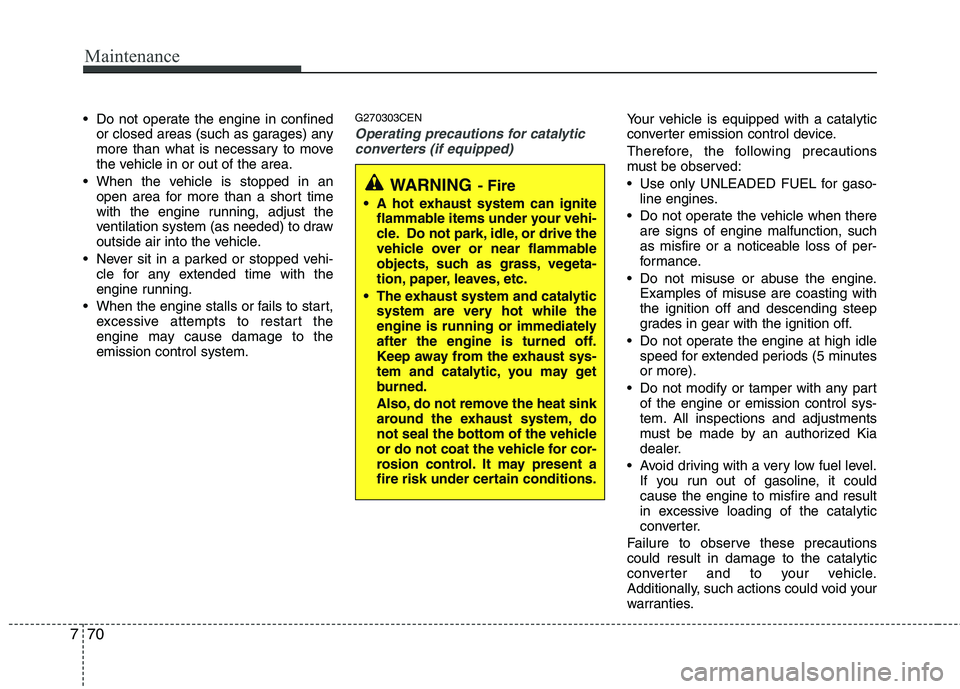
converters (if equipped)Your vehicle is equipped with a catalytic
converter emission control device.
Therefore, the following precautions
must be observed:
Use only UNLEADED FUEL for gaso- line engines.
Do not operate the vehicle when there are signs of engine malfunction, such
as misfire or a noticeable loss of per-
formance.
Do not misuse or abuse the engine. Examples of misuse are coasting withthe ignition off and descending steep
grades in gear with the ignition off.
Do not operate the engine at high idle speed for extended periods (5 minutesor more).
Do not modify or tamper with any part of the engine or emission control sys-
tem. All inspections and adjustments
must be made by an authorized Kia
dealer.
Avoid driving with a very low fuel level. If you run out of gasoline, it couldcause the engine to misfire and result
in excessive loading of the catalytic
converter.
Failure to observe these precautionscould result in damage to the catalytic
converter and to your vehicle.
Additionally, such actions could void your
warranties.
WARNING - Fire
A hot exhaust system can ignite flammable items under your vehi-
cle. Do not park, idle, or drive the
vehicle over or near flammable
objects, such as grass, vegeta-
tion, paper, leaves, etc.
The exhaust system and catalytic system are very hot while the
engine is running or immediately
after the engine is turned off.
Keep away from the exhaust sys-
tem and catalytic, you may get
burned.
Also, do not remove the heat sink
around the exhaust system, do
not seal the bottom of the vehicle
or do not coat the vehicle for cor-
rosion control. It may present a
fire risk under certain conditions.
Page 401 of 420

771
Maintenance
Diesel Particulate Filter (if equipped)
The Diesel Particulate Filter (DPF) sys-
tem removes the soot emitted from the
vehicle.
Unlike a disposable air filter, the DPF
system automatically burns (oxidizes)
and removes the accumulated soot
according to the driving condition. In
other words, the active burning by engine
control system and high exhaust gas
temperature caused by normal/high driv-
ing condition burns and removes the
accumulated soot.
However, if the vehicle continues to be
driven at low speed for long time, the
accumulated soot may not be automati-
cally removed because of low exhaust
gas temperature. In this particular case,the amount of soot is out of detection
limit, the soot oxidation process by
engine control system may not happen
and the malfunction indicator light may
blink. When the malfunction indicator light
blinks, it may stop blinking by driving the
vehicle at more than 60 km/h (37 mph) orat more than second gear with 1500 ~
2000 engine rpm for a certain time (for
about 25 minutes).If the malfunction indicator light contin-
ues to be blinked in spite of the proce-
dure, please visit an authorized Kia deal-
er and then check the DPF system.
If you continue to drive with the malfunc-
tion indicator light blinking for a long time,the DPF system can be damaged and
fuel consumption can be worsen.
CAUTION -
Diesel Fuel
(if equipped with DPF)
It is recommended to use the regu- lated automotive diesel fuel fordiesel vehicle equipped with the
DPF system.
If you use diesel fuel including highsulfur (more than 50 ppm sulfur)and unspecified additives, it can cause the DPF system to be dam-
aged and white smoke can be emit-ted.
Page 402 of 420

8
Dimensions / 8-2
Bulb wattage / 8-2
Tires and wheels / 8-3
Recommended lubricants and capacities / 8-4
Vehicle identification number (VIN) / 8-7
Vehicle certification label / 8-7
Tire specification and pressure label / 8-8
Engine number / 8-8
Air conditioner compressor label / 8-9
Declaration of conformity / 8-9
Specifications & Consumer information
Page 405 of 420

Specifications & Consumer information
4
8
RECOMMENDED LUBRICANTS AND CAPACITIES
I040000GHM-EE
To help achieve proper engine and powertrain performance and durability, use only lubricants of the proper quality. The correct
lubricants also help promote engine efficiency that results in improved fuel economy.
These lubricants and fluids are recommended for use in your vehicle.
Lubricant Volume Classification
Engine oil * 1
*2
(drain and refill) Recommended Gasoline Engine
3.8L
5.7
l (5.49 US qt.) API Service SM*3
,
ILSAC GF-4 or above, ACEA A5 or above
4.6L6.7 l (7.0 US qt.)
Diesel EngineWith DPF * 47.4
l (7.81 US qt.)ACEA C3
Without DPF * 47.4
l (7.81 US qt.ACEA B4
Engine oil consumption Normal driving condition
MAX. 1
l/ 1,500 km
-
Severe driving condition MAX. 1
l/ 1,000 km
-
Automatic
transmission fluid GasolineEngine
3.8L
10
l (10.56 US qt.)
APOLLOIL ATF RED-1K
4.6L9.3
l (9.83 US qt.)
SHELL ATF M1375.4
Diesel Engine 9.7
l (10.2 US qt.)
ATF SP-IV-RR
Power steering 0.9
l (0.95 US qt.)
PSF-3 or PSF-4
Coolant Gasoline Engine
3.8L
10.7
l (11.3 US qt.)
Mixture of antifreeze and distilled water (Ethylene
glycol base coolant for aluminum radiator)
4.6L 14.0
l (14.7 US qt.)
Diesel Engine 14.7
l (15.53 US qt.)
Page 406 of 420
85
Specifications & Consumer information
*1
Refer to the recommended SAE viscosity numbers on the next page.
* 2
Engine oils labeled Energy Conserving Oil are now available. Along with other additional benefits, they contribute to fuel econo my by reducing
the amount of fuel necessary to overcome engine friction. Often, these improvements are difficult to measure in everyday driving, but in a year’s
time, they can offer significant cost and energy savings.
* 3
If the API service SM or ACEA A5 engine oil is not available in your country, you are able to use API service SL or ACEA A3.
* 4
DPF : Diesel Particulate Filter Lubricant Volume Classification
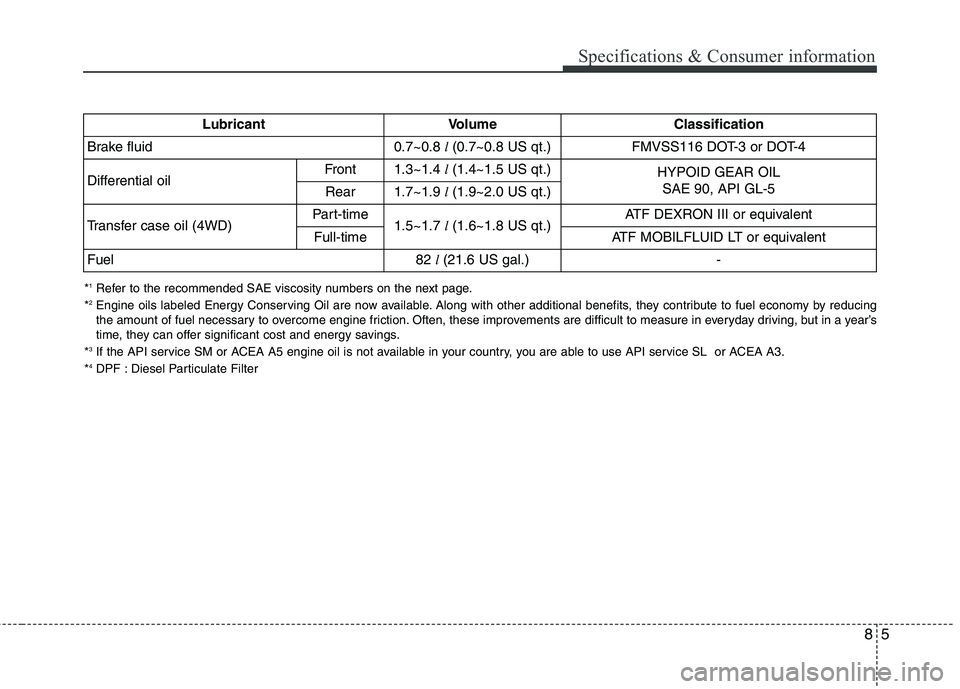
Brake fluid 0.7~0.8
l (0.7~0.8 US qt.)
FMVSS116 DOT-3 or DOT-4
Differential oil
Front 1.3~1.4
l (1.4~1.5 US qt.)
HYPOID GEAR OIL
SAE 90, API GL-5
Rear 1.7~1.9
l (1.9~2.0 US qt.)
Transfer case oil (4WD)
Part-time 1.5~1.7 l (1.6~1.8 US qt.) ATF DEXRON III or equivalent
Full-time
ATF MOBILFLUID LT or equivalent
Fuel 82
l (21.6 US gal.)
-
Page 407 of 420

Specifications & Consumer information
6
8
I040100DUN Recommended SAE viscosity
number
Engine oil viscosity (thickness) has an
effect on fuel economy and cold weather
operating (engine start and engine oil
flowability). Lower viscosity engine oils can
provide better fuel economy and cold
weather performance, however, higher vis-
cosity engine oils are required for satisfac-
tory lubrication in hot weather. Using oils of
any viscosity other than those recom-
mended could result in engine damage.
CAUTION
Always be sure to clean the area
around any filler plug, drain plug, or
dipstick before checking or drain-ing any lubricant. This is especiallyimportant in dusty or sandy areas
and when the vehicle is used on unpaved roads. Cleaning the plugand dipstick areas will prevent dirt and grit from entering the engine and other mechanisms that could
be damaged.
When choosing an oil, consider the range of temperature your vehicle will be operated in
before the next oil change. Proceed to select the recommended oil viscosity from the chart.
Temperature Range for SAE Viscosity Numbers
Temperature
Gasoline Engine Oil
(Except Middle East* 1
)
Gasoline Engine Oil (For Middle East* 1
)
°C
(°F)-30 -20 -10 0 10 20 30 40 50 -10 0 20 40 60 80 100 120
*1
: Middle East includes India, Libya, Algeria, Morocco, Tunisia, Sudan, Egypt and Iran.
* 2
: For better fuel economy, it is recommended to use the engine oil of a viscosity grade SAE
5W-20(API SM / ILSAC GF-4). However, if the engine oil is not available in your country,
select the proper engine oil using the engine oil viscosity chart.
* 3
: For better fuel economy, it is recommended to use the engine oil of a viscosity grade SAE
5W-30(ACEA A5). However, if the engine oil is not available in your country, select the prop-
er engine oil using the engine oil viscosity chart.
* 4
: It is only for extreme cold area and to be restricted by driving condition and area.
(Especially, not recommended for sustained high loaded and high speed operation.)
20W-50
10W-30
15W-40
5W-20 * 2
, 5W-30
20W-50
10W-30
15W-40
5W-30 * 3
, 5W-40
Diesel Engine Oil5W-30
15W-40
10W-30
0W-30 *4
Page 409 of 420

H030000APB
The tires supplied on your new vehicle
are chosen to provide the best perform-
ance for normal driving.
The tire label located on the driver's side
center pillar gives the tire pressures rec-
ommended for your vehicle.
OHM088005N
TIRE SPECIFICATION AND PRESSURE LABEL
ENGINE NUMBEROHM088006NOHM088003
OHM089007H04000AUN
The engine number is stamped on the
engine block as shown in the drawing.
■
Gasoline engine (3.8L)
■Gasoline engine (4.6L)
■Diesel engine (3.0L)
88
Specifications & Consumer information
Page 413 of 420
I3
Index
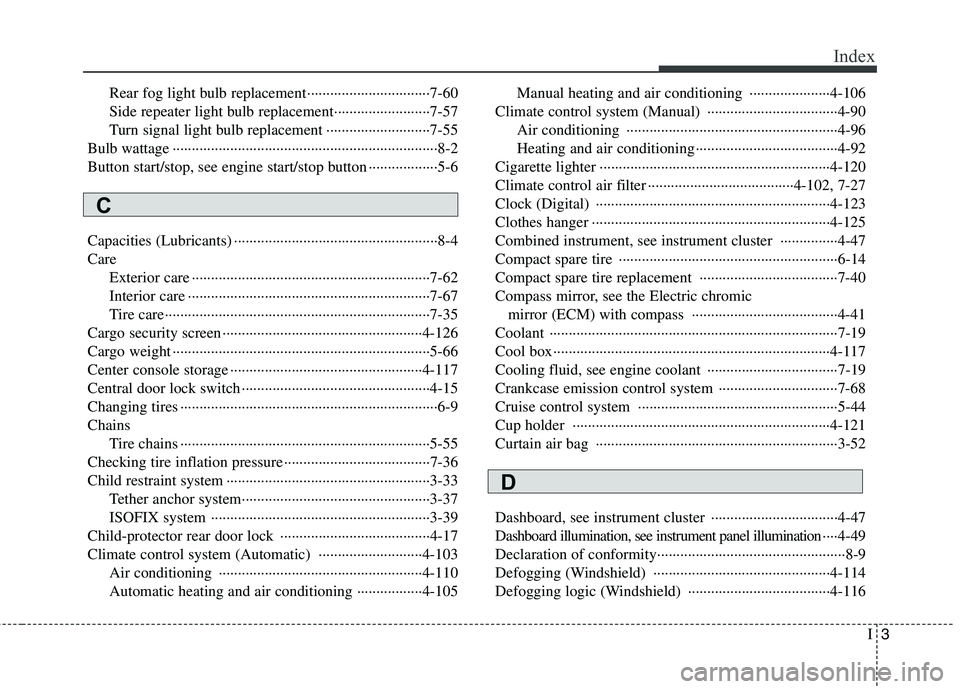
Rear fog light bulb replacement································7-60
Side repeater light bulb replacement·························7-57
Turn signal light bulb replacement ···························7-55
Bulb wattage ·····································································8-2
Button start/stop, see engine start/stop button ··················5-6
Capacities (Lubricants) ·····················································8-4 Care Exterior care ······························································7-62
Interior care ·······························································7-67
Tire care·····································································7-35
Cargo security screen ····················································4-126
Cargo weight ···································································5-66
Center console storage ··················································4-117
Central door lock switch ·················································4-15
Changing tires ···································································6-9Chains Tire chains ·································································5-55
Checking tire inflation pressure ······································7-36
Child restraint system ·····················································3-33 Tether anchor system·················································3-37
ISOFIX system ·························································3-39
Child-protector rear door lock ·······································4-17
Climate control system (Automatic) ···························4-103 Air conditioning ·····················································4-110Automatic heating and air conditioning ·················4-105 Manual heating and air conditioning ·····················4-106
Climate control system (Manual) ··································4-90 Air conditioning ·······················································4-96
Heating and air conditioning ·····································4-92
Cigarette lighter ····························································4-120
Climate control air filter ······································4-102, 7-27
Clock (Digital) ·····························································4-123
Clothes hanger ······························································4-125
Combined instrument, see instrument cluster ···············4-47
Compact spare tire ·························································6-14
Compact spare tire replacement ····································7-40
Compass mirror, see the Electric chromic mirror (ECM) with compass ······································4-41
Coolant ···········································································7-19
Cool box········································································4-117
Cooling fluid, see engine coolant ··································7-19
Crankcase emission control system ·······························7-68
Cruise control system ····················································5-44
Cup holder ···································································4-121
Curtain air bag ·······························································3-52
Dashboard, see instrument cluster ·································4-47
Dashboard illumination, see instrument panel illumination ····4-49
Declaration of conformity·················································8-9
Defogging (Windshield) ··············································4-114
Defogging logic (Windshield) ·····································4-116
C
D